
Disclosure: As an Amazon Associate, CinemaSetup Lab earns from qualifying purchases at no extra cost to you. Commission rates (2% TVs vs. 4% AV cables and accessories) never influence our audits or verdicts.
Asking what gauge speaker wire do I need is the smartest first step before buying spools for any passive surround system in our best home theater accessories pillar hub. Every speaker channel relies on a low-resistance copper path from your AV receiver’s binding posts to each speaker cabinet—and picking wire that is too thin wastes amplifier power as heat across long surround runs, while blindly paying for oversized boutique cables adds cost and stiff jacketing without improving clarity.
Quick Answer: For most home theaters, 14 AWG pure oxygen-free copper (OFC) is the universal safe choice, covering one-way runs up to ~79 ft (24 m) for 8-ohm speakers and ~40 ft (12 m) for 4-ohm speakers. Choose 16 AWG OFC for 8-ohm runs under ~50 ft (15 m), step up to 12 AWG OFC for long 4-ohm runs up to ~63 ft (19 m), and always require UL CL2/CL3 ratings inside walls.
Two factors govern wire gauge sizing under CinemaSetup Lab compatibility rules CR-ACC-SPK-01 and CR-ACC-SPK-02: electrical round-trip loop resistance relative to your speaker’s nominal impedance, and NEC/UL fire-safety jacket ratings when routing wire inside walls or ceilings. In the sections below, we break down the exact 5% impedance guideline, dual-unit imperial/metric AWG lookup charts, worked room math for 8-ohm and 4-ohm systems, why copper-clad aluminum (CCA) changes the gauge math, and verified US OFC spools and connectors that pass every audit check.
In This Guide
- 1. How Wire Gauge (AWG), Impedance & the 5% Rule Work (CR-ACC-SPK-01)
- 2. Speaker Wire Gauge & Run-Length Matrix (OFC vs. CCA)
- 3. Worked Room Examples: Living Room 5.1.2, 4-Ohm Towers & CCA Traps
- 4. Myth vs. Engineering Reality: 5 Speaker Wiring Misconceptions
- 5. Verified US Pure Copper (OFC) Wire & Terminations by Run Type
- 6. UL CL2/CL3 In-Wall Code, Termination & Electrical Safety (CR-ACC-SPK-02)
- 7. Authoritative Standards & Manufacturer References
- 8. Frequently Asked Questions
1. How Wire Gauge (AWG), Impedance & the 5% Rule Work
In North America, speaker cable thickness follows the American Wire Gauge (AWG) standard. Because AWG counts the number of drawing dies used to pull wire down from a thicker rod, the numbering runs backward: lower AWG numbers mean thicker conductors with larger cross-sectional copper area and lower electrical resistance. For example, 12 AWG copper has roughly 2.5 times the cross-sectional area of 16 AWG copper, cutting electrical resistance per foot by more than half.
Every speaker wire run creates a round-trip series circuit with your speaker. Current travels from the AV receiver’s red positive terminal down one conductor to the speaker’s crossover network and returns along the second conductor back to the black negative terminal. That means a 40 ft (12.2 m) run from your equipment rack to a rear surround speaker actually forces current through 80 ft (24.4 m) of wire. Under CinemaSetup Lab engineering rule CR-ACC-SPK-01, the safe threshold keeps total round-trip wire resistance at or below 5% of the speaker’s nominal impedance:
R_loop = (2 × One-Way Run Length in ft × Conductor Resistance per 1,000 ft) / 1,000 ≤ 0.05 × Z_speaker
- Why 5% Impedance Is the Engineering Ceiling: When round-trip wire resistance equals 5% of a speaker’s nominal impedance (for example,
0.40 ohmson an8-ohmspeaker, or0.20 ohmson a4-ohmspeaker), voltage division produces only~0.42 dBof insertion loss—below typical room-to-room variation and easily equalized by receiver level-calibration tones. Exceeding 5% wastes amplifier headroom as heat and lowers effective damping factor across woofer impedance dips. - Why 4-Ohm Speakers Cut Max Run Length in Half (CR-SPK-AVR-01): A
4-ohmspeaker draws twice the electrical current of an8-ohmspeaker for the same voltage and permits only half the absolute loop resistance (0.20 ohmsvs.0.40 ohms) to stay under 5%. Before sizing wire, read the rear terminal plate or spec sheet of both your speakers and your AV receiver (such as confirming 4-to-16-ohm manual support and impedance-selector settings on receivers like the US 120V Denon AVR-X3900H). - Why Pure Oxygen-Free Copper (OFC) Sets the Baseline: Standard ASTM B258 annealed copper resistance tables assume solid or stranded pure copper (
100% IACSconductivity):16 AWG ≈ 4.02 Ω/1,000 ft,14 AWG ≈ 2.53 Ω/1,000 ft, and12 AWG ≈ 1.59 Ω/1,000 ft. Budget copper-clad aluminum (CCA) wire uses an aluminum core plated with a thin copper skin (~61% IACS conductivity), raising DC resistance by roughly1.64×and slashing safe run lengths by almost 40%.
2. Speaker Wire Gauge & Run-Length Matrix (OFC vs. CCA)
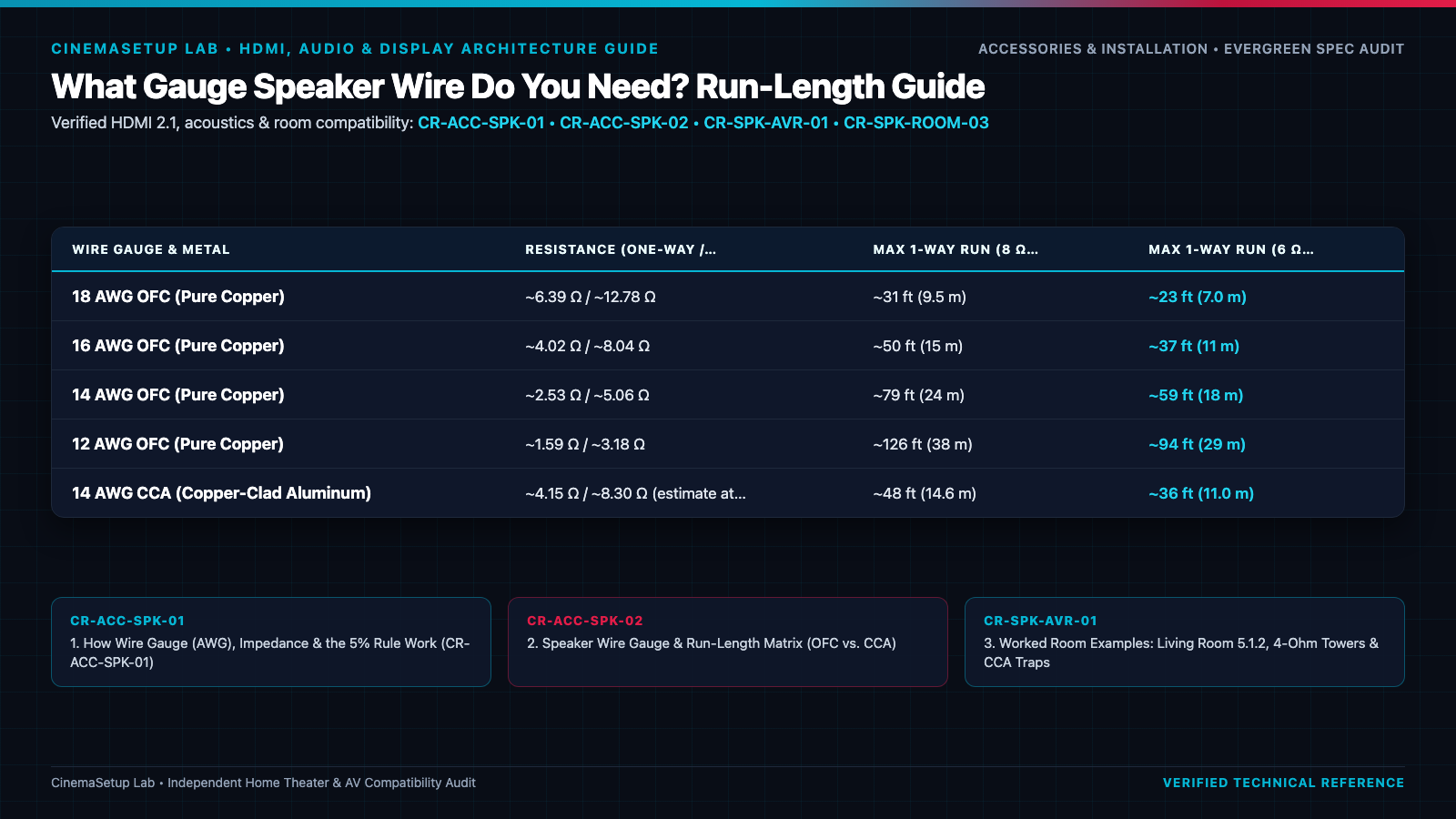
The lookup matrix below converts the CR-ACC-SPK-01 5% round-trip resistance threshold into exact maximum one-way distances (measured along the wall, floor, or attic path—not straight-line bird’s-eye room dimensions) for 8-ohm, 6-ohm, and 4-ohm nominal loads. Always measure actual routing distance including vertical ceiling drops and add 3 to 5 ft (0.9 to 1.5 m) of slack at the receiver rack for easy maintenance.
| Wire Gauge & Metal | Resistance (One-Way / Round-Trip per 1,000 ft) | Max 1-Way Run (8 Ω Speaker, ≤0.40 Ω) | Max 1-Way Run (6 Ω Speaker, ≤0.30 Ω) | Max 1-Way Run (4 Ω Speaker, ≤0.20 Ω) | Home Theater Application & Critical Caveat |
|---|---|---|---|---|---|
| 18 AWG OFC (Pure Copper) | ~6.39 Ω / ~12.78 Ω | ~31 ft (9.5 m) | ~23 ft (7.0 m) | ~16 ft (4.8 m) | Short desktop or satellite runs only; avoid for main towers or long surrounds |
| 16 AWG OFC (Pure Copper) | ~4.02 Ω / ~8.04 Ω | ~50 ft (15 m) | ~37 ft (11 m) | ~25 ft (7.6 m) | Ideal for compact 5.1 living rooms and short 8-ohm surrounds under 45 ft |
| 14 AWG OFC (Pure Copper) | ~2.53 Ω / ~5.06 Ω | ~79 ft (24 m) | ~59 ft (18 m) | ~40 ft (12 m) | Universal home theater standard for LCR fronts, 5.1.2/5.1.4 surrounds, and Atmos heights |
| 12 AWG OFC (Pure Copper) | ~1.59 Ω / ~3.18 Ω | ~126 ft (38 m) | ~94 ft (29 m) | ~63 ft (19 m) | Long basement racks, detached utility closets, and 4-ohm towers beyond 40 ft (12 m) |
| 14 AWG CCA (Copper-Clad Aluminum) | ~4.15 Ω / ~8.30 Ω (estimate at ~61% IACS) | ~48 ft (14.6 m) | ~36 ft (11.0 m) | ~24 ft (7.3 m) | Performs roughly like 16 AWG OFC; stiffer aluminum strands fatigue faster under clamps |
| 16 AWG CCA (Copper-Clad Aluminum) | ~6.59 Ω / ~13.18 Ω (estimate at ~61% IACS) | ~30 ft (9.1 m) | ~23 ft (7.0 m) | ~15 ft (4.6 m) | High-resistance budget trap; avoid in-wall pulls or multi-speaker surround setups |
3. Worked Room Examples: Living Room 5.1.2, 4-Ohm Towers & CCA Traps
Looking up a single room diagonal rarely gives the true wire length because speaker cables hug baseboards, climb door frames, or route up into ceiling joists and back down to ear level. The three worked engineering estimates below demonstrate exactly how CR-ACC-SPK-01 and CR-ACC-SPK-02 apply to real homes.
Example A: Medium Living Room 5.1.2 Atmos System (8-Ohm Speakers)
Consider a typical 15 × 20 × 8 ft (4.6 × 6.1 × 2.4 m) living room running 8-ohm nominal bookshelf fronts, a matching center, side surrounds, and two in-ceiling Atmos heights. Your AV receiver sits in a media console below the TV:
- Front Left, Center & Right (8–12 ft / 2.4–3.7 m each): Using 14 AWG OFC over a
12 ft(3.7 m) one-way run creates only2 × 12 × 2.53 / 1,000 = 0.061 ohmsof round-trip resistance—just 0.76% of an 8-ohm load (~0.07 dBloss). Even 16 AWG OFC stays at0.096 ohms(1.2%). - Side Surrounds Along Baseboards (42 ft / 12.8 m one-way): Routing around two corners adds up quickly. On 16 AWG OFC, round-trip resistance is
2 × 42 × 4.02 / 1,000 = 0.338 ohms, or 4.2% of 8 ohms—a technical pass under the 5% guideline, though with modest margin. Stepping up to 14 AWG OFC drops round-trip resistance to0.213 ohms(2.7%), giving generous headroom. For clean surface concealment around door trim and baseboards, follow our how to hide speaker wire routing guide. - In-Ceiling Heights (35 ft / 10.7 m through wall & attic): Because these cables pass inside drywall and ceiling framing, CR-ACC-SPK-02 requires UL CL2 or CL3 rated cable. Either 16 AWG OFC CL2 (
0.281 ohms= 3.5%) or 14 AWG OFC CL2 (0.177 ohms= 2.2%) passes cleanly, with 14 AWG offering future-proofing if you ever upgrade to 4-ohm or 6-ohm ceiling speakers.
Example B: Dedicated Basement Theater with 4-Ohm Speakers (52 ft Run)
Suppose your AV rack sits in an adjacent utility alcove, forcing a 52 ft (15.8 m) one-way in-wall pull to 4-ohm nominal surround or LCR speakers (maximum 5% loop ceiling = 0.20 ohms):
- 14 AWG OFC Result (SOFT Fail):
2 × 52 × 2.53 / 1,000 = 0.263 ohms, which equals 6.6% of 4 ohms. While audio still plays, this breaches the 5% threshold under CR-ACC-SPK-01 and adds noticeable series impedance against low-impedance woofer dips. - 12 AWG OFC Result (PASS): Stepping up to 12 AWG OFC drops loop resistance to
2 × 52 × 1.59 / 1,000 = 0.165 ohms, or 4.1% of 4 ohms—passing cleanly with room to spare. Remember to confirm that your speakers’ and AVR’s binding posts accept thicker 12 AWG conductors (either bare wire or pin/banana terminations).
Example C: Why 14 AWG CCA Fails Where 14 AWG OFC Passes (45 ft at 6 Ohms)
Many marketplace spools advertise “14 Gauge Speaker Wire” at an unusually low price while burying “CCA” (copper-clad aluminum) in the fine print. Consider a 45 ft (13.7 m) run to 6-ohm speakers (5% ceiling = 0.30 ohms):
- 14 AWG Pure OFC:
2 × 45 × 2.53 / 1,000 = 0.228 ohms(3.8% of 6 ohms — PASS). - 14 AWG CCA (at ~1.64× copper resistance):
2 × 45 × 4.15 / 1,000 = 0.374 ohms(6.2% of 6 ohms — SOFT fail). You would have to pull stiffer, bulkier 12 AWG CCA just to match the electrical conductivity of standard 14 AWG OFC.
If your AVR setup uses Zone 2 speakers or bi-amping (rule CR-SPK-AVR-06, which borrows internal receiver amp channels), note that 14/4 (4-conductor) CL2 cable lets you carry two separate channels inside a single outer jacket—simplifying in-wall pulls without changing the individual conductor gauge math above.
Myth vs. Engineering Reality: 5 Speaker Wiring Misconceptions (G-14 / CR-ACC-SPK-01 / CR-ACC-SPK-02)
- Myth 1: “Cryo-treated or boutique oxygen-free silver cables tighten bass and widen soundstage.”
Engineering Reality (G-14): Passive speaker cables do not store, equalize, or sharpen audio signals. Once you choose pure OFC thick enough to keep round-trip resistance below 5% of nominal speaker impedance and secure tight terminations, spending extra on exotic geometries yields zero measurable acoustic gain. - Myth 2: “14 AWG CCA (copper-clad aluminum) performs just like 14 AWG copper.”
Engineering Reality: Aluminum conducts roughly 61% as well as pure copper, raising resistance by ~64% at the same AWG size. Aluminum strands are also more brittle under spring clips and screw terminals, increasing breakage risk during flexing or re-termination. - Myth 3: “Higher gauge numbers mean thicker speaker wire.”
Engineering Reality: AWG scales inversely. 12 AWG (~0.081 in/2.05 mmsolid-equivalent diameter) is substantially thicker and lower in resistance than 16 AWG (~0.051 in/1.29 mm) or thin 18 AWG (~0.040 in/1.02 mm) “home theater in a box” zip cord. - Myth 4: “Any speaker wire is safe inside drywall because audio is low voltage.”
Engineering Reality (CR-ACC-SPK-02): Standard clear PVC zip-cord jackets can drip flaming plastic or spread smoke along stud bays during a building fire. National Electrical Code (NEC) Article 725 requires UL Listed CL2 or CL3 fire-retardant jackets for concealed wall and ceiling spaces. - Myth 5: “Left and right speaker wires must be cut to the exact same foot for timing alignment.”
Engineering Reality: Electrical signals travel through copper at roughly 60–70% the speed of light—meaning a 25-foot wire difference shifts timing by roughly 35 nanoseconds (0.000035 milliseconds), compared to acoustic sound moving roughly 1.1 ft per millisecond in air. Cut each run neatly to reach the speaker cleanly, keep loop resistance under 5%, and let your AVR’s speaker-distance calibration and level-calibration tones balance arrival timing.
5. Verified US Pure Copper (OFC) Wire & Terminations by Run Type
Every SKU below comes from verified US Amazon organic catalog listings and avoids misleading CCA substitutions. Before buying bulk wire for a whole-room install, compare jacket options in our best speaker wire roundup, and pair bare spools with clean pin or banana terminations from our best banana plugs guide to keep stray copper whiskers off adjacent AVR binding posts.
1. Amazon Basics 14-Gauge 99.9% OFC Speaker Wire (100-Foot White Spool) — Best Exposed Living-Room Run

Key Audited Specs & Box Contents: 14 AWG (2-conductor) | 99.9% Oxygen-Free Copper (OFC) | Max 5% One-Way Run: ~79 ft (24 m) at 8 ohms / ~40 ft (12 m) at 4 ohms | Jacket: White color-coded insulated PVC (not UL CL2/CL3 rated) | In the Box (G-29): Single continuous 100 ft (30.5 m) spool (banana plugs sold separately) | Budget Tier: Under $50 (100 ft OFC Spool)
For renters and living-room builds routing wire behind media consoles, beneath area rugs, or inside adhesive surface raceways, the Amazon Basics 14-Gauge 99.9% OFC spool delivers genuine annealed copper conductivity without CCA compromise. Its white PVC jacket blends neatly against white baseboards, and internal red/black conductor insulation makes polarity checks effortless across all five or seven channels. Because the outer jacket lacks a UL CL2/CL3 fire stamp, keep it strictly outside drywall cavities (CR-ACC-SPK-02).
Pros
- Verified 99.9% oxygen-free pure copper handles up to ~79 ft (24 m) at 8 ohms or ~40 ft (12 m) at 4 ohms
- White outer jacket with red/black polarity coding disappears cleanly along trim and raceways
Cons
- Not UL CL2 or CL3 rated—prohibited for inside-wall or in-ceiling pulls (CR-ACC-SPK-02)
- Ships as bare spool without pre-fitted banana plugs or wall-plate connectors
Seller & Listing Verification (G-26): Verify purchase directly from Amazon.com (US listing) on the 99.9% OFC variant rather than Amazon’s separate bronze CCA-or-standard spool SKUs, and inspect Amazon’s standard return and Basics 1-year limited warranty coverage.
2. 100 ft. UL Listed CL2 14-Gauge Pure OFC Speaker Wire — Best In-Wall & In-Ceiling 14 AWG

Key Audited Specs & Box Contents: 14 AWG (2-conductor) | Oxygen-Free Pure Copper (OFC) | Max 5% One-Way Run: ~79 ft (24 m) at 8 ohms / ~40 ft (12 m) at 4 ohms | In-Wall Rating: UL Listed Class 2 (CL2) | In the Box (G-29): Single 100 ft (30.5 m) continuous spool (connectors sold separately) | Budget Tier: $25-$60 (100 ft UL CL2 OFC Spool)
When your speaker wire routes behind drywall or above ceiling joists to reach surround or Atmos positions, CR-ACC-SPK-02 requires a fire-rated outer jacket. This 100 ft UL Listed Class 2 (CL2) 14 AWG pure OFC spool combines full 2.53 Ω/1,000 ft pure copper conductivity with a NEC-compliant CL2 jacket built to pass residential wall inspections. One 100-foot spool covers a pair of rear surrounds or overhead heights in most medium living rooms with zero need to buy an oversized 250-foot contractor box.
Pros
- Combines pure 14 AWG OFC copper with UL Listed Class 2 (CL2) in-wall fire compliance
- Practical 100 ft (30.5 m) spool length avoids leftover waste on single-room 5.1 or 5.1.2 upgrades
Cons
- 100 ft length runs short if wiring a full 7.1.4 room from a distant equipment closet
- CL2 outer jacket adds minor stiffness around tight baseboard corners compared with zip cord
Seller & Listing Verification (G-26): Confirm the UL Listed Class 2 stamp on the outer jacket upon delivery and verify Amazon seller/return terms before pulling wire through sealed walls.
3. GEARit 16-Gauge OFC In-Wall Speaker Wire (250 ft UL CL2 Spool) — Best Multi-Speaker Short/Medium Runs

Key Audited Specs & Box Contents: 16 AWG (2-conductor) | Pure Oxygen-Free Copper (OFC) | Max 5% One-Way Run: ~50 ft (15 m) at 8 ohms / ~25 ft (7.6 m) at 4 ohms | In-Wall Rating: UL Listed CL2 | In the Box (G-29): Single 250 ft (76.2 m) pull spool (connectors sold separately) | Budget Tier: $40-$80 (250 ft UL CL2 OFC Spool)
If every individual speaker run in your 5.1.2 or 5.1.4 room stays under 45 to 50 ft (13.7 to 15.2 m) to 8-ohm speakers, pulling slimmer 16 AWG OFC makes tight attic holes and stud-bay bends noticeably easier than wrestling 12 AWG or heavy 14 AWG bundles. The GEARit 16 AWG OFC 250 ft spool uses genuine pure copper rather than GEARit’s lower-cost CCA lines and carries a UL CL2 in-wall rating—making it a reliable bulk choice for standard 8-ohm living-room pre-wires. Skip it if your speakers are rated at 4 ohms beyond 25 ft (7.6 m).
Pros
- 250 ft (76.2 m) spool covers an entire 5.1.2 or 7.1.2 8-ohm room with UL CL2 in-wall rating
- Confirmed OFC copper pulls more easily through tight stud holes than thicker 12/14 AWG jackets
Cons
- 4-ohm speakers hit the 5% resistance cap at just ~25 ft (7.6 m) one-way (CR-ACC-SPK-01)
- GEARit sells both CCA and OFC spools on similar pages—always verify the OFC variant before checkout
Seller & Listing Verification (G-26): Verify the “OFC” and “250FT” variant selection sold by GEARit or Amazon.com so you receive full pure-copper conductivity and manufacturer warranty support.
4. Micca 14-Gauge Pure Copper Speaker Cable Pair (6.6 ft Each, Banana Plugs) — Best Front L/R Jumpers

Key Audited Specs & Box Contents: 14 AWG | Pure Copper (OFC) | Cable Length: 6.6 ft (2.0 m) per cable | Terminations: Factory-installed gold-plated banana plugs | In-Wall Rating: Not CL2/CL3 rated (exposed console-to-speaker jumper) | In the Box (G-29): Pair (2 cables, one for Left and one for Right) | Budget Tier: Under $35 (Pre-Terminated Pair)
Your front left and right speakers rarely sit more than a few feet from the AV receiver, making a 100-foot bulk spool overkill if surrounds are wireless or already pre-wired. The Micca 14-Gauge Pure Copper Speaker Cable Pair ships as a finished set of two 6.6 ft (2.0 m) cables with braided nylon jackets and factory-terminated banana plugs. At 6.6 ft, round-trip resistance is a negligible 0.033 ohms (0.4% of 8 ohms, or 0.8% of 4 ohms), and sealed banana boots prevent stray copper strands from shorting crowded binding posts behind modern 7-to-11-channel AVRs.
Pros
- Pure 14 AWG copper pair with factory-crimped banana plugs eliminates stripping and stray-wire shorts
- Flexible braided jacket seats neatly behind narrow media cabinets
Cons
- Fixed 6.6 ft (2.0 m) reach is too short if towers sit wide of a corner AV rack
- Not CL2/CL3 rated for inside-wall runs, and sold as a 2-cable pair (center channel needs a separate wire or single cable)
Seller & Listing Verification (G-26): Verify purchase from Amazon.com or Micca’s authorized Amazon storefront for valid US return and defect replacement support, and remember to remove the tiny plastic center pins from your AVR’s binding posts before inserting banana plugs.
6. UL CL2/CL3 In-Wall Code, Termination & Electrical Safety
Safety, Fire-Code & Installation Notice (G-27 / CR-ACC-SPK-02 / CR-SPK-ROOM-03):
- Manufacturer-Instruction-First & UL CL2/CL3 In-Wall Compliance: Always follow your AV receiver, speaker, and cable manufacturer instructions alongside local building codes. Any speaker wire concealed inside drywall, ceiling cavities, or attic joists must carry a UL Listed CL2 or CL3 (or local code-equivalent) flame-retardant jacket rating—never route unrated zip cord inside walls. If your room includes vertical plenum HVAC chases, consult local codes for CL2P / CL3P plenum wire.
- Rental Permissions, Cavity Checks & Avoiding Mains Wiring: Under CR-SPK-ROOM-03, confirm landlord permission before cutting drywall in rentals, check for concealed pipes, HVAC ducts, and
120V ACRomex electrical cables before drilling studs or joists, and maintain separation from high-voltage power lines when routing speaker cables parallel to electrical runs. - Preventing Binding-Post Shorts & When to Call a Pro: Always power down and unplug your AV receiver before connecting or swapping speaker wires. Twist stranded OFC neatly (or use banana plugs) so zero stray copper filaments bridge positive and negative terminals or touch the metal chassis. Whenever installation requires cutting structural framing, installing low-voltage wall boxes near AC outlets, or navigating local municipal fire codes, hire a licensed electrician or licensed AV installer. Keep playback volume at comfortable levels.
7. Authoritative Standards & Manufacturer References
- National Fire Protection Association (NFPA 70 / NEC Article 725): Class 2 and Class 3 remote-control, signaling, and power-limited circuit wiring classifications governing CL2/CL3 in-wall audio cabling at nfpa.org.
- UL Solutions Cable Certification Standards (UL 13 / CL2 & CL3): Flame-propagation and jacket certification requirements for power-limited circuit cables installed in residential wall and ceiling cavities at ul.com.
- ASTM International (ASTM B258): Standard specification for American Wire Gauge (AWG) solid copper conductor cross-sectional dimensions and DC resistance baselines at astm.org.
- Denon USA & Klipsch USA Owner Manuals: Speaker nominal impedance settings (4–16 ohms), polarity wiring diagrams, and binding-post termination guidance at denon.com and klipsch.com.
How We Audited This Guide
- Installation cabling and hardware were verified across HDMI Ultra High Speed QR certification vs. active fiber directionality, CL2/CL3 UL in-wall cable ratings, VESA/weight wall-mount limits, and UST ALR vs. standard screens.
- Every AV receiver, speaker, subwoofer, soundbar, OLED/Mini-LED TV, projector, source player, and accessory spec was cross-checked against official manufacturer manuals, CEA/CTA standards, and live Amazon US listings.
- Recommendations were evaluated against our weighted vertical scoring rubrics and documented CR-* compatibility rules; we never invent nits, contrast ratios, bench wattage, or room decibels.
Continue Your Audit
8. Frequently Asked Questions
What gauge speaker wire do I need for a normal 5.1 or 5.1.2 living room?
Choose 14 AWG pure oxygen-free copper (OFC) as the safest all-around gauge. It supports runs up to ~79 ft (24 m) for 8-ohm speakers and ~40 ft (12 m) for 4-ohm speakers under the 5% resistance rule (CR-ACC-SPK-01), with CL2 ratings required inside walls.
Is 16 AWG speaker wire thick enough for surround and Atmos height speakers?
Yes, provided you buy pure OFC copper and keep each one-way run within ~50 ft (15 m) for 8-ohm speakers or ~37 ft (11 m) for 6-ohm speakers. For 4-ohm speakers or runs past 50 ft (15 m), step up to 14 AWG or 12 AWG OFC.
When do I actually need 12 AWG speaker wire instead of 14 AWG?
Step up to 12 AWG pure copper when wiring 4-ohm speakers on runs between 40 and 63 ft (12 to 19 m), or when running 8-ohm speakers from a remote equipment closet between 80 and 126 ft (24 to 38 m) away.
Does oxygen-free copper (OFC) sound better than copper-clad aluminum (CCA)?
Pure copper does not add magical detail, but it exhibits ~1.64 times lower electrical resistance than CCA at the same gauge. To stay under the 5% impedance guideline, CCA requires a thicker wire gauge (two AWG numbers lower) and flex-hardens faster under screw terminals.
Do I need CL2 or CL3 speaker wire if the cable runs behind a baseboard or rug?
No—CL2 and CL3 ratings apply when routing wire inside enclosed wall, ceiling, or floor cavities (CR-ACC-SPK-02). Surface runs inside plastic cord channels or behind furniture can safely use standard non-CL2 pure OFC jacketed wire, while avoiding pinch points under heavy traffic.
Can I mix 14 AWG for front speakers and 16 AWG for surrounds in the same system?
Yes. Mixing wire gauges across channels causes zero compatibility issues as long as every individual run stays below the 5% round-trip resistance threshold for that speaker’s nominal impedance, and you run your AV receiver’s room calibration and level-calibration tones afterward.


