
Disclosure: As an Amazon Associate, I earn from qualifying purchases. If you buy through links on this page, CinemaSetup Lab may earn a small commission at no extra cost to you. Commission schedules (for example, 2% on televisions versus 4% on most projector screens, mounts, AV receivers, and accessories) never influence our sizing math, compatibility verdicts, or product selections.
Before comparing gain ratings or frame styles in our best home theater accessories pillar hub, the single most consequential measurement in any projection build is answering what size projector screen do i need for your exact room. Unlike flat-panel TVs that step up in modest 10-inch increments, a projection frame can jump from 92 inches to 150 inches—and picking the wrong diagonal either crowds your center-channel speaker, exceeds your projector’s optical zoom range, or washes out picture brightness.
Quick Answer: Divide your eye-to-screen seating distance in inches by 1.63 for a comfortable 30-degree minimum screen size and by 1.20 for an immersive 40-degree 4K maximum size (CR-DISP-ROOM-01). For a typical 10 to 12 ft (3.05 to 3.66 m) viewing distance, a 100-in to 120-in 16:9 screen fits best—provided wall height and projector throw ratio clear.
Going oversized is one of the most common home theater regrets—not because a huge image looks bad on movie night, but because buyers skip checking physical wall boundaries, ceiling clearance, center-speaker height, and quadratic brightness loss across larger surfaces. This technical guide walks through CinemaSetup Lab’s four-gate sizing framework, complete dual-unit 16:9 dimension and seating tables, worked room calculations, ALR vs. matte surface rules, and verified Amazon US fixed-frame screens matched to each room size.
In This Guide
- 1. The 4 Room Gates That Lock Your Ideal Screen Size
- 2. 16:9 Projector Screen Size & Viewing Distance Matrix (72-in to 150-in)
- 3. Worked Room Audits: 10.5 ft Living Room, 13.5 ft Basement & 15.5 ft XL Theater
- 4. Myth vs. Engineering Reality: 5 Screen-Sizing Mistakes to Avoid
- 5. Verified US Projector Screens Matched by Size & Throw Type
- 6. Wall Anchoring, Speaker Clearance & CL2/CL3 Wiring Safety
- 7. Authoritative Standards & Manufacturer References
- 8. Frequently Asked Questions
1. The 4 Room Gates That Lock Your Ideal Screen Size
Projector screen sizing is never decided by sofa distance alone. Under CinemaSetup Lab compatibility rules, your final diagonal must pass four consecutive geometry checks—seating angle, physical wall footprint, lens throw depth, and room-light luminance density—before you order a frame.
Gate 1 — Seating Viewing Angle (CR-DISP-ROOM-01, SOFT)
Both the Society of Motion Picture and Television Engineers (SMPTE) and THX frame screen size around horizontal viewing angle (θ) rather than raw square footage. For any standard 16:9 projection screen, image width equals diagonal × 0.872 and viewing distance follows the trigonometric relation d = (W / 2) / tan(θ / 2):
- 40° Immersive Cinema Ceiling (THX-style):
d ≈ 1.20 × diagonal. Reversing that formula gives your maximum recommended 4K screen size:max_diagonal = seat_distance / 1.20. Because 4K UHD and 4K pixel-shift projectors resolve fine detail cleanly, sitting near 40° fills peripheral vision without exposing screen-door pixel gaps. - 30° Comfortable Viewing Floor (SMPTE minimum):
d ≈ 1.63 × diagonal. Reversing this gives your comfortable baseline size:comfortable_diagonal = seat_distance / 1.63. Native 1080p projectors, daytime sports, and casual multi-row seating often feel more relaxed around 30° to 35°.
If you are still weighing an 85-to-98-inch flat panel against a 100-to-120-inch projection screen at the same sofa position, cross-check our TV size and viewing distance guide, which uses the exact same 30°-to-40° horizontal angle standard.
Gate 2 — Wall Width, Ceiling Height & Center-Channel Clearance
Once your seating distance yields a target diagonal range, verify that the physical screen housing fits the front wall with breathing room for speakers and eye-level ergonomics:
- Add Frame Bezel Width & Height: Published screen sizes measure the active white/gray viewing area only. Fixed-frame velvet bezels add
2.0 to 6.0 in(5.1 to 15.2 cm) to overall width and height (ultra-thin bezel UST frames add roughly0.8 to 1.5 in/2.0 to 3.8 cm). A 120-inch active image (104.6 × 58.8 in/265.7 × 149.4 cm) typically needs at least110 × 64 in(279 × 163 cm) of clear wall space. - Bottom-Edge & Center-Speaker Clearance: Unless you install an acoustically transparent (AT) woven or micro-perforated screen with front LCR speakers mounted behind it, your center-channel speaker and/or ultra-short-throw (UST) media console sit below the screen. Reserve
24 to 34 in(61 to 86 cm) from the floor to the bottom border of the frame. On a standard8.0 ft(96 in/2.44 m) ceiling, a 150-inch screen (73.5 in/186.7 cmtall before bezel) leaves less than 22 inches total for both bottom clearance and top ceiling margin—making 100 to 120 inches far more practical under 8-foot ceilings. - Left/Right Tower & Doorway Margin: Keep at least
12 to 24 in(30 to 61 cm) flanking the left and right edges of the frame for tower or stand-mounted bookshelf speakers so cabinets do not block the active image or sit jammed into room corners.
Gate 3 — Projector Throw Ratio & Room Depth (CR-DISP-ROOM-02, HARD)
Even if your front wall easily holds a 135-inch frame, your projector lens may physically refuse to fill it inside your room’s back-wall depth. Under hard rule CR-DISP-ROOM-02, compute required room depth from image width (W = diagonal × 0.872): needed_depth = (throw_ratio_min × W) + projector_body_depth + rear_clearance (budgeting 6 to 12 in / 15 to 30 cm behind the chassis for airflow and HDMI bends, verified per manual).
If your projector has a 1.35:1 widest zoom and sits 12.0 ft (3.66 m) lens-to-screen, its widest physical optical image is 12.0 ÷ 1.35 = 8.89 ft (106.7 in) wide—corresponding to a maximum 122-inch diagonal without switching to a short-throw or UST lens. Run your exact back-wall clearance numbers using our projector throw distance and room depth guide before finalizing frame size.
Gate 4 — Quadratic Lumen Drop, Screen Gain & Room Light (CR-DISP-ROOM-03 & CR-DISP-ACC-01)
Every jump in screen diagonal expands surface area by the square of the diagonal ratio. Stepping from a 100-inch screen (29.6 sq ft / 2.75 m²) to a 150-inch screen (66.7 sq ft / 6.20 m²) multiplies area by 2.25×—cutting light density per square foot by more than half from the exact same projector. Always evaluate projector output using standardized ISO 21118 or ANSI lumens (never unverified marketing “LED lumens”) and pair the screen material to your room lighting under CR-DISP-ROOM-03 and CR-DISP-ACC-01:
- Matte White (~1.0 Gain): Best for dark, light-controlled dedicated theaters. Delivers uniform wide viewing cones (up to 160°–170°), accurate color balance, and minimal hotspotting.
- Gray / High-Contrast Surface: Slightly lowers black floor in rooms with light-colored walls or mild ambient light, trading a modest amount of peak white brightness.
- Long-Throw ALR (Angular-Reflective, Non-UST): Engineered for long-throw and standard-throw projectors in living rooms with side/overhead light. Reflects near-horizontal projector beams toward viewers while rejecting off-axis room lamps.
- UST ALR / CLR (Lenticular Ceiling-Light-Rejecting): Strictly for ultra-short-throw projectors firing steeply upward from a console inches below the frame. Never pair a standard long-throw ALR screen with a UST projector, or vice versa (CR-DISP-ACC-01).
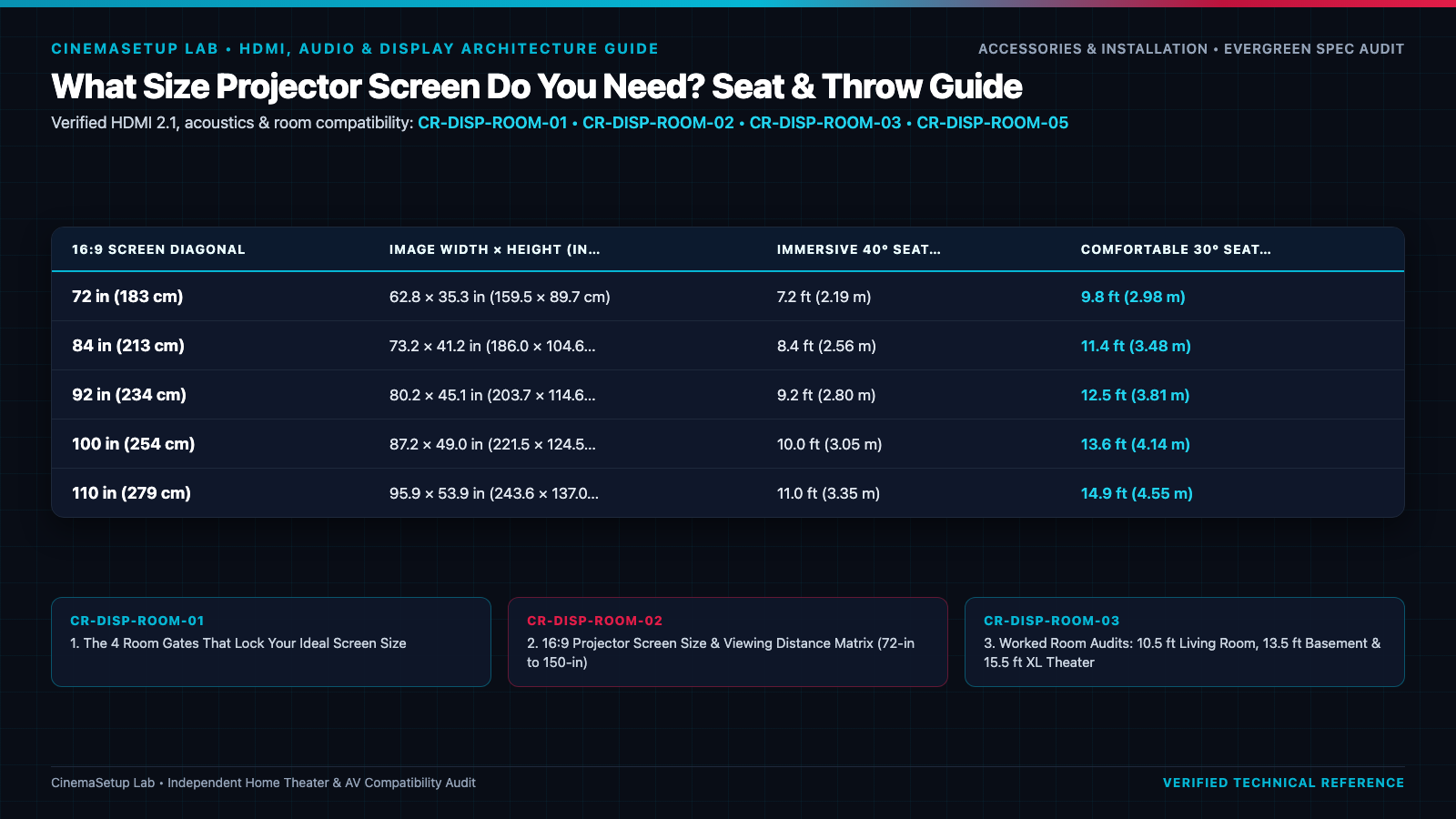
2. 16:9 Projector Screen Size & Viewing Distance Matrix (72-in to 150-in)
The reference matrix below translates every common 16:9 projector screen diagonal into exact image dimensions (excluding bezel borders), SMPTE 30° to THX-style 40° viewing distances in imperial and metric units, surface area scaling relative to a 100-inch reference screen, and room-height caveats.
| 16:9 Screen Diagonal | Image Width × Height (in / cm) | Immersive 40° Seat (1.20× Diag) | Comfortable 30° Seat (1.63× Diag) | Area vs. 100-in Screen | Ideal Room Fit & Ceiling Caveat |
|---|---|---|---|---|---|
| 72 in (183 cm) | 62.8 × 35.3 in (159.5 × 89.7 cm) | 7.2 ft (2.19 m) | 9.8 ft (2.98 m) | 0.52× | Compact dorms/bedrooms; note 75–77 in TVs often offer simpler bright-room installation |
| 84 in (213 cm) | 73.2 × 41.2 in (186.0 × 104.6 cm) | 8.4 ft (2.56 m) | 11.4 ft (3.48 m) | 0.71× | Small apartments & bedrooms; easy 8 ft (2.44 m) ceiling clearance above a media console |
| 92 in (234 cm) | 80.2 × 45.1 in (203.7 × 114.6 cm) | 9.2 ft (2.80 m) | 12.5 ft (3.81 m) | 0.85× | Tight 9–11 ft living rooms needing full center-speaker height below the frame |
| 100 in (254 cm) | 87.2 × 49.0 in (221.5 × 124.5 cm) | 10.0 ft (3.05 m) | 13.6 ft (4.14 m) | 1.00× (Baseline) | Most versatile sweet spot for 8 ft (2.44 m) ceilings, UST credenzas, and 10–13 ft sofas |
| 110 in (279 cm) | 95.9 × 53.9 in (243.6 × 137.0 cm) | 11.0 ft (3.35 m) | 14.9 ft (4.55 m) | 1.21× | Bridge size when 120 in hits side speakers or soffits in 11–13 ft rooms |
| 120 in (305 cm) | 104.6 × 58.8 in (265.7 × 149.4 cm) | 12.0 ft (3.66 m) | 16.3 ft (4.97 m) | 1.44× | Classic cinema benchmark; needs ~110 in wall width and 8.5–9 ft (2.6–2.7 m) ideal ceiling |
| 132 in (335 cm) | 115.1 × 64.7 in (292.3 × 164.4 cm) | 13.2 ft (4.02 m) | 17.9 ft (5.47 m) | 1.74× | Large living rooms & UST upgrades; check low credenza height on 8–9 ft ceilings |
| 135 in (343 cm) | 117.7 × 66.2 in (299.0 × 168.1 cm) | 13.5 ft (4.11 m) | 18.3 ft (5.59 m) | 1.82× | Wide dedicated basements; often paired with AT screens or 9+ ft (2.74+ m) ceilings |
| 150 in (381 cm) | 130.8 × 73.5 in (332.2 × 186.8 cm) | 15.0 ft (4.57 m) | 20.4 ft (6.21 m) | 2.25× | XL dedicated theaters; demands 9.5–10+ ft ceiling, deep throw, and high ISO/ANSI lumens |
3. Worked Room Audits: 10.5 ft Living Room, 13.5 ft Basement & 15.5 ft XL Theater
Applying the CR-DISP-ROOM-01 and CR-DISP-ROOM-02 formulas to actual room geometry shows how quickly wall height and lens optics narrow your real-world choices. Every distance and sizing figure below is a mathematical calculation from published geometric standards rather than a lab measurement (G-03).
Worked Example A: 10.5 ft (3.20 m) Living Room with an 8.0 ft (2.44 m) Ceiling
Assume a medium living room where your primary sofa puts your eyes 10.5 ft (126 in / 3.20 m) from the front wall, the ceiling stands 8.0 ft (96 in / 2.44 m) high, and you place a center-channel speaker on a 20-inch (51-cm) media console.
- Step 1 — Seat Angle Math (CR-DISP-ROOM-01): Comfortable 30° floor =
126 ÷ 1.63 = 77.3 in. Immersive 40° ceiling =126 ÷ 1.20 = 105.0 in. Your geometric sweet spot sits right between 92 in and 100 in. - Step 2 — Vertical Wall Clearance: A
20-inchconsole plus an8-inchcenter speaker reaches28 in(71 cm) off the floor. A 100-inch screen adds49.0 inof active height plus roughly4 inof top/bottom frame bezel (53 intotal), putting the top border at81 in(206 cm)—leaving a clean15 in(38 cm) below the 96-inch ceiling. By contrast, cramming a 120-inch frame (58.8 inimage +4 inbezel =62.8 in) pushes the top bezel to90.8 inand forces a harsh 44° viewing angle at 10.5 ft. - Verdict: Choose a 100-inch screen (paired with an ALR surface if lamps stay on during movie night, or matte white if blacked out).
Worked Example B: 13.5 ft (4.11 m) Dedicated Basement Room (15.5 ft Total Depth)
Suppose your basement theater measures 15.5 ft (4.72 m) front-to-back with a 9.0 ft (108 in / 2.74 m) ceiling, and your main row of recliners sits 13.5 ft (162 in / 4.11 m) from the screen wall.
- Step 1 — Seat Angle Math: Comfortable 30° floor =
162 ÷ 1.63 = 99.4 in. Immersive 40° ceiling =162 ÷ 1.20 = 135.0 in. Either a 120-in (~36°) or 135-in (~40°) screen falls squarely inside the 4K cinema band. - Step 2 — Long-Throw Depth Audit (CR-DISP-ROOM-02): Suppose you mount a long-throw 4K laser projector with a
1.35:1minimum throw ratio, a17.5 in(44.5 cm) chassis depth, and8.0 in(20.3 cm) of rear airflow/cable clearance against the back wall. Total chassis + rear clearance consumes25.5 in(2.13 ft), leaving13.37 ft(4.08 m) from lens to screen. Dividing13.37 ftby1.35yields a maximum optical image width of9.90 ft(118.8 in), which equals a 136-inch diagonal. Both 120-inch and 135-inch frames pass cleanly inside optical zoom! - Verdict: Choose 120 inches if you place floorstanding L/R towers and a center speaker below the screen; step up to 135 inches if you use an acoustically transparent screen with speakers tucked behind the frame.
Worked Example C: 15.5 ft (4.72 m) XL Theater Room Evaluating 150 Inches
In a large dedicated theater with a 9.5 ft (114 in / 2.90 m) ceiling, 18.5 ft (5.64 m) room depth, and main seating at 15.5 ft (186 in / 4.72 m), dividing 186 in by 1.20 allows up to a 155-inch diagonal at 40°. A 150-inch screen (130.8 × 73.5 in / 332.2 × 186.8 cm) leaves roughly 36 inches below the frame on a 114-inch wall—just enough for a low center stand, or seamless integration with in-wall/behind-screen speakers. However, because 150 inches covers 2.25× the area of a 100-inch screen, budget for a genuinely bright home theater projector rated in verified ISO 21118 or ANSI lumens and maintain full room light control.
4. Myth vs. Engineering Reality: 5 Screen-Sizing Mistakes to Avoid
Myth vs. Engineering Reality — Check These 5 Rules Before Ordering a Frame:
- Myth 1: “Always buy the largest screen that physically fits on the wall.”
Engineering Reality (CR-DISP-ROOM-01 & CR-DISP-ROOM-03): Oversizing past a 40° viewing angle forces constant horizontal head scanning, exaggerates compression artifacts on 1080p broadcasts, and spreads your projector’s fixed ISO/ANSI lumen output across vastly more surface area—making HDR highlights look flat and dim. - Myth 2: “Every ALR projector screen works with both long-throw and UST projectors.”
Engineering Reality (CR-DISP-ACC-01): Standard long-throw ALR screens reflect horizontal light from across the room while rejecting steep overhead/floor angles. Ultra-short-throw (UST) projectors fire steeply from inches below the bottom bezel—so a standard ALR material bounces a UST image straight into the ceiling instead of your couch. Match UST projectors exclusively to lenticular UST ALR/CLR screens, or use a neutral 1.0-gain matte screen in a dark room. - Myth 3: “High-gain screens (1.5+ gain) give you free brightness with zero trade-offs.”
Engineering Reality: Screen gain concentrates reflected light into a narrower viewing cone, similar to a spotlight. While moderate 1.1 to 1.3 gain can help in dark rooms with narrow sofa rows, high-gain coatings narrow off-axis brightness for side seats and can introduce center hotspotting or shimmer (“sparkle”). - Myth 4: “You can buy a 100-inch screen and use digital keystone or digital zoom to fit a 120-inch throw.”
Engineering Reality (CR-DISP-ROOM-05): Digital scaling and keystone throw away active pixels inside the projector’s imaging chip, softening 4K sharpness and illuminating a dim gray halo outside the screen border. Always size the physical screen to fit inside the projector’s optical zoom range with digital keystone set to zero. - Myth 5: “Budget sub-$400 ‘4K support’ projectors can drive a 135- to 150-inch cinema screen.”
Engineering Reality: Generic sub-$400 marketplace projectors advertising “4K support” and inflated unstandardized lumen numbers typically use native 720p or 1080p panels with modest real light output. Stretching low-output optics to 135–150 inches exposes coarse pixels and washes out dark scenes; verify standardized ISO 21118 or ANSI lumens and browse audited frames in our best projector screens audited for home theaters guide.
5. Verified US Projector Screens Matched by Size & Throw Type
Once your seating distance, wall height, and projector throw ratio lock down your target diagonal and screen surface class, the four verified fixed-frame screens below represent distinct room profiles—from 100-inch dark-room and ambient-light living spaces up to 132-inch UST and 150-inch dedicated theater rooms. Every listing details exact screen dimensions, throw compatibility, seller warranty checks (G-26), and single-kit box contents (G-29).
1. AWOL Valerion 100″ PureVision Fixed Frame — 10.0 to 13.6 ft Dark-Room Sweet Spot

Key Audited Specs & Box Contents: 100 in (254 cm) diagonal, 16:9 format | Active image area: 87.2 × 49.0 in (221.5 × 124.5 cm) | Recommended seating: 10.0 to 13.6 ft (3.0 to 4.1 m) | Surface: 1.0 Gain PET Matte with laser speckle reduction & 170° viewing angle | Compatibility: Long-throw, short-throw, and UST projectors | In the Box: Single 100-in fixed-frame screen kit (aluminum frame rails, PET matte fabric, tensioning hardware, wall mounting brackets; projector and cables sold separately) | Price Tier: Mid Fixed-Frame Screen Tier (verify live Amazon US pricing)
For light-controlled dens and bedrooms with 10 to 13.5 feet of sofa distance and standard 8-foot ceilings, a 100-inch 1.0-gain matte fixed frame remains the easiest, highest-value reference geometry. The AWOL Valerion PureVision 100″ pairs a neutral 1.0-gain PET matte surface with a laser-speckle-reducing texture and a wide 170° viewing cone—eliminating the narrow hotspotting common on high-gain materials while supporting both long-throw and RGB triple-laser UST projectors in darkened rooms.
Pros
- Neutral 1.0-gain PET matte surface preserves color accuracy and wide 170° seating angles
- Engineered to minimize laser speckle across long-throw, short-throw, and UST laser units
Cons
- 1.0-gain matte fabric provides no ambient-light rejection in sunlit rooms (CR-DISP-ROOM-03)
- Fixed-frame assembly stays permanently mounted on the wall and requires stud/masonry anchoring
Warranty & Seller Check (G-26): Confirm purchase from the official AWOL Vision / Valerion Amazon storefront or an authorized US dealer at checkout so manufacturer US defect and tension-hardware support remain valid.
2. SilverMagic 100″ Standard-Throw ALR Fixed Frame — Ambient-Light Living Rooms (Non-UST)

Key Audited Specs & Box Contents: 100 in (254 cm) diagonal, 16:9 format | Active image area: 87.2 × 49.0 in (221.5 × 124.5 cm) | Recommended seating: 10.0 to 13.6 ft (3.0 to 4.1 m) | Surface: Gray Ambient-Light-Rejecting (ALR) for standard/long-throw optics | Compatibility: Standard/long-throw projectors only (excludes UST under CR-DISP-ACC-01) | In the Box: Single 100-in fixed-frame ALR screen kit (aluminum frame, gray ALR fabric, wall-mount brackets; projector and cables sold separately) | Price Tier: Mid ALR Fixed-Frame Screen Tier (verify live Amazon US pricing)
When your 100-inch screen sits in a multi-purpose living room with white drywall or side windows, a matte white fabric reflects stray room light across dark scenes and crushes contrast. The SilverMagic 100″ Standard-Throw ALR Fixed Frame addresses CR-DISP-ROOM-03 for ceiling- or shelf-mounted long-throw projectors by filtering off-axis room glare on a gray ALR base. Keep CR-DISP-ACC-01 front and center: this listing explicitly specifies Standard Throw (Non-UST)—never pair it with an ultra-short-throw projector sitting on a credenza below the frame.
Pros
- Explicitly labeled for standard/long-throw projectors, avoiding UST ALR mismatch mistakes
- Gray ALR surface preserves better perceived black levels than matte white under moderate room light
Cons
- Incompatible with ultra-short-throw (UST) laser projectors (CR-DISP-ACC-01)
- Directional ALR reflection narrows optimal off-axis seating compared with 1.0-gain matte white
Warranty & Seller Check (G-26): Verify seller fulfillment, return window, and manufacturer warranty details on the live Amazon US checkout page before ordering.
3. NothingProjector 132″ Seamless UST ALR — Large Living-Room Laser TV Upgrade

Key Audited Specs & Box Contents: 132 in (335 cm) diagonal, 16:9 format | Active image area: 115.1 × 64.7 in (292.3 × 164.4 cm) | Recommended seating: 13.2 to 17.9 ft (4.0 to 5.5 m) | Surface: Seamless UST-specific ALR | Compatibility: Ultra-short-throw (UST) laser projectors only (CR-DISP-ACC-01) | In the Box: Single 132-in seamless fixed-frame UST ALR screen kit (frame rails, UST ALR screen sheet, wall mounting brackets; UST projector and low credenza sold separately) | Price Tier: Large UST ALR Fixed-Frame Screen Tier (verify live Amazon US pricing)
Large open-plan living rooms with 13.5-to-17-foot sofa distances quickly outgrow 100-inch screens—yet most UST ALR screens cap at 120 inches before requiring a two-piece seam. The NothingProjector 132″ Seamless UST ALR steps into that 115.1-inch-wide sweet spot with a single-sheet seamless UST-specific rejecting surface (CR-DISP-ACC-01). Before buying, audit your front wall vertically: a 64.7-inch-tall screen requires a low media cabinet (often 14 to 18 in / 36 to 46 cm tall) plus a generous 9+ ft ceiling, and pulling your UST projector back to throw 132 inches pushes the front of the chassis deeper into the room per the projector’s placement chart.
Pros
- Seamless 132-in UST ALR surface fills 13.2 to 17.9 ft seating without a center seam line
- Purpose-built for steep upward UST laser projection while rejecting ceiling light
Cons
- UST-only geometry—incompatible with ceiling-mounted long-throw projectors (CR-DISP-ACC-01)
- Requires a wide 117+ in clear wall, 9+ ft ceiling, and deeper UST credenza pullback
Warranty & Seller Check (G-26): Verify purchase through the NothingProjector US storefront or an authorized US retailer and inspect shipping box integrity on oversized freight delivery before assembly.
4. AWOL Valerion 150″ PureVision Fixed Frame — XL Dedicated Cinema Room (15.0 to 20.4 ft)

Key Audited Specs & Box Contents: 150 in (381 cm) diagonal, 16:9 format | Active image area: 130.8 × 73.5 in (332.2 × 186.8 cm) | Recommended seating: 15.0 to 20.4 ft (4.6 to 6.2 m) | Surface: 1.0 Gain PET Matte with laser speckle reduction & 170° viewing angle | Compatibility: Long-throw, short-throw, and UST projectors rated for 150 in | In the Box: Single 150-in fixed-frame screen assembly (frame rails, PET matte fabric, tensioning hardware, wall brackets; projector and cables sold separately) | Price Tier: XL Dedicated Theater Screen Tier (verify live Amazon US pricing)
When your dedicated theater room places main seating 15 to 20 feet back and gives you a 9.5-to-10-foot (2.9-to-3.0-m) ceiling, stepping up to a true 150-inch screen delivers commercial-cinema scale at home. At 130.8 in (10.90 ft / 3.32 m) wide and 73.5 in (6.13 ft / 1.87 m) tall, the AWOL Valerion 150″ PureVision requires serious front-wall real estate, strict room light control, and a high-lumen projector verified under CR-DISP-ROOM-02 so 2.25× area expansion never leaves HDR highlights starved.
Pros
- True 150-in cinema scale (130.8 × 73.5 in) sized for 15.0 to 20.4 ft dedicated rows
- 1.0-gain PET matte surface maintains uniform wide-angle brightness across multi-seat rows
Cons
- 2.25× surface area vs. 100 in demands a high-output ISO/ANSI lumen projector and dark walls
- 73.5-in image height (plus frame bezel) exceeds practical clearance under standard 8-ft ceilings
Warranty & Seller Check (G-26): Verify purchase from the official AWOL Vision / Valerion US storefront or authorized US dealer, and verify hallway/staircase clearance before delivery of 130+ inch frame boxes.
6. Wall Anchoring, Speaker Clearance & CL2/CL3 Wiring Safety
Safety, Structural Mounting & In-Wall Wiring Notice (G-27 / CR-DISP-ACC-02 / CR-ACC-DISP-01 / CR-ACC-SPK-02):
- Manufacturer-Instruction-First Screen & Projector Anchoring: Large fixed-frame screens span 8 to 11 feet wide, and motorized drop-down housings can weigh 35 to 80+ lb (16 to 36+ kg). Always follow the screen and mount manufacturer’s instructions first, confirm wall-bracket load ratings, and drive structural lag screws into solid wood wall studs, ceiling joists, or rated concrete/masonry anchors—never rely on hollow drywall anchors alone for heavy housings.
- Acoustically Transparent (AT) Speaker Spacing: If a 120-to-150-inch frame forces your front LCR speakers behind the screen, select an acoustically transparent surface and follow the screen maker’s minimum speaker-to-fabric setback distance to prevent acoustic comb filtering or visual moire patterns.
- UL CL2 / CL3 In-Wall HDMI & Speaker Wire Compliance: Whenever routing HDMI or speaker cables inside walls or ceiling cavities toward your screen wall or overhead projector, use exclusively UL-listed CL2 or CL3 (or local-code-equivalent) in-wall-rated cable—including directional Ultra High Speed HDMI Certified active optical fiber (AOC) cables for 4K120 runs beyond
10 ft(3.0 m) (CR-ACC-DISP-01). Never route standard power cords inside drywall. - Licensed Electrician & Pro AV Installer Referrals: For hardwired motorized drop-down screens, recessed ceiling 120V AC outlets, or load-bearing ceiling modifications, hire a licensed electrician or licensed AV installer in your jurisdiction. Keep external audio playback at comfortable listening levels.
7. Authoritative Standards & Manufacturer References
- SMPTE & THX Cinema Viewing-Angle Geometry: SMPTE EG 18 and cinema horizontal field-of-view standards establishing the 30° minimum (
1.63× diagonal) to 40° immersive (1.20× diagonal) viewing envelope at smpte.org and thx.com. - ISO 21118 Projector Lumen Standards & Manufacturer Throw Charts: Standardized brightness reporting and optical placement calculators from Epson USA (epson.com) and BenQ USA (benq.com).
- Screen Manufacturer Specifications & UST ALR Documentation: PureVision PET matte gain/angle specs and UST lenticular ALR matching guides from AWOL Vision / Valerion (awolvision.com) and NothingProjector (nothingprojector.com).
- HDMI Licensing Administrator & NEC Low-Voltage Wiring: Ultra High Speed HDMI Cable Certification (48 Gbps) for long ceiling projector runs at hdmi.org, plus UL CL2/CL3 in-wall cable safety standards.
How We Audited This Guide
- Installation cabling and hardware were verified across HDMI Ultra High Speed QR certification vs. active fiber directionality, CL2/CL3 UL in-wall cable ratings, VESA/weight wall-mount limits, and UST ALR vs. standard screens.
- Every AV receiver, speaker, subwoofer, soundbar, OLED/Mini-LED TV, projector, source player, and accessory spec was cross-checked against official manufacturer manuals, CEA/CTA standards, and live Amazon US listings.
- Recommendations were evaluated against our weighted vertical scoring rubrics and documented CR-* compatibility rules; we never invent nits, contrast ratios, bench wattage, or room decibels.
Continue Your Audit
8. Frequently Asked Questions
What size projector screen do I need for a 10-foot viewing distance?
From a 10.0 ft (3.05 m / 120 in) eye-to-screen seating distance, dividing by 1.63 and 1.20 yields a 74-in to 100-in range. A 92-in or 100-in 16:9 screen is the ideal sweet spot, delivering an immersive ~36° to 40° cinema view while fitting comfortably under an 8-foot ceiling.
What size projector screen is best for a 12-foot viewing distance?
At 12.0 ft (3.66 m / 144 in) away, the 30° to 40° viewing window spans roughly 88 in to 120 in. A 110-in or 120-in 16:9 screen (95.9 to 104.6 in wide) is the benchmark choice—provided your projector’s throw ratio and front-wall speaker clearance accommodate a 110+ inch frame width.
How tall is a 100-inch vs. 120-inch 16:9 projector screen on my wall?
A 100-inch 16:9 screen has an active picture measuring 87.2 in wide by 49.0 in tall (221.5 × 124.5 cm), while a 120-inch screen measures 104.6 in wide by 58.8 in tall (265.7 × 149.4 cm). Always add 2 to 6 inches (5 to 15 cm) for the outer bezel frame before measuring ceiling height.
Is a 150-inch projector screen too big for a standard living room?
In most living rooms with 8-foot ceilings and 10-to-12-foot sofas, yes. A 150-inch image stands 73.5 in (186.8 cm) tall before bezel borders, crowding floor consoles and speakers, requires 15.0 to 20.4 ft (4.6 to 6.2 m) of viewing distance, and spreads lumens over 2.25× the area of a 100-inch screen.
Do I need a different screen size or material for an ultra-short-throw (UST) projector?
Seating-distance sizing stays identical, but UST projectors require a UST-specific lenticular ALR/CLR screen in lit rooms (CR-DISP-ACC-01). Also remember larger 120-to-132-inch UST screens force the projector farther forward from the wall, requiring a deeper or pulled-out media console.
Should I choose a 16:9 or 2.35:1 CinemaScope projector screen?
For mixed streaming, TV series, console gaming, and movies, a 16:9 screen avoids shrinking 16:9 content inside wide side pillarboxes and works cleanly with fixed-lens projectors. Choose 2.35:1 only in dedicated rooms using a projector with motorized lens memory or an anamorphic lens.


