
Disclosure: As an Amazon Associate, I earn from qualifying purchases. If you buy through links on this page, CinemaSetup Lab may earn a small commission at no extra cost to you. Commission rates never influence our rankings or compatibility verdicts.
Buying an flagship OLED television, a 9-channel AV receiver, or an ultra-short-throw laser projector only delivers its full performance when the supporting infrastructure holds up under load. Choosing the best home theater accessories is less about chasing boutique marketing myths and more about enforcing hard electrical, optical, and structural physics across your entire room. One uncertified copper HDMI cord can force a PS5 down to 60 Hz, copper-clad aluminum wire can starve low-impedance surround channels, and a wall bracket rated below a panel’s weight without stand creates a real household safety hazard.
Across this pillar audit, we evaluated hundreds of Amazon US listings against official standards—HDMI Licensing Administrator Ultra High Speed certification, UL 1449 surge clamping, NEC CL2 fire-jacket ratings, VESA bolt geometry, and lenticular ambient-light-rejection optics—to isolate 9 dependable picks across every price bracket. Whether you are finishing a full blueprint from our home theater setup guide or upgrading one weak link, these verified cables, mounts, screens, and room treatments prevent costly signal dropouts and installation bottlenecks without paying for placebo claims.
In This Guide
- Quick Picks: Best Home Theater Accessories at a Glance
- Side-by-Side Comparison of the Best Home Theater Accessories
- Match Your Room & Signal Chain Scenario
- Detailed Audits: 9 Best Home Theater Accessories (1–9)
- 1. Zeskit Maya Certified Ultra High Speed HDMI 2.1 Cable (6 ft)
- 2. Monoprice 8K Ultra High Speed Certified Fiber Optic HDMI 2.1 Cable (32 ft)
- 3. SANUS Extendable Tilting TV Wall Mount (46-90")
- 4. Monoprice 14AWG CL2 In-Wall 100% OFC Speaker Wire (100 ft)
- 5. Sewell Deadbolt Gold-Plated Banana Plugs (12 Pairs)
- 6. Panamax M5300-PM 11-Outlet Home Theater Power Conditioner
- 7. SVS SoundPath Subwoofer Isolation System (4-Pack)
- 8. NothingProjector 100-Inch UST ALR Fixed-Frame Projector Screen
- 9. TONOR Dual-Layer Acoustic Wall Panels (4-Pack)
- Buying Guide: Choosing Home Theater Accessories by Signal Chain & Room
- Audit Methodology, Scoring Rubric & Excluded Hardware
- Frequently Asked Questions
- Final Verdict
Quick Picks: Best Home Theater Accessories at a Glance
#1 Best Certified Short HDMI 2.1
Zeskit Maya 6 ft (48 Gbps)
Official HDMI Forum QR-certified copper cord built for rock-solid 4K120 VRR and eARC rack links. Jump to audit ↓
#2 Best Long-Run Fiber HDMI
Monoprice 8K AOC Fiber (32 ft)
Directional active optical fiber preserves full 48 Gbps HDMI 2.1 bandwidth across ceiling projector spans. Jump to audit ↓
#3 Best Heavy-Duty TV Wall Mount
SANUS Extendable Tilting (46-90")
UL-listed 150 lb (68 kg) stud-mounted bracket with 5.7 in (14.5 cm) pull-out for easy rear HDMI swaps. Jump to audit ↓
Side-by-Side Comparison of the Best Home Theater Accessories
| Accessory & Award | Best For | Key Compliance / Spec | Physical Rating / Limit | Action |
|---|---|---|---|---|
| Zeskit Maya 6 ft HDMI 2.1 Best Certified Short HDMI 2.1 | PS5 / Xbox / eARC under 10 ft | HDMI Forum UHS Certified (48 Gbps) | Passive copper, 6 ft (1.8 m) | View on Amazon |
| Monoprice 8K Fiber HDMI 32 ft Best Long-Run Active Optical | Ceiling projectors > 16 ft | Ultra High Speed AOC (48 Gbps) | Directional Source/Display, 32 ft | View on Amazon |
| SANUS Extendable TV Mount Best Heavy-Duty UL Wall Mount | 65–85 in OLED / Mini-LED TVs | UL Listed, VESA 200×200–600×400 | 150 lb (68 kg) max, 5.7 in pull-out | View on Amazon |
| Monoprice 14AWG CL2 Wire Best In-Wall OFC Speaker Wire | In-wall 5.1.2 / 7.1.4 surrounds | NEC CL2, 100% Pure OFC Copper | 100 ft spool, ~79 ft @ 8 ohms | View on Amazon |
| Sewell Deadbolt Banana Plugs Best Solderless Terminations | Clean AVR binding post installs | 24K Gold-Plated Brass, 16–12 AWG | 12 pairs (24 plugs = 6 speakers) | View on Amazon |
| Panamax M5300-PM Conditioner Best Rack Power Protection | Dedicated AVR & sub racks | UL 1449, 120 V / 60 Hz US | 11 outlets, over/under-volt shutoff | View on Amazon |
| SVS SoundPath Isolation Feet Best Subwoofer Decoupling | Wood subfloors & apartments | Tuned Elastomer + Steel Collar | 4-pack (1 sub); M6/M8/1/4-20 | View on Amazon |
| NothingProjector 100" UST ALR Best UST Lenticular Screen | Bright-room UST laser setups | UST CLR Sawtooth Optics | 100 in (254 cm) 16:9 fixed frame | View on Amazon |
| TONOR Acoustic Panels (4-Pk) Best Reflection Wall Panels | Bare-wall slap-echo control | Dual-Layer Polyester Felt | 47.2 x 23.6 x 0.72 in (4 panels) | View on Amazon |
Match Your Room & Signal Chain Scenario
| Buyer Scenario | Best Match | Why & Expected Outcome |
|---|---|---|
| PS5 / Xbox Series X 4K120 & eARC console hookups | Zeskit Maya 6 ft HDMI 2.1 | Carries verified 48 Gbps FRL6 signaling over short rack spans without VRR flicker or audio dropouts. |
| Ceiling-mounted 4K projector over 20 ft from AVR | Monoprice 32 ft Fiber Optic HDMI | Active optical fiber maintains 48 Gbps bandwidth across long conduits when routed Source-to-Display. |
| 65–85 in OLED or Mini-LED flush wall mounting | SANUS Extendable Tilting Mount | UL-rated 150 lb (68 kg) wood-stud mount pulls out 5.7 in (14.5 cm) so you never unmount the screen to swap HDMI cords. |
| In-wall 5.1.2 or 7.1.4 surround speaker wiring | Monoprice 14AWG CL2 OFC Wire + Sewell Plugs | NEC CL2 pure copper minimizes line loss up to ~79 ft at 8 ohms while banana plugs stop binding-post shorts. |
| Bright living room ultra-short-throw laser cinema | NothingProjector 100" UST ALR Screen | Sawtooth CLR ridges bounce steep upward UST light to the couch while rejecting overhead ceiling lamps. |
| Hardwood floor subwoofer buzz & bare-wall echo | SVS SoundPath Feet + TONOR Panels | Elastomer feet isolate mechanical floor rattles while 0.72 in dense felt panels tame dialogue slap-echo. |
Detailed Audits: 9 Best Home Theater Accessories (1–9)
1. Zeskit Maya Certified Ultra High Speed HDMI 2.1 Cable (6 ft, 48 Gbps) — Best Certified Short HDMI 2.1 Cable

Key Specs: HDMI Forum Ultra High Speed Certified (holographic QR label) | 48 Gbps FRL6 bandwidth (4K120, 8K60, VRR, ALLM, eARC) | 6 ft (1.8 m) passive copper | Pack Contents: Single 6 ft cable | Price Tier: Under $50
Audit Score: 9.4 / 10
- Verified Compliance (35%): 9.8 / 10
- Fit & Compatibility (30%): 9.4 / 10
- Build & Installation (15%): 9.0 / 10
- Value Within Tier (10%): 9.4 / 10
- Warranty & US Support (10%): 8.9 / 10
Every modern 4K120 console, GPU, and lossless eARC soundbar or receiver chain lives or dies by the physical HDMI 2.1 handshake governed under rule CR-ACC-DISP-01. Rather than trusting unverified “8K” marketplace claims, Zeskit participates directly in the official HDMI Licensing Administrator Ultra High Speed HDMI Cable Certification Program. Each retail Maya box carries a tamper-evident holographic QR code certifying full 48 Gbps Fixed Rate Link (FRL6) throughput alongside strict electromagnetic interference (EMI) shielding so nearby Wi-Fi routers and subwoofer wireless transceivers do not induce screen blanking.
At 6 ft (1.8 m), passive copper remains completely immune to the optical transceiver quirks of active cables while staying well inside the conservative ~10 to 16 ft (3 to 4.9 m) passive copper reliability ceiling. Compared with the 32 ft Monoprice active optical fiber HDMI cable (#2), the Zeskit Maya works bi-directionally with zero power draw from your TV or receiver port, and costs under $50 for a fraction of boutique cable markups. Its braided nylon jacket is slightly stiff around tight wall-mounted TV recesses, so pair it with an extendable wall bracket if rear HDMI ports face straight toward the drywall.
Buyer Verification Alert: Scan the official HDMI Forum holographic QR sticker on the physical Zeskit box using the HDMI Cable Certification app upon delivery, and keep passive copper variants under 10–16 ft (3–4.9 m) for 4K120 VRR chains.
Pros
- Verifiable HDMI Forum Ultra High Speed QR hologram confirms 48 Gbps FRL and low EMI compliance
- Passes uncompressed 4K at 120 Hz, 10-bit Dolby Vision, HDMI VRR, ALLM, and Dolby TrueHD eARC cleanly
- Bi-directional passive copper requires zero external power from HDMI ports
- Exact short length options eliminate messy coiled slack behind media consoles
Cons
- Braided 28 AWG construction has a wider bend radius behind flush-mounted rear-facing TV jacks
- Not designed for long 20–50 ft projector runs where passive copper attenuates 48 Gbps signals
Verdict: Buy it if you need dependable, standards-verified 4K120 and eARC connections inside an entertainment stand under 10 ft (3 m). Skip it if your display sits 20+ ft away from your AVR—use an active optical fiber cable instead.
2. Monoprice 8K Ultra High Speed Certified Fiber Optic HDMI 2.1 Cable (32 ft) — Best Long-Run Active Optical HDMI

Key Specs: Ultra High Speed Certified Active Optical Cable (AOC) | 48 Gbps (4K120, 8K60, VRR, eARC, HDCP 2.3) | 32 ft (9.8 m) hybrid fiber | Pack Contents: Single 32 ft directional cable (Source / Display labeled) | Price Tier: $50-$150
Audit Score: 9.1 / 10
- Verified Compliance (35%): 9.3 / 10
- Fit & Compatibility (30%): 9.2 / 10
- Build & Installation (15%): 8.8 / 10
- Value Within Tier (10%): 9.0 / 10
- Warranty & US Support (10%): 8.9 / 10
Once a home theater cable path crosses roughly 16 ft (4.9 m)—such as routing from an AV receiver rack up to a ceiling-mounted 4K laser projector—physics turns against passive copper conductors. High-frequency 48 Gbps FRL signals attenuate rapidly over long copper strands, causing intermittent snow, flickering VRR frames, or complete blackouts. Monoprice solves this cleanly with an Ultra High Speed certified active optical fiber optic HDMI cable that converts electrical video packets into laser light pulses at the Source hood and back again at the Display end.
Unlike passive copper picks such as the Zeskit Maya (#1), this 32 ft (9.8 m) Monoprice fiber optic HDMI run preserves full 48 Gbps bandwidth and HDCP 2.3 integrity while shedding heavy copper bulk, making it far easier to pull gently through 1-inch conduit without kinking. Keep two installation rules in mind: first, AOC cables are strictly directional (ISS-ACC-FIBER-DIRECTION)—if you pull the Display end to the AVR rack by mistake, you get zero picture. Second, always verify full 4K120 HDR signal lock across the cable before closing drywall or ceiling access panels, and consult local electrical codes or a licensed installer before routing any cable inside wall cavities.
Buyer Verification Alert: Check the engraved Source and Display arrows on both shells before pulling through walls or ceilings, and verify handshake compatibility with your exact projector/AVR chain on the floor prior to final routing.
Pros
- Maintains full 48 Gbps HDMI 2.1 bandwidth over 32 ft (9.8 m) without high-frequency attenuation
- Clear Source and Display connector labeling prevents accidental reversed pulls
- Optical fiber core resists EMI noise near room lighting dimmers and power runs
- Lighter, thinner jacket than bulky 24 AWG long-run copper HDMI cables
Cons
- Unidirectional design fails completely if Display and Source connectors are swapped
- Sharp tight bends (< 2 in / 5 cm radius) or crushing staples can permanently fracture internal glass fibers
Verdict: Buy it if you are wiring a ceiling projector or remote AV closet beyond 16 ft (4.9 m) for 4K120 or 4K60 HDR. Skip it for short media-console hookups where a passive 6 ft Zeskit cable costs less and has no directional restrictions.
3. SANUS Extendable Tilting TV Wall Mount (46-90", up to 150 lb, UL Listed) — Best Heavy-Duty UL TV Wall Mount

Key Specs: UL Listed 150 lb (68 kg) max capacity | Fits 46 in to 90 in (117 to 229 cm) TVs | VESA mount pattern 200×200 mm through 600×400 mm | 5.7 in (14.5 cm) extension, +7/-12 deg tilt | Pack Contents: Single mount plate, arms, lag bolts & M4/M6/M8 TV hardware | Price Tier: $100-$200
Audit Score: 9.3 / 10
- Verified Compliance (35%): 9.6 / 10
- Fit & Compatibility (30%): 9.3 / 10
- Build & Installation (15%): 9.2 / 10
- Value Within Tier (10%): 8.7 / 10
- Warranty & US Support (10%): 9.3 / 10
Under compatibility rule CR-DISP-ACC-02, selecting a TV wall mount is a hard structural check: the bracket must match your TV’s VESA mount pattern in millimeters, diagonal range, and weight without stand in pounds (kilograms). According to SANUS official engineering specs, this extendable tilting mount carries third-party UL listing up to 150 lb (68 kg) across 46-to-90-inch screens—giving substantial safety headroom even for heavy 77-to-85-inch Mini-LED sets that weigh 95 to 115 lb (43 to 52 kg) off their pedestals.
Where basic flat brackets force you to lift an entire 83-inch OLED off the wall just to plug in an Apple TV or soundbar eARC cable, the SANUS scissor linkage slides the TV forward 5.7 in (14.5 cm) and collapses back to ~2.4 in (6.1 cm) off the wall. Lateral wall-plate slots accommodate both 16 in and 24 in (40.6 and 61 cm) stud spacing, plus post-install leveling screws so the frame sits dead-level. Always follow the SANUS installation manual strictly: anchor lag bolts into solid wood studs or masonry—never drywall anchors alone—and hire a qualified installer if your wall uses metal studs, plaster, or brick.
Buyer Verification Alert: Check your TV’s VESA pattern (e.g., 300×200 mm or 400×400 mm) and weight without stand before ordering, and confirm whether ultra-thin gallery OLEDs need spacers included in the SANUS bag.
Pros
- UL-listed 150 lb (68 kg) capacity handles flagship 75–85 in Mini-LED and OLED displays safely
- 5.7 in (14.5 cm) extendable rail makes rear HDMI 2.1 and optical connections accessible
- Broad VESA 200×200 to 600×400 mm compatibility and 16/24 in stud lateral shift
- Tool-free fingertip tilt (+7/-12 deg) reduces glare from room windows or lamps
Cons
- Not a full-motion articulating arm — unsuitable for sharp 45–90 degree corner viewing
- Two-person lifting required for 65+ in panels; masonry/metal stud hardware may require separate anchors
Verdict: Buy it if you want a UL-certified stud mount for a 55-to-85-inch screen that still lets you reach rear HDMI ports easily. Skip it if you need a full-swivel corner arm or have a non-VESA proprietary mount TV.
4. Monoprice 14AWG CL2 In-Wall 100% Oxygen-Free Copper Speaker Wire (100 ft) — Best In-Wall OFC Speaker Wire

Key Specs: 14 AWG wire gauge, 100% pure Oxygen-Free Copper (OFC) | NEC / UL CL2 in-wall fire-retardant white jacket | 100 ft (30.5 m) 2-conductor spool | Run limit: ~79 ft (24 m) at 8 ohms / ~40 ft (12 m) at 4 ohms | Price Tier: $50-$100
Audit Score: 9.2 / 10
- Verified Compliance (35%): 9.5 / 10
- Fit & Compatibility (30%): 9.2 / 10
- Build & Installation (15%): 8.9 / 10
- Value Within Tier (10%): 9.2 / 10
- Warranty & US Support (10%): 8.7 / 10
Speaker wire auditing comes down to two objective electrical and safety checks: OFC vs CCA wire metallurgy (`CR-ACC-SPK-01`) and CL2 CL3 in-wall fire-code compliance (`CR-ACC-SPK-02`). Copper-clad aluminum (CCA) wire looks identical in thumbnail photos yet carries roughly 60% higher DC resistance than pure copper, while brittle aluminum cores snap easily inside screw terminals. Monoprice builds this 100 ft (30.5 m) spool with 100% pure oxygen-free copper strands (~2.53 ohms per 1,000 ft), keeping round-trip line loss under 5% across runs up to ~79 ft (24 m) for 8-ohm speakers and ~40 ft (12 m) for 4-ohm designs.
Just as critical, the smooth white outer PVC jacket carries an official NEC CL2 rating required for low-voltage routing behind drywall or above ceiling joists in residential US construction. Check local municipal codes before drilling top plates or fireblocks—and engage a licensed electrician or custom AV installer whenever concealed framing runs intersect house electrical bays. Pair this 14 AWG spool with Sewell Deadbolt banana plugs (#5) at both ends for clean, low-resistance receiver hookups.
Buyer Verification Alert: Measure total one-way wire paths including vertical wall drops before ordering; 7.1.4 rooms with long ceiling runs often require two 100 ft spools or stepping up to 12 AWG OFC for 4-ohm towers beyond 40 ft (12 m).
Pros
- 100% pure oxygen-free copper maintains low electrical resistance without CCA oxidation risks
- NEC CL2-rated smooth outer jacket pulls cleanly around framing studs for in-wall runs
- Color-coded red and black inner insulation speeds up accurate positive/negative polarity matching
- Generous 100 ft (30.5 m) continuous spool covers L/C/R plus typical surround runs
Cons
- 4-ohm speakers placed beyond ~40 ft (12 m) benefit from thicker 12 AWG OFC wire
- Dual-layer CL2 jacket takes an extra stripping step compared with exposed zip-cord wire
Verdict: Buy it if you want reliable, code-compliant 14 AWG OFC wire for living-room 5.1.2 or in-wall surround installs. Skip it if you are wiring long 50+ ft runs to 4-ohm floorstanding speakers—step up to 12 AWG OFC instead.
5. Sewell Deadbolt Gold-Plated Banana Plugs (12 Pairs) — Best Solderless AVR Binding Terminations

Key Specs: 12 pairs (24 plugs total — equips 6 speakers at both AVR and speaker ends) | Fits 16 AWG to 12 AWG (up to 8 AWG max) | 24K gold-plated brass tips, anodized aluminum sleeves | Pack Contents: 12 red + 12 black plugs | Price Tier: Under $50
Audit Score: 9.0 / 10
- Verified Compliance (35%): 8.9 / 10
- Fit & Compatibility (30%): 9.1 / 10
- Build & Installation (15%): 9.3 / 10
- Value Within Tier (10%): 9.2 / 10
- Warranty & US Support (10%): 8.5 / 10
On the back of a modern 7.2- or 9.4-channel AV receiver, speaker binding posts sit tightly packed in two horizontal rows. Threading bare twisted copper wire through tiny cross-drilled holes in a dark media cabinet is an invitation for one stray copper whisker to bridge across adjacent terminals and trigger amplifier protection shutdowns. Sewell Deadbolt banana plugs eliminate that failure mode with a solderless internal gripping collar that bites firmly around flared strands of Monoprice 14 AWG OFC wire (#4) as you twist the sleeve closed—no tiny set screws to vibrate loose over time.
Compared with dual-screw banana connectors, Deadbolt plugs assemble in roughly 20 seconds per end and feature insulated aluminum outer barrels that shield exposed metal inside crowded racks. Remember our explicit pack math (`G-29`): one 12-pair box contains 24 individual plugs, which terminates 5.1 or 6 speakers at both the AVR and speaker ends. For a 5.1.2 (7 speakers = 14 pairs) or 7.1.4 (11 speakers = 22 pairs) room, order two boxes so every channel stays uniform.
Buyer Verification Alert: Pop out the small plastic safety inserts inside your AV receiver’s binding posts before inserting banana plugs, and verify your speakers use 5-way binding posts rather than spring-loaded clips.
Pros
- Internal compression teeth clamp 16–12 AWG copper wire tightly without loosening set screws
- Color-coded insulated barrels prevent terminal-to-terminal short circuits on crowded AVRs
- Speeds up pulling an AV receiver out for HDMI swaps or cabinet dusting
- 12-pair pack covers a complete 5.1 passive speaker system plus one spare pair
Cons
- Incompatible with spring-clip terminals found on entry-level micro satellite speakers
- Straight-entry barrel adds ~1.4 in (3.6 cm) depth behind shallow enclosed cabinets
Verdict: Buy it if you run an AV receiver and passive speakers with 5-way binding posts and want safe, fast connections under $50. Skip it if your receiver sits flush against a shallow cabinet backplate where angled plugs fit better.
6. Panamax M5300-PM 11-Outlet Home Theater Power Conditioner — Best Surge & Voltage Protection Rack Unit

Key Specs: UL 1449 safety & surge standard | 120 V AC / 60 Hz US, 15 A max | 11 total outlets across 5 isolated banks (including high-current AVR/sub outlets) | Automatic over/under-voltage shutoff | Pack Contents: Single 2U chassis + rack ears | Price Tier: $400-$600
Audit Score: 8.9 / 10
- Verified Compliance (35%): 9.6 / 10
- Fit & Compatibility (30%): 8.9 / 10
- Build & Installation (15%): 8.8 / 10
- Value Within Tier (10%): 7.6 / 10
- Warranty & US Support (10%): 8.9 / 10
Power hardware earns a place among the best home theater accessories for one reason: protecting sensitive 120 V HDMI boards, OLED power supplies, and Class-D subwoofer amps (`CR-SYS-02`), never for fictional “blacker backgrounds” or sonic upgrades (`G-14`). Verified against UL 1449 surge protective standards, the Panamax M5300-PM goes far beyond disposable strip protectors. Its automatic voltage monitoring circuitry physically disconnects downstream equipment during sustained over-voltage spikes or damaging brownout sags rather than sacrificing a sacrificial fuse silently.
Inside a ventilated media rack, 11 rear and front outlets split cleanly into 5 isolated filter banks, separating noisy digital streaming wall-warts from dedicated high-current outlets reserved for your 9-channel AVR or external power amplifier. A front-panel digital voltage meter and dimmable rack lamps add practical diagnostics in dark rooms. Remember that no surge unit replaces proper house grounding or dedicated 15 A / 20 A branch circuits—if breakers trip under heavy subwoofer loads, hire a licensed electrician to evaluate your wall circuit.
Buyer Verification Alert: Check the Amazon US seller name at checkout (`G-26`) to confirm Panamax authorized-dealer coverage for its connected-equipment warranty, and ensure your cabinet depth clears the 12.25 in (31.1 cm) chassis plus power cords.
Pros
- UL 1449 listed with automatic over-voltage and brownout under-voltage disconnect protection
- 5 isolated filter banks plus dedicated high-current outlets for AVRs and powered subwoofers
- Dimmable rack lights, 12 V trigger sequencing, and live incoming AC voltage readout
- Includes removable rack ears for both open credenza shelves and standard 19 in racks
Cons
- $400-$600 investment is excessive for minimal TV-plus-soundbar living rooms
- Does not generate wattage, fix room acoustics, or improve speaker frequency response
Verdict: Buy it if you house an expensive AVR, amplifier, disc player, and display inside a dedicated theater rack needing brownout shutoff and clean outlet isolation. Skip it if a compact UL 1449 wall strip meets your living-room outlet count.
7. SVS SoundPath Subwoofer Isolation System (4-Pack) — Best Subwoofer Decoupling Feet

Key Specs: Durometer-tuned elastomer feet with anodized steel collars | Adds ~1.6 in (4.1 cm) under cabinet | Included threads: 1/4-20, M6, and M8 screw kits | Pack Contents: 4 feet (equips 1 subwoofer) | Price Tier: $50-$100
Audit Score: 8.9 / 10
- Verified Compliance (35%): 8.7 / 10
- Fit & Compatibility (30%): 9.0 / 10
- Build & Installation (15%): 9.3 / 10
- Value Within Tier (10%): 8.6 / 10
- Warranty & US Support (10%): 9.1 / 10
Hardwood floors over wooden joists turn a 12-inch or 15-inch subwoofer into a giant mechanical transducer that vibrates picture frames, credenza doors, and downstairs drywall. Per SVS official SoundPath specifications, these four durometer-tuned elastomer feet decouple the subwoofer enclosure from the floor structure itself, stopping cabinet-borne buzz without raising the sub onto an unsightly foam block.
Unlike generic foam risers that squish unevenly under heavy 80 lb ported enclosures, SoundPath threads directly into the subwoofer’s factory foot inserts using the supplied 1/4-20, M6, or M8 machine screws. Under rule CR-SUB-ROOM-03, remember the honest physical limit of subwoofer isolation: decoupling cuts structural floor-to-joist vibration, yet airborne 20–50 Hz pressure waves still travel through shared apartment walls, so pair these feet with receiver dynamic-range night mode late at night. Also verify pack quantity (`G-29`): one 4-pack equips one subwoofer, while a 6-foot tall dual-sub system requires two packs.
Buyer Verification Alert: Tip your subwoofer gently onto a padded rug to confirm it has threaded foot sockets (M6, M8, or 1/4-20) rather than glued-on plastic pads before ordering, and note that SVS also sells a 6-pack for larger dual-driver cabinets.
Pros
- Substantially curbs mechanical floor, cabinet, and adjacent furniture rattles on wood subfloors
- Ships with 1/4-20, M6, and M8 fasteners covering SVS, RSL, Klipsch, and HSU cabinets
- Anodized steel collars support heavy ported subwoofers cleanly without tilting
- Clean low-profile aesthetics compared with thick acoustic foam platforms
Cons
- Cannot block airborne deep-bass sound pressure from crossing thin shared walls
- One 4-pack only serves a single subwoofer — dual-sub rooms double the accessory spend
Verdict: Buy it if your subwoofer rests on hardwood, laminate, or second-story wood joists that buzz during LFE peaks. Skip it if your sub already sits flat on bare basement concrete with zero structural rattle.
8. NothingProjector 100-Inch UST ALR Fixed-Frame Projector Screen — Best UST Fresnel/Lenticular ALR Screen

Key Specs: 100 in (254 cm) diagonal, 16:9 aspect | UST ALR / CLR sawtooth lenticular optical material | Fixed tensioned aluminum slim-bezel frame | Compatibility: Ultra-Short-Throw (UST) projectors only (CR-DISP-ACC-01) | Pack Contents: Frame kit, UST screen sheet & wall brackets | Price Tier: $600-$1,000
Audit Score: 8.8 / 10
- Verified Compliance (35%): 8.6 / 10
- Fit & Compatibility (30%): 9.3 / 10
- Build & Installation (15%): 8.2 / 10
- Value Within Tier (10%): 9.0 / 10
- Warranty & US Support (10%): 8.6 / 10
Projecting an ultra-short-throw (UST) laser unit onto a bare painted wall or standard matte white screen wastes most of its contrast in a bright living room—and magnifies every drywall seam because the light beam grazes upward at an extreme ~0.16–0.25 throw ratio. Under rule CR-DISP-ACC-01, UST projectors require a dedicated UST ALR screen (also called ceiling-light-rejecting or CLR) engineered with microscopic horizontal sawtooth ridges. Those angled facets catch steep upward light from the credenza below and reflect it straight toward seated viewers, while the dark upper-facing slopes absorb overhead room lighting.
Compared with standard angular ALR screens built for long-throw ceiling projectors—which actually darken and hotspot badly when hit from below by a UST lens—this tensioned NothingProjector 100-inch (254 cm) fixed frame keeps the surface dead-flat so straight geometric edges never bow into trapezoids. Unlike motorized floor-rising screens costing double, the fixed frame remains permanently taut and mounts cleanly like a large bezel-less TV. Two adults are required for frame tensioning and wall bracket installation; verify wall width (~88 in / 224 cm) and anchor brackets into studs per the manufacturer manual.
Buyer Verification Alert: Confirm your projector is a bottom-mounted Ultra-Short-Throw (UST) model before checkout; this optical surface cannot be inverted for ceiling-mounted long-throw projectors.
Pros
- Sawtooth CLR/ALR optical structure rejects ceiling glare while preserving UST contrast
- Tensioned aluminum fixed frame eliminates waves that distort steep UST image geometry
- Substantially deeper perceived black levels than white matte screens in ambient light
- Clean narrow-bezel silhouette fits living rooms cleanly in the $600-$1,000 bracket
Cons
- Strictly incompatible with standard long-throw or short-throw ceiling projectors
- Multi-piece frame assembly and tension springs take 60–90 minutes with two people
Verdict: Buy it if you run an Epson LS800, Hisense PX3-Pro, or similar UST laser projector in a room with windows or overhead lamps. Skip it if you own a traditional ceiling-mounted long-throw projector.
9. TONOR Dual-Layer Acoustic Wall Panels (4-Pack, 47.2" x 23.6") — Best High-Density Acoustic Reflection Panels
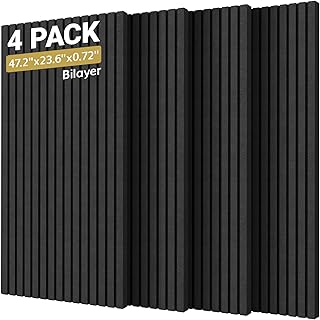
Key Specs: 47.2 in x 23.6 in x 0.72 in (120 x 60 x 1.8 cm) per panel | Dual-layer high-density polyester fiber felt | Pack Contents: 4 large self-adhesive panels (~31 sq ft / 2.9 sq m total coverage) | Price Tier: $50-$150
Audit Score: 8.5 / 10
- Verified Compliance (35%): 8.4 / 10
- Fit & Compatibility (30%): 8.5 / 10
- Build & Installation (15%): 8.6 / 10
- Value Within Tier (10%): 8.9 / 10
- Warranty & US Support (10%): 8.2 / 10
Bare drywall, hardwood floors, and large picture windows bounce dialogue and sibilant sound effects off side walls milliseconds after the direct speaker wave arrives, smearing center-channel clarity. Thin 1-inch decorative egg-crate foam tiles do very little beyond looking cluttered. TONOR’s oversized 47.2 x 23.6 in (120 x 60 cm) dual-layer polyester felt sheets pack far greater fiber density into a 0.72 in (1.8 cm) architectural profile—covering roughly 31 sq ft across one 4-pack for meaningful first-reflection echo control along left and right side walls.
Whereas SVS SoundPath isolation feet (#7) stop structural floor vibration below 60 Hz, TONOR panels work strictly in the upper-midrange and high-frequency reflection bands (~500 Hz and above) to clean up vocal intelligibility and room flutter. Be realistic about physical boundaries: 0.72 in felt panels do not act as deep subwoofer bass traps and will not soundproof a wall between rooms. In rentals, bypass the aggressive factory peel-and-stick glue with removable mounting strips or Z-clips to protect painted drywall.
Buyer Verification Alert: Place a hand mirror along side walls while seated to locate exact first-reflection points for your front left/right speakers, and avoid pressing the factory adhesive directly onto flat-finish drywall you may repaint later.
Pros
- Large 47.2 x 23.6 in (120 x 60 cm) format treats broad side-wall reflection zones neatly
- Dense polyester felt avoids the chemical odor and flaking dust of cheap polyurethane foam
- Chamfered edges create an understated architectural wall finish
- Straightforward peel-and-stick installation with zero framing carpentry required
Cons
- 0.72 in (1.8 cm) thickness only damps upper-mid/treble flutter, not low-bass room modes
- Factory adhesive can tear drywall paper during removal if applied directly to unprimed paint
Verdict: Buy it if bare drywall causes harsh vocal echo and smeared stereo imaging in a spare-room theater. Skip it if your primary goal is deep-bass trapping or blocking sound from reaching adjacent rooms.
Buying Guide: Choosing Home Theater Accessories by Signal Chain & Room
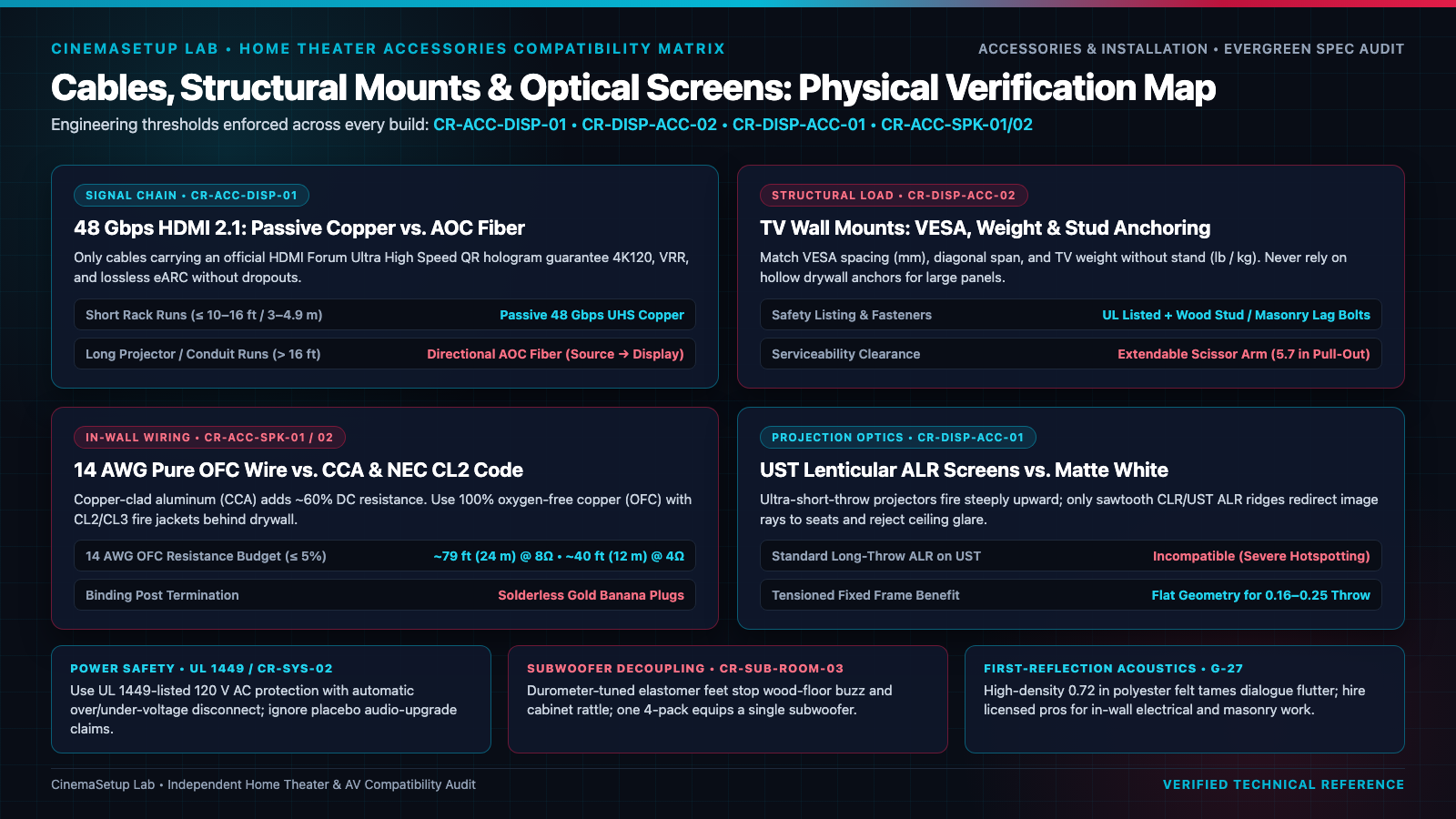
1. 48 Gbps Ultra High Speed HDMI 2.1 vs. Long-Run AOC Fiber (CR-ACC-DISP-01)
Ignore decorative gold-plated claims and unverified “8K” banner graphics on budget cable listings. Under HDMI 2.1 rules (`CR-ACC-DISP-01`), carrying 4K at 120 Hz, 10-bit HDR, HDMI Forum VRR, and uncompressed Dolby TrueHD over eARC demands true 48 Gbps Fixed Rate Link throughput. Look exclusively for the official Ultra High Speed HDMI holographic QR sticker on retail packaging, as detailed in our best HDMI cable for 4K 120Hz guide.
Distance dictates cable topology. Keep passive copper cables at or below 10 to 16 ft (3 to 4.9 m) for reliable 4K120 handshakes. Once your path stretches across a room to a ceiling projector or remote closet (20 to 50 ft / 6 to 15 m), switch to a directional active optical fiber optic HDMI cord. Remember to match the stamped Source connector at your AVR or console and the Display connector at the TV or projector, and confirm full signal lock with level-calibration tones and 4K120 video before sealing conduits.
2. OFC vs. CCA Speaker Wire, AWG Gauge Math & NEC CL2/CL3 In-Wall Code (CR-ACC-SPK-01 & CR-ACC-SPK-02)
Understanding OFC vs CCA wire prevents hidden power loss and installation failures. Oxygen-free copper (OFC) offers low DC resistance (~2.53 ohms per 1,000 ft at 14 AWG), whereas copper-clad aluminum (CCA) adds roughly 60% higher resistance and breaks far more easily when bent around binding posts. Using our AWG wire gauge rule (`CR-ACC-SPK-01`) to keep round-trip cable resistance below ~5% of speaker nominal impedance: 16 AWG OFC covers ~50 ft (15 m) at 8 ohms or ~25 ft (7.6 m) at 4 ohms; 14 AWG OFC covers ~79 ft (24 m) at 8 ohms or ~40 ft (12 m) at 4 ohms; and 12 AWG OFC pushes 4-ohm runs to ~63 ft (19 m).
Any speaker wire routed inside walls or ceilings triggers rule CR-ACC-SPK-02: it must carry an NEC/UL CL2 CL3 in-wall fire-retardant outer jacket (`G-27`). Never bury lamp cord or unrated clear-jacket speaker wire behind drywall. Always read manufacturer instructions first, verify local residential building codes, and hire a licensed electrician or certified AV installer when drilling structural joists or fireblocks. For cleaner rack maintenance, terminate exposed OFC strands at 5-way binding posts with solderless banana plugs—see our best speaker wire audit for complete gauge tables.
3. VESA Load Math, Weight Without Stand & Structural Wall Anchoring (CR-DISP-ACC-02)
Wall-mounting a 65-to-85-inch display is governed by one unforgiving HARD rule (`CR-DISP-ACC-02`): verify your TV’s exact VESA mount pattern (horizontal x vertical spacing in millimeters), diagonal size range, and weight without stand (in lb and kg). Select a UL-listed bracket rated safely above that weight—never cut corners on uncertified steel frames.
Installation safety (`G-27`) starts with following the mount manufacturer’s instructions verbatim: drive structural lag bolts straight into centered wood studs or concrete/masonry anchors using a calibrated stud finder and two-person lift. Never hang a large flat-panel television solely from hollow drywall anchors. If your room has steel studs, plaster-and-lath walls, or fireplace masonry, hire a qualified AV installer—and compare tilt vs. full-motion geometry in our best TV wall mount guide.
4. UST Lenticular ALR Screens vs. Standard ALR & White Matte (CR-DISP-ACC-01)
Projector screens are directional optical instruments, not passive white sheets (`CR-DISP-ACC-01`). Standard matte white surfaces (~1.0 screen gain) work wonderfully in pitch-dark dedicated theaters with velvet-black walls, while long-throw ambient-light-rejecting (ALR) materials help ceiling projectors fight side-wall spill. However, placing a standard long-throw ALR screen in front of an ultra-short-throw laser projector creates a dark, washed-out image because long-throw coatings intentionally reject steep upward rays coming from below the frame.
Instead, UST laser units require a dedicated UST ALR screen (CLR) crafted with horizontal sawtooth lenticular or Fresnel micro-structures. Those upward-angled facets bounce credenza-level projector output straight toward your eyes while blocking overhead ceiling fixtures. Explore screen sizing and throw geometry inside our best UST projector screen audit.
5. UL 1449 Power Protection, Subwoofer Isolation & Accessory Budget Allocation
When planning total audio spend (`CR-SYS-01`), allocate roughly 5% to 10% of your audio budget to cables, speaker wire, banana plugs, stands, and surge hardware—reserving 50%+ for speakers and subwoofers where real acoustic differences live. Choose a UL 1449-listed surge protector or rack power conditioner for US 120 V / 60 Hz circuits (`CR-SYS-02`), and remember our strict anti-myth policy (`G-14`): power conditioners and thick speaker wire prevent equipment damage and signal loss rather than altering musical warmth or HDR color. Compare single-strip and rack-mounted units in our best surge protector for home theater roundup.
Finally, pair mechanical subwoofer isolation elastomer feet on suspended wood floors with dense felt wall panels at side-wall first reflections for balanced physical room control. Keep listening levels comfortable during extended movie sessions and check acoustic placement before adding extra gear.
Audit Methodology, Scoring Rubric & Excluded Hardware
Every SKU in this roundup was evaluated through CinemaSetup Lab’s specification, certification, and US marketplace audit workflow (full criteria on our How We Review page). Because accessory listings on Amazon are especially prone to inflated bandwidth badges and mislabeled metallurgy, we weight verifiable third-party compliance and cross-system compatibility ahead of cosmetic packaging. Note that affiliate commission differences across Amazon categories never alter rankings or verdicts.
| Evaluation Criterion | Weight | What We Audit |
|---|---|---|
| Verified Compliance | 35% | HDMI Forum Ultra High Speed QR certification, UL 1449 / UL wall-mount listings, NEC CL2/CL3 fire ratings, and verified load limits. |
| Fit & Compatibility | 30% | Alignment with CR-ACC-DISP-01, CR-DISP-ACC-02, CR-DISP-ACC-01, CR-ACC-SPK-01/02, and CR-SYS-02 rules. |
| Build & Installation | 15% | Included stud/VESA fasteners, Source/Display AOC markings, solderless termination retention, and manual clarity. |
| Value Within Tier | 10% | Fair pricing within the accessory’s category band without paying for placebo cable or power-conditioning hype. |
| Warranty & US Support | 10% | US manufacturer warranty support, connected-equipment terms, and authorized-dealer transparency. |
| Total Score | 100% | Weighted composite across all five engineering pillars. |
Models We Audited & Excluded
- Uncertified Passive Copper "8K / 48 Gbps" HDMI Cables Over 16 ft: Generic 20-to-50 ft passive copper listings advertising “HDMI 2.1 8K” without the HDMI Forum Ultra High Speed QR hologram frequently drop frames or revert to 4K60 under 4K120 VRR loads (
ISS-ACC-FAKE-HDMI-CERT,CR-ACC-DISP-01). - Copper-Clad Aluminum (CCA) Wire Billed as 14 AWG OFC: Budget spools using aluminum cores coated in thin copper plating exhibit ~60% higher DC resistance, oxidize at screw terminals, and fatigue during pulls (
ISS-ACC-CCA-WIRE-MISLABELED,CR-ACC-SPK-01). - Non-UL Drywall-Anchor-Only TV Mounts for Large Panels: Uncertified “no-stud” brackets relying solely on hollow drywall pins for 55-to-85-inch screens fail structural safety margins under
CR-DISP-ACC-02and are excluded outright. - Sub-1-Inch Decorative Egg-Crate Polyurethane Foam: Cheap compressed foam squares marketed as “broadband room soundproofing” lack density for midrange/bass damping and offer zero sound isolation between rooms.
Frequently Asked Questions
Do I really need a certified 48 Gbps Ultra High Speed HDMI 2.1 cable?
Yes, for 4K at 120 Hz, VRR, and lossless eARC without dropouts. Official HDMI Forum Ultra High Speed certification proves the cable meets 48 Gbps FRL and EMI tolerances, whereas uncertified "8K" listings often drop signals at high frame rates. Shorter 4K60 streaming runs only need 18 Gbps Premium High Speed.
How long can a passive copper HDMI 2.1 cable run before switching to fiber?
Keep passive copper 48 Gbps HDMI runs at or under 10 to 16 ft (3 to 4.9 m) for reliable 4K120 VRR handshakes. Beyond roughly 16 ft, high-frequency signal loss increases sharply, making a directional active optical (AOC) fiber HDMI cable like the 32 ft Monoprice model the dependable choice.
What gauge speaker wire do I need for 8-ohm and 4-ohm home theater speakers?
Choose 14 AWG pure oxygen-free copper (OFC) for most rooms: it supports one-way runs up to ~79 ft (24 m) at 8 ohms and ~40 ft (12 m) at 4 ohms within 5% resistance loss. Step up to 12 AWG OFC for longer 4-ohm tower runs, and require CL2 or CL3 jackets inside walls.
Can I use a standard ALR or white screen with an ultra-short-throw (UST) projector?
No — a standard long-throw ALR screen actually reflects steep bottom-projected UST light away from your sofa, causing severe darkening and hotspots. Always pair a UST laser projector with a dedicated UST ALR/CLR lenticular or Fresnel screen angled to bounce upward light forward while blocking ceiling glare.
Do expensive HDMI cables, speaker wire, or power conditioners improve audio and picture quality?
No — once a certified digital HDMI cable passes 48 Gbps without bit errors, pricier cables cannot sharpen pixels or widen dynamic range. Likewise, 14 AWG OFC wire and UL 1449 power conditioners protect equipment and maintain clean conductivity rather than altering tonal character.
How do I choose a safe TV wall mount for a 65-inch to 85-inch display?
Match three specs: your TV’s VESA hole pattern in millimeters, diagonal size, and weight without the stand (lb/kg). Pick a UL-listed mount rated well above that weight, anchor lag bolts directly into wood studs or masonry per the manual, or hire a qualified installer.
Final Verdict
Building around verified standards makes selecting the best home theater accessories straightforward and waste-free. Start every HDMI 2.1 rack connection with the Zeskit Maya 6 ft cable (under $50) for short 4K120 and eARC links, and step up to the directional Monoprice 32 ft fiber optic cord ($50-$150 tier) whenever a projector run crosses 16 ft (4.9 m). Anchor large OLED or Mini-LED TVs safely into wall studs with the UL-listed SANUS extendable mount ($100-$200 tier), wire rooms cleanly with Monoprice 14 AWG CL2 OFC wire and Sewell Deadbolt banana plugs, protect dedicated racks with the Panamax M5300-PM, and round out living-room UST laser setups with the NothingProjector 100-inch UST ALR screen alongside SVS SoundPath feet and TONOR felt panels.


