
Disclosure: As an Amazon Associate, I earn from qualifying purchases. If you buy through links on this page, we may earn a small commission at no extra cost to you. Commission rates (for example, 2% on televisions versus 4% on most AV receivers, speakers, and accessories) never influence our engineering blueprints, compatibility verdicts, or product selections.
A dependable home theater setup guide starts with room geometry and signal-chain physics rather than shopping cart impulse. Most living-room cinema disappointments happen before a single speaker wire is stripped: buyers pair an oversized or undersized display with the wrong seating distance, overspend on an AV receiver while starving their speakers and subwoofer, or plug a 4K/120Hz game console into an HDMI port that caps bandwidth or drops lossless Dolby Atmos.
This pillar setup blueprint walks you step by step through planning, connecting, mounting, and calibrating a modern US 120V home theater—whether you are assembling a streamlined wireless soundbar room or a discrete Dolby Atmos surround theater. Every recommendation below enforces hard compatibility rules across viewing distance, audio budget allocation, amplifier channel counts, HDMI 2.1 eARC routing, subwoofer room volume, and UL-rated wiring safety.
In This Home Theater Setup Guide
- Phase 1: Room Geometry, Viewing Angle & Budget Allocation (CR-DISP-ROOM-01 & CR-SYS-01)
- Phase 2: Soundbar System vs. Discrete AV Receiver Path (CR-SYS-03)
- Verified Home Theater Hardware Blueprint & System Roles
- Phase 3: Component Matching & IF-THEN Compatibility Proof Box
- Phase 4: HDMI 2.1 Bandwidth, eARC & HDR Port Planning (CR-DISP-AVR-01)
- Phase 5: Mounting, CL2/CL3 Wiring Safety & Calibration Checklist
- Verified Amazon US Equipment Audits (7 Core Roles)
- Authoritative Standards & Manufacturer References
- Frequently Asked Questions
Phase 1: Room Geometry, Viewing Angle & Budget Allocation
Before comparing receiver wattages or OLED panels, measure three physical numbers in your room: seating distance from screen to eyes, total enclosed air volume (length multiplied by width multiplied by ceiling height, including any open adjoining hallways or kitchens without doors), and ambient daytime light. A standard medium US living room measuring roughly 15 ft by 20 ft with an 8 ft flat ceiling (4.6 m by 6.1 m by 2.4 m) encloses approximately 2,400 cu ft (68 m³), whereas a compact 12 ft by 14 ft by 8 ft apartment den (3.7 m by 4.3 m by 2.4 m) encloses about 1,340 cu ft (38 m³).
Screen Size vs. Seating Distance (CR-DISP-ROOM-01)
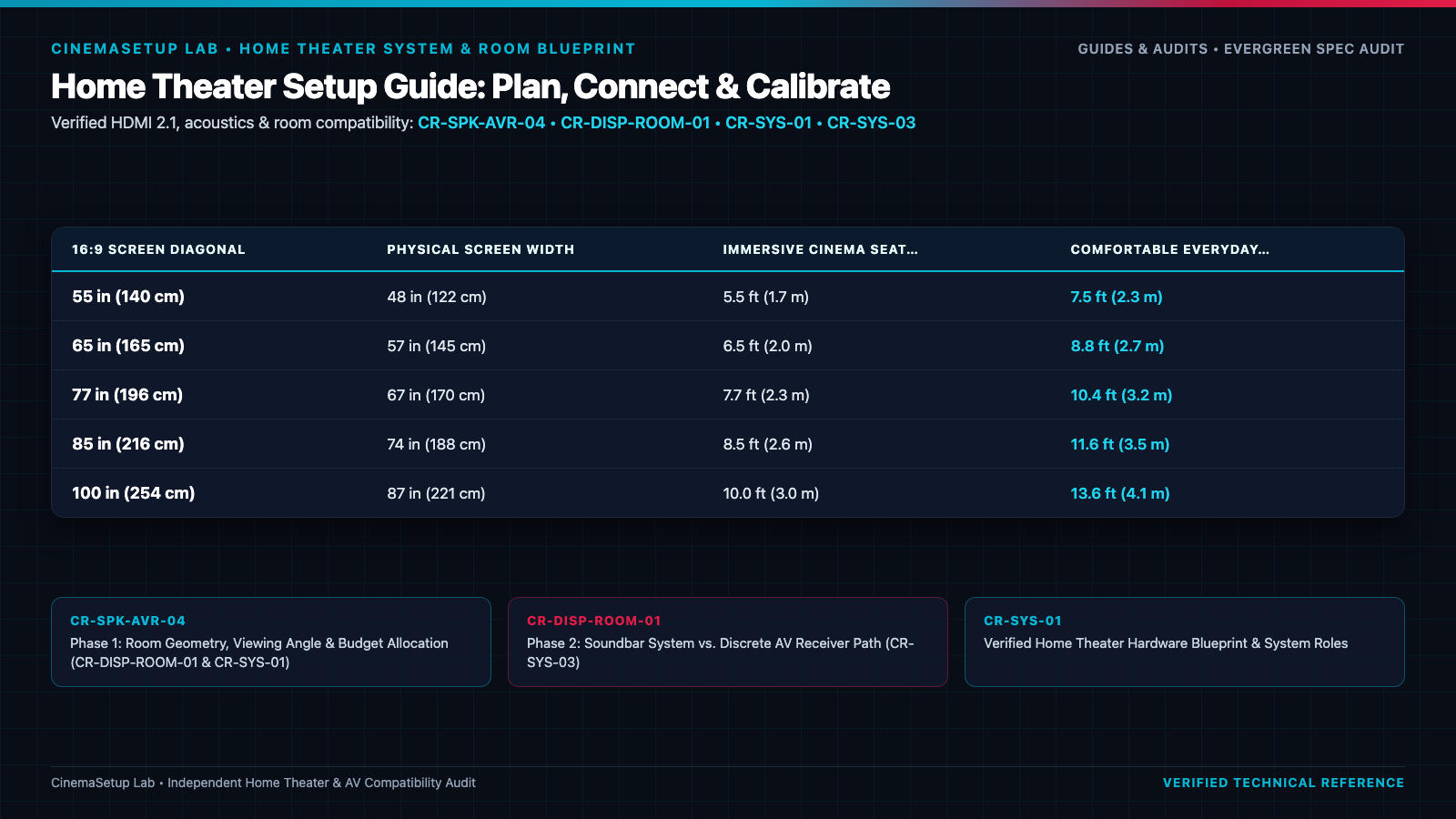
Under CinemaSetup Lab compatibility rule CR-DISP-ROOM-01, a 16:9 television or projection screen works best when your primary seat falls between a 30-degree SMPTE comfortable viewing angle (roughly 1.63 × diagonal) and a 40-degree THX-style immersive cinema angle (roughly 1.20 × diagonal). Sitting farther back than 1.63 × diagonal makes 4K detail difficult to resolve and reduces cinematic immersion—the single most common buyer regret we audit.
| 16:9 Screen Diagonal | Physical Screen Width | Immersive Cinema Seat (40°) | Comfortable Everyday Seat (30°) | Best Room Profile |
|---|---|---|---|---|
| 55 in (140 cm) | 48 in (122 cm) | 5.5 ft (1.7 m) | 7.5 ft (2.3 m) | Small bedroom or apartment den |
| 65 in (165 cm) | 57 in (145 cm) | 6.5 ft (2.0 m) | 8.8 ft (2.7 m) | Compact living room at 7–9 ft |
| 77 in (196 cm) | 67 in (170 cm) | 7.7 ft (2.3 m) | 10.4 ft (3.2 m) | Medium living room at 9–11 ft |
| 85 in (216 cm) | 74 in (188 cm) | 8.5 ft (2.6 m) | 11.6 ft (3.5 m) | Bright great room at 10–12 ft |
| 100 in (254 cm) | 87 in (221 cm) | 10.0 ft (3.0 m) | 13.6 ft (4.1 m) | Controlled-light UST or long-throw room |
| 120 in (305 cm) | 105 in (267 cm) | 12.0 ft (3.7 m) | 16.3 ft (5.0 m) | Dedicated dark home theater |
How to Split Your Audio Budget (CR-SYS-01)
Display hardware sits in its own budget bucket ($500-$1,100 for Value 4K Mini-LED/LED TVs, $1,100-$3,000 for Premium OLEDs like the LG C6 or Samsung S90H, and $3,000+ for Flagship 77-inch to 83-inch panels or dedicated laser projectors). For the audio system alone, compatibility rule CR-SYS-01 requires dedicating at least 50% to 65%+ of your audio budget to speakers and subwoofers and keeping electronics (the AV receiver or processor) at or below 35% to 40%.
| Audio Tier (Display Excluded) | Passive Speakers Share | Subwoofer Share | AVR / Electronics Share | Wire, Cables & Mounts |
|---|---|---|---|---|
| Starter AVR ($300-$800) | 40%–50% | 15%–20% | 35%–40% (entry 5.2 AVR floor) | 5%–10% |
| Core Surround ($1,000-$2,500) | 40%–50% | 15%–20% | 25%–35% (7.2 Atmos AVR) | 5%–8% |
| Enthusiast Atmos ($3,000-$6,000) | 40%–45% | 15%–25% | 25%–35% (9.x / 11.4 AVR) | 5%–8% |
| Reference Room ($7,000+) | 35%–45% | 20%–30% | 25%–35% (flagship AVR / amps) | 5%–8% |
| Soundbar Path (All Tiers) | 75%–90% (Main soundbar + wireless sub kit) | Included inside soundbar | 10%–25% (rears / wall mounts) | |
Note the explicit exception to CR-SYS-01: if you own multiple 4K/120Hz consoles and demand full 40 Gbps switching inside the receiver or need 11-channel processing for a future 7.1.4 expansion, allocating slightly more toward a step-up receiver is justified—just plan your speaker upgrades sequentially rather than shrinking your subwoofer below the room’s cubic-foot requirement. If your target audio budget sits squarely in the Core bracket, inspect our complete home theater setup under $2,500 blueprint for a pre-balanced parts allocation.
Phase 2: Soundbar System vs. Discrete AV Receiver Path
Your first architectural fork is choosing between a soundbar system and an AV receiver (AVR) with discrete passive speakers. Under rule CR-SYS-03, a television outputs HDMI ARC or eARC audio to one audio device at a time—so you must commit to one path as your primary system rather than trying to blend a soundbar and an AVR on the same TV.
Choose a Soundbar Kit If:
- You rent or cannot run speaker wire across doorways, floors, or inside drywall
- Your audio budget sits in the Entry ($100-$300) or Starter ($300-$800) tier where entry AVRs leave too little budget for five passive speakers and a sub
- You want a plug-and-play wireless subwoofer and compact rear satellite kit (like Samsung’s current HW-Q990H or HW-Q990F bundles)
Choose an AV Receiver + Passive Speakers If:
- You want true wide front Left/Right stereo separation and a dedicated center speaker anchored beneath the screen
- You want modular upgradability—swapping the subwoofer, adding in-ceiling Atmos heights, or upgrading the AVR years later without trashing working speakers
- You need 3 to 7 full-bandwidth 40 Gbps HDMI 2.1 inputs, physical 5.1.2/7.1.4 speakers, or multi-sub calibration (Audyssey MultEQ XT32 or Dirac Live)
For a full breakdown of acoustic trade-offs, closed wireless ecosystems, and long-term upgrade cost, read our soundbar vs AV receiver system comparison. Keep rule CR-SYS-05 front and center when evaluating Atmos claims: soundbars without physical upward-firing drivers (or receivers using DSP height virtualization alone) only simulate elevation—true Atmos overhead imaging requires either physical upward-firing drivers bouncing off a flat 7.5–12 ft (2.3–3.7 m) ceiling or physically mounted on-wall/in-ceiling height speakers.
Verified Home Theater Hardware Blueprint & System Roles
The table below maps seven actively stocked Amazon US home theater components across display, soundbar, subwoofer, center-channel, and architectural Atmos speaker roles. For the AV receiver hub itself, pair passive components from this list with an audited US 120V receiver from our best AV receivers roundup—such as a 7.2-channel 5.1.2 unit (Denon AVR-X1800H) or a 9.4-amp / 11.4-processing flagship (Denon AVR-X3900H)—or select one of the verified soundbar systems from our best soundbars guide.
| System Role | Verified Amazon US Pick | Key Compatibility & Package Spec | Budget Tier | Amazon Link |
|---|---|---|---|---|
| Primary 4K OLED Display | Samsung 65″ S90H OLED Bundle (QN65S90HAEXZA) | 4x HDMI 2.1 (up to 4K/165Hz), eARC, HDR10+ (no DV), VESA 300×200 mm; bundle w/ 2x HDMI cables & 1-yr CPS plan | $1,100-$3,000 | View on Amazon |
| Complete 11.1.4 Soundbar Kit | Samsung HW-Q990F 11.1.4 System Bundle | 23 drivers (bar + wireless sub + wireless rears), 2x HDMI 2.1 4K/120Hz in + eARC out, TrueHD & DTS:X; 2-yr Amber plan | $1,000-$2,500 | View on Amazon |
| Compact Living-Room Bar | Bose Smart Dolby Atmos Soundbar | 3.0.2 (5 drivers w/ 2 up-firing), eARC + optical, 0 HDMI inputs; standalone bar only (sub/rears separate) | $300-$800 | View on Amazon |
| Powered AVR Subwoofer | Dayton Audio Classic CS1000 (10-in, Black) | 10-in ported driver, 180 W RMS Class-D, 28–200 Hz, LFE/RCA & speaker-level in; single powered unit | $300-$800 | View on Amazon |
| Compact Center Channel | Blackstone TL1 Center Channel Speaker | 8 ohms, 89 dB sensitivity, 95 Hz–22 kHz, rear port, 4.0 in tall; sold as single speaker (each) | $100-$300 | View on Amazon |
| Atmos In-Ceiling Heights | Dayton Audio CC65W 6.5″ Speaker Pair | 8 ohms, 50 W RMS, 3-1/8 in (8.0 cm) mounting depth, 7-3/4 in (19.7 cm) cutout; sold as pair (2 speakers) | $100-$300 | View on Amazon |
| 5-Pack Ceiling Array | Acoustic Audio CS-IC83 8″ 5-Speaker Set | 8 ohms, 95 dB, 40 Hz–20 kHz, 3.78 in (9.6 cm) depth, 9.45 in (24.0 cm) cutout; sold as 5-speaker pack | $100-$300 | View on Amazon |
Phase 3: Component Matching & IF-THEN Compatibility Proof Box
A home theater only behaves as a unified system when every electrical, acoustic, and physical interface passes cross-component verification. Below is the structured IF -> THEN audit matrix that prevents hardware mismatches before checkout.
Compatibility Proof Box (CR-* Rules Verified):
- CR-SPK-AVR-04 & CR-SPK-AVR-05 (Channel Parity): IF your target layout is
5.1.2(5 ear-level + 1 sub + 2 heights), THEN a 7.2-channel AVR handles both processing and amplification natively (see our 5.1.2 living-room setup blueprint). IF you plan7.1.4(11 speakers + sub), THEN you must buy an 11-channel-processing AVR (such as the Denon AVR-X3900H) plus an external 2-channel power amp on its pre-outs, because 9-amp receivers cannot power 11 speakers alone. - CR-SPK-AVR-01 & CR-SPK-AVR-03 (Impedance & Power Basis): IF you connect 4-ohm speakers to an AVR rated for 6 or 8 ohms minimum, THEN enable the receiver’s 4-ohm impedance setting and enforce full cabinet ventilation clearance (CR-AVR-ROOM-01). Always compare AVR output strictly at 8 ohms, 20 Hz–20 kHz, 2 channels driven—never compare 1-channel 6-ohm peak marketing numbers.
- CR-SPK-AVR-02 (Power & Sensitivity Estimate): Using a conservative ~30% multichannel derating on an 80 W/ch 8-ohm AVR (~56 W available per active channel), an 89 dB sensitivity speaker like the Blackstone TL1 at 10 ft (3.0 m) achieves comfortable 95 dB living-room peaks cleanly by spec-based estimation, whereas low-sensitivity 84 dB speakers at 13 ft (4.0 m) need higher-output amplification to approach cinema reference peaks.
- CR-SPK-SPK-01 (Center Timbre Matching): IF your front Left/Right speakers use a specific tweeter material or horn waveguide, THEN select the matching center channel from the same manufacturer series so voices do not shift tone during across-screen pans. Keep L/C/R tweeters near seated ear height whenever possible; reserve in-ceiling packs like the Acoustic Audio CS-IC83 only for height channels or constrained rooms where ear-level cabinets are prohibited.
- CR-SUB-AVR-01 & CR-SUB-ROOM-01/03 (Subwoofer Sizing): IF using an AVR’s line-level LFE pre-out, THEN you must use a powered subwoofer (such as the active Dayton Audio CS1000), never a passive car or raw theater sub. Size one 10-inch to 12-inch sub for rooms under 1,500 cu ft (42 m³), one 12-inch or dual 10-inch subs for 1,500–3,000 cu ft (42–85 m³), and dual 12-inch to 16-inch subs above 3,000 cu ft (85 m³). In apartments with shared walls, favor sealed enclosures, decoupling pads, and AVR night/dynamic-range compression—while remembering no isolation pad eliminates structural bass transfer next door.
- CR-SPK-ROOM-01 & CR-SPK-ROOM-03 (Height Speakers): IF your ceiling is vaulted, sloped, or acoustically deadened, THEN skip reflective up-firing modules and install on-wall heights or in-ceiling speakers like the Dayton Audio CC65W (confirming at least 3-1/8 in / 8.0 cm of clear joist cavity depth and landlord/owner permission before cutting drywall).
- CR-SUB-SBAR-01 & CR-SBAR-SPK-01 (Closed Soundbar Lock): IF you buy a soundbar, THEN subwoofers and rear surrounds cannot be mixed across brands—expansion is locked strictly to the manufacturer’s official compatible wireless models.
Phase 4: HDMI 2.1 Bandwidth, eARC & HDR Port Planning
Video and audio drop-outs usually trace back to a single bottlenecked link in the HDMI chain. Under CR-SRC-AVR-01 and CR-DISP-AVR-02, a signal feature reaches your eyes and ears only if every hop—source, cable, AVR or soundbar port, and TV input—supports it end to end.
| Signal Requirement | Recommended Routing Path | Critical Port & Cable Rule | Fallback Behavior If Mismatched |
|---|---|---|---|
| 4K/120Hz + VRR Gaming (PS5 / Xbox Series X / PC) | Console → TV 4K/120Hz port → eARC to AVR/Soundbar (or direct into 40 Gbps AVR/HW-Q990F HDMI 2.1 input) | 40/48 Gbps HDMI 2.1 on every hop + Ultra High Speed HDMI Certified (48 Gbps) cable (CR-ACC-DISP-01) | 24 Gbps ports force 4:2:0 chroma or DSC; HDMI 2.0 caps at 4K/60Hz |
| Lossless 4K Blu-ray Audio (Dolby TrueHD Atmos / DTS:X) | Player → AVR/Soundbar HDMI In (safest), OR Player → TV → eARC | Both TV and audio hub must enable HDMI eARC (CR-DISP-AVR-01); verify TV DTS passthrough if playing DTS discs | Plain ARC drops TrueHD Atmos to compressed DD+ or core 5.1; optical drops Atmos completely |
| Streaming Apps (Netflix / Disney+ / Apple TV 4K) | TV native apps or streamer → ARC/eARC to AVR/Soundbar | DD+ Atmos passes over both ARC and eARC; Apple TV 4K sends Dolby MAT LPCM requiring eARC | Verify HDCP 2.3 end-to-end on pre-owned receivers (CR-SRC-AVR-02) |
| Dynamic HDR (Dolby Vision vs. HDR10+) | Match source + AVR passthrough + TV HDR format | LG C6 supports Dolby Vision (no HDR10+); Samsung S90H supports HDR10+ (no Dolby Vision) (CR-SRC-DISP-01) | Content plays safely in static HDR10 rather than breaking video |
Because the TV’s dedicated eARC jack often sits on one of its high-bandwidth HDMI 2.1 inputs, connecting a receiver or soundbar consumes one gaming port on two-port TVs. Display families with four full-bandwidth HDMI 2.1 ports—such as the LG C6 OLED or Samsung S90H OLED—leave three 4K/120Hz+ ports free even after dedicating eARC. For step-by-step wiring diagrams covering two consoles, a 4K Blu-ray player, and eARC lip-sync settings, consult our dedicated HDMI eARC and 4K120 port planning guide.
Phase 5: Mounting, CL2/CL3 Wiring Safety & Calibration Checklist
Installation, Structural & Electrical Safety Notice (G-27 / CR-DISP-ACC-02 / CR-ACC-SPK-02):
- Manufacturer-Instruction-First Mounting: Always follow the TV, projector, and mount manufacturer’s printed instructions. Confirm exact VESA hole spacing (for example,
300 x 200 mmon the 65-inch Samsung S90H) and panel weight without stand (42.1 lb / 19.1 kg) against the bracket’s UL-listed load rating. Anchor lag bolts strictly into wood studs, metal studs with rated toggles, or solid masonry—never hang heavy displays or ceiling mounts from unreinforced drywall. - In-Wall & In-Ceiling Fire Codes: Any speaker wire routed inside wall cavities or ceiling joists must carry a UL CL2 or CL3 (or local building-code equivalent) jacket rating (CR-ACC-SPK-02). Never run standard unrated TV power cords behind drywall; install a recessed code-compliant power relocation kit or hire a licensed electrician for new AC outlets.
- Drywall & Lifting Precautions: Before cutting holes for in-ceiling speakers, scan joist bays for electrical Romex, HVAC ducts, and plumbing lines, and confirm clear depth (3-1/8 in / 8.0 cm minimum for the Dayton CC65W). Use two people when lifting large 65-inch+ OLEDs or heavy 30+ lb subwoofers, or hire a licensed AV installer for overhead projection and ceiling cutouts.
- Comfortable Listening: Keep master volume at a comfortable level during extended movie sessions and take breaks if listening loudly; avoid unverified acoustic isolation promises in multi-unit buildings.
Speaker Wire Gauge & Cable Length Rules (CR-ACC-SPK-01)
Choose pure oxygen-free copper (OFC) rather than copper-clad aluminum (CCA), which exhibits higher resistance and brittleness at terminal screws. To keep round-trip cable resistance below ~5% of nominal speaker impedance, follow these one-way distance limits:
| Pure Copper (OFC) Gauge | Max One-Way Run (8-Ohm Speakers) | Max One-Way Run (6-Ohm Speakers) | Max One-Way Run (4-Ohm Speakers) |
|---|---|---|---|
| 16 AWG | Up to 50 ft (15.2 m) | Up to 37 ft (11.3 m) | Up to 25 ft (7.6 m) |
| 14 AWG (Recommended Baseline) | Up to 79 ft (24.1 m) | Up to 59 ft (18.0 m) | Up to 40 ft (12.2 m) |
| 12 AWG (Long In-Wall / 4-Ohm Runs) | Up to 126 ft (38.4 m) | Up to 94 ft (28.7 m) | Up to 63 ft (19.2 m) |
For HDMI 2.1 48 Gbps links exceeding 10 ft (3.0 m)—such as running from an equipment rack to a wall-mounted TV or ceiling projector—step up to an active optical (fiber) Ultra High Speed HDMI cable and verify its directional Source and Display plugs before closing walls.
5-Step Post-Wiring Calibration Sequence
- Verify Polarity & Subwoofer Knobs: Double-check positive-to-positive (+) and negative-to-negative (-) copper connections across every speaker terminal. On the powered subwoofer, set the low-pass crossover knob to its maximum/LFE bypass setting and phase to
0°so the AVR manages bass cleanly. - Run Multipoint Room Correction: Place the AVR’s supplied calibration microphone at ear height on a tripod across 6–8 listening positions around the main sofa and run Audyssey, Dirac Live, or YPAO using automated level-calibration tones. For soundbars, run room calibration such as Samsung SpaceFit Sound Pro Plus from the app.
- Set All Speakers to “Small” & Verify Crossovers (CR-SUB-SPK-01): Even if an automated routine flags tower or bookshelf speakers as “Large,” switch them to Small with an 80 Hz crossover so your powered subwoofer handles deep low-frequency energy. For compact satellites with higher roll-off (such as the Blackstone TL1 rated down to 95 Hz), raise the crossover to 100–120 Hz to prevent an upper-bass gap.
- Configure Digital Output & Lip-Sync (CR-SYS-04): Set your TV’s HDMI audio output to Pass-Through / Auto (not forced PCM stereo) and turn on eARC. If actor dialogue trails mouth movement slightly, enable AV Auto Lip-Sync or dial in subtle audio delay inside the receiver or soundbar menu.
- Select Filmmaker / Movie Picture Mode: Disable aggressive motion smoothing and dynamic contrast enhancements on your TV, and enable Game Mode / ALLM strictly on console inputs.
Verified Amazon US Equipment Audits (7 Core Roles)
Every component profiled below comes from verified US 120V Amazon listings checked against official manufacturer spec sheets as of 2026-11-26. Always verify the Sold by line at checkout—most brands require purchase from an authorized US dealer to honor factory warranties (G-26).
1. Samsung 65-Inch S90H 4K OLED TV Bundle (QN65S90HAEXZA) — Primary Living-Room Display

Key Specs & Bundle Contents: 65-inch class (64.5 in / 163.8 cm actual diagonal) 4K OLED panel | Up to 165 Hz refresh rate with HDMI VRR, FreeSync Premium Pro & G-SYNC Compatible | 4x HDMI 2.1 inputs + eARC | HDR10+, HDR10, HLG (no Dolby Vision) | VESA 300 x 200 mm | 56.9 x 32.7 x 1.6 in (144.5 x 83.1 x 4.1 cm), 42.1 lb (19.1 kg) without stand | In the Box: QN65S90HAEXZA 65-in TV, 2x HDMI cables, TV setup guide, 1-year CPS enhanced protection pack | Price Tier: $1,100-$3,000
Replacing the older S90D generation, Samsung’s 2026 QN65S90HAEXZA OLED solves two headaches for living-room builders: glare rejection and HDMI 2.1 port scarcity. Its matte anti-glare finish reduces daytime window reflections compared with glossy OLEDs, while four full-bandwidth HDMI 2.1 ports up to 4K/165Hz leave three open high-speed inputs even after connecting an AVR or soundbar to eARC (CR-DISP-AVR-02). At a 7–9 ft (2.1–2.7 m) seating distance, a 65-inch diagonal lands squarely inside the 30°–40° cinema sweet spot (CR-DISP-ROOM-01). Note that Samsung TVs omit Dolby Vision and play Dolby Vision discs or streams in HDR10 (CR-SRC-DISP-01).
Marketplace & Warranty Check (G-26 / G-29): This listing is a third-party retailer bundle (Deco Essentials) bundling two HDMI cables and a 1-year CPS protection pack alongside the TV. Confirm authorized Samsung US warranty eligibility on the checkout seller line, and inspect OLED panel-uniformity and static-HUD burn-in terms before mounting.
Pros
- Four full HDMI 2.1 ports eliminate eARC port-sharing bottlenecks with multiple 4K/120Hz+ consoles
- Matte anti-reflection screen handles mixed evening and daytime rooms cleanly
- Self-emissive pixel contrast with Q-Symphony sync option for compatible Samsung soundbars
Cons
- No Dolby Vision HDR support; falls back to HDR10 on DV-only streaming masters
- Third-party bundle includes generic HDMI cables—verify 48 Gbps Ultra High Speed hologram certification before relying on them for 4K/120Hz
2. Samsung HW-Q990F Q-Series 11.1.4 Soundbar System Bundle — Wire-Free Surround Kit
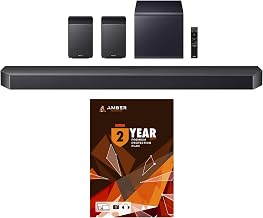
Key Specs & Bundle Contents: 11.1.4 claimed channels (23 total physical drivers across bar, sub, and rears) | 2x HDMI 2.1 inputs (4K/120Hz passthrough) + 1x HDMI eARC out + optical in | Decodes Dolby Atmos, Dolby TrueHD, DTS:X, DTS-HD MA | SpaceFit Sound Pro Plus calibration | In the Box: Main soundbar, wireless subwoofer, wireless rear speaker pair, 2-year Amber Protection Plan | Price Tier: $1,000-$2,500
When running rear speaker wires across a living room is impossible, Samsung’s Q990 series (headed by the 2026 HW-Q990H and this actively stocked 2025 HW-Q990F bundle) delivers genuine discrete rear and upward-firing drivers straight out of one box. Unlike single-bar designs that rely heavily on DSP virtualization, the HW-Q990F pairs physical rear satellite speakers with up-firing height drivers on both the front bar and rear surrounds, plus dual HDMI 2.1 inputs capable of passing 4K/120Hz gaming signals directly into the bar. Note that in very open rooms lacking nearby side walls or flat 7.5–12 ft ceilings, reflected side and height channels soften (CR-SBAR-ROOM-01).
US Model Verification Alert (CR-SYS-02): Confirm at checkout that you are purchasing a US 120V Samsung listing rather than a Canadian /ZC grey-market liquidation unit, which can lack US warranty support. Also review the included 2-year Amber Protection Plan terms and confirm seller authorization as of 2026-11-26.
Pros
- Complete 11.1.4 hardware bundle includes physical wireless rear speakers and wireless subwoofer—no separate add-on purchases required
- Two HDMI 2.1 inputs pass 4K/120Hz VRR alongside full Dolby TrueHD and DTS:X decoding
Cons
- Closed ecosystem: you cannot swap in third-party passive speakers or wired subwoofers later (CR-SUB-SBAR-01)
- Rear speakers still require AC wall outlets behind or beside your couch
3. Bose Smart Dolby Atmos Soundbar — Compact Apartment & Bedroom Bar

Key Specs & Package Contents: 3.0.2 driver array (5 transducers including 2 upward-firing height drivers) | 1x HDMI eARC port + optical input (0 HDMI passthrough inputs) | 27.3 x 4.1 x 2.2 in (69.4 x 10.4 x 5.6 cm) | A.I. Dialogue Mode & TrueSpace processing | In the Box: Standalone soundbar only (wireless Bose Bass Module and rear speakers sold separately) | Price Tier: $300-$800
For compact 10 ft by 12 ft bedrooms or shared-wall apartments where a dedicated subwoofer would rattle neighbors, the 27.3-inch (69.4 cm) Bose Smart Dolby Atmos Soundbar clears low-slung TV stands cleanly at just 2.2 in (5.6 cm) tall (CR-SBAR-DISP-05). Its two physical upward-firing transducers add vertical overhead presence off flat 8–10 ft ceilings while A.I. Dialogue Mode keeps speech legible at moderate evening volumes. Because the bar provides zero HDMI passthrough inputs, plug all game consoles and 4K players directly into your TV and route audio back via HDMI eARC (CR-SBAR-SRC-01).
Pros
- Slim 2.2-inch height avoids blocking IR sensors or the bottom bezel of most 55-inch and 65-inch TVs
- Physical upward-firing height drivers plus crisp center-channel dialogue clarity
Cons
- Standalone bar lacks deep sub-bass extension and rear surrounds; adding Bose modules later pushes cost sharply higher
- No HDMI passthrough inputs—relies entirely on your TV’s eARC port and audio passthrough capabilities
4. Dayton Audio Classic CS1000 10-Inch 180W Powered Subwoofer — Core AVR Bass

Key Specs & Package Contents: 10-inch mineral-filled poly/paper driver | Ported bass-reflex enclosure | 180 W RMS Class-D amplifier | Manufacturer rated frequency response: 28 Hz–200 Hz (tolerance not published) | 13.5 x 16.0 x 14.4 in (34.2 x 40.6 x 36.5 cm), 29.3 lb (13.3 kg) | LFE, stereo RCA, and speaker-level inputs; 0°/180° phase | In the Box: Single powered subwoofer (each) | Price Tier: $300-$800
Every AVR-based home theater requires a self-powered subwoofer to receive the receiver’s line-level LFE pre-out (CR-SUB-AVR-01). The Dayton Audio Classic CS1000 delivers a practical 10-inch ported footprint and 180 W RMS Class-D amplifier sized comfortably for bedrooms, dens, and compact living rooms under 2,000 cu ft (57 m³) per CR-SUB-ROOM-01. For larger open-plan family rooms exceeding 3,000 cu ft (85 m³), plan on running two identical units (where your AVR supports dual outputs per CR-SUB-AVR-02) or stepping up to a 12-inch to 15-inch dedicated theater subwoofer. Note that third-party CEA-2010 groundplane SPL data has no verified data available yet for this SKU.
Pros
- Dedicated LFE input, variable 40–160 Hz crossover, and 0°/180° phase switch simplify AVR integration
- Compact 13.5-inch cabinet width tucks cleanly beside TV consoles without dominating floor space
Cons
- 28 Hz rated floor lacks deep sub-20 Hz infrasonic output for large dedicated cinema rooms
- Ported cabinet needs rear clearance and is less neighbor-friendly in thin-walled apartments than a sealed sub
5. Blackstone TL1 Center Channel Speaker — Ultra-Compact Dialogue Anchor

Key Specs & Package Contents: 8-ohm nominal impedance | 89 dB sensitivity (maker rating; basis not stated on retail spec sheet) | 95 Hz–22 kHz frequency response | Dual 2.5-in mid-woofers + 0.5-in silk dome tweeter | 15.0 x 4.0 x 3.5 in (38.1 x 10.2 x 8.9 cm), 3.35 lb (1.52 kg) | Rear aperiodic port | In the Box: Single center speaker (each) | Price Tier: $100-$300
A dedicated center speaker anchors movie dialogue directly to the screen across wide couches. Sold strictly as a single speaker (each), the 4.0-inch-tall (10.2 cm) Blackstone TL1 Center Channel fits inside tight media shelves or directly beneath a wall-mounted TV without crowding the picture. Its benign 8-ohm nominal load pairs safely with every entry 5.2 and 7.2 AV receiver without requiring a 4-ohm impedance switch. Under CR-SPK-SPK-01 and CR-SUB-SPK-01, pair it with matching Blackstone TL satellites for smooth front panning and set your AVR crossover to 100–120 Hz so your subwoofer covers everything below 95 Hz.
Pros
- Low 4.0-inch profile fits shallow console cubbies and narrow stand gaps under 65-inch TVs
- Easy 8-ohm impedance load puts zero thermal stress on entry-level 7.2 AVRs
Cons
- 95 Hz low-end roll-off makes a powered subwoofer mandatory—cannot run full-range without a subwoofer
- Small 2.5-inch drivers limit maximum dynamic output compared with full-size 5.25-inch or 6.5-inch bookshelf center cabinets
6. Dayton Audio CC65W 6-1/2″ In-Ceiling Speaker Pair — Physical Atmos Heights

Key Specs & Package Contents: 8-ohm nominal impedance | 50 W RMS power handling | Sensitivity: no verified manufacturer dB rating published | 6.5-in poly woofer + 0.5-in aimable PEI dome tweeter | 3-1/8 in (8.0 cm) mounting depth, 7-3/4 in (19.7 cm) cutout diameter | In the Box: Pair (2 passive in-ceiling speakers) | Price Tier: $100-$300
Physical overhead speakers outperform ceiling-bounce modules in nearly every permanent room, and this Dayton Audio CC65W pair makes adding two Top Front or Top Middle Dolby Atmos channels straightforward on a budget. Its shallow 3-1/8 in (8.0 cm) mounting depth clears standard 2×4 or 2×6 ceiling joists easily (CR-SPK-ROOM-03), while the aimable 0.5-inch tweeter lets you angle high-frequency detail slightly toward the main couch. Because Dayton Audio omits a published dB sensitivity figure for this contractor line, verify final channel trim using your AVR’s calibration microphone.
Pros
- Sold as a matched pair with shallow 3-1/8 in mounting depth for tight joist cavities
- Aimable tweeter helps direct Atmos overhead effects toward seated listeners
Cons
- Requires cutting ceiling drywall and running UL CL2/CL3 in-ceiling speaker wire—not suitable for renters
- Manufacturer omits sensitivity (dB) spec, preventing pre-purchase CR-SPK-AVR-02 power estimation
7. Acoustic Audio CS-IC83 8″ 3-Way In-Ceiling 5-Speaker Pack — Concealed Multi-Channel

Key Specs & Package Contents: 8-ohm nominal impedance | 95 dB sensitivity (maker rating at 8 ohms) | 40 Hz–20 kHz response | 8-in poly woofer + poly mica midrange + 13 mm soft dome tweeter | 3.78 in (9.6 cm) mounting depth, 9.45 in (24.0 cm) cutout diameter | In the Box: 5 passive in-ceiling speakers (no AVR or wire included) | Price Tier: $100-$300
Sold as a 5-speaker pack, the Acoustic Audio CS-IC83 targets multi-use family rooms or basements where floor-standing towers and wall shelves are completely off-limits. Its high 95 dB rated sensitivity makes it an easy load for entry 8-ohm receivers, and pressure-lock dogleg clamps speed up drywall installation once a 9.45-inch (24.0 cm) cutout is verified clear of joists and wiring. Be honest about acoustic placement trade-offs: placing Front Left, Center, and Right channels in the ceiling pulls dialogue overhead rather than anchoring voices at screen height, so reserve all-ceiling 5.0 layouts strictly for space-restricted rooms or deploy four units from the pack as 5.1.4 Atmos overheads alongside ear-level fronts.
Pros
- High 95 dB sensitivity and 8-ohm impedance pair effortlessly with entry 5.2 and 7.2 AVRs
- Complete 5-speaker pack covers four Atmos overhead heights plus a spare or full concealed 5.0 room
Cons
- Mounting ear-level L/C/R channels in the ceiling compromises vocal localization compared with ear-level speakers
- Large 9.45-inch cutout and 3.78-inch depth require unobstructed joist spacing and CL2/CL3 wiring
Authoritative Standards & Manufacturer References
- HDMI Licensing Administrator — HDMI 2.1a & Ultra High Speed Cable Specification (48 Gbps FRL, eARC lossless audio, VRR, and ALLM standards).
- Dolby Laboratories — Home Theater Speaker Setup Guides (5.1.2, 5.1.4, and 7.1.4 speaker angles and up-firing ceiling height parameters).
- Samsung US Official Support & Specifications (QN65S90HAEXZA S90H OLED ports/VESA specs and HW-Q990 series HDMI/eARC specifications).
- Dayton Audio Official Specifications (Classic CS1000 powered subwoofer and CC65W in-ceiling mounting cutout dimensions).
- Bose US Official Product Documentation (Bose Smart Soundbar driver topology, eARC, optical, and ecosystem expansion specs).
How We Audited This Guide
- Room setups, upgrade roadmaps, and Amazon marketplace audits enforce system-wide CR-* budgets and acoustics, Canadian /ZC grey-market alerts, pair-vs-single speaker clarity, and manufacturer-first mounting safety.
- Every AV receiver, speaker, subwoofer, soundbar, OLED/Mini-LED TV, projector, source player, and accessory spec was cross-checked against official manufacturer manuals, CEA/CTA standards, and live Amazon US listings.
- Recommendations were evaluated against our weighted vertical scoring rubrics and documented CR-* compatibility rules; we never invent nits, contrast ratios, bench wattage, or room decibels.
Frequently Asked Questions
How far should I sit from a 65-inch or 77-inch home theater TV?
Follow the 30-to-40-degree viewing band under CR-DISP-ROOM-01: multiply screen diagonal by 1.20 for immersive cinema seating or 1.63 for comfortable everyday viewing. That places a 65-inch TV at 6.5–8.8 ft (2.0–2.7 m) and a 77-inch TV at 7.7–10.4 ft (2.3–3.2 m).
How should I split my home theater audio budget between speakers and the receiver?
Allocate at least 50% to 65% of your audio budget to passive speakers and powered subwoofers, keeping the AV receiver at 25%–35% in Core/Enthusiast setups (or 35%–40% in Starter AVR builds) and reserving 5%–10% for CL2/CL3 wire, HDMI cables, and stands.
Can I connect both a soundbar and an AV receiver to the same TV?
No—under rule CR-SYS-03, a television sends ARC or eARC audio to one primary audio system at a time. Trying to run both simultaneously triggers HDMI-CEC switching conflicts and cuts audio from one system, so pick either a soundbar kit or an AVR.
What is the difference between HDMI ARC and eARC for home theater audio?
Standard ARC transmits compressed Dolby Digital Plus Atmos from streaming apps and stereo PCM. HDMI eARC adds full-bandwidth lossless audio return, passing Dolby TrueHD Atmos, DTS-HD Master Audio, and 5.1/7.1 multichannel LPCM from TV-connected consoles and 4K Blu-ray players.
Do I need an external amplifier for a 7.1.4 Dolby Atmos home theater?
If you buy a 9-channel receiver with 11.4 processing—such as the Denon AVR-X3900H—it powers 5.1.4 natively out of the box and requires adding a separate 2-channel external power amplifier to its pre-outs to drive all 11 speakers in 7.1.4.
What speaker wire rating is required inside walls or ceilings?
In-wall and in-ceiling speaker runs require UL-listed CL2 or CL3 pure oxygen-free copper (OFC) cable per local electrical codes, using 14 AWG up to 79 ft (24.1 m) or 12 AWG for longer 4-ohm runs. Consult a licensed installer or electrician before modifying walls.


