
Disclosure: As an Amazon Associate, I earn from qualifying purchases. If you buy through links on this page, we may earn a small commission at no extra cost to you. Commission rates never influence our technical audits, scores, or rankings.
Finding the best soundbar for a living room or bedroom theater requires cutting past inflated channel badges and total-wattage claims. Retail listings regularly slap “Dolby Atmos” and “1000W” across bars that contain zero physical up-firing drivers, omit wireless rear speakers from the box, or cap HDMI inputs at 4K/60Hz when modern gaming consoles demand 4K/120Hz.
To bring clarity to those engineering trade-offs, we audited eight actively stocked US 120V soundbar systems across Amazon US—spanning compact entry units under $300 to flagship 11.1.4-channel kits with physical overhead and rear speakers. Every pick below is verified against official manufacturer datasheets for real transducer counts, HDMI eARC and optical connectivity, lossless Dolby TrueHD and DTS:X support, closed subwoofer ecosystems, and TV stand height clearance so you can decide cleanly between a streamlined soundbar vs AV receiver system or pair your bar with the best TVs for home theater.
In This Guide
- Quick Picks: Top 3 Best Soundbar Winners
- Best Soundbar Side-by-Side Specs Comparison
- Match Your Room, TV & Seating Layout
- Detailed Soundbar Audits (1–8): 1. Sonos Arc Ultra · 2. Samsung HW-Q990F · 3. JBL Bar 1000MK2 · 4. Bose Smart Ultra · 5. Samsung HW-Q800H · 6. Sony BRAVIA Theater System 6 · 7. Sonos Beam (Gen 2) · 8. Ultimea Poseidon M60
- Best Soundbar Buying Guide & Upgrade Roadmap
- 100% Weighted Audit Rubric & Excluded Models
- Frequently Asked Questions
- Final Verdict
Quick Picks: Top 3 Best Soundbar Winners
#1 Best Overall Standalone
Sonos Arc Ultra
Fourteen drivers, physical up-firing tweeters, and a Sound Motion woofer bring strong standalone Atmos immersion with modular Sub 4 and Era 300 expansion. Jump to audit ↓
#2 Best Complete Surround Kit
Samsung HW-Q990F
Bundles bar, compact wireless sub, up-firing wireless rears, DTS:X decoding, and two 4K/120Hz HDMI 2.1 ports in one box. Jump to audit ↓
#3 Best Compact Under $500
Sonos Beam (Gen 2)
Fits tight 25.63-inch TV stands cleanly with HDMI eARC, included optical adapter, Trueplay room tuning, and late-night dialogue modes. Jump to audit ↓
Best Soundbar Side-by-Side Specs Comparison
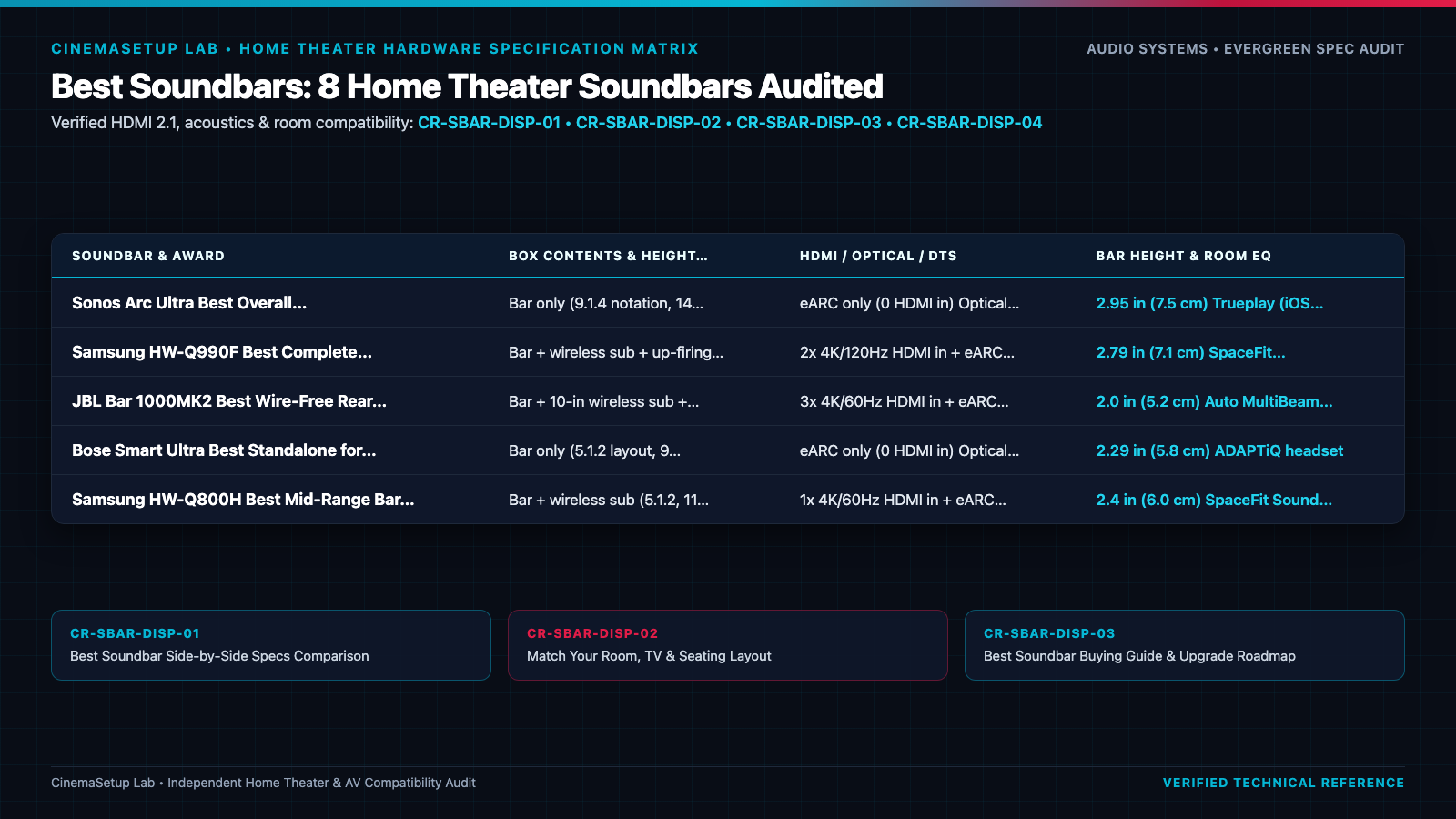
Notice what we intentionally leave out of the comparison matrix below: unstandardized “total system watts” claims. As our engineering guidelines explain, marketing wattage sums cannot predict room loudness or vocal clarity. Instead, compare physical up-firing drivers versus height virtualization, included box contents (subwoofer and rear speakers), HDMI input passthrough limits, and DTS:X support before choosing your system.
| Soundbar & Award | Box Contents & Height Method | HDMI / Optical / DTS | Bar Height & Room EQ | Link |
|---|---|---|---|---|
| Sonos Arc Ultra Best Overall Standalone | Bar only (9.1.4 notation, 14 drivers) Physical up-firing tweeters | eARC only (0 HDMI in) Optical adapter separate · DTS 5.1 | 2.95 in (7.5 cm) Trueplay (iOS & Android) | View on Amazon |
| Samsung HW-Q990F Best Complete Surround Kit | Bar + wireless sub + up-firing rears (11.1.4) Physical up-firing front & rear | 2x 4K/120Hz HDMI in + eARC Optical in · Full DTS:X | 2.79 in (7.1 cm) SpaceFit Sound Pro | View on Amazon |
| JBL Bar 1000MK2 Best Wire-Free Rear Kit | Bar + 10-in wireless sub + battery rears (7.1.4) Physical up-firing drivers | 3x 4K/60Hz HDMI in + eARC Optical in · Full DTS:X | 2.0 in (5.2 cm) Auto MultiBeam calibration | View on Amazon |
| Bose Smart Ultra Best Standalone for Dialogue | Bar only (5.1.2 layout, 9 speakers) Physical up-firing dipoles | eARC only (0 HDMI in) Optical cable incl. · No DTS | 2.29 in (5.8 cm) ADAPTiQ headset | View on Amazon |
| Samsung HW-Q800H Best Mid-Range Bar + Sub | Bar + wireless sub (5.1.2, 11 speakers) Physical up-firing drivers | 1x 4K/60Hz HDMI in + eARC Optical in · No DTS (2026) | 2.4 in (6.0 cm) SpaceFit Sound Pro | View on Amazon |
| Sony BRAVIA System 6 Best Mid-Range Kit w/ Rears | Bar + wired sub + wireless rears (5.1) Height virtualization only | eARC only (0 HDMI in) Optical & 3.5 mm · Full DTS:X | 2.6 in (6.4 cm) BRAVIA Connect app EQ | View on Amazon |
| Sonos Beam (Gen 2) Best Compact Under $500 | Bar only (5.0 layout, 5 drivers) Height virtualization only | eARC only (0 HDMI in) Optical adapter incl. · DTS 5.1 | 2.70 in (6.9 cm) Trueplay (iOS) | View on Amazon |
| Ultimea Poseidon M60 Best Entry Budget Under $300 | Bar + wired 5.25-in sub (5.1, no rears) Height virtualization only | eARC only (0 HDMI in) Optical & USB · No DTS:X | 2.75 in (7.0 cm) 10-band App EQ | View on Amazon |
Match Your Room, TV & Seating Layout
Before ordering a bar, verify three room constraints: whether you have a flat ceiling 7.5–12 ft (2.3–3.7 m) high for overhead reflections, whether your sofa sits in an open floor plan that requires real rear speakers, and whether your TV stand has enough vertical clearance beneath the lower bezel. For narrower budgets or pure surround bundles, pair this matrix with our best soundbars under $1,000, best Dolby Atmos soundbars, and best soundbar kits with subwoofer and rear speakers audits.
| Buyer Scenario & Room Profile | Best Match | Why & Expected Outcome |
|---|---|---|
| Clean living room without floor sub clutter (expandable later) | Sonos Arc Ultra | Sound Motion bass driver handles standalone movie impact cleanly while leaving open a modular path to Sub 4 and Era 300 rears. |
| Dedicated movie room + PS5 / Xbox Series X 4K/120Hz | Samsung HW-Q990F | Full 11.1.4 hardware kit with DTS:X and two 4K/120Hz HDMI 2.1 inputs handles discs, streams, and consoles out of the box. |
| Open-plan living room with no rear AC wall outlets | JBL Bar 1000MK2 | Battery-powered detachable rears deliver real behind-the-sofa surround without trailing rear power cords across the floor. |
| Low-clearance TV stand focused on clear dialogue & news | Bose Smart Ultra | 2.29 in (5.8 cm) chassis slides beneath low TV pedestals while A.I. Dialogue Mode lifts spoken voices over background music. |
| Mid-range open room wanting real rear speakers under $800 | Sony BRAVIA Theater System 6 | Includes discrete wireless rear satellites, a heavy wired subwoofer, and DTS:X support at roughly half the flagship kit price. |
| Bedroom or small apartment under $500 with shared walls | Sonos Beam (Gen 2) | Compact 25.63 in (65.1 cm) width fits small consoles and pairs Speech Enhancement with Night Sound for neighbor-friendly viewing. |
Detailed Home Theater Soundbar Audits (1–8)
1. Sonos Arc Ultra Soundbar — Best Overall Standalone Dolby Atmos Soundbar

Key Specs: Maker notation: 9.1.4 | 14 drivers (7 tweeters incl. 2 up-firing, 6 midwoofers, 1 Sound Motion woofer), 15 Class-D amps | Box contents: standalone bar, power cord, HDMI cable (sub & rears sold separately) | 1x HDMI eARC/ARC (0 HDMI in; optical adapter sold separately) | Decodes Dolby Atmos (DD+, TrueHD), Multichannel PCM, DTS Digital Surround (no DTS:X) | Trueplay (iOS & Android Quick Tune) | 46.38 x 2.95 x 4.35 in (117.8 x 7.5 x 11.1 cm), 13.0 lb (5.9 kg) | Price Tier: $800-$1,100 (Launch MSRP around $999)
Audit Score: 9.3 / 10
- Cited Audio Performance & Driver Layout (30%): 9.4 / 10
- TV Integration & Connectivity (20%): 8.6 / 10
- Expandability & Ecosystem (15%): 9.5 / 10
- Room Adaptability & Clearance (15%): 9.3 / 10
- App, Firmware & Reliability (10%): 8.7 / 10
- Value Within Tier (10%): 9.2 / 10
Most single-piece soundbars struggle to sound authoritative without a separate box on the floor, because tiny oval woofers simply cannot displace enough air. Per Sonos US official specifications, the Sonos Arc Ultra addresses that physics bottleneck with a four-motor, dual-membrane Sound Motion woofer alongside 13 dedicated drivers—seven silk-dome tweeters (two angled upward as physical up-firing drivers) and six midwoofers driven by 15 Class-D amplifiers. In a living room with flat 8-to-10-foot ceilings, it delivers notably stronger low-end weight and cleaner center speech separation than the superseded original Arc while dropping chassis height to 2.95 in (7.5 cm) to improve TV stand clearance.
Compared against the Bose Smart Ultra, the Arc Ultra offers deeper standalone bass and broader multi-room music integration, plus Quick Tune Trueplay calibration now works on Android phones as well as iOS. Still, buyers must weigh three real engineering limits: it includes zero HDMI passthrough inputs (consoles must connect to your TV first and return audio over HDMI eARC per CR-SBAR-SRC-01), it decodes lossy DTS Digital Surround rather than lossless DTS:X, and Sonos’s May 2024 app overhaul drew widespread connectivity complaints before subsequent firmware and app patches mitigated most issues (ISS-SBAR-SONOS-APP-2024). When expanding later, closed ecosystem rules (CR-SUB-SBAR-01, CR-SBAR-SPK-01) limit you strictly to Sonos Sub 4 or Sub Mini and Era 100 or Era 300 wireless rear speakers.
Buyer Verification Alert: This listing includes the standalone soundbar only—no subwoofer or rear speakers are in the box. Unlike the Beam Gen 2, the Arc Ultra does not ship with an optical adapter, so confirm your TV has an active HDMI eARC or ARC port before checkout.
Pros
- Sound Motion woofer and 14-driver architecture produce fuller standalone bass than rival single-bar designs
- Physical up-firing drivers project overhead Atmos effects off flat 7.5-12 ft (2.3-3.7 m) ceilings
- Trueplay Quick Tune runs via built-in microphones for both Android and iOS owners
- Clean modular upgrade path to Sonos Sub 4, Sub Mini, and Era 100 or Era 300 surrounds
Cons
- Zero HDMI inputs on the bar; all gaming consoles and 4K disc players depend on TV eARC passthrough
- Does not decode lossless DTS:X or DTS-HD Master Audio tracks from Blu-ray discs
- Adding a Sub 4 and Era 300 rears pushes total system investment far above complete kits like the Samsung HW-Q990F
Verdict: Buy the Sonos Arc Ultra if you want the best soundbar in a single-bar footprint with rich dialogue enhancement and optional modular expansion. Skip it for the Samsung HW-Q990F if you want rear speakers, a subwoofer, DTS:X, and 4K/120Hz HDMI inputs included in one box.
2. Samsung HW-Q990F 11.1.4-Ch Q-Series System — Best Complete Surround Kit
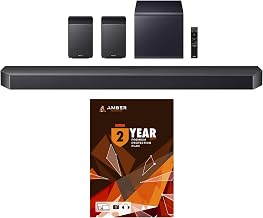
Key Specs: Maker notation: 11.1.4 | 23 total drivers across bar, compact dual-driver wireless sub, and wireless up-firing rears | Box contents: bar, wireless sub, 2 wireless rear speakers, HDMI cable, wall brackets, 2-Year Amber Protection Plan | 2x HDMI 2.1 inputs (4K/120Hz, VRR, ALLM, HDR10+) + 1x HDMI eARC + Optical | Decodes Dolby Atmos (DD+, TrueHD), DTS:X, DTS-HD MA | SpaceFit Sound Pro & Q-Symphony | Bar: 48.5 x 2.79 x 5.43 in (123.2 x 7.1 x 13.8 cm), 16.1 lb (7.3 kg) | Sub: 9.8 x 9.9 x 9.8 in (24.9 x 25.2 x 24.9 cm), 18.3 lb (8.3 kg) | Price Tier: $1,200-$1,800
Audit Score: 9.4 / 10
- Cited Audio Performance & Driver Layout (30%): 9.6 / 10
- TV Integration & Connectivity (20%): 9.6 / 10
- Expandability & Ecosystem (15%): 9.0 / 10
- Room Adaptability & Clearance (15%): 9.0 / 10
- App, Firmware & Reliability (10%): 9.0 / 10
- Value Within Tier (10%): 9.6 / 10
Where standalone bars ask you to spend extra months later on a subwoofer and rear pair, the Samsung HW-Q990F delivers the entire 23-driver home theater rig in one carton. Per Samsung US Q-Series documentation, the package pairs a wide 48.5 in (123.2 cm) main bar—housing front L/C/R, side-firing, wide-firing, and physical up-firing drivers—with a compact cube wireless subwoofer and two AC-powered rear speakers that also feature side and up-firing drivers. Because rear channels come from real speakers placed behind your sofa rather than wall-bounce virtualization, open-plan living rooms get consistent surround localization across multiple seats (CR-SBAR-ROOM-01).
Connectivity is equally thorough. Two full HDMI 2.1 inputs pass 4K/120Hz, VRR, ALLM, and HDR10+ through to your display, which rescues console gamers whose TV shares an HDMI 2.1 port with eARC (CR-SBAR-SRC-01). It also decodes both lossless Dolby TrueHD Atmos and DTS:X / DTS-HD Master Audio, giving 4K Blu-ray collectors full codec coverage that Bose and Samsung’s mid-tier Q800H skip. Note that Q-Symphony TV speaker synchronization and Wireless Dolby Atmos require a supported Samsung TV (CR-SBAR-DISP-03); with LG, Sony, or TCL TVs, the Q990F runs cleanly over standard HDMI eARC.
Buyer Verification Alert: This verified Amazon US listing (B0F717JY29) bundles the HW-Q990F with a 2-Year Amber Protection Plan. Samsung’s newer HW-Q990H also exists in US retail stock; whichever generation you choose, verify the US 120V SKU and avoid grey-market non-US regional liquidator imports that void Samsung US warranty coverage (CR-SYS-02, G-26).
Pros
- Complete bar, wireless dual-driver subwoofer, and up-firing wireless rear speakers included in one package
- Two HDMI 2.1 inputs pass 4K/120Hz, VRR, and HDR10+ natively for PS5, Xbox Series X, and PCs
- Full codec support covers Dolby Atmos, Dolby TrueHD, DTS:X, and DTS-HD Master Audio
- SpaceFit Sound Pro automatically tailors subwoofer and mid-bass output to room boundaries
Cons
- Wide 48.5 in (123.2 cm) bar exceeds the width of many 48-inch and 55-inch TV stands
- Wireless rear satellites still need AC power cords plugged into wall outlets behind seating
- Q-Symphony and Wireless Atmos sync features are locked to compatible Samsung televisions
Verdict: Buy the Samsung HW-Q990F kit if you want turnkey 11.1.4 cinema immersion, DTS:X, and 4K/120Hz console passthrough in a single box. Skip it for the JBL Bar 1000MK2 if you have no electrical outlets behind your couch.
3. JBL Bar 1000MK2 7.1.4-Channel System — Best Wire-Free Rear Surround Kit

Key Specs: Maker notation: 7.1.4 | Rated 480 W RMS continuous output (960 W max) | Box contents: main bar, 2 detachable battery-powered up-firing rears, 10-in wireless sub, HDMI cable, wall mounts | 3x HDMI inputs (4K/60 Dolby Vision & HDR10+) + 1x HDMI eARC + Optical | Decodes Dolby Atmos (DD+, TrueHD) & DTS:X | MultiBeam 3.0 & PureVoice 2.0 | Bar w/ rears: 47.4 x 2.0 x 5.0 in (120.3 x 5.2 x 12.8 cm); Sub: 12.8 x 15.7 x 12.8 in (32.5 x 40.0 x 32.5 cm), 20.0 lb (9.1 kg) | Price Tier: $900-$1,300
Audit Score: 9.1 / 10
- Cited Audio Performance & Driver Layout (30%): 9.1 / 10
- TV Integration & Connectivity (20%): 8.9 / 10
- Expandability & Ecosystem (15%): 8.8 / 10
- Room Adaptability & Clearance (15%): 9.5 / 10
- App, Firmware & Reliability (10%): 8.9 / 10
- Value Within Tier (10%): 9.3 / 10
Open-concept living rooms often have floating sofas with zero electrical outlets nearby, turning “wireless” rear speakers into a tripping hazard of power bricks. The JBL Bar 1000MK2 eliminates rear cords entirely: two rechargeable, battery-powered surround modules snap magnetically onto the left and right ends of the main bar for everyday TV watching, then lift off onto end tables whenever you want true 7.1.4 physical surround and up-firing height channels for movie night.
Its acoustic hardware pairs that flexibility with a large 10-inch wireless subwoofer and three full HDMI inputs supporting 4K/60Hz Dolby Vision and HDR10+ passthrough, plus both Dolby TrueHD Atmos and DTS:X decoding. At just 2.0 in (5.2 cm) tall, the main chassis also boasts the lowest TV stand clearance in our entire roundup. Compared with the Samsung HW-Q990F, the Bar 1000MK2 wins on rear placement freedom and sub driver diameter, but gives up 4K/120Hz VRR HDMI passthrough—so PS5 and Xbox Series X owners must plug consoles straight into their TV and route audio back over HDMI eARC (CR-SBAR-SRC-01).
Buyer Verification Alert: The Bar 1000MK2’s three HDMI inputs support 4K/60Hz Dolby Vision and HDR10+, not 4K/120Hz VRR gaming. Plug high-frame-rate consoles directly into a 48 Gbps TV port and rely on HDMI eARC for lossless audio.
Pros
- Detachable battery-powered wireless rear speakers need zero wall outlets behind the sofa
- Slim 2.0 in (5.2 cm) bar height clears low TV stands without blocking bottom IR sensors
- 10-inch wireless subwoofer and full Dolby TrueHD + DTS:X decoding come standard in the box
- Three HDMI inputs simplify older TVs that lack spare ports for streaming boxes or Blu-ray players
Cons
- HDMI inputs cap at 4K/60Hz, omitting 4K/120Hz and VRR gaming passthrough
- Detachable rears require periodic re-docking or USB charging between long movie sessions
- 10-inch subwoofer cabinet requires a wider 12.8 x 15.7 in (32.5 x 40.0 cm) floor footprint
Verdict: Buy the JBL Bar 1000MK2 if you want physical rear speakers and a 10-inch subwoofer without running power cables behind your couch. Skip it for the Samsung HW-Q990F if you want permanent rear speakers plus 4K/120Hz passthrough.
4. Bose Smart Ultra Dolby Atmos Soundbar — Best Standalone Bar for Dialogue

Key Specs: Maker notation: 5.1.2 layout | 9 speakers (3 tweeters incl. dedicated center tweeter, 6 woofers incl. up-firing dipole transducers) | Box contents: standalone bar, HDMI cable, optical cable, ADAPTiQ headset | 1x HDMI eARC/ARC + 1x Optical (0 HDMI in) | Decodes Dolby Atmos (DD+, TrueHD), Dolby Digital, LPCM (no DTS/DTS:X) | ADAPTiQ & A.I. Dialogue Mode | 41.14 x 2.29 x 4.21 in (104.5 x 5.8 x 10.7 cm), 12.68 lb (5.8 kg) | Price Tier: $700-$1,000
Audit Score: 8.9 / 10
- Cited Audio Performance & Driver Layout (30%): 8.9 / 10
- TV Integration & Connectivity (20%): 8.2 / 10
- Expandability & Ecosystem (15%): 8.8 / 10
- Room Adaptability & Clearance (15%): 9.4 / 10
- App, Firmware & Reliability (10%): 9.0 / 10
- Value Within Tier (10%): 8.7 / 10
Many shoppers replace flat-panel TV speakers for one practical reason: muffled, whispered dialogue buried beneath explosions and orchestral swells. Per Bose US specifications, the Bose Smart Ultra tackles vocal intelligibility with a dedicated center tweeter, side-firing PhaseGuide arrays, physical upward-firing dipole transducers, and A.I. Dialogue Mode—which dynamically isolates and elevates speech frequencies without making soundtracks harsh. Unlike the Sonos Arc Ultra, Bose also packs both an optical cable for legacy TVs and an ADAPTiQ calibration headset inside the box.
Its compact 41.14 x 2.29 in (104.5 x 5.8 cm) chassis fits easily beneath 55-inch and 65-inch OLED pedestals, and SimpleSync lets late-night viewers pair compatible Bose headphones privately. The trade-offs are clear on the spec sheet: Bose omits DTS and DTS:X decoding entirely (forcing DTS disc players to convert to LPCM over HDMI eARC per CR-SBAR-DISP-04), provides zero HDMI inputs, and limits wireless upgrades strictly to Bose Bass Module 500 or 700 subwoofers and Bose Surround Speakers (CR-SUB-SBAR-01, CR-SBAR-SPK-01).
Buyer Verification Alert: Bose sells two visually similar bars on Amazon: the flagship Bose Smart Ultra (with physical up-firing dipole drivers and ADAPTiQ) and the smaller Bose Smart Soundbar. Verify “Ultra” in the product title if you want physical Atmos height drivers.
Pros
- A.I. Dialogue Mode and dedicated center tweeter keep TV, sports, and film speech crisp at moderate volumes
- Low 2.29 in (5.8 cm) profile clears tight TV pedestals without obstructing screen edges
- Ships with HDMI cable, optical backup cable, and ADAPTiQ room-tuning headset included
- SimpleSync connects seamlessly to Bose headphones for private late-night watching
Cons
- No DTS or DTS:X decoding; requires TV or player LPCM conversion for DTS Blu-rays
- Zero HDMI passthrough inputs on the soundbar itself
- Closed ecosystem Bass Module 700 and Surround Speakers add steep upgrade costs compared with bundled kits
Verdict: Buy the Bose Smart Ultra if crisp dialogue enhancement, slim stand clearance, and Bose headphone SimpleSync top your list. Skip it for the Sonos Arc Ultra if you want deeper standalone bass, or the Samsung HW-Q800H if you want an included wireless subwoofer.
5. Samsung Q-Series HW-Q800H (2026) — Best Mid-Range Bar + Wireless Sub

Key Specs: Maker notation: 5.1.2 | 11 speakers (front, side-firing, physical up-firing) + compact wireless subwoofer | Box contents: bar, wireless sub, HDMI cable, remote, wall mount | 1x HDMI in (4K/60Hz HDR10+) + 1x HDMI eARC + Optical | Decodes Dolby Atmos (DD+, TrueHD), Wireless Atmos, Eclipsa Audio (omits DTS/DTS:X) | SpaceFit Sound Pro & Q-Symphony | Bar: 43.7 x 2.4 x 4.7 in (111.0 x 6.0 x 12.0 cm), 11.2 lb (5.1 kg) | Sub: 9.8 x 9.9 x 9.8 in (24.9 x 25.2 x 24.9 cm), 15.9 lb (7.2 kg) | Price Tier: $600-$900
Audit Score: 8.8 / 10
- Cited Audio Performance & Driver Layout (30%): 8.9 / 10
- TV Integration & Connectivity (20%): 8.3 / 10
- Expandability & Ecosystem (15%): 8.6 / 10
- Room Adaptability & Clearance (15%): 9.1 / 10
- App, Firmware & Reliability (10%): 8.8 / 10
- Value Within Tier (10%): 9.1 / 10
If your budget sits under $900 and you want both real up-firing Atmos drivers and a dedicated wireless subwoofer without running rear speakers across your living room, the 2026 Samsung Q-Series HW-Q800H hits a compelling middle ground. Inside its 43.7 x 2.4 in (111.0 x 6.0 cm) chassis sit 11 drivers—including physical upward- and side-firing speakers—paired with Samsung’s compact 9.8-inch cube wireless subwoofer and SpaceFit Sound Pro room calibration.
Compared against the standalone Bose Smart Ultra, the HW-Q800H delivers stronger low-frequency slam out of the box and supports future rear expansion via Samsung’s optional SWA-9500S wireless surround kit. However, buyers must check two critical 2026 spec changes on Samsung’s US sheet: the HW-Q800H omits DTS and DTS:X support entirely (focusing on Dolby Atmos, Dolby TrueHD, and Eclipsa Audio), and its single HDMI input caps at 4K/60Hz rather than 4K/120Hz. Samsung TV owners (2022-2026 models) gain Wireless Dolby Atmos and Q-Symphony speaker sync, while other TV brands connect cleanly via HDMI eARC.
Buyer Verification Alert: Confirm your movie library before buying: the 2026 HW-Q800H omits DTS and DTS:X decoding, and rear speakers are sold separately (compatible with the Samsung SWA-9500S kit). Also confirm you are purchasing a US 120V unit for factory warranty eligibility (G-26).
Pros
- Includes both physical up-firing Atmos drivers and a dedicated wireless subwoofer under $900
- SpaceFit Sound Pro automatically calibrates bass and midrange balance for room acoustics
- 2.4 in (6.0 cm) height fits easily under most 55-in and 65-in TV stands
- Expandable to a 7.1.4 surround system later with Samsung SWA-9500S wireless rears
Cons
- Drops DTS and DTS:X support completely on the 2026 HW-Q800H generation (CR-SBAR-DISP-04)
- Single HDMI input supports 4K/60Hz only, leaving 4K/120Hz consoles dependent on TV eARC
- No rear satellites included; surround width relies on side-wall reflections unless upgraded
Verdict: Buy the Samsung HW-Q800H if you stream Dolby Atmos movies and want physical height drivers plus a wireless sub under $900. Skip it for the Sony BRAVIA Theater System 6 or JBL Bar 1000MK2 if you need DTS:X or rear speakers out of the box.
6. Sony BRAVIA Theater System 6 (HT-S60) — Best Mid-Range Kit With Real Rears

Key Specs: Maker notation: 5.1 system | Bar + wired subwoofer + 2 wireless rear speakers via rear amp box (no up-firing drivers) | Box contents: bar, wired sub, 2 rear speakers, wireless rear amp box, HDMI cable | 1x HDMI eARC/ARC + Optical + 3.5 mm analog (0 HDMI in) | Decodes Dolby Atmos (DD+, TrueHD), DTS:X, DTS-ES, LPCM 7.1 | Voice Zoom 3 & BRAVIA Connect app | Bar: 35.75 x 2.6 x 3.6 in (90.7 x 6.4 x 9.0 cm), 5.75 lb (2.6 kg) | Sub: 10.75 x 15.25 x 15.25 in (27.5 x 38.8 x 38.8 cm), 25.6 lb (11.6 kg) | Price Tier: $500-$800
Audit Score: 8.6 / 10
- Cited Audio Performance & Driver Layout (30%): 8.6 / 10
- TV Integration & Connectivity (20%): 8.5 / 10
- Expandability & Ecosystem (15%): 8.2 / 10
- Room Adaptability & Clearance (15%): 8.6 / 10
- App, Firmware & Reliability (10%): 8.7 / 10
- Value Within Tier (10%): 9.2 / 10
In wide or open-plan rooms with vaulted ceilings, real rear speakers beside your couch consistently outperform virtualized front-bar surround beams. Per Sony US BRAVIA Theater specifications, the Sony BRAVIA Theater System 6 (HT-S60) puts discrete 5.1 surround hardware—a 35.75-inch bar, a hefty 25.6 lb (11.6 kg) wired subwoofer, and two rear satellite speakers connected to a compact wireless rear amp box—inside a $500-$800 package. Better still, it decodes both lossless Dolby TrueHD Atmos and DTS:X over HDMI eARC, giving physical disc watchers complete format coverage.
Because our audit enforces CR-SYS-05 strictly, note what the System 6 does not include: there are zero physical up-firing drivers in the bar or rear satellites. Sony’s Vertical Surround Engine and S-Force PRO rely on height virtualization rather than ceiling-reflected transducers, so overhead cues are simulated rather than discrete. In addition, the subwoofer connects by wire rather than wirelessly, and zero HDMI passthrough inputs appear on the bar. Still, compared with the bar-only Sonos Beam Gen 2 at a similar budget, Sony’s real rear speakers and deep subwoofer punch deliver far stronger cinema envelopment.
Buyer Verification Alert: Do not evaluate this system by its “1,000 W” retail headline (G-16), and note two physical realities: the subwoofer connects via wire to the front bar/amp unit, and Dolby Atmos height effects use DSP height virtualization rather than up-firing drivers (CR-SYS-05).
Pros
- True physical rear satellite speakers and a substantial 25.6 lb (11.6 kg) subwoofer included under $800
- Decodes Dolby Atmos, Dolby TrueHD, and DTS:X via HDMI eARC
- Compact 35.75 in (90.7 cm) bar width fits 43-inch to 55-inch TV furniture easily
- Includes optical and 3.5 mm analog inputs for legacy televisions and audio sources
Cons
- No physical up-firing height drivers; Atmos overhead effects rely on DSP virtualization only
- Subwoofer is wired rather than wireless, limiting front-of-room placement flexibility
- Zero HDMI passthrough inputs and no automated room-calibration microphone
Verdict: Buy the Sony BRAVIA Theater System 6 if you want real rear speakers, strong bass weight, and DTS:X below $800. Skip it for the Samsung HW-Q800H if you want a wireless subwoofer and physical up-firing height drivers.
7. Sonos Beam (Gen 2) Compact Soundbar — Best Compact Pick Under $500

Key Specs: Maker notation: 5.0 | 5 Class-D amps (1 center tweeter, 4 midwoofers, 3 passive radiators; no up-firing drivers) | Box contents: standalone bar, power cord, HDMI cable, Sonos Optical Audio Adapter | 1x HDMI eARC/ARC + optical via included adapter (0 HDMI in) | Decodes Dolby Atmos (DD+, TrueHD), Multichannel PCM, DTS Digital Surround (no DTS:X) | Trueplay | 25.63 x 2.70 x 3.94 in (65.1 x 6.9 x 10.0 cm), 6.2 lb (2.8 kg) | Price Tier: $350-$550
Audit Score: 8.5 / 10
- Cited Audio Performance & Driver Layout (30%): 8.2 / 10
- TV Integration & Connectivity (20%): 8.4 / 10
- Expandability & Ecosystem (15%): 9.3 / 10
- Room Adaptability & Clearance (15%): 9.1 / 10
- App, Firmware & Reliability (10%): 8.4 / 10
- Value Within Tier (10%): 8.5 / 10
Small bedrooms, dorms, and 42-inch to 55-inch apartment TV stands often cannot physically accommodate a 43-inch or 48-inch soundbar. Measuring just 25.63 in (65.1 cm) wide, the Sonos Beam (Gen 2) packs five Class-D amplifiers, four elliptical midwoofers, a dedicated center tweeter, and three passive radiators into a compact shell that keeps vocal clarity tight and balanced for both TV shows and stereo music. Sonos also includes the Optical Audio Adapter right inside the box alongside an HDMI eARC cable.
Under CR-SYS-05, buyers should recognize how the Beam (Gen 2) produces Dolby Atmos: it has no physical up-firing drivers and relies solely on height virtualization via time-delayed DSP arrays. In compact closed rooms under 1,500 cu ft (42 m3), Trueplay tuning and Speech Enhancement / Night Sound modes make it an ideal neighbor-friendly unit, and you can later expand with a sealed Sonos Sub Mini or Era 100 rear speakers. Compared with the budget Ultimea Poseidon M60, Sonos wins clearly on build quality, DTS Digital Surround support, Trueplay, and multi-room AirPlay 2 streaming, while sacrificing an included subwoofer at the under-$500 tier.
Buyer Verification Alert: Sonos Beam (Gen 2) uses DSP height virtualization rather than physical up-firing drivers (CR-SYS-05), and Trueplay room calibration requires an iOS device on this generation. Note also that Sonos’s 2024 app update required subsequent patches to restore playlist and queue stability (ISS-SBAR-SONOS-APP-2024).
Pros
- Compact 25.63 in (65.1 cm) footprint fits small bedrooms and 42-55 in TV stands cleanly
- Includes both HDMI eARC and Sonos Optical Audio Adapter in the box
- Speech Enhancement and Night Sound modes keep apartment listening clear without disturbing neighbors
- Modular upgrade path to Sonos Sub Mini, Sub 4, and Era 100 wireless rear speakers
Cons
- No physical up-firing drivers—Atmos relies purely on height virtualization
- No included subwoofer; deep cinematic rumble requires adding a Sub Mini or Sub 4 later
- Zero HDMI inputs and no lossless DTS:X decoding
Verdict: Buy the Sonos Beam (Gen 2) if you want a compact, musical soundbar under $500 for an apartment or bedroom with room to expand later. Skip it for the Sonos Arc Ultra or Samsung HW-Q800H if you have a large living room and want physical up-firing drivers.
8. Ultimea Poseidon M60 5.1-Ch System — Best Entry-Tier Budget Pick Under $300

Key Specs: Maker notation: 5.1 | 5 built-in drivers inside bar + 1 wired 5.25-in subwoofer (no physical rear speakers or up-firing drivers) | Box contents: bar, wired 5.25-in sub, HDMI cable, optical cable, remote | 1x HDMI eARC + Optical + USB + Bluetooth 5.4 (0 HDMI in) | Decodes Dolby Atmos (virtualized), Dolby Digital Plus, stereo PCM (no DTS:X) | Ultimea Smart App (10-band EQ) | Bar: 31.49 x 2.75 x 3.54 in (80.0 x 7.0 x 9.0 cm); Sub: 5.9 x 7.4 x 13.77 in (18.0 x 20.8 x 33.0 cm); Total: 14.33 lb (6.5 kg) | Price Tier: $100-$300
Audit Score: 7.9 / 10
- Cited Audio Performance & Driver Layout (30%): 7.6 / 10
- TV Integration & Connectivity (20%): 8.0 / 10
- Expandability & Ecosystem (15%): 6.8 / 10
- Room Adaptability & Clearance (15%): 8.2 / 10
- App, Firmware & Reliability (10%): 8.1 / 10
- Value Within Tier (10%): 9.1 / 10
Shoppers strictly capped in the $100-$300 entry tier often face bare 2.0 bars that lack HDMI eARC and offer thin low-end extension. The Ultimea Poseidon M60 stands out in that budget bracket by delivering a real HDMI eARC port, optical backup, Bluetooth 5.4, a dedicated 5.25-inch wired subwoofer, and 10-band graphic EQ presets inside the Ultimea Smart App—making it a straightforward TV speaker upgrade for dorms, home offices, and secondary bedrooms.
However, our spec audit flags two crucial realities hidden behind the “5.1 Dolby Atmos” product title. First, all five main drivers sit inside the 31.49-inch front bar rather than separating into physical rear surround speakers behind your seating (CR-SBAR-ROOM-01), and there are no physical up-firing drivers (CR-SYS-05). Second, the 5.25-inch wired subwoofer (rated down to 45 Hz by the maker) cannot pressurize large living rooms the way 8-inch or 10-inch wireless subs do, and there is no upgrade path to add rear speakers later.
Buyer Verification Alert: Despite “5.1CH Surround” in the Amazon title, the Poseidon M60 ships with the front bar and one wired subwoofer—no physical rear satellite speakers or up-firing Atmos drivers are included (CR-SYS-05).
Pros
- Includes HDMI eARC, optical cable, and a wired 5.25-inch subwoofer under $300
- Ultimea Smart App provides a 10-band EQ and VoiceMX dialogue enhancement presets
- Slim 5.9 in (18.0 cm) subwoofer width tucks beside narrow bedroom TV consoles
Cons
- All 5 full-range/surround drivers are inside the front bar—no physical rear speakers or up-firing height drivers
- Small 5.25-inch wired subwoofer runs out of deep bass authority in medium or open-plan living rooms
- No DTS:X decoding, no microphone room calibration, and zero wireless rear expansion options
Verdict: Buy the Ultimea Poseidon M60 if you need an entry-tier HDMI eARC bar with a compact wired sub under $300 for a small room. Skip it for the Sonos Beam (Gen 2) if you want higher build refinement and modular expansion, or the Sony BRAVIA Theater System 6 if you want real rear speakers.
Best Soundbar Buying Guide: 6 Technical Rules That Prevent Regret
Choosing the best soundbar is a compatibility and room-geometry exercise rather than a wattage contest. Use the engineering blueprint and six verification rules below before you click buy.
1. Physical Up-Firing Drivers vs. Height Virtualization & Channel Notation (CR-SYS-05 & G-16)
Manufacturer channel notation such as “9.1.4” or “5.1” describes decoded or beam-steered output channels, never discrete physical speaker enclosures sitting around your room. Under rule CR-SYS-05, separate soundbars with physical up-firing drivers (Sonos Arc Ultra, Samsung HW-Q990F, JBL Bar 1000MK2, Bose Smart Ultra, Samsung HW-Q800H) from models that rely purely on DSP height virtualization (Sonos Beam Gen 2, Sony BRAVIA Theater System 6, Ultimea Poseidon M60). Even real up-firing drivers depend heavily on room geometry (CR-SBAR-ROOM-01): they require a flat, hard reflective ceiling roughly 7.5 to 12 ft (2.3 to 3.7 m) high—vaulted, sloped, or heavily damped acoustic ceilings weaken overhead bounce noticeably. Equally important, never rank soundbars by “total system watts”: manufacturers sum peak amplifier ratings using incompatible methods that say nothing about real-world clarity or dynamic headroom.
2. HDMI eARC, Optical Backup, DTS:X & 4K/120Hz Gaming Ports (CR-SBAR-DISP-01, 02, 04 & SRC-01)
As detailed in the HDMI Licensing Administrator eARC specification, standard HDMI ARC carries streaming-grade Dolby Digital Plus Atmos fine, whereas lossless Dolby TrueHD Atmos and DTS:X from a 4K Blu-ray player or game console routed through your TV require HDMI eARC on both ends (CR-SBAR-DISP-02). If your older TV lacks ARC/eARC completely, an optical backup drops Dolby Atmos entirely down to compressed 5.1 or stereo PCM (CR-SBAR-DISP-01)—note that Sonos Arc Ultra requires buying an optical adapter separately. Disc collectors must also verify DTS:X passthrough on both the TV and the soundbar (CR-SBAR-DISP-04): Samsung HW-Q990F, JBL Bar 1000MK2, and Sony BRAVIA Theater System 6 decode DTS:X natively, Sonos decodes lossy DTS Digital Surround only, and Bose Smart Ultra plus Samsung’s 2026 HW-Q800H omit DTS decoding altogether. Finally, if you game at 4K/120Hz with VRR on a PS5 or Xbox Series X, plug consoles directly into a 48 Gbps TV port unless your bar supports 4K/120Hz passthrough like the Samsung HW-Q990F (CR-SBAR-SRC-01).
3. Closed Brand Ecosystems & TV Sync Features (CR-SUB-SBAR-01, SBAR-SPK-01 & DISP-03)
Unlike an AV receiver with standard RCA subwoofer outputs and bare speaker binding posts, every modern soundbar enforces a closed wireless ecosystem (CR-SUB-SBAR-01, CR-SBAR-SPK-01). You cannot connect an SVS or Klipsch subwoofer or passive bookshelf speakers to any bar on this list. Sonos bars pair exclusively with Sonos Sub 4, Sub Mini, Era 100, and Era 300; Bose Smart Ultra pairs exclusively with Bose Bass Module 500/700 and Bose Surround Speakers; Samsung HW-Q800H pairs with Samsung SWA-9500S rears. Likewise, brand sync features—such as Samsung Q-Symphony, Sony Acoustic Center Sync, and LG WOW Orchestra—only combine TV speakers with the bar on supported models from the same TV brand (CR-SBAR-DISP-03). With any other television brand, the soundbar operates normally as your primary eARC audio system.
4. TV Stand Clearance, Lip-Sync Delay & Room Calibration (CR-SBAR-DISP-05 & SYS-04)
Always measure the vertical gap between your media console top and the bottom edge of your TV screen before buying (CR-SBAR-DISP-05). A 2.95-inch (7.5 cm) Sonos Arc Ultra can block the IR remote receiver or bottom bezel on low-slung TV pedestals, whereas the 2.0-inch (5.2 cm) JBL Bar 1000MK2 and 2.29-inch (5.8 cm) Bose Smart Ultra clear almost any stand. If you notice voices drifting slightly out of sync when routing audio through HDMI eARC (ISS-SBAR-LIPSYNC), adjust the AV-sync or audio-delay setting inside your TV or soundbar app (CR-SYS-04), and run your bar’s built-in room calibration (Trueplay, SpaceFit Sound Pro, or ADAPTiQ) after final placement.
5. Safe Wall Mounting, CL2/CL3 In-Wall Routing & Electrical Safety (G-27)
Wall-mounting a 13-to-16-pound soundbar beneath a wall-mounted TV demands careful hardware verification. Follow the bracket manufacturer’s instructions strictly: anchor directly into wood studs or use manufacturer-rated wall anchors matched to your drywall, plaster, or masonry surface, and verify total load capacity before hanging the chassis. If you route power or HDMI cables behind drywall for a clean floating look, standard power cords cannot be concealed inside walls—use a UL-listed in-wall power relocation kit and CL2- or CL3-rated Ultra High Speed HDMI cables compliant with local building codes. Consult a licensed electrician or qualified low-voltage AV installer before cutting drywall near electrical wiring or installing new receptacles, plug your system into a UL-listed surge protector, and keep listening levels comfortable during extended movie marathons.
6. US 120V Model Verification & Authorized-Dealer Warranty (CR-SYS-02 & G-26)
Verify the “Ships from and Sold by” line at Amazon checkout before ordering. US manufacturer warranties from Sonos, Samsung, Bose, Sony, and JBL typically require purchasing a US 120V model from an authorized US retailer. Third-party gray-market marketplace imports—especially non-US regional Samsung variants sold by unauthorized liquidators—can void factory warranty support and differ in firmware or power-cord compliance (CR-SYS-02, G-26).
Upgrade Roadmap & Hidden Setup Costs
Under CinemaSetup Lab’s audio budget split (CR-SYS-01), a soundbar and subwoofer should absorb 75% to 90% of your audio budget, reserving 10% to 25% for rear speakers, rear speaker floor stands, soundbar TV-bracket mounts, or longer certified Ultra High Speed HDMI cables if your TV sits far from a console. If you buy a standalone bar first (Sonos Arc Ultra, Bose Smart Ultra, or Sonos Beam Gen 2), budget ahead for that brand’s closed-ecosystem wireless subwoofer—adding a sealed sub (such as Sonos Sub Mini) inside apartments under 1,500 cu ft (42 m3) paired with Night Sound keeps bass clean and neighbor-friendly (CR-SUB-ROOM-03), though no subwoofer is silent through shared walls.
Secondary Intent Resolver: Standalone Bar vs. Full Kit vs. AV Receiver
Standalone Bar vs. Full Bar+Sub+Rear Kit: Buy a standalone bar (Sonos Arc Ultra or Bose Smart Ultra) if clean aesthetics and minimal boxes matter most and your living room has nearby side walls and a flat ceiling. Choose a full kit (Samsung HW-Q990F, JBL Bar 1000MK2, or Sony BRAVIA Theater System 6) if you sit in an open-plan room where virtual surround fades away.
Soundbar System vs. AV Receiver + Passive Speakers: Even the best soundbar kit locks you into brand-specific upgrades and places front L/C/R drivers inches apart inside one bar. If you want wide stereo separation, replaceable speakers, independent multi-subwoofer EQ, and 7.1.4 discrete channels in the ceiling, compare our dedicated soundbar vs AV receiver guide.
100% Weighted Soundbar Audit Rubric & Excluded Models
Every soundbar in this roundup was evaluated strictly under CinemaSetup Lab’s published specification audit methodology using official US manufacturer spec pages, owner’s manuals, HDMI eARC/passthrough port maps, and Amazon US (ZIP 10001) inventory checks. Our scoring rubric weights the six criteria below to 100%, with zero influence from Amazon Associates commission tiers:
| Evaluation Criterion | Weight | What We Verify |
|---|---|---|
| Cited Audio Performance & Driver Layout | 30% | Driver count, dedicated center tweeters, dialogue modes, physical up-firing drivers versus DSP virtualization (CR-SYS-05), and subwoofer sizing. |
| TV Integration & Connectivity | 20% | HDMI eARC lossless Dolby TrueHD transport, HDMI input bandwidth (4K/120Hz vs 4K/60Hz), optical backup, DTS/DTS:X, and TV brand sync limits. |
| Expandability & Ecosystem | 15% | Whether subwoofers and rear satellites are included in the box or locked behind costly brand-specific wireless add-ons (CR-SUB-SBAR-01). |
| Room Adaptability & Clearance | 15% | Room calibration tools (Trueplay, SpaceFit, ADAPTiQ), open-plan reflection dependence (CR-SBAR-ROOM-01), and chassis height vs TV stand clearance. |
| App, Firmware & Reliability | 10% | Companion app stability, documented software advisories (such as Sonos 2024 app updates), eARC CEC handshakes, and AV lip-sync delay controls. |
| Value Within Tier | 10% | Complete box contents (bar-only vs bar + sub vs full surround kit) compared against active US competitors in the same price bracket. |
| Total | 100% |
Models We Audited & Excluded
- Discontinued Sonos Arc (Gen 1): Still surfaces in residual retail stock near the Arc Ultra’s tier, but its older driver layout lacks the Sound Motion woofer, speech clarity refinements, and Android Quick Tune of the current Arc Ultra.
- Grey-Market Non-US Regional Samsung Liquidator Listings: Marketplace listings importing non-US regional variants can forfeit Samsung US factory warranties and carry different regional firmware rules (CR-SYS-02, G-26).
- Legacy Sonos Playbar (2013) New & Renewed Listings: Relies strictly on optical digital input with zero HDMI ARC or eARC support—blocking Dolby Atmos, Dolby TrueHD, and seamless TV remote CEC volume control.
- Unverified Sub-$150 “1000W” No-Name Virtual Surround Bars: Inflated peak-wattage marketing listings that omit HDMI eARC, dedicated center drivers, and clear acoustic topologies fail basic dialogue and compatibility standards.
How We Audited This Guide
- Audio gear was audited across 8-ohm/4-ohm impedance stability, HDMI 2.1 40 Gbps switching and eARC/CEC behavior, speaker sensitivity and center dialogue dispersion, subwoofer room volume sizing, and US warranty authorization.
- Every AV receiver, speaker, subwoofer, soundbar, OLED/Mini-LED TV, projector, source player, and accessory spec was cross-checked against official manufacturer manuals, CEA/CTA standards, and live Amazon US listings.
- Recommendations were evaluated against our weighted vertical scoring rubrics and documented CR-* compatibility rules; we never invent nits, contrast ratios, bench wattage, or room decibels.
Best Soundbar Frequently Asked Questions
What is the difference between physical up-firing Atmos drivers and height virtualization on the best soundbar?
Physical up-firing drivers angle sound upward to bounce off a flat 7.5-12 ft (2.3-3.7 m) ceiling toward your sofa, as found on the Sonos Arc Ultra and Samsung HW-Q990F. Height virtualization uses digital signal processing inside forward drivers alone—useful in small rooms, but not true overhead speakers (CR-SYS-05).
Do I need HDMI eARC on my TV for a Dolby Atmos soundbar?
Streaming apps like Netflix and Disney+ send Dolby Digital Plus Atmos over standard HDMI ARC, so ARC works for streaming. However, lossless Dolby TrueHD Atmos and DTS:X from a 4K Blu-ray player or console via your TV require HDMI eARC on both your TV and soundbar (CR-SBAR-DISP-02).
Can I connect any wireless subwoofer or bookshelf speakers to a soundbar?
No. Modern soundbars use closed brand ecosystems without wired subwoofer pre-outs or passive speaker terminals (CR-SUB-SBAR-01, CR-SBAR-SPK-01). A Sonos Arc Ultra pairs only with Sonos Sub 4/Sub Mini and Era 100/300 rears, while Bose Smart Ultra pairs only with Bose Bass Modules and Bose surrounds.
Should I plug my PS5 or Xbox Series X into the soundbar or directly into the TV?
Plug 4K/120Hz VRR consoles straight into a 48 Gbps HDMI 2.1 port on your TV unless your soundbar explicitly passes 4K/120Hz (like the Samsung HW-Q990F). Most bars—including Sonos Arc Ultra, Bose Smart Ultra, and JBL Bar 1000MK2—either have zero HDMI inputs or cap passthrough at 4K/60Hz (CR-SBAR-SRC-01).
Does Samsung Q-Symphony or Sony Acoustic Center Sync work with any TV brand?
No. Brand sync features such as Samsung Q-Symphony, Sony Acoustic Center Sync, and LG WOW Orchestra work only with supported TVs from the same manufacturer (CR-SBAR-DISP-03). With any other TV brand, the soundbar still delivers full surround performance over HDMI eARC.
How tall can a soundbar be without blocking my TV screen or remote sensor?
Measure the gap between your media console and the bottom edge of your TV bezel before ordering (CR-SBAR-DISP-05). Ultra-slim bars like the JBL Bar 1000MK2 (2.0 in / 5.2 cm) and Bose Smart Ultra (2.29 in / 5.8 cm) clear low TV stands easily, while taller bars may require wall-mounting the TV.
Final Verdict: Choosing the Best Soundbar for Your Room
For most living rooms seeking a sleek single-piece upgrade without subwoofer clutter, the Sonos Arc Ultra is the best soundbar overall: its 14-driver Sound Motion architecture, physical up-firing tweeters, and modular Sub 4 / Era 300 ecosystem lead standalone designs. If you want true discrete rear immersion, lossless DTS:X, a wireless subwoofer, and 4K/120Hz console passthrough out of the box, step directly into the complete Samsung HW-Q990F 11.1.4 system—or choose the JBL Bar 1000MK2 when your sofa sits far from rear electrical outlets.
On tighter budgets, the Sony BRAVIA Theater System 6 delivers genuine rear speakers and DTS:X under $800, while the compact Sonos Beam (Gen 2) remains our top bedroom and apartment pick under $500. Whichever soundbar matches your room, verify TV stand clearance, connect over HDMI eARC, and confirm an authorized US dealer at checkout to protect your factory warranty.


