
Disclosure: As an Amazon Associate, I earn from qualifying purchases. If you buy through links on this page, we may earn a small commission at no extra cost to you. Commission differences (televisions typically earn 2% while soundbars, AV receivers, speakers, and accessories generally earn 4%) never influence our compatibility rules, specs, or verdicts.
Choosing between a soundbar vs av receiver system comes down to four physical and electrical constraints: whether your room allows discrete speaker separation, how many HDMI 2.1 sources need 4K/120Hz switching, whether you accept a closed wireless ecosystem, and where your total audio budget lands. A self-powered soundbar solves tight apartment footprints and rental no-drill rules in ten minutes over one HDMI eARC cable, while an AV receiver (AVR) powers separable passive speakers and open-market subwoofers built to outlast multiple TV upgrades.
In this head-to-head audit anchored to our home theater setup guide, we evaluate US 120 V specifications across both architectures—contrasting standalone bars and wireless surrounds from our best soundbars and full soundbar surround kits audits against entry and mid-tier hubs from our best AV receivers hub. Rather than crowning one universal winner, the matrix below maps the exact path that clears compatibility checks for each living space.
In This Comparison
- Winner-by-Use-Case Quick Verdict Matrix
- Side-by-Side Verified Spec & Compatibility Table
- Battleground 1: Soundstage Width, Driver Physics & Real vs. Virtual Atmos
- Battleground 2: Closed Soundbar Ecosystems vs. Open AVR Expandability
- Battleground 3: HDMI eARC, 4K120 Gaming, DTS:X & Single-System Limits
- Battleground 4: Real Budget Splits, Box Contents & Installation Safety
- Battleground 5: US 120 V Warranties, Known Issues & Marketplace Traps
- Choose a Soundbar vs. Choose an AV Receiver
- Audited Contenders on Amazon US
- Frequently Asked Questions
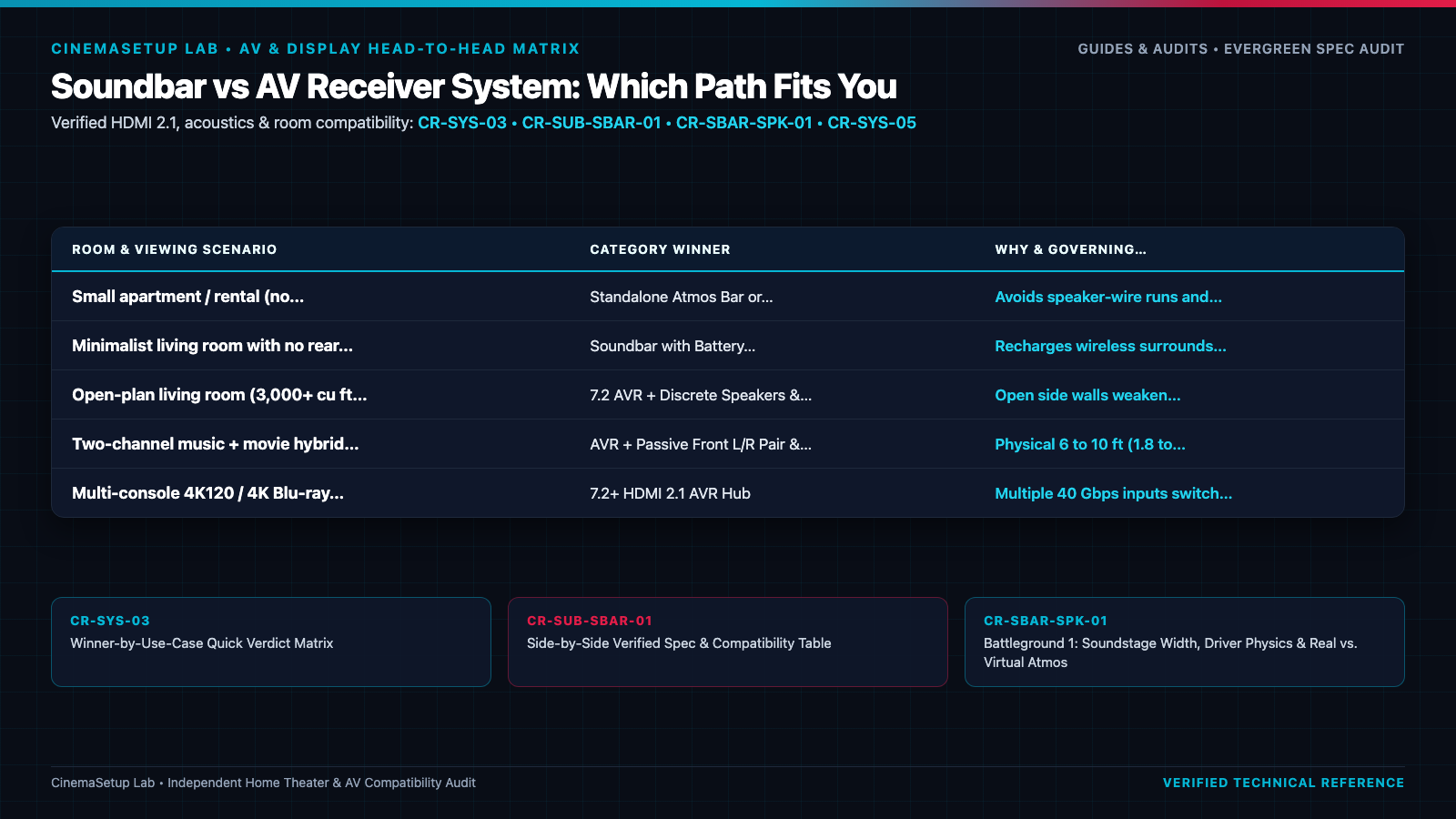
Quick Verdict: Soundbar vs. AV Receiver by Room & Use Case
Under CinemaSetup Lab compatibility rules (CR-SYS-03, CR-SUB-SBAR-01, CR-SBAR-SPK-01, and CR-SYS-05), your room volume, ceiling geometry, and wiring tolerance decide the right audio architecture before individual brands enter the conversation.
| Room & Viewing Scenario | Category Winner | Why & Governing Compatibility Rule |
|---|---|---|
| Small apartment / rental (no drilling, shared walls) | Standalone Atmos Bar or Detachable Kit | Avoids speaker-wire runs and drywall cuts (CR-SPK-ROOM-03) while keeping sub-$750 budgets focused on clean dialogue. |
| Minimalist living room with no rear power outlets | Soundbar with Battery Detachable Rears | Recharges wireless surrounds by docking them onto the bar, sidestepping floor cords while retaining real rear placement. |
| Open-plan living room (3,000+ cu ft / 85+ m3) | 7.2 AVR + Discrete Speakers & Powered Sub | Open side walls weaken reflected soundbar surround (CR-SBAR-ROOM-01); wide L/C/R towers and larger subs scale freely (CR-SUB-ROOM-01). |
| Two-channel music + movie hybrid listener | AVR + Passive Front L/R Pair & Sealed Sub | Physical 6 to 10 ft (1.8 to 3.0 m) tweeter spacing creates genuine stereo imaging and clean 80 Hz sub integration (CR-SUB-SPK-01). |
| Multi-console 4K120 / 4K Blu-ray DTS:X rack | 7.2+ HDMI 2.1 AVR Hub | Multiple 40 Gbps inputs switch PS5, Xbox Series X, and Ultra HD Blu-ray cleanly without TV DTS passthrough blocks (CR-SRC-AVR-01). |
| Dedicated theater (5.1.2 / 5.1.4 / 7.1.4 ceiling Atmos) | 7.2 or 9.4/11.4 AVR + Height Speakers | Only discrete AVRs drive physical overhead ceiling or on-wall Atmos channels and dual independent subwoofers (CR-SPK-AVR-04, CR-SYS-05). |
Side-by-Side Verified Spec & Compatibility Table
To keep comparisons strictly apples-to-apples under guardrails G-04, G-08, and G-16, we never rank audio systems by marketing “total system watts” or treat soundbar channel notation as physical speaker counts. The table below contrasts four verified Amazon US contenders representing the full spectrum: a standalone modular bar, a complete wireless Atmos bar kit, an all-in-one 5.1 AVR package, and a 7.2 Atmos AVR hub.
| Specification & Rule | Bose Smart Ultra (Standalone Bar) | JBL Bar 1000MK2 (Full Wireless Kit) | Yamaha YHT-4970U (5.1 AVR + Speakers Box) | Denon AVR-X1700H (7.2 Atmos AVR Hub) |
|---|---|---|---|---|
| Box Contents (G-29) | Bar only, HDMI & optical cables, ADAPTiQ headset | Bar, 2 detachable battery rears, 10-in wireless sub | RX300A 5.2 AVR, 5x passive speakers, 8-in powered sub | 7.2 AVR only (speakers, sub & wire separate) |
| Physical vs. Virtual Channels (CR-SYS-05) | 9 internal drivers incl. dipole up-firing (5.1.2 Bose notation) | Physical up-firing bar/rears + 10-in sub (7.1.4 JBL notation) | 5x 2.75-in satellites + 8-in sub (5.1 physical; Atmos virtualized) | Up to 7 amplified passive channels + 2 sub outs (5.1.2 physical Atmos) |
| Rated Power Basis (CR-SPK-AVR-03) | Internal active DSP amps (8-ohm rating N/A) | 480 W RMS system rating (bar + sub + rears) | 70 W/ch (8 ohms, 20 Hz–20 kHz, 0.09% THD, 2 ch driven) | 80 W/ch (8 ohms, 20 Hz–20 kHz, 0.08% THD, 2 ch driven) |
| Speaker / Sub Expansion (CR-SUB-SBAR-01 / CR-SBAR-SPK-01) | Closed to Bose Bass Module 500/700 & Surround Speakers | Closed to bundled 10-in sub & detachable surrounds | Open to any 6–16 ohm passive speakers & any powered LFE sub | Open to any 4–16 ohm passive speakers & any powered LFE sub |
| HDMI Inputs & 4K120 Passthrough | 0 HDMI inputs (1x eARC/ARC + 1x Optical) | 3x HDMI in (capped at 4K/60Hz) + 1x eARC out | 4x HDMI 2.1 in (4K/120Hz, VRR, ALLM, QMS) + 1x eARC | 6x HDMI in (3x 40 Gbps 4K/120Hz, VRR, ALLM) + 1x eARC |
| Audio Codec & DTS:X Support (CR-SBAR-DISP-04) | Dolby Atmos (DD+, TrueHD), LPCM (no DTS/DTS:X) | Dolby Atmos (DD+, TrueHD), DTS:X | Dolby Atmos (virtual), DTS:X / DTS Virtual:X | Dolby Atmos (TrueHD), DTS:X |
| Room Calibration | ADAPTiQ headset calibration | Built-in automated room calibration | YPAO with included mic | Audyssey MultEQ XT with included mic |
| Footprint & Stand Fit (CR-SBAR-DISP-05 / CR-AVR-ROOM-01) | 41.14 x 2.29 x 4.21 in (104.5 x 5.8 x 10.7 cm) | Bar w/ rears: 47.4 x 2.0 x 5.0 in (120.3 x 5.2 x 12.8 cm) | AVR: 17.13 x 6.13 x 12.5 in (43.5 x 15.6 x 31.8 cm) + airflow gap | AVR: 17.1 x 13.3 x 6.0 in (43.4 x 33.9 x 15.1 cm) + airflow gap |
| Typical US Tier (G-08) | $700–$1,000 (Bar only) | $900–$1,300 (Complete kit) | $500–$800 (Complete 5.1 box) | $450–$650 (AVR hub only) |
Battleground 1: Soundstage Width, Driver Physics & Real vs. Virtual Atmos
No digital signal processing completely overrides basic speaker geometry. Even a wide 47.4 in (120.3 cm) flagship soundbar puts left, center, and right drivers inside one horizontal enclosure roughly 3.5 to 4 ft (1.1 to 1.2 m) wide. When your couch sits 9 to 12 ft (2.7 to 3.7 m) back, that narrow bar collapses the front soundstage into a tight cluster beneath the screen. With an AV receiver and discrete left and right bookshelf or tower speakers spread 6 to 10 ft (1.8 to 3.0 m) apart—anchored by a timbre-matched center channel (CR-SPK-SPK-01)—dialogue stays locked to the screen while music and off-screen effects span the full width of the front wall.
Cabinet volume and driver surface area follow the same physical divide. Small 2-inch oblong transducers inside a 2.3-inch-tall soundbar cannot move as much air cleanly in the lower midrange (80 to 250 Hz) as 5.25-to-6.5-inch passive bookshelf speakers paired with an 8-inch to 12-inch powered subwoofer. Notably, compact home-theater-in-a-box kits sit right in between: the Yamaha YHT-4970U uses small 2.75-inch satellite cones that still need a higher 100 to 120 Hz crossover (CR-SUB-SPK-01) so vocals do not thin out, yet you gain full physical front-wall separation immediately.
Physical vs. Virtual Height Channels (CR-SYS-05 & CR-SBAR-ROOM-01): Soundbar spec sheets routinely advertise “5.1.2,” “7.1.4,” or “11.1.4” output counts. Under CR-SYS-05 and G-16, never equate marketing channel notation with discrete physical speakers:
- Virtualization-Only Soundbars & 5.1 AVRs: Budget bars without upward-firing drivers—and even 5.2-channel AVRs like the RX300A inside the Yamaha YHT-4970U—use Dolby Atmos Height Virtualization or DTS Virtual:X. They process Atmos object metadata, yet all sound radiates from ear-level drivers (CR-SPK-AVR-04).
- Up-Firing Bars & Atmos Modules: Models with physical upward-firing drivers (such as the Bose Smart Ultra and JBL Bar 1000MK2) follow Dolby ceiling-reflection guidelines (CR-SPK-ROOM-01): they need a flat, hard ceiling roughly 7.5 to 12 ft (2.3 to 3.7 m) high. Vaulted, sloped, or acoustically treated ceilings smear reflected overhead cues.
- Open-Plan Side-Wall Losses (CR-SBAR-ROOM-01): Soundbars that bounce side-firing surround beams off nearby walls lose lateral envelopment in open-concept living rooms where one or both sides open into a kitchen or hallway. Real wireless rear satellites (like the JBL Bar 1000MK2’s detachable surrounds) or wired AVR surrounds solve this immediately.
- True Overhead Speakers (5.1.2 / 5.1.4 / 7.1.4): Stepping up to a 7.2-channel AVR like the Denon AVR-X1700H unlocks dedicated on-wall height or in-ceiling speakers directly above the seating area—bypassing ceiling-bounce guesswork entirely when room construction permits (CR-SPK-ROOM-03).
Battleground 2: Closed Soundbar Ecosystems vs. Open AVR Expandability
The sharpest long-term difference in any soundbar vs av receiver comparison is upgrade lock-in. Soundbar makers build proprietary wireless ecosystems:
- Closed Subwoofer Lists (CR-SUB-SBAR-01): Most soundbars lack a standard line-level RCA LFE subwoofer output. You cannot plug an SVS, RSL, or Klipsch powered subwoofer into a Bose Smart Ultra or JBL Bar 1000MK2—the bar pairs exclusively with its manufacturer’s matching wireless subwoofers (e.g., Bose Bass Module 500 or 700).
- Closed Rear Speaker Lists (CR-SBAR-SPK-01): Standard passive bookshelf speakers never connect to a soundbar. Surround expansion is restricted strictly to the brand’s listed wireless rear models, and if a proprietary wireless module is discontinued years later, finding matching replacements grows difficult.
- Open AVR Component Swapping (CR-SUB-AVR-01 & CR-SPK-AVR-01): An AV receiver treats every speaker and subwoofer as an independent standard module. You can start with a Starter 2.1 or 3.1 setup, add any powered subwoofer (sealed for apartments under CR-SUB-ROOM-03 or ported for larger rooms under CR-SUB-ROOM-01), and upgrade passive speakers piece by piece—checking only nominal impedance (4 to 16 ohms on the Denon AVR-X1700H via its impedance menu, versus 6 to 16 ohms on the Yamaha RX300A) and sensitivity (CR-SPK-AVR-02).
Repairability favors the AVR path as well. Because passive loudspeakers contain no internal wireless radios, streaming chips, or HDMI boards, quality speakers regularly serve 10 to 20 years across multiple AVR generations. On an all-in-one soundbar, a failed power board, degraded battery inside detachable surrounds, or obsolete HDMI board replaces the entire system.
Battleground 3: HDMI eARC, 4K120 Gaming, DTS:X & Single-System Limits
Modern 4K TVs simplify basic audio hookups, yet video bandwidth and audio codec passthrough still trip up buyers who assume every HDMI port behaves identically.
Only One Audio System Per TV (CR-SYS-03): Buyers occasionally ask whether they can keep a soundbar mounted below the TV for casual news while wiring an AV receiver for weekend movies. Under rule CR-SYS-03, a television outputs HDMI ARC or HDMI eARC to only one audio-return device at a time. Connecting both triggers HDMI-CEC power and volume conflicts and forces manual audio-output toggling, so pick either a soundbar or an AVR as your room’s single primary audio hub.
eARC vs. ARC & Codec Gaps (CR-SBAR-DISP-01/02/04 & CR-DISP-AVR-01): Streaming services deliver Dolby Atmos over compressed Dolby Digital Plus, which works over older HDMI ARC. However, lossless Dolby TrueHD Atmos from 4K Blu-ray discs and uncompressed 5.1/7.1 LPCM from consoles require HDMI eARC at both ends—or plugging sources directly into the audio device. Here, AVRs hold two major advantages:
- Multi-Source 40 Gbps Switching (CR-SRC-AVR-01 vs. CR-SBAR-SRC-01): Standalone bars like the Bose Smart Ultra have zero HDMI inputs, and full kits like the JBL Bar 1000MK2 cap their three HDMI inputs at 4K/60Hz. That consumes your TV’s scarce HDMI 2.1 ports when connecting a PS5, Xbox Series X, or gaming PC (CR-DISP-AVR-02). By contrast, the Denon AVR-X1700H includes three 40 Gbps 4K/120Hz inputs (with VRR, ALLM, Dolby Vision, and HDR10+ passthrough), and the Yamaha RX300A inside the YHT-4970U passes 4K/120Hz across all four inputs.
- DTS & DTS:X Disc Support (CR-SBAR-DISP-04): Many current TVs omit DTS passthrough over eARC, and several popular soundbars—including the Bose Smart Ultra and 2026 Samsung Q800H—drop DTS/DTS:X decoding entirely. Almost every mainstream AVR decodes both Dolby TrueHD Atmos and DTS:X natively when a Blu-ray player connects straight to the receiver.
- TV Stand Clearance & Lip-Sync (CR-SBAR-DISP-05 & CR-SYS-04): Because soundbars sit directly beneath the panel, always measure TV stand gap before buying: a 2.0-to-2.3-inch bar clears low pedestals, whereas taller 3-to-4-inch bars can block IR sensors or screen edges unless the TV is wall-mounted. If speech drifts slightly behind video on either path, use the AVR, soundbar, or TV audio-delay / lip-sync slider (CR-SYS-04).
Battleground 4: Real Budget Splits, Box Contents & Installation Safety
Comparing a standalone AVR price tag against a soundbar kit misleads first-time buyers. Under our audio-system budget guidelines (CR-SYS-01 and guardrail G-29), always tally complete box contents:
- Entry Tier ($100–$300): Soundbar territory exclusively. Entry AV receivers alone start near $300 on Amazon US, leaving zero room for five speakers and a powered sub.
- Starter Tier ($300–$800): A soundbar + subwoofer or budget rear kit fits comfortably across the entire band. A complete 5.1 AVR path becomes realistic around $500 to $800—either via an all-in-one box like the Yamaha YHT-4970U or a Starter AVR paired initially with two bookshelf speakers (sold per pair) and a powered subwoofer (sold single) to upgrade toward 5.1 later.
- Core Surround Tier ($1,000–$2,500): This is the decisive crossover tier. Flagship soundbar kits deliver effortless wire-free 7.1.4 or 11.1.4 setups in one carton, while an AVR build following CR-SYS-01 allocates roughly 40–50% to passive speakers (noting L/R towers or bookshelves price per pair or single depending on the SKU, and center channels sell as single units), 15–20% to a powered subwoofer, 25–35% to the 7.2 AVR, and 5–8% to speaker stands (CR-SPK-ROOM-05) and pure oxygen-free copper (OFC) 16 AWG or 14 AWG wire (CR-ACC-SPK-01).
YMYL Installation, Mounting & Electrical Safety (CR-AVR-ROOM-01, CR-ACC-SPK-02 & G-27): Follow manufacturer installation instructions first on both paths. When wall-mounting a television above a soundbar or hanging surround speakers overhead, verify VESA/weight load ratings (CR-DISP-ACC-02) and anchor mounts squarely into wood/steel wall studs, ceiling joists, or rated masonry—never hang heavy brackets on hollow drywall anchors alone. Any speaker wire or HDMI cable routed inside walls or ceilings must carry a UL CL2 or CL3 in-wall fire rating (CR-ACC-SPK-02), and concealed wall outlets or ceiling power drops should be installed by a licensed electrician or qualified AV installer to meet local building codes. Finally, never cram an AV receiver into a tight closed cabinet: follow the manual’s top and rear ventilation clearances (CR-AVR-ROOM-01) to prevent thermal protection shutdowns, and keep listening levels comfortable for long movie sessions.
Battleground 5: US 120 V Warranties, Known Issues & Marketplace Traps
Before checking out on Amazon US, run three quick marketplace checks under CR-SYS-02, G-12, and G-26:
- US 120 V Model & Authorized Seller Check (CR-SYS-02 & G-26): Confirm the listing specifies a US 120 V retail model shipped and sold by Amazon.com or an explicitly authorized brand dealer so factory warranties remain valid. Avoid grey-market regional liquidator imports—such as Canadian
/ZCSamsung soundbar variants—and skip overpriced third-party extended protection bundles. - Documented Firmware & Handshake Issues (G-12): Both paths carry known real-world quirks. On the soundbar side, Sonos’s May 2024 app redesign (ISS-SBAR-SONOS-APP-2024, mitigated via ongoing updates) disrupted wireless setup workflows, and eARC/CEC firmware updates across multiple TV and bar brands occasionally trigger audio dropouts (ISS-SBAR-EARC-HANDSHAKE) fixed by power-cycling both HDMI endpoints. On the AVR side, driving 4-ohm speakers inside poorly ventilated media cabinets triggers thermal protection (ISS-AVR-HEAT-CABINET) unless manual airflow clearance is respected.
- Avoid Inflated “1000W” Budget Claims (G-16): Generic sub-$150 bars advertising “1000W peak” without HDMI eARC, dedicated center drivers, or verifiable driver layouts routinely underperform clear 3.1 bars or starter AVRs.
Final Verdict: Choose a Soundbar vs. Choose an AV Receiver
Choose a Soundbar System If…
- Your total audio budget is under $750 or you rent an apartment where speaker cables and wall cuts are off-limits (CR-SPK-ROOM-03).
- You want a clean 10-minute HDMI eARC setup controlled seamlessly by your TV remote with minimal media-console clutter.
- You lack rear wall outlets and value battery-powered detachable wireless rear speakers like the JBL Bar 1000MK2.
- Your main goal is clear TV dialogue and simple streaming Atmos rather than long-term modular speaker upgrades.
Choose an AV Receiver System If…
- Your budget reaches $1,000–$2,500+ and you can space discrete left, center, and right speakers across the front wall.
- You own an open-plan or large room (2,500+ cu ft / 70+ m3) where soundbars lose side reflections and sub punch (CR-SBAR-ROOM-01, CR-SUB-ROOM-01).
- You want open compatibility with any powered subwoofer and future upgrades to physical 5.1.2/5.1.4 overhead Atmos (CR-SUB-AVR-01, CR-SPK-AVR-04).
- You run multiple 4K/120Hz consoles, UHD Blu-ray DTS:X discs, or two-channel music listening sessions.
Audited Contenders on Amazon US
The four verified Amazon US products below illustrate every major fork in the soundbar vs av receiver decision—from standalone modular bars and detachable wireless kits to an all-in-one 5.1 AVR bundle and a dedicated 7.2 Atmos receiver hub.
1. JBL Bar 1000MK2 7.1.4-Channel Soundbar System — Best Wire-Free Full Soundbar Kit

Key Specs: 7.1.4 (JBL notation) | 480 W RMS system output | Bar + 2 detachable up-firing battery surrounds + 10-in wireless subwoofer | 3x HDMI in (4K/60Hz Dolby Vision & HDR10+) + 1x HDMI eARC + Optical | Dolby Atmos (DD+, TrueHD), DTS:X | Bar w/ rears: 47.4 x 2.0 x 5.0 in (120.3 x 5.2 x 12.8 cm); Sub: 12.8 x 15.7 x 12.8 in (32.5 x 40.0 x 32.5 cm), 20.0 lb (9.1 kg) | Price Tier: $900–$1,300 (Complete kit)
The JBL Bar 1000MK2 shows how closely a complete soundbar kit can rival entry surround packages without running speaker wire across the floor. Its two battery-powered rear satellites detach from the bar ends for movie night and re-dock to recharge, delivering real rear channels plus physical upward-firing drivers and a 10-inch wireless subwoofer. Unlike streaming-only bars, it decodes both Dolby TrueHD Atmos and DTS:X across three direct HDMI inputs.
Pros
- Complete box contents with zero rear power outlets needed for the detachable wireless surrounds (G-29)
- Ultra-low 2.0 in (5.2 cm) bar height clears TV stands cleanly while decoding Dolby Atmos and DTS:X
Cons
- HDMI inputs cap video passthrough at 4K/60Hz—4K/120Hz consoles must connect directly to the TV (CR-SBAR-SRC-01)
- Closed wireless ecosystem cannot accept a second subwoofer or standard passive speakers later (CR-SUB-SBAR-01)
Seller & Warranty Note: Confirm checkout shows shipped and sold by Amazon.com or an authorized JBL US dealer for valid US 120 V factory warranty service (G-26).
2. Bose Smart Ultra Dolby Atmos Soundbar — Best Standalone Modular Bar

Key Specs: 5.1.2 (Bose layout) | 9 internal drivers incl. up-firing dipole transducers | 1x HDMI eARC/ARC + 1x Optical (0 HDMI inputs) | Dolby Atmos (DD+, TrueHD), LPCM (no DTS/DTS:X) | ADAPTiQ headset calibration + A.I. Dialogue Mode | 41.14 x 2.29 x 4.21 in (104.5 x 5.8 x 10.7 cm), 12.68 lb (5.8 kg) | Price Tier: $700–$1,000 (Bar only; sub & surrounds sold separately)
Built for tidy living rooms prioritizing vocal clarity over multi-box hardware, the Bose Smart Ultra pairs a slim 2.29-inch-tall chassis with A.I. Dialogue Mode and an included ADAPTiQ calibration headset. It connects in minutes using the supplied HDMI or optical cable. Keep box contents and ecosystem boundaries clear before buying (G-29): no subwoofer or rear speakers are included, adding Bose Bass Module 500/700 or Surround Speakers is closed to Bose SKUs (CR-SUB-SBAR-01, CR-SBAR-SPK-01), and DTS discs require player PCM conversion (CR-SBAR-DISP-04).
Pros
- A.I. Dialogue Mode sharpens speech cleanly during quiet evening viewing while clearing 2.3 in (5.8 cm) TV stands
- Includes ADAPTiQ headset, HDMI cable, and optical cable inside the box with optional wireless Bose expansion later
Cons
- Bar-only carton omits subwoofer and rears—full Bose ecosystem expansion costs far more than a Starter AVR kit (G-29)
- Omits DTS/DTS:X decoding and provides zero HDMI passthrough inputs (CR-SBAR-DISP-04, CR-SBAR-SRC-01)
Seller & Warranty Note: Confirm Amazon.com or an authorized Bose US dealer listing for factory warranty coverage, and verify your TV supplies HDMI eARC/ARC (CR-SBAR-DISP-01).
3. Yamaha YHT-4970U 5.1-Channel Home Theater System — Best Starter All-in-One AVR Box

Key Specs: RX300A 5.2-ch AVR + 5x 6-ohm 2.75-in passive speakers + 8-in 50 W continuous / 100 W dynamic powered sub | 70 W/ch (8 ohms, 20 Hz–20 kHz, 0.09% THD, 2 ch driven) | 6–16 ohm impedance rating | 4x HDMI 2.1 in (4K/120Hz, 8K/60Hz, VRR, ALLM, QMS, DV, HDR10+) + 1x HDMI eARC | YPAO calibration | AVR: 17.13 x 6.13 x 12.5 in (43.5 x 15.6 x 31.8 cm), 16.8 lb (7.6 kg) | Price Tier: $500–$800 (Complete 5.1 AVR box)
The Yamaha YHT-4970U bridges the price gap between mid-tier soundbars and modular separates by packing a modern 4K/120Hz HDMI 2.1 receiver (RX300A), five wired speakers, and an 8-inch powered subwoofer into one Starter-tier box. Unlike any soundbar, you can space the front left and right speakers cleanly apart and swap in larger 6-to-16-ohm bookshelf towers or a bigger powered subwoofer later. Just keep two engineering limits in mind: 5.2-channel processing caps physical speakers at 5.1 (using height virtualization rather than physical Atmos ceiling/up-firing channels per CR-SYS-05), and its 2.75-inch satellites demand a high 100 to 120+ Hz crossover (CR-SUB-SPK-01).
Pros
- Includes AVR, five discrete speakers, and powered 8-in sub in one box with four 4K/120Hz HDMI 2.1 gaming inputs
- Open speaker terminals and dual sub pre-outs let you upgrade speakers or subwoofers over time without replacing the AVR
Cons
- 5.2-channel processing limits physical speakers to 5.1—Dolby Atmos relies on DSP height virtualization (CR-SYS-05)
- 6-ohm minimum impedance lacks formal 4-ohm rating, and the RX300A omits Wi-Fi/AirPlay streaming
Seller & Warranty Note: Verify the US 120 V YHT-4970U listing is sold by Amazon.com or an authorized Yamaha US dealer (G-26), and use UL CL2/CL3 wire if routing speaker cable inside drywall (CR-ACC-SPK-02).
4. Denon AVR-X1700H 7.2-Channel 8K AV Receiver — Best Modular 5.1.2 Atmos AVR Hub

Key Specs: 7.2-ch amp & processing (true 5.1.2 physical Atmos or 7.1 max) | 80 W/ch (8 ohms, 20 Hz–20 kHz, 0.08% THD, 2 ch driven) | 4–16 ohm impedance menu | 6x HDMI in (3x 40 Gbps 4K/120Hz, VRR, ALLM, DV, HDR10+) + 1x HDMI eARC | Audyssey MultEQ XT | 17.1 x 13.3 x 6.0 in (43.4 x 33.9 x 15.1 cm), 19.0 lb (8.6 kg) | Price Tier: $450–$650 (AVR hub only; speakers & sub sold separately)
For Core Surround builders ready to leave soundbar limits behind, the Denon AVR-X1700H delivers genuine 7.2-channel amplification—unlocking physical 5.1.2 Dolby Atmos ceiling or on-wall height speakers alongside three 40 Gbps 4K/120Hz HDMI 2.1 inputs, Audyssey MultEQ XT room correction, HEOS streaming, and an official 4-to-16-ohm impedance menu (CR-SPK-AVR-01). Remember that this listing includes the receiver only (G-29): budget separately for passive speakers, a powered subwoofer, and OFC copper speaker wire per CR-SYS-01.
Pros
- Powers true physical 5.1.2 Dolby Atmos or DTS:X speakers and supports 4-to-16-ohm passive speaker loads (CR-SPK-AVR-04)
- Three 40 Gbps HDMI 2.1 inputs, Audyssey MultEQ XT, and open LFE sub pre-outs support long-term modular upgrades
Cons
- Receiver only—passive speakers, powered subwoofer, stands, and copper wire add $500–$1,800+ to total cost (G-29)
- 7.2 processing tops out at 5.1.2 (cannot run 5.1.4), omits Front L/R pre-outs, and mirrors both sub terminals on one channel
Seller & Warranty Note: Confirm seller authorization carefully on older-cycle Denon Amazon listings so US 120 V manufacturer warranty eligibility remains intact (G-26), and leave top cabinet clearance per the owner’s manual (CR-AVR-ROOM-01).
How We Audited This Guide
- Room setups, upgrade roadmaps, and Amazon marketplace audits enforce system-wide CR-* budgets and acoustics, Canadian /ZC grey-market alerts, pair-vs-single speaker clarity, and manufacturer-first mounting safety.
- Every AV receiver, speaker, subwoofer, soundbar, OLED/Mini-LED TV, projector, source player, and accessory spec was cross-checked against official manufacturer manuals, CEA/CTA standards, and live Amazon US listings.
- Recommendations were evaluated against our weighted vertical scoring rubrics and documented CR-* compatibility rules; we never invent nits, contrast ratios, bench wattage, or room decibels.
Continue Your Audit
Frequently Asked Questions: Soundbar vs. AV Receiver
Is a soundbar or an AV receiver better for most living rooms?
In apartments, rentals, or budgets under $750 where you cannot run speaker wire, a soundbar or detachable wireless kit wins on convenience and footprint. Once your budget reaches $1,000–$2,500 and you can place discrete left, center, and right speakers, an AV receiver wins on separation, bass authority, and upgrade lifespan.
Can I connect passive speakers or any subwoofer to a soundbar?
No. Under compatibility rules CR-SUB-SBAR-01 and CR-SBAR-SPK-01, soundbars lack passive speaker terminals and standard line-level LFE sub outputs. You can only add wireless subwoofers and rear speakers listed on that exact manufacturer’s compatibility chart.
Can I run both a soundbar and an AV receiver on the same TV?
No—not simultaneously over HDMI ARC or eARC. Under rule CR-SYS-03, a television outputs ARC/eARC audio to only one audio-return device at a time, and running both triggers HDMI-CEC conflicts. Choose either a soundbar or an AVR as your primary system.
Why does an inexpensive 5.1 AV receiver say Dolby Atmos without height speakers?
Receivers with five amplifier channels like the Yamaha RX300A inside the YHT-4970U decode Dolby Atmos metadata and apply DSP height virtualization (CR-SYS-05). Physical overhead Atmos speakers require at least a 7.2-channel AVR (5.1.2) such as the Denon AVR-X1700H (CR-SPK-AVR-04).
How much should I budget for a real AV receiver system versus a soundbar?
Entry soundbars start at $100–$300, whereas a viable Starter 5.1 AVR system begins near $750 and Core Surround 5.1.2 builds span $1,000–$2,500. Under CR-SYS-01, allocate roughly 40–50% to passive speakers, 15–20% to a powered sub, 25–40% to the AVR, and 5–10% to wire and stands.
Do I need HDMI eARC for Dolby Atmos on a soundbar or AV receiver?
Streaming apps deliver lossy Dolby Digital Plus Atmos over standard HDMI ARC. However, lossless Dolby TrueHD Atmos from 4K Blu-ray discs and multichannel LPCM from consoles require HDMI eARC on both the TV and the soundbar or AVR—or plugging the player directly into an HDMI input on the audio hub.


