
Disclosure: As an Amazon Associate, I earn from qualifying purchases. If you buy through links on this page, CinemaSetup Lab may earn a small commission at no extra cost to you. Commission differences across categories (such as 2% on televisions versus 4% on projectors, screens, soundbars, and AV accessories) never influence our compatibility audits, blueprint splits, or product recommendations.
A modern living room projector setup no longer requires blacking out windows or running long ceiling HDMI conduits across drywall joists. By pairing an ultra-short-throw (UST) laser projector on a low front credenza with a directional ambient-light-rejecting (UST ALR / CLR) fixed-frame screen, you can build a 100-to-150-inch cinema image in an everyday family room with the lights dimmed or partially open.
Still, UST living-room systems fail more often at the planning stage than standard flat-panel TVs. Credenza depth limits, vertical image offset without lens shift, wrong screen optics, ARC-only audio bottlenecks, and oversized soundbars blocking the upward projection cone will ruin an expensive build if ignored. This blueprint connects directly to our pillar home theater setup guide and walks through every screen, throw-distance, and sound-path verification rule before you order a single US 120V AC component.
In This Living-Room UST Projector Blueprint
- Room Geometry, 100–150 Inch Sizing & Audio Budget Allocation
- Complete Living-Room UST Parts List & Verified Amazon US Picks
- IF-THEN Compatibility Proof Box (CR-* Rules Audited)
- Credenza Throw Math, Vertical Offset & UST ALR Screen Physics
- Audio Architecture: Soundbar ARC Limits vs. Discrete AVR Hub
- Stud Anchoring, UL CL2/CL3 Wiring & Alignment Checklist
- Audited Living-Room UST Equipment Profiles (6 Verified US Listings)
- Authoritative Standards & Manufacturer References
- Frequently Asked Questions
Room Geometry, 100–150 Inch Sizing & Audio Budget Allocation
This blueprint models a typical North American living or great room measuring 15 to 16 ft wide by 20 to 22 ft long with an 8.5 to 9 ft flat ceiling (4.6–4.9 m by 6.1–6.7 m by 2.6–2.7 m), enclosing roughly 2,550 to 3,170 cu ft (72 to 90 m³) with evening lamps or daytime window blinds. If you are still deciding between an 85-inch Mini-LED television or a 77-inch OLED panel versus a 120-inch laser screen for sunlit sports, compare the room trade-offs first in our TV vs. projector for home theater breakdown.
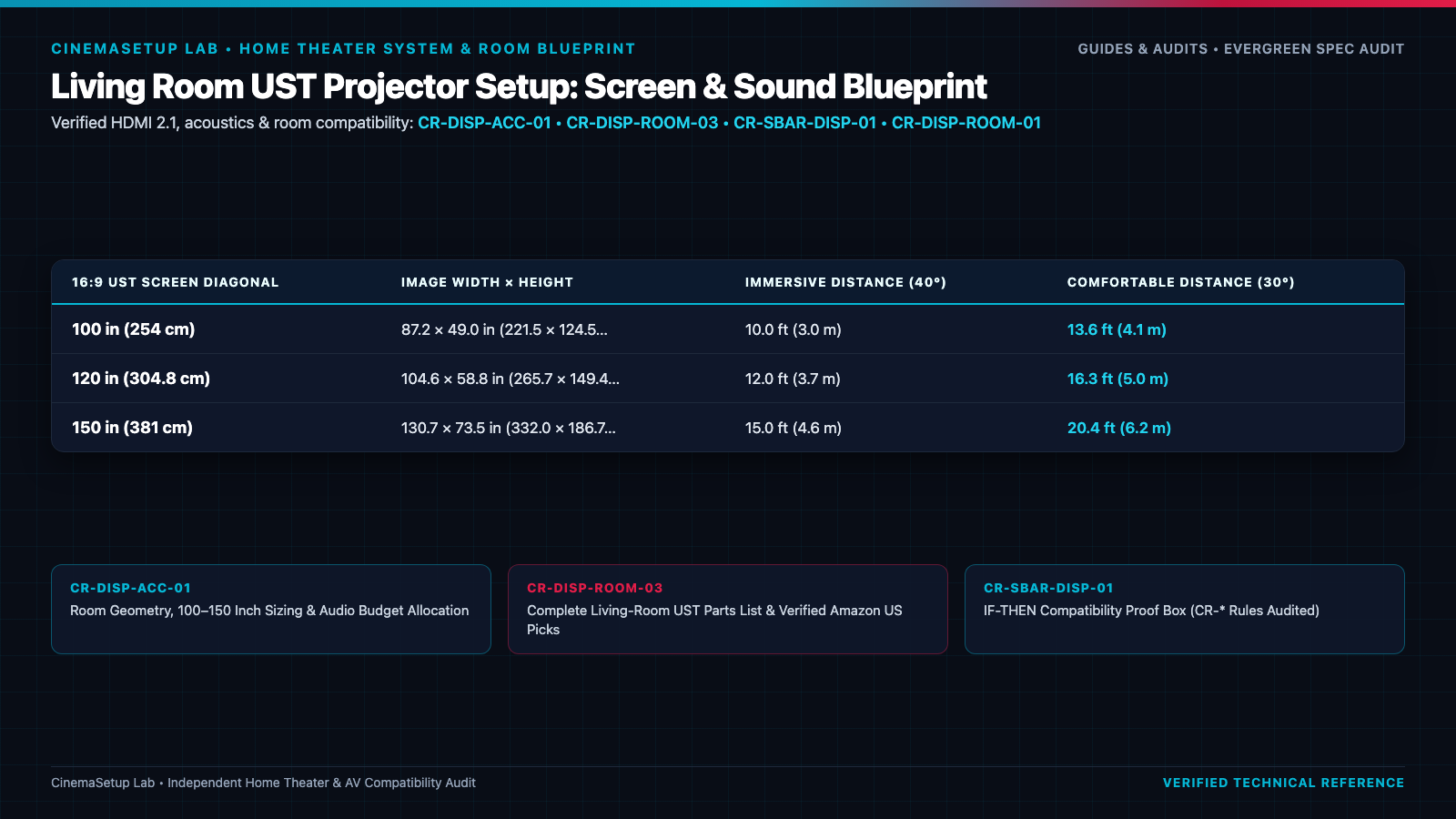
When you commit to projection, start with viewing-angle geometry under rule CR-DISP-ROOM-01. For a 16:9 canvas, placing your primary sofa between 1.20 × diagonal (a 40-degree immersive cinema field of view) and 1.63 × diagonal (a 30-degree comfortable everyday field of view) prevents eye fatigue while preserving 4K pixel-shift sharpness:
| 16:9 UST Screen Diagonal | Image Width × Height | Immersive Distance (40°) | Comfortable Distance (30°) | Minimum Ceiling Practicality (w/ 18-in Console) |
|---|---|---|---|---|
| 100 in (254 cm) | 87.2 × 49.0 in (221.5 × 124.5 cm) | 10.0 ft (3.0 m) | 13.6 ft (4.1 m) | Fits standard 8 ft (2.4 m) ceilings comfortably |
| 120 in (304.8 cm) | 104.6 × 58.8 in (265.7 × 149.4 cm) | 12.0 ft (3.7 m) | 16.3 ft (5.0 m) | 8.5–9 ft (2.6–2.7 m) ideal; tight on 8 ft walls |
| 150 in (381 cm) | 130.7 × 73.5 in (332.0 × 186.7 cm) | 15.0 ft (4.6 m) | 20.4 ft (6.2 m) | Requires 9+ ft (2.7+ m) ceiling or ultra-low plinth |
Next, separate your display budget from your audio budget so sound quality keeps pace with a 10-foot-wide picture. On the video side, budget for two mandatory purchases: the UST projector itself ($3,000-$3,800 tier for flagship bright-room 4,000-lumen 3LCD units, or $1,500-$3,000 for mainstream DLP UST models) plus a dedicated UST ALR fixed-frame screen ($500-$1,500 depending on 120-inch vs. 150-inch span). Strictly skip unbranded sub-$400 “4K support” projectors marketed with inflated LED lumen claims; true living-room UST projection relies on verified ISO 21118 or ANSI lumen output.
On the audio side, apply CinemaSetup Lab’s CR-SYS-01 allocation rule depending on which sound architecture fits your room:
| Living-Room Audio Path | Main Audio Allocation | Subwoofer Share | Electronics / Processing | Cables, Mounts & Wire |
|---|---|---|---|---|
| Minimalist Soundbar Path ($150-$1,100+) | 75%–90% (Standalone Atmos bar or bar + wireless subwoofer kit) | Integrated inside soundbar | 10%–25% (Ultra High Speed HDMI + optical/wall mount) | |
| Core 5.1.2 Discrete AVR Path ($1,000-$2,500) | 40%–50% (L/C/R, surrounds, 2 heights) | 15%–20% (12-in powered sub for 2,500+ cu ft) | 25%–35% (7.2 HDMI 2.1 AVR) | 5%–8% (14 AWG CL2/CL3 OFC wire + UHS HDMI) |
Complete Living-Room UST Parts List & Verified Amazon US Picks
The parts list below combines our primary 4,000-lumen UST projector engine, two size-matched UST ALR fixed-frame screens, and three verified living-room soundbar tiers ranging from ultra-slim ARC clearance to standalone physical-height Dolby Atmos. For builders upgrading later to discrete passive speakers and a multi-channel AVR (such as a 9.4-channel Denon AVR-X3900H), the audio routing section below maps how an AVR replaces the soundbar without creating dual-eARC conflicts (CR-SYS-03).
| System Role | Verified Amazon US Pick | Key Compatibility & Package Spec | Budget Tier | Amazon Link |
|---|---|---|---|---|
| Primary Bright-Room UST Projector | Epson EpiqVision LS800 4K PRO-UHD Laser Projector (White) | 3-chip 3LCD, 4,000 ISO/IDMS lumens, 0.16:1 throw, 3x HDMI 2.0 (HDMI 2 ARC only); single unit | $3,000-$3,800 (Launch MSRP: $3,499) | View on Amazon |
| Sweet-Spot 120-In UST ALR Screen | 120-Inch UST ALR Fixed-Frame 16:9 Wall Screen | 120 in (304.8 cm) diagonal, 104.6 in width, directional UST ALR surface; single screen kit | $500-$1,000 | View on Amazon |
| XL 150-In Tall-Wall UST ALR Screen | 150-Inch UST ALR Fixed-Frame 16:9 4K Screen | 150 in (381 cm) diagonal, 130.7 in width, UST ALR fixed frame for 9+ ft ceilings; single kit | $1,000-$1,500 | View on Amazon |
| Flagship Standalone Atmos Bar | Sonos Arc Ultra Soundbar (Black) | 14 drivers incl. 2 up-firing + Sound Motion woofer, 2.95 in tall, HDMI eARC (0 HDMI in); bar only | $900-$1,100 (Launch MSRP: $999) | View on Amazon |
| DTS:X Value 3.1 Bar + Sub Kit | TCL S60K 3.1-Ch Dolby Atmos & DTS:X Soundbar Kit | 3.1 physical drivers + wireless sub in box; virtualized Atmos/DTS:X (no up-firing drivers) | $150-$300 | View on Amazon |
| Ultra-Slim Low-Profile 2.1 Bar + Sub | Polk Audio Signa S2 Ultra-Slim Soundbar + Sub | 2.15 in ultra-low height clears steep UST beams; HDMI ARC + Optical; bar + wireless sub | $150-$300 | View on Amazon |
IF-THEN Compatibility Proof Box (CR-* Rules Audited)
Before placing your order, verify every physical and signal link against CinemaSetup Lab’s cross-compatibility rules. Unlike flat-panel TVs, a living-room UST projector couples optical wall geometry directly to audio placement and HDMI return capabilities:
Living-Room UST Projector Compatibility Proof Box (Audited CR-* Rules):
- CR-DISP-ACC-01 (SOFT / CRITICAL — UST vs. Standard ALR Screen Match): IF your projector sits inches from the wall projecting steeply upward (0.16:1 to 0.25:1 throw ratio), THEN you must buy a directional UST ALR / CLR screen whose horizontal sawtooth ridges reflect bottom-up rays forward toward your sofa. Buying a standard long-throw ALR screen (such as SilverMagic standard-throw fixed frames) causes severe dark bands and hotspots because long-throw coatings reject steep upward angles.
- CR-DISP-ROOM-03 (SOFT — Ambient Light & ISO/ANSI Lumens): IF your living room has daytime window spill or overhead recessed fixtures on during casual viewing, THEN pair a high-output laser engine (such as the Epson LS800 at 4,000 ISO/IDMS color & white lumens) with a tensioned UST ALR screen rather than bare painted drywall or a matte-white sheet, which washes blacks out rapidly under room light.
- CR-DISP-ROOM-02 & CR-DISP-ROOM-05 (HARD / CONDITIONAL — Throw Depth & Zero Keystone): IF your credenza is 18 to 20 in (45.7 to 50.8 cm) deep, THEN verify the chassis depth plus rear throw gap against the maker’s chart before buying. At 0.16:1, the Epson LS800 (13.4 in / 34.0 cm deep) requires only ~6.8 in (17.3 cm) behind the cabinet for a 120-inch image (~20.2 in / 51.3 cm from wall to front edge). Level the adjustable feet mechanically instead of enabling digital keystone, which softens 4K pixel-shift detail.
- CR-SBAR-DISP-01 & CR-SBAR-DISP-02 (HARD / CONDITIONAL & SOFT — ARC vs. eARC & Lossless Audio): IF you pair the Sonos Arc Ultra (0 HDMI inputs, eARC/ARC only) directly with the Epson LS800 (HDMI 2 supports standard ARC, not eARC), THEN streaming Dolby Digital Plus Atmos works over ARC, whereas lossless Dolby TrueHD Atmos from a 4K Blu-ray player plugged into the projector falls back to compressed 5.1 or stereo. Without HDMI ARC/eARC, optical fallback on the Sonos requires a separate adapter and drops Atmos entirely.
- CR-SBAR-DISP-05 (SOFT — Soundbar Height vs. Upward UST Light Beam): IF placing a soundbar on the same credenza in front of a UST projector, THEN confirm the bar sits low (such as the 2.15 in Polk Signa S2 or 2.95 in Sonos Arc Ultra) and far enough forward (or wall-mounted beneath the screen’s bottom bezel) that the upward-angled light fan clears the top edge of the soundbar cleanly.
- CR-DISP-ROOM-01 (SOFT — Screen Size vs. Viewing Distance): IF your sofa is 12 to 16 ft (3.7 to 4.9 m) away, THEN choose the 120-inch UST ALR screen for the exact 30°–40° viewing window. Step up to 150 inches only if seats sit 15 to 20 ft (4.6 to 6.1 m) back and your wall height supports it.
- CR-ACC-DISP-01 & CR-SYS-02 (CONDITIONAL & HARD — HDMI Certification & US 120V AC): Use Ultra High Speed HDMI Certified cables (active optical directional fiber for runs over ~10 ft / 3 m to an AVR rack) and verify US 120V AC retail units sold by authorized US dealers (G-26).
Credenza Throw Math, Vertical Offset & UST ALR Screen Physics
Unlike ceiling-mounted long-throw projectors that sit behind your couch and zoom optically across 12 to 16 ft (3.7 to 4.9 m), an ultra-short-throw projector locks its image geometry to two fixed measurements: rear-wall clearance and vertical offset above the lens. Because most UST projectors lack mechanical vertical or horizontal lens shift, moving the chassis forward by just 1 inch (2.5 cm) enlarges and raises the projected picture noticeably.
This is why the Epson EpiqVision LS800’s 0.16:1 throw ratio is so consequential for living rooms. Many competing triple-laser DLP UST units use 0.22:1 to 0.25:1 optics, forcing you to pull a 120-inch setup 14 to 20 in (35.6 to 50.8 cm) away from the wall—requiring either an unusually deep 24-to-28-inch credenza or a motorized sliding drawer. By contrast, as documented in our full Epson LS800 audit, the LS800 projects a 100-inch 16:9 image with just 3.9 in (9.8 cm) behind the cabinet and a 120-inch image with roughly 6.8 in (17.3 cm) behind the cabinet. Even including its 13.4 in (34.0 cm) body depth, the front edge sits around 20.2 in (51.3 cm) from the drywall—fitting comfortably on standard 20-to-22-inch media consoles while leaving rear cable breathing room.
Calculating Credenza Height & Ceiling Clearance
Before mounting a fixed-frame screen, measure upward from the floor rather than eyeballing center wall height. On a 120-inch 16:9 screen (58.8 in / 149.4 cm tall image plus roughly 0.4 to 1.0 in aluminum bezel per side), add your UST projector’s chassis height (6.2 in / 15.7 cm on the LS800) plus its upward vertical offset (typically 6 to 10 in / 15 to 25 cm above the chassis top depending on screen diagonal). On a typical 24-inch-tall living-room TV stand, the top bezel of a 120-inch frame already approaches 96 to 98 in (244 to 249 cm)—hitting right against an 8-foot (244 cm) ceiling.
To keep a 120-inch screen comfortably centered near seated eye level under an 8-to-9-foot ceiling, choose a low-profile media console between 14 and 18 in (35.6 to 45.7 cm) tall. If you are planning a 150-inch screen (73.5 in / 186.7 cm image height), you need at least a 9-to-10-foot ceiling paired with a low floor plinth or custom recessed credenza.
Why Bare Drywall & Standard ALR Screens Fail UST Projection
Never project a UST beam onto painted drywall or a portable cloth sheet. Because light strikes the wall at an extreme grazing angle (70° to 80° upward), microscopic drywall tape seams, orange-peel texture, and fabric ripples cast exaggerated horizontal waves along the top and bottom borders. Worse, flat white paint reflects ceiling lamps straight back toward your couch. A tensioned aluminum fixed frame holding a directional UST ALR / CLR optical sheet solves both problems simultaneously—compare screen gain, lenticular PET-Crystal vs. matte anti-speckle trade-offs, and motorized floor-rising options in our best UST projector screen audit.
Audio Architecture: Soundbar ARC Limits vs. Discrete AVR Hub
Audio integration is the most overlooked compatibility trap in a UST living-room build. Every television includes multiple HDMI inputs plus a dedicated ARC/eARC port, whereas UST projectors sit inside a shallow credenza and frequently limit audio return features.
Option A: Minimalist Soundbar Path (ARC-to-Soundbar vs. Optical)
If you want a clean living-room look with zero speaker wire runs, a low-profile soundbar paired with a wireless subwoofer works well—provided you match HDMI expectations carefully:
- Sonos Arc Ultra + Sonos Ecosystem (Best Up-Firing Clarity & Modular Growth): The Arc Ultra packs 14 physical drivers (including 2 upward-firing tweeters and its four-motor Sound Motion woofer) inside a 2.95 in (7.5 cm) tall bar. Because it has zero HDMI inputs (CR-SBAR-SRC-01), you plug an Apple TV 4K or Roku Ultra into the Epson LS800’s HDMI 1 or HDMI 3 port and run HDMI 2 (ARC) back to the Arc Ultra. That carries Dolby Digital Plus Atmos from streaming apps cleanly. However, because the LS800 lacks eARC, lossless Dolby TrueHD Atmos from a 4K Blu-ray player cannot pass over ARC (CR-SBAR-DISP-02), and Sonos omits DTS:X decoding (CR-SBAR-DISP-04). Also keep Sonos’s closed ecosystem in mind: you can expand later only with Sonos Sub 4 / Sub Mini and Era 100 / Era 300 wireless surrounds (CR-SUB-SBAR-01, CR-SBAR-SPK-01).
- TCL S60K 3.1 Bar + Wireless Sub (DTS:X & Dedicated Center on a Budget): Unlike the Sonos, the TCL S60K bundles a dedicated wireless subwoofer right in the box and decodes both Dolby Atmos and DTS:X. Be transparent about physical hardware under rule CR-SYS-05: the 3.1 bar uses front left, center, and right drivers without upward-firing height drivers, so overhead Atmos/DTS:X effects are virtualized rather than physical ceiling reflections.
- Polk Audio Signa S2 Ultra-Slim (Zero Beam Interference): At just 2.15 in (5.5 cm) tall with a bundled compact wireless sub, the Signa S2 easily clears steep UST light cones on shallow consoles and connects reliably via HDMI ARC or built-in Optical Toslink (2.1 Dolby Digital, no Atmos).
Option B: Discrete 5.1.2 / 7.1.4 AV Receiver Hub (Best Cinema Dynamics)
If you watch 4K UHD Blu-ray discs, own multiple consoles, or want wide left-to-right front speakers flanking a 120-inch screen, an AV receiver (AVR) is technically cleaner than any ARC-only soundbar path. Plugging your Apple TV 4K, 4K Blu-ray player, and gaming console directly into a 7.2-channel AVR (or a 9.4-channel Denon AVR-X3900H for 5.1.4/7.1.4 expansion) lets the receiver decode lossless Dolby TrueHD Atmos and DTS:X natively before sending a single video cable up to the UST projector. That eliminates CR-SBAR-DISP-02 eARC bottlenecks, solves lip-sync drift via AVR audio delay (CR-SYS-04), and keeps physical L/C/R tweeters at ear level beside or below the screen frame—though never run both an AVR and a soundbar on the same display simultaneously (CR-SYS-03).
Stud Anchoring, UL CL2/CL3 Wiring & Alignment Checklist
Large fixed-frame projector screens and AC-powered laser engines demand strict physical and electrical safety discipline. Follow our manufacturer-instruction-first checklist before powering on your living-room cinema:
UST Safety, Mounting & Alignment Checklist (G-27 & CR-* Rules):
- Manufacturer-First Stud Anchoring: 120-inch and 150-inch aluminum fixed frames span 8.7 to 10.9 ft (2.7 to 3.3 m) wide. Follow the screen maker’s printed cleat instructions strictly and anchor wall brackets into structural wood studs or manufacturer-rated masonry anchors—never rely on hollow-drywall toggle anchors alone across heavy or wide spans.
- Electrical Safety & UL CL2/CL3 In-Wall Wire Codes: Verify all electronics ship as US 120V AC / 60 Hz retail models (CR-SYS-02). If concealing HDMI cables or speaker wire inside drywall, use only UL-listed CL2 or CL3 rated cables (pure 14 AWG OFC copper wire handles up to 79 ft / 24 m at 8 ohms or 40 ft / 12 m at 4 ohms per CR-ACC-SPK-01/02). Never run an unrated AC power cord inside a wall cavity; consult a licensed electrician or certified AV installer when adding recessed behind-credenza power outlets.
- Laser Eye Safety & Credenza Ventilation: Keep children away from looking down into the upward-firing UST laser lens while active, and preserve the side/rear airflow clearances specified in your projector manual so the laser engine never throttles thermally.
- Mechanical Frame Alignment (Zero Keystone): Level your credenza and projector feet with a bubble level, position the projector mechanically at its exact 0.16:1 throw distance, and verify corner focus rather than using digital keystone warping (see our step-by-step how to set up a home theater projector guide for full pattern alignment).
- Audio Calibration & Comfortable Playback: Disable TV/projector internal speakers when routing to a soundbar or AVR, run Trueplay or AVR room calibration with level-calibration tones, verify lip-sync delay (CR-SYS-04), and keep playback at comfortable household volume levels.
Audited Living-Room UST Equipment Profiles (6 Verified US Listings)
Every SKU below comes from live Amazon US verification (ZIP 10001). Always verify the exact size/color selector, package contents, and authorized US dealer seller badge at checkout so full manufacturer warranty terms remain intact (G-26, G-29).
1. Epson EpiqVision LS800 4K PRO-UHD Ultra Short Throw Laser Projector — Primary UST Engine

Key Specs & Package Contents: 3-Chip 3LCD (4K PRO-UHD pixel-shifting) | 4,000 lumens Color (IDMS) & White (ISO 21118) brightness | 0.16:1 ultra-short throw ratio (80–150 in diagonal) | 3x HDMI 2.0 (18 Gbps; HDMI 2 ARC, HDMI 3 1080p/120Hz Game), Optical S/PDIF out, Wi-Fi 5 | Built-in 2.1 Yamaha virtual surround | 27.4 × 13.4 × 6.2 in (69.6 × 34.0 × 15.7 cm); 27.6 lb (12.5 kg) | In the Box: Single LS800W projector unit, remote, 6 ft AC power cord (screen & streaming stick sold separately) | Price Tier: $3,000-$3,800 (Launch MSRP: $3,499)
For sunlit or lamp-lit living rooms, the Epson EpiqVision LS800 remains one of the easiest UST projectors to place on real furniture. Its 3-chip 3LCD architecture delivers 4,000 equal color and white lumens with zero DLP rainbow flicker and zero triple-laser speckle, while its ultra-steep 0.16:1 throw puts a 120-inch canvas just 6.8 in (17.3 cm) behind the chassis. Plan your sources carefully around its HDMI 2.0 inputs: add an Apple TV 4K or Roku Ultra for Netflix and smooth app speed, and route lossless TrueHD Atmos sources through an AVR rather than HDMI 2 ARC.
Variant & Seller Check (G-05, G-26): ASIN B0BCXT6BSP corresponds to the white LS800W chassis variant (which shares identical optics and electronics with the black LS800B, though white chassis stock is scarcer and occasionally listed by third-party or Renewed resellers). Confirm Ships from and Sold by Amazon.com or an Epson Authorized US Dealer at checkout to keep the 2-year Epson US limited warranty intact.
Pros
- 4,000 ISO/IDMS color & white lumens hold saturation cleanly in lit living rooms
- 0.16:1 throw ratio fits shallow 18–20 in credenzas with zero DLP rainbow effect
Cons
- HDMI 2 supports standard ARC only (no lossless eARC) and inputs cap at 4K/60Hz (no 4K/120Hz or Dolby Vision)
- Higher dark-room black floor than iris DLP rivals in pitch-black theaters
2. 120-Inch UST ALR Fixed-Frame 16:9 Wall Screen — Sweet-Spot Living-Room Canvas

Key Specs & Package Contents: 120 in (304.8 cm) diagonal | 16:9 aspect ratio (104.6 × 58.8 in / 265.7 × 149.4 cm active area) | Directional UST ALR projection sheet | Fixed tensioned aluminum wall frame | In the Box: Single 120-inch screen sheet, perimeter aluminum frame bars, tension & wall-mount cleats | Price Tier: $500-$1,000
A 120-inch fixed-frame UST ALR screen hits the ergonomic sweet spot for living rooms with 12 to 16 ft (3.7 to 4.9 m) seating distances (CR-DISP-ROOM-01). Unlike standard long-throw ALR screens or bare textured drywall, its directional UST surface catches steep upward projector rays and suppresses overhead ceiling-fixture washout (CR-DISP-ACC-01, CR-DISP-ROOM-03) while keeping frame edges dead flat across 8.7 ft (2.66 m) of horizontal width.
Pros
- Purpose-built for upward UST projection angles rather than ceiling-mount beams
- Rigid fixed frame eliminates drywall wave distortion at 120-inch cinema scale
Cons
- Marketplace listing omits published half-gain angle curve and direct US OEM warranty terms (G-26)
- Strictly incompatible with standard ceiling-mounted long-throw projectors
3. 150-Inch UST ALR Fixed-Frame 16:9 4K Screen — Tall-Wall XL Option

Key Specs & Package Contents: 150 in (381.0 cm) diagonal | 16:9 aspect ratio (130.7 × 73.5 in / 332.0 × 186.7 cm active area) | Directional UST ALR fixed-frame surface | In the Box: Single 150-inch UST ALR screen kit, aluminum frame rails, tension springs, wall cleats | Price Tier: $1,000-$1,500
Designed for open-plan great rooms with 9-to-11-foot (2.7-to-3.4-m) ceilings and couches seated 15 to 20 ft (4.6 to 6.1 m) back, this 150-inch UST ALR fixed frame pushes screen scale to the Epson LS800’s maximum rated 150-inch optical boundary (CR-DISP-ROOM-02). Remember that spreading 4,000 lumens across 150 inches lowers image brightness per square foot compared with a 120-inch frame, so pair 150-inch ALR screens exclusively with 3,000-to-4,000-lumen engines and moderate light control.
Pros
- Massive 130.7 in (332 cm) wide UST ALR canvas fills large great rooms cleanly
- Maintains tension flatness where wall texture would ruin 150-inch UST edges
Cons
- 73.5 in (186.7 cm) screen height plus UST offset will not fit standard 8 ft ceilings on typical consoles
- Marketplace seller listing requires immediate crease inspection and return-window verification (G-26)
4. Sonos Arc Ultra Soundbar with Dolby Atmos — Minimalist Flagship Audio

Key Specs & Package Contents: 14 physical drivers (7 tweeters incl. 2 upward-firing, 6 midwoofers, 1 Sound Motion woofer); 15 Class-D amps; Sonos 9.1.4 spatial rating (CR-SYS-05) | 1x HDMI eARC/ARC port (0 HDMI passthrough inputs); Wi-Fi 6, Bluetooth 5.3, Ethernet | 2.95 × 46.38 × 4.35 in (7.5 × 117.8 × 11.1 cm); 13.01 lb (5.9 kg) | In the Box: Standalone bar, 6 ft power cord, 4.9 ft HDMI cable (Sub 4 & Era rears sold separately) | Price Tier: $900-$1,100 (Launch MSRP: $999)
Standing just 2.95 in (7.5 cm) tall, the Sonos Arc Ultra brings genuine upward-firing height tweeters, three-level Speech Enhancement, and its four-motor Sound Motion woofer into living rooms that refuse bulky speaker towers. Because its chassis height stays compact, it sits cleanly in front of a low credenza UST projector without obstructing the upward light cone (CR-SBAR-DISP-05). Remember two critical Sonos boundaries before checkout: first, its 0 HDMI input layout relies on your projector’s HDMI ARC/eARC port (so ARC-only projectors like the LS800 pass streaming Dolby Digital Plus Atmos but drop Blu-ray TrueHD Atmos per CR-SBAR-DISP-02); second, Sonos’s May 2024 app redesign issue (ISS-SBAR-SONOS-APP-2024) has been mitigated through successive firmware and app updates, though app-based Trueplay setup remains mandatory.
Pros
- Low 2.95 in (7.5 cm) profile clears UST projection paths while adding physical up-firing drivers
- Stronger built-in Sound Motion low-end and 3-level Speech Enhancement than typical standalone bars
Cons
- Zero HDMI inputs and zero DTS:X decoding; relies on projector eARC for lossless Atmos
- Closed ecosystem limits sub and rear upgrades strictly to Sonos Sub 4 / Sub Mini and Era 100 / Era 300
5. TCL S60K S Series 3.1 Soundbar with Wireless Subwoofer — DTS:X Value Kit

Key Specs & Package Contents: 3.1 physical channel array (dedicated center + L/R + bundled wireless sub) | Dolby Atmos & DTS:X decoding (virtualized height; zero physical up-firing drivers per CR-SYS-05) | AI Sonic Auto Room Calibration, Bluetooth | In the Box: Complete kit with 3.1 soundbar + 1x wireless subwoofer | Price Tier: $150-$300
When most of your budget goes straight into a UST projector and 120-inch ALR screen, the TCL S60K delivers a complete 3.1 bar-and-subwoofer kit in a single Entry box (G-29). Having a dedicated center channel separates movie dialogue from music, and supporting both Dolby Atmos and DTS:X avoids silent DTS tracks (CR-SBAR-DISP-04). Be realistic about overhead cues under rule CR-SYS-05: without upward-firing height drivers, Atmos and DTS:X rendering is front-stage virtualized rather than overhead.
Pros
- Includes wireless subwoofer and dedicated center speaker inside the $150-$300 bracket
- Supports both Dolby Atmos and DTS:X audio decoding
Cons
- No physical upward-firing drivers or rear surround speakers (virtualized height only)
- Compact wireless subwoofer will not pressurize cavernous 5,000+ cu ft open-plan living rooms
6. Polk Audio Signa S2 Ultra-Slim Soundbar + Subwoofer — Low-Clearance Fit

Key Specs & Package Contents: 2.1 channels + Polk VoiceAdjust speech EQ | Ultra-slim 2.15 in (5.5 cm) bar height | 1x HDMI ARC, 1x Optical Toslink, 3.5 mm AUX, Bluetooth | Dolby Digital 5.1 decoding (no Atmos, no DTS:X) | In the Box: 2.1 soundbar + 1x compact wireless subwoofer + HDMI & optical cables | Price Tier: $150-$300
Height clearance is the Polk Audio Signa S2‘s superpower in a UST credenza setup. At just 2.15 in (5.5 cm) tall, it sits quietly in front of a UST chassis with virtually zero risk of clipping the bottom edge of the projection beam (CR-SBAR-DISP-05), and includes both HDMI ARC and Optical Toslink cables so it works seamlessly with projectors that either support HDMI ARC or fall back to optical (CR-SBAR-DISP-01). Just note that it is strictly a 2.1 Dolby Digital kit without Dolby Atmos or DTS:X support.
Pros
- 2.15 in (5.5 cm) ultra-low profile clears steep upward UST light paths effortlessly
- Includes both HDMI ARC and Optical Toslink inputs with bundled wireless subwoofer
Cons
- No Dolby Atmos, no DTS:X, and no dedicated physical center speaker
- 2.1 stereo-plus-sub soundstage lacks rear surround immersion compared with 5.1.2 systems
Authoritative Standards & Manufacturer References
- Epson US Home Entertainment Projectors Documentation (EpiqVision LS800 4,000 ISO/IDMS lumens, 0.16:1 throw chart, HDMI 2 ARC & optical ports, and US limited warranty terms).
- Sonos US Official Arc Ultra Hardware Specifications (14-driver Sound Motion array, 2.95-inch height, HDMI eARC port, adapter-based optical, and Trueplay compatibility).
- HDMI Licensing Administrator — HDMI 2.1a & eARC Specification (ARC vs. eARC lossless TrueHD Atmos bandwidth and Ultra High Speed Certified cable guidelines).
- ProjectorCentral Screen Gain & UST ALR Engineering Guides (lenticular CLR sawtooth reflection geometry vs. standard long-throw ALR screens and viewing-angle math).
- Dolby Laboratories Home Theater Speaker Setup Guides (physical upward-firing ceiling boundaries and ear-level speaker geometry).
How We Audited This Guide
- Room setups, upgrade roadmaps, and Amazon marketplace audits enforce system-wide CR-* budgets and acoustics, Canadian /ZC grey-market alerts, pair-vs-single speaker clarity, and manufacturer-first mounting safety.
- Every AV receiver, speaker, subwoofer, soundbar, OLED/Mini-LED TV, projector, source player, and accessory spec was cross-checked against official manufacturer manuals, CEA/CTA standards, and live Amazon US listings.
- Recommendations were evaluated against our weighted vertical scoring rubrics and documented CR-* compatibility rules; we never invent nits, contrast ratios, bench wattage, or room decibels.
Frequently Asked Questions
Do I really need a UST ALR screen for a living room projector setup?
Yes. Under rules CR-DISP-ACC-01 and CR-DISP-ROOM-03, a UST projector fires steeply upward from inches below the wall, which magnifies drywall ripples and bounces ceiling glare. A directional lenticular UST ALR screen captures upward rays while rejecting overhead ambient light.
Can I use a standard long-throw ALR screen with an ultra-short-throw projector?
No. Standard angular-reflective ALR screens are engineered to accept horizontal light from across the room and reject steep angles from above or below. Pairing one with a UST laser causes severe hotspotting, color shifts, and dark horizontal banding across the upper screen.
Does the Epson LS800 pass lossless Dolby TrueHD Atmos to a Sonos Arc Ultra?
No. Under rule CR-SBAR-DISP-02, the Epson LS800’s HDMI 2 port supports standard ARC rather than eARC, and the Sonos Arc Ultra has zero HDMI inputs. Streaming Dolby Digital Plus Atmos passes over ARC, whereas Blu-ray TrueHD Atmos falls back unless routed via an AVR or eARC audio extractor.
How deep does my TV stand need to be for a 120-inch UST projector?
It depends entirely on throw ratio (CR-DISP-ROOM-02). With a 0.16:1 throw like the Epson LS800, 120 inches requires roughly 6.8 in (17.3 cm) behind the unit, placing the front edge around 20.2 in (51.3 cm) from the wall. Longer 0.22:1 to 0.25:1 UST projectors need deeper credenzas.
Will a soundbar block the light beam from an ultra-short-throw projector?
It can if placed directly behind the lens path or stacked too tall (CR-SBAR-DISP-05). Keep the soundbar low (under 3 inches, such as the 2.15 in Polk Signa S2 or 2.95 in Sonos Arc Ultra) positioned slightly forward on the credenza or wall-mounted beneath the screen frame.


