
Disclosure: As an Amazon Associate, I earn from qualifying purchases. If you buy through links on this page, CinemaSetup Lab may earn a small commission at no extra cost to you. Commission schedules (for example, 2% on televisions versus 4% on projectors, screens, and AV accessories) never influence our technical audits, scores, or verdicts.
This epson ls800 review audits the North American retail configuration of Epson’s flagship bright-room ultra-short-throw (UST) laser projector—a $3,000-$3,800 centerpiece (Launch MSRP: $3,499, projector only) built for living-room buyers stepping beyond the 77-inch to 98-inch flat panels in our best TVs for home theater hub. Rather than repeating vague marketing claims about “laser TV” theater replacement or uncalibrated dynamic contrast numbers, we verified every specification against Epson’s official US documentation, ISO 21118 brightness standards, HDMI 2.0 bandwidth rules, and CinemaSetup Lab’s cross-compatibility matrix.
In a crowded market dominated by single-chip DLP triple-laser projectors, the EpiqVision Ultra LS800 takes a completely different optical path. Its 3-chip 3LCD engine delivers 4,000 lumens of equal color and white brightness with zero DLP rainbow artifacts and a class-leading 0.16:1 throw ratio that projects 100 inches from just 3.9 in (9.8 cm) behind the chassis. At the same time, its 18 Gbps HDMI 2.0 inputs, standard ARC-only audio return (no eARC), and lack of Dolby Vision or native Netflix on Android TV impose real system-design constraints you need to map out before ordering.
In This Audit
- Audit Verdict Summary & 100% Weighted Scorecard
- Key Specifications & 3LCD Optical Architecture
- 0.16:1 Throw Chart, Room Light & UST ALR Screen Pairing
- HDMI 2.0 Routing, ARC-Only Limits & Gaming Latency
- Compatibility Audit (CR-* Rules), Known Issues & Pros/Cons
- Top Alternatives, Rejected Picks & Verified US Product Cards
- Authoritative Standards & Manufacturer Citations
- Frequently Asked Questions
Audit Verdict Summary & 100% Weighted Scorecard
One-Line Verdict: The Epson EpiqVision Ultra LS800 earns an 8.7 / 10 overall audit score as the standout bright-room and shallow-credenza UST laser projector in our best ultra short throw projector lineup—provided you pair it with a lenticular UST ALR screen, plug an external streaming box and 4K Blu-ray player into an AVR or soundbar HDMI input rather than relying on ARC, and accept HDR10/HLG without Dolby Vision.
Following CinemaSetup Lab’s spec-audit methodology, all optical ratings, throw distances, port bandwidths, and acoustic specs below are sourced from official Epson US documentation (confidence A). Published third-party evaluations (including RTINGS’ contrast and input-lag measurements) are explicitly attributed where cited; we never fabricate in-house lumen or contrast figures, and we separate pixel-shift 4K PRO-UHD rendering from native 4K panels.
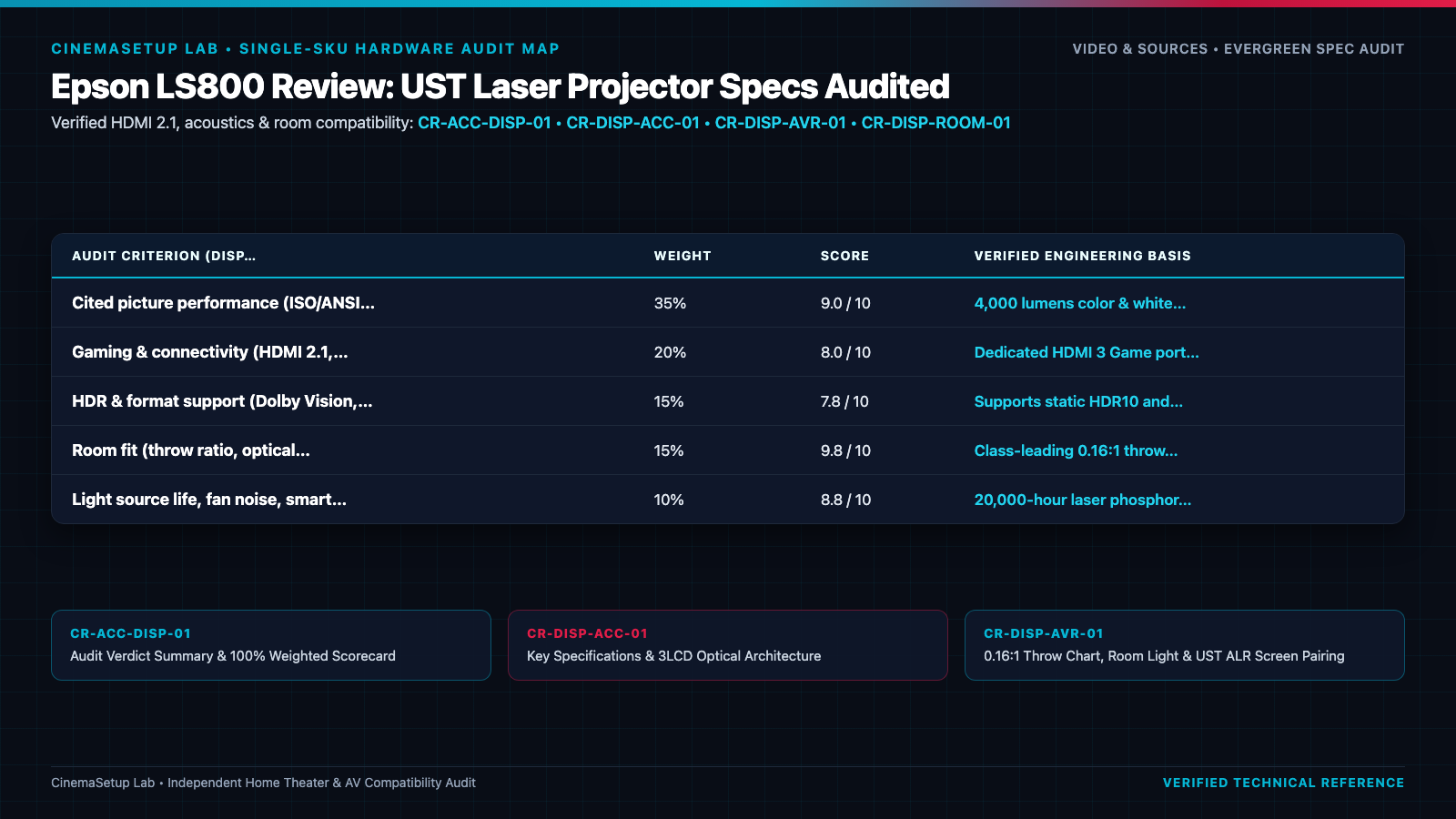
| Audit Criterion (DISP Rubric) | Weight | Score | Verified Engineering Basis |
|---|---|---|---|
| Cited picture performance (ISO/ANSI lumens, native/dynamic contrast, color volume, pixel-shift 4K clarity) | 35% | 9.0 / 10 | 4,000 lumens color & white brightness (ISO 21118 / IDMS); 3-chip 3LCD eliminates DLP rainbow effect and triple-laser speckle; >2,500,000:1 dynamic contrast, though published evaluations note an elevated dark-room black floor compared with iris DLP rivals. |
| Gaming & connectivity (HDMI 2.1, eARC port, input lag) | 20% | 8.0 / 10 | Dedicated HDMI 3 Game port accepts 1080p/120Hz with cited ~16.7 ms lag (4K/60Hz) and sub-20 ms 120Hz response; penalized for 18 Gbps HDMI 2.0 cap (no 4K/120Hz or VRR) and standard ARC on HDMI 2 rather than lossless eARC. |
| HDR & format support (Dolby Vision, HDR10+, tone mapping) | 15% | 7.8 / 10 | Supports static HDR10 and broadcast HLG with scene-adaptive gamma correction; lacks dynamic-metadata Dolby Vision and HDR10+ tone mapping found on triple-laser DLP peers. |
| Room fit (throw ratio, optical zoom/lens shift, UST ALR screen match, ambient light) | 15% | 9.8 / 10 | Class-leading 0.16:1 throw projects 100 in from 3.9 in (9.8 cm) rear gap and 120 in from ~6.8 in (17.3 cm); handles living-room light well on a 0.6-gain UST ALR screen; docked slightly for fixed lens without optical shift (CR-DISP-ROOM-05). |
| Light source life, fan noise, smart OS, warranty, open ISS | 10% | 8.8 / 10 | 20,000-hour laser phosphor source; hushed 19 dB(A) Eco mode (ramps to 32 dB(A) Normal); 2-year Epson US limited warranty with Home Service; docked for built-in Android TV omitting native certified Netflix. |
| Value within tier (screen excluded unless bundled) | 5% | 8.6 / 10 | Justified in the $3,000-$3,800 bracket (Launch MSRP: $3,499) for bright rooms and rainbow-sensitive buyers, though newer competitors undercut it on dark-room contrast and HDMI 2.1 eARC. |
| Weighted Total | 100% | 8.7 / 10 | Calculated weighted average: 8.70 / 10 (exact: 3.15 + 1.60 + 1.17 + 1.47 + 0.88 + 0.43). |
Key Specifications & 3LCD Optical Architecture
Before measuring your media console or planning HDMI cable runs, examine the complete verified specification profile for the US retail Epson EpiqVision Ultra LS800 below. All physical measurements list imperial dimensions first with metric conversions in parentheses, and standardized brightness ratings are distinguished strictly from marketing contrast claims.
| Specification Category | Epson EpiqVision Ultra LS800 (US 120V Model) | Audit & Compatibility Note |
|---|---|---|
| Projection Engine | 3-Chip 3LCD (0.62 in poly-silicon TFT active matrix) | Simultaneous RGB color projection eliminates single-chip DLP rainbow artifacts and triple-laser speckle. |
| Resolution Method | 4K PRO-UHD (dual-axis pixel-shifting from native 1080p LCD panels) | Projects 3840 x 2160 perceived resolution via pixel-shifting; distinct from native 4K panels (02e §g). |
| Light Source & Rated Life | Laser Phosphor Diode (up to 20,000 hours maintenance-free) | Rapid instant-on startup with zero UHP lamp replacements. |
| Brightness (Standardized) | 4,000 lumens Color Brightness (IDMS) & 4,000 lumens White Brightness (ISO 21118) | Equal color and white output preserves saturated colors in sunlit living rooms (CR-DISP-ROOM-03). |
| Contrast Ratio | >2,500,000:1 Dynamic Contrast (dynamic laser dimming) | Native on/off contrast is lower than iris DLP rivals; needs UST ALR screen in bright rooms. |
| Throw Ratio & Screen Range | 0.16:1 wide (0.16-0.40 digital zoom); 80-150 in (203-381 cm) 16:9 | Digital zoom shrinks image at fixed placement but discards active pixels; place physically at 0.16:1. |
| Lens Shift & Focus | No optical lens shift; manual focus lever; multipoint digital geometry | Level projector feet carefully on credenza to avoid softening pixels with keystone (CR-DISP-ROOM-05). |
| HDMI Inputs & Audio Return | 3x HDMI 2.0 (18 Gbps, HDCP 2.3): Port 2 = ARC only; Port 3 = Dedicated Game | Zero 40/48 Gbps HDMI 2.1 ports; no eARC lossless TrueHD return (CR-DISP-AVR-01). |
| HDR & Refresh Support | HDR10, HLG (no Dolby Vision, no HDR10+); 4K up to 60 Hz; 1080p/120Hz (Port 3) | No VRR or 4K/120Hz support; Dolby Vision titles fall back cleanly to HDR10 (CR-SRC-DISP-01). |
| Built-In Audio System | 2.1-ch Yamaha virtual surround (20 W total: 2x 5 W full-range + 10 W woofer) | 4 DSP presets (TV, Sports, Movies, Music) + standalone Bluetooth speaker mode; virtual surround is not physical Atmos (CR-SYS-05). |
| Additional Ports & Wireless | 1x Optical S/PDIF out, 1x 3.5 mm stereo mini out, 3x USB Type-A, 1x USB Type-B, Wi-Fi 5 (802.11ac), Bluetooth 5.0 | No Ethernet RJ-45 port built in; uses Wi-Fi 5 for Android TV and Chromecast built-in. |
| Smart Platform | Android TV (Google Play Store, Chromecast built-in) | Lacks native certified Netflix app; add Apple TV 4K, Roku Ultra, or Fire TV Stick 4K Max. |
| Acoustic Noise & Power | 32 dB(A) Normal / 19 dB(A) Eco; 350 W Normal / 217 W Eco / 2.0 W Standby | Power supply accepts 100-240V AC 50/60 Hz; verify US retail SKU & 120V cord (CR-SYS-02). |
| Dimensions & Weight | 27.4 x 13.4 x 6.2 in (69.6 x 34.0 x 15.7 cm) incl. feet; 27.6 lb (12.5 kg) | Wide 27.4 in chassis requires load-rated, shallow-to-medium credenza planning. |
| Price Bracket / US Warranty | $3,000-$3,800 tier (Launch MSRP: $3,499); 2-year Epson Limited w/ Home Service | Valid only on new US units bought from Epson or an authorized US dealer (G-26). |
3-Chip 3LCD vs. Single-Chip DLP & 4K PRO-UHD Honesty
Every major rival in the $2,500-$3,500 UST bracket—including the Hisense PX3-PRO and AWOL Vision LTV-3000 Pro—uses a single 0.47-inch DLP DMD chip paired with fast-switching RGB lasers or a phosphor wheel. That DLP architecture delivers stronger native contrast, yet viewers sensitive to sequential color flashing can perceive distracting red-green-blue “rainbow” fringes along high-contrast subtitles or camera pans. Because the Epson LS800 dedicates three separate poly-silicon LCD panels (one each for red, green, and blue) that stay illuminated continuously, it produces zero DLP rainbow artifacts and zero triple-laser screen speckle.
At the same time, buyers should understand what Epson’s 4K PRO-UHD label means technically. Like 0.47-inch DLP XPR projectors, the LS800 is a pixel-shift 4K engine rather than a native 3840 × 2160 panel: its dual-axis optical actuator shifts native 1080p LCD panels diagonally to double perceived spatial resolution on screen. From normal living-room seating distances of 10 to 13 ft (3.0 to 4.0 m), 4K streaming and UHD Blu-ray detail looks crisp, though pixel-level desktop PC text appears slightly softer than on a true native 4K SXRD or LCoS dedicated-theater projector.
Chassis Variants: LS800B (Black) vs. LS800W (White) & Renewed Caveat (G-05, G-26)
Epson launched two cosmetic finishes in the United States: the LS800B in matte black (ASIN B0BCXTVXMC) and the LS800W in matte white (ASIN B0BCXT6BSP). Both share identical optics, 4,000-lumen output, HDMI layout, and Yamaha 2.1 acoustics—the only performance nuance is that a matte black top deck reflects slightly less stray upward light in dark rooms. Note that the white LS800W has seen tighter retail availability and discontinuation notices across several distributor channels compared with the black LS800B, so inspect seller badges carefully before ordering.
Equally important, Amazon US search results frequently surface third-party Amazon Renewed refurbished LS800 listings directly beside brand-new retail stock. Under guardrail G-26, Epson’s 2-year US limited warranty (with rapid Home Service exchange) applies strictly to new units sold by Epson or an Authorized US Dealer (such as Ships from and Sold by Amazon.com or an authorized AV integrator)—third-party refurbished or grey-market listings do not carry full factory coverage.
0.16:1 Throw Chart, Room Light & UST ALR Screen Pairing
For ultra-short-throw projectors, physical room geometry determines image sharpness and living-room ergonomics far more than any menu setting. Thanks to an exceptionally steep 0.16:1 throw ratio, the LS800 sits closer to the wall for a given screen size than 0.20:1, 0.22:1, or 0.25:1 rivals—making it unusually forgiving for standard 16-to-20-inch (40.6-to-50.8-cm) deep media credenzas (rule CR-DISP-ROOM-02).
| 16:9 Screen Diagonal | Image Width x Height | Rear of Chassis to Wall | Front Edge of Chassis to Wall (incl. 13.4 in Depth) | Recommended Viewing Band (30°-40°, CR-DISP-ROOM-01) |
|---|---|---|---|---|
| 80 in (203 cm) | 69.7 x 39.2 in (177 x 100 cm) | ~0.9 in (2.3 cm) | ~14.3 in (36.3 cm) | 8.0-10.9 ft (2.4-3.3 m) |
| 100 in (254 cm) | 87.2 x 49.0 in (221 x 125 cm) | 3.9 in (9.8 cm) | 17.3 in (43.9 cm) | 10.0-13.6 ft (3.0-4.1 m) |
| 120 in (305 cm) | 104.6 x 58.8 in (266 x 149 cm) | ~6.8 in (17.3 cm) | ~20.2 in (51.3 cm) | 12.0-16.3 ft (3.7-5.0 m) |
| 150 in (381 cm) | 130.7 x 73.5 in (332 x 187 cm) | ~9.9 in (25.1 cm) | ~23.3 in (59.2 cm) | 15.0-20.4 ft (4.6-6.2 m) |
Vertical Offset & Avoiding Keystone Correction (CR-DISP-ROOM-05)
Because the LS800 uses a fixed-angle optical mirror with zero vertical or horizontal lens shift, every vertical placement calculation starts from the top surface of the projector cabinet. Per Epson’s official 16:9 installation chart for a 100-inch (254 cm) screen, the bottom edge of the active image begins 5.9 in (14.9 cm) above the top of the projector, placing the top edge of the image 54.9 in (139.4 cm) above the chassis. Add the projector’s 6.2 in (15.7 cm) height, and a standard 24-inch (61-cm) tall media console already puts the top of a 100-inch frame at 78.9 in (200 cm)—meaning an 8 ft (2.4 m) ceiling leaves tight vertical clearance when scaling to 120 in or 150 in.
Keep the LS800 dead level using its adjustable feet and align the frame physically rather than relying on digital keystone or corner-fit warping (rule CR-DISP-ROOM-05). Digital geometry correction resamples the 16:9 pixel grid inside the LCD chips, softening fine 4K detail and leaving faint dark overspill borders around the screen frame. Plan your cabinet height and wall screen height together using our living room UST projector setup blueprint before drilling wall brackets.
Ambient Light & Mandatory UST ALR / CLR Screen Match (CR-DISP-ROOM-03 & ACC-01)
With 4,000 ISO/IDMS lumens of matched color and white output, the LS800 produces substantially more daytime punch than 2,400-to-3,000-lumen triple-laser rivals—yet raw lumens alone cannot defeat ceiling light or white walls on bare drywall (rule CR-DISP-ROOM-03). Projecting onto a standard matte-white screen or a traditional long-throw angular-reflective ALR screen fails with a UST optical beam arriving steeply from below: long-throw ALR screens physically reject steep upward angles, causing severe hotspots and dim top corners (rule CR-DISP-ACC-01).
Instead, pair the LS800 strictly with a tensioned, sawtooth lenticular UST ALR / CLR (ceiling-light-rejecting) screen—such as Epson’s matching 0.6-gain SilverFlex Ultra 100-inch or 120-inch screens, or third-party lenticular options audited in our best UST projector screens guide. Those microscopic horizontal ridges reflect upward projector light straight toward the couch while absorbing up to 90% of overhead room glare, anchoring black levels in daytime living rooms. In pitch-black dedicated theaters, however, published third-party evaluations (including RTINGS) consistently note that the LS800’s native contrast and black floor remain lighter than iris-equipped DLP rivals—making dark scenes look slightly charcoal-grey compared with the Hisense PX3-PRO or PX4 Pro.
Credenza Safety, Screen Anchoring & Cable Code Rules (G-27)
At 27.6 lb (12.5 kg) and 27.4 in (69.6 cm) wide, the LS800 is heavier than compact 10-to-18-lb DLP laser projectors. Place it on a rigid, level cabinet rated well above its weight, leave unobstructed airflow along its side intake and exhaust grilles, and never look directly into the upward-firing laser aperture while powered on. When hanging a 100-inch or 120-inch fixed-frame UST ALR screen, follow the screen manufacturer’s printed instructions strictly and anchor brackets into structural wood studs or manufacturer-rated masonry hardware—never into hollow drywall alone. For concealed HDMI or speaker runs inside walls, use only UL-listed CL2 or CL3 rated cabling, never route a non-rated AC power cord inside a wall cavity, and consult a licensed electrician or professional AV installer when adding recessed wall outlets.
HDMI 2.0 Routing, ARC-Only Limits & Gaming Latency
Connectivity is the single area where Epson’s 2022-era LS800 hardware shows its age compared with newer HDMI 2.1 UST designs. Behind the removable rear/side service cover sit three HDMI 2.0 (18 Gbps, HDCP 2.3) inputs, three USB Type-A ports, an Optical Toslink audio output, a 3.5 mm stereo mini jack, and a USB Type-B service port. Notice what is missing: zero 40/48 Gbps HDMI 2.1 inputs, zero Ethernet RJ-45 jack, and zero HDMI eARC.
How to Route Lossless Atmos Around the HDMI 2 ARC Bottleneck
Because HDMI Port 2 supports standard HDMI ARC rather than enhanced eARC (rule CR-DISP-AVR-01 / STD-HDMI-EARC), plugging a 4K UHD Blu-ray player or Xbox Series X directly into the LS800 prevents lossless Dolby TrueHD Atmos, DTS-HD Master Audio, DTS:X, and uncompressed 5.1/7.1 Multichannel PCM from traveling back down HDMI 2 to an AV receiver or Dolby Atmos soundbar. Streaming apps on ARC still pass compressed Dolby Digital Plus Atmos cleanly, and Optical S/PDIF drops further to compressed 5.1.
The clean architectural fix is straightforward: treat the LS800 strictly as an endpoint monitor rather than your switching hub. Plug your Apple TV 4K, 4K Blu-ray player, PS5, or Xbox Series X into an AV receiver such as the Denon AVR-X3900H (or into the HDMI passthrough inputs on a full-kit soundbar like the US Samsung HW-Q990H), then run a single certified 18 Gbps Premium High Speed or 48 Gbps Ultra High Speed HDMI cable up to HDMI 1 or HDMI 3 on the LS800. That way, lossless Dolby TrueHD and DTS:X audio stays inside your AVR or soundbar with zero ARC compression.
Console Gaming: 1080p/120Hz Game Port vs. 4K/60Hz Cap
Because the LS800 lacks 40/48 Gbps HDMI 2.1 inputs, consoles cannot run at 4K/120Hz or use HDMI Forum VRR (rule CR-SRC-DISP-02 / CR-SRC-DISP-03). Instead, Epson equips HDMI Port 3 as a dedicated Game input supporting 4K HDR at 60 Hz or 1080p at 120 Hz. Published third-party evaluations (including RTINGS) report input lag around ~16.7 ms at 4K/60Hz and 1080p/60Hz—and under 20 ms at 1080p/120Hz—making the LS800 responsive enough for casual and fast-paced living-room console sessions despite missing VRR.
Yamaha 2.1 Built-In Audio & Android TV Reality Check
Epson partnered with Yamaha to build a custom 2.1-channel virtual surround speaker system into the LS800’s perforated front grille, powered at 20 W total (two 5 W full-range drivers plus a 10 W internal woofer). For daytime sports, news, and casual TV streaming, it delivers clear dialogue and far fuller mid-bass than typical tiny projector speakers, and even works as a standalone Bluetooth 5.0 speaker when the laser is off. Still, per rule CR-SYS-05, a single-chassis 2.1 speaker array with virtual surround DSP is not physical Dolby Atmos surround sound—cinematic rooms still merit a dedicated AVR speaker layout or eARC/passthrough Atmos soundbar.
On the software side, the built-in Android TV interface connects via Wi-Fi 5 (802.11ac) and includes Google Assistant, Chromecast built-in, YouTube, Disney+, and Prime Video, but omits a native certified Netflix app out of the box. Rather than fiddling with unofficial sideloaded APKs, reserve HDMI 1 for an external Apple TV 4K, Roku Ultra, or Fire TV Stick 4K Max so every streaming service runs smoothly with proper 24p/60p frame handling.
Compatibility Audit (CR-* Rules), Known Issues & Pros/Cons
Every relevant HARD, CONDITIONAL, SOFT, and INFO rule from CinemaSetup Lab’s display and accessory compatibility framework has been executed against the US retail Epson LS800 below (G-10):
| Rule ID | Level | Audit Outcome for Epson LS800 | Required Buyer Action / Condition |
|---|---|---|---|
| CR-SYS-02 | HARD | PASS (US Retail SKU) | Verify new US 120V AC package & authorized US dealer (avoid Renewed or overseas imports). |
| CR-DISP-ROOM-02 | HARD | PASS (0.16:1 Throw) | Place rear of chassis 3.9 in (9.8 cm) from wall for 100 in, or ~6.8 in (17.3 cm) for 120 in; check credenza depth (17.3-20.2 in total). |
| CR-DISP-ROOM-05 | CONDITIONAL / SOFT | CONDITIONAL (Fixed Lens) | Zero optical lens shift; keep projector physically level on a low credenza (5.9 in offset at 100 in) to avoid keystone softening. |
| CR-DISP-ACC-01 | SOFT | UST ALR REQUIRED | Pair strictly with a lenticular UST ALR / CLR screen (e.g., 0.6-gain SilverFlex Ultra); never use long-throw ALR screens. |
| CR-DISP-ROOM-03 | SOFT | DAYLIGHT STRONG / DARK CAVEAT | 4,000 ISO/IDMS lumens resist daytime glare on UST ALR; dark dedicated rooms reveal a lighter black floor than iris DLP rivals. |
| CR-DISP-AVR-01 | CONDITIONAL | ARC ONLY (NO eARC) | HDMI 2 is standard ARC (drops TrueHD Atmos); plug Blu-ray & consoles into an AVR or soundbar HDMI input first. |
| CR-SRC-DISP-01 / 02 / 03 | HARD / SOFT | 4K60 / HDR10 / NO VRR | HDR10 & HLG only (no Dolby Vision/HDR10+); 4K caps at 60 Hz; 120 Hz requires 1080p on HDMI 3 Game port; no VRR. |
| CR-ACC-DISP-01 | CONDITIONAL | CERTIFIED CABLES | Use Premium High Speed (18 Gbps) or Ultra High Speed HDMI Certified cables, especially for runs over 10 ft (3 m); use CL2/CL3 inside walls. |
Known Issues & Mitigation Status (ISS — G-12)
- ISS-DISP-LS800-NO-NATIVE-NETFLIX (Open by Design): Epson’s integrated Android TV board lacks native Netflix certification. Mitigation: Budget for an external streaming device (Apple TV 4K, Roku Ultra, or Fire TV Stick 4K Max) on HDMI 1, or route it through your AV receiver.
- ISS-DISP-LS800-ARC-ONLY (Open Hardware Limit): HDMI Port 2 supports only 1 Mbps-class standard ARC rather than 37 Mbps eARC, preventing lossless Dolby TrueHD Atmos and DTS:X return from projector-connected players. Mitigation: Route all external sources through a Denon AVR-X3900H (or soundbar HDMI-in) before sending video up to the LS800.
- ISS-DISP-LS800-DARK-BLACK-FLOOR & FAN-RAMP (Inherent Optical/Thermal Behavior): Running at full 100% laser brightness lifts the dark-room black floor and ramps fan noise to 32 dB(A). Mitigation: Pair with a 0.6-gain UST CLR screen, enable Dynamic Contrast, and dial laser output down to 60-75% or Eco mode (19 dB(A)) for evening movies.
Verified Pros
- 4,000 lumens of equal color and white brightness (ISO 21118 / IDMS) hold punch in bright living rooms
- 3-chip 3LCD architecture eliminates DLP rainbow artifacts and triple-laser speckle completely
- 0.16:1 throw ratio beams 100-to-120-inch images onto standard 17-to-20-inch deep credenzas
- Sub-20 ms cited gaming lag with dedicated 1080p/120Hz HDMI 3 Game port and 19 dB(A) Eco fan option
Verified Cons
- 18 Gbps HDMI 2.0 inputs support standard ARC only (no eARC), cap 4K at 60 Hz, and omit VRR
- Zero Dolby Vision or HDR10+ dynamic metadata, and higher native black floor in pitch-dark rooms
- Built-in Android TV lacks native certified Netflix and uses Wi-Fi 5 without an Ethernet port
- Large 27.4 in (69.6 cm) wide, 27.6 lb (12.5 kg) chassis with zero optical lens shift
Buy the Epson LS800 if: You watch sports, TV, and movies in a sunlit or partially lit living room (UC-SPORTS-BRIGHT-ROOM), want a huge 100-to-150-inch picture without pulling your media console far into the room, or experience eye strain from single-chip DLP rainbow flashes.
Skip it if: You watch cinema primarily in a pitch-black dedicated theater (UC-DEDICATED-THEATER), want Dolby Vision, HDR10+, and HDMI eARC built into the projector, or play next-gen games at 4K/120Hz with VRR.
Top Alternatives, Rejected Picks & Verified US Product Cards
In the $2,500-$3,800 bracket, the Epson LS800’s closest rival is the Hisense PX3-PRO ($2,500-$3,500 tier), which trades 4,000-lumen 3LCD brightness and the 0.16:1 throw ratio for 3,000:1 native contrast, Dolby Vision, HDR10+, Google TV, and HDMI eARC—see our full Epson LS800 vs Hisense PX3-PRO comparison for side-by-side decision rules. Inside Epson’s own lineup, the newer Epson Lifestudio Grand ($2,000-$3,000 tier) adds Google TV, HDMI eARC, 4K/120Hz ALLM input, and Sound by Bose 2.1 audio in a narrower chassis, though its 0.25:1 throw ratio and 120-inch ceiling cap screen size compared with the LS800.
US Authorized-Dealer Warranty Check (G-26, Verified 2026-11-26): Epson covers new EpiqVision Ultra LS800 projectors with a 2-year US limited warranty and Epson Home Service program only when purchased new from Epson or an Authorized US Reseller (verify Ships from / Sold by Amazon.com or an authorized AV dealer at checkout). Refurbished third-party Amazon Renewed units or grey-market international listings forfeit official factory coverage.
1. Epson EpiqVision LS800 4K PRO-UHD UST Laser Projector — Black (Primary Audited SKU)

Package & Tier (G-29): Projector only in Matte Black ($3,000-$3,800 tier, Launch MSRP: $3,499; UST ALR screen sold separately) | Key Specs: 3-chip 3LCD 4K PRO-UHD, 4,000 lumens color & white (ISO/IDMS), 0.16:1 throw (80-150 in), 3x HDMI 2.0 (Port 2 ARC, Port 3 1080p/120Hz), 20 W Yamaha 2.1 audio, 27.4 x 13.4 x 6.2 in (69.6 x 34.0 x 15.7 cm), 27.6 lb (12.5 kg).
Best For: Sunlit living rooms, shallow 17-to-20-inch media credenzas, and viewers sensitive to single-chip DLP rainbow artifacts who want a massive 100-to-150-inch image with zero stray bezel glare from a matte black top deck.
2. Epson EpiqVision LS800 4K PRO-UHD UST Laser Projector — White Variant

Package & Tier (G-29): Projector only in Matte White ($3,000-$3,800 tier; screen sold separately) | Key Specs: Identical 3-chip 3LCD 4,000-lumen optical engine, 0.16:1 throw chart, 3x HDMI 2.0 (ARC only), and 20 W Yamaha 2.1 speaker chamber as the black LS800B.
Buyer Note: Choose the white LS800W only if your light-colored living-room furniture prioritizes blending the chassis into white cabinetry—verify that the Amazon listing is brand-new from an authorized US dealer, as white inventory has tightened relative to the black LS800B.
3. Hisense PX3-PRO Ultra Short Throw Triple Laser Projector (Dark-Room & HDR Rival)

Package & Tier (G-29): Projector only ($2,500-$3,500 bracket; screen sold separately) | Key Specs: 0.47-in DMD DLP TriChroma RGB triple laser, 3,000 ANSI lumens, 3,000:1 native contrast, 0.22:1 throw (80-150 in), 2x HDMI 2.1 + HDMI 2.0 (eARC), Dolby Vision, HDR10+, Google TV w/ native Netflix, 50 W Harman Kardon audio.
Why Choose Instead: Pick the Hisense PX3-PRO if your viewing happens mostly at night or in light-controlled media rooms where 3,000:1 native contrast, Dolby Vision, HDR10+, and true HDMI eARC outweigh the LS800’s extra daytime lumens and 0.16:1 throw.
4. Epson Lifestudio Grand Ultra Short Throw 4K PRO-UHD Laser Projector (eARC 3LCD Sibling)

Package & Tier (G-29): Projector only ($2,000-$3,000 tier; screen sold separately) | Key Specs: 3-chip 3LCD 4K PRO-UHD, 3,600 ISO lumens color & white, 0.25-0.62:1 throw (60-120 in), 3x HDMI (incl. eARC & 4K/120Hz ALLM), Google TV, Sound by Bose 2.1 audio, 18.4 x 15.7 x 6.2 in (46.7 x 40.0 x 15.3 cm), 16.6 lb (7.4 kg).
Why Choose Instead: Pick the Lifestudio Grand if you insist on Epson’s rainbow-free 3LCD picture yet want Google TV, lossless HDMI eARC, and 4K/120Hz ALLM support in a smaller 18.4-inch chassis—and do not need 150-inch projection or a 0.16:1 throw.
Rejected Picks & Marketplace Traps Excluded (G-22)
- Third-Party Amazon Renewed LS800 Listings: Rejected as primary buyer recommendations because refurbished third-party stock carries shorter seller return policies and forfeits Epson’s 2-year US authorized-dealer warranty and Home Service coverage (G-26).
- Generic Sub-$400 “4K Support” Projectors (e.g., HAPPRUN, XuanPad, KOGATA, Magcubic): Strictly excluded from branded home theater comparisons because these listings market non-standardized lumen claims and accept 4K signals only by downscaling onto low-contrast 720p or 1080p LCD panels.
- Commercial 16:10 Classroom UST Projectors (e.g., Epson PowerLite 760W): Rejected for living-room cinema because native WXGA (1280 × 800) 16:10 office/school units lack 16:9 4K pixel-shifting, HDR10 tone mapping, and cinematic color accuracy.
- Long-Throw ALR Screens & Unpainted Drywall: Rejected as pairing surfaces for the LS800 because non-UST angular-reflective screens reject steep 0.16:1 upward light cones, causing severe brightness falloff and hotspots (CR-DISP-ACC-01).
Authoritative Standards & Manufacturer Citations
- Epson US — Official EpiqVision Home Entertainment Projectors & LS800 Spec Documentation (4,000 lumens ISO/IDMS color & white brightness, 0.16:1 throw geometry, 3x HDMI 2.0 ARC/Game port layout, Yamaha 2.1 audio, 19/32 dB(A) noise ratings, and 2-year US limited warranty).
- HDMI Licensing Administrator — HDMI 2.1, eARC vs. ARC & Cable Certification Specification (Bandwidth boundaries between 18 Gbps HDMI 2.0 ARC and 48 Gbps HDMI 2.1 eARC lossless Dolby TrueHD transport).
- Hisense USA — TriChroma Laser Cinema Specifications (Reference comparison specs for PX3-PRO 3,000 ANSI lumens, 3,000:1 native contrast, 0.22:1 throw, Dolby Vision, HDR10+, and HDMI eARC).
- Dolby Laboratories — Dolby Vision Dynamic Metadata Specification (Frame-by-frame dynamic HDR tone mapping behavior versus static HDR10 fallback on displays without Dolby Vision).
How We Audited This Guide
- Displays and sources were audited across OLED vs. Mini-LED HDR formats (Dolby Vision, HDR10+), 4K/120Hz VRR console support, verified ANSI/ISO projector lumens, throw distance ratios, and lossless optical disc vs. streaming audio codecs.
- Every AV receiver, speaker, subwoofer, soundbar, OLED/Mini-LED TV, projector, source player, and accessory spec was cross-checked against official manufacturer manuals, CEA/CTA standards, and live Amazon US listings.
- Recommendations were evaluated against our weighted vertical scoring rubrics and documented CR-* compatibility rules; we never invent nits, contrast ratios, bench wattage, or room decibels.
Frequently Asked Questions
Does the Epson LS800 have HDMI 2.1 or eARC?
No. The Epson EpiqVision Ultra LS800 includes three 18 Gbps HDMI 2.0 ports. Port 2 handles standard HDMI ARC rather than lossless eARC, so plug 4K Blu-ray players and consoles into an AV receiver like the Denon AVR-X3900H first for lossless Dolby TrueHD Atmos.
Is the Epson LS800 native 4K or pixel-shift 4K?
The Epson LS800 uses 4K PRO-UHD dual-axis pixel-shifting on three native 1080p 3LCD panels to resolve 3840 × 2160 video cleanly without DLP rainbow artifacts. It is not a native 4K LCoS or SXRD panel, though detail holds up well at normal living-room viewing distances.
How far from the wall does the Epson LS800 sit for a 100-inch or 120-inch screen?
At its native 0.16:1 throw ratio, the rear of the LS800 sits 3.9 in (9.8 cm) from the wall for a 100-inch image (17.3 in / 43.9 cm to the front edge) and roughly 6.8 in (17.3 cm) from the wall for a 120-inch image.
Does the Epson LS800 support Netflix natively on Android TV?
No. The built-in Android TV interface includes YouTube, Disney+, Prime Video, and Chromecast built-in, but omits a certified native Netflix app. Connect an Apple TV 4K, Roku Ultra, or Fire TV Stick 4K Max to HDMI 1 for reliable 4K HDR streaming.
Can I use the Epson LS800 on a regular white wall or long-throw ALR screen?
You can project onto a flat white wall in dark rooms, but daytime living rooms wash out blacks quickly and long-throw ALR screens cause severe hotspots. Pair the LS800 with a tensioned sawtooth lenticular UST ALR / CLR screen such as Epson SilverFlex Ultra.
Does the Epson LS800 support 4K at 120Hz for PS5 or Xbox Series X?
No. Its 18 Gbps HDMI 2.0 inputs cap 4K signals at 60 Hz and omit VRR. However, HDMI Port 3 is a dedicated Game input supporting 1080p at 120 Hz with cited sub-20 ms input lag for smoother fast-motion console play.


