
Disclosure: As an Amazon Associate, I earn from qualifying purchases. If you buy through links on this page, CinemaSetup Lab may earn a small commission at no extra cost to you. Commission schedules (for example, 2% on televisions versus 4% on most streaming devices, AV receivers, and accessories) never influence our compatibility audits, app matrices, or hardware recommendations.
Knowing which streaming apps support dolby atmos—and which hardware combinations actually deliver it to your ceiling or soundbar drivers—stops more surround-sound headaches than any receiver upgrade. Even when you own a flagship box from our best streaming devices for home theater hub, Dolby Atmos does not turn on automatically across every service. Each platform enforces separate subscription paywalls, OS-specific app builds, and HDMI audio transport rules (CR-SRC-AVR-04) that determine whether your speakers play object-based 3D audio or silently fall back to compressed 5.1 or stereo PCM.
Quick Answer: Netflix (Premium), Disney+, Max (Ultimate Ad-Free), Prime Video (Ad-Free add-on), Apple TV+, Paramount+ (with Showtime), Peacock, Vudu/Fandango at Home, Apple Music, Tidal, and Amazon Music support Dolby Atmos via compressed Dolby Digital Plus or Dolby MAT. Full playback requires the app’s Atmos-enabled plan, a supported device, HDMI ARC/eARC (or direct AVR connection), and Atmos-capable speakers.
Notice the subtle chain rule behind that answer: device support does not guarantee app support, and app support does not guarantee your HDMI cable or TV will pass the signal. Below, we audit all four gates in sequence—subscription tiers, streaming OS transport formats, HDMI ARC versus eARC bandwidth ceilings, and physical height-channel hardware—so you can pinpoint exactly where Atmos succeeds or fails in your living room.
In This Guide
- 1. The 4 Compatibility Gates Governing Streaming Dolby Atmos
- 2. Worked Engineering Examples: Bitrate Math & Chain Audits
- 3. Master US Streaming App & Device Dolby Atmos Matrix
- 4. Myth vs. Engineering Reality: 5 Streaming Atmos Traps
- 5. Verified US 120V Streaming Devices Audited for Dolby Atmos
- 6. TV Audio Settings, HDMI Cabling & Installation Safety
- 7. Authoritative Standards & Platform References
- 8. Frequently Asked Questions
1. The 4 Compatibility Gates Governing Streaming Dolby Atmos
Every commercial streaming Dolby Atmos session must pass four independent technical checkpoints before height effects leave your speakers. If any single checkpoint fails, your AV receiver (AVR) or soundbar drops cleanly—and often silently—to standard 5.1 surround or two-channel stereo.
Gate 1: Subscription Plan Paywalls & Language Tracks
Most major US streaming apps treat Dolby Atmos (object-based 3D audio) as a premium-tier perk bundled alongside 4K Dolby Vision video. Entry ad-supported tiers on Netflix, Max, Paramount+, and Prime Video routinely cap audio at Dolby Digital Plus 5.1 or stereo, even on titles labeled with an Atmos badge in promotional trailers. Furthermore, within an Atmos-enabled plan, studios typically master the Atmos mix strictly on the primary English audio track; switching to a dubbed language or descriptive audio track frequently reverts the stream to 5.1.
Gate 2: Streaming Device & OS App Build (CR-SRC-AVR-04)
Under CinemaSetup Lab compatibility rule CR-SRC-AVR-04 and open ecosystem issue ISS-SRC-APP-FORMAT-GAPS, a streaming player’s hardware decoder does not force every third-party app on that platform to output Atmos. App developers ship separate builds for tvOS, Google TV / Android TV, Roku OS, Fire OS, LG webOS, Samsung Tizen, PlayStation 5, and Xbox Series X. A service like Hulu or Peacock may unlock Dolby Atmos on Apple TV 4K, modern LG/Samsung TV apps, and Fire TV devices while still capping older smart-TV OS versions or select Android boxes at 5.1.
Equally important, different streaming boxes wrap Dolby Atmos in two fundamentally different HDMI audio formats:
- Dolby Digital Plus with Joint Object Coding (E-AC-3 JOC): Used by built-in TV apps (webOS, Tizen, Google TV), the Google TV Streamer, Roku Ultra, and Amazon Fire TV Stick 4K Plus. This is a compressed bitstream running at roughly 448–768 kbps, lightweight enough to pass over standard HDMI ARC as well as eARC.
- Dolby MAT (Metadata-enhanced Audio Transmission) Inside Multichannel LPCM: Used by the Apple TV 4K (tvOS) and Xbox Series X/S. The player decodes the incoming E-AC-3 JOC stream internally, mixes system sounds or Siri/navigation audio if enabled, and outputs uncompressed 5.1/7.1 LPCM + Atmos object metadata over HDMI. Because uncompressed multichannel PCM exceeds standard ARC bandwidth, Dolby MAT changes which TV ports work.
- Lossless Dolby TrueHD Atmos & DTS:X Exceptions: Commercial US subscription apps do not stream lossless Dolby TrueHD Atmos—that remains exclusive to 4K UHD Blu-ray discs and local media server rips (e.g., Plex or Kodi on an NVIDIA Shield TV Pro). Meanwhile, Disney+ offers IMAX Enhanced DTS:X on select Marvel titles for certified TVs and AVRs—triggering rule CR-SBAR-DISP-04 if your TV (such as Samsung models) blocks DTS passthrough over eARC. Compare both object formats in our Dolby Atmos vs DTS:X breakdown.
Gate 3: HDMI ARC vs. HDMI eARC vs. Direct AVR Wiring (CR-DISP-AVR-01)
If your streaming box plugs into an AV receiver or soundbar with HDMI passthrough inputs, audio is decoded before video ever travels to the television—meaning TV audio-return limits do not apply (provided HDCP 2.2/2.3 and HDR passthrough match under CR-SRC-AVR-02 and CR-SRC-AVR-03). However, when you use built-in TV apps or plug a streamer directly into your TV, your display must send audio down to your soundbar or AVR via HDMI ARC (Audio Return Channel) or HDMI eARC (Enhanced Audio Return Channel):
- Optical TOSLink Cable (0 Atmos): Optical tops out at compressed Dolby Digital 5.1, DTS 5.1, or 2.0 stereo PCM. It cannot carry Dolby Digital Plus or Dolby Atmos from any streaming app (CR-SBAR-DISP-01).
- Standard HDMI ARC (~1 Mbps): Carries compressed Dolby Digital Plus with Atmos (E-AC-3 JOC) from built-in TV apps, Google TV Streamer, Roku Ultra, and Fire TV devices, provided the TV supports DD+ passthrough over ARC. Standard ARC cannot carry uncompressed multichannel LPCM or Apple TV 4K Dolby MAT Atmos (CR-DISP-AVR-01).
- HDMI eARC (~37 Mbps): Carries E-AC-3 JOC, Apple TV 4K Dolby MAT LPCM, Xbox Dolby MAT, and lossless TrueHD Atmos (CR-SBAR-DISP-02) cleanly—provided both the TV and the AVR/soundbar support eARC and TV Digital Audio Out is set to
PassthroughorAuto.
Gate 4: Physical Height Channels vs. Virtualized Soundbars (CR-SYS-05)
Receiving a “Dolby Atmos” badge on your AVR front panel or soundbar app only confirms that the decoder accepted the metadata. Under rule CR-SYS-05, virtualized 2.1, 3.1, or 5.1 soundbars that lack physical height drivers fold overhead audio objects back into ear-level drivers using digital signal processing (DSP). Genuine overhead separation requires either discrete physical height speakers in a 5.1.2, 5.1.4, or 7.1.4 AVR layout (7+ or 9+ processing channels under CR-SPK-AVR-04, such as a 7.2 AVR or the 9.4-channel Denon AVR-X3900H) or physical up-firing Atmos drivers (such as the US-region Samsung HW-Q990H) bouncing sound off a flat, hard ceiling roughly 7.5–12 ft (2.3–3.7 m) high (CR-SPK-ROOM-01, CR-SBAR-ROOM-01).
2. Worked Engineering Examples: Bitrate Math & Chain Audits
Understanding why an Apple TV 4K drops Atmos on an older ARC television—while a Roku Ultra or Google TV Streamer on the same TV succeeds—comes down to raw digital audio payload math.
Worked Example A: Why Dolby MAT LPCM Exceeds Standard HDMI ARC
By our estimate from published uncompressed PCM sampling arithmetic and HDMI Forum ARC/eARC link ceilings (note: these are protocol capacity calculations, not lab measurements):
- Dolby Digital Plus (E-AC-3 JOC) Stream: Netflix, Disney+, and Max compress 5.1 beds plus Atmos spatial object metadata into roughly
448–768 kbps(0.45–0.77 Mbps). Against standard HDMI ARC’s roughly1.0 Mbpsceiling, E-AC-3 JOC fits comfortably with room to spare. - Apple TV 4K Dolby MAT (Uncompressed 5.1 / 7.1 LPCM @ 48 kHz): Once tvOS decodes that compressed stream into uncompressed PCM channels:
5.1 (6 ch) @ 48,000 Hz × 16-bit = 4,608,000 bps ≈ 4.61 Mbps7.1 (8 ch) @ 48,000 Hz × 24-bit = 9,216,000 bps ≈ 9.22 Mbps - The ARC vs. eARC Verdict: Sending
4.61–9.22 Mbpsof Dolby MAT LPCM across a~1.0 Mbpsstandard HDMI ARC link is physically impossible. The TV forces Apple TV 4K down to2.0stereo PCM (unless you disable Atmos in tvOS and force Dolby Digital 5.1). Switching to HDMI eARC raises the link capacity to roughly37 Mbps—comfortably carrying both9.22 MbpsDolby MAT and3–18 Mbpslossless Dolby TrueHD Atmos.
Worked Example B: End-to-End 5.1.2 Living-Room Atmos Chain Audit
Consider a typical medium living room measuring 15 × 20 × 8 ft (4.6 × 6.1 × 2.4 m)—a room volume of 2,400 cu ft (68.0 m³) with a flat 8 ft (2.4 m) reflective drywall ceiling and a 10 ft (3.0 m) viewing distance. Suppose you pair an LG C6 OLED (four 48 Gbps HDMI 2.1 inputs, eARC on HDMI 2, DTS:X bypass supported) with a 7.2-channel Atmos AVR driving a 5.1.2 physical height layout (five ear-level speakers, one 12-in subwoofer, two front-height speakers):
- With Apple TV 4K (4th gen) + Netflix Premium: Plugged into LG C6 HDMI 1 and routed via HDMI 2 eARC to the AVR (or plugged straight into the AVR’s HDMI-in), all four gates pass: Netflix Premium supplies E-AC-3 JOC, tvOS outputs Dolby MAT over eARC, the AVR decodes 7 channels, and the 2 physical height speakers render discrete overhead effects.
- Break Gate 1 (Downgrade to Netflix Standard): Atmos disappears immediately across every movie; the AVR displays Dolby Surround upmixing over 5.1 or 2.0 rather than native Atmos.
- Break Gate 3 (Swap LG C6 for a Pre-eARC ARC TV with Apple TV 4K on TV HDMI 1): Standard ARC drops Dolby MAT to 2.0 stereo PCM. Fix: plug the Apple TV 4K directly into the AVR’s HDMI input (bypassing ARC completely), or swap to a Roku Ultra / Google TV Streamer that outputs E-AC-3 JOC directly over ARC.
- Break Gate 4 (Use a 5.1 AVR Instead of 7.2): Under CR-SPK-AVR-04, a 5-channel AVR lacks physical height processing channels, folding height objects into ear-level surrounds regardless of app tier.
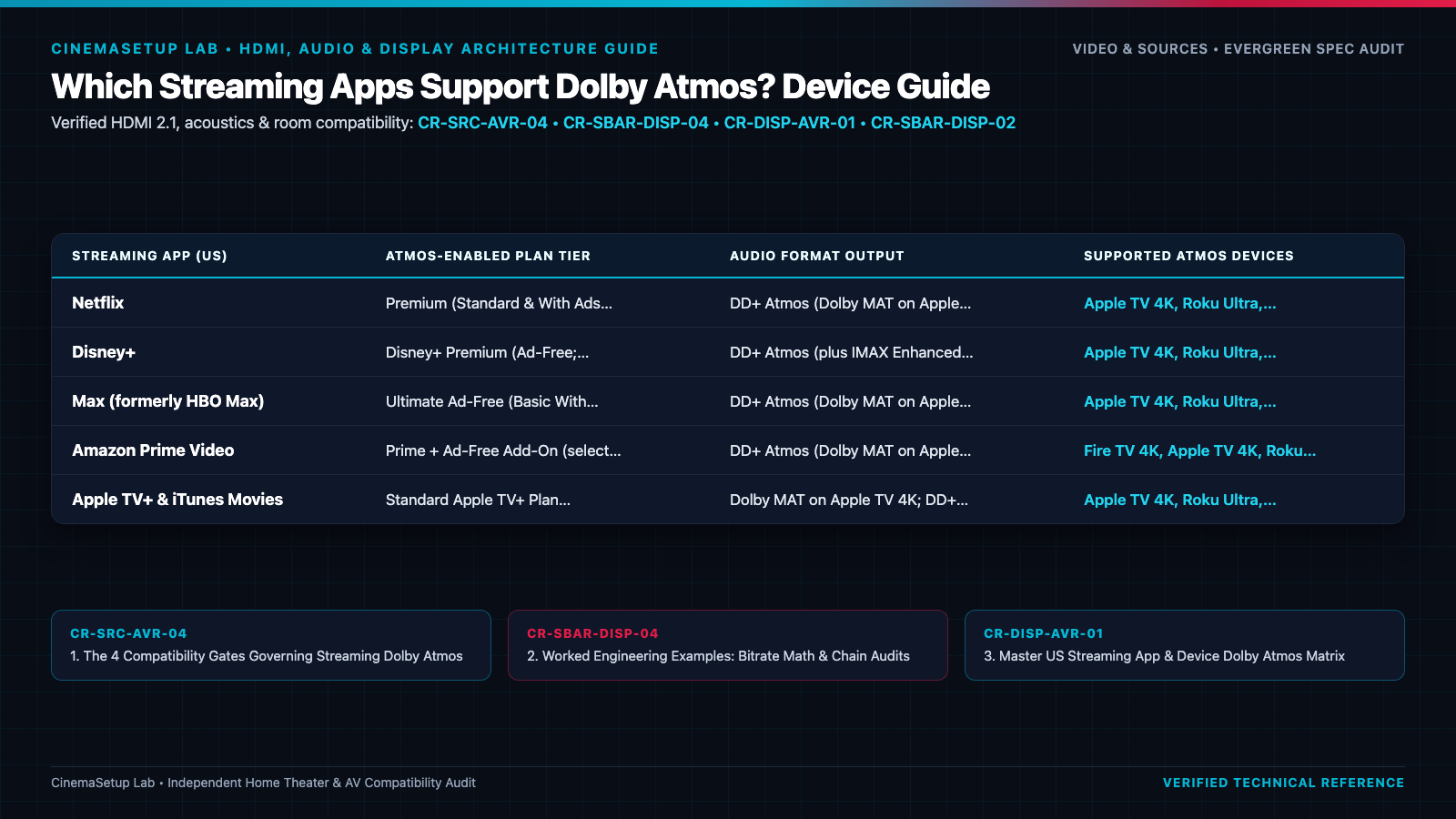
3. Master US Streaming App & Device Dolby Atmos Matrix
The reference matrix below summarizes verified US subscription plan requirements, Atmos transport formats, device coverage, and known platform quirks across major video and music streaming services (subject to ongoing app updates under L-15 and ISS-SRC-APP-FORMAT-GAPS).
| Streaming App (US) | Atmos-Enabled Plan Tier | Audio Format Output | Supported Atmos Devices | Critical Compatibility Caveat |
|---|---|---|---|---|
| Netflix | Premium (Standard & With Ads stop at 5.1) | DD+ Atmos (Dolby MAT on Apple TV 4K / Xbox) | Apple TV 4K, Roku Ultra, Google TV Streamer, Fire TV 4K, modern LG/Samsung/Sony TVs, Xbox, PS5 (select builds) | Strictly gated behind the top Premium tier; verify English original audio track is selected |
| Disney+ | Disney+ Premium (Ad-Free; Basic/With Ads omits Atmos on many setups) | DD+ Atmos (plus IMAX Enhanced DTS:X on select Marvel titles) | Apple TV 4K, Roku Ultra, Google TV Streamer, Fire TV 4K, LG/Samsung/Sony TVs, Xbox, PS5 | IMAX Enhanced DTS:X requires certified TV/AVR; Samsung TVs (e.g., S90H) strip DTS over eARC (CR-SBAR-DISP-04) |
| Max (formerly HBO Max) | Ultimate Ad-Free (Basic With Ads & Standard cap at 5.1) | DD+ Atmos (Dolby MAT on Apple TV 4K / Xbox) | Apple TV 4K, Roku Ultra, Google TV Streamer, Fire TV 4K, LG/Samsung/Sony TVs, Xbox | Atmos & 4K Dolby Vision moved exclusively to the Ultimate Ad-Free plan; check legacy bundle entitlements |
| Amazon Prime Video | Prime + Ad-Free Add-On (select titles free on base Prime vary) | DD+ Atmos (Dolby MAT on Apple TV 4K / Xbox) | Fire TV 4K, Apple TV 4K, Roku Ultra, Google TV Streamer, modern smart TVs, Xbox | Amazon gated Dolby Vision & Dolby Atmos behind the Ad-Free add-on across most Prime originals |
| Apple TV+ & iTunes Movies | Standard Apple TV+ Plan (single tier; purchased/rented 4K titles) | Dolby MAT on Apple TV 4K; DD+ Atmos on other platforms | Apple TV 4K, Roku Ultra, Google TV, Fire TV 4K, LG/Samsung/Sony TVs, Xbox, PS5 | Broadest cross-device Atmos consistency; Apple TV 4K requires eARC or direct AVR input for Dolby MAT |
| Paramount+ | Paramount+ with Showtime (Essential plan excludes Atmos/4K) | DD+ Atmos (select films & original series) | Apple TV 4K, Roku 4K, Fire TV 4K, Google TV, select LG/Samsung/Sony TVs | Catalog depth is smaller than Netflix/Disney+; Essential ad-supported plan stops at 5.1/stereo |
| Peacock | Premium / Premium Plus (title- & device-dependent) | DD+ Atmos (select Universal films & originals) | Apple TV 4K, Roku 4K, Fire TV 4K, Google TV, LG/Samsung TVs | Live sports broadcasts largely stay in 5.1 or 2.0 stereo; Atmos applies to select on-demand movies |
| Hulu | Hulu (Ad-Free or With Ads) — app- & device-dependent | DD+ Atmos (limited select originals) | Apple TV 4K, Fire TV 4K, LG webOS, Samsung Tizen, Roku (select models) | Smallest Atmos catalog among major US apps; legacy TV builds often drop back to 2.0/5.1 |
| Fandango at Home (Vudu) & Movies Anywhere | Transactional 4K UHD Purchases/Rentals (no monthly tier) | DD+ Atmos (Dolby MAT on Apple TV 4K) | Apple TV 4K, Roku Ultra, Google TV, Fire TV 4K, LG/Samsung/Sony TVs | Must own or rent the 4K UHD (not HDX/HD) license; highest commercial streaming bitrates |
| Apple Music / Tidal / Amazon Music Unlimited | Standard Individual/Family Tier (no separate Atmos surcharge) | DD+ JOC / Dolby MAT Spatial Audio (check AVR/box app) | Apple Music: Apple TV 4K & Sonos/select AVRs; Tidal: Apple TV 4K, Fire TV, Google TV; Amazon Music: Fire TV & HEOS/Sonos | Spotify does not stream Dolby Atmos music tracks; music Atmos requires dedicated TV/streamer apps rather than standard Bluetooth |
4. Myth vs. Engineering Reality: 5 Streaming Atmos Traps
5 Common Streaming Dolby Atmos Misconceptions Audited Against Standards:
- Myth 1: “If my TV or streaming stick supports Dolby Atmos, every subscription app delivers it automatically.” Reality (ISS-SRC-APP-FORMAT-GAPS / G-15): Hardware support only certifies the decoder. Netflix, Max, Paramount+, and Prime Video lock Atmos behind higher-priced ad-free tiers, and individual apps still vary by OS build and title language track.
- Myth 2: “Netflix or Apple TV+ Dolby Atmos delivers the exact same audio quality as a 4K Blu-ray.” Reality (CR-SBAR-DISP-02): Streaming apps transmit Atmos inside compressed, lossy Dolby Digital Plus (roughly 448–768 kbps). A 4K UHD Blu-ray disc carries lossless Dolby TrueHD Atmos at multiple megabits per second with uncompressed dynamic range—and requires full HDMI eARC or direct AVR connection.
- Myth 3: “Apple TV 4K works identically to Roku or Google TV on an older HDMI ARC television.” Reality (CR-DISP-AVR-01 / CR-SRC-AVR-04): Roku Ultra, Google TV Streamer, and Fire TV send E-AC-3 JOC over standard HDMI ARC. Apple TV 4K outputs uncompressed multichannel Dolby MAT LPCM, which overflows standard ARC and drops to stereo PCM unless you plug the Apple TV directly into an AVR/soundbar HDMI input or upgrade to an eARC TV.
- Myth 4: “An optical cable or an entry 2.1/3.1 ‘Dolby Atmos’ soundbar gives me overhead height channels.” Reality (CR-SBAR-DISP-01 / CR-SYS-05): Optical TOSLink never carries Dolby Atmos. Likewise, entry 2.1 or 3.1 bars advertised as “Dolby Atmos” use software DSP virtualization without physical up-firing or ceiling drivers—meaning they accept the Atmos signal without physically projecting overhead sound.
- Myth 5: “Expensive silver or gold-plated HDMI cables improve streaming Atmos clarity.” Reality (G-14 / CR-ACC-DISP-01): Digital HDMI audio packets either arrive error-free or drop out completely. An inexpensive Ultra High Speed HDMI Certified (48 Gbps) or Premium High Speed (18 Gbps) cable delivers identical bit-for-bit Atmos performance to boutique audiophile cables.
5. Verified US 120V Streaming Devices Audited for Dolby Atmos
The four North American 120V AC / 60 Hz retail streamers below come from verified Amazon US organic listings checked as of 2026-11-26, covering every major US streaming OS and Atmos transport path. Before buying, confirm how Apple TV 4K and Google TV Streamer differ on older ARC versus modern eARC televisions in our Apple TV 4K vs Google TV Streamer comparison, or review prior-generation A15 behavior in our Apple TV 4K (3rd Gen) audit. At Amazon checkout, verify that Amazon.com or an authorized US brand dealer is the seller so US factory warranty coverage applies (G-26, CR-SYS-02).
1. Apple TV 4K (4th generation) — Broadest US Video & Spatial Music Atmos Ecosystem (Dolby MAT)

Key Audited Specs & Box Contents: 4K60 HDR (HEVC, AV1 hardware decode, HDCP 2.3) | HDR: Dolby Vision, HDR10+, HDR10, HLG with system-wide Match Frame Rate & HDMI 2.1 QMS | Audio: Dolby Atmos via Dolby MAT inside multichannel LPCM, DD+ 7.1, DD 5.1 (no raw TrueHD/DTS-HD bitstream) | Networking: Gigabit Ethernet, Wi-Fi 7 (802.11be), Bluetooth 6.0, Thread/Matter | Dimensions: 3.67 × 3.67 × 1.22 in (9.3 × 9.3 × 3.1 cm), 0.48 lb (217 g) | In the Box: US 120V Apple TV 4K (4th gen) 128 GB unit, Siri Remote (USB-C), US AC power cord (HDMI cable sold separately) | Price Tier: $250-$350
For eARC-equipped OLEDs (such as the LG C6 or Samsung S90H) and direct-AVR theaters, the Apple TV 4K (4th generation) delivers the cleanest US Atmos app support—spanning Netflix, Disney+, Max, Prime Video, Apple TV+, Paramount+, Peacock, Hulu, Apple Music Spatial Audio, and Tidal in a fast, ad-free tvOS launcher. Just respect its CR-DISP-AVR-01 transport rule: because tvOS converts streaming Atmos into uncompressed Dolby MAT LPCM, plug it directly into your AVR’s HDMI input or use full HDMI eARC on both TV and audio gear. Plain HDMI ARC forces a 2.0 stereo fallback unless you sacrifice Atmos for Dolby Digital 5.1. Also note that Apple omits native OS-level DTS:X passthrough (CR-SRC-AVR-04).
Pros
- Consistent Dolby Atmos support across virtually all US video apps plus native Apple Music Spatial Audio
- Ad-free tvOS interface with system-wide Match Frame Rate, HDMI 2.1 QMS, Wi-Fi 7, and Gigabit Ethernet
Cons
- Dolby MAT LPCM Atmos fails over older non-eARC HDMI ARC links (requires eARC or direct AVR input)
- No native raw bitstream passthrough for lossless Dolby TrueHD Atmos or DTS:X local disc rips; HDMI cable sold separately
2. Roku Ultra 4K Streaming Player — Best Plug-and-Play DD+ Atmos + DTS Surround for ARC & eARC

Key Audited Specs & Box Contents: 4K60 HDR (HEVC, AV1, VP9 decode, HDCP 2.3) | HDR: Dolby Vision, HDR10+, HDR10, HLG with Auto Refresh Rate & HDMI 2.1 QMS | Audio: Dolby Atmos via Dolby Digital Plus (E-AC-3 JOC) bitstream + DTS Digital Surround passthrough | Networking: Wi-Fi 6 (802.11ax), 10/100 Ethernet, USB-A, Bluetooth | Dimensions: 4.9 × 5.0 × 1.0 in (12.4 × 12.7 × 2.5 cm), 0.37 lb (167 g) | In the Box: US 120V Roku Ultra player, backlit USB-C Voice Remote Pro (2nd Ed.), Premium High Speed HDMI cable, US power adapter | Price Tier: $75-$125
If your television only has standard HDMI ARC (or you want effortless household navigation without paying flagship Apple pricing), the current Roku Ultra (B0DF44RTTP) solves the Dolby MAT bottleneck cleanly. Because Roku outputs compressed Dolby Digital Plus (E-AC-3 JOC) Atmos bitstreams (~448–768 kbps) instead of uncompressed LPCM, major apps—Netflix, Disney+, Max, Prime Video, Apple TV+, and Paramount+—pass Atmos down both standard ARC and modern eARC links to soundbars and AVRs. It also includes a Premium High Speed HDMI cable in the box, adds DTS Digital Surround passthrough, and packs a USB-C rechargeable backlit Voice Remote Pro. Trade-offs include home-screen ad banners and a 10/100 Mbps Ethernet port (Wi-Fi 6 is faster for high-bitrate streams).
Pros
- Outputs DD+ Dolby Atmos cleanly over both standard HDMI ARC and eARC, plus DTS Digital Surround passthrough
- Includes Dolby Vision, HDR10+, HDMI 2.1 QMS, Wi-Fi 6, HDMI cable, and a backlit rechargeable Voice Remote Pro
Cons
- Wired LAN port stops at 10/100 Fast Ethernet rather than Gigabit
- Home screen shows sponsored promotional tiles, and lacks Apple Music Spatial Audio app support
3. Google TV Streamer (4K) — Gigabit Ethernet & 32 GB Storage With ARC-Friendly DD+ Atmos

Key Audited Specs & Box Contents: 4K60 HDR (HEVC, AV1, VP9 decode, HDCP 2.3) | HDR: Dolby Vision, HDR10+, HDR10, HLG (Android 14 Match Content Frame Rate) | Audio: Dolby Atmos via Dolby Digital Plus (E-AC-3 JOC), Dolby Digital (no native DTS passthrough or TrueHD) | Networking: Gigabit Ethernet (10/100/1000 Mbps), Wi-Fi 5 (802.11ac), Bluetooth 5.1, USB-C, Thread/Matter | Dimensions: 6.4 × 3.0 × 1.0 in (16.2 × 7.6 × 2.7 cm), 0.36 lb (163 g) | In the Box: US 120V Google TV Streamer (4K) 32 GB unit, Voice Remote with 2 AAA batteries, USB-C power cable & US adapter (HDMI 2.1 cable sold separately) | Price Tier: $75-$125
Like the Roku Ultra, the Google TV Streamer (4K) delivers compressed Dolby Digital Plus (E-AC-3 JOC) Atmos across Netflix, Disney+, Max, Prime Video, Apple TV+, Paramount+, and Tidal—making it reliable on both standard ARC soundbars and modern eARC AVRs. Where it separates itself in the under-$125 bracket is wired Gigabit Ethernet, 32 GB of internal storage, and built-in Thread/Matter smart-home routing. Two trade-offs apply before checkout: Google omits an HDMI cable from the box, and Google’s official audio specs exclude native DTS/DTS:X passthrough and lossless Dolby TrueHD—so local DTS-heavy disc backups belong on an NVIDIA Shield TV Pro or UHD Blu-ray player instead (CR-SRC-AVR-04).
Pros
- Gigabit Ethernet and 32 GB storage keep 4K Dolby Vision and DD+ Atmos streams buffer-free across Google TV apps
- Passes E-AC-3 JOC Atmos cleanly over older HDMI ARC televisions as well as eARC
Cons
- No native DTS / DTS:X passthrough or lossless TrueHD Atmos support
- Wireless caps at Wi-Fi 5 (802.11ac) and HDMI 2.1 cable must be purchased separately
4. Amazon Fire TV Stick 4K Plus — Compact Wi-Fi 6 Stick for Video & Amazon Music Atmos

Key Audited Specs & Box Contents: 4K60 HDR (HEVC, AV1 hardware decode, HDCP 2.2/2.3) | HDR: Dolby Vision, HDR10+, HDR10, HLG with Match Original Frame Rate | Audio: Dolby Atmos (Dolby Digital Plus E-AC-3 JOC), 7.1 surround, HDMI audio passthrough up to 5.1 | Networking: Wi-Fi 6 (802.11ax), Bluetooth 5.3 (optional USB OTG Ethernet adapter) | Dimensions: 3.9 × 1.2 × 0.6 in (9.9 × 3.0 × 1.4 cm), 0.12 lb (54 g) | In the Box: US 120V Fire TV Stick 4K Plus, Alexa Voice Remote with 2 AAA batteries, USB power cable, US wall adapter, short HDMI extender | Price Tier: $30-$60
For secondary bedrooms, wall-mounted OLEDs with tight rear clearance, or direct insertion into an AVR’s rear HDMI jack, the Amazon Fire TV Stick 4K Plus brings Wi-Fi 6, Dolby Vision, HDR10+, and E-AC-3 Dolby Atmos into the $30–$60 bracket. Because it runs Fire OS natively, it unlocks Atmos across Prime Video (Ad-Free add-on), Netflix Premium, Disney+, Max Ultimate, Apple TV+, and Amazon Music Unlimited Spatial Audio. Keep two limits in mind: 8 GB of internal storage fills quickly if you install many apps, and Fire OS dedicates prominent home-screen banners to sponsored promotions. Always power the stick with the supplied US 120V wall adapter rather than a TV’s low-amperage USB service port.
Pros
- Supports DD+ Dolby Atmos across major video apps plus Amazon Music Spatial Audio under $60
- Wi-Fi 6 radio and included short HDMI extender fit behind tight TVs or directly into AVR rear ports
Cons
- 8 GB storage fills quickly, and Fire OS displays prominent home-screen advertising
- Wired Ethernet requires a separate USB OTG adapter; no lossless TrueHD bitstream support
6. TV Audio Settings, HDMI Cabling & Installation Safety
Post-Setup Atmos Checklist, Cable Standards & YMYL Safety Rules (CR-ACC-DISP-01 / CR-SYS-03 / CR-SYS-04 / G-27):
- TV Audio Menu Settings: Inside your TV’s sound menu, enable HDMI eARC (when supported by both TV and AVR/soundbar), set Digital Audio Out to
PassthroughorAuto(neverPCM, which downmixes bitstreams to 2.0 stereo), and enable HDMI-CEC (Anynet+, SimpLink, or Bravia Sync) so ARC/eARC handshakes initialize cleanly. Only one audio device can hold the TV’s ARC/eARC return channel at a time (CR-SYS-03). - Cable Certification & Run Length (CR-ACC-DISP-01): Use an Ultra High Speed HDMI Certified (48 Gbps) cable—look for the official QR hologram label—for eARC and 4K HDR links up to 10 ft (3.0 m). For longer concealed runs to wall-mounted TVs, choose a directional Active Optical Fiber (AOC) HDMI cable clearly labeled
SourceandDisplay. - In-Wall CL2/CL3 Wiring, Mounting & Electrical Safety (G-27): Never fish standard PVC-jacketed HDMI cables, speaker wires, or AC power cords inside drywall cavities. Use cables carrying a verified UL CL2 or CL3 in-wall fire rating, plug AV hardware into a UL 1449-listed surge protector, follow the TV, soundbar, and wall-mount manufacturer’s printed instructions for stud anchoring and VESA weight limits, and consult a licensed electrician or licensed AV installer before cutting walls or adding recessed outlets.
- Lip-Sync & Comfortable Listening Levels (CR-SYS-04, G-27): If dialogue lags slightly behind video when routing Atmos through TV eARC, adjust your AVR or soundbar’s AV Sync / Audio Delay menu and run your receiver’s built-in level-calibration tones to balance height-channel volume. Keep playback at comfortable listening levels during extended movie sessions.
7. Authoritative Standards & Platform References
- Dolby Laboratories: Dolby Atmos over Dolby Digital Plus (E-AC-3 JOC), Dolby MAT over LPCM, and Dolby TrueHD home theater delivery specifications at dolby.com.
- HDMI Licensing Administrator / HDMI Forum: HDMI 2.1 eARC vs. ARC audio bandwidth specifications, QMS, and Ultra High Speed HDMI Cable Certification at hdmi.org.
- Apple Support (US): Dolby Atmos audio output via Dolby MAT, tvOS Audio Format settings, and eARC compatibility on Apple TV 4K at support.apple.com.
- Roku Official Product & Support Documentation: Roku Ultra 4K (B0DF44RTTP) Dolby Atmos DD+ decode, DTS Digital Surround passthrough, and HDMI 2.1 QMS specifications at roku.com.
- Google TV Official Specifications: Google TV Streamer (4K) Dolby Digital Plus Atmos audio support, Gigabit Ethernet, and Android 14 frame-rate matching at support.google.com.
How We Audited This Guide
- Displays and sources were audited across OLED vs. Mini-LED HDR formats (Dolby Vision, HDR10+), 4K/120Hz VRR console support, verified ANSI/ISO projector lumens, throw distance ratios, and lossless optical disc vs. streaming audio codecs.
- Every AV receiver, speaker, subwoofer, soundbar, OLED/Mini-LED TV, projector, source player, and accessory spec was cross-checked against official manufacturer manuals, CEA/CTA standards, and live Amazon US listings.
- Recommendations were evaluated against our weighted vertical scoring rubrics and documented CR-* compatibility rules; we never invent nits, contrast ratios, bench wattage, or room decibels.
Continue Your Audit
8. Frequently Asked Questions
Which streaming apps support Dolby Atmos on most 4K devices?
Netflix (Premium), Disney+ (Premium), Max (Ultimate Ad-Free), Prime Video (Ad-Free add-on), Apple TV+, Paramount+ (with Showtime), Peacock, Vudu/Fandango at Home, Apple Music, Tidal, and Amazon Music Unlimited support Dolby Atmos on compatible 4K streamers and smart TVs. Base ad-supported tiers usually drop back to 5.1.
Why does Netflix not show the Dolby Atmos badge on my TV or soundbar?
First verify you subscribe to the Netflix Premium plan rather than Standard or Standard with Ads. Second, confirm your TV Digital Audio Out is set to Passthrough or Auto over HDMI ARC/eARC—not Optical or PCM—and select the primary English Atmos audio track.
Does Apple TV 4K require HDMI eARC for Dolby Atmos in streaming apps?
Yes, if you plug the Apple TV 4K into your TV first. Because tvOS outputs Atmos via uncompressed Dolby MAT LPCM rather than compressed Dolby Digital Plus, standard HDMI ARC lacks the bandwidth and drops to stereo PCM. Plugging directly into an AVR HDMI input avoids eARC entirely.
Do streaming apps play lossless Dolby TrueHD Atmos like a 4K Blu-ray?
No. Commercial subscription apps stream Atmos using compressed Dolby Digital Plus (E-AC-3 JOC) at roughly 448–768 kbps to save internet bandwidth. Lossless Dolby TrueHD Atmos remains exclusive to physical 4K UHD Blu-ray discs and local media server rips played through compatible clients.
Can I get Dolby Atmos from streaming apps over an optical audio cable?
No. Optical TOSLink cables cap at compressed Dolby Digital 5.1, DTS 5.1, or stereo PCM and cannot carry Dolby Digital Plus metadata. Under rule CR-SBAR-DISP-01, you must connect your soundbar or AV receiver via HDMI ARC or HDMI eARC (or plug the streamer straight into the AVR).
Does Spotify support Dolby Atmos music streaming on home theater receivers?
No. Spotify streams stereo audio and does not support Dolby Atmos Music. Listeners who want spatial Dolby Atmos music tracks on an AV receiver or Atmos soundbar should use Apple Music (via Apple TV 4K or supported receivers), Tidal, or Amazon Music Unlimited.


