
Disclosure: As an Amazon Associate, I earn from qualifying purchases. If you buy through links on this page, we may earn a small commission at no extra cost to you.
Finding the best tv for home theater comes down to matching panel physics and HDMI port architecture to your room light and gear chain. Too many buyers pick an OLED for a glare-filled family room or buy a two-port HDMI 2.1 television without realizing that eARC consumes half of their 4K120 console inputs.
To eliminate guesswork, we audited nine current 65-inch OLED, QD-OLED, and Mini-LED models stocked on Amazon US against published manufacturer specifications, HDR format support, and OLED vs. Mini-LED room lighting trade-offs. If you sit farther than 10 ft (3.0 m) away in a dedicated dark room, also compare our best home theater projectors before locking in a screen size.
In This Guide
Quick Picks: Best TV for Home Theater at a Glance
#1 Best Overall
LG C6 65-Inch OLED evo (65C6)
Four 48 Gbps HDMI 2.1 ports, Dolby Vision, and infinite WOLED contrast make it the most adaptable cinema and gaming hub. (Jump to audit)
#2 Best Bright-Room Value
Hisense 65U8QG Mini-LED
Packs 2,048 local dimming zones, native 165 Hz refresh, and both Dolby Vision IQ and HDR10+ between $800 and $1,200. (Jump to audit)
#3 Best Reference Cinema
Sony BRAVIA 8 II QD-OLED
Combines QD-OLED color volume with Sony XR tone mapping for dedicated movie rooms running an HDMI 2.1 AVR. (Jump to audit)
Side-by-Side Comparison: 9 Audited Home Theater TVs
| Product & Award | Best For | Panel & Refresh | HDMI 2.1 / eARC & HDR | Link |
|---|---|---|---|---|
| 1. LG C6 65-Inch (65C6) Best Overall Home Theater TV | Dark-room movies & multi-console gaming | WOLED evo 120 Hz / 165 Hz VRR | 4x HDMI 2.1 (eARC HDMI 2) Dolby Vision, HDR10, HLG | View on Amazon |
| 2. Samsung S90H 65-Inch Best OLED Motion & Gaming Color Volume | Lit living rooms & PC/console gaming | OLED Glare-Free Up to 165 Hz VRR | 4x HDMI 2.1 (eARC shared) HDR10+, HDR10 (no DV) | View on Amazon |
| 3. Sony BRAVIA 8 II 65-Inch Best Reference Cinema Mastering | Cinephile tone mapping + AVR setups | QD-OLED 120 Hz native | 2x HDMI 2.1 (eARC HDMI 3) Dolby Vision, HDR10, HLG | View on Amazon |
| 4. Hisense 65U8QG Best Bright-Room Mini-LED Value | Daytime sports & HDR under $1,200 | Mini-LED (2,048 zones) 165 Hz native | 3x HDMI 2.1 (eARC HDMI 3) Dolby Vision IQ + HDR10+ | View on Amazon |
| 5. TCL 65QM8L Best High-Contrast Mini-LED Light Cannon | High-output bright rooms & wide seats | SQD-Mini LED WHVA 144 Hz native | 4x HDMI 2.1 (eARC HDMI 1) Dolby Vision IQ + HDR10+ | View on Amazon |
| 6. Sony BRAVIA 7 65-Inch Best Sony Mini-LED Under $2,000 | Sports upscaling & zero burn-in worry | Mini-LED QLED 120 Hz native | 2x HDMI 2.1 (eARC HDMI 3) Dolby Vision, HDR10, HLG | View on Amazon |
| 7. Samsung QN90H 65-Inch Best Glare-Free Sunlit Living Room TV | Window-heavy rooms & daytime glare | Neo QLED Glare-Free Up to 144 Hz VRR | 4x HDMI 2.1 (eARC shared) HDR10+, HDR10 (no DV) | View on Amazon |
| 8. TCL 65QM7L Best Mid-Budget Home Theater Mini-LED | Entry local dimming under $900 | SQD-Mini LED HVA 144 Hz native | 2x HDMI 2.1 (eARC HDMI 4) Dolby Vision IQ + HDR10+ | View on Amazon |
| 9. LG B6 65-Inch OLED Best Entry 4K OLED 120Hz | Dark-room OLED near $1,000–$1,400 | WOLED 120 Hz / 144 Hz PC | 4x HDMI 2.1 (eARC HDMI 2) Dolby Vision, HDR10, HLG | View on Amazon |
Match Your Use Case: Which TV Fits Your Room & Gear?
| Buyer Scenario | Best Match | Why & Expected Outcome |
|---|---|---|
| Dedicated dark theater + PS5, Xbox Series X & Atmos bar | 1. LG C6 65-Inch OLED evo | Four 48 Gbps HDMI 2.1 ports leave three 4K120 inputs open when eARC runs on HDMI 2, with Dolby Vision and zero haloing. |
| Lit living room OLED + 165 Hz PC gaming | 2. Samsung S90H 65-Inch OLED | Glare-Free matte surface diffuses overhead reflections across four 165 Hz HDMI 2.1 inputs; trades Dolby Vision for HDR10+. |
| 4K Blu-ray cinema mastering with an HDMI 2.1 AVR | 3. Sony BRAVIA 8 II QD-OLED | QD-OLED color volume and Sony XR processing excel when consoles switch through an AVR rather than the two TV 4K120 ports. |
| Bright open living room under $1,200 | 4. Hisense 65U8QG Mini-LED | 2,048 local dimming zones, high peak output specs, and both Dolby Vision IQ and HDR10+ beat entry LCDs in daytime light. |
| Sunlit family room with direct window glare | 7. Samsung QN90H Neo QLED | Matte Glare-Free Mini-LED backlight eliminates burn-in anxiety during all-day news and sports while keeping four HDMI 2.1 ports. |
| Budget-focused dark cinema under $1,400 | 9. LG B6 65-Inch OLED | Preserves self-emissive black levels, Dolby Vision, and four 48 Gbps HDMI 2.1 ports while freeing budget for surround audio. |
Detailed Audits: Best TVs for Home Theater Ranked 1–9
1. LG C6 65-Inch OLED evo AI 4K Smart TV (65C6) — Best Overall Home Theater TV

Quick Specs: 65-in 4K WOLED evo (Brightness Booster) | 120 Hz native / up to 165 Hz VRR | 4x 48 Gbps HDMI 2.1 (eARC on HDMI 2) | Dolby Vision, HDR10, HLG | VESA 300 x 200 mm, 36.6 lb (16.6 kg) without stand | Price Tier: $1,500–$2,200 (Premium TV)
Audit Score: 9.4 / 10
- Picture Architecture & Contrast Potential (35%): 9.5 / 10
- Gaming & HDMI 2.1 Connectivity (20%): 9.8 / 10
- HDR & Audio Passthrough Formats (15%): 9.0 / 10
- Room Fit & Viewing Geometry (15%): 9.0 / 10
- Smart Platform, Warranty & Open Caveats (10%): 9.2 / 10
- Value Within Tier (5%): 9.4 / 10
Succeeding LG’s retired C4 and C5 generations in current Amazon US inventory, the LG C6 65-inch OLED evo (65C6) earns our top overall rank because it solves the connectivity bottleneck that trips up competing flagship displays. Every one of its four HDMI inputs supports full 48 Gbps HDMI 2.1 bandwidth, 4K at 120 Hz (up to 165 Hz VRR for compatible PCs), ALLM, AMD FreeSync Premium, and NVIDIA G-SYNC Compatible. Placing HDMI eARC on port 2 leaves three unshared high-bandwidth inputs open for a PS5, Xbox Series X, and gaming PC without forcing you to buy an HDMI 2.1 AV receiver just for switching (rule CR-DISP-AVR-02).
In dark or dim evening rooms, self-emissive WOLED evo pixels with Brightness Booster produce absolute zero-nit blacks beside pinpoint specular stars with zero Mini-LED backlight haloing. Compared with the Samsung S90H in the same $1,500–$2,200 bracket, the LG C6 supports Dolby Vision cinema and gaming metadata natively, uses LG’s α11 AI Processor 4K Gen3 on webOS 26, and avoids Samsung’s cross-size panel-lottery uncertainty. Against the Sony BRAVIA 8 II, the C6 gives up QD-OLED peak color saturation in exchange for double the HDMI 2.1 ports and an easier-to-mount 36.6 lb (16.6 kg) chassis.
Buyer Verification Alert: Confirm the Amazon checkout page specifies the 2026 US model (65C6) shipped and sold by Amazon.com or an authorized LG dealer so US warranty coverage remains intact (G-26). Older C4/C5 third-party closeouts should be treated cautiously.
Pros
- Four full 48 Gbps HDMI 2.1 ports leave three 4K120/165Hz inputs free with eARC on HDMI 2
- Per-pixel WOLED evo contrast eliminates Mini-LED blooming around white subtitles and credits
- Dolby Vision, FILMMAKER MODE, HDMI VRR, FreeSync Premium, and G-SYNC Compatible support
- Manageable 36.6 lb (16.6 kg) panel weight simplifies VESA 300 x 200 mm stud mounting
Cons
- No HDR10+ dynamic metadata support; HDR10+-only titles play in baseline HDR10
- Glossy WOLED surface mirrors bright windows more noticeably than matte Glare-Free sets
Verdict: Buy it if you want a versatile dark-room movie and multi-console centerpiece with zero HDMI 2.1 port juggling. Skip it if direct afternoon sunlight hits the screen, where a matte Mini-LED like the Samsung QN90H holds reflections in check. Budget for Ultra High Speed HDMI Certified cables (48 Gbps) and keep static news banners varied to respect OLED pixel longevity.
2. Samsung S90H 65-Inch OLED 4K Smart TV — Best OLED Motion & Gaming Color Volume

Quick Specs: 65-in 4K OLED (Glare-Free matte coating) | Up to 165 Hz VRR | 4x HDMI 2.1 (eARC supported) | HDR10+, HDR10, HLG (no Dolby Vision) | VESA 300 x 200 mm, 42.1 lb (19.1 kg) without stand | Price Tier: $1,500–$2,200 (Premium TV)
Audit Score: 9.1 / 10
- Picture Architecture & Contrast Potential (35%): 9.3 / 10
- Gaming & HDMI 2.1 Connectivity (20%): 9.7 / 10
- HDR & Audio Passthrough Formats (15%): 8.0 / 10
- Room Fit & Viewing Geometry (15%): 9.2 / 10
- Smart Platform, Warranty & Open Caveats (10%): 8.6 / 10
- Value Within Tier (5%): 9.2 / 10
Replacing the discontinued S90D in Amazon’s 2026 US catalog, the Samsung S90H 65-inch OLED matches LG’s four-port HDMI 2.1 layout while adding Samsung’s Glare-Free anti-reflection screen and 165 Hz VRR PC capability. Paired with the NQ4 AI Gen3 processor, FreeSync Premium Pro, G-SYNC Compatible, and ALLM, all four HDMI inputs support full high-bandwidth gaming, leaving three 4K120/165Hz ports open when eARC feeds a soundbar or AV receiver.
Two architectural caveats separate the S90H from the LG C6 and Sony BRAVIA 8 II. First, Samsung omits Dolby Vision entirely: under rule CR-SRC-DISP-01, Dolby Vision discs, Apple TV 4K streams, and Xbox Dolby Vision games play back in static HDR10 (though HDR10+ works on Prime Video and compatible discs). Second, buyers must account for Samsung’s S90-series panel-lottery history across sizes and regions (QD-OLED vs. WOLED uniformity), and recognize that the Glare-Free matte surface diffuses lamps well during the day at the cost of slightly lifted perceived blacks if bright room light hits the screen directly.
Buyer Verification Alert: Check the seller and US SKU code (QN65S90HAEXZA) before checkout. Samsung S90-line panels can vary between QD-OLED and WOLED depending on screen size and regional batch, and non-US or non-authorized third-party listings risk voiding Samsung’s US factory warranty.
Pros
- Four full HDMI 2.1 ports support 4K up to 165 Hz VRR alongside eARC without port starvation
- Glare-Free anti-reflection finish breaks up mirror-like window and lamp reflections in lit living rooms
- Supports HDR10+, FreeSync Premium Pro, G-SYNC Compatible, ALLM, and Q-Symphony sync
Cons
- Lacks Dolby Vision support, forcing Dolby Vision sources to fall back to static HDR10
- S90-series panel lottery across sizes/batches and slightly raised matte blacks under direct ambient light compared with glossy WOLED
Verdict: Buy it if you game on PC or multiple consoles in a room with uncontrollable lamp reflections and prioritize HDR10+ over Dolby Vision. Skip it if your 4K UHD Blu-ray collection relies on Dolby Vision mastering or you demand guaranteed glossy WOLED black-level behavior in dim lighting.
3. Sony BRAVIA 8 II 65-Inch QD-OLED 4K HDR Smart Google TV (K-65XR80M2) — Best Reference Cinema Mastering & Tone Mapping

Quick Specs: 65-in 4K QD-OLED | 120 Hz native | 2x HDMI 2.1 (HDMI 3 & 4, 48 Gbps; eARC on HDMI 3) + 2x HDMI 2.0 | Dolby Vision, HDR10, HLG | Google TV, Acoustic Surface Audio+ | Price Tier: $2,200–$3,000 (Premium TV)
Audit Score: 9.1 / 10
- Picture Architecture & Contrast Potential (35%): 9.7 / 10
- Gaming & HDMI 2.1 Connectivity (20%): 8.0 / 10
- HDR & Audio Passthrough Formats (15%): 9.2 / 10
- Room Fit & Viewing Geometry (15%): 9.0 / 10
- Smart Platform, Warranty & Open Caveats (10%): 9.2 / 10
- Value Within Tier (5%): 8.2 / 10
Purists building around 4K UHD Blu-ray discs and calibrated streaming gravitate toward the Sony BRAVIA 8 II (K-65XR80M2) for one clear reason: it pairs QD-OLED quantum-dot color volume with Sony’s XR Processor and Dolby Vision support. Unlike the Samsung S90H, Sony gives film fans full Dolby Vision mastering, DTS:X and Dolby TrueHD eARC passthrough, and Sony Pictures Core / Netflix calibrated modes on Google TV without sacrificing self-emissive pixel precision.
Where the BRAVIA 8 II loses points against the LG C6 and Samsung S90H is its HDMI 2.1 port budget. Only two of its four inputs (HDMI 3 and HDMI 4) carry 48 Gbps 4K120 bandwidth, while HDMI 1 and HDMI 2 top out at 4K60. Because HDMI 3 is also the eARC return port, plugging an eARC soundbar or receiver directly into HDMI 3 leaves only HDMI 4 available for a 4K120 console—unless you route your PS5, Xbox Series X, and PC through a multi-input 40 Gbps HDMI 2.1 AV receiver first (CR-DISP-AVR-02).
Buyer Verification Alert: Plan your HDMI topology before ordering. With only two 4K120 inputs and eARC shared on HDMI 3, dual-console households without an HDMI 2.1 AVR should step to the 4-port LG C6 instead. Verify exact K-65XR80M2 VESA spacing and weight on Sony’s manual before buying a wall mount.
Pros
- QD-OLED panel delivers saturated HDR color volume alongside infinite per-pixel contrast
- Sony XR Processor leads in near-black gradation, motion clarity, and 1080p/720p upscaling
- Passes Dolby TrueHD Atmos, DTS:X, and 7.1 LPCM over eARC plus Dolby Vision and PS5 Auto HDR Tone Mapping
Cons
- Only two HDMI 2.1 ports (HDMI 3 & 4), with eARC sharing HDMI 3 and leaving just one open 4K120 port
- Sits in the upper $2,200–$3,000 bracket without HDR10+ dynamic metadata support
Verdict: Buy it if reference film accuracy, Dolby Vision disc playback, and Sony XR upscaling sit above port count, especially when feeding video through a 40 Gbps HDMI 2.1 AVR. Skip it if you connect multiple 4K120 consoles straight to the display alongside an eARC soundbar.
4. Hisense 65U8QG 65-Inch U8 ULED Mini-LED 4K Smart Google TV — Best Bright-Room Mini-LED Value

Quick Specs: 65-in 4K Mini-LED Pro QLED (2,048 local dimming zones) | 165 Hz native / 288 Hz VRR QHD mode | 3x HDMI 2.1 + USB-C DP (eARC on HDMI 3) | Dolby Vision IQ, HDR10+, HDR10, HLG | Google TV | Price Tier: $800–$1,200 (Value / Entry Premium TV)
Audit Score: 8.9 / 10
- Picture Architecture & Contrast Potential (35%): 8.8 / 10
- Gaming & HDMI 2.1 Connectivity (20%): 9.1 / 10
- HDR & Audio Passthrough Formats (15%): 9.5 / 10
- Room Fit & Viewing Geometry (15%): 8.6 / 10
- Smart Platform, Warranty & Open Caveats (10%): 8.5 / 10
- Value Within Tier (5%): 9.6 / 10
For sunlit living rooms where OLEDs can feel muted against daylight windows, the Hisense 65U8QG brings flagship Mini-LED hardware into the $800–$1,200 price tier. Hisense specifies 2,048 local dimming zones on the 65-inch chassis alongside its Hi-View AI Engine Pro and an advertised peak brightness ceiling of up to 5,000 nits on HDR highlight windows. Equally rare at this budget, it supports both Dolby Vision IQ and HDR10+ plus IMAX Enhanced, so no streaming service or disc falls back to static HDR10.
Connectivity sits neatly between two-port Sony sets and four-port LG/Samsung OLEDs: all three HDMI ports on the 65U8QG are full HDMI 2.1 (up to 4K at 165 Hz), supplemented by a side USB-C DisplayPort input. Because eARC occupies HDMI 3, connecting a soundbar or AVR leaves two open 4K120/165Hz HDMI ports—enough for both current consoles at once. Compared with the TCL 65QM8L, the Hisense saves money while keeping dense zone counts, though off-axis VA viewing angles narrow slightly more for wide sectional couches (CR-DISP-ROOM-04).
Buyer Verification Alert: Remember that manufacturer-advertised 5,000-nit peak specifications apply to small specular windows in specific HDR modes rather than full-screen white brightness, and confirm the 65-inch variant rather than smaller sizes whose zone counts differ (L-09 size exception).
Pros
- 2,048 local dimming zones and high bright-room Mini-LED output between $800 and $1,200
- Universal HDR coverage supporting both Dolby Vision IQ and HDR10+ alongside 165 Hz refresh
- Three HDMI 2.1 ports leave two open 4K120/165Hz inputs after eARC connects on HDMI 3
Cons
- VA Mini-LED contrast and color shift faster off-center than WOLED, QD-OLED, or WHVA panels
- Three traditional HDMI ports (plus USB-C DP) mean eARC shares one of the HDMI 2.1 inputs
Verdict: Buy it if you want maximum bright-room HDR punch, dual dynamic HDR formats, and dual-console HDMI 2.1 headroom around $800–$1,200. Skip it if your couch sits at sharp side angles or you want zero-halo dark-room black uniformity, where the LG B6 OLED wins.
5. TCL 65QM8L 65-Inch SQD-Mini LED QLED 4K Google TV (144Hz) — Best High-Contrast Mini-LED Light Cannon

Quick Specs: 65-in 4K SQD-Mini LED (WHVA 2.0 Ultra Panel) | 144 Hz native / 288 Game Accelerator | 4x HDMI 2.1 (eARC on HDMI 1) | Dolby Vision IQ, HDR10+, HDR10, HLG | VESA 300 x 300 mm, 46.5 lb (21.1 kg) without stand | Price Tier: $1,000–$1,500 (Value / Premium TV)
Audit Score: 8.9 / 10
- Picture Architecture & Contrast Potential (35%): 9.0 / 10
- Gaming & HDMI 2.1 Connectivity (20%): 9.3 / 10
- HDR & Audio Passthrough Formats (15%): 9.4 / 10
- Room Fit & Viewing Geometry (15%): 8.7 / 10
- Smart Platform, Warranty & Open Caveats (10%): 8.4 / 10
- Value Within Tier (5%): 9.1 / 10
TCL’s 65QM8L SQD-Mini LED tackles the two biggest traditional headaches of high-output VA LCDs: narrow off-axis seating angles and limited HDMI 2.1 ports. Using a WHVA 2.0 Ultra wide-angle panel paired with thousands of local dimming zones and a manufacturer-rated peak output ceiling up to 6,000 nits, it holds contrast better across wide living room sectionals than standard VA Mini-LEDs while supporting both Dolby Vision IQ and HDR10+.
On the port panel, the 65QM8L upgrades over TCL’s lower QM7L tier by offering four HDMI 2.1 inputs rated up to 4K at 144 Hz (with eARC assigned to HDMI 1), FreeSync Premium Pro, and ALLM on Google TV. Compared with the Sony BRAVIA 7 in a similar $1,000–$1,800 neighborhood, the TCL 65QM8L gives you two additional HDMI 2.1 inputs, HDR10+ support, and higher rated peak output, while Sony keeps the edge on sports motion cleanup and low-resolution broadcast scaling.
Buyer Verification Alert: Confirm the exact model code 65QM8L before adding to cart—TCL’s step-down 65QM7L retail SKU drops from four HDMI 2.1 ports down to two 4K144 inputs plus two 4K60 inputs.
Pros
- WHVA 2.0 Ultra panel widens off-axis seating contrast over conventional VA Mini-LEDs
- Four HDMI 2.1 ports (eARC on HDMI 1) support 4K at 144 Hz VRR without port bottlenecks
- Dual dynamic HDR support covering Dolby Vision IQ and HDR10+ on Google TV
Cons
- Manufacturer-rated 6,000-nit ceiling targets small HDR windows; subtle dark-room blooming can still appear around bright text
- Heavier 46.5 lb (21.1 kg) chassis requires two-person lifting and stud-anchored VESA 300 x 300 mm mounting
Verdict: Buy it if you need massive sunlit HDR headroom, wide-sofa viewing resilience, and four 144 Hz HDMI 2.1 ports under $1,500. Skip it if you watch movies mostly in pitch-dark rooms where the LG C6’s self-emissive pixels eliminate haloing entirely.
6. Sony BRAVIA 7 65-Inch Mini LED QLED 4K Google TV (K-65XR70) — Best Sony Mini-LED Processing Under $2,000

Quick Specs: 65-in 4K Mini-LED QLED | 120 Hz native | 2x HDMI 2.1 (HDMI 3 & 4; eARC on HDMI 3) + 2x HDMI 2.0 | Dolby Vision, HDR10, HLG | VESA 300 x 300 mm, 59.7 lb (27.1 kg) without stand | Price Tier: $1,200–$1,800 (Premium TV)
Audit Score: 8.6 / 10
- Picture Architecture & Contrast Potential (35%): 8.8 / 10
- Gaming & HDMI 2.1 Connectivity (20%): 8.0 / 10
- HDR & Audio Passthrough Formats (15%): 9.0 / 10
- Room Fit & Viewing Geometry (15%): 8.3 / 10
- Smart Platform, Warranty & Open Caveats (10%): 9.1 / 10
- Value Within Tier (5%): 8.5 / 10
Sports fans and cable-broadcast households who prefer Mini-LED durability over OLED burn-in management get Sony’s signature XR processing in the Sony BRAVIA 7 (K-65XR70). Its XR Backlight Master Drive controls dense local dimming zones while upscaling compressed 720p/1080p feeds cleanly on Google TV, backed by full Dolby Vision, VRR, ALLM, and PS5 Auto HDR Tone Mapping.
Like its QD-OLED sibling, the BRAVIA 7 restricts HDMI 2.1 4K120 support to HDMI 3 and HDMI 4, with eARC anchored on HDMI 3 (CR-DISP-AVR-02). Compared with the Samsung QN90H, Sony gives you Dolby Vision and superior low-bit-rate motion cleanup, whereas Samsung counters with a Glare-Free matte coating and two extra HDMI 2.1 ports. Also note the BRAVIA 7’s substantial 59.7 lb (27.1 kg) chassis weight without stand—nearly 22 lb (10 kg) heavier than the Samsung QN90H.
Buyer Verification Alert: At 59.7 lb (27.1 kg) without stand, the K-65XR70 requires a UL-listed VESA 300 x 300 mm mount anchored directly into wood or steel framing studs (G-27), and if you connect an eARC soundbar, only HDMI 4 remains open for 4K120.
Pros
- Sony XR Processor excels at cleaning up compressed sports streams and 1080p cable broadcasts
- Mini-LED architecture avoids static scoreboard or ticker burn-in worries
- Full Dolby Vision, VRR, ALLM, and Google TV integration under $1,800
Cons
- Only two HDMI 2.1 inputs (HDMI 3 & 4), with eARC sharing HDMI 3 and leaving one open 4K120 port
- Heavy 59.7 lb (27.1 kg) build, narrower off-axis viewing angles, and no HDR10+ support
Verdict: Buy it if you watch live sports, cable, and Dolby Vision movies in a centered living room and route consoles through a 40 Gbps AVR. Skip it if you sit far off-axis or need three direct 4K120 TV inputs, where the TCL 65QM8L or Samsung QN90H fits better.
7. Samsung QN90H 65-Inch Neo QLED Mini LED 4K Smart TV — Best Glare-Free Sunlit Living Room TV

Quick Specs: 65-in 4K Neo QLED Mini-LED (Glare-Free) | Up to 144 Hz VRR | 4x HDMI 2.1 (eARC supported) | HDR10+, HDR10, HLG (no Dolby Vision) | VESA 400 x 300 mm, 37.9 lb (17.2 kg) without stand | Price Tier: $1,500–$2,200 (Premium TV)
Audit Score: 8.7 / 10
- Picture Architecture & Contrast Potential (35%): 8.7 / 10
- Gaming & HDMI 2.1 Connectivity (20%): 9.5 / 10
- HDR & Audio Passthrough Formats (15%): 8.0 / 10
- Room Fit & Viewing Geometry (15%): 9.2 / 10
- Smart Platform, Warranty & Open Caveats (10%): 8.8 / 10
- Value Within Tier (5%): 8.0 / 10
Rooms wrapped in sliding glass doors or overhead recessed lighting punish glossy televisions. The Samsung QN90H 65-inch Neo QLED pairs Quantum Mini LED Full Array local dimming with Samsung’s Glare-Free matte surface, dispersing distracting window reflections while maintaining strong daytime punch. All four HDMI inputs carry HDMI 2.1 bandwidth up to 144 Hz VRR (120 Hz for consoles), FreeSync Premium Pro, and ALLM on Tizen OS.
Compared with the Samsung S90H OLED in the same price band, the QN90H gives up self-emissive per-pixel dark-room contrast in exchange for higher sustained full-screen brightness and zero static-HUD burn-in concern. However, like every Samsung display on our list, it omits Dolby Vision (falling back to HDR10 under CR-SRC-DISP-01) and costs more than the dual-HDR Hisense 65U8QG and TCL 65QM8L.
Buyer Verification Alert: Check your wall-mount bracket compatibility before replacing a smaller-pattern OLED—the 65-inch QN90H uses a wider 400 x 300 mm VESA mounting footprint rather than 300 x 200 mm.
Pros
- Glare-Free matte Mini-LED screen tames direct sunlight and overhead room fixtures
- Four full HDMI 2.1 ports with 144 Hz VRR, FreeSync Premium Pro, and eARC support
- Zero OLED burn-in risk for all-day daytime TV, news tickers, or bright PC desktop use
Cons
- No Dolby Vision support; plays Dolby Vision titles in baseline HDR10
- Pricier than the Hisense 65U8QG and TCL 65QM8L, which offer both Dolby Vision IQ and HDR10+
Verdict: Buy it if windows sit directly opposite your screen and matte reflection control matters more than dark-room OLED contrast or Dolby Vision. Skip it if you watch movies mostly at night, where the LG C6 OLED delivers deeper shadow fidelity for the same tier.
8. TCL 65QM7L 65-Inch SQD-Mini LED QLED 4K Google TV (144Hz) — Best Mid-Budget Home Theater Mini-LED

Quick Specs: 65-in 4K SQD-Mini LED (HVA 2.0 Pro Panel) | 144 Hz native / 288 Game Accelerator | 2x HDMI 2.1 (HDMI 1 & 2, 4K144) + 2x HDMI 2.0 (eARC on HDMI 4) | Dolby Vision IQ, HDR10+, HDR10, HLG | VESA 300 x 300 mm, 39.7 lb (18.0 kg) without stand | Price Tier: $600–$900 (Value 4K TV)
Audit Score: 8.4 / 10
- Picture Architecture & Contrast Potential (35%): 8.3 / 10
- Gaming & HDMI 2.1 Connectivity (20%): 8.4 / 10
- HDR & Audio Passthrough Formats (15%): 9.3 / 10
- Room Fit & Viewing Geometry (15%): 8.1 / 10
- Smart Platform, Warranty & Open Caveats (10%): 8.2 / 10
- Value Within Tier (5%): 9.4 / 10
Shoppers targeting a 65-inch Value-tier display between $600 and $900 often stumble into edge-lit 60 Hz LCDs that fail CR-SRC-DISP-02 and wash out HDR movies. The TCL 65QM7L clears that hurdle cleanly by pairing SQD-Mini LED local dimming and a manufacturer-rated peak output ceiling up to 3,000 nits with native 144 Hz refresh, FreeSync Premium Pro, ALLM, Dolby Vision IQ, and HDR10+ on Google TV.
Notice one clever port layout difference on standard retail 65QM7L units: HDMI 1 and HDMI 2 carry full 4K144 HDMI 2.1 bandwidth, while eARC sits on HDMI 4 (a 4K60 port). That means plugging in a soundbar or AVR leaves both 4K144 inputs open—one more free 4K120 console slot than Sony’s two-port BRAVIA 7 when eARC is active! Compared with the step-up Hisense 65U8QG and TCL 65QM8L, you trade away zone density, brightness headroom, and off-axis WHVA angles to keep total display spending below $900.
Buyer Verification Alert: Plug your PS5 or Xbox Series X into HDMI 1 or HDMI 2 for 4K120/144Hz—HDMI 3 and eARC HDMI 4 on standard retail 65QM7L units are capped at 4K60 (check listing specs carefully, as warehouse-club Pro variants can differ).
Pros
- Placing eARC on HDMI 4 leaves both 4K144 HDMI 2.1 ports (HDMI 1 and 2) open on standard retail units
- Full Dolby Vision IQ and HDR10+ format support with true Mini-LED local dimming under $900
- Native 144 Hz panel, ALLM, and VRR outperform entry 60 Hz LCDs in motion clarity
Cons
- HDMI 3 and 4 max out at 4K60 on standard retail 65QM7L models
- Narrower off-axis viewing angles and lower local-dimming zone density than the 65QM8L and Hisense 65U8QG
Verdict: Buy it if you need a genuinely capable 65-inch local-dimming 144 Hz Mini-LED between $600 and $900 so more of your budget stays available for a subwoofer or AVR. Skip it if you watch in very bright rooms or sit off-center, where stepping up to the Hisense 65U8QG or TCL 65QM8L pays off.
9. LG B6 65-Inch OLED AI 4K Smart TV — Best Entry 4K OLED 120Hz

Quick Specs: 65-in 4K WOLED (Alpha 8 AI Processor Gen3) | 120 Hz native / 144 Hz HFR PC | 4x 48 Gbps HDMI 2.1 (eARC on HDMI 2) | Dolby Vision, HDR10, HLG | VESA 300 x 200 mm, 37.7 lb (17.1 kg) without stand | Price Tier: $1,000–$1,400 (Entry Premium OLED)
Audit Score: 8.6 / 10
- Picture Architecture & Contrast Potential (35%): 8.5 / 10
- Gaming & HDMI 2.1 Connectivity (20%): 9.5 / 10
- HDR & Audio Passthrough Formats (15%): 8.8 / 10
- Room Fit & Viewing Geometry (15%): 8.2 / 10
- Smart Platform, Warranty & Open Caveats (10%): 8.6 / 10
- Value Within Tier (5%): 8.9 / 10
Buyers who want per-pixel OLED shadow accuracy without crossing into the $1,500–$2,200 mid-tier find a compelling gateway in the LG B6 65-inch OLED. Crucially, LG does not strip away HDMI 2.1 ports on its entry OLED: the B6 keeps all four 48 Gbps HDMI 2.1 inputs (with eARC on HDMI 2), HDMI VRR, AMD FreeSync, NVIDIA G-SYNC Compatible, QMS, QFT, ALLM, and Dolby Vision on webOS 26.
Where the B6 trails the #1 LG C6 is peak specular headroom and processing muscle. LG equips the B6 with the step-down Alpha 8 AI Processor 4K Gen3 and a lower maker-rated peak output ceiling (up to roughly 850 nits) rather than the C6’s Brightness Booster and Alpha 11 Gen3 chip. In blackout-curtain bedrooms or evening basements, that difference is subtle; in sunlit living rooms, however, the C6 or the Hisense 65U8QG Mini-LED resists ambient washout noticeably better.
Buyer Verification Alert: Confirm the listing states the 2026 65-inch B6 US retail model sold by Amazon.com or an authorized LG dealer rather than older refurbished inventory or third-party closeouts.
Pros
- All four 48 Gbps HDMI 2.1 ports remain intact with eARC on HDMI 2 and full VRR/ALLM support
- True per-pixel WOLED contrast eliminates Mini-LED blooming around starfields and subtitles
- Lightweight 37.7 lb (17.1 kg) chassis with standard VESA 300 x 200 mm mounting
Cons
- Lower peak brightness rating (~850 nits) and Alpha 8 processor compared with the LG C6
- No HDR10+ support and glossy panel reflections in sunlit daytime spaces
Verdict: Buy it if you watch movies mostly at night or in a shaded room and want authentic 120 Hz OLED contrast plus four HDMI 2.1 ports near $1,000–$1,400. Skip it if your room stays bright all afternoon, where the Hisense 65U8QG or TCL 65QM8L Mini-LED delivers far more ambient-light headroom.
Buying Guide: How to Choose the Best TV for Home Theater
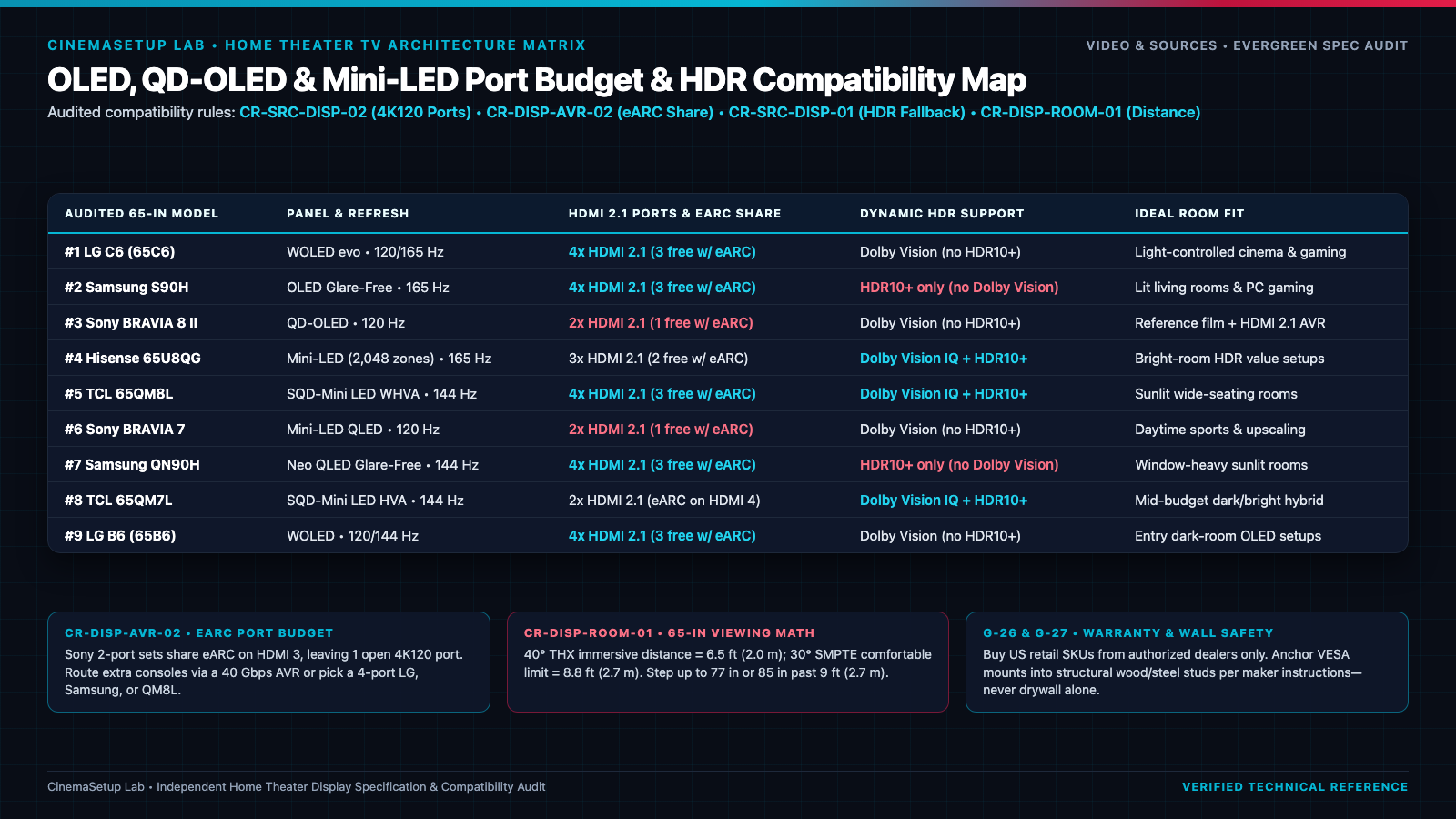
Spec sheets for modern televisions often hide the real compatibility traps behind bold marketing claims. Before ordering any 65-inch display, cross-check four engineering rules from our home theater setup guide: ambient light matching, HDMI 2.1 and eARC port sharing, dynamic HDR format support, and seating geometry.
1. OLED vs. QD-OLED vs. Mini-LED: Room Light & Panel Variance
Self-emissive OLED (WOLED on LG C6 and LG B6) and QD-OLED (Sony BRAVIA 8 II and Samsung’s 65-inch S90H US retail tier) switch off individual pixels for absolute dark-room contrast with zero haloing. Mini-LED LCDs (Hisense 65U8QG, TCL 65QM8L, Sony BRAVIA 7, Samsung QN90H, TCL 65QM7L) use dense local dimming backlights to drive higher sustained full-screen brightness and eliminate OLED static-image burn-in anxiety during all-day news or sports (CR-DISP-ROOM-03). Note that Samsung’s S90 OLED lineage carries documented size-by-size panel-lottery variance across regions (QD-OLED vs. WOLED), and Samsung’s Glare-Free matte coating trades a slight lift in perceived black floor under direct room light for superior daytime reflection diffusion.
2. HDMI 2.1 Bandwidth (40/48 Gbps) & Shared eARC Port Budgets
Under HDMI 2.1 rules (CR-SRC-DISP-02 and CR-DISP-AVR-02), 4K120, 4K144, VRR, and ALLM require both a high-refresh panel and a 40/48 Gbps HDMI 2.1 input paired with an Ultra High Speed HDMI Certified cable. On four-port displays (LG C6, LG B6, Samsung S90H, Samsung QN90H, TCL 65QM8L), dedicating one input to eARC still leaves three open 4K120+ inputs. By contrast, Sony’s BRAVIA 8 II and BRAVIA 7 provide only two 4K120 HDMI 2.1 ports (HDMI 3 and 4) and assign eARC to HDMI 3—leaving just one free 4K120 port unless consoles connect through a multi-input 40 Gbps HDMI 2.1 AV receiver. Hisense’s 65U8QG sits in the middle with three HDMI 2.1 ports (two free after eARC), while standard retail TCL 65QM7L units isolate eARC on 4K60 HDMI 4 so both 4K144 HDMI 2.1 ports stay open. Console shoppers should also check our best TV for PS5 and Xbox Series X breakdown.
3. Dolby Vision vs. HDR10+ Dynamic Metadata Fallbacks
Dynamic HDR adjusts tone mapping scene by scene, yet brand ecosystems remain split (CR-SRC-DISP-01). LG (C6, B6) and Sony (BRAVIA 8 II, BRAVIA 7) support Dolby Vision but omit HDR10+; Samsung (S90H, QN90H) supports HDR10+ but omits Dolby Vision, playing Dolby Vision discs and streams in static HDR10 instead. Hisense (65U8QG) and TCL (65QM8L, 65QM7L) support both Dolby Vision IQ and HDR10+, removing format friction across Apple TV 4K, Prime Video, and 4K UHD Blu-ray players.
4. THX & SMPTE Viewing Distance Math (Imperial & Metric)
Buying too small for your sofa distance wastes 4K detail faster than any spec trade-off (CR-DISP-ROOM-01). For a 16:9 television, screen width equals diagonal × 0.872 (about 56.7 in / 144.0 cm wide on a 65-inch model). Multiply screen diagonal by 1.20 for a 40-degree THX-style immersive field of view, and by 1.63 for a 30-degree SMPTE comfortable viewing angle. Use our TV size viewing distance guide if your room sits past 9 ft (2.7 m).
| Screen Diagonal | 16:9 Image Width | 40° Immersive (THX) | 30° Comfortable (SMPTE) |
|---|---|---|---|
| 55 in (139.7 cm) | 48.0 in (121.9 cm) | 5.5 ft / 66 in (1.7 m) | 7.5 ft / 90 in (2.3 m) |
| 65 in (165.1 cm) | 56.7 in (144.0 cm) | 6.5 ft / 78 in (2.0 m) | 8.8 ft / 106 in (2.7 m) |
| 77 in (195.6 cm) | 67.1 in (170.5 cm) | 7.7 ft / 92 in (2.3 m) | 10.4 ft / 125 in (3.2 m) |
| 85 in (215.9 cm) | 74.1 in (188.2 cm) | 8.5 ft / 102 in (2.6 m) | 11.6 ft / 139 in (3.5 m) |
5. Wall-Mounting, Stud Safety & Upgrade Roadmap
Large 65-inch televisions weigh between 36.6 lb (16.6 kg) on the LG C6 and 59.7 lb (27.1 kg) on the Sony BRAVIA 7 before adding the mount hardware. Always follow the television and bracket manufacturer’s exact installation instructions (G-27): confirm the VESA pattern (300 x 200 mm, 300 x 300 mm, or 400 x 300 mm) and bolt thread depth, use a UL-listed mount rated well above your screen’s without-stand weight, and anchor lag bolts squarely into structural wood/steel framing studs or rated masonry—never hang a heavy television on drywall anchors alone. For concealed power outlets or CL2/CL3 in-wall HDMI and speaker wiring, consult a licensed electrician or qualified AV installer to meet local building codes. Finally, budget for a dedicated eARC audio upgrade via our best soundbars guide or a 5.1.2 AV receiver, plus Ultra High Speed HDMI Certified cables.
How We Audited, Scored & Filtered These Models
Every display in this guide underwent a technical specification and compatibility audit rather than fabricated bench scores: we quote only manufacturer-published panel architectures, local-dimming zone counts, HDMI 2.1 port layouts, HDR metadata standards, and VESA/weight measurements from official US documentation. Where manufacturers publish peak nit ceilings (such as Hisense 65U8QG, TCL 65QM8L/QM7L, and LG B6), we cite them explicitly as maker-rated specifications rather than independent window measurements.
Editorial Commission & Warranty Transparency (G-25 & G-26): Amazon US Associates typically pays roughly 2% commission on Televisions compared with 4% on AV receivers, speakers, and installation accessories. That commission difference never influences our rankings, scores, or whether we recommend a television over an AV receiver or projector. Before completing checkout on Amazon, always verify that the listing is shipped and sold by Amazon.com or an explicitly authorized brand dealer so US manufacturer warranty coverage stays valid.
| Evaluation Criterion | Weight | What We Audited |
|---|---|---|
| Picture Architecture & Contrast Potential | 35% | Self-emissive WOLED/QD-OLED vs Mini-LED local dimming zones, anti-reflection coatings, and processor tone mapping. |
| Gaming & HDMI 2.1 Connectivity | 20% | 40/48 Gbps HDMI 2.1 port count, eARC port sharing (CR-DISP-AVR-02), 120–165 Hz refresh, VRR, and ALLM. |
| HDR & Audio Passthrough Formats | 15% | Dolby Vision, HDR10+, HDR10, HLG support (CR-SRC-DISP-01) and lossless Atmos/DTS:X eARC passthrough. |
| Room Fit & Viewing Geometry | 15% | Bright vs dark room suitability (CR-DISP-ROOM-03), VA off-axis shift, glare rejection, VESA pattern, and weight. |
| Smart Platform, Warranty & Open Caveats | 10% | OS ecosystem (webOS, Google TV, Tizen), OLED retention disclosures, panel-lottery notes, and US dealer clarity. |
| Value Within Tier | 5% | Feature competitiveness within 65-inch Value and Premium tiers with zero influence from affiliate commission rates. |
Models We Audited & Excluded
- Edge-Lit Budget 60 Hz LCD TVs: Excluded under CR-SRC-DISP-02 because 60 Hz panels cannot accept 4K120 gaming signals and edge-lit strips lack local dimming zones for dark-room HDR contrast.
- Grey-Market Canadian /ZC Samsung Variants: Excluded under CR-SYS-02 and G-26 because Canadian-region /ZC units sold by third-party Amazon liquidators risk voiding US manufacturer warranties and carry regional tuner or firmware differences.
- Discontinued 2024 LG C4 & Samsung S90D Closeout Listings: Excluded under G-20 and G-26 because both families are superseded in current US inventory by the 2026 LG C6 and Samsung S90H, and remaining third-party closeouts often lack authorized-dealer warranty coverage.
- Sub-500-Nit Non-Local-Dimming Entry LED TVs: Excluded under CR-DISP-ROOM-03 because low peak output and unzoned direct backlights flatten HDR specular highlights and struggle against daytime window glare.
Frequently Asked Questions About the Best TVs for Home Theater
Is OLED or Mini-LED better for a home theater TV?
OLED is better for light-controlled rooms because per-pixel dimming eliminates blooming and haloing around dark scenes. Mini-LED is better for sunlit living rooms because thousands of LEDs push higher sustained full-screen brightness and eliminate static-logo burn-in risk.
Why do Sony and TCL HDMI 2.1 ports matter when connecting an eARC soundbar or AVR?
Two-port HDMI 2.1 TVs lose half their 4K120 capacity to eARC. Models such as the Sony BRAVIA 8 II and BRAVIA 7 place eARC on HDMI 3, leaving only one open 4K120 input for a console. TVs with four HDMI 2.1 ports like the LG C6 or Samsung S90H leave three 4K120 ports free.
Does it matter that Samsung TVs do not support Dolby Vision?
Samsung TVs fall back to standard HDR10 on Dolby Vision content while supporting dynamic HDR10+ on compatible streams and discs. You still receive 4K HDR playback, though scene-by-scene Dolby Vision mastering metadata from 4K UHD Blu-rays and Apple TV 4K is bypassed.
What viewing distance is ideal for a 65-inch home theater TV?
Aim for 6.5 ft to 8.8 ft (2.0 m to 2.7 m) for a 65-inch 4K TV. Under THX and SMPTE viewing geometry, 6.5 ft (2.0 m) delivers an immersive 40-degree field of view while 8.8 ft (2.7 m) marks the 30-degree comfortable boundary. Beyond 9 ft (2.7 m), consider a 77-inch or 85-inch screen.
How do I avoid losing the manufacturer warranty when buying a TV on Amazon?
Buy only from Amazon.com or an authorized brand dealer. Always inspect the seller line below the Buy button before checkout, because third-party marketplace liquidators and grey-market regional variants, such as Canadian /ZC suffixes, frequently disqualify US manufacturer warranty claims.
Are Ultra High Speed HDMI cables actually required for 4K120 TVs?
Yes, reliable 4K120, 4K144, and VRR signals require 48 Gbps bandwidth. Choose cables bearing the official Ultra High Speed HDMI Certified hologram and QR label rather than unverified marketing claims, and follow manufacturer length guidelines for runs exceeding 10 ft (3.0 m).
Final Verdict: Choosing the Best TV for Home Theater
For most dark-to-dim rooms, the best tv for home theater overall is the LG C6 65-Inch OLED evo (65C6) because it delivers infinite per-pixel contrast, Dolby Vision, and four uncompromised 48 Gbps HDMI 2.1 ports. Buyers facing bright window reflections should choose the Hisense 65U8QG for dual-HDR value under $1,200, the Samsung QN90H for matte glare diffusion, or the TCL 65QM8L for wide-angle Mini-LED punch. Finally, dedicated film collectors routing consoles through a 40 Gbps HDMI 2.1 AV receiver will get standout QD-OLED mastering from the Sony BRAVIA 8 II.


