
Disclosure: As an Amazon Associate, I earn from qualifying purchases. If you buy through links on this page, we may earn a small commission at no extra cost to you.
Choosing an oled vs mini-led tv comes down to matching panel physics against your room’s ambient light, seating geometry, and HDMI ecosystem rather than chasing marketing buzzwords. Self-emissive OLED televisions switch every pixel off to zero nits for infinite dark-room contrast and near-180-degree off-axis uniformity, while Mini-LED LCD televisions combine thousands of local dimming zones with high sustained full-screen brightness, zero organic burn-in exposure, and lower pricing in 75-inch and 85-inch sizes.
To frame this comparison inside our full display rankings, start with our best TVs for home theater hub, where both architectures sit side by side across value, premium, and flagship tiers. Below, we compare verified US retail 65-inch contenders—representing OLED (such as the 2026 Samsung S90H and LG C6) and Mini-LED (the TCL QM8L, Sony BRAVIA 7, and TCL QM6K)—under CinemaSetup Lab’s room-fit, HDMI 2.1, HDR format, and safety rules.
In This Comparison
- Winner-by-Use-Case Quick Verdict Matrix
- Side-by-Side Specs, Tiers & Cited Measurements
- Battleground 1: Ambient Light, Black Depth & Blooming (CR-DISP-ROOM-03)
- Battleground 2: Wide Seating Angles & Screen Coatings (CR-DISP-ROOM-04)
- Battleground 3: Burn-In Exposure, VRR Flicker & HDMI 2.1 Port Share
- Battleground 4: Dolby Vision vs. HDR10+ & DTS eARC Passthrough
- Battleground 5: Viewing Distance, Mounting Safety & US Warranty
- Choose OLED vs. Choose Mini-LED + Verified US Models
- Frequently Asked Questions
Quick Verdict: OLED vs. Mini-LED by Room & Use Case
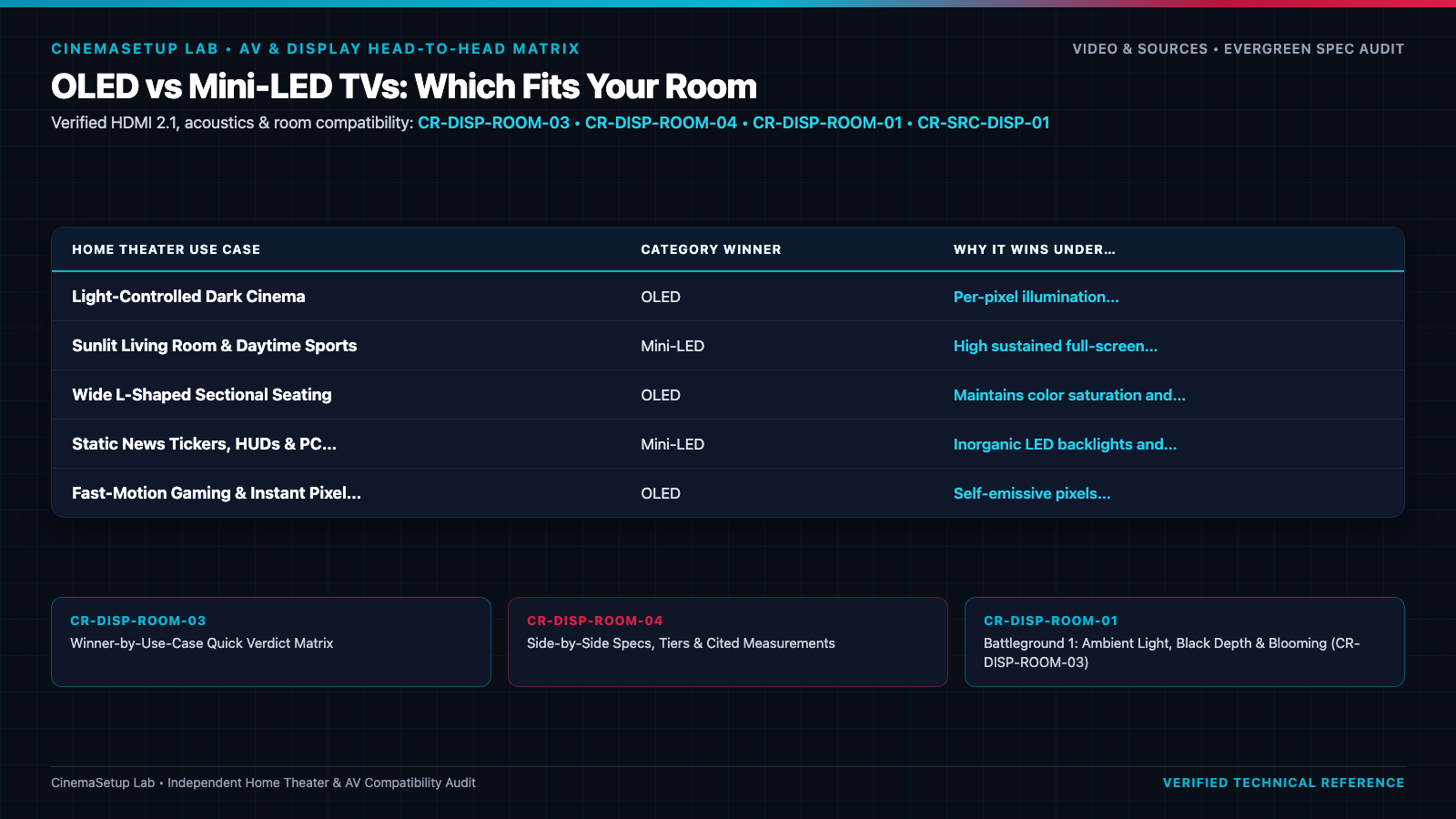
Neither display architecture dominates every living space. A self-emissive OLED that looks breathtaking in a shaded basement theater can struggle against unshaded midday skylights, whereas a Mini-LED that powers through daytime sports can reveal haloing around subtitles in a pitch-black room. Match your primary use case to the winning technology below:
| Home Theater Use Case | Category Winner | Why It Wins Under Audited Rules |
|---|---|---|
| Light-Controlled Dark Cinema | OLED | Per-pixel illumination achieves true zero-nit blacks with zero backlight blooming or letterbox-bar glow (CR-DISP-ROOM-03). |
| Sunlit Living Room & Daytime Sports | Mini-LED | High sustained full-screen luminance resists Automatic Brightness Limiter (ABL) dimming under open windows and bright lamps (CR-DISP-ROOM-03). |
| Wide L-Shaped Sectional Seating | OLED | Maintains color saturation and contrast past 60 degrees off-axis, whereas standard VA Mini-LED panels wash out off-center unless equipped with wide-angle layers (CR-DISP-ROOM-04). |
| Static News Tickers, HUDs & PC Desktop Use | Mini-LED | Inorganic LED backlights and liquid crystals carry zero permanent organic burn-in risk during marathon static sessions (ISS-DISP-OLED-RETENTION). |
| Fast-Motion Gaming & Instant Pixel Response | OLED | Self-emissive pixels transition nearly instantaneously without VA dark-smearing trails, though dark-scene VRR flicker can occur on unstable frame rates. |
| 75-In to 85-In Large-Room Value | Mini-LED | Big-screen Mini-LED sets start near the upper Value and lower Premium tiers, whereas 77-in and 83-in OLEDs escalate sharply into Flagship pricing (CR-DISP-ROOM-01). |
Side-by-Side Specs, Tiers & Cited Measurements (65-Inch US Models)
To keep hardware comparisons accurate across identical screen diagonals (G-05), the matrix below aligns verified 65-inch US retail configurations spanning OLED and Mini-LED tiers. Note the budget separation across categories (G-08): entry-to-mid Mini-LED sets such as the TCL 65QM6K anchor TIER-DISP-TV-VALUE ($500–$1,100), while flagship Mini-LED models like the TCL 65QM8L and Sony BRAVIA 7 (K-65XR70) compete directly in the $1,100–$1,800 range against 65-inch OLED contenders such as the Samsung S90H (QN65S90HAEXZA) and LG C6 (OLED65C6PUA)—eliminating the price-tier gap at the premium 65-inch level.
| Specification / Compatibility Check | Samsung S90H 65-In (OLED Representative) | TCL 65QM8L (Flagship Mini-LED) | Sony BRAVIA 7 K-65XR70 (Mini-LED) | TCL 65QM6K (Value Mini-LED) |
|---|---|---|---|---|
| Panel Architecture (65-In US) | Self-emissive WOLED (US 65-in retail SKU) • Glare-Free matte | SQD-Mini LED • WHVA wide-view LCD | Mini-LED QLED • VA LCD (XR Backlight Master Drive) | QLED Mini-LED • VA LCD |
| Native Refresh & Gaming | Up to 165 Hz VRR (PC) / 4K120 consoles | 144 Hz native / up to 288 Hz VRR | 120 Hz native / 4K120 consoles | 144 Hz native / 288 Hz VRR (1080p) |
| HDMI 2.1 & eARC Port Share (CR-DISP-AVR-02) | 4 of 4 HDMI 2.1 • 3 open with eARC active | 4 of 4 HDMI 2.1 • eARC on HDMI 1 (3 open) | 2 of 4 HDMI 2.1 (HDMI 3 & 4) • eARC on HDMI 3 (1 open) | 2 of 4 HDMI 2.1 (HDMI 1 & 2) • eARC on HDMI 4 HDMI 2.0 (2 open) |
| HDR Formats (CR-SRC-DISP-01) | HDR10+, HDR10+ Adaptive, HDR10, HLG (no Dolby Vision) | Dolby Vision IQ, HDR10+, HDR10, HLG | Dolby Vision, HDR10, HLG (no HDR10+) | Dolby Vision IQ, HDR10+, HDR10, HLG |
| DTS Passthrough (CR-SBAR-DISP-04) | No DTS decoding or passthrough | DTS audio & Dolby Atmos support | DTS:X & Dolby TrueHD passthrough over eARC | DTS Virtual:X / DTS support |
| VESA & Weight (Without Stand) | 300 x 200 mm • 42.1 lb (19.1 kg) | 300 x 300 mm • 46.5 lb (21.1 kg) | 300 x 300 mm • 59.7 lb (27.1 kg) | 300 x 300 mm • 37.4 lb (17.0 kg) |
| US Budget Tier (G-08) | $1,300–$1,800 (TIER-DISP-TV-PREMIUM) | $1,100–$1,800 (TIER-DISP-TV-PREMIUM) | $1,100–$1,800 (TIER-DISP-TV-PREMIUM) | $500–$1,100 (TIER-DISP-TV-VALUE) |
Independent Measurements vs. Published Specifications (G-01, G-02, G-03)
We strictly separate manufacturer specifications from independent third-party measurements with disclosed window sizes and picture modes. Under TechRadar’s 2026 published evaluations using a 10% HDR window in Filmmaker Mode, the 65-inch Samsung S90H reached roughly 1,689 nits (and the 65-inch glossy LG C6 reached roughly 1,438 nits), with both OLEDs recording roughly 9.2 ms input lag at 4K 60 Hz in Game Mode. On the Mini-LED side, TCL publishes a peak luminance specification of up to 6,000 nits on the 65QM8L without disclosing a standardized measurement window, and unpaywalled independent 10% and 100% window readings are no verified third-party window data available yet for the 65QM8L, Sony BRAVIA 7, or TCL 65QM6K. Qualitative published findings from RTINGS confirm that the Sony BRAVIA 7 delivers high HDR and SDR output with low blooming when local dimming is set to High (albeit slower Game Mode pixel transitions), while the value-tier TCL 65QM6K achieves deep VA contrast with milder HDR highlight punch than upper-tier Mini-LED models.
Battleground 1: Ambient Light, Black Depth & Blooming (CR-DISP-ROOM-03)
Rule CR-DISP-ROOM-03 governs how room lighting interacts with display technology. Every OLED pixel generates its own light and shuts off completely for black areas, producing infinite native contrast with zero light bleed into neighboring stars, subtitles, or 2.39:1 cinema letterbox bars. However, OLEDs rely on an Automatic Brightness Limiter (ABL) to manage heat and power across large white scenes—such as daytime hockey ice or sunlit desert exteriors—meaning full-screen 100% window output drops noticeably below small 10% specular highlight peaks.
Mini-LED TVs work differently. An array of tiny blue or quantum-dot LEDs sits behind an LCD layer and divides the screen into hundreds or thousands of local dimming zones. Because those LEDs can drive high current across large portions of the frame simultaneously, Mini-LED televisions sustain strong full-screen brightness in rooms flooded with daylight. If your family room has floor-to-ceiling windows, explore our dedicated best TVs for bright rooms roundup for Mini-LED models engineered specifically for high daytime luminance.
- When OLED Wins (Dim & Light-Controlled Rooms): Zero blooming around white credits on black backgrounds, razor-sharp shadow gradation near black, and true zero-nit letterbox bars during night movie sessions.
- When Mini-LED Wins (Sunlit Living Rooms): Overpowers window glare during midday sports and bright SDR broadcasts without triggering aggressive full-screen ABL dimming, while keeping colors punchy under overhead lighting.
- The Blooming Trade-Off: Even high-zone Mini-LED panels like the TCL 65QM8L or Sony BRAVIA 7 illuminate clusters of pixels together, which can create faint halos around bright objects against dark backgrounds when viewed in pitch-dark rooms—especially from off-axis angles.
Battleground 2: Wide Seating Angles & Screen Coatings (CR-DISP-ROOM-04)
Room geometry breaks more Mini-LED purchases than brightness does. Under rule CR-DISP-ROOM-04, most Mini-LED televisions—including the Sony BRAVIA 7 and TCL 65QM6K—use Vertical Alignment (VA) LCD panels to maximize straight-on native contrast. When viewers sit far off to the side on an L-shaped sectional or dining-area barstool, VA liquid crystals lose contrast, black bars turn milky gray, and skin tones desaturate.
Higher-tier Mini-LED sets work around this limitation with wide-angle compensation films; for example, TCL equips the 65QM8L with a WHVA wide-viewing-angle panel, and flagship Samsung Neo QLED sets such as the 75-inch QN90H pair wide-angle layers with anti-reflective coatings. Even with optical compensation films, self-emissive OLEDs retain a structural advantage: OLED luminance and color remain virtually unchanged across wide living-room seating arcs.
Screen finish also narrows the gap between the two camps. Glossy OLEDs (such as the LG C6) preserve crisp dark-room contrast but reflect windows like mirrors, whereas Samsung’s Glare-Free matte coating on the 65-inch S90H scatters direct lamp reflections into a soft haze—at the cost of slightly lifted perceived blacks if bright sunlight strikes the matte surface directly. For a closer head-to-head breakdown of glossy WOLED versus Glare-Free matte OLED behavior, read our LG C6 vs. Samsung S90H comparison.
Battleground 3: Burn-In Exposure, VRR Flicker & HDMI 2.1 Port Share
Long-term durability and gaming ergonomics split buyers cleanly across panel types:
- OLED Static Image Retention (ISS-DISP-OLED-RETENTION): Organic emitters age cumulatively as they display bright, static elements—such as cable-news banners, sports scorebugs, or fixed game HUDs—over thousands of hours. Modern OLEDs include pixel shifting, automatic logo dimming, and standby pixel-refresh cycles, but standard 1-year US manufacturer warranties generally exclude permanent burn-in. Mini-LED LCDs use inorganic LED backlights and carry zero burn-in risk.
- Motion Clarity vs. VRR Gamma Flicker (ISS-DISP-VRR-FLICKER-OLED): OLED pixels switch states almost instantaneously, eliminating the dark-gray smearing trails occasionally seen on VA Mini-LED panels like the Sony BRAVIA 7 in fast-panning games. Conversely, OLED displays can exhibit subtle dark-scene gamma flicker when PC or console Variable Refresh Rate (VRR) frame rates fluctuate sharply, whereas Mini-LEDs hold steadier shadow gamma under VRR.
- HDMI 2.1 & eARC Port Budgets (CR-SRC-DISP-02 & CR-DISP-AVR-02): Never assume “HDMI 2.1” means four 4K120 inputs. The Samsung S90H, LG C6, and TCL 65QM8L provide four full-speed HDMI 2.1 ports, leaving three open high-refresh ports when an eARC soundbar or receiver (such as a US 120 V Denon AVR-X3900H or Samsung HW-Q990H) connects. By contrast, the Sony BRAVIA 7 supplies only two HDMI 2.1 inputs (HDMI 3 and 4) and places eARC on HDMI 3—leaving just one free 4K120 port unless you route consoles through a 40 Gbps AVR. Cleverly, the budget-friendly TCL 65QM6K puts eARC on HDMI 4 (an HDMI 2.0 port), keeping both 4K144 HDMI 2.1 inputs (HDMI 1 and 2) completely free for a PS5 and Xbox Series X.
Whichever panel you pick, 4K120 and 4K144/165 VRR signals require Ultra High Speed HDMI Certified 48 Gbps cables (CR-ACC-DISP-01). For runs longer than roughly 10 ft (3.0 m), step up to a directional active optical fiber HDMI cable and match its source and display plugs correctly.
Battleground 4: Dolby Vision vs. HDR10+ & DTS eARC Passthrough
Dynamic HDR metadata and audio passthrough cut across brand lines rather than strictly separating OLED from Mini-LED (CR-SRC-DISP-01 and CR-SBAR-DISP-04):
- Dual-Format Mini-LED Advantage: TCL’s 65QM8L and 65QM6K support both Dolby Vision IQ and HDR10+ alongside static HDR10 and HLG, meaning neither Apple TV 4K Dolby Vision streams nor Amazon Prime Video HDR10+ streams fall back to static tone mapping.
- OLED & Sony Format Splits: The Samsung S90H supports HDR10+ and HDR10+ Adaptive while omitting Dolby Vision (playing Dolby Vision titles cleanly in baseline HDR10). Conversely, the LG C6 and Sony BRAVIA 7 support Dolby Vision while omitting HDR10+.
- DTS:X Disc Passthrough Caveat (CR-SBAR-DISP-04): If you spin 4K UHD Blu-rays with DTS-HD Master Audio or DTS:X soundtracks, note that 2026 LG C6 and Samsung S90H OLEDs omit DTS decoding and DTS passthrough over eARC—whereas the Sony BRAVIA 7 and TCL 65QM8L retain DTS support. On LG or Samsung OLEDs, plug your 4K Blu-ray player directly into a DTS-capable AVR or soundbar HDMI input rather than routing audio through the TV.
Battleground 5: Viewing Distance, Mounting Safety & US Warranty
Size mismatches undermine contrast and resolution more than panel chemistry (CR-DISP-ROOM-01). Using the 16:9 horizontal field-of-view guidelines (1.20x diagonal for a 40-degree THX-style cinema view; 1.63x diagonal for a 30-degree SMPTE comfortable view), a 65-inch TV fits viewing distances between 6.5 ft and 8.8 ft (2.0 m and 2.7 m). If your primary sofa sits 9.5 ft to 12 ft (2.9 m to 3.7 m) back in a large family room, stepping up to a 75-inch or 85-inch Mini-LED—such as the 75-inch Samsung QN90H or Hisense U7—often delivers greater visual immersion than sitting too far from a smaller 65-inch OLED at a similar budget.
Wall-Mounting & Electrical Safety (CR-DISP-ACC-02 & G-27): Mini-LED backlights add noticeable chassis mass compared with ultra-thin OLED screens. Without a stand, the 65-inch Samsung S90H weighs 42.1 lb (19.1 kg) (VESA 300 x 200 mm) and the TCL 65QM6K weighs 37.4 lb (17.0 kg), whereas the 65-inch TCL 65QM8L weighs 46.5 lb (21.1 kg) and the Sony BRAVIA 7 reaches 59.7 lb (27.1 kg) (all three Mini-LEDs use VESA 300 x 300 mm). Always follow both the TV and mount manufacturer’s instructions first: choose a UL-listed bracket rated well above your panel’s weight, lift with two people, and anchor lag bolts squarely into wood/steel wall studs or rated masonry—never hang a 40-to-60 lb display into drywall alone. Any concealed AC power relocation or in-wall HDMI/speaker cabling requires UL-listed CL2 or CL3 rated wiring and consultation with a licensed electrician or qualified AV installer to meet local building codes.
US Retail Warranty & Bundle Integrity (G-26, G-29, CR-SYS-02): Confirm every listing specifies a US 120 V / 60 Hz retail model and check the “Ships from / Sold by” line before purchasing. US manufacturer warranties from Samsung, LG, Sony, and TCL require purchase from an authorized US dealer; third-party marketplace resellers may void factory coverage. Additionally, note that the verified Amazon US listing for the 65-inch Samsung S90H below (B0HPRDJ5HN) is a retail bundle containing the TV, two HDMI cables, a Television Home Theater Guide, and a 1-year CPS Enhanced Protection Pack—verify the seller’s authorized status at checkout before ordering.
Final Verdict: Choose OLED vs. Choose Mini-LED
Choose an OLED TV if…
- You watch movies primarily in dark or dim evening environments where per-pixel zero-nit blacks and zero blooming matter most.
- Your living room has wide seating angles where viewers sit off-center and cannot tolerate VA contrast washout.
- You want instant pixel transitions for 4K120 or 165 Hz gaming and watch varied dynamic content rather than static news tickers or HUDs all day.
Choose a Mini-LED TV if…
- Your TV sits in a sunlit living room with unshaded windows or bright overhead lights where sustained full-screen luminance beats glare.
- You stream daytime sports, leave cable-news tickers running, or connect a PC desktop with static taskbars and want zero burn-in anxiety.
- You want lower Value-tier pricing at 65 inches or need a 75-inch to 85-inch screen for a 10+ ft (3.0+ m) room without flagship OLED cost.
Verified Amazon US OLED & Mini-LED Contenders
Commission Independence Note (G-25): Amazon Associates pays 2% on Televisions compared with 4% on AV receivers and accessories; affiliate rates never alter our compatibility findings or category winners. All four product cards below feature verified 65-inch US retail SKUs.
1. Samsung 65-Inch Class S90H OLED 4K Smart TV Bundle (QN65S90HAEXZA) — Best All-Room OLED

Quick Specs & Bundle Contents (G-29): 65-in 4K Glare-Free Matte WOLED (US 65-in SKU) | Up to 165 Hz VRR (PC) / 4K120 | 4x HDMI 2.1 (3 open w/ eARC) | HDR10+, HDR10, HLG | VESA 300 x 200 mm, 42.1 lb (19.1 kg) without stand | Includes TV + 2x HDMI cables + TV Home Theater Guide + 1-Year CPS Enhanced Protection Pack | Price Tier: $1,300–$1,800 (Premium TV Bundle)
Pros
- Self-emissive zero-nit blacks and near-180-degree off-axis uniformity with zero local-dimming blooming
- Glare-Free matte screen diffuses window reflections alongside ~1,689 nits cited 10% window output (Filmmaker Mode, TechRadar)
- Four full HDMI 2.1 inputs leave three 4K120/165Hz ports free with an eARC AVR or soundbar connected
Cons
- Omits Dolby Vision (falls back to HDR10) and omits DTS:X passthrough over eARC
- Retains cumulative organic burn-in risk under static HUDs; verify authorized dealer status on third-party bundle listings (G-26)
2. TCL 65-Inch QM8L Series SQD-Mini LED 4K Google TV (65QM8L) — Best High-Output Mini-LED

Quick Specs: 65-in 4K SQD-Mini LED (WHVA wide-view panel) | 144 Hz native / 288 Hz VRR | 4x HDMI 2.1 (eARC on HDMI 1; 3 open) | Dolby Vision IQ, HDR10+, HDR10, HLG | VESA 300 x 300 mm, 46.5 lb (21.1 kg) without stand | Price Tier: $1,100–$1,800 (Premium TV)
Pros
- Supports both Dolby Vision IQ and HDR10+ plus four full-speed HDMI 2.1 ports and ATSC 3.0 tuner
- WHVA wide-view panel mitigates standard VA off-axis contrast drop (CR-DISP-ROOM-04) with zero burn-in exposure
Cons
- Zoned LCD dimming can still show faint blooming around bright subtitles in pitch-dark cinema rooms compared with OLED
- No verified third-party 10% and 100% window brightness data available yet beyond TCL’s unwindowed peak specification
3. Sony 65-Inch BRAVIA 7 Mini LED QLED 4K Google TV (K-65XR70) — Best Cinema-Processing Mini-LED

Quick Specs: 65-in 4K Mini-LED QLED (VA panel, XR Backlight Master Drive) | 120 Hz native | 2x HDMI 2.1 (HDMI 3 & 4; eARC on HDMI 3) | Dolby Vision, HDR10, HLG | VESA 300 x 300 mm, 59.7 lb (27.1 kg) without stand | Price Tier: $1,100–$1,800 (Premium TV)
Pros
- XR Backlight Master Drive controls local dimming cleanly with low blooming in High mode per RTINGS’ published evaluation
- Retains Dolby Vision alongside lossless Dolby TrueHD and DTS:X passthrough over eARC for 4K Blu-ray setups
Cons
- Only two HDMI 2.1 ports—using eARC on HDMI 3 leaves just one open 4K120 input (CR-DISP-AVR-02)
- Standard VA viewing angles wash out off-axis (CR-DISP-ROOM-04), heavier 59.7 lb (27.1 kg) panel, and slower Game Mode pixel response
4. TCL 65-Inch QM6K Series QLED Mini LED 4K Google TV (65QM6K) — Best Value-Tier Mini-LED

Quick Specs: 65-in 4K QLED Mini-LED (VA panel) | 144 Hz native / 288 Hz VRR (1080p) | 2x HDMI 2.1 (HDMI 1 & 2) + eARC on HDMI 4 (HDMI 2.0) | Dolby Vision IQ, HDR10+, HDR10, HLG | VESA 300 x 300 mm, 37.4 lb (17.0 kg) without stand | Price Tier: $500–$1,100 (Value 4K TV)
Pros
- Smart eARC placement on HDMI 4 keeps both 4K144 HDMI 2.1 gaming inputs free for two consoles simultaneously
- Supports both Dolby Vision IQ and HDR10+ at Value-tier pricing well below 65-inch OLED alternatives
Cons
- Lower HDR highlight intensity than flagship Mini-LEDs (QM8L / BRAVIA 7) or premium OLEDs per RTINGS’ summary
- Standard VA off-axis contrast drop (CR-DISP-ROOM-04) and mild haloing around bright objects on black scenes
Authoritative Technical Sources
- Samsung Electronics USA TV Specifications — QN65S90HAEXZA Glare-Free coating, HDR10+, HDMI 2.1 capabilities, and US warranty policy.
- TCL USA Official TV Specifications — 65QM8L and 65QM6K Mini-LED specs, VESA 300 x 300 mm weights, HDR10+ / Dolby Vision IQ, and port layouts.
- Sony Electronics USA BRAVIA Specifications — K-65XR70 (BRAVIA 7) HDMI 2.1 port assignment, DTS:X eARC passthrough, and 59.7 lb (27.1 kg) chassis specifications.
- RTINGS Published Display Evaluations — Qualitative local dimming, HDR output, blooming, and Game Mode behavior across Mini-LED and OLED architectures.
- HDMI Licensing Administrator HDMI 2.1 Specification — 48 Gbps FRL bandwidth, VRR, ALLM, eARC, and Ultra High Speed HDMI certification.
How We Audited This Guide
- Displays and sources were audited across OLED vs. Mini-LED HDR formats (Dolby Vision, HDR10+), 4K/120Hz VRR console support, verified ANSI/ISO projector lumens, throw distance ratios, and lossless optical disc vs. streaming audio codecs.
- Every AV receiver, speaker, subwoofer, soundbar, OLED/Mini-LED TV, projector, source player, and accessory spec was cross-checked against official manufacturer manuals, CEA/CTA standards, and live Amazon US listings.
- Recommendations were evaluated against our weighted vertical scoring rubrics and documented CR-* compatibility rules; we never invent nits, contrast ratios, bench wattage, or room decibels.
Continue Your Audit
- Best TVs for PS5 & Xbox Series X 2026: 4K120 Ports Audited
- TV vs Projector for Home Theater 2026: Room-by-Room Compared
Frequently Asked Questions: OLED vs. Mini-LED TVs
Is OLED or Mini-LED better for a bright living room with windows?
Mini-LED is generally better for sunlit living rooms because its zoned LED backlight sustains high full-screen brightness without triggering heavy Automatic Brightness Limiter dimming. If you prefer OLED in a lit room, choose a matte Glare-Free model like the Samsung S90H over glossy glass.
Can Mini-LED TVs match OLED black levels in a dark room?
High-zone Mini-LED TVs get very close, but OLED still wins in pitch-dark rooms. Because every OLED pixel turns completely off to zero nits, bright subtitles or starfields show zero haloing. Even thousands of Mini-LED dimming zones can leak faint light around sharp bright highlights.
Do Mini-LED TVs have worse viewing angles than OLED TVs?
Yes, standard VA Mini-LED TVs lose contrast and color off-center (rule CR-DISP-ROOM-04), making wide L-shaped seating look washed out from side chairs. Flagship WHVA panels like the TCL 65QM8L improve off-axis clarity, though OLED remains unmatched past 60 degrees.
Should gamers worry about OLED burn-in vs. Mini-LED?
Varied gaming sessions rarely cause OLED burn-in, thanks to pixel shifting and refresh routines, though thousands of hours on one static HUD can leave uneven wear that US warranties typically exclude. Mini-LED uses inorganic backlights and carries zero burn-in risk.
Which technology offers better HDMI 2.1 port availability with eARC?
Port counts depend on the brand, not OLED vs. Mini-LED chemistry. The Samsung S90H, LG C6, and TCL 65QM8L include four HDMI 2.1 ports (three free with eARC), while the Sony BRAVIA 7 has two total and the TCL 65QM6K keeps two free by placing eARC on HDMI 4.
What screen size should I buy for a 9-foot viewing distance?
At 9 ft (2.7 m), choose a 65-inch or 75-to-77-inch television based on rule CR-DISP-ROOM-01 (30-degree SMPTE comfortable to 40-degree THX immersive angle). For 10 to 12 ft (3.0 to 3.7 m) living rooms, a 75-inch or 85-inch Mini-LED delivers far stronger scale per dollar than a smaller OLED.


