
Disclosure: As an Amazon Associate, I earn from qualifying purchases. If you buy through links on this page, we may earn a small commission at no extra cost to you.
Comparing lg c6 vs samsung s90h comes down to one critical room-and-ecosystem split: the glossy LG C6 (OLED65C6PUA) pairs per-pixel WOLED evo contrast with Dolby Vision for light-controlled theaters, while the Samsung S90H (QN65S90HAEXZA) counters with a Glare-Free matte surface, higher published peak HDR measurements, and HDR10+ for sunlit living rooms. Both 2026 US models supersede the discontinued 2024 LG C4 and Samsung S90D in the same $1,300–$1,800 65-inch tier—making HDMI 2.1 port allocation, HDR metadata fallback, and panel consistency far more decisive than price.
Before locking in either screen, cross-check our broader best TVs for home theater hub to see how self-emissive OLEDs stack up against high-output Mini-LED alternatives for bright daytime rooms. Below, we evaluate both 65-inch contenders across official manufacturer specifications, cited third-party measurements, and CinemaSetup Lab compatibility rules.
In This Comparison
- Winner-by-Use-Case Quick Verdict Matrix
- Side-by-Side Specs & Cited Measurements
- Battleground 1: Panel Finish, Room Light & Panel Variance
- Battleground 2: Dolby Vision vs. HDR10+ Metadata (CR-SRC-DISP-01)
- Battleground 3: HDMI 2.1 Ports, eARC & 165 Hz Gaming (CR-DISP-AVR-02)
- Battleground 4: Soundbar Sync, DTS Limits & Stand Clearance
- Battleground 5: Viewing Distance, Mounting Safety & US Warranty
- Choose LG C6 vs. Choose Samsung S90H + Product Cards
- Frequently Asked Questions
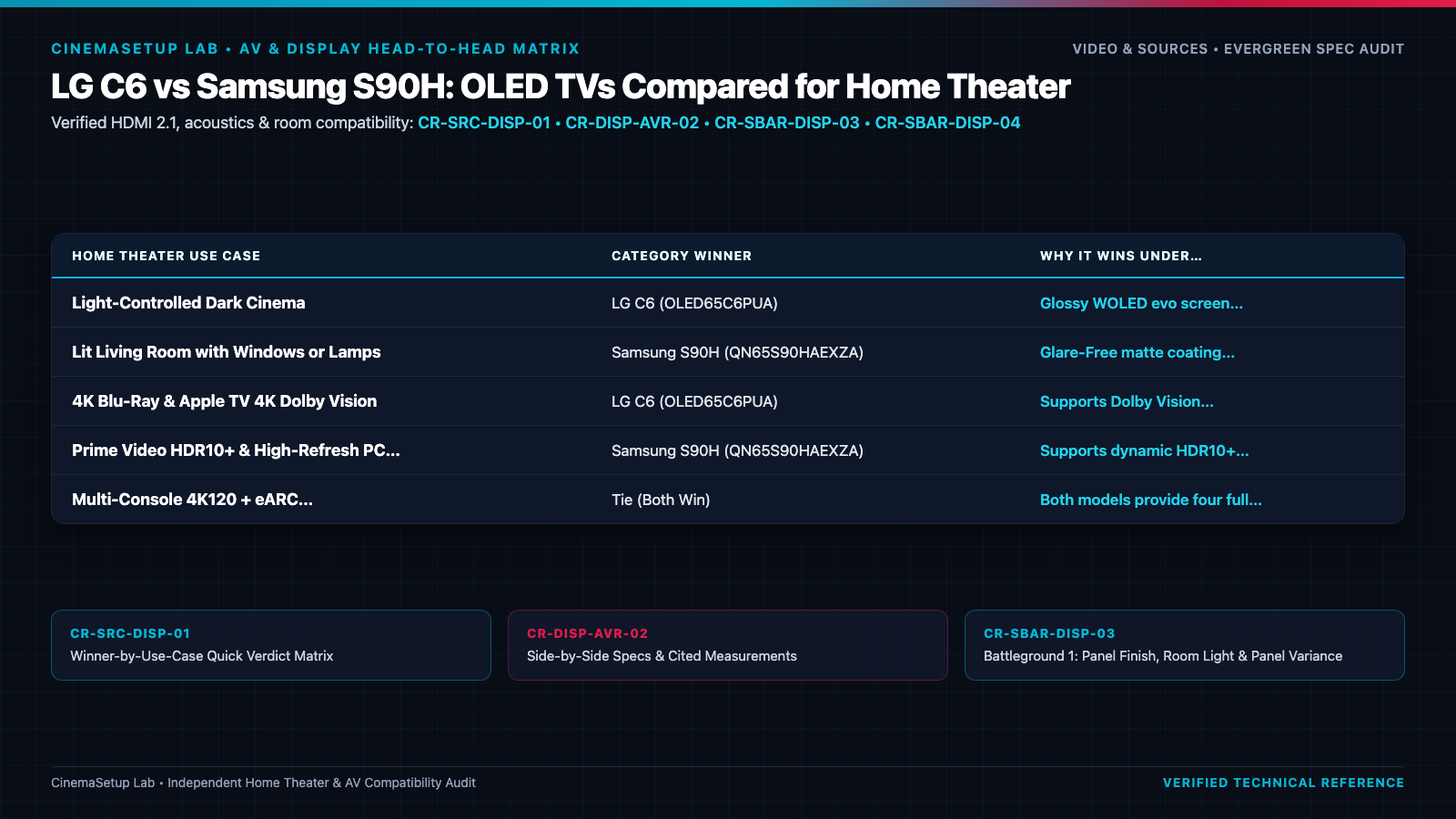
Quick Verdict: LG C6 vs. Samsung S90H by Room & Use Case
Neither television takes an absolute crown across every home theater scenario. Instead, the right choice depends on your room lighting, HDR library, and audio ecosystem:
| Home Theater Use Case | Category Winner | Why It Wins Under Audited Rules |
|---|---|---|
| Light-Controlled Dark Cinema | LG C6 (OLED65C6PUA) | Glossy WOLED evo screen preserves crisp perceived black depth without matte light scatter, paired with Dolby Vision cinema mastering (CR-SRC-DISP-01). |
| Lit Living Room with Windows or Lamps | Samsung S90H (QN65S90HAEXZA) | Glare-Free matte coating diffuses direct window and lamp reflections effectively alongside higher measured 10% HDR highlight output (CR-DISP-ROOM-03). |
| 4K Blu-Ray & Apple TV 4K Dolby Vision | LG C6 (OLED65C6PUA) | Supports Dolby Vision natively; the Samsung S90H falls back to baseline static HDR10 on Dolby Vision sources. |
| Prime Video HDR10+ & High-Refresh PC Gaming | Samsung S90H (QN65S90HAEXZA) | Supports dynamic HDR10+ Adaptive and up to 165 Hz native/VRR capability across all four HDMI 2.1 inputs. |
| Multi-Console 4K120 + eARC AVR/Soundbar | Tie (Both Win) | Both models provide four full HDMI 2.1 inputs, leaving three 4K120/165Hz ports free when eARC connects on HDMI 2 (LG) or HDMI 3 (Samsung) (CR-DISP-AVR-02). |
| Samsung Soundbar Q-Symphony Pairing | Samsung S90H (QN65S90HAEXZA) | Unlocks Q-Symphony speaker synchronization with supported US Samsung bars such as the HW-Q990H (CR-SBAR-DISP-03). |
Side-by-Side Specs & Cited Measurements (65-Inch US Models)
To keep comparisons strictly apples-to-apples (G-04 and G-05), every manufacturer specification below applies specifically to the 65-inch US retail configurations—OLED65C6PUA for LG and QN65S90HAEXZA for Samsung. Both models sit in the same 65-inch Premium TV tier ($1,300–$1,800 on Amazon US at verification time, with zero price-tier gap separating them).
| Specification / Compatibility Check | LG C6 65-Inch (OLED65C6PUA) | Samsung S90H 65-Inch (QN65S90HAEXZA) | Audited Rule |
|---|---|---|---|
| Panel Architecture (65-In US) | WOLED evo with Brightness Booster | WOLED (North American 65-in retail SKU) | L-09 / AMZ-005 |
| Screen Coating | Glossy glass-like finish | Glare-Free matte anti-reflective coating | CR-DISP-ROOM-03 |
| Video Processor & OS | Alpha 11 AI Processor 4K Gen3 • webOS 26 | NQ4 AI Gen3 Processor • Tizen OS | G-17 |
| Refresh Rate | 120 Hz native / up to 165 Hz VRR (PC) | Up to 165 Hz native/VRR (PC) • 4K120 consoles | CR-SRC-DISP-02 |
| VRR & ALLM Support | HDMI VRR, FreeSync Premium, G-SYNC Compatible, ALLM | HDMI VRR, FreeSync Premium Pro, G-SYNC Compatible, ALLM | CR-SRC-DISP-03/04 |
| HDMI 2.1 Ports & eARC Port | 4 of 4 (48 Gbps) • eARC on HDMI 2 (3 free) | 4 of 4 (4K165) • eARC on HDMI 3 (3 free) | CR-DISP-AVR-02 |
| HDR Formats | Dolby Vision, HDR10, HLG (no HDR10+) | HDR10+, HDR10+ Adaptive, HDR10, HLG (no Dolby Vision) | CR-SRC-DISP-01 |
| DTS Audio Passthrough | No DTS decoding or DTS passthrough | No DTS decoding or DTS passthrough | CR-SBAR-DISP-04 |
| Soundbar Sync Feature | LG WOW Orchestra / WOW Interface | Samsung Q-Symphony | CR-SBAR-DISP-03 |
| VESA Pattern & Weight (No Stand) | 300 x 200 mm • 36.6 lb (16.6 kg) | 300 x 200 mm • 42.1 lb (19.1 kg) | CR-DISP-ACC-02 |
| Dimensions (W x H x D, With Stand) | 56.7 x 34.6 x 9.1 in (144.0 x 87.9 x 23.1 cm) | 56.9 x 35.3 x 10.4 in (144.4 x 89.7 x 26.5 cm) | CR-SBAR-DISP-05 |
| US Limited Warranty | 1-year US parts & labor (authorized dealer) | 1-year US parts & labor (authorized dealer) | G-26 |
| 65-In US Price Tier | $1,300–$1,800 (TIER-DISP-TV-PREMIUM) | $1,300–$1,800 (TIER-DISP-TV-PREMIUM) | G-08 |
Cited Third-Party Measurements (Identical Picture Modes & Windows)
Separating published maker specifications from independent measurements (G-02 and G-03), TechRadar’s published 2026 display evaluations measured both models under Filmmaker Mode on a 10% HDR window and in low-latency Game Mode:
| Measurement Metric & Conditions | LG C6 (Cited Reading) | Samsung S90H (Cited Reading) | Source & Condition Basis |
|---|---|---|---|
| HDR Peak Brightness (10% Window, Filmmaker Mode) | ~1,438 nits | ~1,689 nits | TechRadar 2026 published evaluation (10% window, Filmmaker Mode) |
| Game Mode Input Lag (4K 60 Hz) | ~9.2 ms (Game Optimizer Boost) | ~9.2 ms (Game Mode) | TechRadar 2026 published evaluation (Game Mode active) |
Battleground 1: Glossy WOLED vs. Glare-Free Matte & Panel Variance
In previous model years, choosing between LG’s C-series and Samsung’s S90-series boiled down to WOLED versus QD-OLED. For 2026, that assumption no longer holds across North American 65-inch stock, and treating the lineup as uniform is a costly mistake (L-09 and G-05).
In North America, the 65-inch Samsung S90H (QN65S90HAEXZA) transitions to a WOLED panel paired with Samsung’s Glare-Free matte coating—previously reserved for flagship S95 models—while 48-inch and 77-inch S90H sizes use RGB Tandem WOLED architectures and certain overseas regions still receive QD-OLED panels. Before purchasing any S90-series size outside 65 inches, review our Samsung OLED panel variance audit so you know exactly which subpixel layout and finish ships in your chosen diagonal.
The practical difference you see every day is the screen coating under room light (CR-DISP-ROOM-03):
- LG C6 (Glossy WOLED evo): In a dark basement theater or shaded evening living room, the glossy surface preserves razor-sharp micro-contrast and pure, inky perceived blacks without scattering ambient stray light across the screen. However, opposite open blinds or overhead lamps, the glass-like coating creates mirror-like reflections.
- Samsung S90H (Glare-Free Matte OLED): Samsung’s matte anti-reflection layer breaks up direct lamp and window reflections into a soft, unobtrusive diffusion, making daytime sports and bright living-room viewing noticeably easier to watch. The trade-off occurs when bright room light hits the screen directly: matte diffusion slightly lifts perceived black levels into a dark charcoal tone compared with a glossy OLED in the dark, though in pitch-black rooms both displays achieve self-emissive zero-nit blacks.
Size Lineup Caveat & OLED Retention (ISS-DISP-OLED-RETENTION): LG splits its 2026 C6 family across 42, 48, 55, and 65 inches under the C6 designation and 77 and 83 inches under the C6H series (with 48-inch and C6H sizes adopting Tandem OLED variations). Never apply a 65-inch brightness measurement directly to a 42-inch desktop screen or an 83-inch C6H. Both brands include pixel-shift, logo-dimming, and automated pixel-refresh routines to mitigate static image retention, though standard 1-year US warranties exclude cumulative burn-in from static news tickers or permanent HUD elements.
Battleground 2: Dolby Vision vs. HDR10+ Compatibility (CR-SRC-DISP-01)
Dynamic HDR metadata adjusts brightness and tone mapping scene by scene—or frame by frame—to match a television’s luminance limits. Under rule CR-SRC-DISP-01, both televisions divide the market neatly down ecosystem lines, and neither supports both dynamic standards:
- LG C6 HDR Support: Supports Dolby Vision (including Dolby Vision cinema and Dolby Vision gaming on Xbox Series X), baseline static HDR10, and broadcast HLG. It omits HDR10+; any HDR10+ stream from Amazon Prime Video or compatible disc plays cleanly in static HDR10.
- Samsung S90H HDR Support: Supports HDR10+ (including HDR10+ Adaptive and HDR10+ Gaming), baseline HDR10, and HLG, while omitting Dolby Vision entirely.
Let us be clear under CR-SRC-DISP-01: Dolby Vision discs, Apple TV 4K streams, Netflix titles, and Disney+ movies are not “broken” on the Samsung S90H—they automatically fall back to standard static HDR10, which still looks crisp thanks to the S90H’s ~1,689-nit 10% window headroom. Even so, collectors with large 4K UHD Blu-ray libraries or Apple TV 4K setups heavily invested in Dolby Vision mastering gain genuine scene-by-scene dynamic tone mapping on the LG C6.
Battleground 3: HDMI 2.1 Bandwidth, eARC Port Share & 165 Hz Gaming
Multi-device console and PC gamers get a decisive advantage on both models compared with two-port competitors like the Sony BRAVIA 8 II. Under rules CR-SRC-DISP-02 and CR-DISP-AVR-02, every HDMI hop matters when connecting an eARC soundbar or AV receiver alongside modern consoles.
On both the LG C6 and Samsung S90H, all four HDMI ports support full HDMI 2.1 bandwidth, 4K120 console gaming, VRR, and ALLM. Because LG places eARC on HDMI 2 and Samsung places eARC on HDMI 3, plugging in an eARC soundbar or AV receiver still leaves three open full-speed HDMI 2.1 inputs for a PS5, Xbox Series X, and high-frame-rate gaming PC. For a broader look at port budgets across competing sets, check our best TV for PS5 and Xbox Series X guide.
For PC builders specifically, the Samsung S90H pushes native/VRR support up to 165 Hz across all four ports with AMD FreeSync Premium Pro and NVIDIA G-SYNC compatibility, while the LG C6 pairs a 120 Hz native panel with VRR up to 165 Hz for compatible PCs alongside FreeSync Premium and G-SYNC Compatible support. Both OLEDs exhibit minor dark-scene VRR gamma flicker in unstable-frame-rate games (ISS-DISP-VRR-FLICKER-OLED), and both require certified Ultra High Speed HDMI 48 Gbps cables (CR-ACC-DISP-01). For in-wall or living-room cable runs longer than roughly 10 ft (3.0 m), use a directional active optical fiber HDMI cable with the source and display plugs oriented properly.
Battleground 4: Soundbar Sync, DTS Passthrough & Stand Clearance
Audio integration reveals a major 2026 catch that catches many disc collectors off guard (CR-SBAR-DISP-04): neither the LG C6 nor the Samsung S90H supports native DTS decoding or DTS passthrough over eARC. While LG temporarily offered DTS:X bypass on older 2024 C4 models, the 2026 C6 drops DTS support alongside Samsung.
If your 4K Blu-ray collection includes DTS:X or DTS-HD Master Audio discs, do not plug your player directly into either TV expecting bitstream passthrough—the soundbar or AVR will receive PCM stereo or silence depending on player settings. Instead, plug your 4K UHD player directly into a 40 Gbps HDMI input on a DTS-capable AV receiver (such as the US 120 V Denon AVR-X3900H) or into the HDMI input of a DTS-capable soundbar, then pass video forward to the TV (CR-SBAR-SRC-01). For streaming apps like Netflix and Disney+, both TVs pass Dolby Digital Plus Atmos and lossless Dolby TrueHD Atmos via eARC without issue (CR-DISP-AVR-01, CR-SBAR-DISP-02).
Brand-ecosystem audio sync is an INFO-level bonus rather than a requirement (CR-SBAR-DISP-03):
- Samsung Q-Symphony: Synchronizes the S90H’s built-in 2.1-channel speakers with compatible US Samsung bars such as the Samsung HW-Q990H. Watch out for grey-market Canadian
/ZCSamsung soundbar listings (likeHW-Q990H/ZC) sold by third-party liquidators, which risk US warranty disqualification (CR-SYS-02). - LG WOW Orchestra: Pairs LG C6 TV speakers with supported LG soundbars, though remember rule CR-SYS-03 (only one audio system can occupy eARC at a time) and CR-SYS-05 (TV speaker virtualization is never equivalent to physical overhead speakers).
Stand Clearance Trap (CR-SBAR-DISP-05): Both 65-inch OLEDs sit low on their included center stands—the LG C6 leaves roughly 1.6 to 2.2 in (4.1 to 5.6 cm) of vertical clearance beneath the bottom bezel, and Samsung’s Simple Plus Blade stand sits similarly low. Any Atmos soundbar taller than 2.2 in (5.6 cm) placed directly in front of either stand will clip the bottom edge of the picture or obstruct the IR remote sensor unless you wall-mount the display.
Battleground 5: Viewing Distance, Mounting Safety & US Warranty
Even the sharpest OLED disappoints if the screen is too small for your sofa distance (CR-DISP-ROOM-01). For a 65-inch 16:9 screen (image width 56.7 in / 144.0 cm), THX-style 40-degree immersion sits at 6.5 ft (2.0 m) and SMPTE’s 30-degree comfortable boundary sits at 8.8 ft (2.7 m). If your primary sofa sits at 10 to 12 ft (3.0 to 3.7 m), consider stepping up to the 77-inch or 83-inch tiers rather than squeezing a 65-inch panel into a long great room.
Wall-Mounting & In-Wall Wiring Safety (CR-DISP-ACC-02 & G-27): Both 65-inch models share a standard VESA 300 x 200 mm mounting pattern, with the LG C6 weighing 36.6 lb (16.6 kg) without its stand and the Samsung S90H weighing 42.1 lb (19.1 kg) without its stand. Always follow the television and bracket manufacturer’s instructions first: use a UL-listed wall mount rated comfortably above the panel’s weight, use two people when lifting, and anchor lag bolts squarely into structural wood/steel framing studs or rated masonry—never rely on drywall anchors alone. For concealed AC power outlets or running speaker and HDMI lines inside walls, use UL-listed CL2 or CL3 in-wall-rated cables and consult a licensed electrician or qualified AV installer to comply with local building codes.
Amazon US Seller & Warranty Verification (G-26 & CR-SYS-02): Both LG and Samsung provide a 1-year limited US manufacturer warranty only when purchased new from an authorized US retailer. At verification time in the US ZIP 10001 catalog, the 65-inch LG C6 (OLED65C6PUA) frequently ships directly from Amazon.com, whereas the 65-inch Samsung S90H (QN65S90HAEXZA) Buy Box often rotates among third-party marketplace dealers and bundle resellers. Always verify the “Ships from / Sold by” line before checkout, confirm the US SKU suffix (PUA for LG, XZA for Samsung), and avoid unverified third-party protection bundles if standalone Amazon.com fulfillment is available.
Final Verdict: Choose LG C6 vs. Choose Samsung S90H
Choose LG C6 OLED (OLED65C6PUA) if…
- You watch movies primarily in a dark or dim room where a glossy WOLED evo panel preserves crisp perceived black depth.
- Your 4K UHD Blu-rays, Apple TV 4K, or Xbox Series X rely on dynamic Dolby Vision metadata.
- You want predictable WOLED architecture across US stock without cross-size QD-OLED/WOLED variance, plus lighter 36.6 lb (16.6 kg) wall mounting.
Choose Samsung S90H OLED (QN65S90HAEXZA) if…
- Your television sits in a lit living room with windows or lamps where Samsung’s Glare-Free matte finish beats glossy reflections.
- You prioritize higher measured 10% HDR highlight output (~1,689 nits in Filmmaker Mode), HDR10+, and native 165 Hz PC gaming across all four HDMI 2.1 ports.
- You already own—or plan to add—a compatible US Samsung Q-Symphony soundbar such as the HW-Q990H.
Verified Amazon US Models & Step-Up QD-OLED Alternative
Commission Independence Note (G-25): Amazon Associates typically pays 2% on Televisions compared with 4% on AV receivers and accessories; commission tiers never influence our compatibility scores or category verdicts. All product cards below reflect verified 65-inch US retail SKUs.
1. LG 65-Inch Class OLED evo AI C6 4K Smart TV (OLED65C6PUA) — Best for Dark Rooms & Dolby Vision

Quick Specs: 65-in 4K Glossy WOLED evo | 120 Hz native / 165 Hz VRR PC | 4x 48 Gbps HDMI 2.1 (eARC on HDMI 2) | Dolby Vision, HDR10, HLG | VESA 300 x 200 mm, 36.6 lb (16.6 kg) without stand | Price Tier: $1,300–$1,800 (Premium TV)
Pros
- All four 48 Gbps HDMI 2.1 inputs leave three 4K120/165Hz ports open with eARC on HDMI 2
- Full Dolby Vision cinema and Xbox gaming support on glossy WOLED evo glass
- Lighter 36.6 lb (16.6 kg) chassis simplifies two-person stud wall mounting
Cons
- No HDR10+ dynamic metadata and no DTS:X / DTS-HD MA passthrough over eARC
- Glossy screen mirrors bright daytime windows; low 1.6–2.2 in (4.1–5.6 cm) stand height blocks taller soundbars
2. Samsung 65-Inch Class S90H Series OLED 4K Smart TV (QN65S90HAEXZA) — Best for Lit Rooms & HDR10+

Quick Specs: 65-in 4K Glare-Free Matte OLED | Up to 165 Hz native/VRR | 4x HDMI 2.1 (eARC on HDMI 3) | HDR10+, HDR10, HLG | VESA 300 x 200 mm, 42.1 lb (19.1 kg) without stand | Price Tier: $1,300–$1,800 (Premium TV)
Pros
- Glare-Free matte surface diffuses overhead lamps and bright window reflections cleanly
- Higher cited 10% HDR highlight output (~1,689 nits in Filmmaker Mode) and 165 Hz across all 4 HDMI 2.1 inputs
- Supports HDR10+ Adaptive, FreeSync Premium Pro, G-SYNC Compatible, and Samsung Q-Symphony
Cons
- No Dolby Vision and no DTS passthrough; Dolby Vision titles fall back to static HDR10 (CR-SRC-DISP-01)
- US 65-in uses WOLED rather than QD-OLED while other sizes/regions vary (AMZ-005), and direct ambient light slightly raises perceived matte blacks
3. Sony 65-Inch BRAVIA 8 II QD-OLED 4K HDR Google TV (K-65XR80M2) — Step-Up QD-OLED + Dolby Vision Alternative

Quick Specs: 65-in 4K QD-OLED | 120 Hz native | 2x HDMI 2.1 (HDMI 3 & 4; eARC on HDMI 3) | Dolby Vision, HDR10, HLG | Google TV | Price Tier: $2,200–$3,000 (Step-Up Premium TV)
Pros
- Combines genuine QD-OLED color volume with Dolby Vision cinema mastering and Sony XR tone mapping
- Supports DTS:X and lossless Dolby TrueHD passthrough over eARC for disc-first collectors
Cons
- Only two HDMI 2.1 inputs, leaving just one 4K120 port free when eARC occupies HDMI 3 (CR-DISP-AVR-02)
- Steps into a higher $2,200–$3,000 budget tier than both the LG C6 and Samsung S90H
Authoritative Technical Sources
- LG Electronics USA Official OLED TV Specifications — OLED65C6PUA port layout, eARC on HDMI 2, VESA 300 x 200 mm, weight, and US warranty terms.
- Samsung Electronics USA OLED Specifications — QN65S90HAEXZA Glare-Free coating, HDR10+, 165 Hz HDMI 2.1, and VESA/weight specifications.
- HDMI Licensing Administrator HDMI 2.1 Specification — 48 Gbps FRL bandwidth, VRR, ALLM, eARC, and Ultra High Speed HDMI certification rules.
- Dolby Laboratories Official Formats — Dolby Vision dynamic metadata and Dolby TrueHD / Atmos eARC transport requirements.
How We Audited This Guide
- Displays and sources were audited across OLED vs. Mini-LED HDR formats (Dolby Vision, HDR10+), 4K/120Hz VRR console support, verified ANSI/ISO projector lumens, throw distance ratios, and lossless optical disc vs. streaming audio codecs.
- Every AV receiver, speaker, subwoofer, soundbar, OLED/Mini-LED TV, projector, source player, and accessory spec was cross-checked against official manufacturer manuals, CEA/CTA standards, and live Amazon US listings.
- Recommendations were evaluated against our weighted vertical scoring rubrics and documented CR-* compatibility rules; we never invent nits, contrast ratios, bench wattage, or room decibels.
Continue Your Audit
- Best TVs for Bright Rooms 2026: Mini-LED Picks Audited
- OLED vs Mini-LED TVs 2026: Which Fits Your Room
Frequently Asked Questions: LG C6 vs. Samsung S90H
Does the 65-inch Samsung S90H use QD-OLED or WOLED in the US?
The US 65-inch Samsung S90H (QN65S90HAEXZA) uses a WOLED panel with Samsung’s Glare-Free matte finish, rather than QD-OLED. Other S90H diagonals such as 48-inch and 77-inch models adopt RGB Tandem WOLED, while certain overseas markets receive QD-OLED variants.
Is Dolby Vision worth choosing the LG C6 over the Samsung S90H?
Yes, if your sources rely heavily on Dolby Vision—such as 4K UHD Blu-rays, Apple TV 4K, Netflix, or Xbox Series X games. On the Samsung S90H, Dolby Vision titles automatically fall back to baseline static HDR10 instead of scene-by-scene dynamic metadata.
How many 4K120 gaming ports remain free when using an eARC soundbar or AVR?
Both TVs leave three full-speed HDMI 2.1 ports open when an eARC soundbar or AV receiver is connected. LG assigns eARC to HDMI 2 and Samsung assigns eARC to HDMI 3, avoiding the two-port bottleneck found on competing Sony OLED displays.
Can either the LG C6 or Samsung S90H pass DTS:X audio to a soundbar?
No, neither 2026 OLED natively decodes or passes DTS:X or DTS-HD Master Audio over eARC. If you play DTS-encoded 4K Blu-rays, connect your disc player directly to a DTS-capable AV receiver or soundbar HDMI input instead of routing audio through the TV.
Which OLED handles bright living rooms and window glare better?
The Samsung S90H handles bright rooms better thanks to its Glare-Free matte screen coating and higher cited 10% window peak HDR output (~1,689 nits in Filmmaker Mode). The glossy LG C6 excels in darkened rooms where matte light diffusion cannot soften black levels.
What viewing distance fits a 65-inch LG C6 or Samsung S90H?
Sit between 6.5 ft and 8.8 ft (2.0 m and 2.7 m) from a 65-inch OLED for a 40-degree immersive THX angle to a 30-degree SMPTE comfortable view. Beyond 9 ft (2.7 m), consider stepping up to a 77-inch screen.


