
Disclosure: As an Amazon Associate, I earn from qualifying purchases. If you buy through links on this page, CinemaSetup Lab may earn a small commission at no extra cost to you. Commission schedules (for example, 2% on televisions versus 4% on most AV receivers, speakers, and mounting accessories) never influence our sizing math, technical audits, or hardware selections.
Before narrowing down OLED versus Mini-LED contrast ratios or HDMI 2.1 port counts in our best TVs for home theater pillar guide, the highest-impact specification you need to lock down is what size TV for viewing distance actually fills your field of view. Buying a screen that is too small for your sofa distance forces you to squint at subtitle details and flattens the sense of cinema immersion, whereas buying too large without checking off-axis angles or VESA wall load limits creates neck scan fatigue and mounting hazards.
Quick Answer: Multiply a 16:9 TV’s diagonal by 1.20 for an immersive 40-degree cinema view or by 1.63 for a comfortable 30-degree mixed-TV view. Reverse that math by dividing your eye-to-screen distance in inches by 1.63 (minimum comfortable size) and 1.20 (maximum immersive 4K size)—making 65 to 85 in (165 to 216 cm) ideal for 7.5 to 11.6 ft (2.3 to 3.5 m) living rooms.
Older rules of thumb written for low-resolution standard-definition sets told shoppers to sit three to four times the screen height away so scan lines disappeared. Modern 4K UHD panels pack 3,840 × 2,160 pixels—four times the pixel count of 1080p—allowing you to sit inside the closer 35-to-40-degree angular window without seeing individual subpixels. This engineering guide walks through the exact horizontal viewing-angle trigonometry behind CinemaSetup Lab rule CR-DISP-ROOM-01, converts every standard screen size into dual-unit distance bands, audits ambient light and seating-angle limits, and pairs each distance tier with verified US 120V televisions.
In This Guide
- 1. The Viewing-Angle Standard & Room Compatibility Rules (CR-DISP-ROOM-01)
- 2. TV Size & Viewing Distance Decision Matrix (42-in to 120-in)
- 3. Worked Engineering Examples: Sofa Math, Wall Width & Center Height
- 4. Myth vs. Engineering Reality: 5 Screen-Sizing Traps to Avoid
- 5. Verified US 120V TVs Matched to Each Viewing Distance Tier
- 6. VESA Mount Load Limits, Stud Anchoring & In-Wall Wiring Safety
- 7. Authoritative Standards & Manufacturer References
- 8. Frequently Asked Questions
1. The Viewing-Angle Standard & Room Compatibility Rules
Cinema exhibition standards from the Society of Motion Picture and Television Engineers (SMPTE) and THX define screen sizing by horizontal viewing angle (θ) rather than arbitrary room square footage. Measuring the horizontal angle subtended by the left and right edges of a 16:9 display from your main seat keeps the geometry consistent across bedrooms, apartments, and dedicated theaters.
Rule CR-DISP-ROOM-01 (SOFT): The 30° Comfortable to 40° Immersive Window
For any standard 16:9 widescreen television, physical image width equals W = diagonal × 0.872 and vertical image height equals H = diagonal × 0.490. Using basic right-triangle trigonometry from the center of the panel to the viewer’s eyes, viewing distance d for horizontal angle θ is:
d = (W / 2) / tan(θ / 2)
- 30° SMPTE Comfortable Baseline (
d ≈ 1.63 × diagonal): Filling 30 degrees of horizontal vision works well for mixed daytime television, broadcast sports, news, and older 1080p or 720p broadcasts where lower-bitrate compression looks softer up close. - 40° THX Cinema Immersive Target (
d ≈ 1.20 × diagonal): Filling 40 degrees matches the immersive feel of mid-auditorium cinema seating for 4K UHD Blu-ray discs, 4K HDR streaming, and console gaming without pushing edges out of peripheral comfort.
When working backward from a fixed tape-measure reading between your backrest pillow and the TV wall, use the inverse formulas:
- Comfortable Minimum Diagonal (30°):
diagonal_comfortable = seat_distance_in / 1.63 - Immersive Cinema Diagonal (40°):
max_diagonal_immersive = seat_distance_in / 1.20
Under rule CR-DISP-ROOM-01, any screen falling outside the 1.20 × diagonal to 1.63 × diagonal band triggers a sizing warning. In practice, buyers almost always regret choosing a screen that is too small rather than one near the 40-degree end, especially when 2.39:1 widescreen movies add top and bottom letterbox bars that shrink active vertical image height.
Rule CR-DISP-ROOM-03 (SOFT): Ambient Light Dictates Panel Class Before Size
Diagonal size alone cannot compensate for washed-out contrast in sunlit spaces. Under rule CR-DISP-ROOM-03, bright daytime living rooms with unshaded windows favor high-output Mini-LED LCD TVs or matte anti-glare OLED panels, whereas light-controlled dens and evening-only rooms unlock the full per-pixel black depth of glossy WOLED and QD-OLED televisions. If your seat sits beyond 10 to 12 ft (3.0 to 3.7 m), review our TV vs projector for home theater comparison before committing to a large-format screen—projectors require room darkness or dedicated ambient-light-rejecting (ALR) screens to hold dark-scene contrast.
Rule CR-DISP-ROOM-04 (INFO) & CR-SRC-DISP-02 (HARD/CONDITIONAL): Off-Axis Seating & Cross-Size Spec Traps
Two secondary constraints interact directly with screen size:
- Off-Axis Contrast Loss (CR-DISP-ROOM-04): Many value and mid-tier Mini-LED TVs use high-contrast VA-type LCD panels. While VA panels look punchy dead-center, viewers seated on wide sectional wings beyond 25 to 30 degrees off-axis see faded black levels and shifted colors. Wide seating layouts benefit from OLED panels or wide-viewing-angle LCD layers.
- Cross-Size Spec Variance (L-09 / CR-SRC-DISP-02): Do not assume a 43-inch, 55-inch, and 85-inch TV inside the same model series share identical panel tech, dimming zones, or HDMI 2.1 bandwidth. Always verify native 120 Hz refresh rates, eARC port locations, and VESA patterns for the exact diagonal SKU you plan to buy, and align speaker placement alongside your complete home theater setup guide.
2. TV Size & Viewing Distance Decision Matrix
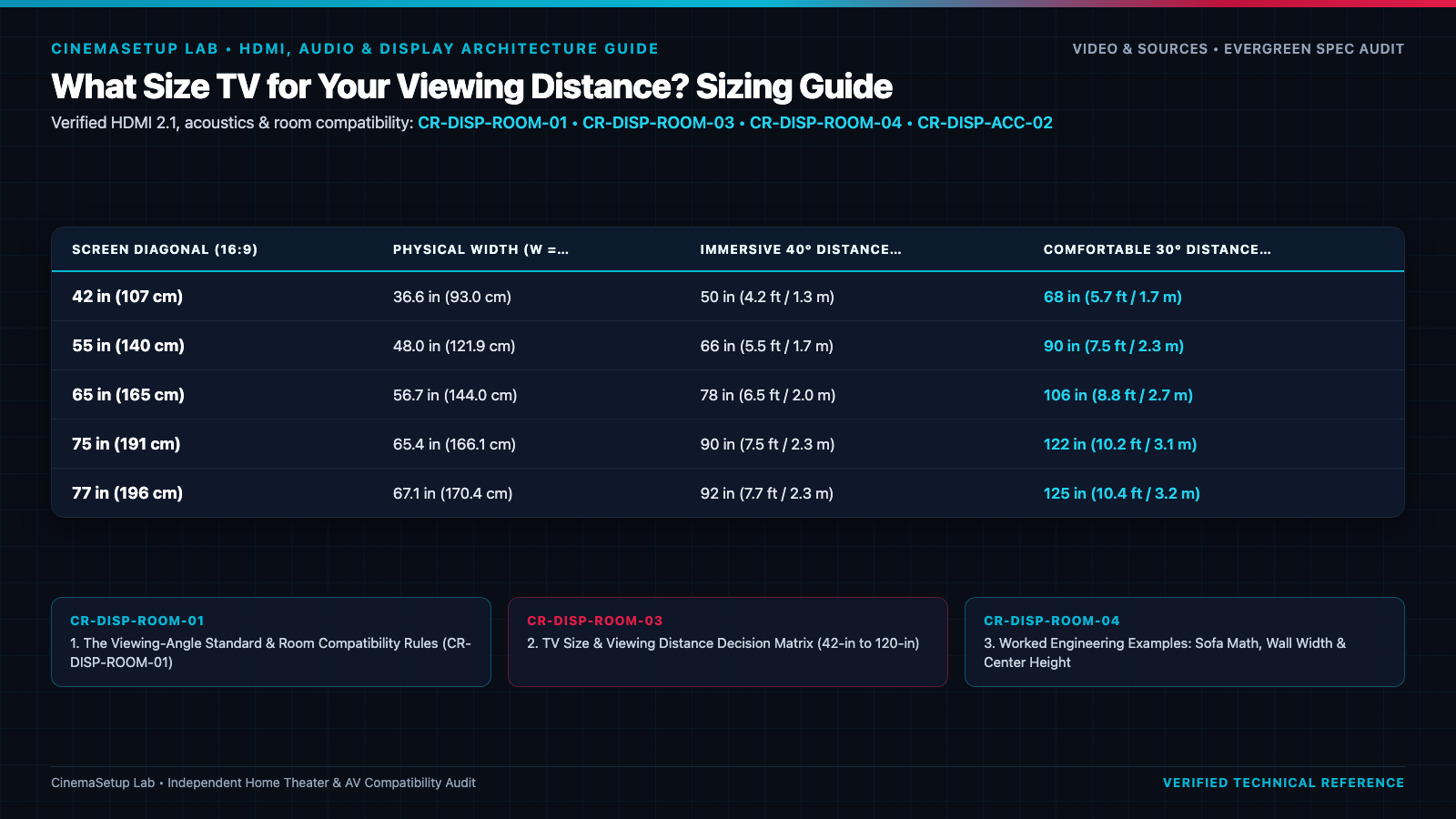
The sizing matrix below translates every common US television diagonal—plus the 100-to-120-inch projector threshold—using the exact W = diagonal × 0.872, 1.20× immersive (40°), and 1.63× comfortable (30°) formulas. Once your distance points toward 100 in (254 cm) or larger in a darkened room, consult our projector screen sizing guide and projector throw distance guide to verify lens-to-wall room depth.
| Screen Diagonal (16:9) | Physical Width (W = 0.872 × D) | Immersive 40° Distance (1.20 × D) | Comfortable 30° Distance (1.63 × D) | Best Room & Usage Fit | Critical Caveat & Rule Check |
|---|---|---|---|---|---|
| 42 in (107 cm) | 36.6 in (93.0 cm) | 50 in (4.2 ft / 1.3 m) | 68 in (5.7 ft / 1.7 m) | PC gaming desk, dorm, compact study | Check desk depth ≥ 40 in (102 cm) and OLED static-HUD habits |
| 55 in (140 cm) | 48.0 in (121.9 cm) | 66 in (5.5 ft / 1.7 m) | 90 in (7.5 ft / 2.3 m) | Bedroom or small apartment (12 × 14 ft / 3.7 × 4.3 m) | Often feels undersized in open living rooms beyond 8.5 ft (2.6 m) |
| 65 in (165 cm) | 56.7 in (144.0 cm) | 78 in (6.5 ft / 2.0 m) | 106 in (8.8 ft / 2.7 m) | Standard US living room (8–9 ft / 2.4–2.7 m sofa) | Verify 120 Hz vs. 60 Hz panel specs on entry models (CR-SRC-DISP-02) |
| 75 in (191 cm) | 65.4 in (166.1 cm) | 90 in (7.5 ft / 2.3 m) | 122 in (10.2 ft / 3.1 m) | Mid-sized family room (9–10.5 ft / 2.7–3.2 m sofa) | Check VA off-axis washout on wide L-shaped couches (CR-DISP-ROOM-04) |
| 77 in (196 cm) | 67.1 in (170.4 cm) | 92 in (7.7 ft / 2.3 m) | 125 in (10.4 ft / 3.2 m) | Dark-room OLED cinema setup (8–10.5 ft / 2.4–3.2 m) | OLED wide viewing angle holds contrast across broad seating rows |
| 85 in (216 cm) | 74.1 in (188.2 cm) | 102 in (8.5 ft / 2.6 m) | 139 in (11.6 ft / 3.5 m) | Large living room & bright great room (9–12 ft / 2.7–3.7 m) | Requires 600 × 400 mm VESA stud mount and wide media stand (CR-DISP-ACC-02) |
| 98 in (249 cm) | 85.5 in (217.2 cm) | 118 in (9.8 ft / 3.0 m) | 160 in (13.3 ft / 4.1 m) | XL bright media room (10–13.5 ft / 3.0–4.1 m) | Check stairway/doorway turn clearance and 130+ lb (59+ kg) wall load |
| 100 in (254 cm) | 87.2 in (221.5 cm) | 120 in (10.0 ft / 3.0 m) | 163 in (13.6 ft / 4.1 m) | UST laser projector + ALR screen or XL TV wall | UST requires lenticular UST ALR/CLR screen in lit rooms (CR-DISP-ACC-01) |
| 120 in (305 cm) | 104.6 in (265.7 cm) | 144 in (12.0 ft / 3.7 m) | 196 in (16.3 ft / 5.0 m) | Dedicated light-controlled theater (12–16 ft / 3.7–4.9 m) | Confirm projector throw depth (CR-DISP-ROOM-02) and ceiling height |
3. Worked Engineering Examples: Sofa Math, Wall Width & Center Height
Before ordering a television, run through two concrete room calculations and one physical clearance check using the published formulas above. Note that all angular distances below are geometric calculations derived from standard 16:9 panel dimensions rather than subjective estimates.
Worked Example A: Standard 10 ft (120 in / 3.05 m) Living-Room Sofa
Suppose your tape measure reads exactly 10.0 ft (120 in / 3.05 m) from your seated eye position on the couch to the front wall where the TV will mount:
- Comfortable 30° Diagonal:
120 in / 1.63 = 73.6 in→ rounds to a 75-inch or 77-inch TV. - Immersive 40° Diagonal:
120 in / 1.20 = 100.0 in→ aligns with a 98-inch TV or 100-inch projector screen. - What Happens If You Buy 65 in Instead? A 65-inch panel is
56.7 in (144.0 cm)wide. At 120 in (3.05 m), its horizontal viewing angle drops to2 × arctan(28.35 / 120) = 26.6°, falling below the 30-degree SMPTE comfort floor under CR-DISP-ROOM-01. For a 10 ft (3.05 m) sofa, an 85-inch TV delivers a balanced34.3°viewing angle right in the middle of the sweet spot.
Worked Example B: Compact 6.5 ft (78 in / 1.98 m) Apartment or Bedroom
Now measure a smaller bedroom or city apartment where your seating sits 6.5 ft (78 in / 1.98 m) from the dresser or wall:
- Comfortable 30° Diagonal:
78 in / 1.63 = 47.9 in→ aligns with a 48-inch or 50-inch TV. - Immersive 40° Diagonal:
78 in / 1.20 = 65.0 in→ aligns with a 65-inch TV. - Balanced Recommendation: A 55-inch TV (
48.0 in / 121.9 cmwide) yields a34.2°horizontal angle at 6.5 ft (1.98 m), leaving clean wall margin for left/right bookshelf speakers and keeping mixed cable or YouTube feeds sharp.
Worked Example C: Front Wall Width, Stand Clearance & Eye-Level Height
Screen diagonal only tells half the spatial story. Always verify three physical room clearances before choosing between 65-inch and 85-inch screens:
- Speaker Flanking Margin: An 85-inch TV spans
74.1 in (188.2 cm)horizontally. Add two floorstanding towers or bookshelf stands spaced 12 to 18 in (30 to 46 cm) outside the cabinet edges, and your front wall needs at least 9.5 to 10.5 ft (2.9 to 3.2 m) of unobstructed width so front speakers are not crammed into corners. - Seated Eye-Level Alignment: Center the middle third of the screen near seated eye height—roughly 40 to 44 in (102 to 112 cm) above the floor for standard sofas. Mounting a 75- or 85-inch panel high above a fireplace mantel tilts your neck upward and degrades vertical LCD viewing angles.
- Soundbar & Center-Channel Clearance (CR-SBAR-DISP-05): Many modern TVs sit on low-profile blade feet offering only 2.0 to 3.0 in (5.1 to 7.6 cm) of bottom-bezel clearance. Placing a 3.0-in (7.6 cm) soundbar or 7.0-in (17.8 cm) center speaker on the console blocks subtitles and the TV’s IR sensor unless you wall-mount the display above the audio gear.
4. Myth vs. Engineering Reality: 5 Screen-Sizing Traps to Avoid
Myth vs. Engineering Reality Audit:
- Myth 1: “A 65-inch TV is more than big enough for any 10-to-12-foot living room.”
Engineering Reality: At 11 ft (132 in / 3.35 m), a 65-inch screen fills only 24.2 degrees of horizontal vision—well below SMPTE’s 30-degree baseline (CR-DISP-ROOM-01). Stepping up from 65 in to 85 in increases visible screen area by roughly 71% (2,960 sq in vs. 1,731 sq in), restoring movie-scale detail at normal American living-room distances. - Myth 2: “Sitting close to a large 4K TV damages your eyes or exposes pixelation.”
Engineering Reality: On a 4K UHD panel, individual pixels sit four times denser than on 1080p sets. Sitting inside the 30-to-40-degree angular cone (for example, 6.5 ft / 2.0 m from a 65-inch screen) preserves sharp text and film grain without visible pixel structure, provided room lighting and screen brightness remain comfortable. - Myth 3: “Every size inside one TV series uses the exact same panel and ports.”
Engineering Reality: Manufacturers frequently swap panel technologies, local-dimming zone counts, and stand designs between sizes within one model family (L-09 / G-05). For example, some 42-inch OLEDs run dimmer in HDR highlights than 65-inch siblings, and several mid-range series mix IPS/ADS and VA LCD panels across 55-, 65-, and 75-inch SKUs. - Myth 4: “You can reuse an older 55-inch wall mount for an 85-inch upgrade.”
Engineering Reality: Moving from 55 in (~30–40 lb / 14–18 kg) to 85 in (~66–95 lb / 30–43 kg) or 98 in (~135 lb / 61 kg) alters both VESA bolt spacing (shifting from 300 × 200 or 400 × 400 mm to 600 × 400 or 800 × 400 mm) and wall-bracket torque. Always match mount load limits and VESA specs to the chassis weight without stand (CR-DISP-ACC-02). - Myth 5: “A budget projector automatically outperforms an 85-inch TV for daytime living rooms.”
Engineering Reality: Even bright projectors struggle against daytime window glare without a dedicated ambient-light-rejecting screen (CR-DISP-ROOM-03), and sub-$400 generic “4K support” projectors use native 720p/1080p engines with low true ANSI/ISO lumen output. In sunlit family rooms, an 85-inch Mini-LED TV sustains dramatically higher contrast.
5. Verified US 120V TVs Matched to Each Viewing Distance Tier
To translate viewing-distance math into real hardware, the four US 120V models below come from verified Amazon US inventory checked on 2026-11-26, spanning compact 42-inch close-range OLEDs up to 85-inch family-room Mini-LED screens. Always verify the Sold by line at Amazon checkout to confirm Amazon.com or an authorized US dealer so factory warranty coverage stays valid (G-26).
1. LG 42-Inch Class OLED evo AI C6 (OLED42C6PUA, 2026) — Best for 4.2 to 5.7 ft (1.3 to 1.7 m)

Key Audited Specs & Box Contents: 42-in class 4K WOLED evo panel (36.7 in / 93.2 cm wide) | Ideal Viewing Distance: 4.2 to 5.7 ft (1.3 to 1.7 m) | 120 Hz native / up to 165 Hz VRR (PC) | 4 of 4 HDMI 2.1 ports (48 Gbps) with eARC, G-SYNC Compatible, and FreeSync Premium | HDR: Dolby Vision, HDR10, HLG (no HDR10+) | VESA: 300 × 200 mm | Weight: 21.6 lb (9.8 kg) without stand | In the Box: US 120V LG 42-in C6 TV, tabletop stand, Magic Remote with batteries, power cord, quick-start guide (wall mount and Ultra High Speed HDMI cables sold separately) | Price Tier: $1,100-$1,500 (Premium TV)
When your room is a deep gaming desk, studio apartment, or cozy den with seating 4.2 to 5.7 ft (1.3 to 1.7 m) away, a 55-inch television pushes your horizontal angle past 45 degrees and forces constant head movement. The 2026 LG 42-inch OLED evo C6 hits the exact 30-to-40-degree sweet spot at close range while delivering per-pixel self-emissive black levels and all four HDMI inputs rated for full 48 Gbps bandwidth. Using one port for eARC audio still leaves three 4K120/165Hz inputs free for consoles and a PC (CR-DISP-AVR-02). Keep in mind that HDR10+ is absent on LG sets (falling back to HDR10 per CR-SRC-DISP-01), and desktop PC users should enable OLED screen-saver and pixel-shift protections against static taskbar burn-in.
Pros
- Ideal 36.7-in (93.2 cm) width for 4.2 to 5.7 ft (1.3 to 1.7 m) desk or small-bedroom viewing
- Four full-bandwidth 48 Gbps HDMI 2.1 ports support 4K120 consoles, 165 Hz PC VRR, Dolby Vision, and eARC simultaneously
Cons
- No HDR10+ support (plays HDR10+ discs/streams in static HDR10); glossy OLED screen reflects direct opposite windows
- Requires OLED burn-in precautions for static PC toolbars or news tickers (ISS-DISP-OLED-RETENTION)
2. Hisense 55-Inch U7 Mini-LED ULED (55U7SG, 2026) — Best for 5.5 to 7.5 ft (1.7 to 2.3 m)

Key Audited Specs & Box Contents: 55-in class 4K Mini-LED ULED panel (48.0 in / 121.9 cm wide) with Anti-Reflection coating | Ideal Viewing Distance: 5.5 to 7.5 ft (1.7 to 2.3 m) | Native 165 Hz / VRR 330 | HDMI 2.1 gaming inputs + eARC (HDMI 3) | HDR: Dolby Vision IQ, HDR10+, HDR10, HLG, IMAX Enhanced | Google TV OS | VESA: 400 × 400 mm | Weight: ~30.4 lb (13.8 kg) without stand | In the Box: US 120V Hisense 55U7SG TV, stand legs, voice remote with batteries, power cord, quick-start guide (HDMI cables and mount sold separately) | Price Tier: $500-$1,100 (Value 4K TV)
For bedrooms and smaller apartment living rooms where the couch sits 5.5 to 7.5 ft (1.7 to 2.3 m) from the wall, 55 inches delivers the ideal 30-to-40-degree angular footprint. The 2026 Hisense 55U7SG pairs a high-output Mini-LED backlight and anti-reflection layer with both Dolby Vision IQ and HDR10+, eliminating dynamic-HDR format gaps across streaming apps and discs (CR-SRC-DISP-01). Under CR-DISP-ROOM-03, its Mini-LED headroom handles unshaded afternoon window glare without burn-in worry, though buyers should confirm seating remains reasonably centered if wide sectional arms exceed 25 to 30 degrees off-axis (CR-DISP-ROOM-04). Also verify the updated 400 × 400 mm VESA bolt pattern before reusing an older 400 × 200 mm wall bracket (CR-DISP-ACC-02).
Pros
- Sized squarely for 5.5 to 7.5 ft (1.7 to 2.3 m) bedrooms and apartments with anti-reflection Mini-LED punch
- Supports Dolby Vision IQ, HDR10+, IMAX Enhanced, and native 165 Hz VRR gaming without format lock-in
Cons
- VA-class LCD contrast softens for viewers sitting far off to the side of the screen (CR-DISP-ROOM-04)
- eARC shares HDMI 3, requiring port planning when connecting both an AVR/soundbar and multiple 4K120+ sources
3. Sony 65-Inch BRAVIA 2 II LED 4K (K-65S20M2) — Casual 6.5 to 8.8 ft (2.0 to 2.7 m)

Key Audited Specs & Box Contents: 65-in class (64.5 in viewable) 4K Direct LED IPS-type panel (56.7 in / 144.0 cm wide) | Ideal Viewing Distance: 6.5 to 8.8 ft (2.0 to 2.7 m) | 60 Hz native refresh rate | 4 side HDMI inputs (4K60 max, ALLM, eARC/ARC supported) | HDR: HDR10, HLG (no Dolby Vision or HDR10+) | Google TV OS | VESA: 300 × 300 mm | Weight: 43.4 lb (19.7 kg) without stand | In the Box: US 120V Sony K-65S20M2 TV, tabletop stand blades, voice remote with batteries, AC cord, setup paperwork (HDMI cables and mount sold separately) | Price Tier: $500-$1,100 (Value 4K TV)
Sixty-five inches remains the core living-room size for sofas positioned 6.5 to 8.8 ft (2.0 to 2.7 m) away. The Sony BRAVIA 2 II (K-65S20M2) offers a straightforward 65-inch Google TV option with Sony’s 4K X-Reality PRO upscaling for broadcast cable, sports, and everyday streaming, plus an IPS-type panel that holds colors better for wide family seating. However, our spec audit flags two hard technical limits: its 60 Hz panel cannot accept 4K120 or VRR from PS5/Xbox Series X consoles (CR-SRC-DISP-02), and it supports only static HDR10 and HLG without Dolby Vision (CR-SRC-DISP-01). Serious movie cinephiles or 120 Hz gamers in this 65-inch tier should step up to an OLED or 120 Hz Mini-LED model from our best TVs for home theater hub.
Pros
- Hits the 6.5 to 8.8 ft (2.0 to 2.7 m) living-room distance band with wide IPS-type off-axis color stability
- Includes HDMI eARC/ARC and ALLM across a clean Google TV interface with strong 1080p/720p broadcast upscaling
Cons
- 60 Hz refresh cap excludes 4K120 and VRR console gaming (CR-SRC-DISP-02); lacks local dimming for dark-room black depth
- No Dolby Vision or HDR10+ dynamic metadata support (CR-SRC-DISP-01 fallback to HDR10)
4. Hisense 85-Inch U6 Pro Mini-LED (85U6SF Pro, 2026) — Best for 8.5 to 11.6 ft (2.6 to 3.5 m)

Key Audited Specs & Box Contents: 85-in class 4K Mini-LED ULED panel (74.1 in / 188.2 cm wide) with Glare-Free finish | Ideal Viewing Distance: 8.5 to 11.6 ft (2.6 to 3.5 m) | Native 144 Hz / Motion Rate 480 / FreeSync Premium Pro | 2x HDMI 2.1 (4K144/VRR) + eARC (HDMI 1) | HDR: Dolby Vision IQ, HDR10+, HDR10, HLG | Fire TV OS | VESA: 600 × 400 mm | Weight: ~66.1 to 68.3 lb (30.0 to 31.0 kg) without stand | In the Box: US 120V Hisense 85U6SF Pro TV, stand legs, Alexa voice remote with batteries, power cord, setup guide (heavy-duty wall mount and HDMI cables sold separately) | Price Tier: $1,100-$1,800 (Premium TV)
When your living-room sofa sits 8.5 to 11.6 ft (2.6 to 3.5 m) from the front wall, stepping up to an 85-inch display prevents the “postage stamp” regret common with 65-inch purchases. The 2026 Hisense 85U6SF Pro brings Mini-LED local dimming, a Glare-Free reflection finish, native 144 Hz refresh capability, and dual HDR10+ / Dolby Vision IQ support into an accessible Premium TV budget tier—making it far easier to live with in bright great rooms than a long-throw projector (CR-DISP-ROOM-03). Check two connection and mounting details before ordering: full HDMI 2.1 4K144/VRR bandwidth sits on two dedicated ports while eARC is assigned to HDMI 1 (CR-DISP-AVR-02), and the 600 × 400 mm VESA chassis weighs nearly 70 lb (31 kg), requiring sturdy stud anchoring.
Pros
- Restores true 30°–40° theater immersion at 8.5 to 11.6 ft (2.6 to 3.5 m) with Glare-Free Mini-LED contrast
- Supports 144 Hz VRR, FreeSync Premium Pro, Dolby Vision IQ, and HDR10+ inside a value-conscious 85-inch tier
Cons
- Only two full-bandwidth HDMI 2.1 inputs; eARC on HDMI 1 requires routing extra consoles through an AVR if needed
- Wide 74.1-in (188.2 cm) footprint demands a broad credenza or 600 × 400 mm stud-anchored wall mount and two-person lift
6. VESA Mount Load Limits, Stud Anchoring & In-Wall Wiring Safety
Safety, Structural & Electrical Compliance Notice (G-27 / CR-DISP-ACC-02 / CR-ACC-SPK-02):
- Manufacturer-Instruction-First Mounting & Stud Anchoring (CR-DISP-ACC-02): Always verify the TV’s exact VESA hole pattern (e.g., 300 × 200 mm, 400 × 400 mm, or 600 × 400 mm) and chassis weight without stand against the wall mount’s UL-listed load rating. Follow the mount and TV manufacturer’s printed instructions strictly, anchor lag bolts into solid wood wall studs or rated masonry anchors—never mount a medium or large TV into hollow drywall alone—and use two or more people to lift 65-inch and 85-inch+ displays safely.
- UL CL2 / CL3 In-Wall HDMI & Speaker Cabling (CR-ACC-SPK-02): When concealing HDMI cables or speaker wire behind a wall-mounted screen, use only UL-listed CL2 or CL3 rated cables (or local building-code-equivalent jacket ratings) and verify directional Ultra High Speed HDMI fiber specs for runs exceeding 10 ft (3.0 m) carrying 4K120/48 Gbps signals (CR-ACC-DISP-01).
- AC Power Safety & Licensed Pro Referrals: Never route a television’s standard AC power cord inside drywall cavities. Install recessed power outlets or UL-listed in-wall power-bridge kits strictly according to manufacturer documentation and local electrical codes, and consult a licensed electrician or licensed AV installer whenever cutting into walls, relocating AC receptacles, or mounting 85-inch and 98-inch displays on metal studs, brick, or plaster.
- US 120V Model & Warranty Verification (CR-SYS-02 / G-26): Confirm every television listing specifies North American 120V AC / 60 Hz power, ATSC US tuners, and authorized US dealer fulfillment so manufacturer panel warranties remain valid.
7. Authoritative Standards & Manufacturer References
- SMPTE & THX Cinema Viewing-Angle Geometry: SMPTE EG-18-1994 / THX 30° minimum and 40° recommended horizontal field-of-view viewing geometry for 16:9 widescreen displays at smpte.org and thx.com.
- LG USA Official Specifications: LG 42-inch Class OLED evo AI C6 (OLED42C6PUA: 4x 48 Gbps HDMI 2.1, eARC, VESA 300 × 200 mm, 21.6 lb without stand) at lg.com/us.
- Sony USA Official Specifications: Sony BRAVIA 2 II K-65S20M2 (64.5-in viewable Direct LED, 60 Hz panel, 4x HDMI with eARC/ARC, HDR10/HLG, VESA 300 × 300 mm, 43.4 lb without stand) at electronics.sony.com.
- Hisense USA Official Product Documentation: Hisense 55U7SG (55-in Mini-LED, 165 Hz native, VESA 400 × 400 mm, Dolby Vision IQ / HDR10+) and 85U6SF Pro (85-in Mini-LED, 144 Hz native, VESA 600 × 400 mm, Glare-Free surface) at hisense-usa.com.
- HDMI Forum & UL Standards: HDMI 2.1 48 Gbps Ultra High Speed cable certification and eARC audio return specs at hdmi.org.
How We Audited This Guide
- Displays and sources were audited across OLED vs. Mini-LED HDR formats (Dolby Vision, HDR10+), 4K/120Hz VRR console support, verified ANSI/ISO projector lumens, throw distance ratios, and lossless optical disc vs. streaming audio codecs.
- Every AV receiver, speaker, subwoofer, soundbar, OLED/Mini-LED TV, projector, source player, and accessory spec was cross-checked against official manufacturer manuals, CEA/CTA standards, and live Amazon US listings.
- Recommendations were evaluated against our weighted vertical scoring rubrics and documented CR-* compatibility rules; we never invent nits, contrast ratios, bench wattage, or room decibels.
8. Frequently Asked Questions
How do I calculate what size TV for my viewing distance?
Measure the distance from your seated eyes to the screen in inches, then divide by 1.63 for a comfortable 30-degree view or by 1.20 for an immersive 40-degree cinema view. A 10 ft (120 in / 3.05 m) seat supports 75 to 98 in (191 to 249 cm).
Is a 65-inch TV big enough for a 10-foot viewing distance?
At 10 ft (120 in / 3.05 m), a 65-inch TV spans only 26.6 degrees horizontally—just below SMPTE’s 30-degree baseline. It works for casual news or sports, but stepping up to a 75-, 77-, or 85-inch display restores genuine movie-theater immersion.
Can you sit closer to a 4K TV than a 1080p TV?
Yes. Because a 4K UHD panel packs four times as many pixels as 1080p across the same diagonal, pixel structure disappears even at the closer 40-degree distance (1.20 times screen diagonal). You can safely sit closer for 4K movies and games without visible grid lines.
What is the best TV size for an 8-foot viewing distance?
At 8 ft (96 in / 2.44 m), dividing by 1.63 gives 58.9 in and dividing by 1.20 gives 80.0 in. That places a 65-inch TV right in the comfortable-to-balanced sweet spot and a 75- or 77-inch TV near the immersive cinema limit.
When should I choose a projector instead of an 85-inch or 98-inch TV?
Consider a projector once your seating sits 10 to 15 ft (3.0 to 4.6 m) back in a light-controlled room where you want a 100-to-120-inch screen. In sunlit living rooms, an 85-inch Mini-LED TV preserves substantially stronger daytime HDR contrast.
How high should I mount a 65-inch or 85-inch TV on the wall?
Aim for the vertical center of the screen to sit near seated eye height—roughly 40 to 44 in (102 to 112 cm) off the floor for standard couches. Follow the mount maker’s stud-anchoring instructions and verify VESA weight ratings first.


