
Disclosure: As an Amazon Associate, I earn from qualifying purchases. If you buy through links on this page, we may earn a small commission at no extra cost to you. Commission differences (TVs typically earn 2% while projectors and AV accessories generally earn 4%) never influence our compatibility rules, scores, or verdicts.
Deciding between a tv vs projector for home theater comes down to three physical constraints rather than brand hype: how much ambient light hits your screen, how many feet sit between your sofa and the front wall, and whether your sources demand 4K120 HDMI 2.1 bandwidth. A bright Mini-LED or self-emissive OLED television dominates sunlit living rooms and multi-console gaming setups, while a dedicated light-controlled theater or ultra-short-throw laser room unlocks 100-to-150-inch cinema scale that flat panels cannot match in typical budgets.
To give you a concrete room-by-room verdict, we audited published US manufacturer specs across current Amazon US retail benchmarks—comparing high-output Mini-LED and Glare-Free OLED options from our best TVs for home theater hub against ultra-short-throw (UST) and long-throw 3LCD projectors. Rather than declaring one universal winner, the matrix below maps the exact display architecture that passes our compatibility rules for each room archetype.
In This Comparison
- Winner-by-Use-Case Quick Verdict Matrix
- Side-by-Side Spec & Compatibility Table
- Battleground 1: Ambient Room Light & Contrast Physics
- Battleground 2: Screen Size, Viewing Distance & Throw Depth
- Battleground 3: Screen Pairing & Mounting Safety
- Battleground 4: HDMI 2.1 Gaming, eARC Audio & HDR Formats
- Battleground 5: True Setup Cost, Warranties & Marketplace Traps
- Choose a TV vs. Choose a Projector
- Audited Contenders on Amazon US
- Frequently Asked Questions
Quick Verdict: TV vs. Projector by Room & Use Case
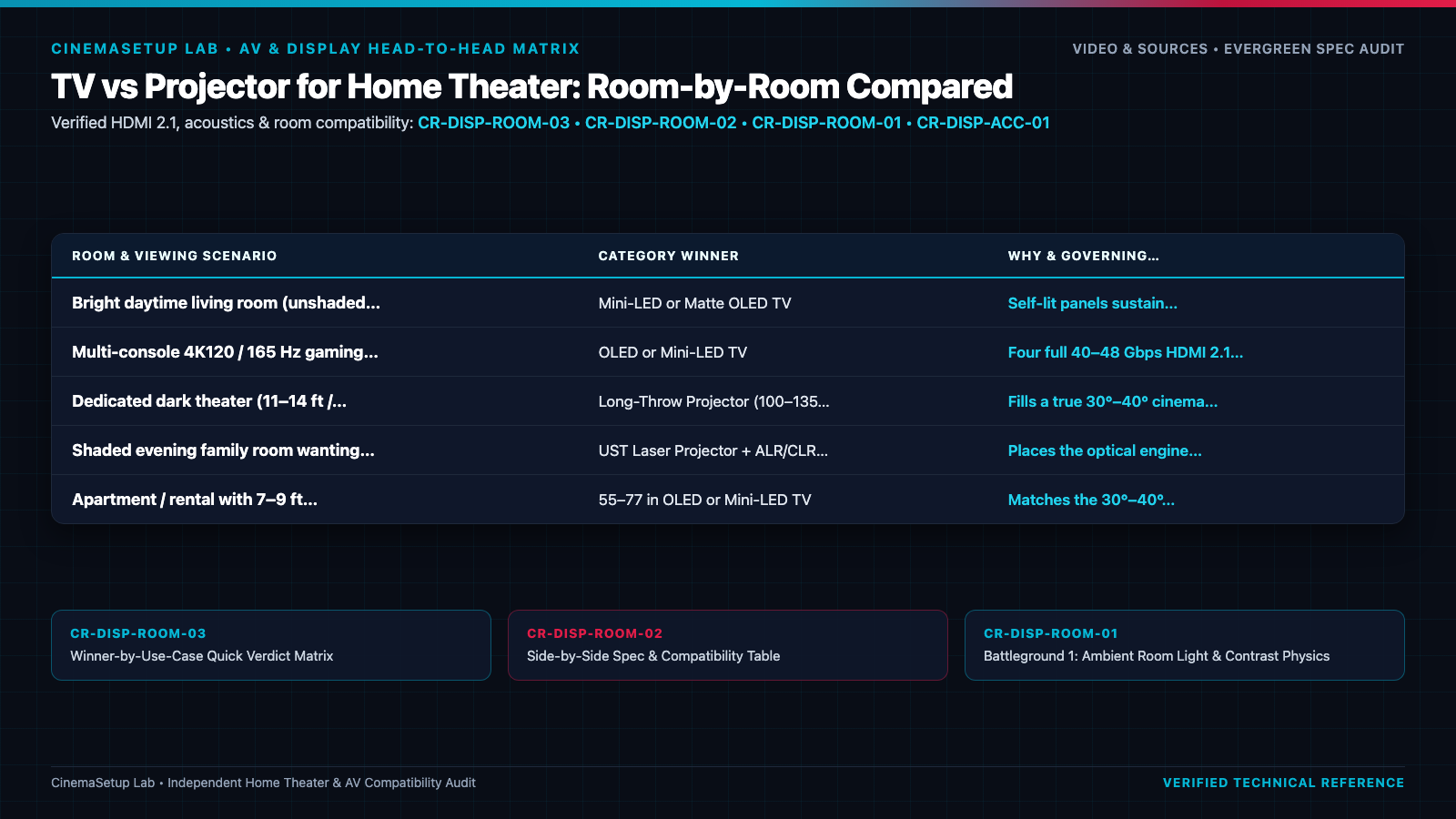
No single display wins every room. Under CinemaSetup Lab compatibility rules (CR-DISP-ROOM-01 through CR-DISP-ACC-01), room light and seating distance pick the category winner before you ever compare individual SKUs.
| Room & Viewing Scenario | Category Winner | Why & Governing Compatibility Rule |
|---|---|---|
| Bright daytime living room (unshaded windows) | Mini-LED or Matte OLED TV | Self-lit panels sustain daytime punch and resist window washout; long-throw projectors fail in unshaded sun (CR-DISP-ROOM-03). |
| Multi-console 4K120 / 165 Hz gaming room | OLED or Mini-LED TV | Four full 40–48 Gbps HDMI 2.1 ports carry 4K120/165Hz, VRR, ALLM, and eARC; most projectors cap at 4K60 (CR-SRC-DISP-02). |
| Dedicated dark theater (11–14 ft / 3.4–4.3 m seat) | Long-Throw Projector (100–135 in) | Fills a true 30°–40° cinema field of view and supports acoustically transparent screens when room depth fits (CR-DISP-ROOM-02). |
| Shaded evening family room wanting 100–120 in | UST Laser Projector + ALR/CLR Screen | Places the optical engine inches from the wall without ceiling wiring, provided you pair a lenticular UST screen (CR-DISP-ACC-01). |
| Apartment / rental with 7–9 ft (2.1–2.7 m) seating | 55–77 in OLED or Mini-LED TV | Matches the 30°–40° viewing-angle band cleanly with zero ceiling drilling or wall-to-wall throw clearance (CR-DISP-ROOM-01). |
Side-by-Side Verified Spec & Compatibility Comparison
To keep comparisons fair under G-04 and G-16, we evaluate televisions and projectors on their native engineering specs without mixing marketing lumen claims or transferring measurements across screen sizes. Notice the architectural trade-off: televisions bundle high-bandwidth HDMI 2.1 switching and dynamic HDR metadata, whereas projectors scale image width above 100 in (254 cm) while offloading audio and screen hardware.
| Specification & Rule | Mini-LED TV (TCL 65QM8L) | OLED TV (Samsung 65S90H) | UST Laser Projector (Epson LS800) | Long-Throw Projector (Epson HC 2350) |
|---|---|---|---|---|
| Image Scale | 65 in fixed (series up to XL sizes) | 65 in fixed (55–83 in class options) | 80–150 in (203–381 cm) via throw chart | Up to 120–150 in (305–381 cm) by room depth |
| Display / Optical Engine | 4K SQD-Mini LED (WHVA 2.0) | 4K Self-Emissive OLED (Glare-Free) | 3-Chip 3LCD Laser (4K PRO-UHD pixel shift) | 3-Chip 3LCD Lamp (4K PRO-UHD pixel shift) |
| Rated Luminance Basis | Maker-rated up to 6,000 nits small-window peak | Self-emissive OLED (independent nit window BM not cited) | 4,000 lumens color & white (ISO 21118 / IDMS) | 2,800 lumens color & white (ISO / IDMS) |
| HDMI Bandwidth & Gaming | 4x HDMI 2.1 (144 Hz native, VRR, ALLM) | 4x HDMI 2.1 (up to 165 Hz VRR, ALLM) | 3x HDMI 2.0 (18 Gbps, 4K60 max, no VRR) | 2x HDMI 2.0 (18 Gbps, 4K60 max, no VRR) |
| Audio Return (ARC/eARC) | eARC on HDMI 1 (3 ports left free) | eARC supported (3 ports left free) | ARC on 1 HDMI port (no lossless eARC) | None (built-in 10 W mono speaker + 3.5 mm) |
| Dynamic HDR Support | Dolby Vision IQ, HDR10+, HDR10, HLG | HDR10+, HDR10, HLG (no Dolby Vision) | HDR10, HLG (static tone mapping) | HDR10, HLG (static tone mapping) |
| Throw Depth (120 in / 305 cm) | 0 ft (flat wall mount or stand) | 0 ft (flat wall mount or stand) | 0.16–0.40 ratio (~17.3 in / 43.9 cm for 100 in) | 1.32–2.15 ratio (11.5–18.7 ft / 3.5–5.7 m) |
| Required Extras | VESA 300×300 mount (stand included) | VESA 300×200 mount (stand included) | Lenticular UST ALR/CLR screen (separate) | Matte white/ALR screen + ceiling mount (separate) |
| Typical Price Tier (US) | $1,000–$1,500 (Value / Premium TV) | $1,500–$2,200 (Premium TV) | $1,900–$3,100 (Renewed / Mid-High Proj.) | $1,000–$1,500 (Mid Projector) |
Battleground 1: Ambient Room Light & Contrast Physics (CR-DISP-ROOM-03)
Room lighting creates the sharpest performance divide in any tv vs projector for home theater decision. A television generates light directly behind or inside each pixel and pairs that emission with polarized or anti-reflective front filters. By contrast, every front projector relies on reflected light bouncing off a screen back to your eyes—meaning any stray sunlight, recessed ceiling fixture, or light-colored painted wall competes directly with the darkest parts of the image.
Under rule CR-DISP-ROOM-03, display behavior splits cleanly across three light profiles:
- Bright Daytime Rooms: High-output Mini-LED televisions such as the TCL 65QM8L (manufacturer-rated up to 6,000 nits peak highlight capability with dense local dimming zones) and matte-coated OLEDs like the Samsung S90H preserve punchy daytime visibility. Long-throw lamp or modest-lumen projectors wash out severely when daylight hits the screen.
- Evening Family Rooms: When blinds are drawn or lamps sit dim, self-emissive OLED TVs (such as the Samsung S90H or Dolby Vision-equipped LG C6) deliver zero-nit pixel blacks without backlight blooming. A high-output UST laser projector like the 4,000-lumen Epson EpiqVision Ultra LS800 also becomes viable here—provided it projects onto a ceiling-light-rejecting UST ALR screen rather than bare drywall.
- Dedicated Light-Controlled Theaters: With dark matte walls, blackout shades, and zero stray light, a long-throw projector like the 2,800-lumen Epson Home Cinema 2350 reaches cinema scale comfortably. Even in a pitch-black theater, remember that OLED TVs hold deeper absolute black floors, while projectors win on enveloping field-of-view immersion.
Watch out for misleading projector brightness claims on retail listings. Under CR-DISP-ROOM-03 and G-16, only compare projector output rated under standardized ISO 21118 or ANSI / IDMS 15.4 lumen standards—and remember that you cannot directly convert projector lumens into television nits without factoring screen size, screen gain, and room reflectance.
Battleground 2: Screen Size, Viewing Distance & Throw Depth (CR-DISP-ROOM-01 & CR-DISP-ROOM-02)
Viewing geometry often settles the TV vs. projector debate automatically. For a standard 16:9 display, image width equals diagonal × 0.872. Under CR-DISP-ROOM-01, a 40-degree THX-style immersive angle places your eyes at roughly 1.20 × diagonal, while a 30-degree SMPTE comfortable baseline sits around 1.63 × diagonal. If your sofa sits 7 to 8.5 ft (2.1 to 2.6 m) from the screen in a bedroom or apartment, a 65-inch or 77-inch TV already fills the ideal cinema cone—making a 120-inch projector overwhelmingly tall at close range. Check our TV size viewing distance guide to verify your exact sofa measurement.
| 16:9 Screen Diagonal | Image Width | 40° Immersive Seat Distance | 30° Comfortable Seat Distance |
|---|---|---|---|
| 65 in (165.1 cm) TV | 56.7 in (144.0 cm) | 6.5 ft / 78 in (2.0 m) | 8.8 ft / 106 in (2.7 m) |
| 77 in (195.6 cm) TV | 67.1 in (170.5 cm) | 7.7 ft / 92 in (2.3 m) | 10.4 ft / 125 in (3.2 m) |
| 85 in (215.9 cm) TV | 74.1 in (188.2 cm) | 8.5 ft / 102 in (2.6 m) | 11.6 ft / 139 in (3.5 m) |
| 100 in (254.0 cm) Screen | 87.2 in (221.5 cm) | 10.0 ft / 120 in (3.0 m) | 13.6 ft / 163 in (4.1 m) |
| 120 in (304.8 cm) Screen | 104.6 in (265.7 cm) | 12.0 ft / 144 in (3.7 m) | 16.3 ft / 196 in (5.0 m) |
Once your room calls for a 100-inch or 120-inch image, hard rule CR-DISP-ROOM-02 checks whether a projector physically fits your room depth: needed_depth = (throw_ratio × image_width) + projector_body_depth + rear_clearance (allow 6 to 12 in / 15 to 30 cm behind the chassis for intake/exhaust airflow and HDMI bend radius). For a 120-inch screen (104.6 in / 265.7 cm wide), a long-throw unit like the Epson Home Cinema 2350 (1.32–2.15 throw ratio) requires 11.5 to 18.7 ft (3.5 to 5.7 m) from lens to screen before counting chassis depth. If your room is only 11 ft (3.4 m) deep front-to-back, a standard long-throw projector fails CR-DISP-ROOM-02 outright—forcing either a smaller image, a short-throw model, or an ultra-short-throw laser like the Epson LS800 (0.16–0.40 ratio, sitting roughly 17.3 in / 43.9 cm from the wall edge for a 100-inch picture). Run your room measurements through our projector throw distance guide before ordering.
Also inspect optical lens shift (CR-DISP-ROOM-05). The Epson Home Cinema 2350 provides ±60% vertical lens shift alongside 1.6x optical zoom, letting you mount the projector cleanly near the ceiling without tilting the chassis and relying on resolution-degrading digital keystone correction. Many low-cost lifestyle projectors omit optical lens shift entirely.
Battleground 3: Screen Matching, Acoustics & Mounting Safety (CR-DISP-ACC-01 & G-27)
Projecting onto a painted living-room wall wastes contrast and highlights every drywall seam—especially with ultra-short-throw optics whose steep upward projection angle magnifies surface waves. Under rule CR-DISP-ACC-01, screen material must match projector geometry:
- UST Laser Projectors: Require a dedicated lenticular / sawtooth UST ALR/CLR screen (typically ~0.5–0.6 gain). Its horizontal micro-ridges reflect steep upward projector light toward the couch while rejecting downward overhead room light. Never pair a UST projector with a standard long-throw angular-reflective ALR screen—it will bounce the UST beam away from viewers. See our living room UST projector setup blueprint for cabinet-height math.
- Long-Throw Projectors: Pair with a tensioned matte white screen (~1.0 gain) in blackout rooms, a gray / high-contrast screen when white walls reflect stray light, or an acoustically transparent woven/micro-perforated screen when placing left, center, and right speakers directly behind the picture (check the screen maker’s speaker-clearance guidance).
Installation & YMYL Structural Safety (CR-DISP-ACC-02 & G-27): Large 65-inch-plus televisions weigh 42 to 60+ lb (19 to 27+ kg) without stands, and fixed screens or ceiling-mounted projectors hang directly overhead. Always follow the display and mount manufacturer’s exact installation instructions first: verify the TV’s VESA pattern (300 x 200 mm on the Samsung S90H, 300 x 300 mm M6 on the TCL 65QM8L) and UL load rating, and anchor TV wall brackets or ceiling projector mounts squarely into structural wood/steel studs, ceiling joists, or rated masonry—never hang heavy displays or ceiling mounts on hollow drywall anchors alone. For concealed AC outlets behind wall-mounted TVs, long ceiling power drops, or in-wall HDMI and speaker wire (which must carry a UL CL2 or CL3 fire rating under CR-ACC-SPK-02), consult a licensed electrician or qualified AV installer to comply with local building codes.
Battleground 4: HDMI 2.1 Gaming, eARC Audio & HDR Formats (CR-SRC-DISP-01 & CR-SRC-DISP-02)
If a PlayStation 5, Xbox Series X, or gaming PC drives your room, televisions hold a decisive connectivity edge under CR-SRC-DISP-02 and CR-DISP-AVR-02. Both the TCL 65QM8L and Samsung 65S90H include four full-bandwidth HDMI 2.1 ports supporting 4K at 120 Hz (up to 144 Hz on the TCL QM8L and 165 Hz VRR on the Samsung S90H), HDMI Forum VRR, and ALLM. Even after dedicating one port to HDMI eARC for lossless Dolby TrueHD Atmos to an AV receiver or soundbar, three high-frame-rate inputs stay open.
By contrast, mainstream home theater projectors still rely predominantly on 18 Gbps HDMI 2.0 inputs. The Epson LS800 provides three HDMI 2.0 ports capped at 4K60 with basic ARC (not lossless eARC) on one port, while the Epson Home Cinema 2350 carries two HDMI 2.0 ports with no ARC/eARC at all. With a projector, your streaming box, 4K Blu-ray player, and game console should plug directly into a modern AV receiver first, sending video up to the projector over a certified HDMI cable. For ceiling runs longer than 10 to 15 ft (3.0 to 4.6 m), use a directional active optical fiber HDMI cable—and verify the source and display labels match each end before closing drywall (CR-ACC-DISP-01).
Dynamic HDR metadata splits across ecosystems as well (CR-SRC-DISP-01). The TCL 65QM8L supports both Dolby Vision IQ and HDR10+, whereas Samsung’s S90H supports HDR10+ and plays Dolby Vision content in baseline HDR10 (while LG’s C6 OLED reverses that split with Dolby Vision and no HDR10+). Most projectors rely on static HDR10 tone mapping or proprietary frame-by-frame optimization rather than native Dolby Vision—making high-contrast TVs easier to match to varied streaming apps without manual tone-curve adjustments.
Battleground 5: True Setup Cost, Warranties & Excluded Marketplace Traps
Comparing standalone Amazon prices hides the real budget equation. A $1,000–$1,500 television like the TCL 65QM8L arrives ready to place on its included stand out of the box. A $1,000–$1,500 long-throw projector like the Epson Home Cinema 2350 excludes the screen, UL-rated ceiling mount, long CL2/CL3 HDMI run, and an external surround audio system—easily adding several hundred to over a thousand dollars before your first movie night. Ultra-short-throw projectors like the Epson LS800 carry an even steeper accessory add-on because lenticular UST ALR/CLR fixed-frame screens add substantial cost on top of the optical engine. Browse our best home theater projectors guide for complete system budgeting across tiers.
US Warranty & Excluded Amazon Marketplace Traps (G-26 & CR-SYS-02): Always verify the Amazon seller line before checkout and prioritize units shipped and sold by Amazon.com or an explicitly authorized brand dealer so US manufacturer warranties remain valid. Strictly avoid third-party closeouts or grey-market regional imports—such as Canadian /ZC Samsung soundbar/TV variants—and skip generic sub-$400 projectors advertising inflated “8,000 ANSI lumens” or “4K support” on low-contrast native 720p/1080p engines (such as HAPPRUN, XuanPad, KOGATA, or Magcubic), which we exclude from serious home theater picks.
Final Verdict: Choose a TV vs. Choose a Projector
Choose a 4K OLED or Mini-LED TV If…
- Your room has daytime windows, overhead lamps, or light-colored walls you cannot black out (CR-DISP-ROOM-03).
- You play PS5, Xbox Series X, or PC games requiring 4K120/144/165Hz, VRR, ALLM, and full eARC (CR-SRC-DISP-02).
- Your seating sits 6.5 to 9.5 ft (2.0 to 2.9 m) away, where a 65-to-77-inch screen already fills a 30°–40° cinema view (CR-DISP-ROOM-01).
- You want plug-and-play HDR (Dolby Vision or HDR10+) with zero screen, throw-depth, or ceiling-mount extras.
Choose a Home Theater Projector If…
- You control ambient light in a dedicated theater or shaded evening room and want 100 to 150 in (254 to 381 cm) of image scale.
- Your sofa sits 10 to 15 ft (3.0 to 4.6 m) back, where even an 85-inch TV falls short of a 40° THX field of view.
- You have either 11.5+ ft (3.5+ m) of throw clearance for a long-throw unit or budget for a UST laser plus lenticular ALR/CLR screen (CR-DISP-ROOM-02, CR-DISP-ACC-01).
- You already route sources through an AV receiver and surround speakers rather than relying on built-in display audio.
Audited Benchmark Contenders on Amazon US
Below are four verified Amazon US contenders representing the key display classes in this comparison—spanning bright-room Mini-LED, Glare-Free OLED, living-room UST laser projection, and dedicated dark-room long-throw projection.
1. TCL 65QM8L 65-Inch SQD-Mini LED QLED 4K Google TV (144Hz) — Best Bright-Room Mini-LED TV

Key Specs: 65-in 4K SQD-Mini LED (WHVA 2.0 Ultra Panel) | 144 Hz native / 288 Game Accelerator | 4x HDMI 2.1 (eARC on HDMI 1) | Dolby Vision IQ, HDR10+, HDR10, HLG | VESA 300 x 300 mm (M6 x 20 mm), 46.5 lb (21.1 kg) without stand | Price Tier: $1,000–$1,500 (Value / Premium TV; stand included)
The TCL 65QM8L demonstrates why high-output Mini-LED televisions outperform projectors in sunlit family rooms. Its dense local-dimming backlight and WHVA 2.0 wide-angle layer preserve contrast across broad living-room sectionals, while four full HDMI 2.1 inputs leave three 4K144 gaming ports free even with an eARC soundbar or AVR connected on HDMI 1. Supporting both Dolby Vision IQ and HDR10+ eliminates dynamic HDR fallbacks.
Pros
- High bright-room output headroom with zero static-logo burn-in risk
- Four HDMI 2.1 ports with 144 Hz native VRR and dual Dolby Vision IQ + HDR10+ support
Cons
- Fixed 65-inch diagonal cannot match 100-to-135-inch projector immersion beyond 10 ft (3.0 m)
- Local-dimming haloing can remain visible around bright white subtitles in pitch-black rooms
Seller & Warranty Note: Confirm checkout shows shipped and sold by Amazon.com or an authorized TCL US dealer for US warranty eligibility.
2. Samsung S90H 65-Inch Class OLED 4K Smart TV (QN65S90HAEXZA) — Best Self-Emissive OLED TV

Key Specs: 65-in 4K OLED (Glare-Free matte surface) | 4K120 consoles / up to 165 Hz VRR (PC) | 4x HDMI 2.1 (eARC supported) | HDR10+, HDR10, HLG (no Dolby Vision) | VESA 300 x 200 mm, 42.1 lb (19.1 kg) without stand | Price Tier: $1,500–$2,200 (Premium TV; stand included)
Replacing Samsung’s discontinued S90D generation in current US inventory, the Samsung S90H combines per-pixel OLED dark-room black precision with a Glare-Free matte coating that diffuses living-room lamp reflections far better than glossy panels or projector screens. Four HDMI 2.1 inputs up to 165 Hz VRR handle multiple consoles and a gaming PC effortlessly. Keep two caveats in mind: Dolby Vision titles fall back to static HDR10 (CR-SRC-DISP-01), and Samsung’s S90 OLED lineage carries documented size-by-size panel-composition variance (QD-OLED vs. WOLED) across regions.
Pros
- Self-emissive per-pixel contrast eliminates Mini-LED blooming and projector black-floor lift
- Glare-Free screen and four 165 Hz HDMI 2.1 ports bridge daytime living rooms and serious gaming
Cons
- Omits Dolby Vision support (Dolby Vision sources fall back to HDR10)
- Inherent OLED image-retention risk with static HUDs/tickers and cross-size panel variance
Seller & Warranty Note: Confirm the US retail model code (QN65S90HAEXZA) and authorized Samsung US dealer status on Amazon before ordering (G-26); avoid grey-market imports.
3. Epson EpiqVision Ultra LS800 UST 3-Chip 3LCD Laser Projector (Renewed) — Best Living-Room UST Projector

Key Specs: 3-Chip 3LCD Laser UST (4K PRO-UHD pixel shift, 80–150 in) | 4,000 lumens color & white (ISO 21118 / IDMS) | 0.16–0.40 throw ratio | 3x HDMI 2.0 (18 Gbps, ARC on 1 port; 4K60 cap) | 27.4 x 13.4 x 6.2 in (69.6 x 34.0 x 15.7 cm), 26.5 lb (12.0 kg) | Price Tier: $1,900–$3,100 (Mid / High-End Projector; UST ALR screen sold separately)
When you want a 100-to-120-inch screen in a family room without ceiling mounts or 15 ft (4.6 m) of long-throw clearance, the Epson EpiqVision Ultra LS800 sits inches off the front wall (~17.3 in / 43.9 cm wall-to-front-edge for a 100-inch picture per Epson’s throw chart). Its 4,000 lumens of equal color and white brightness outshine typical dim projectors in shaded evening rooms, while built-in 2.1-channel Yamaha audio adds stopgap sound before upgrading to an AVR. Note that it uses 4K PRO-UHD pixel shifting rather than a native 4K chip, caps at 4K60 over HDMI 2.0, and requires a lenticular UST ALR/CLR screen budgeted separately.
Pros
- Ultra-short 0.16–0.40 throw projects 100–150 in from a low media console without ceiling wiring
- 4,000 ISO/IDMS lumens and 3-chip 3LCD optics eliminate single-chip DLP rainbow artifacts
Cons
- HDMI 2.0 ports cap at 4K60 without 4K120/VRR or lossless eARC, and pixel-shift 4K is softer on desktop text than native 4K TVs
- Requires a separate lenticular UST ALR/CLR screen (CR-DISP-ACC-01); this Amazon ASIN is Renewed rather than factory-new
Seller & Warranty Note: Amazon ASIN B0CQ47DYH8 is an Amazon Renewed listing covered by the Amazon Renewed Guarantee rather than Epson’s new-unit factory warranty; verify condition and return terms before checkout (G-26).
4. Epson Home Cinema 2350 4K PRO-UHD Smart Streaming Projector — Best Dark-Room Long-Throw Value

Key Specs: 3-Chip 3LCD Long-Throw (4K PRO-UHD pixel shift) | 2,800 lumens color & white (ISO / IDMS) | 1.32–2.15 throw ratio, 1.6x optical zoom, ±60% vertical lens shift | 2x HDMI 2.0 (4K60 cap, no ARC/eARC) | 9.0 lb (4.1 kg) | Price Tier: $1,000–$1,500 (Mid Projector; screen & mount excluded)
For dedicated dark bedrooms, basements, or bonus rooms with 12 to 19 ft (3.7 to 5.8 m) of wall-to-wall depth, the Epson Home Cinema 2350 delivers genuine 100-to-135-inch movie scale for less than flagship 85-inch televisions. Its 1.6x optical zoom and ±60% vertical lens shift simplify shelf or ceiling-mount alignment without destructive keystone cropping (CR-DISP-ROOM-05). Remember that it includes only a 10 W monaural speaker and lacks HDMI eARC/ARC—so pair it with an AV receiver and a dedicated fixed-frame screen.
Pros
- 1.6x optical zoom and ±60% vertical lens shift make ceiling or rear-shelf placement forgiving
- 3-chip 3LCD 4K PRO-UHD engine avoids DLP rainbow shimmer at an approachable Mid-tier budget
Cons
- Needs 11.5–18.7 ft (3.5–5.7 m) of lens-to-screen throw depth for a 120-inch image plus rear clearance (CR-DISP-ROOM-02)
- No HDMI eARC/ARC, no 4K120 VRR gaming, and lamp-based light source washes out quickly in daytime light
Seller & Warranty Note: Buy shipped and sold by Amazon.com or an authorized Epson US dealer for full warranty coverage, and budget separately for a fixed-frame screen, UL-rated ceiling mount, and CL2/CL3 long-run HDMI cabling.
How We Audited This Guide
- Displays and sources were audited across OLED vs. Mini-LED HDR formats (Dolby Vision, HDR10+), 4K/120Hz VRR console support, verified ANSI/ISO projector lumens, throw distance ratios, and lossless optical disc vs. streaming audio codecs.
- Every AV receiver, speaker, subwoofer, soundbar, OLED/Mini-LED TV, projector, source player, and accessory spec was cross-checked against official manufacturer manuals, CEA/CTA standards, and live Amazon US listings.
- Recommendations were evaluated against our weighted vertical scoring rubrics and documented CR-* compatibility rules; we never invent nits, contrast ratios, bench wattage, or room decibels.
Frequently Asked Questions: TV vs. Projector for Home Theater
Is a TV or a projector better for a bright living room?
A high-output Mini-LED TV or matte Glare-Free OLED TV is noticeably better for bright living rooms. Sunlight and overhead lamps wash out long-throw projectors, and even a 4,000-lumen ultra-short-throw laser projector with a UST ALR screen loses dark-scene contrast compared with a self-lit television.
How far back does a long-throw projector need to sit for a 120-inch screen?
A 120-inch 16:9 screen is 104.6 in (265.7 cm) wide. With a 1.32 to 2.15 throw ratio like the Epson Home Cinema 2350, the lens must sit 11.5 to 18.7 ft (3.5 to 5.7 m) from the screen, plus 6 to 12 in (15 to 30 cm) for chassis depth and rear airflow.
Do ultra-short-throw projectors really need a special ALR screen?
Yes. Because a UST projector beams light upward at a steep angle from inches below the screen, a flat white wall exaggerates drywall waves and reflects ceiling light. Standard long-throw ALR screens also block the UST beam, so you need a lenticular UST ALR/CLR screen.
Are TVs better than projectors for PS5, Xbox Series X, and PC gaming?
For 4K120, 4K144, or 165 Hz VRR gaming, yes. Modern OLED and Mini-LED TVs include full-bandwidth 40 to 48 Gbps HDMI 2.1 ports with ALLM and eARC. Most home theater projectors, including the Epson LS800 and Home Cinema 2350, top out at 4K60 over HDMI 2.0.
What viewing distance makes a projector worth it over a 65-inch or 77-inch TV?
Under THX and SMPTE guidelines, a 65-inch TV fits seats 6.5 to 8.8 ft (2.0 to 2.7 m) away. Once your main couch sits 10 to 13 ft (3.0 to 4.0 m) back in a light-controlled room, a 100-to-120-inch projector screen restores true 30-to-40-degree cinema immersion.
Does a projector save money compared with an 85-inch TV?
Not automatically. While a 1,000-to-1,500-dollar long-throw projector beats an 85-inch TV on raw diagonal size per dollar in a dark room, adding a quality screen, UL-rated ceiling mount, long fiber HDMI cable, and external AV audio narrows or erases the price gap.


