
Disclosure: As an Amazon Associate, I earn from qualifying purchases. If you buy through links on this page, we may earn a small commission at no extra cost to you. Commission differences across product categories (such as 2% on televisions versus 4% on AV receivers, wall mounts, and cables) never influence our technical audits, scores, or rankings.
Choosing the best tv for ps5 and xbox series x comes down to far more than a “4K 120Hz” sticker on a retail box. Both consoles demand full-bandwidth HDMI 2.1 inputs, HDMI Forum Variable Refresh Rate (VRR), and Auto Low Latency Mode (ALLM)—yet many televisions quietly restrict 4K/120Hz signaling to just two ports and then share one of those fast jacks with HDMI eARC. Add differing HDR standards between PlayStation 5 (HDR10) and Xbox Series X (HDR10 plus Dolby Vision Gaming), alongside 2026 DTS passthrough removals on major OLED brands, and the wrong screen can bottleneck your entire console setup.
As a specialized follow-up to our best TVs for home theater pillar hub, we audited nine actively stocked US 120V AC retail televisions on Amazon US—spanning $500-$800 Value Mini-LED screens up to $2,000-$2,800 Premium QD-OLED and Neo QLED flagships. Every pick below is ranked using manufacturer specification sheets, cited third-party window brightness (nits) and input-lag benchmarks, and CinemaSetup Lab cross-compatibility rules.
In This Guide
- Quick Picks: Top 3 Best TV for PS5 and Xbox Series X Winners
- Best TV for PS5 and Xbox Series X Side-by-Side Matrix
- Match Your Console Count, Room Light & Audio Setup
- Detailed Gaming TV Audits (1–9): 1. LG C6 OLED · 2. Samsung S90H OLED · 3. Hisense U8QG Mini-LED · 4. Sony BRAVIA 8 II QD-OLED · 5. TCL QM8L Mini-LED · 6. Hisense U7SG Mini-LED · 7. Samsung QN90H Neo QLED · 8. TCL QM6K Mini-LED · 9. Hisense U6SF Pro Mini-LED
- Best TV for PS5 and Xbox Series X Buying Guide: HDMI 2.1, eARC & Room Geometry
- 100% Weighted Scoring Rubric & Excluded Models
- Frequently Asked Questions
- Final Verdict
Quick Picks: Top 3 Best TV for PS5 and Xbox Series X Winners
#1 Best Overall Console Gaming TV
LG 65-Inch OLED evo AI C6
Four full 48 Gbps HDMI 2.1 ports leave three 4K/120Hz+ slots open with eARC active, paired with glossy OLED contrast and Dolby Vision Gaming. Jump to audit ↓
#2 Best Glare-Free Living-Room OLED
Samsung 65-Inch S90H OLED
Diffuses bright window reflections via its Glare-Free matte screen while offering four 165 Hz HDMI 2.1 ports and ~1,689-nit 10% HDR output. Jump to audit ↓
#3 Best Bright-Room Mini-LED TV
Hisense 65-Inch U8QG Mini-LED
Delivers ~4,000-4,300+ nit HDR peaks, zero HUD burn-in risk, three 48 Gbps HDMI 2.1 ports, USB-C DisplayPort, and DTS passthrough. Jump to audit ↓
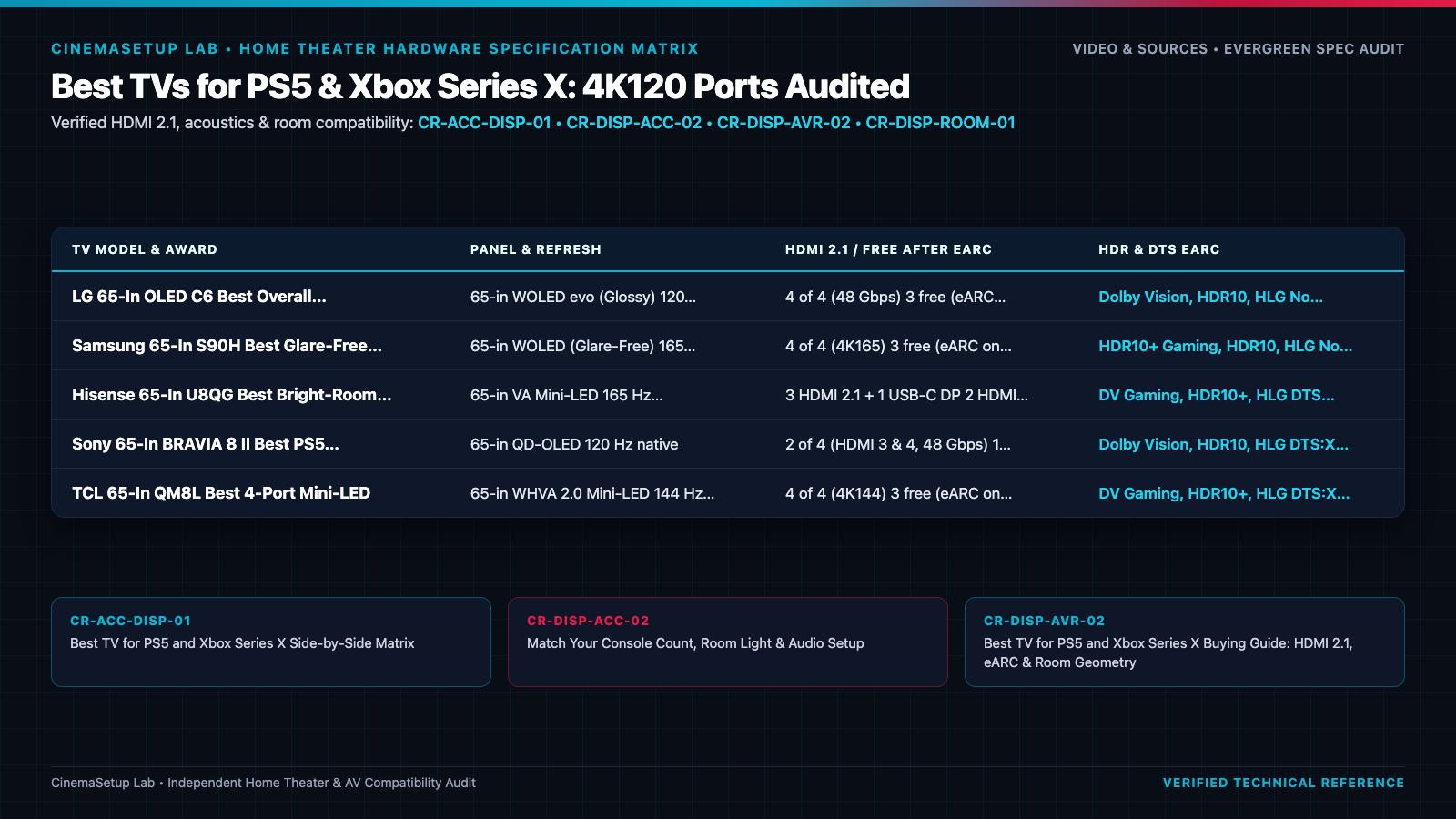
Best TV for PS5 and Xbox Series X Side-by-Side Matrix
Every specification below reflects the exact US retail screen size listed in each row, because manufacturers frequently change panel suppliers, dimming zones, and stand geometry across sizes within the same model line. Pay particular attention to how many HDMI 2.1 ports remain available after dedicating one port to an HDMI eARC soundbar or AV receiver (rule CR-DISP-AVR-02).
| TV Model & Award | Panel & Refresh | HDMI 2.1 / Free After eARC | HDR & DTS eARC | Link |
|---|---|---|---|---|
| LG 65-In OLED C6 Best Overall Console TV | 65-in WOLED evo (Glossy) 120 Hz / 165 Hz VRR | 4 of 4 (48 Gbps) 3 free (eARC on HDMI 2) | Dolby Vision, HDR10, HLG No HDR10+ • No DTS | View on Amazon |
| Samsung 65-In S90H Best Glare-Free OLED | 65-in WOLED (Glare-Free) 165 Hz PC / 4K120 console | 4 of 4 (4K165) 3 free (eARC on HDMI 3) | HDR10+ Gaming, HDR10, HLG No Dolby Vision • No DTS | View on Amazon |
| Hisense 65-In U8QG Best Bright-Room Mini-LED | 65-in VA Mini-LED 165 Hz native / 288 Hz VRR | 3 HDMI 2.1 + 1 USB-C DP 2 HDMI 2.1 free (eARC HDMI 3) | DV Gaming, HDR10+, HLG DTS passthrough supported | View on Amazon |
| Sony 65-In BRAVIA 8 II Best PS5 QD-OLED Color | 65-in QD-OLED 120 Hz native | 2 of 4 (HDMI 3 & 4, 48 Gbps) 1 free (eARC on HDMI 3) | Dolby Vision, HDR10, HLG DTS:X & TrueHD eARC | View on Amazon |
| TCL 65-In QM8L Best 4-Port Mini-LED | 65-in WHVA 2.0 Mini-LED 144 Hz native / 288 Hz VRR | 4 of 4 (4K144) 3 free (eARC on HDMI 1) | DV Gaming, HDR10+, HLG DTS:X eARC passthrough | View on Amazon |
| Hisense 65-In U7SG Best Mid-Range 4-Port | 65-in Hi-QLED Mini-LED 165 Hz native / 330 Hz VRR | 4 of 4 (4K165) 3 free (eARC on HDMI 3) | DV Gaming, HDR10+, HLG DTS passthrough supported | View on Amazon |
| Samsung 65-In QN90H Best Anti-Glare Neo QLED | 65-in Neo QLED Mini-LED 144 Hz Motion Xcelerator | 4 of 4 (4K144) 3 free (eARC on HDMI 3) | HDR10+ Gaming, HDR10, HLG No Dolby Vision • No DTS | View on Amazon |
| TCL 55-In QM6K Best Value Under $800 | 55-in VA Mini-LED 144 Hz native / 288 Hz VRR | 2 of 4 (4K144) Verify eARC port share | DV Gaming, HDR10+, HLG DTS:X eARC passthrough | View on Amazon |
| Hisense 55-In U6SF Pro Best Budget High-Nit | 55-in Hi-QLED Mini-LED 144 Hz native | 2 of 4 HDMI 2.1 1 free (eARC on HDMI 1) | Dolby Vision IQ, HDR10+ Dolby Atmos / Fire TV | View on Amazon |
Match Your Console Count, Room Light & Audio Setup
A television that excels in a pitch-black basement theater can feel frustrating opposite sunny living-room windows, while a flagship OLED with only two HDMI 2.1 inputs can force constant cable swapping if you own both consoles and an eARC soundbar. Match your exact room light, console count, and audio chain in the scenario table below.
| Console & Room Scenario | Recommended Pick | Why It Works Under Audited Rules |
|---|---|---|
| PS5 + Xbox Series X + eARC soundbar in a dim room | LG 65-Inch OLED evo AI C6 | Four 48 Gbps HDMI 2.1 ports leave three 4K/120Hz+ inputs free after eARC, paired with glossy OLED contrast and Dolby Vision Gaming. |
| Sunlit living room OLED opposite lamps or windows | Samsung 65-Inch S90H OLED | Glare-Free matte coating scatters room reflections alongside ~1,689-nit 10% HDR output and four 165 Hz HDMI 2.1 ports. |
| Bright daytime room + consoles + USB-C gaming PC | Hisense 65-Inch U8QG Mini-LED | ~4,000-4,300+ nit specular highlights cut through heavy glare, with three HDMI 2.1 jacks plus side USB-C DisplayPort Alt Mode. |
| PS5-only cinematic room wanting QD-OLED color & DTS | Sony 65-Inch BRAVIA 8 II | QD-OLED color volume, PS5 Auto HDR Tone Mapping, and DTS:X eARC passthrough shine when one direct 4K/120Hz console port suffices. |
| Multi-console living room under $1,100 | Hisense 65-Inch U7SG Mini-LED | Delivers four full-bandwidth HDMI 2.1 ports, 165 Hz VRR, ~2,700+ nit highlights, and universal DV/HDR10+/DTS support below OLED pricing. |
| Budget 144 Hz bedroom or apartment setup under $800 | TCL 55-Inch QM6K Mini-LED | Unlocks native 144 Hz VRR, low input lag, and DTS:X passthrough on a Value budget for single-console or AVR-switched rooms. |
Detailed Gaming TV Audits (1–9)
1. LG 65-Inch Class OLED evo AI C6 (OLED65C6PUA) — Best Overall TV for PS5 & Xbox Series X

Key Specs: 65-in 4K WOLED evo (glossy finish; Alpha 11 AI Processor Gen3; webOS 26) | 4 of 4 HDMI 2.1 ports (48 Gbps) with eARC on HDMI 2 (3 open 4K/120Hz+ ports) | 120 Hz native / up to 165 Hz VRR (PC); HDMI Forum VRR, AMD FreeSync Premium, NVIDIA G-SYNC Compatible, ALLM | Cited BMs: ~1,438 nits (10% HDR window, Filmmaker Mode) and ~9.2 ms input lag (4K60 Game Optimizer Boost) per TechRadar | HDR: Dolby Vision Gaming, HDR10, HLG (no HDR10+) | Audio: No DTS passthrough | VESA 300 x 200 mm, 36.6 lb (16.6 kg) without stand | Price Tier: $1,300-$1,800 (TIER-DISP-TV-PREMIUM)
Audit Score: 9.5 / 10
- Cited Picture Performance (35%): 9.5 / 10
- Gaming & Connectivity (20%): 9.8 / 10
- HDR & Format Support (15%): 9.0 / 10
- Room Fit & Geometry (15%): 9.2 / 10
- Platform, Warranty & Open Issues (10%): 9.4 / 10
- Value Within Tier (5%): 9.6 / 10
For households running both consoles alongside an eARC soundbar or receiver, the 65-inch LG OLED evo AI C6 (OLED65C6PUA) remains the cleanest plug-and-play choice on the market. Every single one of its four HDMI inputs carries full 48 Gbps HDMI 2.1 bandwidth—so connecting an Atmos soundbar to HDMI 2 (eARC) still leaves HDMI 1, HDMI 3, and HDMI 4 open for a PS5, an Xbox Series X, and a gaming PC with zero switching compromises (rule CR-DISP-AVR-02).
Unlike VA Mini-LED rivals that exhibit subtle dark-transition trailing in fast shooters, LG’s self-emissive WOLED evo pixels transition nearly instantaneously with zero backlight blooming around white HUD text. TechRadar measured ~1,438 nits on a 10% HDR window in Filmmaker Mode and ~9.2 ms input lag in Game Optimizer Boost, while Xbox owners gain native Dolby Vision Gaming alongside HDMI Forum VRR, FreeSync Premium, G-SYNC Compatible, and ALLM. As we detail in our LG C6 vs. Samsung S90H comparison, the C6’s glossy finish preserves deeper perceived blacks in dark rooms, though direct sunny windows mirror more strongly than Samsung’s matte Glare-Free coating.
Buyer Verification Alert: Two 2026 caveats apply: first, LG dropped DTS decoding and DTS:X eARC passthrough on the C6, so connect DTS 4K Blu-ray players straight to an AVR or DTS-capable soundbar (CR-SBAR-DISP-04). Second, LG uses C6 for 42-65 in models and C6H for 77-83 in models—never apply 65-inch brightness readings to other sizes (G-05). Purchase from an authorized US dealer for standard 1-year factory warranty coverage.
Pros
- Four full 48 Gbps HDMI 2.1 inputs leave three open 4K/120Hz+ console ports even with eARC active
- Instantaneous OLED pixel transitions eliminate dark-scene motion smearing and local-dimming haloing
- Supports Dolby Vision Gaming on Xbox Series X plus HDMI VRR, FreeSync Premium, G-SYNC, and ALLM
- Light 36.6 lb (16.6 kg) chassis simplifies VESA 300 x 200 mm stud-anchored wall mounting
Cons
- 2026 C6 omits DTS audio decoding and DTS:X eARC passthrough (unlike Sony, TCL, and Hisense rivals)
- Glossy screen mirrors bright lamps or uncovered daytime windows positioned behind seating
- Standard 1-year US warranty excludes cumulative static-HUD burn-in, and VRR can show mild dark-scene gamma flicker
Verdict: Buy the LG 65-Inch OLED evo AI C6 if you run both a PS5 and Xbox Series X in a dim or evening-lit room and want four 48 Gbps ports plus Dolby Vision Gaming. Skip it if you game opposite bright sunlit windows or rely on eARC DTS:X passthrough.
2. Samsung 65-Inch Class S90H OLED (QN65S90HAEXZA) — Best Glare-Free Living-Room OLED

Key Specs: 65-in 4K OLED (North American 65-in WOLED with Glare-Free matte finish; NQ4 AI Gen3; Tizen OS) | 4 of 4 HDMI 2.1 ports (4K/165Hz) with eARC on HDMI 3 (3 open fast ports) | Up to 165 Hz native/VRR (PC) & 4K/120Hz (consoles); HDMI VRR, FreeSync Premium Pro, G-SYNC Compatible, ALLM | Cited BMs: ~1,689 nits (10% HDR window, Filmmaker Mode) and ~9.2 ms input lag (Game Mode) per TechRadar | HDR: HDR10+, HDR10+ Gaming, HDR10, HLG (no Dolby Vision) | Audio: No DTS passthrough; Q-Symphony sync | VESA 300 x 200 mm, 42.1 lb (19.1 kg) without stand | Price Tier: $1,300-$1,800 (TIER-DISP-TV-PREMIUM)
Audit Score: 9.3 / 10
- Cited Picture Performance (35%): 9.4 / 10
- Gaming & Connectivity (20%): 9.7 / 10
- HDR & Format Support (15%): 8.4 / 10
- Room Fit & Geometry (15%): 9.6 / 10
- Platform, Warranty & Open Issues (10%): 9.0 / 10
- Value Within Tier (5%): 9.5 / 10
Sitting in the exact same $1,300-$1,800 tier as the LG C6, the 65-inch Samsung S90H OLED (QN65S90HAEXZA) solves the biggest headache of glossy living-room OLEDs: distracting window and lamp reflections. Samsung brings its Glare-Free matte coating down into the 2026 S90H series, scattering harsh daytime glare across the screen instead of turning dark dungeon corridors into a mirror of your living-room couch (rule CR-DISP-ROOM-03).
Under identical Filmmaker Mode 10% window conditions, TechRadar measured ~1,689 nits on the S90H—roughly 250 nits higher than the LG C6—alongside matching ~9.2 ms Game Mode input lag. Every one of its four HDMI 2.1 inputs supports 4K/120Hz consoles, FreeSync Premium Pro, G-SYNC compatibility, ALLM, and up to 165 Hz native/VRR PC gaming, leaving three ports free when eARC connects on HDMI 3. Unlike the C6, Samsung omits Dolby Vision completely; under rule CR-SRC-DISP-01, Xbox Series X Dolby Vision games and Apple TV Dolby Vision streams play cleanly in static HDR10, though dynamic Dolby Vision tone mapping is absent.
Buyer Verification Alert: Samsung S90-series OLEDs exhibit documented size/region panel variance (L-09): the North American 65-inch QN65S90HAEXZA uses a WOLED panel with Glare-Free matte coating, whereas other diagonals or overseas regions may use QD-OLED or RGB Tandem WOLED. Choose the standalone US SKU over third-party bundle listings, and avoid grey-market /ZC Canadian Samsung soundbars if pairing for Q-Symphony (CR-SYS-02).
Pros
- Glare-Free matte screen breaks up direct window and overhead lamp reflections far better than glossy OLEDs
- Four full-speed HDMI 2.1 ports support 4K/120Hz consoles and 165 Hz PC VRR with three ports free after eARC
- Higher ~1,689-nit 10% HDR highlight output than the LG C6 with crisp ~9.2 ms Game Mode latency
- Supports FreeSync Premium Pro, HDR10+ Gaming, and Q-Symphony sync with supported US Samsung bars
Cons
- Omits Dolby Vision (Xbox Dolby Vision titles fall back to static HDR10) and drops DTS eARC passthrough
- Matte diffusion slightly lifts perceived black depth into dark charcoal when direct room light hits the glass
- North American 65-inch WOLED panel differs from overseas QD-OLED S90H variants and 48/77-inch Tandem sizes
Verdict: Buy the Samsung 65-Inch S90H if you game in a bright living room with lamps or windows and want OLED motion speed plus four 165 Hz HDMI 2.1 ports. Skip it if Dolby Vision Gaming or DTS:X eARC passthrough is non-negotiable.
3. Hisense 65-Inch U8QG Mini-LED (65U8QG) — Best Bright-Room Mini-LED Gaming TV

Key Specs: 65-in 4K ULED Mini-LED (VA-type local dimming; 4.1.2-ch built-in audio; Google TV) | 3x HDMI 2.1 (48 Gbps) + 1x side USB-C DisplayPort Alt Mode; eARC on HDMI 3 (2 open HDMI 2.1 ports) | 165 Hz native / up to 288 Hz VRR (1080p); FreeSync Premium Pro, G-SYNC Compatible, HDMI VRR, ALLM | Cited BMs: ~4,000-4,300+ nits peak HDR specular highlights (Tom’s Guide / IGN) and ~9.8-10.1 ms (4K60) / ~4.3 ms (1080p120) input lag per PCMag | HDR & Audio: Dolby Vision Gaming, HDR10+, HLG, DTS passthrough | VESA 400 x 400 mm, 53.8 lb (24.4 kg) without stand | Price Tier: $1,100-$1,600 (TIER-DISP-TV-PREMIUM)
Audit Score: 9.2 / 10
- Cited Picture Performance (35%): 9.2 / 10
- Gaming & Connectivity (20%): 9.1 / 10
- HDR & Format Support (15%): 9.8 / 10
- Room Fit & Geometry (15%): 9.0 / 10
- Platform, Warranty & Open Issues (10%): 8.8 / 10
- Value Within Tier (5%): 9.4 / 10
If your consoles sit in a sun-drenched great room—or you log thousands of hours in HUD-heavy RPGs, sports titles, and live-service shooters where static health bars never move—the Hisense 65U8QG removes OLED burn-in anxiety while delivering massive luminance headroom. While Hisense markets up to 5,000 nits peak, independent evaluations from Tom’s Guide and IGN recorded ~4,000 to 4,300+ nits of real-world HDR specular brightness alongside ~2,900 nits SDR output, overpowering afternoon sunlight effortlessly.
Gaming responsiveness is equally strong: PCMag measured ~9.8 to 10.1 ms lag at 4K/60Hz and ~4.3 ms at 1080p/120Hz, backed by native 165 Hz support, FreeSync Premium Pro, G-SYNC compatibility, HDMI VRR, and ALLM. The U8QG also beats both LG and Samsung on format completeness by supporting Dolby Vision Gaming, HDR10+, and DTS passthrough simultaneously. Its only connectivity wrinkle sits on the port map: Hisense puts eARC on HDMI 3 out of three 48 Gbps HDMI 2.1 ports, leaving two HDMI 2.1 jacks open for PS5 and Xbox Series X while a side USB-C DisplayPort Alt Mode jack handles a gaming PC or handheld.
Buyer Verification Alert: At 53.8 lb (24.4 kg) without the stand and using a VESA 400 x 400 mm pattern, the 65U8QG is significantly heavier than the 36.6 lb LG C6—follow the mount maker’s instructions and anchor into wood or metal studs rather than drywall (CR-DISP-ACC-02, G-27). Also remember VA off-axis contrast narrows at steep side seating angles (CR-DISP-ROOM-04).
Pros
- Cited ~4,000-4,300+ nit HDR highlights cut through direct daytime sunlight with zero burn-in risk
- Supports Dolby Vision Gaming, HDR10+, HLG, and DTS eARC passthrough in one chassis
- Three 48 Gbps HDMI 2.1 ports plus side USB-C DisplayPort Alt Mode feed dual consoles and a PC
- Fast ~4.3 ms (120 Hz) and ~9.8-10.1 ms (4K60) Game Mode lag with 165 Hz native refresh
Cons
- Using eARC on HDMI 3 leaves two open HDMI 2.1 ports rather than three on 4-port competitors
- VA panel viewing angles lose black-level depth when watched far off-center compared with OLED
- Heavy 53.8 lb (24.4 kg) panel demands heavy-duty stud-mounted VESA 400 x 400 mm hardware
Verdict: Buy the Hisense 65U8QG if you game in a bright room, want zero static-HUD burn-in risk, and need Dolby Vision, HDR10+, and DTS support. Skip it if your sofa wraps wide off-axis or you need three free HDMI 2.1 inputs alongside eARC without using USB-C.
4. Sony 65-Inch BRAVIA 8 II QD-OLED (K-65XR80M2) — Best PS5 Tone-Mapping & QD-OLED Color

Key Specs: 65-in 4K QD-OLED (Acoustic Surface Audio+; Google TV) | 2 of 4 HDMI 2.1 ports (HDMI 3 & 4, 48 Gbps) with eARC on HDMI 3 (1 open 4K/120Hz port) | 120 Hz native; HDMI Forum VRR, ALLM (no FreeSync or 144/165 Hz PC overclock) | Cited BMs: ~183 nits (Cinema) to ~250 nits (Standard) full-screen (TechRadar); ~16.1 ms (4K60) & ~7.9-8.5 ms (120 Hz) lag per FlatpanelsHD/PCMag | HDR & Audio: Dolby Vision, HDR10, HLG; DTS:X & Dolby TrueHD eARC passthrough | VESA 300 x 300 mm, 50.5 lb (22.9 kg) without stand | Price Tier: $2,000-$2,800 (TIER-DISP-TV-PREMIUM)
Audit Score: 8.9 / 10
- Cited Picture Performance (35%): 9.6 / 10
- Gaming & Connectivity (20%): 7.7 / 10
- HDR & Format Support (15%): 9.3 / 10
- Room Fit & Geometry (15%): 8.7 / 10
- Platform, Warranty & Open Issues (10%): 9.1 / 10
- Value Within Tier (5%): 7.8 / 10
Picture purists pairing a PlayStation 5 with 4K UHD Blu-ray playback gain genuine advantages on the Sony BRAVIA 8 II QD-OLED (K-65XR80M2). Because QD-OLED emitters generate pure red, green, and blue subpixels without a white subpixel dilution layer, bright explosions and neon cityscapes retain saturated color volume that WOLED panels cannot match. Sony’s Perfect for PlayStation 5 handshake automates HDR Tone Mapping at console setup, while 120 Hz input lag drops to a crisp ~7.9 to 8.5 ms (FlatpanelsHD / PCMag).
Just as important for disc collectors, the BRAVIA 8 II preserves full DTS:X and Dolby TrueHD Atmos eARC passthrough—making it far friendlier to physical-media setups than the 2026 LG C6 or Samsung S90H. Yet the reason it ranks fourth instead of first comes down to rule CR-DISP-AVR-02: only HDMI 3 and HDMI 4 run at full 4K/120Hz bandwidth, and HDMI 3 also acts as the eARC jack. Once you connect an eARC soundbar, only HDMI 4 remains for a 4K/120Hz console—requiring a 40 Gbps AV receiver from our best AV receivers for gaming roundup if you own both a PS5 and Xbox Series X.
Buyer Verification Alert: Verify your port math before buying (ISS-DISP-SONY-HDMI-PORT-BUDGET): HDMI 1 and 2 top out at 4K/60Hz, while HDMI 3 handles eARC. Dual-console owners without a 40 Gbps gaming AVR will lose 4K/120Hz on one console. Choose the standalone K-65XR80M2 SKU over bundled CPS protection packs.
Pros
- Pure QD-OLED RGB subpixel color volume outperforms WOLED in saturated HDR highlights
- Automates PS5 HDR calibration and genre picture switching while keeping 120 Hz lag around ~7.9-8.5 ms
- Passes DTS:X and lossless Dolby TrueHD Atmos bitstreams over HDMI eARC
- Acoustic Surface Audio+ actuators anchor dialogue directly to the screen
Cons
- Only two HDMI 2.1 ports, and HDMI 3 shares eARC—leaving just one 4K/120Hz port open with a soundbar
- Higher ~16.1 ms 4K/60Hz input lag and 120 Hz panel ceiling (no 144/165 Hz PC refresh or FreeSync)
- Costs noticeably more than the 4-port LG C6 and Samsung S90H
Verdict: Buy the Sony BRAVIA 8 II if you prioritize QD-OLED color richness, PS5 optimization, and DTS:X eARC passthrough alongside a 40 Gbps AVR or single-console rig. Skip it if you want to plug PS5, Xbox Series X, and an eARC soundbar directly into the TV.
5. TCL 65-Inch QM8L SQD-Mini LED (65QM8L) — Best 4-Port Flagship Mini-LED

Key Specs: 65-in 4K SQD-Mini LED (WHVA 2.0 wide-angle VA panel; Audio by Bang & Olufsen; Google TV) | 4 of 4 HDMI 2.1 ports (4K/144Hz) with eARC on HDMI 1 (3 open 4K/120Hz+ ports) | 144 Hz native / 288 Hz VRR (1080p); HDMI VRR, FreeSync Premium Pro, ALLM | Cited BMs: ~10-15 ms (4K60) & ~5 ms or under (4K120/144) per RTINGS | HDR & Audio: Dolby Vision Gaming, HDR10+, HLG; DTS, DTS-HD MA & DTS:X eARC passthrough | VESA 300 x 300 mm (M6 x 20 mm), 46.5 lb (21.1 kg) without stand | Price Tier: $1,100-$1,800 (TIER-DISP-TV-PREMIUM)
Audit Score: 9.0 / 10
- Cited Picture Performance (35%): 9.0 / 10
- Gaming & Connectivity (20%): 9.3 / 10
- HDR & Format Support (15%): 9.7 / 10
- Room Fit & Geometry (15%): 8.9 / 10
- Platform, Warranty & Open Issues (10%): 8.6 / 10
- Value Within Tier (5%): 8.8 / 10
Whereas budget TCL sets force dual-console owners to ration two HDMI 2.1 inputs, the flagship TCL 65QM8L equips all four rear inputs with full-speed 4K/144Hz HDMI 2.1 bandwidth. Placing eARC on HDMI 1 leaves HDMI 2, 3, and 4 ready for PS5, Xbox Series X, and a gaming PC with zero external switcher required. TCL also pairs Super Quantum Dot (SQD) Mini-LED backlighting with a WHVA 2.0 wide-viewing-angle panel, easing the off-axis contrast drop that narrows seating on conventional VA LCDs (rule CR-DISP-ROOM-04).
RTINGS clocked Game Mode latency around ~10 to 15 ms at 4K/60Hz and ~5 ms or under at 120/144 Hz, alongside support for Dolby Vision Gaming, HDR10+, FreeSync Premium Pro, and full DTS:X / DTS-HD Master Audio bitstream passthrough over eARC. Compared directly with the Hisense U8QG, the 65QM8L trades a 144 Hz ceiling (versus 165 Hz) and slightly slower dark-scene VA pixel transitions (noted by RTINGS) in exchange for a true fourth HDMI 2.1 port and Bang & Olufsen-tuned chassis audio.
Buyer Verification Alert: Set TCL’s Digital Audio Out preference to “Pass Through” rather than “Auto” so DTS:X and uncompressed 7.1 LPCM reach your eARC soundbar or receiver intact (CR-SBAR-DISP-04). When wall mounting, verify M6 x 20 mm fastener length matches the 300 x 300 mm rear VESA bosses.
Pros
- All four HDMI ports support 4K/144Hz, leaving three fast console/PC ports open after eARC on HDMI 1
- WHVA 2.0 panel improves horizontal seating angles compared with standard VA Mini-LED screens
- Supports Dolby Vision Gaming, HDR10+, and full DTS-HD MA / DTS:X eARC passthrough
- Sub-5 ms 120/144 Hz input lag with bright Mini-LED HDR and zero static-HUD burn-in risk
Cons
- RTINGS reports slower VA pixel response times than OLED, showing mild dark-scene motion smearing
- 144 Hz ceiling trails the 165 Hz cap on Hisense U8QG and Samsung S90H for high-fps PCs
- Bright-room tone mapping prioritizes punch over fine dark-shadow gradation compared with OLED
Verdict: Buy the TCL 65QM8L if you want a bright, zero-burn-in flagship Mini-LED with four full-speed HDMI 2.1 ports and full DTS:X eARC passthrough. Skip it if you play dark competitive titles where OLED’s instantaneous pixel transitions shine.
6. Hisense 65-Inch U7SG Mini-LED (65U7SG) — Best Mid-Range 4-Port 165Hz Gaming TV

Key Specs: 65-in 4K Hi-QLED Mini-LED (Anti-Reflection coating; 2.1.2-ch built-in audio; Google TV) | 4 of 4 HDMI 2.1 ports (48 Gbps class, 4K/165Hz) with eARC on HDMI 3 (3 open fast ports) | 165 Hz native / 330 Hz VRR (1080p); 48-165 Hz VRR, FreeSync Premium Pro, ALLM | Cited BMs: ~2,700-2,800+ nits peak HDR and ~9.4-9.8 ms Game Mode input lag per Tom’s Guide | HDR & Audio: Dolby Vision IQ/Gaming, HDR10+, HLG, DTS passthrough | VESA 400 x 300 mm, 43.2 lb (19.6 kg) without stand | Price Tier: $700-$1,100 (TIER-DISP-TV-VALUE / Lower Premium)
Audit Score: 8.9 / 10
- Cited Picture Performance (35%): 8.7 / 10
- Gaming & Connectivity (20%): 9.4 / 10
- HDR & Format Support (15%): 9.6 / 10
- Room Fit & Geometry (15%): 8.7 / 10
- Platform, Warranty & Open Issues (10%): 8.5 / 10
- Value Within Tier (5%): 9.8 / 10
Gamers shopping in the $700-$1,100 tier normally expect a painful compromise: either accept two HDMI 2.1 inputs or give up high-brightness Mini-LED local dimming. The 2026 Hisense 65U7SG eliminates that sacrifice by packing four full-bandwidth HDMI 2.1 ports into a mid-tier 65-inch Google TV chassis. Dedicating HDMI 3 to an eARC receiver or soundbar still leaves three 4K/165Hz inputs free for PS5, Xbox Series X, and a gaming PC.
Independent evaluations from Tom’s Guide recorded ~2,700 to 2,800+ nits peak HDR brightness and ~9.4 to 9.8 ms Game Mode input lag—numbers that easily clear bright living-room glare while staying fast enough for competitive FPS play. You also get 48-165 Hz VRR, FreeSync Premium Pro, ALLM, Dolby Vision Gaming, HDR10+, and DTS passthrough. Compared with the step-up Hisense U8QG, the U7SG trades away some local-dimming zone density and the side USB-C DisplayPort jack, yet delivers superior pure HDMI 2.1 port flexibility at a much lower tier.
Buyer Verification Alert: Hisense sells both the Google TV U7SG (65U7SG) and Fire TV U7SF variants on Amazon—double-check the exact model suffix before checkout if you prefer Google TV. Toggle Enhanced HDMI format inside input settings on each console port to activate full 4K/120Hz HDR.
Pros
- Four full-bandwidth HDMI 2.1 ports leave three 4K/165Hz inputs free alongside eARC under $1,100
- Measured ~2,700-2,800+ nit HDR brightness and anti-reflection screen handle sunlit rooms cleanly
- Low ~9.4-9.8 ms Game Mode input lag with 48-165 Hz VRR and FreeSync Premium Pro
- Universal Dolby Vision Gaming, HDR10+, and DTS passthrough avoid format lock-in
Cons
- Fewer dimming zones than the U8QG permit mild haloing around bright stars or HUD elements in dark rooms
- VA panel contrast narrows for viewers sitting far off-axis (CR-DISP-ROOM-04)
- Lacks the U8QG’s side USB-C DisplayPort Alt Mode input
Verdict: Buy the Hisense 65U7SG if you want the best value 4-port HDMI 2.1 gaming TV under $1,100 with bright Mini-LED punch for both PS5 and Xbox Series X. Skip it if you sit far off-center or want inky zero-halo OLED blacks in a dark theater.
7. Samsung 65-Inch Class QN90H Neo QLED (QN65QN90HAFXZA) — Best Anti-Glare 4-Port Mini-LED

Key Specs: 65-in 4K Neo QLED Mini-LED (Glare-Free / Wide Viewing Angle; Tizen OS) | 4 of 4 HDMI 2.1 ports (4K/144Hz) with eARC on HDMI 3 (3 open 4K/120Hz+ ports) | 144 Hz Motion Xcelerator; HDMI VRR, FreeSync Premium Pro, G-SYNC Compatible, ALLM | Cited BMs: No verified independent 2026 window-nit or input-lag benchmark data available yet for QN90H (G-01) | HDR & Audio: Neo Quantum HDR+, HDR10+ Gaming, HDR10, HLG (no DV, no DTS); Q-Symphony | VESA 400 x 300 mm, 37.9 lb (17.2 kg) without stand | Price Tier: $1,400-$2,100 (TIER-DISP-TV-PREMIUM)
Audit Score: 8.6 / 10
- Cited Picture Performance (35%): 8.5 / 10
- Gaming & Connectivity (20%): 9.4 / 10
- HDR & Format Support (15%): 8.2 / 10
- Room Fit & Geometry (15%): 9.2 / 10
- Platform, Warranty & Open Issues (10%): 8.4 / 10
- Value Within Tier (5%): 7.9 / 10
For sunlit living rooms with wide sectional seating where buyers refuse any OLED burn-in risk, the 2026 Samsung 65-Inch QN90H (QN65QN90HAFXZA) pairs Glare-Free reflection handling and wide-angle Mini-LED optics with four full-speed 4K/144Hz HDMI 2.1 inputs. Connecting an eARC soundbar on HDMI 3 leaves three fast inputs open for PS5, Xbox Series X, and a gaming PC, while Motion Xcelerator 144 Hz, FreeSync Premium Pro, G-SYNC compatibility, and ALLM cover console and PC VRR standards.
In strict adherence to our spec-audit guardrails (G-01 and G-09), there is no verified independent 2026 window-nit or input-lag benchmark data available yet for the QN90H SKU at our verification date, so we evaluate it strictly on published US specifications rather than projecting numbers from prior QN90 models. Compared with the Samsung S90H OLED in the same price bracket, the QN90H trades per-pixel black contrast for total immunity to static-HUD retention and lighter 37.9 lb (17.2 kg) wall-mount handling.
Buyer Verification Alert: Because independent third-party window brightness and lag benchmarks for the 2026 QN90H are not yet published, confirm the exact QN65QN90HAFXZA model code and authorized US seller return window before checkout. Like the S90H, it omits Dolby Vision and DTS eARC passthrough.
Pros
- Four 4K/144Hz HDMI 2.1 ports leave three open console inputs when eARC uses HDMI 3
- Glare-Free finish and wide-angle Neo QLED optics suit sunlit living rooms with broad seating
- Zero static-HUD image retention or burn-in risk for marathon gaming sessions
- Relatively trim 37.9 lb (17.2 kg) chassis on a standard VESA 400 x 300 mm bolt pattern
Cons
- Omits Dolby Vision Gaming (falls back to HDR10) and drops DTS eARC passthrough
- No verified independent 2026 window-nit or input-lag measurements published yet at verification date
- Priced close to the Samsung S90H OLED and above the brighter Hisense U8QG
Verdict: Buy the Samsung 65-Inch QN90H if you want a glare-resistant, 4-port 4K/144Hz Mini-LED built for wide seating and zero burn-in anxiety inside a Samsung Q-Symphony setup. Skip it if you want OLED contrast per dollar or Dolby Vision Gaming.
8. TCL 55-Inch QM6K QLED Mini-LED (55QM6K) — Best Value 144Hz Gaming TV Under $800

Key Specs: 55-in 4K QLED Mini-LED (VA panel; Google TV) | 2x HDMI 2.1 (4K/144Hz) + 2x HDMI 2.0 (60 Hz); verify eARC port location per unit | 144 Hz native / 288 Hz VRR (1080p); HDMI VRR, FreeSync Premium Pro, ALLM | Cited BMs: ~10-15 ms (4K60) & ~5 ms or under (120/144 Hz) with modest HDR peak nits per RTINGS | HDR & Audio: Dolby Vision Gaming, HDR10+, HLG; DTS & DTS:X eARC passthrough | VESA 300 x 300 mm (M6), verify 55-in manual weight before mounting | Price Tier: $500-$800 (TIER-DISP-TV-VALUE)
Audit Score: 8.4 / 10
- Cited Picture Performance (35%): 8.0 / 10
- Gaming & Connectivity (20%): 8.4 / 10
- HDR & Format Support (15%): 9.3 / 10
- Room Fit & Geometry (15%): 8.3 / 10
- Platform, Warranty & Open Issues (10%): 8.4 / 10
- Value Within Tier (5%): 9.6 / 10
Budget buyers shopping in the $500-$800 bracket usually hit a hard 60 Hz wall that locks both PS5 and Xbox Series X out of 120 fps performance modes and hardware VRR. The TCL 55-Inch QM6K (55QM6K) breaks that ceiling with a native 144 Hz Mini-LED panel, FreeSync Premium Pro, ALLM, and sub-5 ms 120/144 Hz Game Mode lag verified by RTINGS. It also carries Dolby Vision Gaming, HDR10+, and full DTS:X eARC passthrough—making it far better equipped for physical discs and Xbox Dolby Vision than budget LED sets.
Two real compromises keep the 55QM6K in eighth place rather than competing with the Hisense U7SG. First, RTINGS notes modest HDR peak brightness that limits specular highlight punch in bright rooms compared with the U7SG or QM8L. Second, only two of its four HDMI inputs run at full HDMI 2.1 4K/144Hz speeds, though TCL routes eARC through a 60 Hz port (HDMI 4) on standard US QM6K boards—cleverly keeping both 4K/144Hz inputs free when pairing with a soundbar.
Buyer Verification Alert: Confirm the rear HDMI port labels on your specific 55QM6K production unit before routing cables: plug PS5 and Xbox Series X into the labeled 4K/144Hz ports and reserve the labeled eARC jack for your soundbar or AVR. Because 55-inch weight differs from the 37.4 lb 65-inch SKU, check your box manual before selecting a mount (G-05, CR-DISP-ACC-02).
Pros
- Native 144 Hz Mini-LED local dimming and ~5 ms high-refresh lag inside the $500-$800 Value tier
- Separating eARC onto a 60 Hz HDMI input keeps both 4K/144Hz ports open on standard US boards
- Supports Dolby Vision Gaming, HDR10+, and DTS:X eARC passthrough
- Clean Google TV smart platform with smooth app coverage
Cons
- Modest HDR peak nits underperform brighter Mini-LED sets in sunlit daytime rooms
- Two-port HDMI 2.1 cap leaves zero spare high-bandwidth port for a third gaming PC
- Narrow VA off-axis viewing angles favor centered bedroom or apartment seating (CR-DISP-ROOM-04)
Verdict: Buy the TCL 55-Inch QM6K if you want the cleanest sub-$800 4K/120Hz+ Mini-LED with Dolby Vision, DTS:X passthrough, and dual 144 Hz ports. Skip it if you want blinding daytime HDR highlights or need four HDMI 2.1 ports.
9. Hisense 55-Inch U6 Pro Mini-LED (55U6SF Pro) — Best Budget High-Nit 144Hz Mini-LED

Key Specs: 55-in 4K Hi-QLED Mini-LED (Glare-Free; Fire TV OS) | 2x HDMI 2.1 (of 4 total) with eARC on HDMI 1 (1 open 4K/120Hz+ port) | 144 Hz native / Motion Rate 480; VRR, FreeSync Premium, ALLM | Cited BMs: ~1,400+ nits peak HDR, ~9.2 ms (4K60) & ~4.6 ms (1080p120) input lag per PCMag | HDR & Audio: Dolby Vision IQ, HDR10+, HLG, Dolby Atmos | VESA 200 x 300 mm, 29.8 lb (13.5 kg) without stand | Price Tier: $500-$750 (TIER-DISP-TV-VALUE)
Audit Score: 8.3 / 10
- Cited Picture Performance (35%): 8.1 / 10
- Gaming & Connectivity (20%): 8.2 / 10
- HDR & Format Support (15%): 9.1 / 10
- Room Fit & Geometry (15%): 8.4 / 10
- Platform, Warranty & Open Issues (10%): 7.8 / 10
- Value Within Tier (5%): 9.5 / 10
Rounding out our nine audited picks, the 2026 Hisense 55-Inch U6 Pro (55U6SF Pro) out-punches most budget TVs in raw HDR luminance and responsiveness. PCMag measured upwards of ~1,400+ nits peak HDR brightness alongside ~9.2 ms (4K/60Hz) and ~4.6 ms (1080p/120Hz) input lag—bringing genuine Glare-Free Mini-LED HDR and native 144 Hz VRR into the $500-$750 tier. At 29.8 lb (13.5 kg) without its stand, it is also the easiest set in this guide to mount on a bedroom VESA 200 x 300 mm bracket.
Its ninth-place finish comes straight from rule CR-DISP-AVR-02: the 55U6SF Pro carries only two HDMI 2.1 inputs, and HDMI 1 doubles as eARC. Plugging an eARC soundbar into HDMI 1 leaves just one 4K/144Hz port open—forcing dual-console PS5 and Xbox Series X owners either to route consoles through a 40 Gbps AV receiver or to step up to the 4-port Hisense U7SG.
Buyer Verification Alert: Do not confuse the U6SF Pro with the dimmer non-Pro U6SF, and note that HDMI 1 carries eARC—leaving only HDMI 2 at full 4K/144Hz if you connect an eARC soundbar. Fire TV OS also presents heavier promotional tiles than Google TV or webOS.
Pros
- Cited ~1,400+ nit HDR brightness and ~4.6 ms (120 Hz) lag punch far above typical budget screens
- Native 144 Hz panel with VRR, FreeSync Premium, ALLM, Dolby Vision IQ, and HDR10+
- Glare-Free finish tames afternoon bedroom light reflections
- Compact 29.8 lb (13.5 kg) weight simplifies VESA 200 x 300 mm wall installation
Cons
- HDMI 1 shares eARC with one of only two HDMI 2.1 ports, leaving one 4K/144Hz port open with a bar
- Fire TV interface displays denser sponsored content than Google TV rivals
- Lower dimming zone count than the U7SG allows softer dark-scene black levels
Verdict: Buy the Hisense 55U6SF Pro if you need high-nit 144 Hz Mini-LED performance for a single console or AVR-switched bedroom setup under $750. Skip it if you connect two consoles directly to the TV alongside an eARC soundbar.
Best TV for PS5 and Xbox Series X Buying Guide: HDMI 2.1, eARC & Room Geometry
Marketing badges routinely lump 60 Hz panels, 24 Gbps ports, and true 48 Gbps displays together under generic “4K Gaming” labels. Auditing five physical rules before clicking Buy prevents costly signal bottlenecks and return headaches.
1. Count Open 4K/120Hz Ports After eARC (CR-SRC-DISP-02 & CR-DISP-AVR-02)
A television only displays 4K at 120 Hz if both its panel runs at 120 Hz+ natively and the specific HDMI port accepts 40/48 Gbps Fixed Rate Link (FRL) signals. When you plug a Dolby Atmos soundbar or AV receiver into the TV’s eARC port to return lossless multichannel LPCM or Dolby Atmos, that eARC jack is consumed for audio. On a 4-port HDMI 2.1 TV (LG C6, Samsung S90H, Samsung QN90H, Hisense U7SG, TCL QM8L), three full-speed ports remain open. On a 2-port TV where eARC shares one of the fast jacks (Sony BRAVIA 8 II, Hisense U6SF Pro), only one 4K/120Hz port remains—requiring a 40 Gbps AV receiver per our HDMI eARC and 4K120 port guide if you own both consoles.
2. VRR, ALLM & HDR Format Realities (CR-SRC-DISP-01, 03, 04)
Both consoles support HDMI Forum VRR and ALLM to smooth out frame-rate dips and switch into low-latency Game Mode automatically, while Xbox Series X adds AMD FreeSync Premium Pro and Dolby Vision Gaming. PlayStation 5 and PS5 Pro output standard HDR10 for games rather than Dolby Vision. On Samsung TVs without Dolby Vision (S90H, QN90H), Xbox Dolby Vision content falls back cleanly to static HDR10 (CR-SRC-DISP-01). Meanwhile, if you play 4K UHD Blu-ray discs with DTS:X soundtracks on either console, verify eARC DTS passthrough (CR-SBAR-DISP-04): Sony, TCL, and Hisense pass DTS bitstreams over eARC, whereas 2026 LG C6 and Samsung models omit DTS support.
3. Secondary Intent Resolver: OLED vs. Mini-LED & Panel Variance
Choose OLED or QD-OLED (LG C6, Samsung S90H, Sony BRAVIA 8 II) when gaming in dim or evening-lit rooms where per-pixel contrast, zero haloing, and instantaneous pixel transitions matter most. Choose Mini-LED (Hisense U8QG, U7SG, TCL QM8L, Samsung QN90H) when gaming opposite bright daytime windows or running marathon static-HUD titles where ~1,400 to 4,300+ nits and burn-in immunity beat absolute dark-room black depth. Remember OLEDs carry minor dark-scene VRR gamma flicker in unstable-frame-rate games (ISS-DISP-VRR-FLICKER-OLED), and Samsung S90-series diagonals vary between WOLED and QD-OLED across sizes.
4. Match Screen Size to Viewing Distance (CR-DISP-ROOM-01)
Using CinemaSetup Lab’s 30-to-40 degree horizontal viewing-angle standard (d = 1.20 x diagonal for 40° immersive play up to 1.63 x diagonal for 30° comfortable viewing), match your couch distance carefully—or check our full TV size and viewing distance guide before ordering:
| TV Diagonal | Screen Width | Immersive Gaming (40°) | Comfortable Mixed Seating (30°) |
|---|---|---|---|
| 55 in (140 cm) | 48 in (122 cm) | 5.5 ft (1.7 m) | 7.5 ft (2.3 m) |
| 65 in (165 cm) | 57 in (145 cm) | 6.5 ft (2.0 m) | 8.8 ft (2.7 m) |
| 77 in (196 cm) | 67 in (170 cm) | 7.7 ft (2.3 m) | 10.4 ft (3.2 m) |
5. Upgrade Roadmap, Hidden Costs & Wall-Mounting Safety (G-27)
Budget for three real-world accessories beyond the screen itself: first, certified 48 Gbps cords from our best HDMI cables for 4K 120Hz guide (passive copper under ~10 ft / 3.0 m, or directional Active Optical Fiber cables for longer wall runs per CR-ACC-DISP-01). Second, a VESA-matched TV wall mount rated comfortably above the panel’s stand-free weight (for example, 36.6 lb / 16.6 kg on the LG C6 versus 53.8 lb / 24.4 kg on the Hisense U8QG). Always follow the television and mount manufacturer instructions first, anchor lag bolts into wood/metal studs or rated masonry anchors rather than hollow drywall (CR-DISP-ACC-02), and hire a licensed electrician or qualified AV installer for recessed outlets or CL2/CL3 in-wall cable routing.
100% Weighted Scoring Rubric & Excluded Models
Every display in this audit is scored on a transparent 100% weighted framework built for PlayStation 5, Xbox Series X, and living-room home theater compatibility (read our full methodology):
- Cited Picture Performance (35%): Self-emissive contrast vs. Mini-LED dimming control, cited HDR window brightness (nits), pixel motion speed, and reflection handling.
- Gaming & Connectivity (20%): Full-bandwidth HDMI 2.1 port count, open ports remaining after eARC (CR-DISP-AVR-02), VRR/FreeSync/G-SYNC, ALLM, and cited Game Mode input lag.
- HDR & Format Support (15%): Dolby Vision Gaming, HDR10+, HDR10 fallback behavior, and DTS:X / TrueHD Atmos eARC passthrough.
- Room Fit & Geometry (15%): Viewing distance fit, daytime glare defense, and VA off-axis seating tolerance.
- Smart Platform, Burn-In Warranty & Open Issues (10%): OS speed, US authorized-dealer 1-year warranty rules, retention safeguards, and documented panel variance or VRR flicker.
- Value Within Tier (5%): Hardware specs and port count delivered relative to same-size US tier competitors.
Models We Audited & Rejected (And Why)
- LG C4 & Samsung S90D (Discontinued 2024 Models): Superseded in active Amazon US (ZIP 10001) channels by the 2026 LG C6 and Samsung S90H; remaining listings frequently stem from third-party liquidators with questionable warranty standing.
- Sony BRAVIA 3 II & 60 Hz Budget QLED/LED Sets (e.g., Roku Select B0FXZ5GVBB): Disqualified under HARD rule CR-SRC-DISP-02 because native 60 Hz panels physically cannot display 4K/120Hz or hardware VRR from PS5 or Xbox Series X.
- Renewed Vizio VQD50R-1010 (B0H4S4BGNB) & Inflated Protection Bundles: Amazon Renewed units carry shorter warranty windows and exclude standard US factory coverage, while bundled CPS/cable listings obscure standalone display pricing and authorized-dealer status (G-26).
- Generic Unbranded 55U85 Smart TV Listing (B0F7LN6MKZ): Excluded due to missing transparent US manufacturer documentation for HDMI 2.1 port bandwidth, VRR range, and domestic warranty service centers.
Continue Your Audit
Frequently Asked Questions
Do I need four HDMI 2.1 ports for PS5 and Xbox Series X?
Only if you connect both consoles and an eARC soundbar directly to the TV. Because eARC consumes one port (CR-DISP-AVR-02), a 2-port HDMI 2.1 TV like the Sony BRAVIA 8 II leaves just one 4K/120Hz input open, whereas 4-port TVs like the LG C6, Samsung S90H, or Hisense U7SG leave three open.
Is OLED or Mini-LED better for PS5 and Xbox Series X?
OLED wins in dark rooms, while Mini-LED wins in bright rooms. Self-emissive OLEDs like the LG C6 deliver instantaneous pixel motion and zero blooming, whereas Mini-LED TVs like the Hisense U8QG reach ~4,000-4,300+ nits to defeat daytime glare with zero static-HUD burn-in risk.
Does the PS5 support Dolby Vision gaming like the Xbox Series X?
No—PS5 and PS5 Pro output HDR10 for games. Xbox Series X supports Dolby Vision Gaming on compatible sets (LG C6, Sony BRAVIA 8 II, TCL, Hisense), while Samsung OLED and Neo QLED models play Dolby Vision sources cleanly in static HDR10 (CR-SRC-DISP-01).
Why does DTS passthrough matter when buying a 2026 gaming TV?
Both consoles play 4K UHD Blu-ray discs that frequently use DTS:X or DTS-HD Master Audio. The 2026 LG C6 and Samsung S90H/QN90H drop DTS eARC passthrough (CR-SBAR-DISP-04), whereas Sony BRAVIA 8 II, TCL, and Hisense pass DTS bitstreams to compatible eARC soundbars and receivers.
What HDMI cable is required for 4K at 120Hz with VRR?
You need an official 48 Gbps Ultra High Speed HDMI Certified cable on every hop. Use the cord included with your PS5 or Xbox Series X for short runs, or choose a directional active optical fiber cable for wall runs beyond roughly 10 ft (3.0 m) under rule CR-ACC-DISP-01.
What TV size fits my console seating distance best?
A 65-inch screen fits 6.5 to 8.8 ft (2.0 to 2.7 m) seating distances cleanly. Using our 30-to-40 degree viewing-angle standard (CR-DISP-ROOM-01), smaller 55-inch sets suit 5.5 to 7.5 ft (1.7 to 2.3 m), while 77-inch screens fit 7.7 to 10.4 ft (2.3 to 3.2 m).
Final Verdict
For most dual-console living rooms, the LG 65-Inch OLED evo AI C6 earns our #1 recommendation as the best tv for ps5 and xbox series x thanks to four full 48 Gbps HDMI 2.1 inputs, Dolby Vision Gaming, ~9.2 ms lag, and instantaneous OLED pixel response. If sunny windows dominate your space, step laterally to the Glare-Free Samsung 65-Inch S90H OLED or choose the ~4,000+ nit Hisense 65U8QG Mini-LED for zero burn-in anxiety and DTS passthrough. On a tighter budget under $1,100, the 4-port Hisense 65U7SG delivers unbeatable multi-console port headroom.


