
Disclosure: As an Amazon Associate, I earn from qualifying purchases. If you buy through links on this page, CinemaSetup Lab may earn a small commission at no extra cost to you. Commission schedules (for example, 2% on televisions versus 4% on most AV receivers, soundbars, and speakers) never influence our technical audits, compatibility verdicts, or hardware selections.
Comparing dolby atmos vs dts x comes down to ecosystem reach versus disc-focused flexibility. Both are object-based 3D audio formats capable of placing sound overhead and around your room, yet Dolby Atmos dominates streaming services, music apps, and TV eARC passthrough, while DTS:X shines on 4K UHD Blu-ray discs and layout-independent speaker mapping. Because modern US receivers and many dual-format soundbars decode both codecs, your real buying hurdle is checking whether your TV and source devices actually pass DTS:X along the HDMI chain—a core step covered in our home theater setup guide.
Before committing to a receiver or bar, verify how your speaker topology scales in our Dolby Atmos speaker layouts explained walkthrough, confirm which services deliver 3D audio in our streaming apps Dolby Atmos support guide, and compare physical driver designs in our best Dolby Atmos soundbars audit. Below, we compare codec architectures, lossless bitrates, TV HDMI eARC DTS blocks, virtualization traps, and four verified Amazon US hardware contenders.
In This Comparison
- Winner-by-Use-Case Quick Verdict Matrix
- Side-by-Side Format Specs & Verified Contender Hardware
- Battleground 1: Object Architecture, Lossless Disc Cores & Channel Limits
- Battleground 2: Streaming Apps, IMAX Enhanced & Source Bottlenecks (CR-SRC-AVR-04)
- Battleground 3: TV HDMI eARC Passthrough Traps & Bypass Paths (CR-SBAR-DISP-04)
- Battleground 4: Physical Height Drivers vs. Virtualization & Room Fit (CR-SYS-05)
- Battleground 5: Installation Safety, CL2/CL3 Wiring & US Warranty (G-26, G-27, G-29)
- Choose Atmos-Focused Gear vs. Choose Dual-Format Gear + Verified Amazon US Picks
- Frequently Asked Questions
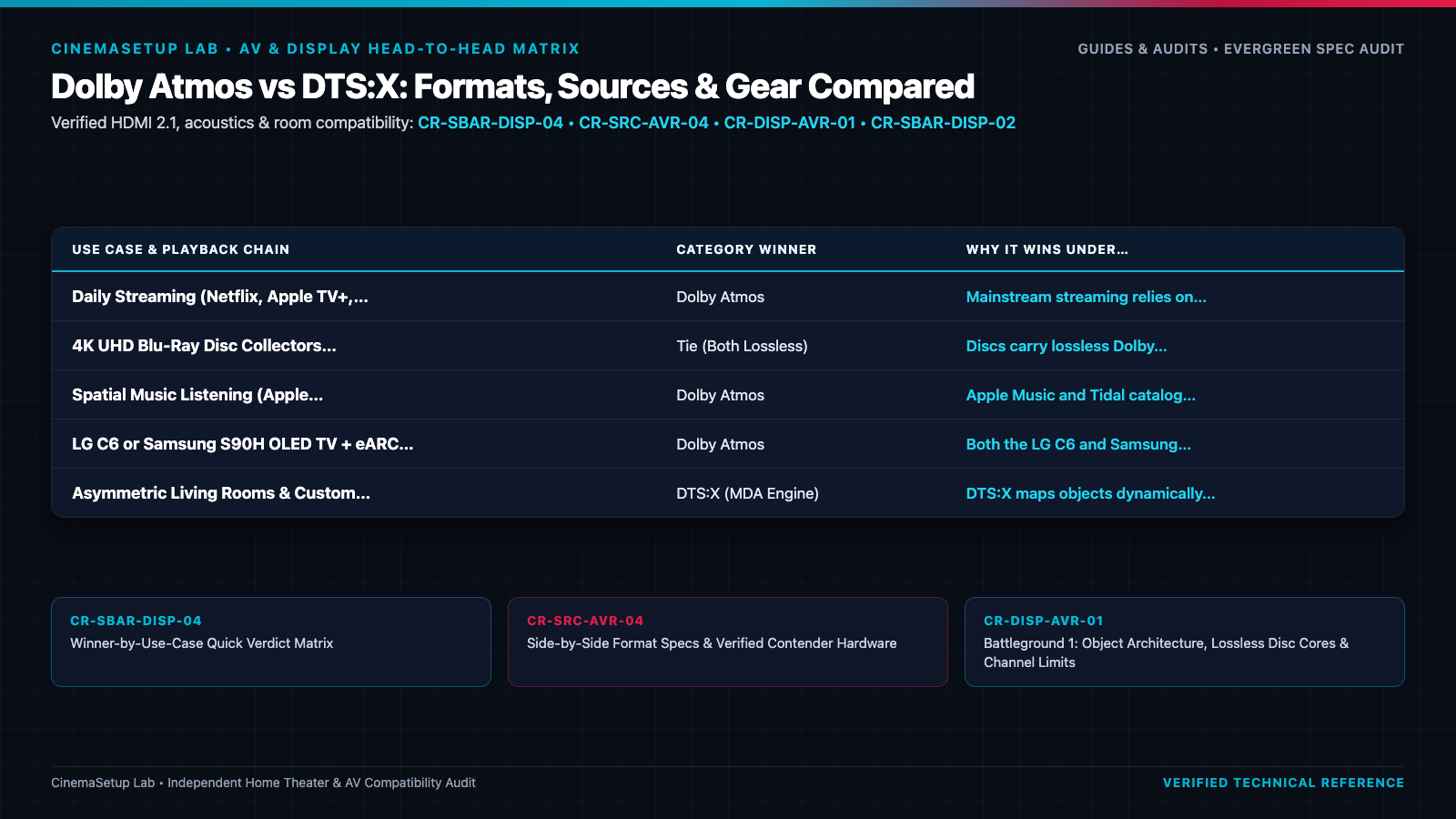
Quick Verdict: Dolby Atmos vs. DTS:X by Source & System
Neither format wins every home theater scenario. Under CinemaSetup Lab compatibility rules, your primary playback source, television model, and speaker hardware determine whether Atmos-only gear suffices or dual-format Atmos plus DTS:X decoding is mandatory:
| Use Case & Playback Chain | Category Winner | Why It Wins Under Audited Compatibility Rules |
|---|---|---|
| Daily Streaming (Netflix, Apple TV+, Max, Prime Video) | Dolby Atmos | Mainstream streaming relies on Dolby Digital Plus (DD+ JOC) Atmos; DTS:X streaming is limited primarily to select IMAX Enhanced titles on Disney+ (CR-SRC-AVR-04). |
| 4K UHD Blu-Ray Disc Collectors (Physical Media) | Tie (Both Lossless) | Discs carry lossless Dolby TrueHD Atmos or lossless DTS-HD Master Audio DTS:X; connect players to a dual-format AVR or multi-HDMI soundbar to avoid TV DTS blocks. |
| Spatial Music Listening (Apple Music, Tidal) | Dolby Atmos | Apple Music and Tidal catalog thousands of native Dolby Atmos music tracks, whereas DTS:X has no mainstream music streaming footprint. |
| LG C6 or Samsung S90H OLED TV + eARC Soundbar | Dolby Atmos | Both the LG C6 and Samsung S90H omit DTS/DTS:X eARC passthrough; Dolby Atmos passes cleanly over eARC while DTS discs require direct HDMI input into the audio system (CR-SBAR-DISP-04). |
| Asymmetric Living Rooms & Custom Speaker Angles | DTS:X (MDA Engine) | DTS:X maps objects dynamically to non-standard speaker locations without rigid bed-channel assumptions and adds dialogue gain control on supported decoders. |
| Console Gaming (Xbox Series X / PS5 via TV eARC) | Dolby Atmos | Xbox Series X outputs game and app Atmos via Dolby MAT over eARC, and PS5 outputs Tempest 3D audio wrapped in Dolby Atmos; neither console uses DTS:X for native games. |
Side-by-Side Format Matrix & Verified Contender Hardware
Before comparing receivers and soundbars, review how the two object-based audio standards differ across carriers, bandwidth, channel limits, and HDMI return rules:
| Technical Parameter | Dolby Atmos | DTS:X | Governing Rule |
|---|---|---|---|
| Spatial Audio Model | Hybrid channel beds (5.1/7.1) + dynamic audio objects | Layout-independent spatial mapping via Multi-Dimensional Audio (MDA) | Codec Architecture |
| 4K UHD Blu-Ray Lossless Carrier | Dolby TrueHD (~3–5 Mbps typical core bitrate) | DTS-HD Master Audio (~4–6+ Mbps typical core bitrate) | CR-DISP-AVR-01 |
| Streaming Carrier & Bitrate | Dolby Digital Plus with JOC (~448–768 kbps, lossy) | DTS:X Profile 2 (~448 kbps, lossy, IMAX Enhanced) | CR-SRC-AVR-04 |
| Console / Streamer Low-Latency Path | Dolby MAT (uncompressed LPCM + object metadata) | Bitstream or decoded multichannel LPCM (app-dependent) | CR-SRC-AVR-04 |
| Maximum Home Speaker Capacity | Up to 24.1.10 (34 speakers) on flagship processors | Up to 30.2 discrete speaker positions with DTS:X Pro | CR-SPK-AVR-04 |
| HDMI ARC (Legacy) Compatibility | Passes lossy DD+ Atmos; drops lossless TrueHD | Drops DTS:X and DTS-HD MA (core DTS 5.1 only if TV allows) | CR-SBAR-DISP-02 |
| HDMI eARC TV Passthrough | Broadly supported across current US OLED & Mini-LED TVs | Varies by TV; blocked on LG C6 and Samsung S90H OLEDs | CR-SBAR-DISP-04 |
| Virtualization DSP Companion | Dolby Atmos Height Virtualization (non-physical height) | DTS Virtual:X (non-physical surround/height) | CR-SYS-05 |
To translate format specs into real US living-room hardware, the table below compares four verified Amazon US products: one complete 7.1.4 dual-format soundbar kit, one Dolby-Atmos-centric flagship bar that omits DTS:X, one dual-format 7.2-channel AV receiver for discrete passive speakers, and one mid-tier 5.1.2 dual-format soundbar-plus-subwoofer bundle. Kit contents (G-29) and power rating conditions (G-02, CR-SPK-AVR-03) are stated explicitly.
| Verified Hardware Spec | JBL Bar 1000MK2 | Sonos Arc Ultra | Yamaha RX-A2A AVENTAGE | Polk Audio MagniFi Max AX |
|---|---|---|---|---|
| System Type & Pack Contents (G-29) | Complete 7.1.4 Kit (bar + 2 detachable rears + 10-in sub) | Single Soundbar Only (subwoofer & rears sold separately) | 7.2 AV Receiver Only (passive speakers & powered sub separate) | 5.1.2 Bar + 10-in Sub Kit (optional SR2 rears separate) |
| Amazon US Price Tier (G-08) | $900–$1,200 complete kit | $900–$1,100 bar only | $700–$1,000 AVR only | $600–$900 bar + sub kit |
| Dolby Atmos Decoding | Yes (DD+, TrueHD via eARC & HDMI in) | Yes (DD+, TrueHD via eARC, Dolby MAT) | Yes (TrueHD, DD+, Dolby MAT, Height Virtualizer) | Yes (DD+, TrueHD via eARC & HDMI in) |
| DTS:X Decoding (CR-SBAR-DISP-04) | Yes (full DTS:X & DTS-HD MA) | No (lossy DTS Digital Surround only) | Yes (DTS:X, DTS-HD MA, DTS Virtual:X) | Yes (full DTS:X) |
| Physical Height Drivers (CR-SYS-05) | 4 up-firing 2.75-in drivers (2 in bar + 2 in rears) | 2 up-firing silk-dome drivers in bar | Supports 2 physical overhead/on-wall/up-firing heights (5.1.2) | 2 up-firing 2.6-in drivers in bar |
| HDMI Inputs / eARC Bypass (CR-SBAR-SRC-01) | 3x HDMI in (4K DV/HDR10+) + 1x eARC out | 0 HDMI in (1x eARC port; optical via adapter) | 7x HDMI in (3x 40 Gbps 4K120 / 24 Gbps 8K60) + 1x eARC out | 3x HDMI in (4K DV/HDR10) + 1x eARC out + Optical |
| Amplification / Output Basis | 480 W RMS system rating (active) | 15 Class-D amps driving 14 drivers (active) | 100 W/ch (8 ohms, 20 Hz–20 kHz, 0.06% THD, 2 ch driven); 4-ohm front L/R | Active bar + wireless 10-in down-firing sub |
| Dimensions & Weight (Imperial / Metric) | Bar docked: 47.4 x 2.0 x 5.0 in (120.3 x 5.2 x 12.8 cm), 12.1 lb (5.5 kg) | 46.2 x 3.4 x 4.5 in (117.3 x 8.7 x 11.4 cm), 14.2 lb (6.4 kg) | 17.13 x 6.75 x 14.63 in (43.5 x 17.1 x 37.2 cm) w/o antennas, 22.5 lb (10.2 kg) | Bar: 44.94 x 2.88 x 4.63 in (114.3 x 7.2 x 11.8 cm), 12.85 lb (5.8 kg) |
| US Warranty Context (G-26) | 1-year US limited warranty (authorized dealer) | 1-year US limited warranty (authorized dealer) | 3-year US AVENTAGE warranty (authorized dealer) | 1-year electronics / 3-year speaker US warranty (authorized dealer) |
Measurement Transparency Note (G-01 & G-09): Independent third-party CEA-2010 subwoofer output sweeps and standardized multi-angle frequency response curves for these four exact SKUs have no verified data available yet in our measurement graph. Soundbar maximum total watt labels (such as “960 W Max” on retail boxes) are marketing peaks excluded from loudness comparisons per G-16; only rated RMS figures or FTC 8-ohm, 20 Hz–20 kHz, 2-channel-driven receiver ratings apply.
Battleground 1: Object Architecture, Lossless Disc Cores & Channel Limits
Prior to object-based audio, surround tracks baked every sound permanently into fixed speaker feeds—Left, Center, Right, Surround Left, Surround Right, and LFE. Moving a helicopter overhead required the mixing engineer to guess how your living room speakers were angled. Both Dolby Atmos and DTS:X replace rigid channel baking with 3D spatial metadata, allowing your AV receiver or soundbar renderer to calculate in real time which speakers reproduce each sound object.
Despite sharing the same goal, the two formats build that 3D dome differently:
- Dolby Atmos (Beds + Dynamic Objects): Atmos mixes combine a traditional 5.1 or 7.1 surround bed (for music stems and diffuse ambient wash) with discrete dynamic audio objects tagged with X/Y/Z coordinates. On 4K UHD Blu-ray discs, those objects ride inside a lossless Dolby TrueHD container (typically ~3 to 5 Mbps for the audio core). Over streaming services, Dolby compresses the object mix into lossy Dolby Digital Plus with Joint Object Coding (DD+ JOC) at roughly 448 to 768 kbps.
- DTS:X (Layout-Independent Spatial Mapping): Built on DTS’s Multi-Dimensional Audio (MDA) platform, DTS:X does not assume a fixed reference speaker grid. The decoder dynamically remaps objects onto asymmetric rooms—helpful if one side surround sits slightly farther forward than the other. On physical 4K Blu-ray discs, DTS:X rides inside lossless DTS-HD Master Audio (often running ~4 to 6+ Mbps core bitrates) and preserves a legacy 5.1 DTS core for backward compatibility with older receivers.
- Dialogue Control & Channel Ceilings (CR-SPK-AVR-04 & CR-SPK-AVR-05): DTS:X lets compatible decoders adjust dialogue object gain independently of background effects on supported mixes. At the high end, Dolby Atmos scales up to 24.1.10 (34 speakers) while DTS:X Pro scales up to 30.2 discrete speaker locations. In real living rooms, your AVR’s processing limit governs what plays: a 7.2 receiver such as the Yamaha RX-A2A tops out at 5.1.2 Atmos or 5.1.2 DTS:X (CR-SPK-AVR-04), whereas expanding to 5.1.4 or 7.1.4 requires a 9.4/11.4-processing receiver like the current US Denon AVR-X3900H (adding a 2-channel external power amp via pre-outs for 7.1.4 under CR-SPK-AVR-05).
Audited Verdict on Sound Quality: When comparing lossless Dolby TrueHD Atmos against lossless DTS-HD Master Audio DTS:X on 4K Blu-ray discs, neither format holds an inherent resolution advantage. Perceived immersion depends far more on the studio’s sound mix, speaker placement accuracy, and subwoofer room integration than on the logo printed on the disc case.
Battleground 2: Streaming Apps, IMAX Enhanced & Source Bottlenecks (CR-SRC-AVR-04)
Ecosystem support is where dolby atmos vs dts x stops being a tie. Under compatibility rule CR-SRC-AVR-04, your receiver or soundbar can only decode the spatial format that both your hardware source and individual streaming app actually transmit.
- Dolby Atmos Owns Mainstream Streaming & Music: Netflix, Apple TV+, Max, Amazon Prime Video, and Disney+ deliver thousands of titles in DD+ Atmos. Apple Music and Tidal also stream spatial music mixes exclusively in Dolby Atmos.
- DTS:X Streaming Relies on IMAX Enhanced: In the streaming market, DTS:X appears primarily via IMAX Enhanced mixes—a joint certification program from IMAX and DTS rather than a separate codec—delivered in lossy DTS:X Profile 2 (~448 kbps) on select Disney+ catalog titles and high-bitrate download platforms. Even on Disney+, IMAX Enhanced DTS:X playback requires explicitly certified TVs or receivers (such as certified Sony, Denon, Marantz, or Hisense hardware); unsupported players fall back to Dolby Atmos or 5.1.
- Apple TV 4K vs. Dedicated Media Players: The Apple TV 4K decodes streaming apps internally and outputs Dolby Atmos wrapped inside uncompressed Dolby MAT (Multichannel LPCM + metadata), which requires HDMI eARC if routed through a TV. However, the Apple TV 4K lacks native DTS:X bitstream output for local media apps. Disc collectors running dedicated 4K UHD Blu-ray players (such as Panasonic dual-HDMI players) or local-server boxes like the NVIDIA Shield TV Pro get effortless bitstream pass-through of both lossless Dolby TrueHD Atmos and lossless DTS-HD MA DTS:X.
- Console Gaming Behavior: Xbox Series X supports Dolby Atmos for games and apps via Dolby MAT, and PlayStation 5 supports Dolby Atmos spatial wrapper output for Tempest 3D Audio games. Neither console uses DTS:X for native game audio, though both can bitstream disc soundtracks depending on player settings.
Battleground 3: TV HDMI eARC Passthrough Traps & Bypass Paths (CR-SBAR-DISP-04)
The single biggest source of silent speakers and missing height audio in US living rooms happens between the television and the sound system. Under rules CR-SBAR-DISP-04 and CR-DISP-AVR-01, plugging a 4K Blu-ray player into your TV and relying on HDMI eARC to carry audio backward only works if both the TV and the audio system support that exact codec.
Critical US TV Passthrough Alert: Current flagship US OLED televisions—including both the LG C6 OLED and the Samsung S90H OLED—omit DTS and DTS:X eARC passthrough. (While LG briefly supported DTS:X bypass on the older C4 generation, LG removed DTS decoding and passthrough starting with the C5 and continuing on the C6; Samsung likewise omits DTS across its S90H lineup.) If you plug a 4K Blu-ray player playing a DTS:X disc directly into an LG C6 or Samsung S90H and send audio over eARC to a soundbar or AVR, the TV strips or blocks the DTS:X bitstream—leaving you with stereo PCM or silence depending on player settings.
| Signal Path Scenario | Dolby Atmos Result | DTS:X Result | Fix Under CR-SBAR-DISP-04 / CR-SBAR-SRC-01 |
|---|---|---|---|
| 4K Blu-Ray Player → LG C6 / Samsung S90H → eARC → AVR/Bar | Lossless TrueHD Atmos passes cleanly over eARC | Blocked / Drops to PCM or Silence (TV lacks DTS passthrough) | Plug the Blu-ray player directly into an HDMI input on the AVR or soundbar |
| 4K Blu-Ray Player → Yamaha RX-A2A / JBL Bar 1000MK2 → TV | Lossless TrueHD Atmos decoded natively | Lossless DTS:X decoded natively (TV only receives video) | Use a dual-HDMI player or bar/AVR HDMI input; reserve TV ports for 4K120 consoles |
| 4K Blu-Ray Player → Sonos Arc Ultra (0 HDMI Inputs) via LG C6 | Lossless TrueHD Atmos passes cleanly over eARC | Unsupported (both TV passthrough and Arc Ultra lack DTS:X) | Switch disc player to PCM/Dolby conversion, or buy a DTS:X bar with HDMI inputs |
| TV Built-In Apps → Standard HDMI ARC (Non-eARC TV) | Lossy DD+ Atmos works over ARC (TrueHD blocked) | Lossless DTS:X blocked; only legacy DTS 5.1 if TV passes DTS | Upgrade to eARC chain (CR-SBAR-DISP-02) or plug external source into AVR/bar |
Notice how this splits soundbar hardware cleanly: the Sonos Arc Ultra has zero HDMI inputs and decodes only Dolby Atmos and lossy DTS Digital Surround (no DTS:X or DTS-HD MA). By contrast, dual-format systems with dedicated HDMI inputs—such as the JBL Bar 1000MK2 (3 HDMI inputs), Polk Audio MagniFi Max AX (3 HDMI inputs), current US Samsung HW-Q990H kits (avoiding Canadian grey-market /ZC listings under CR-SYS-02), and AV receivers like the Yamaha RX-A2A (7 HDMI inputs)—let you plug your 4K Blu-ray player straight into the audio hardware first, completely bypassing LG C6 or Samsung S90H DTS blocks while passing 4K Dolby Vision or HDR10+ video onward to the display (CR-SBAR-SRC-01). Keep 4K120 gaming consoles connected straight to your TV’s HDMI 2.1 ports if your soundbar’s HDMI inputs cap at 4K60.
Battleground 4: Physical Height Drivers vs. Virtualization & Room Fit (CR-SYS-05)
Whether you feed a system Dolby Atmos or DTS:X, audio physics in your room beats codec branding every time. Under rule CR-SYS-05, psychoacoustic DSP modes—namely Dolby Atmos Height Virtualization and DTS Virtual:X—use phase and frequency filtering on ear-level speakers to mimic height cues, but they are never equivalent to physical height drivers.
- In-Ceiling & On-Wall Heights (AVR Path): Pairing a dual-format AVR like the Yamaha RX-A2A with dedicated in-ceiling speakers or angled on-wall height speakers mounted high on your front or side walls delivers crisp overhead localization for both Atmos and DTS:X, regardless of ceiling slope or acoustic treatment (CR-SPK-ROOM-02).
- Up-Firing Modules & Soundbars (CR-SPK-ROOM-01 & CR-SBAR-ROOM-01): Soundbars with upward-angled drivers—including the JBL Bar 1000MK2 (four 2.75-in up-firing drivers across bar and detachable rears), Sonos Arc Ultra (two up-firing tweeters), and Polk Audio MagniFi Max AX (two 2.6-in up-firing drivers)—rely on bouncing height waves off your ceiling toward the couch. That acoustic bounce works best under a flat, hard, reflective drywall ceiling between 7.5 and 12 ft (2.3 and 3.7 m) high. Vaulted, beamed, or heavily treated ceilings scatter those reflections, shrinking the vertical gap between Atmos and DTS:X.
- Room Correction Matters More Than Codec Logos (CR-AVR-ROOM-02): Calibration systems such as Yamaha YPAO R.S.C. multipoint EQ, Audyssey MultEQ XT32, Sonos Trueplay, or optional paid Dirac Live licenses on step-up AVRs level-match speaker distances and smooth bass peaks using level-calibration tones—improving clarity across both Atmos and DTS:X soundtracks far more than switching between the two formats.
Battleground 5: Installation Safety, CL2/CL3 Wiring & US Warranty (G-26, G-27, G-29)
Building a dual-format Atmos and DTS:X theater involves physical mounting and electrical rules that directly impact home safety and US warranty coverage:
- Wall & Ceiling Mounting Safety (G-27 & CR-SPK-ROOM-03): Always follow the speaker, soundbar, or bracket manufacturer’s installation instructions first. Heavy soundbars (12 to 15+ lb / 5.4 to 6.8+ kg) and wall-mounted surround or height speakers must anchor directly into structural wood studs or manufacturer-rated masonry/toggle anchors—never into hollow drywall alone. Before cutting drywall for in-ceiling Atmos/DTS:X speakers, verify joist cavity depth, check for live electrical wiring or plumbing lines, obtain landlord permission in rentals, and consult a licensed AV installer or electrician if local building codes apply.
- UL-Listed CL2/CL3 In-Wall Speaker Wire & HDMI Certification (CR-ACC-SPK-01/02 & CR-ACC-DISP-01): Any speaker cable routed inside walls or ceilings must carry a UL CL2 or CL3 in-wall fire rating, and long runs over 50 ft (15 m) benefit from 14 AWG or 12 AWG pure oxygen-free copper (OFC) rather than copper-clad aluminum (CCA). For 4K120/eARC HDMI runs, choose officially certified Ultra High Speed HDMI cables (and directional active optical fiber cables over ~10 ft / 3 m). Keep playback at comfortable listening levels and take breaks during extended movie marathons.
- US 120V Models & Authorized-Dealer Warranty (CR-SYS-02 & G-26): Confirm every powered AVR, subwoofer, or soundbar listing is a genuine US 120V AC / 60 Hz model—avoiding grey-market imports such as Canadian
/ZCSamsung soundbar units. Because Denon, Yamaha, JBL, Polk, and Sonos tie US manufacturer warranty service to authorized dealers, check the Amazon “Sold by” line on2026-11-26before checkout rather than assuming third-party resellers include US factory coverage.
Verdict: Choose Atmos-Focused Gear vs. Dual-Format Atmos + DTS:X Gear
Choose Dolby Atmos-Focused Gear if…
- 95%+ of your watching is streaming on Netflix, Apple TV+, Max, Prime Video, Disney+, or spatial music on Apple Music and Tidal.
- You connect a console or Apple TV 4K directly to an LG C6 or Samsung S90H OLED over HDMI eARC and want clean single-cable simplicity.
- You prefer the compact form factor and Sonos multi-room ecosystem of the Sonos Arc Ultra without owning a large DTS:X 4K Blu-ray shelf.
Choose Dual-Format (Atmos + DTS:X) Gear if…
- You collect 4K UHD Blu-ray or standard Blu-ray discs featuring DTS:X and DTS-HD Master Audio soundtracks.
- You want direct HDMI inputs on a soundbar (JBL Bar 1000MK2, Polk MagniFi Max AX) or AVR (Yamaha RX-A2A) to bypass TV DTS eARC blocks.
- You stream IMAX Enhanced DTS:X titles on supported devices or build an expandable discrete 5.1.2 speaker theater.
Verified Amazon US Hardware for Dolby Atmos & DTS:X
1. JBL Bar 1000MK2 7.1.4-Channel Soundbar System — Best Complete Dual-Format Wireless Kit

Quick Specs: Complete 7.1.4 Kit (main bar + 2 detachable battery-powered wireless rears + 10-in wireless sub) | Decodes Dolby Atmos & DTS:X | 4 physical 2.75-in up-firing drivers (2 in bar, 2 in rears) | 3x HDMI in (4K Dolby Vision / HDR10+ / HDCP 2.3) + 1x HDMI eARC out + Optical | 480 W RMS system output | Bar (docked): 47.4 x 2.0 x 5.0 in (120.3 x 5.2 x 12.8 cm), 12.1 lb (5.5 kg) | Price Tier: $900–$1,200 complete kit
Pros
- Full native decoding for both Dolby Atmos (DD+ & TrueHD) and DTS:X with four physical up-firing drivers and true wireless rear channels (CR-SYS-05)
- Three direct HDMI inputs let 4K Blu-ray players bypass LG C6 and Samsung S90H DTS eARC blocks cleanly (CR-SBAR-DISP-04)
- Detachable battery-powered surrounds require zero rear-wall speaker wire or power outlets during movie nights
Cons
- Closed ecosystem—cannot integrate third-party passive speakers or subwoofers (CR-SUB-SBAR-01)
- Up-firing height reflections require a flat 7.5–12 ft (2.3–3.7 m) ceiling (CR-SBAR-ROOM-01), and rears need periodic docking to recharge
2. Sonos Arc Ultra Soundbar — Best Dolby-Atmos-First Standalone Bar (No DTS:X)

Quick Specs: Single Soundbar Only (subwoofer & Era 100/300 rears sold separately) | 14 drivers (incl. 2 up-firing tweeters + Sound Motion woofer) + 15 Class-D amps | Decodes Dolby Atmos (DD+ & TrueHD via eARC) and lossy DTS Digital Surround (no DTS:X) | 1x HDMI eARC port (0 HDMI inputs) | 46.2 x 3.4 x 4.5 in (117.3 x 8.7 x 11.4 cm), 14.2 lb (6.4 kg) | Price Tier: $900–$1,100 bar only
Pros
- Supports lossless Dolby TrueHD Atmos via HDMI eARC plus streaming DD+ Atmos and Apple Music / Tidal spatial audio
- Compact single-chassis Sound Motion woofer design with Trueplay room calibration and modular Sonos Sub 4 / Era 300 expansion
- Broad ecosystem compatibility with AirPlay 2, Wi-Fi 6, and Bluetooth 5.3 for daily living-room streaming
Cons
- No DTS:X or DTS-HD MA decoding and zero HDMI inputs—unsuitable for DTS:X 4K Blu-ray collectors (CR-SBAR-DISP-04, CR-SBAR-SRC-01)
- Bar-only price excludes sub/rears (G-29), and Sonos’s May 2024 app redesign caused connectivity and feature gaps mitigated across subsequent app/firmware updates (G-12)
3. Yamaha RX-A2A AVENTAGE 7.2-Channel AV Receiver — Best Discrete Dual-Format AVR

Quick Specs: Single AV Receiver Only (passive speakers & powered sub separate; US 120V AC / 60 Hz) | 7 amps / 7.2 processing (5.1.2 max Atmos or DTS:X) | Rated 100 W/ch (8 ohms, 20 Hz–20 kHz, 0.06% THD, 2 ch driven); 4-ohm front L/R support | 7x HDMI in (3x 40 Gbps 4K120 / 24 Gbps 8K60) + 1x HDMI eARC out | YPAO R.S.C. multipoint | 17.13 x 6.75 x 14.63 in (43.5 x 17.1 x 37.2 cm) w/o antennas, 22.5 lb (10.2 kg) | Price Tier: $700–$1,000 AVR only
Pros
- Decodes both lossless Dolby Atmos (TrueHD) and lossless DTS:X (DTS-HD MA) natively across 7 direct HDMI inputs—eliminating TV DTS blocks
- Drives discrete passive in-ceiling, on-wall, or up-firing height speakers up to 5.1.2 with genuine physical overhead separation (CR-SYS-05)
- Three 40 Gbps HDMI 2.1 inputs support 4K120/VRR/ALLM gaming passthrough plus Dolby Vision and HDR10+ (CR-SRC-AVR-01/03)
Cons
- Caps at 7 processed speaker channels (5.1.2 or 7.1 max)—expanding to 5.1.4 or 7.1.4 requires a 9.4/11.4 AVR such as the Denon AVR-X3900H (CR-SPK-AVR-04)
- Requires buying passive speakers, a powered sub, and CL2/CL3 wire separately, plus generous cabinet clearance for heat dissipation (CR-AVR-ROOM-01)
4. Polk Audio MagniFi Max AX 5.1.2 Soundbar + 10-in Sub — Best Mid-Tier Dual-Format Bar Kit

Quick Specs: 5.1.2 Bar + 10-in Wireless Sub Kit (optional Polk SR2 wireless rears sold separately) | 11 drivers in bar (incl. two 2.6-in up-firing drivers) + 10-in down-firing sub | Decodes Dolby Atmos & DTS:X | 3x HDMI in (4K Dolby Vision/HDR10) + 1x HDMI eARC out + Optical | Bar: 44.94 x 2.88 x 4.63 in (114.3 x 7.2 x 11.8 cm), 12.85 lb (5.8 kg) | Price Tier: $600–$900 bar + sub kit
Pros
- Supports both Dolby Atmos and DTS:X out of the box at a lower tier than flagship 7.1.4 bars, paired with a substantial 10-inch wireless subwoofer
- Three HDMI inputs let disc players and media boxes connect straight to the bar to bypass TV DTS passthrough blocks (CR-SBAR-DISP-04)
- Low 2.88-in (7.2 cm) bar height clears most pedestal TV stands without blocking the screen or IR sensor (CR-SBAR-DISP-05)
Cons
- Ships as a 3.1.2 front-stage bar + sub kit—true rear surround channels require buying Polk SR2 wireless surrounds separately (G-29, CR-SBAR-SPK-01)
- HDMI inputs cap at 4K60 rather than 4K120 VRR gaming passthrough (connect consoles straight to the TV and return audio via eARC per CR-SBAR-SRC-01)
Authoritative Standards & Manufacturer Sources
- Dolby Laboratories Official Dolby Atmos Documentation — Object-based bed-plus-object architecture, TrueHD and DD+ JOC carriers, and home theater height placement rules.
- DTS (Xperi) Official DTS:X & IMAX Enhanced Documentation — Multi-Dimensional Audio (MDA) spatial mapping, DTS-HD Master Audio disc core, and DTS:X Profile 2 streaming specs.
- HDMI Licensing Administrator (HDMI.org) eARC Specification — Bandwidth distinction between legacy ARC and HDMI 2.1 eARC for uncompressed LPCM, Dolby TrueHD, and DTS-HD MA return.
- Yamaha USA Official RX-A2A AVENTAGE Specifications — FTC 100 W/ch (8 ohms, 20 Hz–20 kHz, 0.06% THD, 2 ch driven) output rating, 4-ohm front L/R support, and 7-input HDMI 2.1 map.
- Sonos, JBL & Polk Audio US Product Support Pages — Verified audio format support matrices (Sonos Arc Ultra Dolby Atmos/TrueHD vs. DTS Digital Surround limits; JBL Bar 1000MK2 & Polk MagniFi Max AX dual Atmos/DTS:X specs).
How We Audited This Guide
- Room setups, upgrade roadmaps, and Amazon marketplace audits enforce system-wide CR-* budgets and acoustics, Canadian /ZC grey-market alerts, pair-vs-single speaker clarity, and manufacturer-first mounting safety.
- Every AV receiver, speaker, subwoofer, soundbar, OLED/Mini-LED TV, projector, source player, and accessory spec was cross-checked against official manufacturer manuals, CEA/CTA standards, and live Amazon US listings.
- Recommendations were evaluated against our weighted vertical scoring rubrics and documented CR-* compatibility rules; we never invent nits, contrast ratios, bench wattage, or room decibels.
Continue Your Audit
Frequently Asked Questions: Dolby Atmos vs. DTS:X
Does DTS:X sound better than Dolby Atmos?
Neither codec inherently sounds better on lossless 4K Blu-ray discs. Dolby TrueHD Atmos and DTS-HD Master Audio DTS:X both deliver studio-master lossless fidelity. Real-world differences come from the movie’s specific audio mix, speaker calibration, and whether your TV or soundbar passes DTS:X cleanly.
Why does my soundbar play Dolby Atmos but not DTS:X?
Two common bottlenecks block DTS:X under rule CR-SBAR-DISP-04. First, bars like the Sonos Arc Ultra do not license DTS:X decoding. Second, modern US TVs such as the LG C6 and Samsung S90H drop DTS passthrough over eARC, forcing you to connect disc players straight into a dual-format AVR or multi-HDMI bar.
Which streaming services use DTS:X instead of Dolby Atmos?
Almost all major streaming services standardize on Dolby Atmos via Dolby Digital Plus. Streaming DTS:X is largely restricted to select IMAX Enhanced titles on Disney+ encoded in DTS:X Profile 2, and playback still requires an IMAX Enhanced-certified TV, streaming box, and audio decoder.
Can Dolby Atmos speakers play DTS:X soundtracks?
Yes, physical speakers do not care which 3D codec feeds them. Passive in-ceiling, on-wall, or up-firing Atmos height speakers wired to a dual-format receiver such as the Yamaha RX-A2A reproduce DTS:X height objects seamlessly because DTS:X maps objects dynamically to your existing layout.
Do I need HDMI eARC for Dolby Atmos and DTS:X?
You need HDMI eARC whenever lossless disc audio or Dolby MAT passes through a TV (CR-DISP-AVR-01). Standard HDMI ARC handles lossy DD+ streaming Atmos, whereas lossless Dolby TrueHD Atmos and lossless DTS:X require either end-to-end eARC (on a DTS-capable TV) or direct HDMI connection into your AVR or soundbar.
Is DTS Virtual:X the same as real DTS:X or Dolby Atmos?
No—under rule CR-SYS-05, DTS Virtual:X and Dolby Atmos Height Virtualization are DSP illusions that process ear-level speakers without physical height drivers. True Dolby Atmos and DTS:X immersion requires dedicated overhead, high on-wall, or ceiling-bounce up-firing height channels.


