Disclosure: As an Amazon Associate, I earn from qualifying purchases. If you buy through links on this page, we may earn a small commission at no extra cost to you. Commission differences across categories (such as 2% on televisions versus 4% on most AV receivers, speakers, and accessories) never influence our compatibility audits, blueprint splits, or product selections.
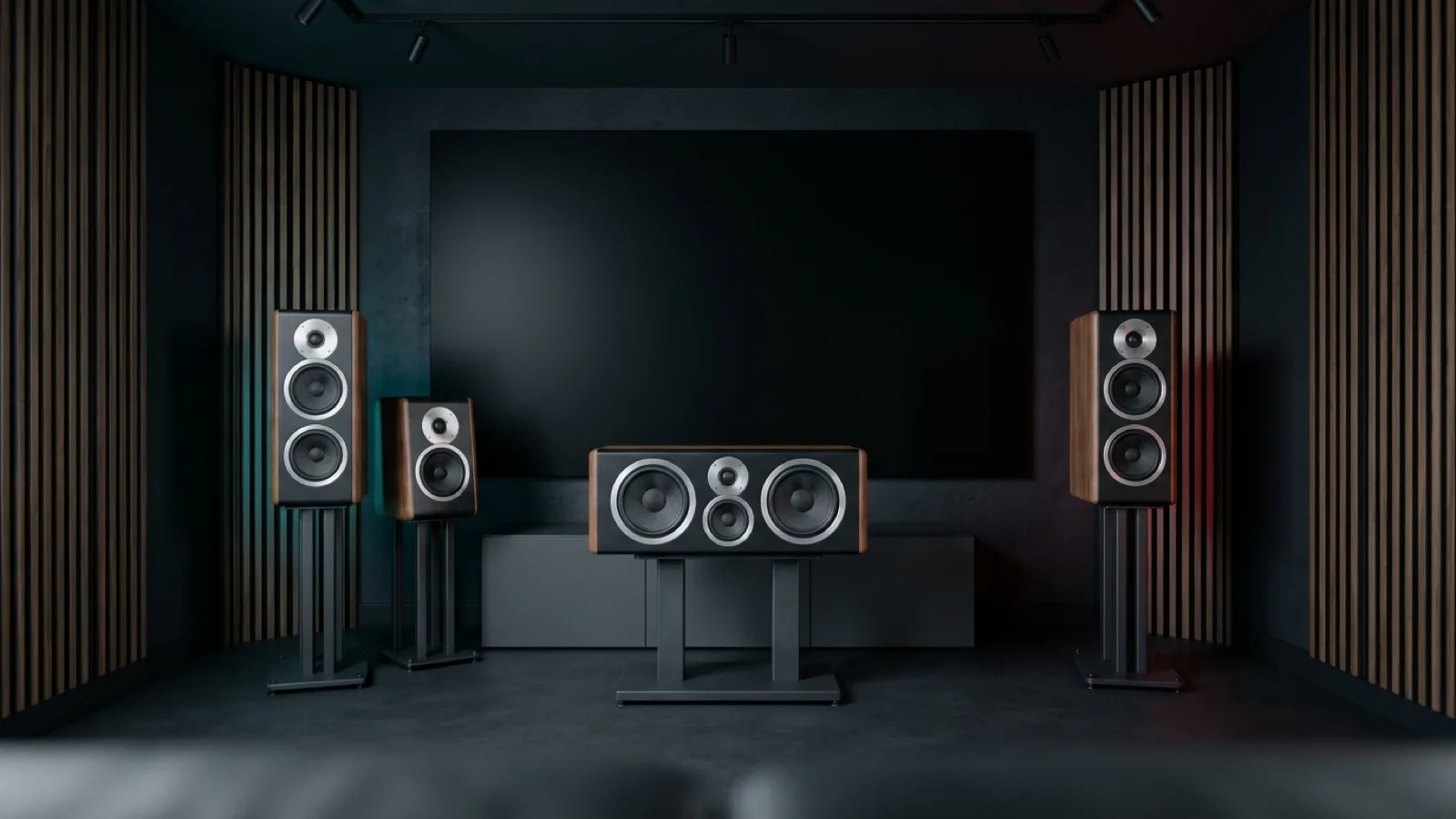
A well-planned 5.1.2 home theater setup is the sweet spot for modern US living rooms: it combines five ear-level surround speakers (front left, center, front right, and two side surrounds), one powered subwoofer for low-frequency effects (LFE), and two physical height channels for overhead Dolby Atmos and DTS:X audio. Because a 5.1.2 system requires exactly seven amplified speaker channels, it unlocks true three-dimensional sound without turning an everyday family room into a 9- or 11-speaker dedicated cinema.
Building a living-room 5.1.2 layout cleanly requires solving five compatibility bottlenecks before checkout: verifying a 7-channel AV receiver (or physical-height 5.1.2 soundbar), allocating at least half of your audio budget to speakers and subwoofers, matching height drivers to your ceiling height and slope, routing 4K/120Hz consoles and lossless eARC audio without port bottlenecks, and sizing your display and subwoofer to the room. This blueprint pairs directly with our pillar home theater setup guide so every component works together on US 120V AC power.
In This 5.1.2 Living-Room Blueprint
- Living-Room Envelope, Screen Sizing & CR-SYS-01 Budget Split
- 5.1.2 System Parts List & Verified Amazon US Picks
- IF-THEN Compatibility Proof Box (CR-* Rules Audited)
- 5.1.2 Speaker Angles, Height Options & AVR Power Math
- HDMI 2.1 40 Gbps Switching, eARC & Console Port Plan
- UL CL2/CL3 Wiring, Mounting Safety & 5-Step Calibration
- Audited 5.1.2 Equipment Profiles (8 Verified US Listings)
- Authoritative Standards & Manufacturer References
- Frequently Asked Questions
Living-Room Envelope, Screen Sizing & CR-SYS-01 Budget Split
This blueprint models a typical medium US living room measuring 15 ft wide by 20 ft long with an 8 ft flat ceiling (4.6 m by 6.1 m by 2.4 m), enclosing 2,400 cu ft (68 m³) with a primary sofa positioned 9 to 11 ft (2.7 to 3.4 m) from the screen. Before selecting speakers or a receiver, confirm two foundational constraints: whether your open-plan hallways add connected air volume for subwoofer sizing, and whether your ceiling is flat drywall or vaulted.
First, lock in screen geometry under rule CR-DISP-ROOM-01. For a 16:9 television, sitting between 1.20 × diagonal (a 40-degree immersive cinema viewing angle) and 1.63 × diagonal (a 30-degree comfortable everyday angle) keeps 4K detail legible without neck strain. At a 9 to 11 ft (2.7 to 3.4 m) living-room distance, a 77-inch OLED hits 7.7 ft (2.3 m) at 40 degrees and 10.4 ft (3.2 m) at 30 degrees, while an 85-inch Mini-LED TV covers 8.5 to 11.6 ft (2.6 to 3.5 m). If you sit closer—around 7 to 8.5 ft (2.1 to 2.6 m) in a compact apartment—a 65-inch display fits cleanly.
Second, enforce audio budget discipline under rule CR-SYS-01 (excluding the television and game consoles). Most living-room buyers overspend on receiver logos and starve their speakers and subwoofer. Keep speakers plus subwoofer at 50% or higher of your audio spend and electronics at or below 35% to 40%:
| 5.1.2 Audio System Path | Passive Speakers Share | Powered Sub Share | 7.2-Ch AVR Share | Wire, Cables & Mounts |
|---|---|---|---|---|
| Core Surround AVR ($1,000-$2,500) | 40%–50% (L/C/R, SL/SR, 2 Heights) | 15%–20% (12-in sealed or ported) | 25%–35% (7.2 HDMI 2.1 AVR) | 5%–8% (14 AWG OFC + UHS HDMI) |
| Starter AVR + Pack ($300-$800+) | 40%–50% (Compact 5.1.2 pack) | 15%–20% (Bundled 8–10 in sub) | 35%–40% (Entry 7.2 AVR floor) | 5%–10% (16/14 AWG OFC + HDMI) |
| Wireless 5.1.2 Soundbar ($500-$1,000) | 75%–90% (Main 5.1.2 bar + wireless sub + detachable rears) | Integrated inside soundbar | 10%–25% (Wall bracket / UHS HDMI) | |
Notice the explicit exception for Starter AVR builders: because current US 7.2-channel Atmos receivers rarely retail below the entry $400–$600 bracket, an entry discrete 5.1.2 build often pushes the AVR share toward 35%–40%, and realistic total AVR + 5.1.2 speaker + sub budgets start in the upper Starter to Core bracket. If you want a pre-matched budget breakdown targeting that exact ceiling, see our home theater setup under $2,500 guide. Still debating whether two surround-back channels beat two overhead channels in your room? Read our 7.1 vs 5.1.2 layout comparison before buying.
5.1.2 System Parts List & Verified Amazon US Picks
The parts list below maps verified Amazon US hardware across every role in a 5.1.2 living room—from full-tower Core Surround speaker packs and 4-ohm Starter satellite kits to vaulted-ceiling height upgrades, a 12-inch sealed subwoofer, a wire-free 5.1.2 soundbar alternative, and two room-matched 4K displays. Every passive speaker system below pairs with a US 120V 7.2-channel AV receiver (such as the Denon AVR-X1800H evaluated in our Denon AVR-X1800H audit) rather than a 5.2-channel receiver.
| 5.1.2 System Role | Verified Amazon US Pick | Key Compatibility & Package Spec | Budget Tier | Amazon Link |
|---|---|---|---|---|
| Core 5.1.2 Tower Speaker Pack | Klipsch Reference 5.1.2 Pack (2x R-625FA + R-52C + 2x R-41M + Sub) | 8 ohms, 96 dB front sensitivity (2.83V/1m), built-in up-firing Atmos tops on towers; AVR & wire separate | $1,000-$2,500 | View on Amazon |
| Starter 5.1.2 Compact Pack | Monoprice Premium 5.1.2 Immersive System | 4 ohms nominal, 89 dB (2.83V/1m), 70 Hz–20 kHz, 8-in 200 W peak sub; needs AVR 4-ohm mode | $300-$800 | View on Amazon |
| Scalable 5.1.2 / 5.1.4 Pack | Klipsch Reference Cinema Dolby Atmos 5.1.4 | 8 ohms, 92 dB sats / 91 dB center (2.83V/1m), 10-in 150 W RMS sub; wire front heights for 5.1.2 | $300-$800 | View on Amazon |
| Vaulted-Ceiling Height Pair | SVS Prime Elevation Speaker (Pair) | 8 ohms, 87 dB (2.83V/1m), angled cabinet w/ Multi-Angle Wall Brackets; sold strictly as 1 pair (2 spks) | $300-$800 | View on Amazon |
| Living-Room Sealed Sub | SVS SB-1000 Pro (12-in Sealed, Black Ash) | 12-in driver, 325 W RMS (820+ W peak), 20–270 Hz (±3 dB), app DSP EQ; single powered sub (each) | $300-$800 | View on Amazon |
| Wire-Free 5.1.2 Alternative | JBL Bar 800 5.1.2 Soundbar System | 2x 2.75-in up-firing drivers, detachable wireless rears, 10-in wireless sub, 1x HDMI In + eARC Out | $500-$1,000 | View on Amazon |
| Primary 9–10.5 ft OLED TV | LG 77-In OLED evo AI C6 Bundle (OLED77C6HUP) | Tandem WOLED, 4x full HDMI 2.1 (up to 165 Hz), eARC on HDMI 2, Dolby Vision (no HDR10+ / no DTS) | $3,000+ | View on Amazon |
| Bright-Room 85-In Mini-LED | Hisense 85″ U6 Pro Mini-LED TV (85U6SF Pro) | Matte anti-glare Mini-LED, 144 Hz native, 2x HDMI 2.1 + eARC, Dolby Vision IQ & HDR10+ | $1,100-$3,000 | View on Amazon |

IF-THEN Compatibility Proof Box (CR-* Rules Audited)
Before finalizing any 5.1.2 shopping cart, run every pairing through our cross-group compatibility logic. Below are the exact IF -> THEN conditions governing a 5.1.2 living-room build:
5.1.2 Living-Room Compatibility Proof Box (Verified CR-* Rules):
- CR-SPK-AVR-04 (HARD — Channel Processing Count): IF your target layout is
5.1.2(5 ear-level speakers + 2 height speakers + 1 subwoofer), THEN your AV receiver must process and amplify at least 7 speaker channels (a 7.2-channel AVR such as the Denon AVR-X1800H). Entry 5.2-channel receivers (such as the Denon AVR-S570BT) process only 5 speaker channels and FAIL HARD for 5.1.2—no splitter or external amplifier can add missing Atmos height channels. If you want room to expand to 5.1.4 or 7.1.4 later, step up to a 9.4-amp / 11.4-processing receiver such as the Denon AVR-X3900H (adding a 2-ch external amp on pre-outs for 7.1.4 per CR-SPK-AVR-05). - CR-SPK-AVR-01 & CR-AVR-ROOM-01 (CONDITIONAL — Speaker Impedance & Heat): IF you choose the 4-ohm Monoprice Premium 5.1.2 satellites, THEN select the 4-ohm impedance setting in your AVR setup menu and maintain the full top and rear cabinet clearance printed in the receiver manual to avoid thermal protection shutdowns. Eight-ohm speaker packs like the Klipsch Reference series and SVS Prime Elevation run cleanly on the default AVR setting.
- CR-SPK-ROOM-01 & CR-SPK-ROOM-02 (CONDITIONAL / SOFT — Ceiling vs. Up-Firing Heights): IF your living room has a flat, hard drywall ceiling between 7.5 and 12 ft (2.3 and 3.7 m) high, THEN up-firing height drivers integrated into the Klipsch R-625FA towers, Monoprice 5.1.2 fronts, or JBL Bar 800 reflect cleanly down to the couch. IF your ceiling is vaulted, sloped, beamed, or acoustically treated, THEN switch to angled wall-mounted or ceiling-mounted direct drivers like the SVS Prime Elevation pair aimed toward the main seat.
- CR-SRC-AVR-01 & CR-DISP-AVR-02 (CONDITIONAL — 40 Gbps Console & eARC Ports): IF you own an Xbox Series X, PS5, or 120Hz+ gaming PC, THEN connect it either to one of your AVR’s dedicated 40 Gbps HDMI 2.1 inputs (for example, HDMI 4, 5, or 6 on the Denon AVR-X1800H) or directly into a 4K/120Hz+ port on your TV and return audio via HDMI eARC. When using the 2-port Hisense 85U6SF Pro, using eARC consumes one of its two HDMI 2.1 inputs; when using the 4-port LG C6 OLED, three 4K/120Hz+ inputs stay free.
- CR-SPK-AVR-02 (SOFT — Sensitivity, Power & Seat Distance): IF your speakers are 87 dB sensitivity (such as SVS Prime Elevation) at 10 ft (3.05 m), THEN an 80 W/ch 8-ohm AVR comfortably reaches everyday 95 dB living-room peaks, whereas high-sensitivity 96 dB horn towers (Klipsch R-625FA) deliver generous headroom even for louder movie dynamics.
- CR-SUB-AVR-01 & CR-SUB-ROOM-01/03 (HARD / SOFT — Powered Sub & Shared Walls): IF connecting to an AVR’s line-level LFE pre-out, THEN you must use a self-powered subwoofer (never a passive car or unpowered theater sub). In closed rooms under 1,700–2,400 cu ft (48–68 m³) or townhomes with shared walls, a 12-inch sealed sub like the SVS SB-1000 Pro paired with AVR night/dynamic-range compression keeps bass tight and more neighbor-friendly—though no decoupling pad makes deep bass silent next door.
- CR-SYS-03 & CR-SYS-05 (INFO — Single eARC Device & Real Height Drivers): Never connect both a soundbar and an AVR to the same TV simultaneously (HDMI eARC serves one primary device). Verify physical upward-firing or overhead drivers rather than relying on DSP “virtual Atmos” height simulation.
5.1.2 Speaker Angles, Height Options & AVR Power Math
Getting 5.1.2 immersion right in a living room depends far more on geometry and crossover handoff than on chasing inflated amplifier wattage numbers.
Exact Ear-Level & Height Placement Targets
- Front Left & Right (FL / FR): Place at 22° to 30° off center on either side of the TV with tweeters near seated ear height—typically 36 to 42 in (91 to 107 cm) off the floor. Under CR-SPK-ROOM-04, leave breathing space behind rear-ported cabinets or use manufacturer port plugs if boundary bass sounds heavy.
- Center Channel (C): Position directly beneath (or above) the TV aimed straight toward seated ears, matching the front L/R series tweeter architecture per CR-SPK-SPK-01 so dialogue panning across the screen does not shift tone.
- Side Surrounds (SL / SR): In a 5.1.2 setup, surrounds sit at 110° to 120°—slightly behind the sofa’s side axis rather than directly behind the couch against a back wall—about 1 to 2 ft (0.3 to 0.6 m) above seated ear height so nearby listeners do not block the driver for the center seat.
- Two Height Channels (.2): Dolby’s 5.1.2 home layout supports three physical height approaches: Top Middle in-ceiling speakers mounted slightly ahead of the knees (~65°–100° elevation), Front Height angled on-wall speakers (such as SVS Prime Elevation) mounted high on the front wall above FL/FR, or Dolby Atmos Enabled up-firing drivers firing off a flat, hard 7.5–12 ft (2.3–3.7 m) ceiling.
Worked AVR Power & Sensitivity Estimate (CR-SPK-AVR-02)
Always compare receivers strictly using their 8 ohms, 20 Hz–20 kHz, 2 channels driven continuous rating (CR-SPK-AVR-03), never 6-ohm 1 kHz or 1-channel-driven marketing figures. Using a conservative ~30% multichannel derating for five to seven active channels, an 80 W/ch 8-ohm 7.2 AVR (like the Denon AVR-X1800H) supplies roughly 56 W per active channel. How far does that go at a 10 ft (3.05 m) living-room seat?
By our estimate from published specs (assumptions: free-field inverse-square distance loss of ~9.7 dB at 10 ft / 3.05 m, 0 dB room-gain allowance, and an 80 Hz subwoofer crossover relieving the main amp of deep bass):
- High-Sensitivity Horn Towers (Klipsch R-625FA, 96 dB at 2.83V/1m, 8 ohms): Reaching loud 100 dB living-room peaks requires an estimated ~23 W per channel, and even cinema 105 dB reference peaks estimate ~74 W. That gives an 80 W/ch AVR comfortable dynamic headroom.
- Mid-Sensitivity Speakers (87 dB at 2.83V/1m, 8 ohms, like SVS Prime Elevation): Reaching comfortable 95 dB living-room peaks requires an estimated ~59 W per channel—sitting right alongside the ~56 W derated receiver budget for clean everyday movie playback—while pushing to 100 dB peaks estimates ~186 W (calling for closer seating or higher-power amplification).
- 4-Ohm Compact Satellites (Monoprice 5.1.2, 89 dB at 2.83V/1m, 4 ohms): Because 2.83 V into 4 ohms draws 2 W rather than 1 W, normalized 1 W/1 m sensitivity drops by 3 dB to 86 dB. Reaching 95 dB peaks at 10 ft estimates ~74 W, and engaging the AVR’s 4-ohm protection mode lowers maximum voltage rails slightly—so keep seating around 8 to 10 ft (2.4 to 3.0 m) and cross satellites over at 100–120 Hz.
HDMI 2.1 40 Gbps Switching, eARC & Console Port Plan
Even with the right 7.2 AVR and speaker layout, plugging a 4K/120Hz console or 4K Blu-ray player into the wrong port can silently strip Dolby TrueHD Atmos, DTS:X, or 120 Hz VRR. Apply these end-to-end routing rules across every hop (CR-SRC-AVR-01, CR-DISP-AVR-01, CR-ACC-DISP-01):
| Source Device | Recommended Port Path | Audio & Video Behavior Verified | Critical Caveat |
|---|---|---|---|
| PS5 / Xbox Series X / 120Hz PC | Direct to LG C6 / Hisense U6 Pro HDMI 2.1 port → HDMI eARC to AVR (or direct to 40 Gbps AVR port) | Full 4K/120Hz+ VRR, ALLM, plus uncompressed multichannel LPCM / Dolby MAT Atmos via eARC | Must use Ultra High Speed HDMI Certified (48 Gbps) cables on every hop |
| 4K UHD Blu-ray Player | Direct into AVR HDMI In (or JBL Bar 800 HDMI In for 4K/60Hz DV/HDR10) | Preserves lossless Dolby TrueHD Atmos and DTS:X / DTS-HD MA before video reaches the TV | 2026 LG C6 OLEDs omit DTS passthrough via eARC—wire Blu-ray players to the AVR first |
| Apple TV 4K / Streaming Stick | Direct into AVR HDMI In, or TV HDMI → eARC | Streaming apps deliver DD+ Atmos; Apple TV 4K sends Dolby MAT PCM requiring eARC | Set TV Digital Sound Out to Pass-Through, never forced PCM stereo |
For HDR format alignment (CR-SRC-DISP-01), note that LG’s 2026 C6 OLED supports Dolby Vision, HDR10, and HLG (omitting HDR10+), whereas Hisense’s 85U6SF Pro Mini-LED handles both Dolby Vision IQ and HDR10+. Whenever an HDR format is unsupported by the panel, sources fall back cleanly to static HDR10 rather than breaking video.
UL CL2/CL3 Wiring, Mounting Safety & 5-Step Calibration
Manufacturer-First Mounting, Electrical & In-Wall Wiring Safety (G-27 / CR-ACC-SPK-02 / CR-DISP-ACC-02):
- Wall & Ceiling Brackets: Always follow the TV, speaker, and bracket manufacturer’s printed mounting instructions. Confirm VESA spacing and TV weight without stand against the mount’s load rating, and drive lag hardware strictly into solid wood studs, rated metal-stud toggles, or masonry—never support heavy displays or angled elevation speakers like the 7.8 lb (3.5 kg) SVS Prime Elevation on unreinforced drywall alone.
- In-Wall & In-Ceiling Wire Codes: Any speaker cable concealed behind drywall or above a ceiling must use UL-listed CL2 or CL3 (or local building-code equivalent) pure oxygen-free copper (OFC) wire—never copper-clad aluminum (CCA) or standard zip cord. Never route TV power cords inside walls; hire a licensed electrician for recessed AC outlets and a licensed AV installer before cutting ceiling joists around electrical Romex, plumbing, or HVAC lines.
- Heavy Lifting & Volume Comfort: Use two people when lifting 77-inch to 85-inch TVs, 40-inch floorstanding towers, or 26+ lb subwoofers onto decoupling pads. Keep listening levels comfortable during extended movie nights and avoid unverified claims about soundproofing walls in shared buildings.
Size pure copper (OFC) speaker runs conservatively under CR-ACC-SPK-01: 16 AWG suffices up to ~50 ft (15.2 m) for 8-ohm speakers or ~25 ft (7.6 m) for 4-ohm satellites; 14 AWG is the ideal living-room baseline up to ~79 ft (24.1 m) at 8 ohms and ~40 ft (12.2 m) at 4 ohms; and 12 AWG covers long in-wall 4-ohm runs up to ~63 ft (19.2 m). For HDMI 2.1 runs longer than 10 ft (3.0 m) to a wall-mounted TV, use a directional active optical (fiber) Ultra High Speed HDMI cable.
- Assign Receiver Amp Mode to 5.1.2: Before running calibration, verify your 7.2 AVR’s Amp Assign menu is set to 5.1.2 (Front Height / Top Middle / Dolby Enabled) matching your physical height placement—not 7.1 Surround Back. If wiring 4-ohm Monoprice satellites, switch the AVR impedance setting to 4 ohms first.
- Check Polarity & Subwoofer Knobs: Confirm positive-to-positive (+) and negative-to-negative (-) copper connections across all seven speakers. On your powered subwoofer, set the low-pass crossover knob to LFE / Bypass (maximum) and phase to
0°. - Run Multipoint Room Correction: Place the AVR’s supplied microphone at ear height on a tripod across 6 to 8 positions around the sofa and run Audyssey, Dirac Live, or YPAO using automated level-calibration tones.
- Override Speakers to “Small” & Set Crossover (CR-SUB-SPK-01): Even with floorstanding towers like the Klipsch R-625FA, set all channels to Small with an 80 Hz crossover (or 100–120 Hz for compact satellites like the Monoprice 5.1.2 rated down to 70 Hz) so the powered subwoofer handles deep LFE and bass cleanly.
- Verify eARC Pass-Through & Night DRC: Enable HDMI eARC and Bitstream/Pass-Through on the TV, dial in AV Lip-Sync if needed (CR-SYS-04), and activate Dynamic Volume or Night Mode for late-night apartment viewing (CR-SUB-ROOM-03).
Audited 5.1.2 Equipment Profiles (8 Verified US Listings)
Every SKU below was verified against live US 120V Amazon listings and manufacturer specifications as of 2026-11-26. Always confirm the Sold by line at checkout—US factory warranties typically require buying from an authorized dealer rather than an unauthorized third-party liquidator (G-26).
1. Klipsch Reference Series 5.1.2-Capable Home Theater Pack (2x R-625FA + R-52C + 2x R-41M + Sub)

Key Specs & Package Contents: 8 ohms compatible nominal impedance | Front R-625FA: 96 dB sensitivity (2.83V/1m), 40 in (101.7 cm) tall with integrated upward-firing Dolby Atmos elevation driver | R-52C Center: 95 dB (2.83V/1m), 7.3 in (18.5 cm) tall | R-41M Surrounds: 90 dB (2.83V/1m), 11.3 in (28.7 cm) tall | In the Box: 2x R-625FA floorstanding Atmos towers, 1x R-52C center speaker, 2x R-41M bookshelf surrounds, 1x powered subwoofer (AV receiver and speaker wire sold separately) | Price Tier: $1,000-$2,500
Despite the “5.1” shorthand in the retail bundle title, each Klipsch R-625FA tower houses two separate speaker binding-post pairs: one for the main front floorstander and a second dedicated pair for its built-in angled Dolby Atmos elevation driver. Wired to a 7.2-channel AVR, this pack builds an immediate 5.1.2 layout with uniform Tractrix horn-loaded tweeters across L/C/R and heights (CR-SPK-SPK-01) and 96 dB sensitivity that preserves generous headroom on an 80 W/ch receiver (CR-SPK-AVR-02). Confirm your living room has a flat 7.5–12 ft (2.3–3.7 m) ceiling so the tower-top height channels reflect cleanly (CR-SPK-ROOM-01).
Pros
- True 5.1.2 physical driver count out of one timbre-matched Klipsch Reference pack—no separate ceiling speakers needed
- 96 dB tower and 95 dB center sensitivity demand minimal wattage from entry 7.2 AVRs
Cons
- Up-firing tower tops lose precision under vaulted, sloped, or acoustically treated ceilings
- Requires an external 7.2-channel AV receiver, 14 AWG OFC wire, and floor/stand space for the R-41M surrounds
2. Monoprice Premium 5.1.2 Channel Immersive Home Theater System

Key Specs & Package Contents: 4 ohms nominal impedance | 89 dB sensitivity (2.83V/1m) | Satellites: 70 Hz–20 kHz (±3 dB), 30 W max input (15–100 W recommended amp), 3-in midrange + 0.75-in aluminum tweeter + 3-in top Atmos driver | Powered 8-in ported subwoofer (200 W peak) | In the Box: 2x front Atmos-enabled satellites, 1x center, 2x rear surrounds, 1x 8-in powered subwoofer (no AVR included) | Price Tier: $300-$800
For smaller living rooms or Starter-tier budgets that want discrete AVR separation without floorstanding towers, the Monoprice Premium 5.1.2 System packs all seven speaker terminals and an 8-inch powered subwoofer into compact cabinets. Two mandatory compatibility steps apply: because the Atmos-enabled satellites present a 4-ohm nominal load, enable your 7.2 receiver’s 4-ohm speaker setting with full ventilation clearance (CR-SPK-AVR-01 / CR-AVR-ROOM-01), and set the AVR crossover to 100–120 Hz (CR-SUB-SPK-01) so the 8-inch sub handles everything below the satellites’ 70 Hz floor.
Pros
- Compact Starter-tier entry into discrete 5.1.2 AVR home theater with included 8-inch powered sub
- Front satellites incorporate dedicated upward-firing 3-inch drivers for flat-ceiling rooms
Cons
- 4-ohm nominal load and 30 W max handling cap maximum volume in rooms larger than ~1,800–2,400 cu ft
- Requires an external 7.2 AVR and 14 AWG OFC wire for runs approaching 40 ft (12.2 m)
3. Klipsch Reference Cinema Dolby Atmos 5.1.4 System (5.1.2-Ready + 5.1.4 Scalable)

Key Specs & Package Contents: 8 ohms compatible nominal impedance | 92 dB satellite sensitivity (2.83V/1m); 91 dB center (2.83V/1m) | 10-in spun-copper IMG ported subwoofer, 150 W continuous / 300 W peak, 32–120 Hz (±3 dB) | In the Box: 4x compact satellites with built-in up-firing Atmos tops, 1x center speaker, 1x 10-in powered subwoofer (AV receiver sold separately) | Price Tier: $300-$800
The Klipsch Reference Cinema 5.1.4 System bridges Starter and Core living-room builds with two advantages over standard compact packs: an 8-ohm nominal load with high 92 dB satellite sensitivity, and a stronger 10-inch 150 W RMS subwoofer rated down to 32 Hz (±3 dB). When paired with a 7.2-channel AVR today, wire the five ear-level channels plus only the two front elevation terminals for a clean 5.1.2 setup; if you later upgrade to a 9.4-channel receiver like the Denon AVR-X3900H, connect the rear satellite height terminals to unlock 5.1.4 without replacing your speakers.
Pros
- Runs cleanly in 5.1.2 on a 7.2 AVR now while preserving built-in rear height drivers for future 5.1.4 upgrades
- 8-ohm impedance, 92 dB sensitivity, and 10-in 150 W RMS sub suit medium rooms far better than 8-in micro kits
Cons
- Rear-ported 10-in subwoofer requires wall clearance and leaves rear height drivers unused on a 7.2 AVR
- Compact satellites still depend on a 100–120 Hz AVR crossover and flat ceiling geometry
4. SVS Prime Elevation Speaker (Pair) — Direct-Radiating Atmos Heights

Key Specs & Package Contents: 8 ohms nominal impedance | 87 dB sensitivity (2.83V/1m, 300 Hz–3 kHz) | Overall dimensions: 9.4 × 5.44 × 8.33 in (23.9 × 13.8 × 21.2 cm), 7.8 lb (3.5 kg) per single speaker | In the Box: Matched pair (2 passive angled speakers) plus Multi-Angle Wall Brackets | Price Tier: $300-$800 (per pair)
When your living room has a vaulted, sloped, beamed, or higher-than-12-ft ceiling—failing CR-SPK-ROOM-01 for upward-firing bounce modules—the SVS Prime Elevation pair solves the problem without cutting drywall. Its angled front baffle fires direct sound cleanly down from high front-wall, side-wall, or surface-ceiling positions (CR-SPK-ROOM-02). Each speaker weighs 7.8 lb (3.5 kg); anchor the included Multi-Angle Wall Brackets directly into studs or rated masonry anchors per SVS’s printed mounting instructions (G-27).
Pros
- Sold as a complete 2-speaker pair with multi-angle brackets for high walls or ceilings—zero ceiling reflection loss
- Direct-radiating angled baffle maintains overhead localization in vaulted or open-beam living rooms
Cons
- Requires wall/ceiling mounting hardware into studs and visible or in-wall CL2/CL3 wire runs
- 87 dB sensitivity requires more amplifier wattage for high reference-level peaks than 93–96 dB horn speakers
5. SVS SB-1000 Pro 12-Inch 325W RMS Sealed Subwoofer — Living-Room & Shared-Wall Anchor

Key Specs & Package Contents: 12-in high-excursion driver | Sealed acoustic-suspension cabinet | 325 W RMS (820+ W peak) Class-D Sledge amplifier | Manufacturer frequency response: 20 Hz–270 Hz (±3 dB) | 13.5 × 13.0 × 14.76 in (34.2 × 33.0 × 37.5 cm with grille), 26 lb (11.8 kg) | LFE/RCA + speaker-level inputs, Bluetooth DSP app | In the Box: Single powered sealed subwoofer (each) | Price Tier: $300-$800
Whether you build a custom 5.1.2 speaker set around bookshelf fronts or upgrade the subwoofer inside an entry pack, the SVS SB-1000 Pro delivers deep, controlled bass from a compact 13-inch cube. SVS sizes a single SB-1000 Pro for small-to-medium closed rooms up to roughly 1,500–1,700 cu ft (42–48 m³) for heavy theater output, stretching gracefully into ~2,400 cu ft (68 m³) living rooms at moderate listening levels (CR-SUB-ROOM-01). Its sealed cabinet and SVS smartphone EQ app also make it the premier choice for townhomes or apartments paired with AVR night mode (CR-SUB-ROOM-03). For open floor plans exceeding 3,000 cu ft (85 m³), run dual units across your AVR’s two sub outputs (CR-SUB-AVR-02).
Pros
- Compact 13.5 × 13.0-inch footprint houses a 12-inch driver rated down to 20 Hz (±3 dB)
- 3-band parametric EQ and room-gain compensation in the SVS app tame living-room bass peaks
Cons
- Single sealed unit has less deep sub-30 Hz headroom in huge open-plan spaces above 3,000 cu ft than a ported PB-1000 Pro or dual subs
- Sold as a single subwoofer—dual-sub builds require purchasing two units
6. JBL Bar 800 — Wire-Free 5.1.2-Channel Soundbar System (Renter Alternative)

Key Specs & Package Contents: Physical 5.1.2 driver layout (bar: 3x racetrack drivers, 3x 0.75-in tweeters, 2x 2.75-in up-firing Atmos drivers; 2x detachable battery-powered wireless rears; 1x 10-in wireless down-firing subwoofer) | 1x HDMI In (4K/60Hz Dolby Vision / HDR10, HDCP 2.3) + 1x HDMI eARC Out | In the Box: Main soundbar, 2x detachable wireless surround speakers, 1x 10-in wireless subwoofer, wall-mount brackets | Price Tier: $500-$1,000
If running speaker wire across doorways or mounting wall surrounds is impossible in a rental apartment, the JBL Bar 800 delivers physical 5.1.2 channels without trailing cables. Its two rear surrounds dock magnetically onto the main bar to recharge and lift off onto end tables for movie night, while two dedicated 2.75-inch upward-firing drivers deliver physical Atmos height off a flat 7.5–12 ft ceiling (CR-SYS-05, CR-SBAR-ROOM-01). Because the Bar 800 includes only one 4K/60Hz HDMI input, plug PS5 or Xbox Series X consoles straight into your TV’s 4K/120Hz ports and send audio back via HDMI eARC (CR-SBAR-SRC-01).
Pros
- Detachable battery-powered rear speakers eliminate both speaker wire and rear AC wall cords during movie night
- Physical 2.75-in up-firing Atmos drivers and 10-in wireless sub included in one complete kit
Cons
- No 4K/120Hz HDMI 2.1 passthrough input—consoles must connect to the TV first
- Closed ecosystem: you cannot upgrade speakers, center dispersion width, or wired subwoofers later (CR-SUB-SBAR-01)
7. LG 77-Inch OLED evo AI 4K C6 Series Smart TV (OLED77C6HUP Bundle) — Primary Display

Key Specs & Package Contents: 77-inch Tandem WOLED panel (C6H series) | Alpha 11 AI Processor Gen3 | 4x full-bandwidth HDMI 2.1 inputs (4K up to 165 Hz VRR, ALLM, G-SYNC Compatible, FreeSync Premium) | eARC on HDMI 2 | Dolby Vision IQ, HDR10, HLG (no HDR10+, no DTS passthrough) | In the Box: 77-inch OLED77C6HUP TV, Deco Essentials protection bundle, guidebook | Price Tier: $3,000+
Replacing the older C4 generation for US buyers, the 2026 77-inch LG OLED77C6HUP upgrades the 77-inch tier to LG’s Tandem WOLED panel architecture and preserves four full-bandwidth HDMI 2.1 inputs. At a 9 to 10.5 ft (2.7 to 3.2 m) sofa distance, 77 inches fills the exact 30°–40° cinema field of view (CR-DISP-ROOM-01), while leaving three 4K/120Hz+ ports open even after dedicating HDMI 2 to eARC (CR-DISP-AVR-02). Because this 2026 series omits DTS audio passthrough, plug 4K Blu-ray players carrying DTS:X discs directly into your AVR rather than routing through the TV.
Seller & Bundle Check (G-26): This Amazon US listing is a Deco Essentials third-party protection bundle. Verify authorized LG US warranty eligibility at checkout, confirm VESA spacing and weight without stand on LG’s printed manual before wall mounting, and inspect static-HUD OLED retention care terms.
Pros
- Four full HDMI 2.1 inputs leave three open 4K/120Hz+ gaming ports alongside eARC
- Tandem WOLED panel architecture and Dolby Vision IQ excel in evening and dark-room cinema
Cons
- No HDR10+ support and no DTS audio passthrough via eARC
- Third-party bundle seller status requires verifying authorized LG US warranty coverage at checkout
8. Hisense 85-Inch U6 Pro Mini-LED 4K Fire TV (85U6SF Pro) — Bright-Room Alternative

Key Specs & Package Contents: 85-inch matte anti-glare Mini-LED LCD panel | Native 144 Hz refresh rate with FreeSync Premium Pro & ALLM | 4x HDMI ports (2x HDMI 2.1 4K/144Hz + eARC) | Dolby Vision IQ, HDR10+, HDR10, HLG | In the Box: 85-inch 85U6SF Pro TV, stand legs, Fire TV Alexa remote | Price Tier: $1,100-$3,000
For sunlit living rooms with wide windows or 10 to 12 ft (3.0 to 3.7 m) seating distances, the Hisense 85U6SF Pro pairs an 85-inch matte anti-reflection Mini-LED panel with both Dolby Vision IQ and HDR10+ format support (CR-SRC-DISP-01). Plan your HDMI topology carefully under CR-DISP-AVR-02: because the TV provides two HDMI 2.1 inputs and eARC occupies one high-speed port, plug extra 4K/120Hz consoles into your AVR’s 40 Gbps inputs if you own more than one console.
Pros
- Massive 85-inch matte anti-glare screen fits 10–12 ft rooms cleanly in the Core/Premium display bracket
- Supports both Dolby Vision IQ and HDR10+ dynamic HDR formats
Cons
- Only two HDMI 2.1 inputs means eARC leaves just one open 4K/120Hz+ port directly on the TV
- Off-axis contrast and black depth trail self-emissive OLED panels in dark-room viewing
Authoritative Standards & Manufacturer References
- Dolby Laboratories — 5.1.2 Overhead & Dolby Atmos Enabled Speaker Setup Guides (ear-level angles, height placement, and 7.5–12 ft ceiling reflection guidance).
- HDMI Licensing Administrator — HDMI 2.1a & Ultra High Speed Cable Specification (48 Gbps FRL bandwidth, eARC lossless audio, VRR, and ALLM standards).
- Denon US Official AV Receiver Specifications (7.2 vs 5.2 channel topologies, 8-ohm 2-channel driven power ratings, and 4-ohm impedance settings).
- SVS Sound US Official Product Specifications (SB-1000 Pro 325 W RMS sealed cabinet room guidance and Prime Elevation sensitivity/mounting specs).
- Klipsch US Official Reference Documentation (R-625FA elevation tower, R-52C center, R-41M surround, and Reference Cinema 5.1.4 specs).
How We Audited This Guide
- Room setups, upgrade roadmaps, and Amazon marketplace audits enforce system-wide CR-* budgets and acoustics, Canadian /ZC grey-market alerts, pair-vs-single speaker clarity, and manufacturer-first mounting safety.
- Every AV receiver, speaker, subwoofer, soundbar, OLED/Mini-LED TV, projector, source player, and accessory spec was cross-checked against official manufacturer manuals, CEA/CTA standards, and live Amazon US listings.
- Recommendations were evaluated against our weighted vertical scoring rubrics and documented CR-* compatibility rules; we never invent nits, contrast ratios, bench wattage, or room decibels.
Continue Your Audit
Frequently Asked Questions
Can a 5.2 AV receiver run a 5.1.2 Dolby Atmos home theater setup?
No. Under rule CR-SPK-AVR-04, a 5.1.2 layout requires seven processed and amplified speaker channels (five ear-level plus two heights). A 5.2-channel AVR tops out at 5.1, so you must step up to at least a 7.2-channel receiver.
Do up-firing Dolby Atmos speakers work under vaulted ceilings?
Vaulted, sloped, or heavily treated ceilings scatter upward-firing reflections away from the couch (CR-SPK-ROOM-01). Up-firing drivers work best with flat, hard ceilings roughly 7.5 to 12 ft (2.3 to 3.7 m) high; otherwise, mount angled height speakers like the SVS Prime Elevation on the wall.
What crossover setting should I use in a 5.1.2 living-room setup?
Set every speaker—including floorstanding towers—to Small inside your receiver menu (CR-SUB-SPK-01). Use an 80 Hz crossover for full-size towers and bookshelves, or 100 to 120 Hz for compact satellite packs so your powered subwoofer handles deep bass cleanly.
Should my PS5 or Xbox Series X plug into the TV or the AV receiver?
Either path delivers 4K/120Hz VRR if every hop supports 40 Gbps+ HDMI 2.1 and uses Ultra High Speed Certified cables (CR-SRC-AVR-01). When using a soundbar lacking 4K/120Hz passthrough, plug the console into the TV and return audio via eARC.
What speaker wire gauge and rating do I need for 5.1.2?
Use pure oxygen-free copper (OFC) 14 AWG wire for most living-room runs up to 79 ft (24.1 m) at 8 ohms or 40 ft (12.2 m) at 4 ohms. Any cable routed inside walls or ceilings must carry a UL CL2 or CL3 rating.


