
Disclosure: As an Amazon Associate, I earn from qualifying purchases. If you buy through links on this page, we may earn a small commission at no extra cost to you. Commission differences across product categories (such as 2% on televisions versus 4% on most soundbars, speakers, subwoofers, and AV receivers) never influence our compatibility audits, budget splits, or equipment recommendations.
Planning a home theater setup under 1000 requires drawing one clear boundary before you add a single item to your cart: a realistic $1,000 ceiling builds a genuinely capable audio system (excluding your 4K television or projector) rather than trying to cram both a large-screen display and surround speakers into the same budget. When all $800 to $1,000 stays focused on sound, US 120V AC buyers face a fundamental architectural fork: choose a complete wireless soundbar kit for instant 5.1 or 5.1.2 surround, or start with a modular 2.1 AV receiver (AVR) foundation that scales into full surround over time without discarding existing gear.
Getting this starter tier right prevents three expensive mistakes that trap budget shoppers: buying a closed-ecosystem soundbar hoping to pair a third-party subwoofer later, plugging an optical-only speaker kit into an Atmos-capable TV, or blowing half the budget on receiver badges while starving speakers and bass. This blueprint follows the system-first rules established in our pillar home theater setup guide so every component matches electrically, acoustically, and mechanically.
In This Under-$1,000 Starter Blueprint
- Room Fit, Viewing Distance & CR-SYS-01 Budget Allocation
- Under-$1,000 System Parts List & Verified Amazon US Picks
- IF-THEN Compatibility Proof Box (CR-* Rules Audited)
- Two Proven Paths: Wireless Surround Kit vs. Modular 2.1 AVR
- Mounting Safety, CL2/CL3 Wiring & 5-Step Calibration
- Audited Under-$1,000 Equipment Profiles (8 Verified US Listings)
- Authoritative Standards & Manufacturer References
- Frequently Asked Questions
Room Fit, Viewing Distance & CR-SYS-01 Budget Allocation
Under-$1,000 audio hardware performs best inside two common US room envelopes. The first is a small apartment or den measuring roughly 12 ft wide by 14 ft long with an 8 ft flat ceiling (3.7 m × 4.3 m × 2.4 m), enclosing about 1,340 cu ft (38 m³) with a sofa 8 to 9 ft (2.4 to 2.7 m) from the screen and shared neighbor walls. The second is a closed medium living room measuring 15 ft by 20 ft with an 8 ft flat ceiling (4.6 m × 6.1 m × 2.4 m), enclosing 2,400 cu ft (68 m³) at a 9 to 11 ft (2.7 to 3.4 m) seating distance.
Before locking in speaker size, verify your existing television geometry under rule CR-DISP-ROOM-01. For a 16:9 4K TV, seating between 1.20 × diagonal (a 40-degree cinema angle) and 1.63 × diagonal (a 30-degree everyday viewing angle) keeps image scale crisp. At 8 to 9 ft (2.4 to 2.7 m), a 55- to 65-inch TV fits cleanly; at 9 to 11 ft (2.7 to 3.4 m), a 65- to 77-inch screen fills the field of view comfortably. Under rule CR-SBAR-DISP-05, measure the vertical clearance under your TV stand legs—many tabletop stands leave only 1.5 to 3.0 in (3.8 to 7.6 cm) beneath the bezel, which determines whether a 2.2- to 2.7-in soundbar clears the screen and IR sensor without wall-mounting the TV.
Next, enforce budget discipline under rule CR-SYS-01. Speakers and subwoofers shape tonal accuracy, dialogue clarity, and bass impact far more than amplifier feature checklists, so passive discrete builds must keep at least 50% of total audio spend on speakers and subwoofers and keep electronics at or below 35% to 40%:
| Under-$1,000 Audio Architecture | Speakers / Bar Share | Subwoofer Share | Electronics / AVR Share | Cables, Wire & Mounts |
|---|---|---|---|---|
| Path A: Complete 5.1 / 5.1.2 Soundbar Kit ($550–$950) | 75%–90% (All-in-one bar + wireless sub + rear surround speakers) | Integrated inside main bar or sub hub | 10%–25% (Wall brackets / UHS HDMI) | |
| Path B: Starter 2.1 AVR Blueprint ($800–$1,000) | 40%–50% (Front L/R bookshelf pair) | 15%–20% (Single 12-in powered sub) | 35%–40% (Entry 5.2 or 7.2 US 120V AVR) | 5%–10% (14/16 AWG OFC + UHS HDMI) |
| Path C: Modular Apartment Bar ($750–$1,000) | 45%–55% (Compact eARC soundbar) | 40%–50% (Sealed wireless sub add-on) | Integrated inside soundbar | 5%–10% (Optical adapter / wall mount) |
Notice the deliberate Starter AVR exception in Path B: because new US 120V 5.2- and 7.2-channel AV receivers start near the $300 to $450 bracket, an under-$1,000 discrete system allocates 35% to 40% to the receiver and starts at 2.1 (front left, front right, and one powered subwoofer) rather than squeezing five cheap satellite speakers into the same total. If you already have room in your budget to jump straight to a discrete 5.1.2 or 5.1.4 AVR package out of the box, compare our home theater setup under $2,500 blueprint.
Under-$1,000 System Parts List & Verified Amazon US Picks
The verified Amazon US parts table below spans both under-$1,000 architectures: three soundbar-system building blocks for single-purchase surround or apartment scalability (which you can explore further in our roundup of the best soundbars under $1,000), plus four passive speaker and subwoofer components designed to pair with an entry 5.2- or 7.2-channel AV receiver.
| System Role & Path | Verified Amazon US Pick | Key Compatibility & Package Spec | Budget Tier | Amazon Link |
|---|---|---|---|---|
| Best Complete 5.1.2 Kit (Path A) | JBL Bar 800 5.1.2 Soundbar System | 2x 2.75-in physical up-firing drivers, 2 detachable wireless rears, 10-in wireless sub, 1x HDMI In + eARC (no DTS) | $600–$950 | View on Amazon |
| Best DTS:X 5.1 Kit Under $800 (Path A) | Sony BRAVIA Theater System 6 | 5.1 bar + wired-hub 7.9-in sub + AC-powered wireless rears; Dolby Atmos & DTS:X via eARC (virtual height) | $550–$800 | View on Amazon |
| Compact Apartment Bar (Path C) | Sonos Beam (Gen 2) Soundbar | 25.63 in wide, HDMI eARC + optical adapter, TrueHD Atmos & DTS core (virtual height only); bar only | $350–$550 | View on Amazon |
| Apartment Sealed Sub (Path C) | Sonos Sub Mini Wireless Sub | Dual 6-in force-canceling sealed cylinder, 5 GHz Wi-Fi; pairs only with Sonos (no RCA/LFE) | $350–$500 each | View on Amazon |
| AVR 2.1 Front L/R Pair (Path B) | Polk Audio Monitor XT20 (Pair) | 6.5-in woofer + 1-in Terylene dome, 87 dB (1 W / 1 m), 4/8-ohm compatible; sold as 1 stereo pair | $200–$300 / pair | View on Amazon |
| Compact Front / Surround Pair (Path B) | Polk Audio Monitor XT15 (Pair) | 5.25-in woofer + 1-in Terylene dome, 86 dB (1 W / 1 m), 4/8-ohm compatible; timbre-matched surrounds | $150–$200 / pair | View on Amazon |
| Future 5.1.2 Height Pair (Path B) | Polk Audio Monitor XT90 (Pair) | 4-in driver, 89 dB (1 W / 1 m), up-firing or wall-mount; requires 7.2-ch AVR for 5.1.2 expansion | $150–$250 / pair | View on Amazon |
| AVR 12-In Powered Sub (Path B) | Klipsch R-120SW Subwoofer | 12-in front-firing woofer, 200 W RMS / 400 W peak, 29–120 Hz (±3 dB), rear port, LFE/RCA; single unit | $250–$450 each | View on Amazon |

IF-THEN Compatibility Proof Box (CR-* Rules Audited)
Every under-$1,000 blueprint must pass cross-equipment compatibility checks before checkout. Review these verified IF -> THEN rules governing soundbar kits, closed wireless subwoofers, TV return paths, and discrete AV receiver starters:
Under-$1,000 Compatibility Proof Box (Verified CR-* Rules):
- CR-SYS-01 (SOFT — Transducer-First Budget Split): IF building a discrete AVR system under $1,000, THEN allocate at least 50% of your audio budget to speakers plus subwoofer (40%–50% speakers, 15%–20% sub) and cap the entry AVR at 35%–40%, starting in 2.1 rather than diluting five channels across ultra-cheap plastic satellites.
- CR-SUB-SBAR-01 & CR-SBAR-SPK-01 (HARD — Closed Soundbar Subwoofer & Rear Ecosystems): IF you buy a soundbar system, THEN subwoofer and rear speaker compatibility is strictly locked to the manufacturer’s published list. The Sonos Sub Mini connects exclusively over Wi-Fi to compatible amplified Sonos hardware (such as the Beam Gen 2) and has zero RCA/LFE inputs for an AVR or JBL/Sony bar. Likewise, passive Polk Monitor XT speakers can never wire into a soundbar, and the JBL Bar 800 or Sony System 6 cannot accept a third-party subwoofer.
- CR-SBAR-DISP-01 & CR-SBAR-DISP-02 (HARD / CONDITIONAL / SOFT — HDMI eARC vs. Optical): IF your television provides an HDMI eARC port, THEN connect your soundbar or AVR there to carry both streaming Dolby Digital Plus Atmos and disc-based lossless Dolby TrueHD Atmos. IF an older TV lacks HDMI ARC/eARC and offers only optical TOSLINK, THEN you drop Dolby Atmos and multichannel PCM completely, falling back to compressed 5.1 or stereo PCM (and the Sonos Beam Gen 2 requires its bundled optical adapter).
- CR-SBAR-SRC-01 & CR-DISP-AVR-02 (CONDITIONAL — 4K/120Hz Gaming Consoles): IF you own a PS5, Xbox Series X, or 120 Hz gaming PC, THEN plug the console directly into a 40/48 Gbps HDMI 2.1 port on your TV—because the Sonos Beam Gen 2 and Sony BRAVIA Theater System 6 have zero HDMI inputs, and the JBL Bar 800’s single HDMI input tops out at 4K/60Hz. Audio returns cleanly to the soundbar over HDMI eARC.
- CR-SYS-05 & CR-SBAR-ROOM-01 (INFO / SOFT — Physical Up-Firing vs. Virtual Height): IF a soundbar or AVR lacks physical upward-aimed or overhead drivers, THEN “Dolby Atmos” playback uses DSP height virtualization rather than true overhead speakers. Only the JBL Bar 800 (2× 2.75-in bar drivers) and a discrete 7.2 AVR paired with Polk Monitor XT90 modules produce physical ceiling reflections—and both require a flat, hard ceiling roughly 7.5 to 12 ft (2.3 to 3.7 m) high (CR-SPK-ROOM-01).
- CR-SPK-AVR-01, CR-SPK-AVR-02 & CR-SPK-AVR-03 (CONDITIONAL / SOFT / INFO — Impedance & Sensitivity): IF pairing Polk Monitor XT20 (87 dB at 1 W / 1 m, 4- and 8-ohm compatible) with an entry AVR rated at 70 to 80 W/ch (8 ohms, 20 Hz–20 kHz, 2 channels driven), THEN check the receiver manual’s minimum impedance guidance and maintain full cabinet airflow clearance (CR-AVR-ROOM-01).
- CR-SUB-AVR-01, CR-SUB-SPK-01 & CR-SUB-ROOM-03 (HARD / SOFT — Powered Sub, Crossover & Neighbors): IF connecting a subwoofer to an AVR LFE pre-out, THEN use a self-powered subwoofer (such as the Klipsch R-120SW) and set front speakers to Small with an 80 Hz crossover. In shared-wall apartments, pair a sealed sub like the Sonos Sub Mini with Night Sound / dynamic-range compression—recognizing that low bass travels through floors and walls and no pad makes deep bass silent next door.
- CR-SYS-02 & CR-SYS-03 (HARD / INFO — US 120V Retail & Single eARC Hub): Verify US 120V AC, 60 Hz model codes and authorized-dealer status at checkout (avoid grey-market imports or Canadian
/ZCSamsung variants), and connect only one ARC/eARC audio device per television.
Two Proven Paths: Wireless Surround Kit vs. Modular 2.1 AVR
Choosing between a wireless soundbar kit and a starter AV receiver setup under $1,000 comes down to how you weigh instant rear speakers today against modular component longevity over the next five to ten years.
Path A: Plug-and-Play 5.1 & 5.1.2 Wireless Soundbar Kits ($550–$950)
If you rent an apartment, keep living-room aesthetics clean, or want genuine behind-the-couch surround sound on day one without running copper wire along baseboards, a multi-piece soundbar kit stretches $1,000 remarkably far. Our top overall plug-and-play pick, the JBL Bar 800, delivers genuine physical 5.1.2 audio in one box: two 2.75-in up-firing drivers in the main bar, two battery-powered detachable wireless surround pods you place beside the sofa during movie night (or leave plugged in via USB-C), and a 10-in (25.4 cm) down-firing wireless subwoofer. Note its two main trade-offs: zero DTS/DTS:X support and one 4K/60Hz HDMI input.
If your 4K Blu-ray collection leans on DTS:X soundtracks or you prefer AC-powered rear speakers that never need docking to recharge, step sideways to the Sony BRAVIA Theater System 6 under $800. Sony supplies both Dolby Atmos and DTS:X decoding plus real rear speakers wired into a compact wireless rear amplifier box—while trimming cost by omitting physical up-firing drivers (relying on DSP height virtualization per CR-SYS-05) and wiring its 7.9-in hub subwoofer directly to the soundbar. Want to compare more complete 5.1 packages in this bracket? See our full audit of the best 5.1 speaker systems under $1,000.
For compact apartments with narrow TV consoles and shared walls, Path C (Modular Sonos) splits the $1,000 budget between clarity and sealed bass: start with the 25.63-in Sonos Beam (Gen 2) and pair it with the Sonos Sub Mini. The Sub Mini’s dual 6-in force-canceling woofers inside a sealed cylinder cancel cabinet rattle on hardwood apartment floors (CR-SUB-ROOM-03) while leaving room to add Era 100 wireless rears later—keeping in mind that Sonos’s May 2024 app overhaul introduced early connectivity friction mitigated by subsequent firmware updates (ISS-SBAR-SONOS-APP-2024).
Path B: Modular 2.1 AVR Foundation Scaling to 5.1.2 ($800–$1,000 Start)
Every soundbar kit hits a hard ceiling: if an internal amplifier or HDMI board fails years from now, or you outgrow compact bar drivers, the entire ecosystem must be replaced (CR-SUB-SBAR-01). A modular 2.1 AVR blueprint avoids that dead end. Allocate 35% to 40% ($300–$450) to an entry US 120V 5.2-channel AVR (for 5.1 maximum) or entry 7.2-channel AVR (if you plan to add height speakers later per CR-SPK-AVR-04), 20% to 30% to the Polk Audio Monitor XT20 6.5-in bookshelf pair for front left and right, 25% to 40% to the Klipsch R-120SW 12-in 200 W RMS powered subwoofer, and 5% to 10% to 14 or 16 AWG pure oxygen-free copper (OFC) speaker wire, subwoofer RCA cable, and a certified Ultra High Speed HDMI cable.
Let’s verify amplifier headroom using our conservative specification-based estimate (CR-SPK-AVR-02, CR-SPK-AVR-03). Polk rates the Monitor XT20 at 87 dB (1 W / 1 m) and 4/8-ohm compatibility. At an apartment or medium living-room distance of 9 ft (2.74 m), free-field distance attenuation is roughly 8.8 dB. Reaching comfortable 95 dB peak movie dynamics per channel (listening 10 dB below cinema reference level) requires an estimated ~48 W per channel from published specs (assumptions: 87 dB at 1 W / 1 m, 9 ft seat, 0 dB room gain). An entry AVR rated at 80 W per channel (8 ohms, 20 Hz–20 kHz, 2 channels driven) supplies roughly 56 W per channel using a conservative ~30% multichannel derating—clearing 95 dB living-room peaks cleanly, especially once the Klipsch R-120SW takes over everything below an 80 Hz crossover (CR-SUB-SPK-01).
Best of all, nothing in Phase 1 becomes obsolete later. When future budget allows, add a timbre-matched Monitor XT center channel (CR-SPK-SPK-01), move in a pair of Polk Monitor XT15 speakers for side surrounds (CR-SPK-SPK-02), and—if your AVR has 7.2 channels—mount a pair of Polk Monitor XT90 modules on the front wall or top of your fronts for 5.1.2 Dolby Atmos. If you sit in a smaller closed bedroom and want to compare sealed vs. ported subwoofers before choosing the R-120SW, consult our best subwoofers under $1,000 audit.
Marketplace Red Flags to Skip Under $1,000
- “1,000 W Peak” Generic Surround Kits: Off-brand surround boxes advertise inflated peak wattage numbers rather than continuous 20 Hz–20 kHz RMS ratings (CR-SPK-AVR-03) and frequently ship with tiny single-driver satellites and underpowered passive subs.
- Optical-Only Desktop 5.1 Kits on Modern TVs: Legacy PC 5.1 systems (such as optical/coaxial/3.5 mm desktop kits) lack HDMI ARC/eARC completely—meaning no Dolby Atmos, no Dolby Digital Plus streaming passthrough, and no single-remote HDMI-CEC volume control (CR-SBAR-DISP-01).
- Copper-Clad Aluminum (CCA) Wire & Uncertified HDMI Cables: Always buy pure oxygen-free copper (OFC) speaker wire—16 AWG handles runs up to ~50 ft (15 m) at 8 ohms or ~25 ft (7.6 m) at 4 ohms, while 14 AWG stretches to ~79 ft (24 m) at 8 ohms or ~40 ft (12 m) at 4 ohms (CR-ACC-SPK-01). For HDMI eARC or 4K/120Hz consoles, look for the official Ultra High Speed HDMI Certified QR hologram (CR-ACC-DISP-01).
- Unauthorized Third-Party Sellers & Pair-vs-Single Traps (G-26 / G-29): US manufacturer warranties on Polk, Klipsch, Sony, JBL, and Sonos typically require purchase from Amazon.com directly or an authorized US dealer. Always verify whether a speaker listing sells a Pair (2 speakers) or Each (1 speaker) before clicking Buy.
Mounting Safety, CL2/CL3 Wiring & 5-Step Calibration
Installation, Electrical & Mounting Safety Notice (G-27):
- Manufacturer-Instruction-First Mounting: Always follow the printed installation instructions, weight limits, and VESA or keyhole bracket specifications from your TV, soundbar, or speaker manufacturer. Anchor heavy TVs and wall-mounted speakers directly into wood wall studs or manufacturer-rated masonry/concrete anchors—never suspend heavy AV gear on hollow drywall alone (CR-DISP-ACC-02).
- In-Wall Speaker & Power Wiring Codes: Any speaker wire routed behind drywall or inside ceilings must carry a UL CL2 or CL3 in-wall fire rating (CR-ACC-SPK-02). Never run standard TV or soundbar AC power cords inside a wall cavity; consult a licensed electrician or certified low-voltage AV installer when adding recessed outlets or cutting framing.
- AVR Ventilation & Comfortable Listening: Keep the full top and rear cabinet clearance stated in your AV receiver’s owner’s manual (CR-AVR-ROOM-01) and never stack components atop AVR exhaust vents. Keep playback at a comfortable listening level for your room and neighbors.
Once your hardware is placed—with bookshelf tweeters near seated ear height of 36 to 42 in (91 to 107 cm) on stands or a solid shelf (CR-SPK-ROOM-05), rear-ported cabinets spaced away from back walls (CR-SPK-ROOM-04), and front L/R angled 22° to 30° from the center seat—run this five-step baseline calibration:
- Connect Only One Audio-Return System: Run an Ultra High Speed HDMI cable from your TV’s labeled eARC port to your soundbar or AVR (CR-SYS-03). Plug 4K/120Hz consoles into the TV’s remaining HDMI 2.1 inputs.
- Set TV Digital Audio Output to Pass Through / Bitstream: Enable eARC in the TV sound menu and switch digital audio output from PCM to Auto or Pass Through so Dolby Atmos reaches your audio system intact.
- Configure Speaker Size & Crossover (AVR Path): Run your AVR’s bundled calibration microphone using internal level-calibration tones, then confirm every speaker is set to Small with an 80 Hz crossover (CR-SUB-SPK-01) and set the Klipsch R-120SW low-pass knob to LFE/max.
- Run Soundbar Room Tuning (Soundbar Path): Run JBL One app calibration, Sony BRAVIA Connect room optimization, or Sonos iOS Trueplay after placing your rear speakers and subwoofer in their permanent spots.
- Verify AV Lip-Sync Timing: Watch dialogue-heavy scenes across built-in TV apps and HDMI devices; if speech drifts slightly from lip movement, adjust the receiver, soundbar, or TV audio-delay slider (CR-SYS-04).
Audited Under-$1,000 Equipment Profiles (8 Verified US Listings)
1. JBL Bar 800 5.1.2-Channel Soundbar System — Best All-In-One Under $1,000

Key Specs & Package Contents: 5.1.2 physical architecture (2× 2.75-in up-firing bar drivers + 2 detachable battery-powered wireless rears + 10-in down-firing wireless subwoofer) | 1× HDMI in (4K/60Hz Dolby Vision/HDR10) + 1× HDMI eARC out + Optical | Dolby Atmos (DD+ & TrueHD) | Bar w/ ends: 46.2 × 4.7 × 2.2 in (117.4 × 12.0 × 5.6 cm), 7.4 lb (3.4 kg); Sub: 12.0 × 12.0 × 17.3 in (30.5 × 30.5 × 44.0 cm), 22.0 lb (10.0 kg) | In the Box: Complete 5.1.2 kit (main bar, 2 rear pods, 10-in sub, HDMI cable, wall brackets) | Price Tier: $600–$950
The JBL Bar 800 stands out under $1,000 because it puts real physical surround and height hardware in one box without requiring an AV receiver or rear speaker wire. Unlike virtual-only soundbars, its detachable rear pods sit directly behind your sofa and its two 2.75-in upward-firing drivers reflect height cues off flat 7.5 to 12 ft (2.3 to 3.7 m) ceilings (CR-SYS-05, CR-SBAR-ROOM-01). Under CR-SBAR-DISP-05, its slim 2.2-in (5.6 cm) height clears nearly all TV stands, though its 46.2-in (117.4 cm) docked width fits best beneath 55-in and larger displays. Plug 4K/120Hz consoles straight into your TV and return audio via eARC (CR-SBAR-SRC-01).
Pros
- Genuine physical 5.1.2 speaker hardware with battery-powered detachable rears and a 10-in wireless subwoofer
- HDMI eARC passes lossless Dolby TrueHD Atmos alongside Wi-Fi AirPlay, Chromecast, and JBL One room calibration
Cons
- Omits DTS and DTS:X decoding completely (CR-SBAR-DISP-04) and caps its single HDMI input at 4K/60Hz
- Closed wireless sub/rear ecosystem (CR-SUB-SBAR-01); detachable rear batteries need periodic docking or USB-C power
2. Sony BRAVIA Theater System 6 — Best 5.1 Kit With DTS:X & AC Rears

Key Specs & Package Contents: 5.1 physical channels (3-ch bar + wired-hub 7.9-in subwoofer + 2 rear speakers via wireless rear amp module) | 1× HDMI eARC/ARC out (0 HDMI inputs) + Optical + 3.5 mm analog | Dolby Atmos, DTS:X, DTS Virtual:X | Bar: 35.75 × 2.56 × 3.88 in (90.7 × 6.5 × 9.9 cm); Sub: 10.88 × 15.25 × 16.63 in (27.6 × 38.7 × 42.2 cm) | In the Box: Complete 5.1 kit (bar, wired-hub sub, 2 rear speakers, wireless rear amp, HDMI cable) | Price Tier: $550–$800 (Launch MSRP: $800)
For buyers who want real rear surround speakers without recharging battery pods—or who watch DTS:X discs—the Sony BRAVIA Theater System 6 fills a clean gap below $800. Its rear speakers connect to a dedicated AC-powered wireless receiver box in the back of the room, while the bar handles both Dolby Atmos and DTS:X over HDMI eARC (CR-SBAR-DISP-02/04). Two architectural details matter before placement: first, the main A/V electronics sit inside the subwoofer and connect by wire to the bar, so keep the sub near your TV console; second, overhead height uses DSP virtualization with zero physical up-firing drivers (CR-SYS-05).
Pros
- Decodes both Dolby Atmos and DTS:X with AC-powered rear speakers (no battery recharging needed)
- Compact 35.75-in (90.7 cm) bar width fits 48- to 65-in TV consoles easily; integrates with BRAVIA Voice Zoom 3
Cons
- Zero physical up-firing height drivers (height effects are DSP-virtualized only per CR-SYS-05)
- Subwoofer wires physically to the soundbar and offers zero HDMI passthrough inputs on the bar itself
3. Sonos Beam (Gen 2) — Best Compact eARC Bar for Modular Apartments

Key Specs & Package Contents: 5.0 claimed (Sonos); 5 physical drivers (1 tweeter, 4 midwoofers) + 3 passive radiators; zero up-firing drivers | 1× HDMI eARC/ARC (0 HDMI inputs); optical via bundled adapter | Dolby Atmos (DD+ & TrueHD), Multichannel PCM, DTS Digital Surround | 25.63 × 3.94 × 2.70 in (65.1 × 10.0 × 6.9 cm), 6.35 lb (2.88 kg) | In the Box: Soundbar only + HDMI cable + Sonos Optical Audio Adapter | Price Tier: $350–$550
In small apartments or bedrooms under 1,340 cu ft (38 m³), the Sonos Beam (Gen 2) prioritizes dialogue intelligibility, Speech Enhancement, Night Sound, and seamless multiroom Wi-Fi streaming over a compact 25.63-in (65.1 cm) footprint. Under CR-SYS-05, be clear about what it does and does not have: Beam Gen 2 relies solely on DSP height virtualization rather than physical up-firing drivers, and Trueplay tuning requires an iOS device. Also note ISS-SBAR-SONOS-APP-2024: Sonos’s May 2024 app redesign drew connectivity complaints before subsequent firmware and app patches mitigated many stability issues. Buy from Amazon or an authorized US dealer for warranty coverage (G-26).
Pros
- Compact 25.63-in chassis with HDMI eARC, TrueHD Atmos, Speech Enhancement, and bundled optical adapter
- Expands cleanly inside the Sonos ecosystem with Sub Mini and Era 100 wireless rear speakers
Cons
- Zero physical up-firing drivers (virtualized height only per CR-SYS-05) and no Bluetooth or HDMI passthrough ports
- Trueplay requires iOS; closed Sonos sub/rear ecosystem (CR-SUB-SBAR-01); 2024 app transition required multi-patch recovery
4. Sonos Sub Mini — Best Sealed Wireless Subwoofer for Sonos Apartments

Key Specs & Package Contents: Dual 6-in inward-facing force-canceling woofers in a sealed cylindrical enclosure | Maker-listed LF extension down to 25 Hz (dB tolerance not published) | 5 GHz Wi-Fi + Ethernet; Sonos app & iOS Trueplay (zero RCA/LFE inputs) | 12.0 in H × 9.1 in dia (30.5 × 23.0 cm), 14.0 lb (6.4 kg) | In the Box: Single wireless subwoofer (each) + AC power cord | Price Tier: $350–$500 each
Paired with the Sonos Beam (Gen 2), the Sonos Sub Mini keeps a two-piece apartment system within reach of $1,000 while offloading low bass from the compact bar. Its opposing dual 6-in drivers cancel cabinet vibration on wood floors, fitting rule CR-SUB-ROOM-03 cleanly when paired with Night Sound—though remember no subwoofer eliminates bass transmission through shared apartment walls. Observe the hard ecosystem lock under CR-SUB-SBAR-01: because the Sub Mini has zero RCA, LFE, or speaker-level inputs, it works only with compatible amplified Sonos devices and cannot connect to an AV receiver.
Pros
- Force-canceling sealed dual 6-in woofers minimize cabinet buzz and fit tiny 9.1-in (23.0 cm) floor footprints
- 5 GHz wireless crossover integration with Sonos Beam Gen 2 frees the bar’s midwoofers for cleaner dialogue
Cons
- Hard ecosystem lock: incompatible with any AV receiver or non-Sonos soundbar (CR-SUB-SBAR-01)
- No published continuous RMS wattage or ±3 dB extension tolerance; larger open rooms outgrow its output
5. Polk Audio Monitor XT20 (Pair) — Best Value Front L/R for Starter AVR Builds

Key Specs & Package Contents: 1-in (2.5 cm) Terylene dome tweeter + 6.5-in (16.5 cm) Dynamic Balance woofer | Sensitivity: 87 dB (1 W / 1 m) | 4-ohm and 8-ohm compatible | Maker-listed frequency range: 38 Hz–40 kHz (±3 dB tolerance not published) | Rear-firing bass-reflex port; 5-way binding posts | 7.5 × 13.0 × 10.99 in (19.1 × 33.0 × 27.9 cm), 12.0 lb (5.4 kg) each | In the Box: Matched stereo pair (2 passive speakers; AVR & wire separate) | Price Tier: $200–$300 per pair
The Polk Audio Monitor XT20 pair anchors Phase 1 of our modular Path B blueprint. Its 6.5-in Dynamic Balance woofer and 1-in Terylene dome tweeter give a 2.1 starter setup authentic front-stage scale while handing off smoothly at an 80 Hz AVR crossover (CR-SUB-SPK-01). Because the XT20 uses a rear bass-reflex port, allow 6 to 12 in (15 to 30 cm) of rear wall breathing room (CR-SPK-ROOM-04) and budget sturdy stands to bring tweeters to 36 to 42 in (91 to 107 cm) seated ear level (CR-SPK-ROOM-05).
Pros
- 6.5-in woofer scale and 38 Hz maker-listed reach blend seamlessly at an 80 Hz crossover with a powered sub
- Complete Monitor XT family lets you add timbre-matched center, XT15 surrounds, and XT90 heights later
Cons
- Rear-firing port requires wall clearance to avoid boomy mid-bass on tight consoles (CR-SPK-ROOM-04)
- 87 dB (1 W / 1 m) sensitivity and Midnight Black vinyl finish prioritize value over ultra-high-SPL sensitivity
6. Polk Audio Monitor XT15 (Pair) — Compact Fronts or Matched Surrounds
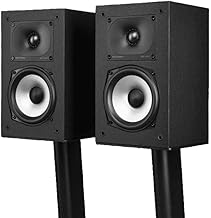
Key Specs & Package Contents: 1-in (2.5 cm) Terylene dome tweeter + 5.25-in (13.3 cm) Dynamic Balance woofer | Sensitivity: 86 dB (1 W / 1 m) | 4-ohm and 8-ohm compatible | Maker-listed range: 48 Hz–40 kHz (±3 dB tolerance not published) | Rear-firing port | 6.5 × 10.6 × 7.18 in (16.5 × 26.9 × 18.2 cm), 9.0 lb (4.1 kg) each | In the Box: Matched stereo pair (2 passive speakers; AVR & wire separate) | Price Tier: $150–$200 per pair
The Polk Audio Monitor XT15 pair plays two smart roles in an under-$1,000 AVR roadmap. In tight bedrooms or narrow media consoles where the 10.99-in-deep XT20 overhangs the shelf, the trimmer 7.18-in-deep XT15 fits easily as a 2.1 front pair; then, if you move to a larger living room later and buy XT20 fronts, the XT15 transitions directly to timbre-matched side surrounds (CR-SPK-SPK-02). Confirm the listing specifies Pair, Midnight Black at checkout (G-29) and set your AVR crossover to 80 Hz Small.
Pros
- Compact 7.18-in (18.2 cm) depth fits tight apartment shelves and side-surround stands cleanly
- Shares the exact 1-in Terylene tweeter voicing as Monitor XT20 fronts for smooth 5.1 surround pans
Cons
- 86 dB (1 W / 1 m) sensitivity limits maximum clean volume as front L/R beyond 10 ft seating distances
- No built-in keyhole bracket; requires clamp-style wall mounts or speaker stands
7. Polk Audio Monitor XT90 (Pair) — Modular 5.1.2 Dolby Atmos Height Add-On

Key Specs & Package Contents: Single 4-in (10.2 cm) bi-laminate paper woofer (no separate tweeter) | Sensitivity: 89 dB (1 W / 1 m) | 4-ohm and 8-ohm compatible | 164 Hz–17 kHz (-3 dB) / 94 Hz–22 kHz overall | Up-firing Atmos module or keyhole wall-mount | 7.56 × 5.69 × 8.5 in (19.2 × 14.5 × 21.6 cm), 6.0 lb (2.7 kg) each | In the Box: Matched passive height pair (2 speakers; requires 7.2-ch AVR & wire) | Price Tier: $150–$250 per pair
The Polk Audio Monitor XT90 pair completes the Monitor XT upgrade ladder once you own a 7.2-channel AV receiver (CR-SPK-AVR-04; a 5.2 AVR cannot power heights). Renters with flat, hard ceilings between 7.5 and 12 ft (2.3 and 3.7 m) high can rest them atop Monitor XT20 fronts as upward-firing modules, while homeowners or vaulted-ceiling rooms can hang them high on the front wall via integrated keyhole slots (CR-SPK-ROOM-01/02). Because their -3 dB low-frequency cutoff sits at 164 Hz, set height crossovers around 150 to 180 Hz in your AVR menu (CR-SUB-SPK-01).
Pros
- Supports both renter-friendly up-firing placement and keyhole front-wall mounting for sloped ceilings
- Affordable pair pricing lets a 7.2-ch Monitor XT build expand to true 5.1.2 Atmos without replacing front speakers
Cons
- Single 4-in driver rolls off at 164 Hz (-3 dB) and omits a dedicated tweeter, restricting it strictly to height duty
- Requires a 7.2-channel AVR—incompatible with 5.2 receivers (CR-SPK-AVR-04)
8. Klipsch R-120SW 12-Inch Subwoofer — Best Entry LFE Bass for AVR Builds

Key Specs & Package Contents: 12-in front-firing spun-copper IMG woofer, rear-firing port | 200 W RMS / 400 W peak all-digital amp | 29 Hz–120 Hz (±3 dB) | Line-level / LFE RCA inputs | 16.5 × 14.0 × 19.2 in (41.9 × 35.6 × 48.8 cm), 31.0 lb (14.1 kg) | In the Box: Single powered subwoofer (each; LFE cable sold separately) | Price Tier: $250–$450 each
The Klipsch R-120SW gives Path B’s $800 to $1,000 starter AVR blueprint true 12-in cone area and a transparent 29 Hz (±3 dB) low-frequency floor backed by 200 W RMS continuous amplification—well suited to closed rooms between 1,500 and 2,500 cu ft (42 and 71 m³) under CR-SUB-ROOM-01. Because its bass-reflex port fires out the back, leave several inches of clearance from the rear wall, and verify you are ordering the single-unit US model (B07FK2WNW4) from an authorized dealer so Klipsch’s US electronics and woofer warranty applies (G-26, G-29).
Pros
- True 12-in driver and 200 W RMS amp deliver far greater cinema punch than 5- to 8-in HTiB subwoofers
- Published 29 Hz (±3 dB) spec integrates cleanly with an 80 Hz AVR LFE crossover (CR-SUB-SPK-01)
Cons
- Rear-firing port requires clearance behind the cabinet; 29 Hz roll-off trails deeper 20 Hz sealed/ported step-up subs
- Ported cabinet in shared-wall apartments demands careful gain trim and AVR dynamic-range mode (CR-SUB-ROOM-03)
Authoritative Standards & Manufacturer References
- Dolby Laboratories — Official Speaker & Atmos Enabled Setup Guides (2.1, 5.1, and 5.1.2 speaker placement geometry and 7.5–12 ft ceiling reflection guidance).
- HDMI Licensing Administrator — HDMI 2.1a, eARC & Ultra High Speed Cable Standards (eARC lossless audio return requirements and 48 Gbps certification hologram rules).
- Polk Audio US — Monitor XT Series Official Specifications (Monitor XT20, XT15, and XT90 impedance, sensitivity, and frequency range specs).
- Klipsch US — Powered Subwoofer Reference Documentation (R-120SW 200 W RMS / 400 W peak rating and 29–120 Hz ±3 dB response).
- Sonos US — Beam (Gen 2) & Sub Mini Technical Specifications (driver layout, eARC/optical connectivity, closed wireless subwoofer compatibility, and US warranty terms).
How We Audited This Guide
- Room setups, upgrade roadmaps, and Amazon marketplace audits enforce system-wide CR-* budgets and acoustics, Canadian /ZC grey-market alerts, pair-vs-single speaker clarity, and manufacturer-first mounting safety.
- Every AV receiver, speaker, subwoofer, soundbar, OLED/Mini-LED TV, projector, source player, and accessory spec was cross-checked against official manufacturer manuals, CEA/CTA standards, and live Amazon US listings.
- Recommendations were evaluated against our weighted vertical scoring rubrics and documented CR-* compatibility rules; we never invent nits, contrast ratios, bench wattage, or room decibels.
Frequently Asked Questions
Can a home theater setup under $1,000 include both a 4K TV and surround audio?
Splitting $1,000 across a 55- to 65-inch TV and surround speakers forces severe compromises on both sides. Following our CR-SYS-01 budget framework, treat $1,000 as your dedicated audio budget—getting either a complete 5.1.2 wireless soundbar kit or a modular 2.1 AVR system.
Should I buy a soundbar kit or an AV receiver setup under $1,000?
Choose a complete soundbar kit like the JBL Bar 800 or Sony BRAVIA Theater System 6 if you want instant rear speakers without running wires. Choose an entry AVR with Polk Monitor XT20 speakers and a Klipsch R-120SW sub if you value modular upgrades.
Can I connect a Klipsch or SVS subwoofer to a Sonos or JBL soundbar?
No. Under compatibility rule CR-SUB-SBAR-01, consumer soundbar ecosystems are closed. A Sonos Beam Gen 2 pairs only with Sonos wireless subwoofers like the Sub Mini, and the JBL Bar 800 and Sony System 6 work only with their factory-bundled subwoofers.
Does optical audio support Dolby Atmos in an under-$1,000 setup?
No. Under rule CR-SBAR-DISP-01, optical TOSLINK connections top out at compressed 5.1 Dolby Digital, DTS, or 2-channel stereo PCM. To get Dolby Atmos from streaming apps or lossless Dolby TrueHD Atmos from 4K discs, connect over HDMI ARC or eARC.
What speaker wire gauge and rating should I buy for a starter AVR build?
Buy pure oxygen-free copper (OFC) rather than copper-clad aluminum (CCA). Use 16 AWG OFC for runs up to 50 ft (15 m) at 8 ohms, or 14 AWG for longer runs and 4-ohm loads, and choose UL CL2 or CL3 rated cable inside walls.


