
Disclosure: As an Amazon Associate, I earn from qualifying purchases. If you buy through links on this page, we may earn a small commission at no extra cost to you. Affiliate commission rates never influence our technical audits, scores, or rankings.
Finding the best 5.1 speaker system under 1000 starts with clearing up the biggest trap in budget surround shopping: half of the listings on Amazon under $1,000 are passive speaker packs that require an external AV receiver, while the rest are all-in-one Home Theater in a Box (HTiB) kits, wireless soundbar systems, or optical-only desktop rigs. Picking the wrong category leaves your living room either with silent speakers waiting on an amplifier or a closed soundbar box that cannot match real left-center-right separation.
To help you match your room and budget without guesswork—and complement our broader best home theater speakers pillar guide—we audited eight actively stocked US 120V 5.1 surround systems across Klipsch, Yamaha, Energy, JBL, Sony, and Logitech. Every pick below is verified against official manufacturer specifications for nominal impedance, sensitivity rating basis (2.83 V / 1 m), subwoofer RMS power versus peak marketing claims, box contents, and room-size fit so your surround stage integrates cleanly on day one.
In This Guide
- Quick Picks: Best 5.1 Speaker System Under 1000 Winners
- Best 5.1 Speaker System Under 1000 Comparison Matrix
- Match Your Room & Setup Path
- Detailed Best 5.1 Speaker System Under 1000 Audits (1–8): 1. Klipsch Black Reference Theater Pack 5.1 · 2. Yamaha YHT-4970U · 3. Klipsch Reference Cinema 5.1.4 · 4. Energy Take Classic 5.1 · 5. JBL Bar 800 · 6. Sony BRAVIA Theater System 6 · 7. Yamaha YHT-4950U · 8. Logitech Z906
- Best 5.1 Speaker System Under 1000 Buying Guide: Compatibility & Upgrade Roadmap
- 100% Weighted Scoring Rubric & Excluded Models
- Best 5.1 Speaker System Under 1000 Frequently Asked Questions
- Final Verdict: Choosing the Best 5.1 Speaker System Under 1000
Quick Picks: Best 5.1 Speaker System Under 1000 Winners
#1 Best Overall Passive 5.1 Pack
Klipsch Black Reference Theater Pack 5.1
High 91-94 dB sensitivity, Tractrix horn timbre matching, and an 8-in wireless powered sub for entry or mid-range AVRs. Jump to audit ↓
#2 Best All-in-One With AVR
Yamaha YHT-4970U 5.1 System
Bundles a 70 W/ch 8-ohm RX300A HDMI 2.1 receiver (4K/120Hz, eARC), five passive speakers, and an 8-in powered sub in one box. Jump to audit ↓
#3 Best Physical Atmos Pack
Klipsch Reference Cinema 5.1.4
Steps up to 5.25-in IMG mains, a 10-in 150 W RMS sub, and four physical up-firing height drivers for 7.2/9.2 AVR builds. Jump to audit ↓
Best 5.1 Speaker System Under 1000 Comparison Matrix
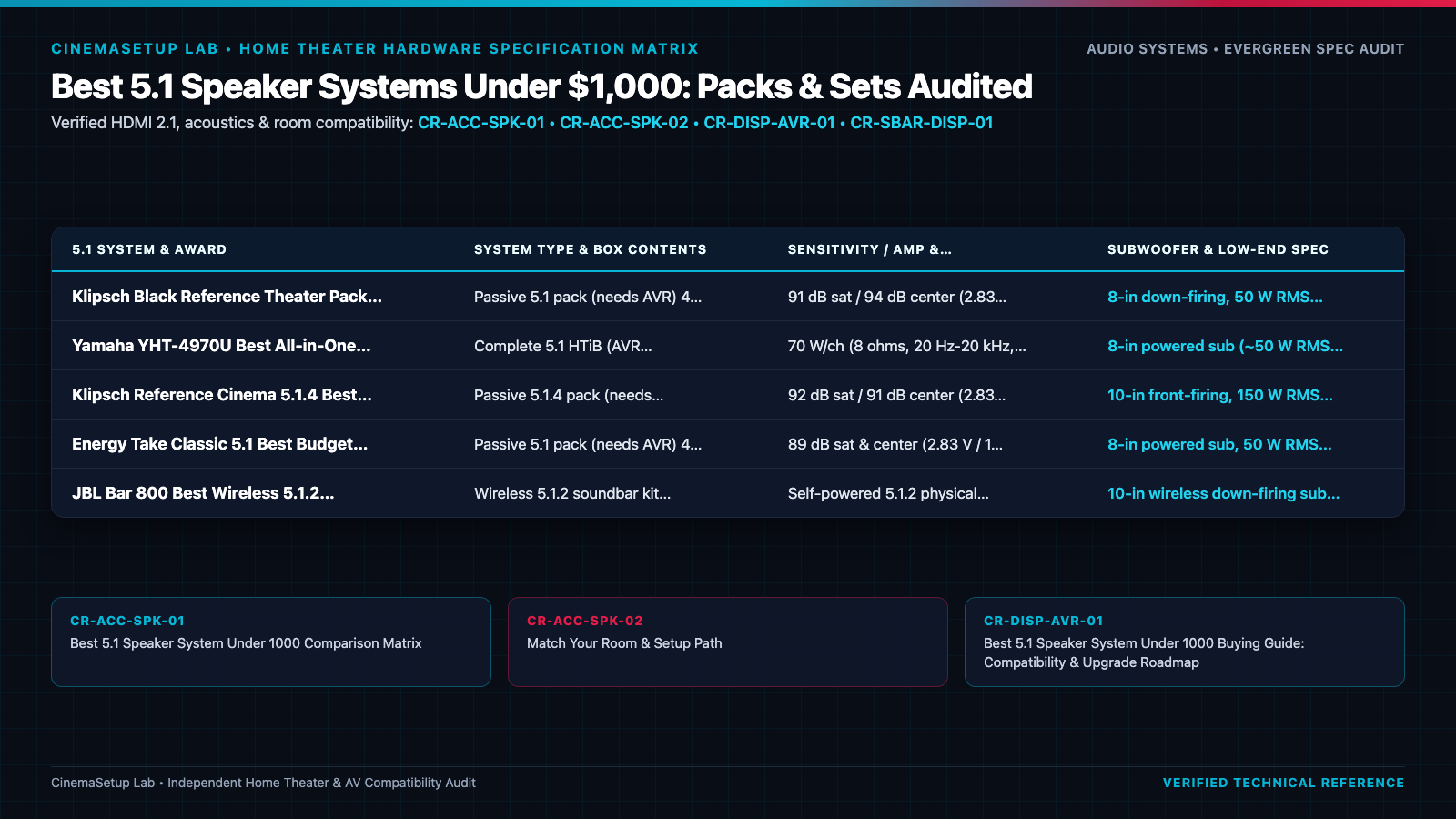
Always verify two facts before comparing 5.1 systems in this tier: whether an AV receiver is included in the carton (rule G-29) and what frequency the satellites hit at their -3 dB low-end limit (rule CR-SUB-SPK-01). Notice also that soundbar makers publish inflated total-watt figures—under guardrail G-16, we never rank soundbars by total watts and evaluate physical driver counts and connectivity instead.
| 5.1 System & Award | System Type & Box Contents | Sensitivity / Amp & Impedance | Subwoofer & Low-End Spec | Link |
|---|---|---|---|---|
| Klipsch Black Reference Theater Pack Best Overall Passive 5.1 | Passive 5.1 pack (needs AVR) 4 satellites + center + wireless sub | 91 dB sat / 94 dB center (2.83 V / 1 m) 8 ohms compatible | 8-in down-firing, 50 W RMS (150 W peak) 38-120 Hz (+/-3 dB); sat 110 Hz | View on Amazon |
| Yamaha YHT-4970U Best All-in-One With HDMI 2.1 | Complete 5.1 HTiB (AVR included) RX300A 5.2 AVR + 5 speakers + sub | 70 W/ch (8 ohms, 20 Hz-20 kHz, 0.09% THD, 2 ch) 4x 4K/120Hz HDMI + eARC | 8-in powered sub (~50 W RMS class) Dual AVR sub pre-outs | View on Amazon |
| Klipsch Reference Cinema 5.1.4 Best Up-Firing Atmos Pack | Passive 5.1.4 pack (needs 7.2/9.2 AVR) 4 Atmos satellites + center + sub | 92 dB sat / 91 dB center (2.83 V / 1 m) 8 ohms compatible | 10-in front-firing, 150 W RMS (300 W peak) 32-120 Hz (+/-3 dB); sat 90 Hz | View on Amazon |
| Energy Take Classic 5.1 Best Budget Compact Passive 5.1 | Passive 5.1 pack (needs AVR) 4 satellites + center + wired sub | 89 dB sat & center (2.83 V / 1 m) 8 ohms compatible | 8-in powered sub, 50 W RMS (200 W peak) 33-150 Hz (+/-3 dB); sat 115 Hz | View on Amazon |
| JBL Bar 800 Best Wireless 5.1.2 Detachable | Wireless 5.1.2 soundbar kit (no AVR) Bar (2 up-firing) + 2 battery rears + sub | Self-powered 5.1.2 physical drivers 1x 4K60 HDMI in + HDMI eARC | 10-in wireless down-firing sub Wi-Fi AirPlay / Chromecast | View on Amazon |
| Sony BRAVIA Theater System 6 Best Living-Room 5.1 Soundbar Kit | 5.1 soundbar + wired-hub sub + wireless rears No AVR needed; Atmos/DTS:X virtualized | Self-powered 5.1 physical ear-level HDMI eARC + Optical + 3.5 mm | 7.9-in (200 mm) wired-hub bass-reflex sub AC-powered wireless rear amp box | View on Amazon |
| Yamaha YHT-4950U Best Budget 4K/60Hz HTiB | Complete 5.1 HTiB (AVR included) 5.1 4K60 AVR + 5 speakers + sub | Discrete 5.1 AVR (4K/60Hz HDMI 2.0) ARC only (no 4K120 or eARC) | 8-in powered sub, 50 W RMS YPAO auto-calibration mic | View on Amazon |
| Logitech Z906 Best Self-Powered Optical / PC 5.1 | Self-powered 5.1 console system 5 wired satellites + powered sub | 500 W total RMS (5x 67 W RMS sats) 2x Optical, Coax, 6-ch direct (no HDMI) | 165 W RMS built-in amp sub Dolby Digital 5.1 & DTS decoding | View on Amazon |
Match Your Room & Setup Path
Choosing between passive speaker bundles, HTiB kits, and wireless soundbar packs depends on three room realities: whether you already own an AV receiver, how large your listening room volume is in cubic feet, and whether running speaker wire to rear seats is realistic. Use the scenario matrix below to match your exact living space.
| Buyer Scenario | Best Match | Why & Expected Outcome |
|---|---|---|
| Own an entry/mid AVR + want wireless sub flexibility | Klipsch Black Reference Theater Pack | 91-94 dB sensitivity reaches living-room peaks cleanly on 70-80 W/ch AVRs while the 2.4 GHz sub drops the LFE wire. |
| First home theater + PS5/Xbox Series X under $1,000 total | Yamaha YHT-4970U | Includes a 4K/120Hz HDMI 2.1 receiver, five discrete speakers, and an 8-in powered sub with zero separate AVR cost. |
| Flat 8-10 ft ceiling + 7.2/9.2 AVR wanting physical Atmos | Klipsch Reference Cinema 5.1.4 | 5.25-in mains, a 10-in 150 W RMS sub, and four physical up-firing drivers deliver stronger mid-bass and height cues. |
| Tight budget pairing passive speakers + starter AVR under $1,000 | Energy Take Classic 5.1 | Compact 89 dB dome-tweeter cabinets leave $350-$500 in the budget for an entry receiver and 16 AWG copper wire. |
| No rear outlets or speaker wire + physical 5.1.2 Atmos | JBL Bar 800 | Detachable battery surrounds and two bar-top up-firing drivers deliver genuine 5.1.2 surround with a 10-in wireless sub. |
| Sony BRAVIA TV living room wanting AC-powered wireless rears | Sony BRAVIA Theater System 6 | Pairs physical wireless-amp rear speakers with eARC Dolby Atmos/DTS:X decoding and Voice Zoom 3 under $800. |
| PC gaming desk or older TV with optical output only | Logitech Z906 | 500 W RMS self-powered console system connects via optical or 6-ch direct analog with no AV receiver required. |
Detailed Best 5.1 Speaker System Under 1000 Audits (1–8)
1. Klipsch Black Reference Theater Pack 5.1 Surround Sound System — Best Overall Passive 5.1 Pack

Key Specs: 5.1 passive speaker pack (4 satellites, 1 center channel, 1 powered 8-in wireless subwoofer; AVR required) | Nominal impedance: 8 ohms compatible | Sensitivity: 91 dB (satellites) and 94 dB (center) @ 2.83 V / 1 m | Frequency response: 110 Hz-23 kHz (+/-3 dB) satellites/center; 38 Hz-120 Hz (+/-3 dB) sub | Sub power: 50 W RMS / 150 W peak | Dimensions: Sat 4.38 x 7.75 x 5.37 in (11.1 x 19.7 x 13.7 cm), 3.0 lb (1.4 kg); Sub 11.75 x 13.25 x 11.75 in (29.9 x 33.7 x 29.9 cm), 15.0 lb (6.8 kg) | Price Tier: $350-$500
Audit Score: 9.1 / 10
- Cited Acoustic Performance (30%): 8.8 / 10
- System Fit & Timbre Matching (25%): 9.4 / 10
- Placement Flexibility (15%): 9.2 / 10
- Value Within Tier (15%): 9.4 / 10
- Build & Finish (10%): 8.9 / 10
- US Warranty & Support (5%): 9.0 / 10
When paired with an entry-level receiver from our best AV receivers under $1,000 guide, the Klipsch Black Reference Theater Pack 5.1 delivers the strongest combination of efficiency, front-stage coherence, and total budget flexibility on Amazon US. Per Klipsch US specifications, every ear-level speaker shares the same 3/4-in aluminum diaphragm compression tweeter mated to a 90×90 Tractrix horn and 3.5-in spun-copper IMG woofer (dual 3.5-in drivers in the center). That guarantees strict timbre matching across front L/C/R and surrounds (rules CR-SPK-SPK-01 and CR-SPK-SPK-02) so dialogue pans never shift tone across the screen.
Independent third-party anechoic measurements have no verified data available yet for this pack, so we evaluate its published specs strictly under compatibility rules CR-SPK-AVR-02 and CR-SUB-SPK-01. At 91 dB sensitivity (2.83 V / 1 m, 8 ohms compatible), our spec-based estimate shows that at a 10 ft (3.05 m) seat distance, reaching 95 dB living-room peaks requires roughly 23 W per channel—well inside the derated multichannel output of a 70-80 W/ch starter AVR. The included 8-in down-firing subwoofer runs at 50 W RMS (150 W peak) and comes with a pre-paired 2.4 GHz wireless transmitter alongside standard LFE RCA inputs, letting you place the sub near a corner without dragging a long coax cable across walkways.
Buyer Verification Alert: Check pair vs single and complete kit contents carefully (G-29): this box includes five passive speakers and one powered wireless subwoofer, but NO AV receiver and NO speaker wire. Because the satellites roll off at 110 Hz (+/-3 dB), set your AVR speaker size to Small with a 120 Hz to 150 Hz crossover frequency—never 80 Hz—so bass transitions smoothly to the sub (CR-SUB-SPK-01).
Pros
- High 91 dB satellite and 94 dB center sensitivity (2.83 V / 1 m) play cleanly on entry 70-80 W/ch AVRs
- Matched Tractrix horn tweeters across all five channels preserve seamless dialogue and surround pans
- 2.4 GHz wireless subwoofer link simplifies placement while keeping wired LFE RCA as backup
- Keyhole slots and 1/4-20 threaded inserts support wall mounting or compact speaker stands
Cons
- 110 Hz (-3 dB) low-frequency cutoff forces a 120-150 Hz crossover, which can make deep male voices pull slightly toward the sub if sub placement is off-axis
- 8-in 50 W RMS subwoofer lacks deep output below 38 Hz (+/-3 dB) in rooms larger than ~2,000 cu ft (57 cu m)
- Requires buying an AV receiver and 16 AWG speaker wire separately
Verdict: Buy the Klipsch Black Reference Theater Pack 5.1 if you already own a receiver or want to pair an entry 5.2/7.2 AVR while keeping your complete 5.1 setup under $1,000. Skip it if you want a single-box kit with built-in HDMI amplification or need room-shaking bass in an open-plan great room.
2. YAMAHA YHT-4970U 5.1-Channel Home Theater System — Best All-in-One 5.1 System With HDMI 2.1 AVR

Key Specs: Complete 5.1 HTiB (Yamaha RX300A 5.2-ch AVR + 5 passive speakers + 8-in powered sub + starter wire) | AVR power: 70 W/ch (8 ohms, 20 Hz-20 kHz, 0.09% THD, 2 ch driven) | HDMI: 4 in / 1 eARC out (8K/60Hz, 4K/120Hz, VRR, ALLM, QMS, Dolby Vision, HDR10+) | Calibration: YPAO room correction | Wireless: Bluetooth 5.3 Multipoint | Price Tier: $550-$800
Audit Score: 8.9 / 10
- Cited Acoustic Performance (30%): 8.2 / 10
- System Fit & Timbre Matching (25%): 9.3 / 10
- Placement Flexibility (15%): 8.8 / 10
- Value Within Tier (15%): 9.5 / 10
- Build & Finish (10%): 8.6 / 10
- US Warranty & Support (5%): 9.0 / 10
If your budget ceiling for everything—speakers, subwoofer, and amplification—is strictly under $1,000, the Yamaha YHT-4970U is the cleanest single-box starting point available on Amazon US. Unlike legacy HTiB packages stuck on 4K/60Hz HDMI 2.0 boards, Yamaha US specifications confirm the YHT-4970U includes the current RX300A 5.2-channel AV receiver with four HDMI 2.1 inputs supporting 4K/120Hz, VRR, ALLM, QMS, Dolby Vision, HDR10+, and HDMI eARC on the main output.
On the amplifier side, Yamaha rates the RX300A at 70 W per channel into 8 ohms (20 Hz-20 kHz, 0.09% THD, 2 channels driven)—ignore inflated 145 W single-channel 6-ohm 10% THD figures when comparing receivers (rule CR-SPK-AVR-03). The bundled YPAO room correction microphone automatically sets speaker distances, trim levels, and crossover integration for the five compact passive satellites and 8-in powered subwoofer. Compared with the Klipsch Black Reference Theater Pack (#1), the YHT-4970U’s small HTiB satellites offer less dynamic ceiling, yet the included receiver lets you swap in larger bookshelf front speakers years down the road without replacing your electronics.
Buyer Verification Alert: The Amazon product title mentions Dolby Atmos, but under compatibility rules CR-SPK-AVR-04 and CR-SYS-05, the 5.2-channel RX300A has ZERO physical height speaker terminals. It delivers Atmos and DTS:X through software height virtualization over five ear-level speakers, not real overhead speakers.
Pros
- Complete all-in-one bundle includes a modern 4K/120Hz HDMI 2.1 AV receiver, five speakers, 8-in powered sub, and wire
- True discrete front left, center, and right speaker separation beats soundbars for dialogue width
- Dual subwoofer pre-outs on the RX300A allow adding a second powered subwoofer later
- YPAO microphone calibration simplifies initial setup for beginners
Cons
- 5.2-channel receiver relies on height virtualization rather than physical Dolby Atmos speakers (CR-SYS-05)
- Lacks built-in Wi-Fi, AirPlay 2, and Google Cast (wireless audio is Bluetooth 5.3 only)
- Compact satellite cabinets and 8-in sub suit small-to-medium rooms (~1,200-2,000 cu ft) rather than large open spaces
Verdict: Buy the Yamaha YHT-4970U if you want a complete, upgradeable 5.1 surround system with a 4K/120Hz HDMI 2.1 receiver ready out of one carton well under $1,000. Skip it if you want Wi-Fi streaming apps built into the receiver or physical overhead Atmos drivers.
3. Klipsch Reference Cinema Dolby Atmos 5.1.4 System — Best Up-Firing Atmos Expansion Pack

Key Specs: 5.1.4 passive pack (4 dual-driver Atmos satellites, 1 center channel, 1 powered 10-in subwoofer; 7.2 or 9.2 AVR required) | Nominal impedance: 8 ohms compatible | Sensitivity: 92 dB (satellites) and 91 dB (center) @ 2.83 V / 1 m | Frequency response: 90 Hz-20 kHz (+/-3 dB) satellites; 80 Hz-20 kHz (+/-3 dB) center; 32 Hz-120 Hz (+/-3 dB) sub | Sub power: 150 W RMS / 300 W peak | Dimensions: Sat 6.47 x 13.47 x 7.45 in (16.4 x 34.2 x 18.9 cm), 8.2 lb (3.7 kg); Sub 12.5 x 14.5 x 16.4 in (31.8 x 36.8 x 41.7 cm), 24.0 lb (10.9 kg) | Price Tier: $600-$950
Audit Score: 8.8 / 10
- Cited Acoustic Performance (30%): 9.1 / 10
- System Fit & Timbre Matching (25%): 8.6 / 10
- Placement Flexibility (15%): 8.3 / 10
- Value Within Tier (15%): 8.9 / 10
- Build & Finish (10%): 9.0 / 10
- US Warranty & Support (5%): 9.0 / 10
If you already own a 7.2-channel or 9.2-channel AV receiver and want substantially bigger cabinets and deeper subwoofer bass than micro-satellite packs provide, the Klipsch Reference Cinema Dolby Atmos 5.1.4 System sits near the top of the sub-$1,000 speaker-pack bracket. According to Klipsch US technical data, each of the four main/surround cabinets combines a 5.25-in IMG woofer and 1-in LTS Tractrix horn tweeter (90 Hz-20 kHz, +/-3 dB) with an integrated 4-in upward-firing height driver, paired with a dual-4-in center channel (80 Hz-20 kHz, +/-3 dB) and a 10-in front-firing 150 W RMS subwoofer rated down to 32 Hz (+/-3 dB).
That 10-in 150 W RMS sub gives the Reference Cinema 5.1.4 much stronger mid-size living-room stamina (~2,400 cu ft / 68 cu m) than the 8-in 50 W RMS subs bundled with the Black Reference Theater Pack (#1) or Energy Take Classic (#4). Furthermore, because the front satellites reach down to 90 Hz and the center down to 80 Hz (+/-3 dB), a standard 100-120 Hz AVR crossover bridges cleanly to the subwoofer without pulling vocal chestiness into the corner sub (CR-SUB-SPK-01). No verified third-party lab anechoic curve is available yet, so evaluate overhead performance strictly through room geometry.
Buyer Verification Alert: Two critical rules apply before buying (CR-SPK-AVR-04 and CR-SPK-ROOM-01). First, running all four up-firing height drivers (5.1.4) requires a 9-channel AVR (such as the Denon AVR-X3900H above $1,000); a 7.2 AVR powers 5.1.2 only, leaving two height terminals unconnected. Second, up-firing modules require a flat, hard reflective ceiling between 7.5 and 12 ft (2.3-3.7 m)—vaulted or acoustic-tile ceilings severely smear overhead effects.
Pros
- 5.25-in main woofers (90 Hz -3 dB) and dual-4-in center (80 Hz -3 dB) bridge cleanly near 100-120 Hz
- 10-in 150 W RMS / 300 W peak subwoofer reaches 32 Hz (+/-3 dB) for medium living rooms
- Includes four physical up-firing Atmos height modules integrated cleanly inside matching cabinets
- 91-92 dB sensitivity @ 2.83 V / 1 m pairs comfortably with mainstream 80-100 W/ch receivers
Cons
- Full 5.1.4 operation requires an expensive 9-channel AVR; a 7.2 AVR only drives 5.1.2
- Up-firing height reflections underperform in rooms with vaulted, sloped, or 12+ ft ceilings
- Dual-terminal cabinets require running two pairs of speaker wires to every up-firing speaker
Verdict: Buy the Klipsch Reference Cinema 5.1.4 if you have a flat 8-10 ft ceiling, own a 7.2 or 9.2 AVR, and want larger 5.25-in cabinets with a 10-in 150 W RMS subwoofer under $1,000. Skip it if your ceiling is vaulted or you need an AV receiver included in the budget.
4. Energy Take Classic 5.1 Speaker System — Best Budget Compact Passive 5.1 Set

Key Specs: 5.1 passive speaker pack (4 satellites, 1 center channel, 1 powered 8-in wired subwoofer; AVR required) | Nominal impedance: 8 ohms compatible | Sensitivity: 89 dB @ 2.83 V / 1 m across satellites & center | Frequency response: 115 Hz-20 kHz (+/-3 dB) satellites; 110 Hz-20 kHz (+/-3 dB) center; 33 Hz-150 Hz (+/-3 dB) sub | Sub power: 50 W RMS / 200 W dynamic peak | Dimensions: Sat 4.19 x 6.69 x 4.94 in (10.6 x 17.0 x 12.5 cm); Sub 12.25 x 14.31 x 13.44 in (31.1 x 36.3 x 34.1 cm) | Price Tier: $300-$500
Audit Score: 8.6 / 10
- Cited Acoustic Performance (30%): 8.5 / 10
- System Fit & Timbre Matching (25%): 9.0 / 10
- Placement Flexibility (15%): 8.8 / 10
- Value Within Tier (15%): 9.1 / 10
- Build & Finish (10%): 8.3 / 10
- US Warranty & Support (5%): 8.0 / 10
For buyers assembling a complete home theater setup under $1,000 around a dedicated AV receiver rather than a soundbar, the Energy Take Classic 5.1 remains one of the smartest compact passive packages on Amazon US. Instead of horn-loaded tweeters, every satellite and the horizontal center use identical 3/4-in Hyperbolic aluminum-dome tweeters paired with 3-in poly-titanium woofers. That uniformity satisfies front-stage and surround timbre matching (rules CR-SPK-SPK-01 and CR-SPK-SPK-02) while delivering smooth horizontal dispersion across wider living-room couches.
Rated at 8 ohms compatible and 89 dB sensitivity (2.83 V / 1 m), our spec-based calculation under CR-SPK-AVR-02 estimates roughly 37 W per channel at 10 ft (3.05 m) for 95 dB living-room peaks—meaning even an entry 70-80 W/ch 5.2 receiver has ample breathing room. Compared with the Klipsch Black Reference Theater Pack (#1), the Energy Take Classic trades away the 2.4 GHz wireless sub link and 2-5 dB of raw sensitivity, but fits tighter apartment shelves at just 6.7 in (17.0 cm) tall and keeps its pack cost low enough to leave $350-$500 in the budget for an entry receiver and pure copper wire.
Buyer Verification Alert: Like the Klipsch Theater Pack, the Energy Take Classic 5.1 requires an external AV receiver, 16 AWG speaker wire, and a wired RCA subwoofer cable (none are included). Set all five speakers to Small with a 120 Hz to 150 Hz crossover because the satellites roll off at 115 Hz (+/-3 dB).
Pros
- Uniform 3/4-in dome tweeters and 3-in woofers maintain cohesive timbre across all five speakers
- Compact 6.7-in-tall cabinets with rear keyhole slots suit apartments, dens, and bookshelf stands
- 8-in 50 W RMS / 200 W dynamic peak sub offers front-accessible volume and crossover dials
- Low pack tier preserves budget room for a separate 5.2 or 7.2 AV receiver under $1,000 total (CR-SYS-01)
Cons
- 115 Hz (-3 dB) satellite low-end forces a high 120-150 Hz AVR crossover (CR-SUB-SPK-01)
- Wired subwoofer lacks wireless transmission, and receiver plus cables are sold separately
- 89 dB sensitivity and 50 W RMS sub suit small-to-medium rooms (~1,060-1,800 cu ft) best
Verdict: Buy the Energy Take Classic 5.1 if you want smooth dome-tweeter surround sound in a small-to-medium room while keeping your combined speaker-plus-AVR spend under $1,000. Skip it if you prefer wireless subwoofer placement or want higher 92+ dB sensitivity for a large living room.
5. JBL Bar 800 5.1.2-Channel Soundbar System — Best Wireless 5.1.2 Kit With Detachable Rears

Key Specs: Self-powered 5.1.2 wireless soundbar kit (main bar w/ 2 up-firing drivers + 2 detachable battery-powered surrounds + 10-in wireless down-firing sub) | Connectivity: 1x HDMI in (4K Dolby Vision/HDR10), 1x HDMI eARC, Optical, Wi-Fi (AirPlay, Alexa MRM, Chromecast), Bluetooth | Dimensions: Bar w/ rears docked 46.2 x 2.2 x 4.7 in (117.4 x 5.6 x 12.0 cm); Sub 12.0 x 17.3 x 12.0 in (30.5 x 44.0 x 30.5 cm) | Price Tier: $700-$1,000 (Launch MSRP around $1,000)
Audit Score: 8.6 / 10
- Cited Acoustic Performance (30%): 8.4 / 10
- System Fit & Timbre Matching (25%): 8.7 / 10
- Placement Flexibility (15%): 9.3 / 10
- Value Within Tier (15%): 8.3 / 10
- Build & Finish (10%): 8.7 / 10
- US Warranty & Support (5%): 8.6 / 10
Not every living room can run speaker wire under baseboards or around doorways, yet most budget “5.1 soundbars” cheat by firing side drivers at walls instead of giving you rear speakers. Per JBL US specifications, the JBL Bar 800 solves that cleanly: its 5.1.2 physical driver array combines three front racetrack drivers, three 0.75-in tweeters, two physical 2.75-in up-firing Dolby Atmos height drivers, two truly wireless detachable rear surround speakers, and a substantial 10-in down-firing wireless subwoofer.
Notice we ignore JBL’s “720 W max” headline figure in scoring (rule G-16), because soundbar total-wattage marketing is non-comparable across brands. What genuinely sets the Bar 800 apart in this bracket is physical layout accuracy: you get real rear speakers behind your seating position plus physical ceiling-bounce Atmos height drivers (unlike virtual-only 5.1 bars under CR-SYS-05), and its 10-in wireless subwoofer handles medium-sized rooms (~2,400 cu ft / 68 cu m) far better than 5-in or 6-in soundbar subs. Its HDMI eARC port also accepts lossless Dolby TrueHD Atmos from TV-connected Blu-ray players (CR-SBAR-DISP-02).
Buyer Verification Alert: The Bar 800’s single HDMI input caps at 4K/60Hz Dolby Vision/HDR10, so plug PS5 or Xbox Series X consoles straight into your TV’s HDMI 2.1 port and return audio over eARC (CR-SBAR-SRC-01). Also note the 46.2-in (117.4-cm) docked width requires at least a 50-in-wide console or TV wall mounting (CR-SBAR-DISP-05).
Pros
- True physical 5.1.2 driver layout with detachable wireless surrounds and two 2.75-in up-firing drivers
- 10-in wireless subwoofer provides stronger low-frequency room authority than compact soundbar subs
- Battery-powered rear pods run ~10 hours wire-free or stay charged via USB-C without docking
- HDMI eARC, AirPlay, Chromecast built-in, and Alexa Multi-Room Music cover modern streaming
Cons
- Closed ecosystem cannot connect third-party subwoofers or passive speakers (CR-SUB-SBAR-01, CR-SBAR-SPK-01)
- Single HDMI input lacks 4K/120Hz VRR passthrough, and front L/C/R width stays narrower than discrete bookshelf speakers
- Battery-powered surrounds require periodic re-docking or USB-C power cables behind the couch
Verdict: Buy the JBL Bar 800 if you want zero speaker wire across the floor, physical up-firing Atmos height, and a 10-in wireless sub in the $700-$1,000 tier. Skip it if you want wider front left-right separation or an open component system you can upgrade piece by piece.
6. Sony BRAVIA Theater System 6 5.1ch System — Best Living-Room 5.1 Soundbar With Wireless Rears

Key Specs: 5.1 soundbar + wired-hub subwoofer + 2 rear speakers via wireless rear amp box (no AVR needed) | Audio decoding: Dolby Atmos & DTS:X (virtualized height per CR-SYS-05) | Connectivity: 1x HDMI eARC/ARC, Optical, 3.5 mm analog, Bluetooth 5.3 | Dimensions: Bar 35.75 x 2.56 x 3.88 in (90.7 x 6.4 x 9.0 cm); Sub 10.88 x 15.25 x 16.63 in (27.5 x 38.8 x 38.8 cm); Rears 4.2 x 8.5 x 3.9 in (10.6 x 21.6 x 9.8 cm) | Price Tier: $550-$800 (Launch MSRP around $800)
Audit Score: 8.4 / 10
- Cited Acoustic Performance (30%): 8.2 / 10
- System Fit & Timbre Matching (25%): 8.5 / 10
- Placement Flexibility (15%): 8.4 / 10
- Value Within Tier (15%): 8.6 / 10
- Build & Finish (10%): 8.4 / 10
- US Warranty & Support (5%): 8.5 / 10
If battery-powered rear speakers feel like one more chore to recharge, the Sony BRAVIA Theater System 6 (HT-S60) solves rear placement with an AC-powered wireless rear amplifier box. According to Sony US official specifications, the kit delivers 10 total transducers across a compact 35.75-in (90.7-cm) front bar, two dedicated rear surround satellites, and a 7.9-in (200-mm) bass-reflex subwoofer—plus both Dolby Atmos and DTS:X decoding over HDMI eARC, which many mid-tier bars omit.
Compared with the JBL Bar 800 (#5), Sony’s system saves roughly $200 at Launch MSRP (around $800 vs. around $1,000) and supports Sony BRAVIA TV Voice Zoom 3 dialogue enhancement, yet trades away two key hardware pieces: there are zero physical up-firing drivers (height cues come strictly from Vertical Surround Engine DSP virtualization under CR-SYS-05), and the subwoofer acts as the wired A/V hub that connects physically to the front bar. As with all soundbars, ignore the “1,000 W total” marketing spec when comparing against discrete AV receivers (rule G-16).
Buyer Verification Alert: Uniquely on the System 6, the main HDMI eARC and power electronics live inside the subwoofer cabinet and wire directly to the soundbar—so plan to place the subwoofer near your TV stand rather than in the rear corner. With zero HDMI inputs on the bar, all consoles and players connect to your TV first (CR-SBAR-SRC-01).
Pros
- Dedicated rear surround speakers connect via a compact wireless rear amp box—no front-to-back cables and no batteries to recharge
- Decodes both Dolby Atmos and DTS:X over HDMI eARC (CR-SBAR-DISP-02/04)
- 35.75-in (90.7-cm) width fits neatly beneath 50-in to 65-in TV stands with Voice Zoom 3 on compatible BRAVIA TVs
- Includes optical and 3.5 mm analog inputs alongside HDMI eARC and Bluetooth 5.3
Cons
- Relies on height virtualization with zero physical up-firing overhead drivers (CR-SYS-05)
- Subwoofer wires directly to the front soundbar and offers zero HDMI passthrough inputs
- Closed Sony architecture cannot mix in third-party subwoofers or passive speakers (CR-SUB-SBAR-01)
Verdict: Buy the Sony BRAVIA Theater System 6 if you want real AC-powered rear surround speakers, eARC Dolby Atmos/DTS:X support, and tidy living-room setup under $800. Skip it if you want wireless subwoofer placement anywhere in the room or physical overhead height drivers.
7. Yamaha Audio YHT-4950U 4K Ultra HD 5.1-Channel Home Theater System — Best Value 4K/60Hz 5.1 HTiB Bundle

Key Specs: Complete 5.1 HTiB (5.1-ch 4K/60Hz AV receiver + 5 passive speakers + 8-in 50 W RMS powered subwoofer + wire) | HDMI: 4K/60Hz HDMI 2.0 passthrough, Dolby Vision, HDR10, HLG, HDMI ARC (no 4K/120Hz or eARC) | Calibration: YPAO auto-calibration | Modes: Virtual Cinema Front, Bluetooth | Price Tier: $450-$700
Audit Score: 8.0 / 10
- Cited Acoustic Performance (30%): 7.7 / 10
- System Fit & Timbre Matching (25%): 8.5 / 10
- Placement Flexibility (15%): 8.2 / 10
- Value Within Tier (15%): 8.3 / 10
- Build & Finish (10%): 8.0 / 10
- US Warranty & Support (5%): 8.4 / 10
The Yamaha YHT-4950U is the older sibling to our #2 pick, the YHT-4970U, and remains widely stocked on Amazon US at a lower street tier. Inside the carton you still receive a genuine discrete 5.1-channel AV receiver, five compact passive speakers, an 8-in 50 W RMS powered subwoofer, YPAO room calibration microphone, and starter speaker wire—giving tight budgets an entry into component-based surround sound rather than a disposable soundbar.
Its Virtual Cinema Front DSP mode is particularly useful in tight dens or bedrooms (~1,000-1,600 cu ft / 28-45 cu m) where running rear wire is temporarily impossible, letting all five speakers sit along the front wall until you rearrange later. However, the YHT-4950U’s receiver relies on an older HDMI 2.0 video board capped at 4K/60Hz with standard ARC rather than HDMI eARC, and omits Dolby Atmos and DTS:X decoding altogether. Whenever the newer YHT-4970U sits within ~$100-$150, stepping up to the YHT-4970U buys 4K/120Hz gaming ports and eARC longevity.
Buyer Verification Alert: Because the YHT-4950U stops at 4K/60Hz HDMI 2.0 and lacks eARC, 4K/120Hz gaming consoles cannot pass 120 Hz video through this receiver (CR-SRC-AVR-01) and lossless Dolby TrueHD from TV-connected Blu-ray players falls back to core Dolby Digital/DTS over standard ARC (CR-DISP-AVR-01).
Pros
- Complete AVR + 5 passive speakers + 50 W RMS 8-in sub bundle at a lower entry tier than the YHT-4970U
- YPAO microphone calibration balances speaker distances and channel levels automatically
- Standard speaker terminals allow upgrading front L/C/R speakers individually later
Cons
- Capped at 4K/60Hz HDMI 2.0 with ARC only (no 4K/120Hz, VRR, eARC, Dolby Atmos, or DTS:X)
- Small single-driver satellites and 50 W RMS sub top out in small-to-medium rooms
- Single subwoofer pre-out and no Wi-Fi streaming
Verdict: Buy the Yamaha YHT-4950U only if it is discounted significantly below the YHT-4970U for a 4K/60Hz streaming room or bedroom TV. Skip it for the YHT-4970U if you own a PS5, Xbox Series X, or want HDMI eARC.
8. Logitech Z906 5.1 Surround Sound Speaker System, THX Certified — Best Self-Powered 5.1 System for Optical & PC Desks

Key Specs: Self-powered 5.1 speaker system (4 satellites, 1 center, powered subwoofer w/ integrated amp, desktop control console, remote) | Power rating: 500 W total RMS (165 W RMS sub + 5x 67 W RMS satellites; 1,000 W peak) | Inputs: 2x Optical (TOSLINK), 1x Digital Coaxial, 6-channel direct (3x 3.5 mm), RCA, 3.5 mm Aux | Decoding: Dolby Digital 5.1 & DTS | HDMI: None | Dimensions: Sat 3.91 x 6.51 x 3.64 in (9.9 x 16.5 x 9.3 cm), 1.85 lb (0.84 kg); Sub 11.02 x 11.50 x 13.78 in (28.0 x 29.2 x 35.0 cm), 18.8 lb (8.5 kg) | Price Tier: $300-$450
Audit Score: 7.9 / 10
- Cited Acoustic Performance (30%): 7.8 / 10
- System Fit & Timbre Matching (25%): 7.6 / 10
- Placement Flexibility (15%): 8.0 / 10
- Value Within Tier (15%): 8.5 / 10
- Build & Finish (10%): 7.9 / 10
- US Warranty & Support (5%): 8.0 / 10
For PC gaming desks, dorms, and near-field bedrooms, the Logitech Z906 fills a niche none of the living-room AVR or soundbar systems above serve well: compact self-powered 5.1 surround with direct 6-channel analog PC jacks and dual optical inputs. Unlike generic peak-wattage desktop kits, Logitech publishes a concrete 500 W total RMS specification (165 W RMS inside the subwoofer plus 67 W RMS per satellite) alongside THX certification and onboard Dolby Digital 5.1 and DTS hardware decoding.
Why does it rank #8 in a home theater roundup? Simply because the Z906 omits HDMI, HDMI ARC, and HDMI eARC entirely. In a living room, you cannot decode Dolby Atmos, DTS:X, or uncompressed multichannel LPCM over HDMI from a modern TV or 4K Blu-ray player, and all five satellites must run speaker wire back to the subwoofer’s rear amplifier plate. Keep it strictly on desktop gaming stations or secondary TVs using Digital Optical output.
Buyer Verification Alert: Verify your TV or computer outputs before checkout: the Z906 has ZERO HDMI ports. Living-room TVs must use an Optical (TOSLINK) cable set to Dolby Digital or DTS Bitstream output, which drops Dolby Atmos and lossless TrueHD formats (CR-SBAR-DISP-01/02).
Pros
- Self-powered 500 W RMS (165 W RMS sub + 5x 67 W RMS) needs no external AV receiver
- Dual optical, coaxial, and 6-channel direct 3.5 mm PC inputs cover desks and older consoles
- Hardware Dolby Digital 5.1 and DTS decoding with THX certification
Cons
- Zero HDMI, ARC, eARC, Dolby Atmos, or Bluetooth support
- Proprietary control console and wired subwoofer hub cannot be upgraded piece by piece
- Small 3-in satellite cabinets lack the midrange body of 3.5-in to 5.25-in home theater speakers
Verdict: Buy the Logitech Z906 if you are building a PC gaming desk or wiring an optical-output bedroom TV under $450. Skip it for any primary living-room home theater where HDMI eARC and upgradeability matter.
Best 5.1 Speaker System Under 1000 Buying Guide: Compatibility & Upgrade Roadmap
Choosing the best 5.1 speaker system under 1000 comes down to verifying four physical compatibility rules before checkout rather than chasing inflated peak-wattage stickers. The decision matrix below summarizes how system type, satellite crossover points, physical versus virtual Atmos height drivers, and wire gauge govern real-world performance.
1. Set Your Crossover Frequency to 120–150 Hz on Compact Satellites (CR-SUB-SPK-01)
The most common setup mistake buyers make with compact 5.1 packs is leaving their AV receiver at the default 80 Hz crossover. Under compatibility rule CR-SUB-SPK-01, your crossover frequency should sit roughly 1.5 times above your satellite speakers’ published -3 dB low-frequency limit (`f3`). Because compact 3-in and 3.5-in satellite speakers like the Energy Take Classic 5.1 (115 Hz, +/-3 dB) and Klipsch Black Reference Theater Pack (110 Hz, +/-3 dB) roll off above 100 Hz, an 80 Hz setting leaves a hollow bass gap between 80 Hz and 115 Hz. Always set every speaker in your AVR menu to Small with a 120 Hz to 150 Hz crossover for compact satellites—or 100 Hz to 120 Hz for 5.25-in packs like the Klipsch Reference Cinema 5.1.4—and set the subwoofer’s rear low-pass dial to maximum or LFE bypass so your receiver’s room correction manages the blend cleanly.
2. Nominal Impedance, Sensitivity & AVR Power Headroom (CR-SPK-AVR-01 & CR-SPK-AVR-02)
Compare passive speaker packs by checking both nominal impedance (ohms) and sensitivity with its exact rating basis (2.83 V / 1 m vs. 1 W / 1 m). Every passive pack on our shortlist is rated 8 ohms compatible, eliminating 4-ohm receiver shutdown headaches (CR-SPK-AVR-01). Under our spec-based power formula (CR-SPK-AVR-02), using a conservative ~30% multichannel amplifier derating at a 10 ft (3.05 m) seat distance, 91 dB Klipsch satellites need an estimated 23 W per channel for 95 dB living-room peaks, while 89 dB Energy satellites need roughly 37 W—both well within an entry 70-80 W/ch receiver’s continuous 8-ohm capability. Always verify speaker placement per Dolby’s official 5.1 speaker setup guides, placing front left and right speakers symmetrically around the display, aiming the center channel at ear height, and positioning surrounds slightly behind or beside your main seat.
3. Subwoofer Room-Volume Fit & Apartment Considerations (CR-SUB-ROOM-01 & CR-SUB-ROOM-03)
Multiply your room’s length, width, and ceiling height in feet (including open-plan kitchens or hallways without doors) to check subwoofer fit. Compact 8-in 50 W RMS subwoofers—like those inside the Klipsch Black Reference Pack, Energy Take Classic, and Yamaha HTiB bundles—deliver solid tactile bass in small bedrooms and enclosed living rooms between roughly 1,060 and 2,000 cu ft (30-57 cu m). Medium living rooms around 2,400 cu ft (68 cu m) benefit noticeably from the 10-in 150 W RMS sub in the Klipsch Reference Cinema 5.1.4 or the 10-in wireless sub on the JBL Bar 800. If you eventually want deeper 20 Hz cinema extension in a larger space, browse our best subwoofers under $1,000 guide for dedicated 12-in sealed or ported upgrades. In shared-wall apartments, place your powered subwoofer away from shared walls on a decoupling pad and engage your receiver’s Night Mode / Dynamic Range Compression—while keeping in mind no subwoofer eliminates low-frequency wall transfer completely.
4. Physical vs. Virtual Atmos & Port Clearance (CR-SYS-05 & CR-SPK-ROOM-04)
Do not pay extra for a “Dolby Atmos” badge without checking for physical height drivers. Systems like the Yamaha YHT-4970U and Sony BRAVIA Theater System 6 decode Atmos streams using software height virtualization over ear-level drivers (CR-SYS-05). By contrast, the Klipsch Reference Cinema 5.1.4 and JBL Bar 800 use physical up-firing drivers that depend on a flat, hard reflective ceiling roughly 7.5 to 12 ft (2.3-3.7 m) high (CR-SPK-ROOM-01). Also check port clearance: rear-ported bookshelf cabinets need several inches of breathing room from the back wall to avoid boomy mid-bass (CR-SPK-ROOM-04), whereas sealed or front-ported satellites mount flush on walls much more predictably.
5. Mounting Safety, CL2/CL3 In-Wall Wire & US Warranty Rules (G-26 & G-27)
For wired passive systems, use pure oxygen-free copper (OFC) 16 AWG speaker wire for runs up to ~50 ft (15 m) to 8-ohm speakers, or 14 AWG for longer rear paths (CR-ACC-SPK-01); avoid cheap copper-clad aluminum (CCA) wire. Whenever routing speaker wire inside drywall or ceilings, strictly follow manufacturer instructions and local building codes by using UL-listed CL2 or CL3 fire-rated in-wall cable (CR-ACC-SPK-02). When wall-mounting surrounds or placing heavy 24 lb (10.9 kg) subwoofers, follow manufacturer mounting templates, anchor brackets into structural wall studs or rated anchors per instructions, and consult a licensed electrician or qualified AV installer for in-wall cable runs or outlet work (G-27). Keep movie playback at comfortable listening levels during extended sessions, and verify on Amazon checkout that your US 120V unit ships from and is sold by an authorized US dealer to preserve factory warranty coverage (G-26, CR-SYS-02).
Upgrade Roadmap & Budget Allocation (CR-SYS-01)
Under system budget allocation rule CR-SYS-01, keep at least 50% of your total audio spend in speakers and subwoofers, budgeting roughly 35%-40% for an entry AV receiver in Starter AVR builds and reserving 5%-10% for accessories (16 AWG pure copper speaker wire, CL2/CL3 in-wall cable where needed, banana plugs, compact rear speaker stands at ear height per CR-SPK-ROOM-05, and a certified Ultra High Speed 48 Gbps HDMI cable for eARC or 4K/120Hz connections). Remember the single biggest advantage of a passive 5.1 pack or Yamaha HTiB over a soundbar: every piece uses standard speaker terminals and an RCA subwoofer pre-out, so you can upgrade your front L/C/R speakers or drop in a larger subwoofer years later without tossing the entire system.
Secondary Intent Resolver: Passive 5.1 Pack + AVR vs. HTiB vs. Soundbar Kit
Passive 5.1 Pack + Separate AVR vs. All-in-One HTiB: Buy the Klipsch Black Reference Theater Pack (#1) or Energy Take Classic (#4) plus a separate 5.2 or 7.2 AV receiver if you want stronger speaker sensitivity, wireless subwoofer placement, or Audyssey/YPAO room correction features tailored to your room. Choose the Yamaha YHT-4970U (#2) if you want one box, one warranty, and guaranteed 4K/120Hz HDMI 2.1 compatibility out of the carton.
HTiB / Passive 5.1 vs. 5.1 Soundbar With Rears: Choose a passive AVR system whenever you can run wire to the front three speakers and want true wide left-center-right imaging plus future upgrade paths. Choose the JBL Bar 800 (#5) or Sony BRAVIA Theater System 6 (#6) in rentals or open living spaces where running front-to-back speaker wire or housing an AVR box is off the table.
100% Weighted Scoring Rubric & Excluded Models
All eight 5.1 surround systems were audited under CinemaSetup Lab’s published evaluation methodology using official US 120V manufacturer spec sheets, owner’s manuals, box-content disclosures, and Amazon US (ZIP 10001) availability checks. Affiliate commission rates never influence rankings or verdicts.
| Evaluation Criterion | Weight | What We Verify |
|---|---|---|
| Cited Acoustic Performance | 30% | Published +/-3 dB frequency response, tweeter-woofer integration, subwoofer RMS output/extension, and transparency where third-party lab BM data is unavailable. |
| System Fit & Timbre Matching | 25% | 8-ohm nominal impedance compatibility, 2.83 V / 1 m sensitivity vs. entry AVRs (CR-SPK-AVR-01/02), L/C/R timbre matching (CR-SPK-SPK-01), and box completeness. |
| Placement Flexibility | 15% | Cabinet footprint, keyhole/threaded mounts, port clearance (CR-SPK-ROOM-04), wireless rear/sub options, and ceiling height rules for up-firing drivers (CR-SPK-ROOM-01). |
| Value Within Tier | 15% | Delivered speakers, subwoofer driver size, and whether amplification/AVR hardware is included under $1,000 (G-29, CR-SYS-01). |
| Build & Finish Quality | 10% | Cabinet rigidity, binding posts vs. spring clips, grille construction, and amplifier/transmitter build quality. |
| US Warranty & Support | 5% | US 120V retail compliance (CR-SYS-02) and manufacturer warranty terms through authorized US dealers (G-26). |
| Total | 100% |
Models We Audited & Rejected
- Klipsch Reference R-625FA 5.1 Pack & R-625FA 5.0.2 Pack: The full R-625FA 5.1 floorstanding bundle typically sits above $1,000 (around $1,200-$1,300), while the sub-$1,000 5.0.2 listing ships with NO subwoofer—forcing an extra powered sub purchase to complete a true 5.1 system (CR-SUB-ROOM-01).
- Rockville HTS56 & Bobtot 1000W Peak Wireless Surround Systems: Both lead with inflated 1,000 W peak marketing headlines while using small 3-in satellites, legacy RCA speaker outputs, and zero HDMI ARC/eARC inputs (Rockville drops to 250 W total system RMS and relies on optical/RCA/karaoke jacks, missing modern HDMI eARC handshakes).
- Acoustic Audio CS-IC83 5-Speaker In-Ceiling Set & MartinLogan IC3 Single: The CS-IC83 is an incomplete 5.0 in-ceiling kit with no subwoofer that demands ceiling cutouts and CL2/CL3 wiring (CR-SPK-ROOM-03, CR-ACC-SPK-02), whereas the MartinLogan IC3 listing sells a single speaker rather than a 5.1 bundle (G-29).
- ULTIMEA Poseidon M60 5.1 Soundbar System: Uses angled side-firing bar drivers and a compact 5.25-in wired sub without physical rear surround speakers, placing it behind discrete behind-the-listener kits such as the Sony BRAVIA Theater System 6 or JBL Bar 800 (CR-SYS-05).
Continue Your Audit
Best 5.1 Speaker System Under 1000 Frequently Asked Questions
What is the best 5.1 speaker system under 1000 for most home theater rooms?
The Klipsch Black Reference Theater Pack 5.1 is the best 5.1 speaker system under 1000 if you own or pair an AV receiver, thanks to its 91-94 dB sensitivity and wireless 8-in sub. For a single-box kit with a 4K/120Hz receiver included, choose the Yamaha YHT-4970U.
Do passive 5.1 speaker packs under $1,000 include an AV receiver?
No. Passive packs like the Klipsch Black Reference Theater Pack, Klipsch Reference Cinema 5.1.4, and Energy Take Classic 5.1 include five speakers and a powered sub only, so budget $300-$450 separately for an AV receiver and speaker wire—or choose the all-in-one Yamaha YHT-4970U.
What crossover frequency should I set for compact 5.1 satellite speakers?
Set your receiver to Small with a 120 Hz to 150 Hz crossover for compact 3-in to 3.5-in satellite kits like the Klipsch Black Reference Pack or Energy Take Classic. Because their -3 dB cutoff sits near 110-115 Hz, an 80 Hz crossover leaves a noticeable bass gap (rule CR-SUB-SPK-01).
Are ‘Dolby Atmos’ 5.1 systems under $1,000 physically overhead or virtualized?
It depends on the hardware. The Klipsch Reference Cinema 5.1.4 and JBL Bar 800 use physical up-firing drivers aimed at flat 7.5-12 ft ceilings, whereas the Yamaha YHT-4970U and Sony BRAVIA Theater System 6 rely on software height virtualization with zero physical height drivers (rule CR-SYS-05).
What gauge speaker wire do I need for a 5.1 surround system?
Use pure oxygen-free copper 16 AWG speaker wire for runs up to ~50 ft (15 m) with 8-ohm speakers, or step up to 14 AWG for longer rear runs (rule CR-ACC-SPK-01). For any in-wall routing, strictly use UL-listed CL2 or CL3 rated cable per local building codes.
How do I keep the US warranty valid when buying a 5.1 speaker system on Amazon?
Verify an authorized US dealer at checkout. Klipsch, Yamaha, JBL, Sony, and Logitech factory warranties apply to North American 120V models sold through authorized retailers, so confirm the Shipped From and Sold By line rather than buying from unauthorized third-party liquidators (rule CR-SYS-02, G-26).
Final Verdict: Choosing the Best 5.1 Speaker System Under 1000
For most buyers building around an AV receiver, the Klipsch Black Reference Theater Pack 5.1 stands as the best 5.1 speaker system under 1000: it pairs high 91-94 dB sensitivity with matched Tractrix horn tweeters and a 2.4 GHz wireless subwoofer while leaving room in a budget under $1,000 for an entry 5.2 or 7.2 AVR. First-time shoppers who want a receiver, five passive speakers, a powered sub, and 4K/120Hz HDMI 2.1 switching inside one carton should buy the Yamaha YHT-4970U, while cable-free living rooms gain physical 5.1.2 surround from the JBL Bar 800.
Before clicking checkout, confirm whether your pick includes an AV receiver, verify an authorized US 120V seller on Amazon, set compact satellites to Small with a 120 Hz crossover, and follow manufacturer mounting instructions with UL-listed CL2/CL3 cable if routing wire inside walls.


