
Disclosure: As an Amazon Associate, I earn from qualifying purchases. If you buy through links on this page, we may earn a small commission at no extra cost to you. Affiliate commission rates never influence our technical audits, scores, or rankings.
Shopping for the best av receiver under 1000 requires reading past inflated single-channel wattage claims and confusing “8K / 4K120” retail headlines. In this price bracket, every mainstream surround unit tops out at 7.2 channels—which defines your maximum speaker layout, your gaming console switching, and whether you can add external amplification later—yet two receivers sitting in the exact same budget tier can behave completely differently with 4-ohm towers or a PlayStation 5.
To help you choose the right centerpiece without overpaying for step-up 9.4-channel flagships covered in our main best AV receivers hub, we audited eight actively stocked US 120V AC 7.2-channel models on Amazon US from Denon, Onkyo, Yamaha, and Sony. Every unit below is verified against official US manufacturer specifications for continuous 8-ohm (or 6-ohm where applicable) power, 4-ohm support, 40 Gbps versus 24 Gbps HDMI 2.1 port bandwidth, pre-outs, and room correction so your living-room build—or a complete home theater setup under $2,500—connects cleanly on day one.
In This Guide
- Quick Picks: Best AV Receiver Under 1000 Winners
- Best AV Receiver Under 1000 Comparison Matrix
- Match Your Room & Speaker Setup
- Detailed Best AV Receiver Under 1000 Audits (1–8): 1. Denon AVR-X1800H · 2. Onkyo TX-NR6100 · 3. Yamaha RX500A · 4. Denon AVR-S980H · 5. Sony STR-AN1000 · 6. Denon AVR-X1700H · 7. Yamaha RX-V6A · 8. Yamaha RX-A2A
- Best AV Receiver Under 1000 Buying Guide: Compatibility & Upgrade Roadmap
- 100% Weighted Scoring Rubric & Excluded Models
- Best AV Receiver Under 1000 Frequently Asked Questions
- Final Verdict: Choosing the Best AV Receiver Under 1000
Quick Picks: Best AV Receiver Under 1000 Winners
#1 Best Overall Under $1,000
Denon AVR-X1800H
Pairs three full 40 Gbps HDMI 2.1 inputs, Audyssey MultEQ XT, 4-ohm stability, and US-only Front L/R pre-outs for 5.1.2 rooms. Jump to audit ↓
#2 Best 100 W/ch Dual-HDMI Pick
Onkyo TX-NR6100
Delivers 100 W/ch continuous 8-ohm power, three 40 Gbps inputs, 4-ohm support, and dual HDMI outputs for TV plus projector setups. Jump to audit ↓
#3 Best Compact 40 Gbps 7.2 Receiver
Yamaha RX500A
Modern 40 Gbps HDMI 2.1 board with QMS, AirPlay 2, and Google Cast in a shallow 12.6 in (319 mm) chassis built for 6-8 ohm speakers. Jump to audit ↓
Best AV Receiver Under 1000 Comparison Matrix
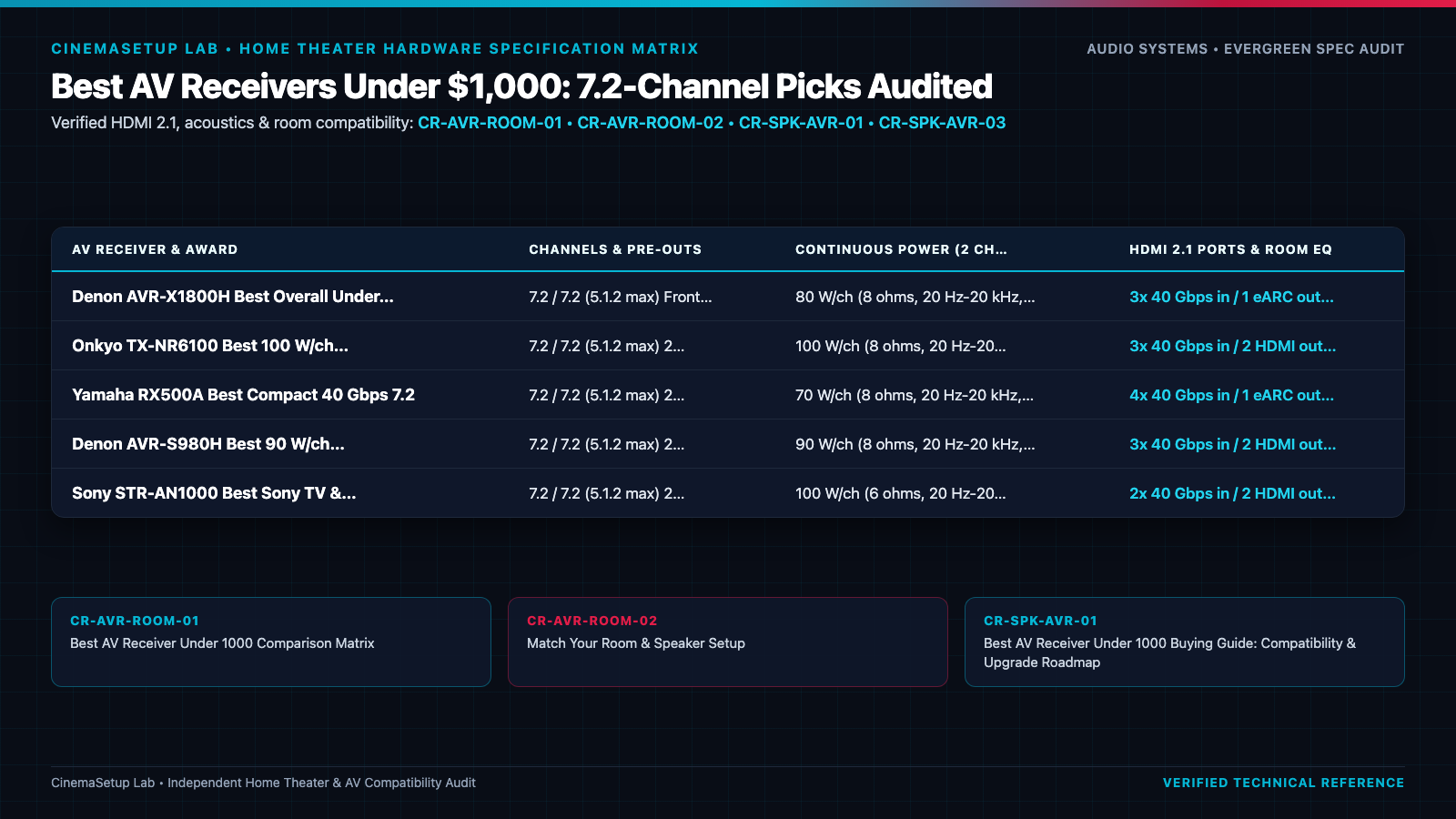
Under compatibility rule CR-SPK-AVR-03, amplifier specs can only be compared fairly when stated on an identical basis: continuous watts per channel into 8 ohms across 20 Hz-20 kHz with two channels driven and stated THD. Notice that Sony publishes its STR-AN1000 power spec into 6 ohms rather than 8 ohms—we flag that difference directly in the matrix below so no 6-ohm number misleads your comparison.
| AV Receiver & Award | Channels & Pre-Outs | Continuous Power (2 ch Driven) | HDMI 2.1 Ports & Room EQ | Link |
|---|---|---|---|---|
| Denon AVR-X1800H Best Overall Under $1,000 | 7.2 / 7.2 (5.1.2 max) Front L/R pre-outs + 2 parallel subs | 80 W/ch (8 ohms, 20 Hz-20 kHz, 0.08% THD) | 3x 40 Gbps in / 1 eARC out Audyssey MultEQ XT | View on Amazon |
| Onkyo TX-NR6100 Best 100 W/ch Dual-HDMI Pick | 7.2 / 7.2 (5.1.2 max) 2 parallel subs + Zone 2 line-out | 100 W/ch (8 ohms, 20 Hz-20 kHz, 0.08% THD) | 3x 40 Gbps in / 2 HDMI out AccuEQ + AccuReflex | View on Amazon |
| Yamaha RX500A Best Compact 40 Gbps 7.2 | 7.2 / 7.2 (5.1.2 max) 2 parallel sub outs (no speaker pre-outs) | 70 W/ch (8 ohms, 20 Hz-20 kHz, 0.09% THD) | 4x 40 Gbps in / 1 eARC out (QMS) YPAO Auto-Calibration | View on Amazon |
| Denon AVR-S980H Best 90 W/ch Dual-Out Denon | 7.2 / 7.2 (5.1.2 max) 2 parallel sub outs (no speaker pre-outs) | 90 W/ch (8 ohms, 20 Hz-20 kHz, 0.08% THD) | 3x 40 Gbps in / 2 HDMI out Audyssey MultEQ | View on Amazon |
| Sony STR-AN1000 Best Sony TV & Wireless Rears | 7.2 / 7.2 (5.1.2 max) 2 parallel subs + S-Center out | 100 W/ch (6 ohms, 20 Hz-20 kHz, 0.09% THD; no 8-ohm spec) | 2x 40 Gbps in / 2 HDMI out D.C.A.C. IX | View on Amazon |
| Denon AVR-X1700H Best Budget MultEQ XT | 7.2 / 7.2 (5.1.2 max) 2 parallel sub outs (no speaker pre-outs) | 80 W/ch (8 ohms, 20 Hz-20 kHz, 0.08% THD) | 3x 40 Gbps in / 1 eARC out Audyssey MultEQ XT | View on Amazon |
| Yamaha RX-V6A Best MusicCast & Pre-Out Value | 7.2 / 7.2 (5.1.2 max) Front L/R pre-outs + 2 parallel subs | 100 W/ch (8 ohms, 20 Hz-20 kHz, 0.06% THD) | 3x 24 Gbps cap in / 1 eARC out YPAO R.S.C. Multipoint | View on Amazon |
| Yamaha RX-A2A Best AVENTAGE Chassis | 7.2 / 7.2 (5.1.2 max) Front L/R pre-outs + 2 parallel subs | 100 W/ch (8 ohms, 20 Hz-20 kHz, 0.06% THD) | 3x 24 Gbps cap in / 1 eARC out YPAO R.S.C. Multipoint | View on Amazon |
Match Your Room & Speaker Setup
Before selecting an AV receiver under $1,000, confirm three room constraints: your speaker nominal impedance, whether your gaming console plugs into the receiver or straight into the TV via eARC, and how deep your media cabinet is. Use the scenario matrix below to match your exact setup to the strongest verified receiver.
| Buyer Scenario | Best Match | Why & Expected Outcome |
|---|---|---|
| Living room 5.1.2 Atmos + PS5/Xbox + future amp upgrade | Denon AVR-X1800H | Three 40 Gbps inputs handle 4K/120Hz consoles natively while US Front L/R pre-outs support a future 2-ch stereo amp. |
| 4-ohm front/center speakers + TV and projector dual screens | Onkyo TX-NR6100 | Delivers 100 W/ch into 8 ohms, full-channel 4-ohm impedance setting, and dual HDMI outputs without an external splitter. |
| Shallow 13-14 in media shelf + Apple AirPlay 2 / Google Cast | Yamaha RX500A | Compact 12.6 in (319 mm) chassis houses four 40 Gbps ports with QMS for 6-8 ohm speaker packages. |
| Higher 90 W/ch Denon power + dual HDMI outputs | Denon AVR-S980H | Adds 10 W/ch rated output and a second HDMI output over the X1800H while staying under its Launch MSRP around $949. |
| Sony Bravia TV owner wanting wireless rear speakers | Sony STR-AN1000 | Unlocks S-Center Sync and compatible Sony wireless surrounds alongside D.C.A.C. IX angle calibration. |
| Strict budget 5.1.2 build prioritizing Audyssey MultEQ XT | Denon AVR-X1700H | Keeps MultEQ XT filter precision, 4-ohm support, and three 40 Gbps ports when Front L/R pre-outs are unnecessary. |
Detailed Best AV Receiver Under 1000 Audits (1–8)
1. Denon AVR-X1800H 7.2-Channel AV Receiver — Best Overall Under $1,000

Key Specs: 7.2 amp & processing channels (5.1.2 max) | Rated 80 W/ch (8 ohms, 20 Hz-20 kHz, 0.08% THD, 2 ch driven) | 4-16 ohm speaker support | 6 HDMI in / 1 eARC out (3x 40 Gbps 8K/60 & 4K/120) | Front L/R pre-outs + 2 parallel sub outs | Audyssey MultEQ XT | 17.1 x 13.3 x 6.0 in (434 x 337 x 151 mm), 19.0 lb (8.6 kg) | Price Tier: $600-$800
Audit Score: 9.2 / 10
- Channel Capability & Pre-Outs (25%): 9.0 / 10
- HDMI & Video Feature Set (20%): 9.4 / 10
- Amplification & 4-Ohm Support (20%): 8.9 / 10
- Room Correction & Bass Management (15%): 9.1 / 10
- Usability & Ecosystem (10%): 9.2 / 10
- Value Within Tier (10%): 9.6 / 10
In a standard 15 x 20 ft (4.6 x 6.1 m) living room built around five ear-level speakers, a powered subwoofer, and two height channels (5.1.2), the Denon AVR-X1800H resolves more compatibility traps than any competing receiver under $1,000. Per Denon US official specifications, three of its six HDMI inputs deliver full 40 Gbps bandwidth for uncompressed 4K/120Hz, VRR, ALLM, QFT, Dolby Vision, and HDR10+ passthrough, paired with HDCP 2.3 and HDMI eARC on the main output. That cleanly beats the Yamaha RX-V6A and RX-A2A, both of which cap their HDMI 2.1 inputs at 24 Gbps and force 4K/120Hz consoles into chroma subsampling or direct-to-TV eARC workarounds.
Denon rates the AVR-X1800H at 80 W/ch into 8 ohms (20 Hz-20 kHz, 0.08% THD, 2 channels driven)—ignore 120 W 6-ohm 1 kHz headline figures when comparing across brands. Using a conservative 30% multichannel derating (~56 W available across five or more active channels), the X1800H easily reaches 95-100 dB living-room peaks at 9-11 ft (2.7-3.4 m) with typical 88-92 dB sensitivity speakers. Crucially, the North American 120V version includes Front L/R pre-outs so you can add an external stereo power amplifier later, plus Audyssey MultEQ XT (higher filter resolution than the base MultEQ inside the Denon AVR-S980H) and full-channel 4-16 ohm speaker impedance support when ventilated properly.
Buyer Verification Alert: Only the US 120V AVR-X1800H ships with Front L/R pre-outs (international editions omit them). Verify that the Amazon checkout page lists a US 120V model sold by an authorized Denon dealer to keep factory warranty coverage intact.
Pros
- Three 40 Gbps HDMI 2.1 inputs pass uncompressed 4K/120Hz, VRR, ALLM, Dolby Vision, and HDR10+
- US 120V chassis uniquely provides Front L/R pre-outs for future external stereo amplification
- Audyssey MultEQ XT improves room correction precision over entry S-series models
- Official 4-16 ohm impedance setting supports 4-ohm speaker loads with manual ventilation
Cons
- 7.2-channel processing permanently caps Atmos layouts at 5.1.2 (cannot run 5.1.4 or 7.1.4)
- Dual subwoofer outputs run in parallel rather than offering independent multi-sub delay and EQ
- Single HDMI output cannot feed both a TV and a projector simultaneously
Verdict: Buy the Denon AVR-X1800H if you want the strongest overall 5.1.2 combination of 40 Gbps HDMI 2.1 gaming, Audyssey MultEQ XT, 4-ohm stability, and Front L/R pre-outs under $1,000. Skip it if you need dual HDMI outputs for a projector plus TV or want four overhead speakers.
2. Onkyo TX-NR6100 7.2-Channel THX Certified AV Receiver — Best 100 W/ch Dual-HDMI Pick

Key Specs: 7.2 amp & processing channels (5.1.2 max) | Rated 100 W/ch (8 ohms, 20 Hz-20 kHz, 0.08% THD, 2 ch driven) | 4-16 ohm speaker support | 6 HDMI in / 2 out (Inputs 1-3 at 40 Gbps 4K/120Hz) | 2 parallel sub outs + Zone 2/B line-out (no speaker pre-outs) | AccuEQ + AccuReflex | 17.1 x 14.9 x 6.8 in (435 x 379.5 x 173.5 mm), 21.7 lb (9.8 kg) | Price Tier: $500-$800
Audit Score: 8.9 / 10
- Channel Capability & Pre-Outs (25%): 8.4 / 10
- HDMI & Video Feature Set (20%): 9.3 / 10
- Amplification & 4-Ohm Support (20%): 9.3 / 10
- Room Correction & Bass Management (15%): 8.1 / 10
- Usability & Ecosystem (10%): 8.9 / 10
- Value Within Tier (10%): 9.3 / 10
If your top priority under $1,000 is continuous two-channel 8-ohm wattage and dual-screen flexibility, the Onkyo TX-NR6100 leads our 40 Gbps lineup. According to Onkyo US specifications, its discrete amplifier stage delivers 100 W/ch into 8 ohms (20 Hz-20 kHz, 0.08% THD, 2 channels driven), carries THX Certified Select certification, and supports 4-16 ohm speakers when you configure its Speaker Impedance menu to 4 ohms. Unlike the single-output Denon AVR-X1800H and Yamaha RX500A, the TX-NR6100 also gives you two HDMI outputs (Main eARC plus Sub/Zone 2) so a living-room television and a drop-down projector can share one rack without external HDMI splitters.
HDMI Inputs 1 through 3 provide full 40 Gbps HDMI 2.1 bandwidth with 4K/120Hz, VRR, ALLM, QFT, QMS, Dolby Vision, and HDR10+ passthrough, while Inputs 4 through 6 handle 18 Gbps 4K/60Hz streamers or cable boxes. The main trade-offs compared with the Denon AVR-X1800H are room correction and expansion: the US TX-NR6100 omits Front L/R speaker pre-outs (offering subwoofer pre-outs and Zone 2/B line-outs only) and uses Onkyo’s AccuEQ system rather than Dirac Live or Audyssey MultEQ XT. At 6.8 in (17.3 cm) tall and 14.9 in (37.9 cm) deep, measure your shelf height plus top ventilation space carefully before ordering.
Buyer Verification Alert: Dirac Live is NOT included on the TX-NR6100 (Onkyo begins Dirac Live on the 9.2-channel TX-NR7100 above $1,000), and the US TX-NR6100 omits Front L/R pre-outs. Plug 4K/120Hz consoles strictly into Inputs 1-3, as Inputs 4-6 cap at 4K/60Hz.
Pros
- 100 W/ch continuous 8-ohm rating (20 Hz-20 kHz, 0.08% THD, 2 ch driven) leads the 40 Gbps group
- Inputs 1-3 deliver full 40 Gbps 4K/120Hz, VRR, ALLM, QMS, Dolby Vision, and HDR10+
- Dual HDMI outputs feed a TV and projector cleanly from one receiver
- Official 4-16 ohm speaker impedance setting supports 4-ohm surround packages
Cons
- US chassis lacks Front L/R speaker pre-outs for adding an external stereo amplifier
- AccuEQ room calibration offers less granular low-frequency EQ than Audyssey MultEQ XT
- Inputs 4-6 are limited to 18 Gbps HDMI 2.0 (4K/60Hz max)
Verdict: Buy the Onkyo TX-NR6100 if you want 100 W/ch 8-ohm power, 4-ohm stability, three 40 Gbps console ports, and dual HDMI outputs in a 5.1.2 theater. Skip it if you want higher-resolution room correction or Front L/R pre-outs (pick the Denon AVR-X1800H).
3. Yamaha RX500A 7.2-Channel Home Theater AV Receiver — Best Compact 40 Gbps 7.2 Receiver

Key Specs: 7.2 amp & processing channels (5.1.2 max) | Rated 70 W/ch (8 ohms, 20 Hz-20 kHz, 0.09% THD, 2 ch driven) | 6-16 ohm official rating | 4 HDMI in / 1 eARC out (40 Gbps 4K/120Hz, QMS) | 2 parallel sub outs (no speaker pre-outs) | YPAO | 17.1 x 12.6 x 6.2 in (434 x 319 x 157 mm), 17.6 lb (8.0 kg) | Price Tier: $500-$700
Audit Score: 8.7 / 10
- Channel Capability & Pre-Outs (25%): 8.0 / 10
- HDMI & Video Feature Set (20%): 9.5 / 10
- Amplification & 4-Ohm Support (20%): 8.1 / 10
- Room Correction & Bass Management (15%): 8.4 / 10
- Usability & Ecosystem (10%): 9.3 / 10
- Value Within Tier (10%): 9.1 / 10
Yamaha’s newer RX500A directly answers the biggest criticism of the older RX-V6A: it moves to full 40 Gbps HDMI 2.1 hardware across its four HDMI inputs and eARC output, adding Quick Media Switching (QMS) alongside 4K/120Hz, VRR, ALLM, Dolby Vision, and HDR10+. It also brings Yamaha’s A.R.T. Wedge fifth anti-resonance center foot into a noticeably shallower 12.6 in (319 mm) chassis weighing just 17.6 lb (8.0 kg), making it far easier to wire inside 14-15 in media consoles without crushing rear HDMI plugs.
The streaming stack is equally modern, bundling Wi-Fi, AirPlay 2, Google Cast, Spotify Connect, TIDAL Connect, Qobuz Connect, and Bluetooth 5.3 Multipoint plus YPAO auto-calibration with an included microphone. However, buyers must audit two hardware limits on Yamaha US official specifications before pairing speakers: continuous output is a modest 70 W/ch into 8 ohms (20 Hz-20 kHz, 0.09% THD, 2 channels driven), and the US impedance menu lists 8-ohm default and 6-ohm minimum settings—meaning the RX500A lacks formal 4-ohm speaker support and omits Front L/R pre-outs. Pair it with 6-ohm or 8-ohm speakers at 89 dB sensitivity or higher for effortless 95-100 dB living-room peaks.
Buyer Verification Alert: Unlike the Denon AVR-X1800H and Onkyo TX-NR6100, the US Yamaha RX500A specifies a 6-ohm minimum speaker load rather than formal 4-ohm certification, and offers four HDMI inputs with zero speaker pre-outs.
Pros
- Full 40 Gbps HDMI 2.1 switching with 4K/120Hz, VRR, ALLM, QMS, Dolby Vision, and HDR10+
- Shallow 12.6 in (319 mm) depth with A.R.T. Wedge fifth foot fits tighter living-room cabinets
- Comprehensive AirPlay 2, Google Cast, TIDAL/Qobuz/Spotify Connect, and Bluetooth 5.3 Multipoint
- YPAO microphone calibration simplifies initial 5.1.2 level and distance alignment
Cons
- 70 W/ch continuous 8-ohm rating (0.09% THD) has lower headroom than 80-100 W peers
- Official US impedance spec stops at 6 ohms minimum (no formal 4-ohm rating)
- Only four rear HDMI inputs and zero Front L/R pre-outs for external power amps
Verdict: Buy the Yamaha RX500A if you want a modern, compact 40 Gbps 5.1.2 receiver with QMS and AirPlay 2 / Google Cast for 6-ohm or 8-ohm speakers. Skip it for the Denon AVR-X1800H or Onkyo TX-NR6100 if you run 4-ohm towers or need five or more HDMI inputs.
4. Denon AVR-S980H 7.2-Channel AV Receiver — Best 90 W/ch Dual-Out Denon

Key Specs: 7.2 amp & processing channels (5.1.2 max) | Rated 90 W/ch (8 ohms, 20 Hz-20 kHz, 0.08% THD, 2 ch driven) | 4-16 ohm speaker support | 6 HDMI in / 2 out (3x 40 Gbps 4K/120Hz, eARC) | 2 parallel sub outs (no speaker pre-outs) | Audyssey MultEQ | 17.1 x 13.0 x 6.6 in (434 x 330 x 167 mm), 21.0 lb (9.5 kg) | Price Tier: $800-$1,000 (Launch MSRP around $949)
Audit Score: 8.6 / 10
- Channel Capability & Pre-Outs (25%): 8.3 / 10
- HDMI & Video Feature Set (20%): 9.4 / 10
- Amplification & 4-Ohm Support (20%): 9.0 / 10
- Room Correction & Bass Management (15%): 8.0 / 10
- Usability & Ecosystem (10%): 9.1 / 10
- Value Within Tier (10%): 8.1 / 10
Sitting under $1,000 at a Launch MSRP around $949, the Denon AVR-S980H updates Denon’s top S-series 7.2 platform with 90 W/ch continuous 8-ohm amplification (20 Hz-20 kHz, 0.08% THD, 2 channels driven), a 21.0 lb (9.5 kg) chassis, and dual HDMI outputs. Like the X1800H, three of its six HDMI inputs deliver full 40 Gbps 4K/120Hz and 8K/60Hz passthrough with VRR, ALLM, QFT, AMD FreeSync, Dolby Vision, and HDR10+, while official 4-16 ohm impedance support handles 4-ohm speakers safely via Denon’s impedance menu.
Why does the S980H rank fourth behind the AVR-X1800H? Because Denon reserves higher-resolution Audyssey MultEQ XT and US Front L/R pre-outs for the X-series. The AVR-S980H ships with base Audyssey MultEQ and 0.2 parallel subwoofer pre-outs only—meaning you gain 10 W/ch of rated power and a second HDMI output, yet lose MultEQ XT filter precision and external stereo amp expandability at a higher Launch MSRP. If you specifically want a current-cycle Denon unit with two HDMI outputs under $1,000, the S980H fits; otherwise, the AVR-X1800H remains the smarter engineering buy.
Buyer Verification Alert: Despite a higher Launch MSRP (around $949) than the AVR-X1800H, the AVR-S980H uses base Audyssey MultEQ rather than MultEQ XT and omits Front L/R speaker pre-outs. Both subwoofer jacks share one parallel mono channel.
Pros
- 90 W/ch continuous 8-ohm power rating adds output headroom over the X1800H and RX500A
- Three 40 Gbps HDMI 2.1 inputs plus dual HDMI outputs with eARC, VRR, FreeSync, DV, and HDR10+
- Official 4-16 ohm speaker impedance support alongside HEOS, AirPlay 2, and phono input
- Clear Denon guided setup assistant simplifies initial wiring and level-calibration tones
Cons
- Uses base Audyssey MultEQ instead of the MultEQ XT filter set included on the X1800H and X1700H
- Omits Front L/R speaker pre-outs and independent dual-subwoofer calibration
- Launch MSRP (around $949) presses the top of the under-$1,000 tier
Verdict: Buy the Denon AVR-S980H if you want a current-cycle Denon 7.2 receiver with dual HDMI outputs and 90 W/ch rated output under $1,000. Skip it for the Denon AVR-X1800H if you only need one HDMI output and prefer MultEQ XT plus Front L/R pre-outs.
5. Sony STR-AN1000 7.2-Channel 8K AV Receiver — Best for Sony TV & Wireless Rears

Key Specs: 7.2 amp & processing channels (5.1.2 max) | Rated 100 W/ch (6 ohms, 20 Hz-20 kHz, 0.09% THD, 2 ch driven; no 8-ohm spec published) | 6-16 ohm speaker impedance | 6 HDMI in / 2 out (HDMI 5 & 6 at 40 Gbps 4K/120Hz) | 2 parallel sub outs + S-Center out (no speaker pre-outs) | D.C.A.C. IX + 360 Spatial Sound Mapping | 17.0 x 13.1 x 6.3 in (430 x 331 x 156 mm), 20.8 lb (9.4 kg) | Price Tier: $600-$900 (Launch MSRP around $899)
Audit Score: 8.5 / 10
- Channel Capability & Pre-Outs (25%): 8.2 / 10
- HDMI & Video Feature Set (20%): 8.4 / 10
- Amplification & 4-Ohm Support (20%): 8.1 / 10
- Room Correction & Bass Management (15%): 8.9 / 10
- Usability & Ecosystem (10%): 9.2 / 10
- Value Within Tier (10%): 8.4 / 10
If running speaker wire across an open living room is a dealbreaker, the Sony STR-AN1000 solves a physical installation headache that Denon and Onkyo leave untouched: it natively pairs with compatible Sony wireless rear surround speakers and subwoofers, and includes Sony’s S-Center Out jack to blend compatible Bravia TV speakers with a center channel via Acoustic Center Sync. Its stereo-microphone D.C.A.C. IX auto-calibration also measures speaker angles and distance in 3D space to power Sony’s 360 Spatial Sound Mapping.
From a strict compatibility audit standpoint, however, Sony US STR-AN1000 specifications carry three critical caveats. First, Sony does not publish a 2-channel 8-ohm wattage rating—quoting 100 W/ch into 6 ohms (20 Hz-20 kHz, 0.09% THD, 2 ch driven) and 120 W at 6 ohms (1 kHz)—and rates speaker impedance strictly for 6-16 ohms with zero official 4-ohm support. Second, only two of its six HDMI inputs (HDMI 5 Game and HDMI 6 Media Box) carry 40 Gbps 4K/120Hz bandwidth while Inputs 1-4 cap at 18 Gbps. Third, the STR-AN1000 passes Dolby Vision and HDR10, but drops HDR10+ passthrough completely—a real drawback for Samsung TV or HDR10+ UHD disc owners.
Buyer Verification Alert: Sony rates the STR-AN1000 at 6-16 ohms only (no 4-ohm rating), omits HDR10+ passthrough, and limits 40 Gbps 4K/120Hz switching to HDMI 5 and HDMI 6. Never compare its 6-ohm wattage directly against 8-ohm Denon or Onkyo ratings.
Pros
- Supports compatible Sony wireless rear surrounds, wireless subs, and Bravia S-Center Sync
- D.C.A.C. IX stereo-mic calibration maps speaker angles and room placement accurately
- Dual HDMI outputs plus two 40 Gbps 4K/120Hz inputs (HDMI 5 & 6) with VRR, ALLM, and Dolby Vision
- AirPlay 2, Chromecast built-in, Spotify Connect, and Works with Sonos support
Cons
- No official 8-ohm power spec and no 4-ohm speaker support (6-16 ohm impedance floor)
- Omits HDR10+ passthrough and restricts 40 Gbps bandwidth to just two HDMI inputs
- No Front L/R speaker pre-outs for external power amplification
Verdict: Buy the Sony STR-AN1000 if you own a Sony TV, run 6-ohm or 8-ohm speakers, and want wireless surround flexibility or D.C.A.C. IX calibration. Skip it for the Denon AVR-X1800H or Onkyo TX-NR6100 if you use 4-ohm speakers, Samsung HDR10+ displays, or three 4K/120Hz sources.
6. Denon AVR-X1700H 7.2-Channel AV Receiver — Best Budget Audyssey MultEQ XT

Key Specs: 7.2 amp & processing channels (5.1.2 max) | Rated 80 W/ch (8 ohms, 20 Hz-20 kHz, 0.08% THD, 2 ch driven) | 4-16 ohm speaker support | 6 HDMI in / 1 eARC out (3x 40 Gbps 4K/120Hz) | 2 parallel sub outs (no speaker pre-outs) | Audyssey MultEQ XT | 17.1 x 13.3 x 6.0 in (434 x 339 x 151 mm), 19.0 lb (8.6 kg) | Price Tier: $450-$650
Audit Score: 8.8 / 10
- Channel Capability & Pre-Outs (25%): 8.1 / 10
- HDMI & Video Feature Set (20%): 9.3 / 10
- Amplification & 4-Ohm Support (20%): 8.9 / 10
- Room Correction & Bass Management (15%): 9.1 / 10
- Usability & Ecosystem (10%): 8.6 / 10
- Value Within Tier (10%): 9.4 / 10
For budget-minded builders who want Denon’s X-series Audyssey MultEQ XT filter precision without paying for Front L/R pre-outs, the Denon AVR-X1700H remains a strong value play whenever authorized US stock sits in the $450-$650 tier. Under the hood, it matches the AVR-X1800H’s core amplifier stage—80 W/ch continuous into 8 ohms (20 Hz-20 kHz, 0.08% THD, 2 channels driven)—and includes the same 4-16 ohm impedance setting plus three 40 Gbps HDMI 2.1 inputs supporting 4K/120Hz, VRR, ALLM, Dolby Vision, and HDR10+.
Compared with the newer Denon AVR-X1800H, the AVR-X1700H omits Front L/R speaker pre-outs (leaving 0.2 parallel subwoofer pre-outs only) and runs Denon’s older text-based on-screen overlay rather than the X1800H’s higher-resolution HD setup menus. Still, if you plan to power a 5.1.2 bookshelf or compact tower system strictly from the receiver’s built-in seven amplifiers, getting Audyssey MultEQ XT and three 40 Gbps gaming ports at a lower budget bracket frees extra money for speakers and a subwoofer.
Buyer Verification Alert: Because the AVR-X1700H is an earlier-generation Denon model, inspect the “Ships from and Sold by” line carefully on Amazon—unauthorized third-party liquidators can void Denon’s US manufacturer warranty.
Pros
- Includes Audyssey MultEQ XT and three 40 Gbps HDMI 2.1 inputs at a lower budget bracket
- 80 W/ch continuous 8-ohm rating (0.08% THD, 2 ch driven) with 4-16 ohm speaker support
- Passes Dolby Vision, HDR10+, VRR, ALLM, and eARC cleanly for modern consoles
- Built-in HEOS, AirPlay 2, Wi-Fi, Bluetooth, and phono input
Cons
- No Front L/R speaker pre-outs for adding an external stereo amplifier later
- Single HDMI output and parallel dual subwoofer outputs limit expansion
- Older generation menu interface and narrowing authorized-dealer US stock
Verdict: Buy the Denon AVR-X1700H if authorized US inventory gives you meaningful savings over the AVR-X1800H and you do not need Front L/R pre-outs. Skip it for the Denon AVR-X1800H if prices sit close together.
7. Yamaha RX-V6A 7.2-Channel AV Receiver — Best MusicCast & Pre-Out Value

Key Specs: 7.2 amp & processing channels (5.1.2 max) | Rated 100 W/ch (8 ohms, 20 Hz-20 kHz, 0.06% THD, 2 ch driven) | 4-ohm Front L/R only (6+ ohms other channels) | 7 HDMI in / 1 eARC out (Inputs 1-3 capped at 24 Gbps) | Front L/R pre-outs + 2 parallel sub outs | YPAO R.S.C. Multipoint | 17.1 x 14.9 x 6.8 in (435 x 377 x 171 mm), 21.6 lb (9.8 kg) | Price Tier: $500-$750
Audit Score: 8.4 / 10
- Channel Capability & Pre-Outs (25%): 8.7 / 10
- HDMI & Video Feature Set (20%): 7.5 / 10
- Amplification & 4-Ohm Support (20%): 8.7 / 10
- Room Correction & Bass Management (15%): 8.5 / 10
- Usability & Ecosystem (10%): 9.0 / 10
- Value Within Tier (10%): 8.4 / 10
Despite launching earlier in the HDMI 2.1 cycle, the Yamaha RX-V6A stays relevant for two specific living-room scenarios: high 100 W/ch continuous 8-ohm output (20 Hz-20 kHz, 0.06% THD, 2 channels driven) paired with Front L/R pre-outs, and wireless rear surround capability using Yamaha MusicCast 20 or MusicCast 50 speakers. Its YPAO R.S.C. Multipoint calibration also improves over single-point YPAO by measuring reflections across multiple listening positions, and seven total HDMI inputs handle older 4K/60Hz streaming sticks and Blu-ray players easily.
Before clicking buy, review our full Denon AVR-X1800H vs. Yamaha RX-V6A comparison because the RX-V6A carries two documented hardware limitations. First, its three HDMI 2.1 inputs (Inputs 1-3) are hardware-capped at 24 Gbps rather than 40 Gbps (and lack QMS support per Yamaha’s published compatibility advisory), forcing 4K/120Hz signals into 4:2:0 chroma subsampling or DSC unless you plug consoles straight into your TV and return audio via HDMI eARC. Second, Yamaha permits 4-ohm speakers strictly on Front L/R (with the 6-ohm min setting active), while center, surround, and height channels must be 6 ohms or higher.
24 Gbps & 4-Ohm Warning: HDMI Inputs 1-3 on the RX-V6A are capped at 24 Gbps rather than 40 Gbps, and early 2020 units had a 4K/120Hz chipset advisory (mitigated via board revision on later production). Keep 4-ohm speakers strictly on Front L/R.
Pros
- 100 W/ch continuous 8-ohm rating (0.06% THD, 2 ch driven) with Front L/R pre-outs
- MusicCast ecosystem supports wireless rear surround speakers without running rear cables
- YPAO R.S.C. Multipoint calibration accounts for early room reflections across seats
- Seven total HDMI inputs accommodate multi-source 4K/60Hz racks easily
Cons
- 24 Gbps HDMI 2.1 cap on Inputs 1-3 prevents uncompressed 4K/120Hz 10-bit RGB passthrough
- 4-ohm speaker support applies to Front L/R only (6+ ohms required on center and surrounds)
- No Quick Media Switching (QMS) support on current hardware
Verdict: Buy the Yamaha RX-V6A if you want MusicCast wireless rears, Front L/R pre-outs, and 100 W/ch continuous 8-ohm output while routing 4K/120Hz consoles through your TV over eARC. Skip it for the Denon AVR-X1800H or Yamaha RX500A if you want direct 40 Gbps switching.
8. Yamaha RX-A2A AVENTAGE 7.2-Channel AV Receiver — Best AVENTAGE Chassis Under $1,000

Key Specs: 7.2 amp & processing channels (5.1.2 max) | Rated 100 W/ch (8 ohms, 20 Hz-20 kHz, 0.06% THD, 2 ch driven) | 4-ohm Front L/R only (6+ ohms other channels) | 7 HDMI in / 1 eARC out (Inputs 1-3 capped at 24 Gbps) | Front L/R pre-outs + 2 parallel sub outs | YPAO R.S.C. Multipoint | 17.1 x 14.9 x 6.8 in (435 x 377 x 171 mm), 22.4 lb (10.2 kg) | Price Tier: $700-$1,000
Audit Score: 8.2 / 10
- Channel Capability & Pre-Outs (25%): 8.6 / 10
- HDMI & Video Feature Set (20%): 7.4 / 10
- Amplification & 4-Ohm Support (20%): 8.6 / 10
- Room Correction & Bass Management (15%): 8.4 / 10
- Usability & Ecosystem (10%): 9.1 / 10
- Value Within Tier (10%): 7.4 / 10
As the entry point to Yamaha’s AVENTAGE lineup, the Yamaha RX-A2A upgrades the RX-V6A chassis with a fifth center Anti-Resonance Technology (A.R.T.) Wedge foot, heavier 22.4 lb (10.2 kg) damped construction, and extended AVENTAGE warranty coverage when purchased through an authorized US Yamaha dealer. You keep 100 W/ch continuous 8-ohm power (20 Hz-20 kHz, 0.06% THD, 2 channels driven), Front L/R pre-outs, YPAO R.S.C. Multipoint calibration, and MusicCast wireless surround integration.
However, buyers paying a premium over the RX-V6A or Denon AVR-X1800H must note that the RX-A2A uses the exact same 24 Gbps HDMI 2.1 board as the RX-V6A—so Inputs 1-3 cap at 24 Gbps, QMS is absent, and 4-ohm speaker support applies strictly to Front L/R. For most under-$1,000 shoppers, the Denon AVR-X1800H and Onkyo TX-NR6100 deliver stronger 40 Gbps gaming compatibility and unrestricted 4-ohm support for equal or less money, leaving the RX-A2A strictly for Yamaha loyalists who value AVENTAGE warranty terms and wire consoles straight to their TV.
24 Gbps Split-Spec Warning: Do not confuse “8K and 4K/120 HDMI” in the Amazon title with full 40 Gbps passthrough. Inputs 1-3 on the RX-A2A max out at 24 Gbps; verify an authorized US Yamaha dealer at checkout to qualify for AVENTAGE warranty coverage.
Pros
- AVENTAGE damped chassis with fifth A.R.T. Wedge foot and extended authorized-dealer warranty
- 100 W/ch continuous 8-ohm rating (0.06% THD, 2 ch driven) plus Front L/R pre-outs
- MusicCast wireless rear speaker compatibility and seven total HDMI inputs
- Stable HDMI eARC return when 4K/120Hz consoles plug directly into the display
Cons
- 24 Gbps HDMI 2.1 cap on Inputs 1-3 forces 4:2:0 or DSC on 4K/120Hz console signals
- 4-ohm speaker support applies to Front L/R only (center and surrounds require 6+ ohms)
- Costs more than the Denon AVR-X1800H and Yamaha RX-V6A while lacking 40 Gbps ports
Verdict: Buy the Yamaha RX-A2A only if you specifically want AVENTAGE chassis build, extended dealer warranty coverage, and MusicCast wireless surrounds alongside TV-direct console connections. Skip it for the Denon AVR-X1800H if you want native 40 Gbps switching.
Best AV Receiver Under 1000 Buying Guide: Compatibility & Upgrade Roadmap
Picking the best av receiver under 1000 comes down to verifying four physical compatibility rules before checkout rather than chasing brochure badges. The compatibility blueprint below summarizes how channel limits, 40 Gbps ports, 8-ohm wattage bases, and parallel sub outputs govern every 7.2-channel chassis in this bracket.
1. 7.2 Processing Limits & Physical vs. Virtual Atmos (CR-SPK-AVR-04 & CR-SYS-05)
Every AV receiver on this shortlist has seven built-in amplifiers and seven processing channels (the “.2” denotes two mirrored subwoofer line outputs). Under rule CR-SPK-AVR-04, a 7.2 chassis maxes out at either a 5.1.2 Dolby Atmos / DTS:X speaker layout (five ear-level speakers plus two physical ceiling, on-wall height, or Atmos-enabled up-firing speakers) or a traditional 7.1 ear-level layout. No external power amplifier can turn a 7.2 receiver into a 5.1.4 or 7.1.4 system because the internal DSP lacks the ninth and eleventh processing channels—you must step above $1,000 to a 9-channel or 11.4-processing AVR for four overhead speakers. Also note that Dolby Atmos Height Virtualization and DTS Virtual:X only simulate overhead cues on 5.1 speakers; they are never equivalent to physical height channels (CR-SYS-05).
2. 40 Gbps vs. 24 Gbps HDMI 2.1 Bandwidth & eARC Routing (CR-SRC-AVR-01)
According to the HDMI Licensing Administrator HDMI 2.1 specification, a “4K/120” badge alone does not prove full 40 Gbps or 48 Gbps Fixed Rate Link (FRL) throughput. On our shortlist, the Yamaha RX500A (4 inputs), Denon AVR-X1800H (3 inputs), AVR-S980H (3 inputs), AVR-X1700H (3 inputs), Onkyo TX-NR6100 (3 inputs), and Sony STR-AN1000 (2 inputs: HDMI 5 and 6) pass full 40 Gbps signals for uncompressed 4K/120Hz 10-bit 4:4:4 RGB gaming, VRR, and ALLM. By contrast, Yamaha’s RX-V6A and RX-A2A cap Inputs 1-3 at 24 Gbps. If you already own a 24 Gbps AVR—or want to save receiver ports—plug your PS5 or Xbox Series X directly into a 48 Gbps TV port and send lossless Dolby TrueHD or multichannel PCM back to the receiver via HDMI eARC (keeping in mind that on many TVs, the eARC jack occupies one of your 4K/120Hz TV ports).
3. Continuous 8-Ohm Power Ratings, Speaker Sensitivity & 4-Ohm Loads (CR-SPK-AVR-01..03)
Always compare receivers using their continuous 8-ohm, 20 Hz-20 kHz, 2-channel-driven power rating with stated THD (CR-SPK-AVR-03). Ignore 1 kHz, 6-ohm, or single-channel peak numbers—and remember Sony publishes only a 6-ohm figure for the STR-AN1000. In real multichannel playback, expect output per channel to drop by a conservative ~30% when five or more speakers are driven simultaneously. By our estimate from published specs, 87 dB sensitivity speakers (2.83 V / 1 m, 8 ohms) at an 11.5 ft (3.5 m) seat distance need roughly 78 W per channel for 95 dB living-room peaks, whereas high-sensitivity 93 dB speakers need around 62 W even for 100 dB peaks. If your speakers are rated at 4 ohms nominal impedance, choose Denon (X1800H, S980H, X1700H) or Onkyo (TX-NR6100) and engage their 4-ohm menu setting; avoid pairing 4-ohm center or surround speakers with the Yamaha RX500A or Sony STR-AN1000 (both 6-ohm minimum) or Yamaha’s RX-V6A/RX-A2A (4-ohm Front L/R only).
4. Room Correction, Parallel Dual Sub Outs & Paid Upgrade Reality (CR-AVR-ROOM-02)
Every receiver in this under-$1,000 roundup includes automated microphone calibration—Audyssey MultEQ XT (Denon X1800H/X1700H), base Audyssey MultEQ (Denon S980H), AccuEQ (Onkyo TX-NR6100), YPAO / YPAO R.S.C. (Yamaha), or D.C.A.C. IX (Sony)—but none includes Dirac Live (which enters above $1,000 on models like the Onkyo TX-NR7100 or as a paid license on the Denon AVR-X3900H). Likewise, every 7.2 receiver here mirrors its two subwoofer pre-out jacks in parallel mono rather than calibrating two subwoofers independently. If you run two subwoofers, match their physical level and phase manually before running your receiver’s level-calibration tones.
5. Cabinet Ventilation, CL2/CL3 In-Wall Wiring & YMYL Safety (CR-AVR-ROOM-01 & G-27)
Follow the manufacturer’s owner’s manual strictly for top and rear shelf clearance—never block top chassis vents, enclose a 7.2 Class AB amplifier inside a tight glass-door cabinet, or stack streaming boxes on the ventilation grille, especially when running 4-ohm speakers. For in-wall or ceiling speaker runs (and overhead 5.1.2 heights), follow speaker manufacturer mounting templates, anchor into structural joists/studs per instructions, use pure oxygen-free copper (OFC) 14 AWG or 12 AWG speaker wire sized for run length, and verify UL-listed CL2 or CL3 in-wall fire ratings per local building codes. Consult a licensed electrician or qualified AV installer before cutting drywall, installing in-wall power kits, or adding dedicated 120V circuits, and plug your receiver into a UL-listed surge protector. During extended movie marathons, keep playback at comfortable listening levels.
6. US 120V Authorized-Dealer Warranty Check (CR-SYS-02 & G-26)
Every pick in this guide assumes a North American 120V AC, 60 Hz model. Manufacturer US warranties from Denon, Onkyo, Yamaha, and Sony require purchase from an authorized US dealer—check the “Ships from and Sold by” line at Amazon checkout because third-party unauthorized resellers can forfeit factory warranty support or ship non-US variants (such as international AVR-X1800H chassis lacking Front L/R pre-outs).
Upgrade Roadmap & Hidden Setup Costs
Under our system budget allocation rule (CR-SYS-01), spend 50% or more of your total audio budget on passive speakers and a powered subwoofer, keeping the AV receiver near 25%-35% of total audio spend (or 35%-40% in starter builds). Reserve 5%-10% for installation essentials: certified Ultra High Speed HDMI (48 Gbps) cables for every 4K/120Hz hop (use active directional fiber-optic HDMI for runs over 10 ft / 3.0 m), pure OFC 14 AWG or 12 AWG speaker wire, CL2/CL3 jacketed cable for in-wall paths, and a powered subwoofer—remember AVRs output a line-level LFE signal and cannot drive passive subwoofers.
Secondary Intent Resolver: Under-$1,000 7.2 AVR vs. 9.4 Step-Up vs. Soundbar
7.2 Under-$1,000 AVR vs. 9.4 Step-Up: Stick with a 7.2 receiver like the Denon AVR-X1800H if your couch sits near the back wall and two height speakers (5.1.2) fit your ceiling cleanly. Step up above $1,000 to a 9.4/11.4 receiver only if you have room behind the sofa for four overhead speakers (5.1.4 or 7.1.4), want independent multi-subwoofer EQ, or want Dirac Live.
7.2 AV Receiver vs. Soundbar: Choose a soundbar kit in compact rentals or bedrooms where running speaker wire is impossible. Choose a 7.2 AV receiver when you want wide front left-center-right separation, real discrete surround and height placement, replaceable components, and a dedicated powered subwoofer.
100% Weighted Scoring Rubric & Excluded Models
All eight AV receivers were audited under CinemaSetup Lab’s published evaluation methodology using manufacturer US 120V spec sheets, owner’s manuals, HDMI port diagrams, and Amazon US (ZIP 10001) availability checks. Our six-pillar 100% rubric carries zero influence from affiliate commission rates:
| Evaluation Criterion | Weight | What We Verify |
|---|---|---|
| Channel Capability & Pre-Outs | 25% | 7.2 amplifier vs. processing ceiling (CR-SPK-AVR-04), Front L/R pre-outs, and parallel subwoofer outputs (CR-SUB-AVR-02). |
| HDMI & Video Feature Set | 20% | Full 40 Gbps vs. 24 Gbps input counts, eARC, HDCP 2.3, Dolby Vision, HDR10+, VRR, ALLM, and QMS passthrough (CR-SRC-AVR-01..03). |
| Amplification & 4-Ohm Support | 20% | Like-for-like 8-ohm, 20 Hz-20 kHz, 2-ch driven power rating (CR-SPK-AVR-03) and documented 4-ohm or 6-ohm impedance limits (CR-SPK-AVR-01). |
| Room Correction & Bass Management | 15% | Bundled calibration software (Audyssey MultEQ XT vs. MultEQ, AccuEQ, YPAO R.S.C., D.C.A.C. IX) and crossover options (CR-AVR-ROOM-02). |
| Usability & Ecosystem | 10% | Guided setup UI, HEOS/MusicCast/AirPlay/Google Cast stability, Zone 2 amp sharing, and hardware advisories. |
| Value Within Tier | 10% | Hardware specs, 40 Gbps ports, and expansion features delivered under $1,000 in the US market. |
| Total | 100% |
Models We Audited & Rejected
- Denon AVR-S570BT & Yamaha RX300A (5.2-Channel Non-Atmos Units): Both models cap at 5.2 processing channels (CR-SPK-AVR-04), preventing physical 5.1.2 Dolby Atmos height channels; the RX300A relies solely on DSP height virtualization (CR-SYS-05) and omits Wi-Fi/AirPlay.
- Denon AVR-X2900H, Marantz Cinema 60 & Denon AVR-X3900H: Active US receivers whose Launch MSRPs sit above $1,000 (and note the older Denon AVR-X3800H is discontinued and superseded by the 9.4-channel AVR-X3900H).
- Donner MAMP 1000W Peak Stereo Karaoke Amplifiers: Frequently appear in broad Amazon “home theater receiver” searches under $300, but lack HDMI switching, eARC, Dolby Atmos/DTS:X decoding, and continuous 8-ohm multichannel theater amplification.
- Renewed Yamaha RX-V385 & Unauthorized Third-Party Listings: The RX-V385 stops at older 5.1 HDMI 2.0 video without 4K/120Hz or Dolby Atmos, while unauthorized marketplace sellers risk forfeiting US 120V manufacturer warranties (G-26).
Continue Your Audit
Best AV Receiver Under 1000 Frequently Asked Questions
What is the best AV receiver under 1000 for most 5.1.2 Dolby Atmos living rooms?
The Denon AVR-X1800H is the best AV receiver under 1000 for most living rooms because it combines three full 40 Gbps HDMI 2.1 inputs, Audyssey MultEQ XT room correction, 4-ohm speaker support, and US-exclusive Front L/R pre-outs in one chassis.
Can a 7.2 AV receiver under $1,000 power a 5.1.4 or 7.1.4 Dolby Atmos layout?
No. Under compatibility rule CR-SPK-AVR-04, a 7.2-channel AV receiver processes and powers at most seven ear-level plus height speakers (5.1.2 Atmos or 7.1). Running four overhead speakers (5.1.4) requires stepping up to a 9-channel receiver above $1,000.
Why do Yamaha RX-V6A and RX-A2A warn about 24 Gbps HDMI 2.1 ports?
Both models use 24 Gbps HDMI 2.1 ports rather than 40 Gbps inputs, forcing 4K/120Hz signals from PS5, Xbox Series X, or PCs into 4:2:0 chroma subsampling or compression. Connect consoles straight to a 48 Gbps TV port and use eARC, or buy a 40 Gbps receiver.
How should I compare wattage ratings on AV receivers under $1,000?
Always compare continuous power into 8 ohms from 20 Hz to 20 kHz with two channels driven and stated THD (rule CR-SPK-AVR-03). Ignore 1 kHz, 6-ohm, or single-channel burst numbers, and note Sony rates the STR-AN1000 into 6 ohms only.
Do dual subwoofer outputs on a 7.2 receiver calibrate two subs independently?
No. All eight 7.2-channel receivers in this bracket mirror their two subwoofer outputs as one parallel mono signal rather than offering independent delay and EQ per sub. Set individual sub phase and gain manually before running Audyssey, YPAO, or AccuEQ.
Does buying an AV receiver under $1,000 on Amazon include a US warranty?
Factory US warranties require buying from an authorized dealer. Denon, Onkyo, Yamaha, and Sony warranties apply to US 120V units purchased through authorized retailers, so verify the Shipped From and Sold By line at checkout rather than buying from unauthorized third-party sellers.
Final Verdict: Choosing the Best AV Receiver Under 1000
For most 5.1.2 living-room systems, the Denon AVR-X1800H stands as the best av receiver under 1000 overall: it pairs three full 40 Gbps HDMI 2.1 inputs, Audyssey MultEQ XT, 4-ohm stability, and US Front L/R pre-outs without locking you into 24 Gbps video caps. Buyers needing 100 W/ch continuous 8-ohm headroom and dual HDMI outputs for a TV plus projector should choose the Onkyo TX-NR6100, while shallow media shelves with 6-8 ohm speakers benefit most from the compact, QMS-ready Yamaha RX500A.
Whichever 7.2-channel model matches your speaker impedance and console layout, verify an authorized US 120V dealer at Amazon checkout, leave the manual’s specified top airflow clearance above the chassis, and put at least half of your total audio budget into speakers and a capable powered subwoofer.


