
Disclosure: As an Amazon Associate, I earn from qualifying purchases. If you buy through links on this page, we may earn a small commission at no extra cost to you. Commission rates never influence our technical audits, scores, or rankings.
Choosing the best av receiver for dolby atmos starts with one unforgiving hardware rule: the Dolby Atmos badge on a retail box tells you the processor recognizes object-based audio, not how many physical overhead speakers the chassis can actually power. Too many shoppers bring home a budget 5.2-channel unit expecting true surround-plus-height immersion, only to learn that it lacks height amplifier channels entirely or falls back on DSP height virtualization rather than real ceiling speakers.
To eliminate guesswork across living rooms and dedicated home theaters, we audited eight actively stocked US 120V AC models on Amazon US from Denon, JBL, Marantz, Yamaha, and Onkyo—covering 7.2-channel 5.1.2 foundations and 9.4-channel 5.1.4 / 7.1.4 powerhouses. Every recommendation below is verified against manufacturer specifications for continuous 8-ohm 2-channel wattage, 4-ohm speaker support, HDMI 2.1 40 Gbps switching, eARC transport, and independent subwoofer EQ. If you are still deciding on overall rack features beyond overhead sound, start at our main best AV receivers hub, or map your room geometry first with our Dolby Atmos speaker layouts guide.
In This Guide
- Quick Picks: Best AV Receiver for Dolby Atmos Winners
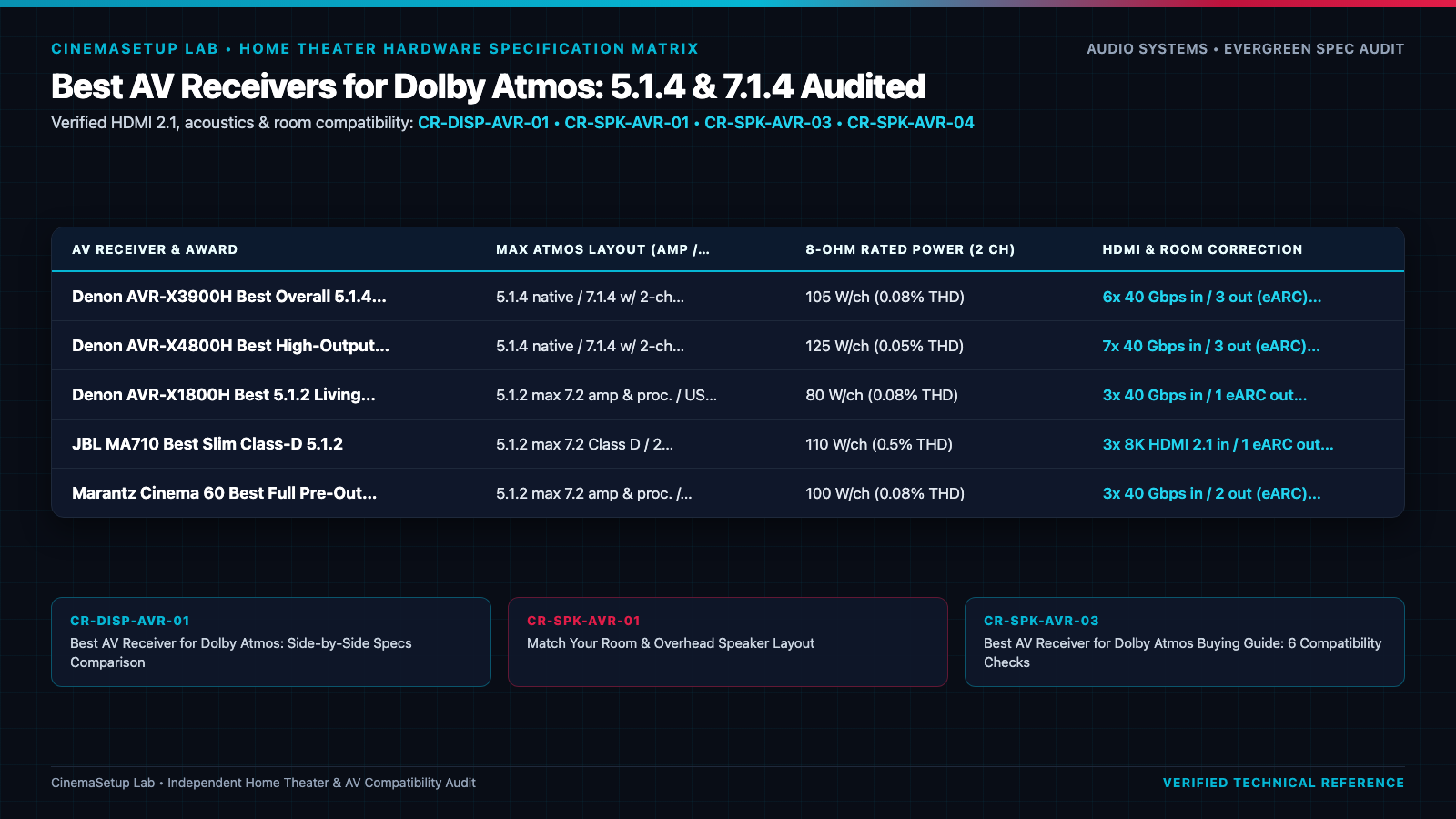
- Best AV Receiver for Dolby Atmos: Side-by-Side Specs Comparison
- Match Your Room & Overhead Speaker Layout
- Detailed Best AV Receiver for Dolby Atmos Audits (1–8): 1. Denon AVR-X3900H · 2. Denon AVR-X4800H · 3. Denon AVR-X1800H · 4. JBL MA710 · 5. Marantz Cinema 60 · 6. Yamaha RX500A · 7. Yamaha RX-A2A · 8. Onkyo TX-SR494
- Best AV Receiver for Dolby Atmos Buying Guide: 6 Compatibility Checks
- 100% Weighted Scoring Rubric & Models We Excluded
- Best AV Receiver for Dolby Atmos Frequently Asked Questions
- Final Verdict
Quick Picks: Best AV Receiver for Dolby Atmos Winners
#1 Best Overall (5.1.4 & 7.1.4)
Denon AVR-X3900H
Drives four overhead speakers natively (5.1.4), expands to 7.1.4 via 11.4 pre-outs, calibrates four discrete subwoofers, and includes six 40 Gbps HDMI 2.1 inputs. Jump to audit ↓
#2 Best High-Output 7.1.4 Flagship
Denon AVR-X4800H
Steps up to 125 W/ch monolithic amplification (8 ohms, 2 ch driven), seven 40 Gbps HDMI ports, Auro-3D, and 11.4 preamp disconnect for large rooms. Jump to audit ↓
#3 Best 5.1.2 Living Room Value
Denon AVR-X1800H
Pairs three 40 Gbps gaming ports, Audyssey MultEQ XT, 4-ohm stability, and US Front L/R pre-outs for living rooms running two physical height speakers. Jump to audit ↓
Best AV Receiver for Dolby Atmos: Side-by-Side Specs Comparison
Every power specification below uses the standardized two-channel-driven, full-bandwidth 8-ohm basis (20 Hz-20 kHz) so single-channel 6-ohm burst numbers cannot distort comparisons. Pay equal attention to processing ceiling versus internal amplifiers: a 9-amp receiver with 11.4 processing runs 5.1.4 out of the box and unlocks 7.1.4 once you add an external 2-channel power amplifier.
| AV Receiver & Award | Max Atmos Layout (Amp / Proc.) | 8-Ohm Rated Power (2 ch) | HDMI & Room Correction | Link |
|---|---|---|---|---|
| Denon AVR-X3900H Best Overall 5.1.4 & 7.1.4 | 5.1.4 native / 7.1.4 w/ 2-ch amp 9 powered / 11.4 proc. / 4 discrete subs | 105 W/ch (0.08% THD) | 6x 40 Gbps in / 3 out (eARC) Audyssey XT32 + Dirac (paid) | View on Amazon |
| Denon AVR-X4800H Best High-Output Flagship | 5.1.4 native / 7.1.4 w/ 2-ch amp 9 powered / 11.4 proc. / 4 discrete subs | 125 W/ch (0.05% THD) | 7x 40 Gbps in / 3 out (eARC) Audyssey XT32 + Dirac (paid) | View on Amazon |
| Denon AVR-X1800H Best 5.1.2 Living Room Value | 5.1.2 max 7.2 amp & proc. / US Front pre-outs | 80 W/ch (0.08% THD) | 3x 40 Gbps in / 1 eARC out Audyssey MultEQ XT | View on Amazon |
| JBL MA710 Best Slim Class-D 5.1.2 | 5.1.2 max 7.2 Class D / 2 parallel subs | 110 W/ch (0.5% THD) | 3x 8K HDMI 2.1 in / 1 eARC out EZ Set EQ + Dirac Ready (paid) | View on Amazon |
| Marantz Cinema 60 Best Full Pre-Out 5.1.2 | 5.1.2 max 7.2 amp & proc. / 7.2 pre-outs | 100 W/ch (0.08% THD) | 3x 40 Gbps in / 2 out (eARC) Audyssey MultEQ XT | View on Amazon |
| Yamaha RX500A Best Compact 40 Gbps 5.1.2 | 5.1.2 max 7.2 amp & proc. / 6+ ohm min | 70 W/ch (0.09% THD) | 4x 40 Gbps in / 1 eARC out (QMS) YPAO Auto Mic Calibration | View on Amazon |
| Yamaha RX-A2A Best MusicCast Wireless Rears | 5.1.2 max 7.2 amp & proc. / Front L/R pre-outs | 100 W/ch (0.06% THD) | 3x 24 Gbps cap in / 1 eARC out YPAO R.S.C. Multipoint | View on Amazon |
| Onkyo TX-SR494 Best Budget 5.1.2 (4K60) | 5.1.2 max 7.2 amp & proc. / 2 parallel subs | 80 W/ch (0.08% THD) | 4x HDMI 2.0 (18 Gbps) / 1 ARC out AccuEQ + AccuReflex | View on Amazon |
Match Your Room & Overhead Speaker Layout
Before locking in a receiver, measure your seating position relative to the back wall and count how many physical height speakers your ceiling permits. Rooms with couches pushed against the rear wall generally suit a 5.1.2 layout (two top-front or top-middle heights), whereas rooms with 4 to 6 ft (1.2 to 1.8 m) of space behind the main row unlock smooth front-to-back overhead panning in 5.1.4 or 7.1.4. See our breakdown of how many AV receiver channels you need if you are still sizing your speaker count.
| Buyer Scenario | Best Match | Why & Expected Outcome |
|---|---|---|
| Dedicated 5.1.4 or 7.1.4 theater with 2-4 subwoofers | Denon AVR-X3900H | Powers four overheads out of the box, adds rear surrounds via a 2-ch amp on 11.4 pre-outs, and calibrates four subwoofers independently. |
| Large dedicated room with 7 HDMI 2.1 sources | Denon AVR-X4800H | Delivers 125 W/ch monolithic amplification, seven 40 Gbps inputs, three HDMI outputs, and built-in Auro-3D decoding. |
| Living room 5.1.2 Atmos + PS5/Xbox Series X | Denon AVR-X1800H | Runs 5.1.2 with three 40 Gbps console ports, Audyssey MultEQ XT, and US Front L/R pre-outs in the $500-$800 tier. |
| Shallow shelf or 4-ohm speakers in a 5.1.2 room | JBL MA710 | Slim 4.3-inch (10.9 cm) Class D chassis rated at 160 W/ch into 4 ohms with optional Dirac Live readiness. |
| Compact luxury 5.1.2 rack using external power amps | Marantz Cinema 60 | Full 7.2 pre-outs let external amplifiers drive every channel alongside dual HDMI outputs for TV plus projector. |
| No-wire rear living room needing wireless surrounds | Yamaha RX-A2A | Pairs wireless Yamaha MusicCast surrounds with wired front/height speakers (connect 4K/120Hz consoles straight to TV eARC). |
Detailed Best AV Receiver for Dolby Atmos Audits (1–8)
1. Denon AVR-X3900H 9.4-Channel 8K AV Receiver — Best Overall for 5.1.4 & 7.1.4 Atmos

Key Specs: 9 powered / 11.4 processing channels (5.1.4 native; 7.1.4 w/ 2-ch ext. amp) | Rated 105 W/ch (8 ohms, 20 Hz-20 kHz, 0.08% THD, 2 ch driven) | 4-16 ohm speaker support | 6 HDMI in / 3 out (all 6x 40 Gbps, eARC) | 11.4 pre-outs + 4 independent sub outs | Audyssey MultEQ XT32 (Dirac Live / Bass Control paid upgrade) | 17.1 x 14.9 x 6.6 in (434 x 379 x 168 mm), 27.6 lb (12.5 kg) | Price Tier: $1,500-$2,000
Audit Score: 9.5 / 10
- Channel Capability & Pre-Outs (25%): 9.7 / 10
- HDMI & Video Feature Set (20%): 9.6 / 10
- Amplification & 4-Ohm Support (20%): 9.2 / 10
- Room Correction & Bass Management (15%): 9.5 / 10
- Usability & Ecosystem (10%): 9.3 / 10
- Value Within Tier (10%): 9.4 / 10
Four overhead speakers—two top-front and two top-rear—transform Dolby Atmos from an occasional vertical accent into a seamless three-dimensional dome where rain, helicopters, and ambient pans track accurately front to back. As the direct Amazon US successor to the retired AVR-X3800H, the Denon US AVR-X3900H specification earns our top spot because it solves both 5.1.4 and 7.1.4 growth without forcing buyers into flagship pricing. Out of the box, its nine built-in amplifiers power a full 5.1.4 setup natively; when you are ready to add rear surround speakers for 7.1.4, its 11.4-channel processing and full 11.4 pre-outs satisfy rule CR-SPK-AVR-05 with a modest 2-channel external amplifier.
Every rear HDMI input (all six) passes full 40 Gbps bandwidth for 4K/120Hz consoles, VRR, ALLM, QFT, Dolby Vision, and HDR10+, paired with three HDMI outputs (dual main plus Zone 2) and eARC. Denon rates its amplifiers at 105 W per channel into 8 ohms (20 Hz-20 kHz, 0.08% THD, 2 channels driven) with official 4-ohm impedance menu support and preamp disconnect mode on every channel. Unlike 7.2 receivers that share a single mono subwoofer signal, the AVR-X3900H provides four genuinely independent subwoofer pre-outs calibrated via bundled Audyssey MultEQ XT32 (Sub EQ HT) or optional paid Dirac Live and Dirac Live Bass Control licenses.
Buyer Verification Alert: Old third-party marketplace listings for the discontinued AVR-X3800H still surface intermittently, so confirm you are ordering the active US 120V AVR-X3900H from an authorized Denon dealer to retain factory warranty coverage—and remember Dirac Live licenses cost extra.
Pros
- Powers 5.1.4 Dolby Atmos natively and expands cleanly to 7.1.4 via 11.4 pre-outs and a 2-channel external power amp
- Four independent subwoofer outputs allow separate level, distance, and room EQ per subwoofer
- All six HDMI inputs carry full 40 Gbps bandwidth alongside three HDMI outputs (dual main + Zone 2)
- Ships with high-resolution Audyssey MultEQ XT32 and supports optional Dirac Live and Bass Control upgrades
Cons
- Requires buying a separate 2-channel external amplifier to drive all 11 speakers in a 7.1.4 layout
- Dirac Live and Bass Control require paid software licenses rather than coming included
- At 27.6 lb (12.5 kg) and 6.6 in (168 mm) tall, the chassis needs generous open-shelf clearance for heat dissipation
Upgrade / TCO Note: Pair with a compact Class D or Class AB 2-channel power amplifier on the Front L/R or Top Rear pre-outs when moving from 5.1.4 to 7.1.4, and use the preamp disconnect feature on those channels to minimize internal heat.
Verdict: Buy the Denon AVR-X3900H if you want the smartest balance of 5.1.4 native power, 7.1.4 pre-out expandability, four independent subwoofer outputs, and six 40 Gbps HDMI inputs. Skip it for the AVR-X1800H if your room physically limits you to two overhead speakers (5.1.2).
2. Denon AVR-X4800H 9.4-Channel 8K AV Receiver — Best High-Output 7.1.4 Flagship

Key Specs: 9 powered / 11.4 processing channels (5.1.4 native; 7.1.4 w/ 2-ch ext. amp) | Rated 125 W/ch (8 ohms, 20 Hz-20 kHz, 0.05% THD, 2 ch driven) | 4-16 ohm speaker support | 7 HDMI in / 3 out (all 7x 40 Gbps, eARC) | 11.4 pre-outs + 4 independent sub outs | Audyssey MultEQ XT32 (Dirac Live / Bass Control paid upgrade) | 17.1 x 15.3 x 6.6 in (434 x 389 x 167 mm), 29.5 lb (13.4 kg) | Price Tier: $2,000-$2,600
Audit Score: 9.4 / 10
- Channel Capability & Pre-Outs (25%): 9.7 / 10
- HDMI & Video Feature Set (20%): 9.8 / 10
- Amplification & 4-Ohm Support (20%): 9.5 / 10
- Room Correction & Bass Management (15%): 9.5 / 10
- Usability & Ecosystem (10%): 9.3 / 10
- Value Within Tier (10%): 8.4 / 10
Larger dedicated theater rooms—especially spaces exceeding 3,000 cu ft (85 m³) with seating distances past 12 ft (3.7 m)—benefit from the heavier power supply and Japan-assembled monolithic amplifier layout inside the Denon AVR-X4800H. Each of its nine internal channels sits on an isolated board rated at 125 W/ch into 8 ohms (20 Hz-20 kHz, 0.05% THD, 2 channels driven), tightening distortion figures compared with the 105 W/ch (0.08% THD) AVR-X3900H. Like its sibling, it powers 5.1.4 natively and unlocks 7.1.4 with a 2-channel external power amp connected to its 11.4 pre-outs.
Where the AVR-X4800H pulls ahead for complex media racks is input capacity and format flexibility: all seven HDMI inputs support full 40 Gbps bandwidth alongside three HDMI outputs (dual main plus Zone 2), and the chassis adds native Auro-3D processing alongside Dolby Atmos and DTS:X. You still receive four independent subwoofer outputs with Audyssey MultEQ XT32 out of the box and optional paid Dirac Live / Bass Control upgrades, plus official 4-ohm menu support.
Buyer Verification Alert: At 15.3 in (389 mm) deep before rear banana plugs and HDMI connector bends, the AVR-X4800H requires a minimum 19 in (48 cm) deep equipment rack plus unobstructed top ventilation per Denon’s owner’s manual.
Pros
- Seven full 40 Gbps HDMI 2.1 inputs plus three outputs handle dense console, disc-player, and dual-display racks
- 125 W/ch continuous rating (8 ohms, 20 Hz-20 kHz, 0.05% THD, 2 ch driven) with monolithic amplifier boards
- Four independent subwoofer outputs plus Audyssey MultEQ XT32 and optional Dirac Live Bass Control
- Built-in Auro-3D decoding alongside Dolby Atmos, DTS:X, and full 11.4 preamp disconnect
Cons
- Still requires a separate 2-channel external amplifier to complete an 11-speaker 7.1.4 system
- Dirac Live and Bass Control licenses remain extra-cost add-ons
- Substantial price premium over the AVR-X3900H yields less than 1 dB of additional rated stereo power headroom
Verdict: Buy the Denon AVR-X4800H if you need seven 40 Gbps HDMI ports, Auro-3D, and Japan-built monolithic amplifiers for a dedicated 5.1.4 or 7.1.4 theater. Skip it for the Denon AVR-X3900H if six 40 Gbps inputs already cover your sources—the savings can fund an external 2-channel amp or second subwoofer.
3. Denon AVR-X1800H 7.2-Channel 8K AV Receiver — Best 5.1.2 Living Room Value

Key Specs: 7.2 amp & processing channels (5.1.2 max Atmos) | Rated 80 W/ch (8 ohms, 20 Hz-20 kHz, 0.08% THD, 2 ch driven) | 4-16 ohm speaker support | 6 HDMI in / 1 eARC out (3x 40 Gbps 8K/60 & 4K/120) | US Front L/R pre-outs + 2 parallel sub outs | Audyssey MultEQ XT | 17.1 x 13.3 x 6.0 in (434 x 337 x 151 mm), 19.0 lb (8.6 kg) | Price Tier: $500-$800
Audit Score: 9.1 / 10
- Channel Capability & Pre-Outs (25%): 8.6 / 10
- HDMI & Video Feature Set (20%): 9.3 / 10
- Amplification & 4-Ohm Support (20%): 8.8 / 10
- Room Correction & Bass Management (15%): 8.9 / 10
- Usability & Ecosystem (10%): 9.2 / 10
- Value Within Tier (10%): 9.7 / 10
If your couch sits near the back wall of a living room—making rear ceiling heights impractical—a clean 5.1.2 setup with two physical top-middle or top-front speakers delivers genuine overhead Atmos separation without doubling receiver spend. In that sweet spot, the Denon AVR-X1800H outclasses competing 7.2 models by combining three 40 Gbps HDMI 2.1 inputs, higher-tap Audyssey MultEQ XT room calibration, and US-only Front L/R pre-outs in the $500-$800 tier. Compared directly against the Yamaha RX-A2A, the X1800H delivers full 40 Gbps console passthrough instead of a 24 Gbps bandwidth ceiling.
Denon rates the X1800H at 80 W/ch into 8 ohms (20 Hz-20 kHz, 0.08% THD, 2 channels driven)—ignore 6-ohm 1 kHz marketing peaks—and backs it with an official 4-ohm speaker impedance setting. With 87-91 dB speakers at 10-11 ft (3.0-3.4 m), conservative multichannel derating (~56 W across active channels) hits satisfying living-room peaks cleanly, while Front L/R pre-outs preserve an upgrade path to a separate stereo power amplifier if you later buy demanding front towers.
Buyer Verification Alert: Only the North American 120V US model includes Front L/R pre-outs (international editions omit them). Check the Amazon checkout page for an authorized Denon US dealer and verify you do not plan to expand to 5.1.4 later, as 7.2 processing caps permanently at 5.1.2.
Pros
- Three 40 Gbps HDMI 2.1 inputs support uncompressed 4K/120Hz, VRR, ALLM, Dolby Vision, and HDR10+
- US 120V variant adds Front L/R pre-outs for driving heavy front towers with an external stereo amp
- Audyssey MultEQ XT resolves bass and midrange room modes more finely than base MultEQ models
- Supports 4-16 ohm speakers via the impedance menu with proper top cabinet airflow
Cons
- 7.2-channel processing cannot expand beyond two overhead speakers (no 5.1.4 or 7.1.4 path)
- Dual subwoofer jacks share one parallel mono output without independent sub EQ
- Single HDMI output cannot feed both a living-room TV and a projector
Verdict: Buy the Denon AVR-X1800H if you want the highest-value 5.1.2 Atmos foundation with 40 Gbps gaming ports, MultEQ XT, and Front L/R pre-outs. Skip it for the Denon AVR-X3900H if four overhead speakers or discrete dual-sub calibration are on your roadmap.
4. JBL MA710 7.2-Channel 8K AV Receiver — Best Slim Class-D & 4-Ohm 5.1.2 Pick

Key Specs: 7.2 amp & processing channels (5.1.2 max Atmos) | Rated 110 W/ch RMS (8 ohms, 20 Hz-20 kHz, 0.5% THD, 2 ch driven) & 160 W/ch RMS (4 ohms) | Class D amplification | 6 HDMI in / 1 eARC out (3x 8K HDMI 2.1) | 2 parallel sub outs + Zone 2 (no main speaker pre-outs) | EZ Set EQ + Dirac Live Ready (paid license) | 17.0 x 13.7 x 4.3 in (432 x 348 x 109 mm), 13.9 lb (6.3 kg) | Price Tier: $600-$900
Audit Score: 8.9 / 10
- Channel Capability & Pre-Outs (25%): 8.3 / 10
- HDMI & Video Feature Set (20%): 9.1 / 10
- Amplification & 4-Ohm Support (20%): 9.1 / 10
- Room Correction & Bass Management (15%): 8.6 / 10
- Usability & Ecosystem (10%): 8.9 / 10
- Value Within Tier (10%): 9.1 / 10
Standard Class AB receivers stand 6.0 to 7.0 in (15.2 to 17.8 cm) tall and shed heavy heat inside low-profile media credenzas. The JBL MA710 solves both physical bottlenecks with a slim 4.3-inch (10.9 cm) chassis weighing just 13.9 lb (6.3 kg) and cool-running Class D amplification. Better yet, JBL publishes explicit dual-impedance continuous ratings: 110 W/ch RMS into 8 ohms and 160 W/ch RMS into 4 ohms (20 Hz-20 kHz, 2 channels driven), giving 4-ohm 5.1.2 speaker packages native current headroom without requiring a restrictive voltage-limiting switch—though note JBL specifies a looser 0.5% THD ceiling rather than Denon’s 0.08% THD benchmark.
Three of its six HDMI inputs support 8K/60Hz and 4K/120Hz passthrough alongside VRR, ALLM, QFT, Dolby Vision, HDR10+, and eARC. Out of the box, room tuning relies on JBL’s app-driven EZ Set EQ, but the MA710 is also Dirac Live Ready via a separate paid license and calibrated USB microphone if you want precision room-mode correction later.
Buyer Verification Alert: Do not confuse the standard MA710 with JBL’s higher-tier MA7100HP: the MA710 lacks main-channel speaker pre-outs, ships without a free Dirac Live license, and tops out at 5.1.2.
Pros
- Slim 4.3-inch (10.9 cm) chassis and cool Class D amps fit tighter cabinets than full-height receivers
- Explicit 110 W/ch (8 ohms) and 160 W/ch (4 ohms) RMS ratings drive 4-ohm 5.1.2 speaker sets cleanly
- Three 8K HDMI 2.1 inputs support 4K/120Hz gaming, VRR, ALLM, QFT, Dolby Vision, and HDR10+
- Dirac Live Ready hardware offers a precision room-EQ upgrade path beyond EZ Set EQ
Cons
- Power ratings use a 0.5% THD limit rather than the stricter 0.08% THD standard on Denon and Marantz
- No main-channel pre-outs for external power amps, and dual sub outs operate in parallel
- EZ Set EQ provides simpler correction out of the box than Audyssey MultEQ XT unless you pay for Dirac Live
Verdict: Buy the JBL MA710 if your media console demands a slim, cool-running Class D chassis or if you run 4-ohm 5.1.2 speakers and want optional Dirac Live. Skip it for the Denon AVR-X1800H if you want Front L/R pre-outs and MultEQ XT included at no extra software fee.
5. Marantz Cinema 60 7.2-Channel 8K AV Receiver — Best Full Pre-Out 5.1.2 Chassis

Key Specs: 7.2 amp & processing channels (5.1.2 max Atmos) | Rated 100 W/ch (8 ohms, 20 Hz-20 kHz, 0.08% THD, 2 ch driven) | 4-16 ohm speaker support | 6 HDMI in / 2 out (3x 40 Gbps 8K/60 & 4K/120, eARC) | Full 7.2-channel pre-outs + 2 parallel sub outs | Audyssey MultEQ XT | 17.4 x 14.2 x 6.3 in (442 x 360 x 160 mm), 22.3 lb (10.1 kg) | Price Tier: $1,200-$1,800
Audit Score: 8.6 / 10
- Channel Capability & Pre-Outs (25%): 8.5 / 10
- HDMI & Video Feature Set (20%): 9.1 / 10
- Amplification & 4-Ohm Support (20%): 9.0 / 10
- Room Correction & Bass Management (15%): 8.3 / 10
- Usability & Ecosystem (10%): 9.2 / 10
- Value Within Tier (10%): 7.6 / 10
Most 7.2 receivers restrict pre-outs strictly to subwoofers—or at best Front L/R on the US Denon AVR-X1800H. The Marantz Cinema 60 stands apart in the 5.1.2 category by providing a complete 7.2-channel bank of analog pre-outs, allowing you to pair external 3-channel, 5-channel, or 7-channel power amplifiers across every ear-level and overhead speaker. Internally, it also steps up to 100 W/ch continuous power into 8 ohms (20 Hz-20 kHz, 0.08% THD, 2 channels driven) with Marantz HDAM discrete circuitry and adds a second HDMI output for dual TV/projector rooms.
For dedicated Dolby Atmos buyers, however, value math is unforgiving: the Cinema 60 sits in the $1,200-$1,800 bracket alongside 9.4-channel receivers like the Denon AVR-X3900H, yet its 7.2 processing still caps Atmos layouts at two overhead speakers (5.1.2) and its calibration remains Audyssey MultEQ XT rather than XT32.
Buyer Verification Alert: Standard Cinema 60 units include Audyssey MultEQ XT only without Dirac Live support, and dual subwoofer outputs remain parallel mono—verify the listing generation and authorized Marantz US dealer status before checkout.
Pros
- Full 7.2-channel analog pre-outs allow external power amplification on every speaker in a 5.1.2 layout
- 100 W/ch continuous 8-ohm rating (0.08% THD, 2 ch driven) with Marantz HDAM circuitry and 4-ohm menu support
- Three 40 Gbps HDMI 2.1 inputs plus dual HDMI outputs for TV and projector setups
- Refined industrial faceplate with clear HD graphical setup menus
Cons
- 7.2 processing caps Atmos at 5.1.2 even though its tier overlaps 9.4-channel 5.1.4 / 7.1.4 receivers
- Ships with Audyssey MultEQ XT and parallel sub outputs rather than XT32 and discrete multi-sub EQ
Verdict: Buy the Marantz Cinema 60 if you are committed to a 5.1.2 setup, want full 7.2 pre-outs for external power amps, and prize Marantz styling. Skip it for the Denon AVR-X3900H if you want four overhead Atmos channels (5.1.4/7.1.4) and XT32 for similar money.
6. Yamaha RX500A 7.2-Channel AV Receiver — Best Compact 40 Gbps 5.1.2 Pick

Key Specs: 7.2 amp & processing channels (5.1.2 max Atmos) | Rated 70 W/ch (8 ohms, 20 Hz-20 kHz, 0.09% THD, 2 ch driven) | 6-16 ohm speaker support (no 4-ohm rating) | 4 HDMI 2.1 in (40 Gbps, 4K/120Hz, VRR, ALLM, QMS) / 1 eARC out | 2 parallel sub outs (no speaker pre-outs) | YPAO Auto Mic Calibration | 17.1 x 12.6 x 6.2 in (434 x 319 x 157 mm), 17.6 lb (8.0 kg) | Price Tier: $500-$700
Audit Score: 8.4 / 10
- Channel Capability & Pre-Outs (25%): 8.0 / 10
- HDMI & Video Feature Set (20%): 9.2 / 10
- Amplification & 4-Ohm Support (20%): 7.8 / 10
- Room Correction & Bass Management (15%): 8.2 / 10
- Usability & Ecosystem (10%): 9.1 / 10
- Value Within Tier (10%): 8.8 / 10
For buyers comparing Yamaha receivers, the newer Yamaha RX500A fixes the single biggest flaw of Yamaha’s older 2020-era RX-V6A and RX-A2A lineup: its HDMI 2.1 board runs full 40 Gbps bandwidth across its four inputs alongside Quick Media Switching (QMS), VRR, ALLM, Dolby Vision, HDR10+, and eARC. Priced around $599 Launch MSRP, it also packs a shallow 12.6-inch (31.9 cm) depth with Yamaha’s fifth A.R.T. Wedge center foot, plus Wi-Fi, AirPlay 2, Google Cast, Spotify Connect, TIDAL Connect, and Bluetooth 5.3.
Two hardware constraints keep the RX500A below the Denon AVR-X1800H: first, continuous output is rated at 70 W/ch (8 ohms, 20 Hz-20 kHz, 0.09% THD, 2 channels driven) with zero speaker pre-outs; second, Yamaha officially specifies a 6-ohm minimum speaker impedance rather than supporting 4-ohm loads under CR-SPK-AVR-01. Pair it with 8-ohm, high-sensitivity speakers (89+ dB at 2.83 V / 1 m) and cross them over at 80 Hz to a powered subwoofer.
Buyer Verification Alert: Check your speakers’ impedance label before buying—the RX500A is rated for 6-ohm to 16-ohm speakers only and omits an official 4-ohm mode, unlike Denon, JBL, Marantz, and Onkyo receivers on this list.
Pros
- Full 40 Gbps HDMI 2.1 inputs support 4K/120Hz, VRR, ALLM, QMS, Dolby Vision, and HDR10+
- Shallow 12.6-inch (31.9 cm) depth fits compact media consoles cleanly
- AirPlay 2, Google Cast, Spotify Connect, TIDAL Connect, and Bluetooth 5.3 streaming built in
- YPAO microphone calibration automates speaker levels and distance timing
Cons
- No official 4-ohm speaker support (6-ohm minimum rating across channels)
- Lower 70 W/ch continuous 8-ohm rating and zero main-channel pre-outs limit large-room headroom
- Only four HDMI inputs accommodate fewer legacy sources than 6-input or 7-input rivals
Verdict: Buy the Yamaha RX500A if you want a shallow, modern 40 Gbps 5.1.2 receiver with QMS and Google Cast/AirPlay 2 for 8-ohm speakers. Skip it for the Denon AVR-X1800H or JBL MA710 if you own 4-ohm speakers or need more HDMI ports.
7. Yamaha RX-A2A AVENTAGE 7.2-Channel AV Receiver — Best MusicCast Wireless-Rear 5.1.2 Pick

Key Specs: 7.2 amp & processing channels (5.1.2 max Atmos) | Rated 100 W/ch (8 ohms, 20 Hz-20 kHz, 0.06% THD, 2 ch driven) | 4 ohms Front L/R only (w/ 6-ohm min setting; 6+ ohms other channels) | 7 HDMI in (Inputs 1-3 capped at 24 Gbps) / 1 eARC out | Front L/R pre-outs + 2 parallel sub outs | YPAO R.S.C. Multipoint | 17.1 x 14.9 x 6.8 in (435 x 377 x 171 mm), 22.4 lb (10.2 kg) | Price Tier: $700-$1,000
Audit Score: 8.2 / 10
- Channel Capability & Pre-Outs (25%): 8.4 / 10
- HDMI & Video Feature Set (20%): 7.3 / 10
- Amplification & 4-Ohm Support (20%): 8.6 / 10
- Room Correction & Bass Management (15%): 8.3 / 10
- Usability & Ecosystem (10%): 9.1 / 10
- Value Within Tier (10%): 7.5 / 10
Living rooms with open doorways or tile floors often make running surround wire behind the sofa nearly impossible. The Yamaha RX-A2A AVENTAGE earns a specialized slot here because Yamaha’s MusicCast Surround ecosystem lets you pair wireless MusicCast 20 or MusicCast 50 speakers as your rear surrounds while using the receiver’s wired terminals for your front L/C/R stage and two physical overhead Atmos heights. You also gain 100 W/ch continuous output (8 ohms, 20 Hz-20 kHz, 0.06% THD, 2 channels driven), Front L/R pre-outs, seven HDMI inputs, and YPAO R.S.C. multipoint calibration.
However, buyers must weigh two clear hardware caveats before ordering: first, its HDMI 2.1 gaming inputs (Inputs 1-3) are hardware-capped at 24 Gbps rather than 40 Gbps (requiring 4:2:0 subsampling or DSC on 4K/120Hz signals, with no QMS upgrade); second, Yamaha permits 4-ohm speakers strictly on the Front L/R channels (center, surrounds, and heights require 6+ ohms).
Buyer Verification Alert: 24 Gbps HDMI 2.1 Cap—do not route PS5 or Xbox Series X consoles through the RX-A2A if you demand uncompressed 40 Gbps 4K/120Hz RGB; plug consoles directly into a 48 Gbps TV port and send lossless Dolby TrueHD Atmos back to the RX-A2A via eARC.
Pros
- MusicCast Surround supports wireless rear speakers when floor or wall wire runs are blocked
- 100 W/ch (8 ohms, 0.06% THD, 2 ch driven) with Front L/R pre-outs and AVENTAGE chassis damping
- Seven HDMI inputs and YPAO R.S.C. multipoint reflection control
- Supports eARC lossless Atmos return from modern 4K/120Hz televisions
Cons
- HDMI 2.1 ports cap at 24 Gbps (forces 4:2:0 or DSC at 4K/120Hz) and lack QMS support
- 4-ohm speaker support applies solely to Front L/R channels (center, surrounds, and heights require 6+ ohms)
- Priced above the Denon AVR-X1800H and Yamaha RX500A despite older 24 Gbps video switching
Verdict: Buy the Yamaha RX-A2A if wireless MusicCast rear speakers solve a hard room wiring obstacle and you route 4K/120Hz consoles through your TV’s eARC port. Skip it for the Denon AVR-X1800H if you can run standard 14 AWG surround wire and want full 40 Gbps switching.
8. Onkyo TX-SR494 7.2-Channel Dolby Atmos AV Receiver — Best Budget 5.1.2 (4K60 / Projector Rooms)

Key Specs: 7.2 amp & processing channels (5.1.2 / 5.2.2 max Atmos) | Rated 80 W/ch (8 ohms, 20 Hz-20 kHz, 0.08% THD, 2 ch driven) | 4-16 ohm speaker support (via 4-ohm setting) | 4 HDMI 2.0 in (18 Gbps, 4K/60Hz, HDCP 2.2) / 1 ARC out | 2 parallel sub outs + Zone B line-out (no speaker pre-outs) | AccuEQ + AccuReflex | 17.1 x 12.9 x 6.3 in (435 x 328 x 160 mm), 18.1 lb (8.2 kg) | Price Tier: $300-$500
Audit Score: 8.0 / 10
- Channel Capability & Pre-Outs (25%): 8.2 / 10
- HDMI & Video Feature Set (20%): 6.4 / 10
- Amplification & 4-Ohm Support (20%): 8.5 / 10
- Room Correction & Bass Management (15%): 7.9 / 10
- Usability & Ecosystem (10%): 7.4 / 10
- Value Within Tier (10%): 9.3 / 10
When shopping strictly inside the $300-$500 bracket, nearly every competing AVR is a 5.2-channel chassis capped at five ear-level speakers. The Onkyo TX-SR494 stands out as the most accessible active Amazon US receiver with seven built-in discrete amplifier channels, letting budget builders wire a true physical 5.1.2 Dolby Atmos or DTS:X layout rated at 80 W/ch into 8 ohms (20 Hz-20 kHz, 0.08% THD, 2 channels driven) with an official 4-ohm menu setting.
How does Onkyo hit that price tier? By keeping the video board on 18 Gbps HDMI 2.0 (4K/60Hz with Dolby Vision and HDR10) and standard ARC rather than eARC or 40 Gbps HDMI 2.1, and omitting Wi-Fi/AirPlay streaming in favor of Bluetooth audio. For a basement 4K/60Hz projector room or streaming-box setup where Apple TV 4K, Roku Ultra, or a 4K Blu-ray player plugs straight into the receiver’s HDMI inputs, those omissions cost you zero movie audio quality because Dolby TrueHD Atmos decodes directly inside the AVR before video travels out to the display.
Buyer Verification Alert: No eARC & No 4K/120Hz—because the TX-SR494 uses HDMI 2.0 and standard ARC, plugging a 4K Blu-ray player or PS5 into your TV first will strip lossless TrueHD Atmos down to compressed Dolby Digital Plus or 5.1, and 4K/120Hz gaming cannot pass through the AVR.
Pros
- Genuine 7-channel amplification powers a real 5.1.2 Dolby Atmos setup in the $300-$500 bracket
- 80 W/ch continuous 8-ohm rating (0.08% THD, 2 ch driven) with official 4-ohm speaker menu support
- Passes 4K/60Hz Dolby Vision and HDR10 directly from streaming boxes and 4K Blu-ray players
- Includes AccuReflex phase alignment tuned specifically for up-firing Dolby Atmos elevation speakers
Cons
- Limited to HDMI 2.0 (18 Gbps, 4K/60Hz max) with standard ARC—no 4K/120Hz VRR and no eARC lossless TV return
- No Wi-Fi, AirPlay 2, Chromecast, or speaker pre-outs
- Basic AccuEQ room correction offers coarser low-frequency filtering than Audyssey MultEQ XT
Verdict: Buy the Onkyo TX-SR494 if you want an affordable 5.1.2 receiver for a 4K/60Hz projector or streaming-box room where sources plug straight into the AVR. Skip it for the Denon AVR-X1800H if you game at 4K/120Hz or rely on TV eARC for lossless audio.
Best AV Receiver for Dolby Atmos Buying Guide: 6 Compatibility Checks
Selecting the best av receiver for dolby atmos is a systems-engineering match between your ceiling geometry, speaker count, impedance load, and HDMI chain. Walk through the six compatibility checks below before finalizing your cart.
1. Processing Channels vs. Built-In Amps vs. Pre-Outs (CR-SPK-AVR-04 & CR-SPK-AVR-05)
Under rule CR-SPK-AVR-04, count your ear-level speakers plus overhead height speakers (subwoofers count separately on LFE pre-outs): 5.1.2 needs 7 channels, 5.1.4 needs 9 channels, and 7.1.4 needs 11 processing channels. No external amplifier can add speakers beyond what the processor decodes. That is why a 7.2 receiver (Denon AVR-X1800H, JBL MA710, Marantz Cinema 60, Yamaha RX500A, RX-A2A, or Onkyo TX-SR494) stops permanently at 5.1.2 or 7.1—even if the unit offers Front L/R or 7.2 pre-outs.
To reach 7.1.4, apply rule CR-SPK-AVR-05: choose a receiver with 11-channel processing and multichannel pre-outs such as the Denon AVR-X3900H or AVR-X4800H. Both include 9 internal amplifiers (powering 5.1.4 right out of the box) and rely on a 2-channel external power amplifier connected to their front or top-rear pre-outs to bring total speaker count to 11 (7.1.4). Note also that enabling Zone 2 powered speakers or bi-amping front towers borrows internal amplifier channels away from your surround or height layout.
2. Physical Height Speakers vs. Virtualization & Ceiling Rules (CR-SYS-05 & CR-SPK-ROOM-01..03)
Never confuse DSP height virtualization—such as Dolby Atmos Height Virtualizer or DTS Virtual:X—with physical overhead sound (CR-SYS-05). Virtualization uses psychoacoustic filtering to simulate vertical cues from ear-level speakers when height drivers are absent, which is not equivalent to discrete 5.1.2, 5.1.4, or 7.1.4 speakers. According to Dolby’s official home theater speaker setup guides, you have three true physical height paths:
- In-ceiling speakers (Top Front / Top Middle / Top Rear): Deliver the cleanest overhead localization, provided you verify joist cavity depth, avoid plumbing or wiring, obtain homeowner/landlord permission, and follow the speaker maker’s cut-out template.
- On-wall angled height speakers: Mount high on front or side walls angled toward the listening area—ideal when ceiling drywall cutting is impossible.
- Up-firing Dolby Atmos-enabled modules: Bounce sound off a flat, hard, reflective ceiling between roughly 7.5 and 12 ft (2.3 and 3.7 m) high; vaulted, sloped, or acoustically treated ceilings weaken or smear reflected height cues.
3. Lossless TrueHD Atmos via eARC vs. 40 Gbps HDMI 2.1 (CR-DISP-AVR-01 & CR-SRC-AVR-01)
Streaming apps deliver Dolby Atmos inside a compressed Dolby Digital Plus container that travels reliably over standard HDMI ARC. However, lossless Dolby TrueHD Atmos from 4K Blu-ray discs and multichannel LPCM / Dolby MAT Atmos from consoles (Xbox Series X, PS5, Apple TV 4K) plugged into your TV require HDMI eARC on both ends—or plugging those sources straight into the AVR. Under the HDMI Licensing Administrator HDMI 2.1 specification, verify input bandwidth per port: Denon’s AVR-X3900H (6 ports), AVR-X4800H (7 ports), AVR-X1800H (3 ports), and Yamaha’s RX500A (4 ports) deliver full 40 Gbps switching, whereas the Yamaha RX-A2A caps at 24 Gbps and the Onkyo TX-SR494 uses 18 Gbps HDMI 2.0 (4K/60Hz with standard ARC only). Always pair 4K/120Hz hops with certified Ultra High Speed HDMI cables (or active directional fiber-optic HDMI for long projector runs over 10 ft / 3 m).
4. Continuous 8-Ohm Power Ratings, Sensitivity & 4-Ohm Stability (CR-SPK-AVR-01..03)
Evaluate receiver wattage exclusively on continuous 8-ohm, 20 Hz-20 kHz, 2-channel-driven ratings with stated THD—never compare 6-ohm 1 kHz peak numbers. When five to nine speakers fire simultaneously in an Atmos mix, expect roughly 30% multichannel derating per channel. By our estimate from published specs, 87 dB sensitivity speakers (2.83 V / 1 m, 8 ohms) seated 11.5 ft (3.5 m) away require roughly 78 W per channel for 95 dB living-room peaks, whereas 93 dB high-sensitivity speakers need around 62 W even for 100 dB peaks. If your speakers are rated at 4 ohms nominal, verify the receiver’s manual: Denon, Marantz, JBL, and Onkyo TX-SR494 support 4-ohm loads across main channels, Yamaha RX-A2A limits 4-ohm speakers strictly to Front L/R (with 6+ ohms elsewhere), and Yamaha RX500A specifies a 6-ohm minimum.
5. Room Correction & Parallel vs. Discrete Subwoofer Outputs (CR-SUB-AVR-02)
Every 7.2 receiver in this roundup includes dual subwoofer jacks wired in parallel—they send the exact same mono signal like an internal Y-splitter. Stepping up to the 9.4-channel Denon AVR-X3900H or AVR-X4800H unlocks four genuinely independent subwoofer outputs so Audyssey MultEQ XT32 (Sub EQ HT) or paid Dirac Live Bass Control can align phase, delay, and room peaks per subwoofer across multiple seats.
6. Mounting, CL2/CL3 In-Wall Wire, Airflow & US Warranty Safety (G-26 & G-27)
Running overhead Atmos speakers introduces structural and electrical rules that demand strict adherence to manufacturer instructions and local codes. Follow the speaker and bracket maker’s mounting manual to anchor hardware securely into ceiling joists or wall studs—never hang heavy speakers solely into unsupported drywall—and route only UL-listed CL2 or CL3 fire-rated oxygen-free copper (OFC) speaker wire inside walls or ceilings (14 AWG suits 8-ohm runs up to ~79 ft / 24 m and 4-ohm runs up to ~40 ft / 12 m). Consult a licensed electrician or qualified low-voltage AV installer whenever cutting structural framing or adding electrical circuits. Keep manual-specified top and rear airflow clearance above your AVR, plug 120V US hardware into a UL-listed surge protector, confirm an authorized US dealer at checkout to protect OEM warranty terms, and listen at comfortable volume levels.
Upgrade Roadmap & Hidden Setup Costs
Under our system budget split (CR-SYS-01), allocate 50% or more of your total audio budget to speakers and powered subwoofers, keeping the AVR near 25%-35% (or 35%-40% in starter builds) and setting aside 5%-10% for wiring and accessories. When pricing speakers on Amazon, verify carefully whether each listing is sold per pair (common for bookshelf and angled height modules) or each / single (standard for center channels, subwoofers, and many in-ceiling speakers). If building a 7.1.4 system around the Denon AVR-X3900H or X4800H, also budget for a compact 2-channel power amp, two pure copper RCA interconnect cables, banana plugs, and—if desired—optional Dirac Live software licenses.
Secondary Intent Resolver: 5.1.2 vs. 5.1.4 vs. 7.1.4 — Which Layout Fits Your Room?
Choose 5.1.2 (7.2 AVR) if your sofa sits against the back wall, you rent without ceiling-cutting permission (pairing up-firing modules on a flat 7.5-12 ft / 2.3-3.7 m ceiling or front on-wall heights), or your receiver budget sits under $800. Choose 5.1.4 (9-ch AVR) if you have space behind the seats for rear heights—adding a second pair of overhead speakers creates dramatically smoother front-to-back overhead pans than jumping from 5.1.2 to 7.1.2. Choose 7.1.4 (11-proc. AVR + 2-ch ext. amp) in dedicated rooms with 4+ ft (1.2+ m) behind the couch for discrete rear surrounds alongside four ceiling speakers.
100% Weighted Scoring Rubric & Models We Excluded
Every model in this roundup was evaluated strictly under CinemaSetup Lab’s published audit methodology using US manufacturer spec pages, owner’s manuals, HDMI port bandwidth maps, and active Amazon US (ZIP 10001) retail listings. Our six evaluation criteria sum to 100%, with zero influence from Amazon Associates commission rates:
| Evaluation Criterion | Weight | What We Verify |
|---|---|---|
| Channel Capability & Pre-Outs | 25% | Built-in amps vs. processing channels (CR-SPK-AVR-04/05), 5.1.2 / 5.1.4 / 7.1.4 ceilings, multichannel pre-outs, and parallel vs. independent sub outputs (CR-SUB-AVR-02). |
| HDMI & Video Feature Set | 20% | Full 40 Gbps vs. 24 Gbps or HDMI 2.0 input counts, eARC lossless audio transport, HDCP 2.3, Dolby Vision, HDR10+, VRR, ALLM, and QMS. |
| Amplification & 4-Ohm Support | 20% | Continuous 8-ohm, 20 Hz-20 kHz, 2-ch driven wattage ratings (CR-SPK-AVR-03) and documented 4-ohm impedance compatibility (CR-SPK-AVR-01). |
| Room Correction & Bass Management | 15% | Bundled calibration tiers (Audyssey XT32/XT, EZ Set EQ, YPAO R.S.C., AccuEQ), multi-sub EQ, and paid Dirac Live upgrade paths. |
| Usability & Ecosystem | 10% | Setup assistant clarity, HEOS/MusicCast/AirPlay/Google Cast streaming, Zone 2 channel borrowing, and documented HDMI chipset advisories. |
| Value Within Tier | 10% | Total overhead channel capacity, HDMI bandwidth, pre-outs, and room EQ delivered relative to active Amazon US tier competitors. |
| Total | 100% |
Models We Audited & Excluded
- Denon AVR-X3800H: Discontinued and absent from new organic Amazon US (ZIP 10001) inventory; superseded directly by our #1 pick, the 9.4-channel Denon AVR-X3900H.
- Yamaha RX300A, Pioneer VSX-534 & Denon AVR-S570BT (5.2-Channel Receivers): All three cap at five powered speaker channels (CR-SPK-AVR-04). Despite Dolby Atmos Height Virtualizer labels on the Pioneer VSX-534 and Yamaha RX300A, height virtualization is DSP simulation rather than physical overhead Atmos (CR-SYS-05), and 3.1.2 modes force you to sacrifice surround speakers.
- Denon AVR-X2900H & Denon AVR-S980H: Solid 7.2 receivers (95 W/ch and 90 W/ch), but their $949-$1,349 Launch MSRP territory collides with 9.4-channel Atmos models without unlocking 5.1.4 overhead speakers or 11.4 pre-outs.
- Renewed Units & Unauthorized Third-Party Marketplace Listings: Refurbished listings and unauthorized gray-market sellers often forfeit US 120V manufacturer warranty coverage (G-26) or ship non-US regional hardware.
Continue Your Audit
- Best AV Receivers Under $1,000 2026: 7.2-Channel Picks Audited
- Best AV Receivers for PS5 & Xbox (2026): 4K120 Inputs Audited
Best AV Receiver for Dolby Atmos Frequently Asked Questions
How many AV receiver channels do I need for 5.1.2, 5.1.4, and 7.1.4 Dolby Atmos?
Count ear-level speakers plus overhead height speakers (subwoofers count separately under CR-SPK-AVR-04). A 7.2-channel AVR runs 5.1.2 (seven speakers), a 9-channel AVR runs 5.1.4 (nine speakers), and a 7.1.4 layout (eleven speakers) requires an 11-processing-channel receiver—usually 9 built-in amps plus a 2-channel external amplifier on the pre-outs.
Can a 5.2-channel AV receiver run Dolby Atmos with surround speakers?
No. A 5.2-channel receiver powers only five speakers total, so it tops out at 5.1 ear-level surround or a compromised 3.1.2 front-plus-height layout with zero side surrounds. Features labeled Dolby Atmos Height Virtualizer rely strictly on DSP simulation rather than physical overhead speakers (CR-SYS-05).
Do I need a 2-channel external amplifier for 7.1.4 on the Denon AVR-X3900H or AVR-X4800H?
Yes. Both the Denon AVR-X3900H and AVR-X4800H process 11.4 channels but include 9 internal power amplifiers (CR-SPK-AVR-05). They drive 5.1.4 out of the box and unlock a full 7.1.4 layout once you connect a 2-channel external amplifier to their front or rear-height pre-outs.
Should I buy in-ceiling, on-wall angled, or up-firing Dolby Atmos speakers?
In-ceiling speakers provide the cleanest overhead localization when joist cavity depth and homeowner or landlord permission allow drywall cutouts. On-wall angled height speakers avoid ceiling cutting, while up-firing Atmos modules require a flat, reflective ceiling roughly 7.5 to 12 ft (2.3 to 3.7 m) high to bounce sound effectively.
Do I need HDMI eARC on my AV receiver for Dolby Atmos?
Streaming apps use Dolby Digital Plus, which works over standard HDMI ARC. However, lossless Dolby TrueHD Atmos from 4K Blu-ray players and multichannel PCM from consoles plugged into your TV require HDMI eARC on both ends—or plugging those sources directly into the receiver’s HDMI inputs (CR-DISP-AVR-01).
Does buying a Dolby Atmos AV receiver on Amazon include a US manufacturer warranty?
Factory US warranties from Denon, JBL, Marantz, Yamaha, and Onkyo generally require purchasing a US 120V AC model from an authorized US dealer. Always verify the Shipped From and Sold By details at Amazon checkout, as unauthorized third-party sellers or renewed listings can forfeit OEM warranty coverage.
Final Verdict: Choosing the Best AV Receiver for Dolby Atmos
For dedicated four-height 5.1.4 and expandable 7.1.4 rooms, the Denon AVR-X3900H is the best av receiver for dolby atmos overall: it powers 5.1.4 natively, unlocks 7.1.4 via 11.4 pre-outs with a 2-channel external amp, calibrates four discrete subwoofers independently, and gives every rear HDMI port 40 Gbps bandwidth. Large flagship theaters requiring seven 40 Gbps inputs, 125 W/ch monolithic power, and Auro-3D justify stepping up to the Denon AVR-X4800H.
In standard 5.1.2 living rooms, the Denon AVR-X1800H delivers the best blend of 40 Gbps gaming ports, Audyssey MultEQ XT, and US Front L/R pre-outs, while the JBL MA710 solves tight cabinet height and 4-ohm speaker loads with cool Class D power. Whichever layout fits your ceiling, verify an authorized US dealer at checkout, use UL-rated CL2/CL3 wire for in-wall runs, and invest at least half of your audio budget in capable speakers and subwoofers.


