
Disclosure: As an Amazon Associate, I earn from qualifying purchases. If you buy through links on this page, CinemaSetup Lab may earn a small commission at no extra cost to you. Commission schedules (for example, 2% on televisions versus 4% on most AV receivers, speakers, and accessories) never influence our technical audits, compatibility verdicts, or product selections.
Before comparing wattages, HDMI 2.1 port maps, or room-correction badges in our best AV receivers pillar guide, the first hardware constraint you must lock down is simple: how many channels do i need on an av receiver? Buying too few channels permanently locks your living room out of overhead Dolby Atmos speakers or a second listening zone, while paying for 11-channel processing you never wire steals budget away from your speakers and subwoofer.
Quick Answer: Choose a 5.2-channel AVR for traditional 2.1, 3.1, or 5.1 setups without overhead sound; a 7.2-channel AVR for 5.1.2 Dolby Atmos or 7.1 surround; and a 9.4- or 11.4-processing AVR for 5.1.4 (four heights) or 7.1.4 rooms (using a 2-channel external amplifier on pre-outs when the receiver houses 9 built-in amps).
The challenge is that receiver spec sheets bundle three different numbers into a single retail headline like “7.2” or “11.4.” To avoid hitting a hard compatibility wall after unspooling speaker wire, you need to separate speaker layout notation, internal amplifier channels, DSP processing channels, and powered Zone 2 or bi-amping deductions. This engineering guide breaks down the exact channel math, shows a worked headroom and channel-allocation example, exposes common marketing myths, and pairs each channel tier with audited US 120V receivers.
In This Guide
- 1. Decoding X.Y.Z Notation vs. Amps, Processing & Pre-Outs (CR-SPK-AVR-04/05/06)
- 2. AV Receiver Channel Decision Matrix by Room Size & Layout
- 3. Worked Engineering Examples: Channel Math, Power Derating & Ceiling Rules
- 4. Myth vs. Engineering Reality: 5 Channel Traps That Waste Budget
- 5. Verified US 120V AV Receivers Matched to Each Channel Tier
- 6. Cabinet Ventilation, CL2/CL3 In-Wall Wiring & Installation Safety
- 7. Authoritative Standards & Manufacturer References
- 8. Frequently Asked Questions
1. Decoding X.Y.Z Notation vs. Amps, Processing & Pre-Outs
Modern surround sound layouts use three-part X.Y.Z notation. Every position in that notation maps directly to a distinct hardware requirement inside your AV receiver (AVR):
- X (Ear-Level Speakers): Front Left, Center, Front Right, Side Surrounds, and optional Surround Back speakers (typically 2, 3, 5, or 7 passive cabinets driven by the AVR’s speaker terminals).
- .Y (Subwoofer / LFE Outputs): Line-level RCA pre-outs sending Low-Frequency Effects and bass-managed low end to 1, 2, or 4 powered subwoofers (CR-SUB-AVR-01). Because subwoofers contain their own built-in amplifiers,
.Ynever consumes AVR speaker-amplifier channels. - .Z (Physical Height / Overhead Channels): Two (
.2) or four (.4) speakers mounted in the ceiling, angled high on walls, or placed as Dolby Atmos enabled up-firing modules on top of front/surround cabinets.
To determine how many receiver channels a layout requires, add only X + Z (ear-level speakers plus height speakers). A 5.1.2 layout needs 5 + 2 = 7 speaker channels plus 1 subwoofer pre-out. A 7.1.4 layout needs 7 + 4 = 11 speaker channels plus 1 subwoofer pre-out. Once you know X + Z, audit every candidate AVR against three CinemaSetup Lab compatibility rules:
Rule CR-SPK-AVR-04 (HARD): Processing Channels Set Your Maximum Layout
An AVR’s digital signal processor (DSP) decides how many discrete speaker channels it can decode simultaneously. Under hard rule CR-SPK-AVR-04, your target speaker count (X + Z) must be less than or equal to the receiver’s processing channels. No external amplifier can add missing DSP processing. For example, a 7.2-channel AVR processes at most seven speaker channels, permanently capping your system at 5.1.2 or 7.1—even if the US model includes Front L/R pre-outs.
Rule CR-SPK-AVR-05 (HARD / CONDITIONAL): Built-In Amps vs. Pre-Out Expansion
Many upper-midrange AVRs process more channels than their internal heatsink and power supply can amplify alone. Under rule CR-SPK-AVR-05, a 9.4-channel AVR with 11.4 processing (such as the Denon AVR-X3900H or Onkyo TX-RZ50) drives 5.1.4 (9 speakers) straight out of the box. Stepping up to 7.1.4 (11 speakers) is conditional on connecting an external 2-channel power amplifier to the receiver’s assignable pre-outs for the remaining two channels. Conversely, 9-channel AVRs that cap processing at 9 channels without 11-channel pre-outs cannot reach 7.1.4 at all.
Rule CR-SPK-AVR-06 (INFO): Zone 2 & Bi-Amping Consume Internal Channels
Spare amplifier channels are not strictly reserved for surrounds and heights. If you wire a pair of patio or dining-room speakers to the AVR’s powered Zone 2 speaker terminals, or if you bi-amp your front Left/Right towers using two extra internal channels, those assignments borrow two amplifiers from your main room (CR-SPK-AVR-06). On a 7.2 receiver, enabling powered Zone 2 automatically drops a 5.1.2 theater down to 5.1 whenever Zone 2 plays. Always confirm Amp Assign rules in the manufacturer’s manual before buying.
Rule CR-SUB-AVR-02 (CONDITIONAL): Mirrored “.2” vs. Independent “.4” Sub Outputs
Do not assume the .2 on a 5.2 or 7.2 AVR provides two separately calibrated subwoofer channels. Most entry and core receivers—including the Denon AVR-S570BT, Denon AVR-X1800H, and even the 9.2-channel Onkyo TX-RZ50—mirror both subwoofer RCA jacks internally, sending the identical mono signal, distance delay, and room-correction EQ to both subs. True independent multi-subwoofer calibration (separate level, delay, and Audyssey Sub EQ HT or Dirac Bass Control per sub) requires stepping up to a .4 or dedicated dual-independent model such as the Denon AVR-X3900H.
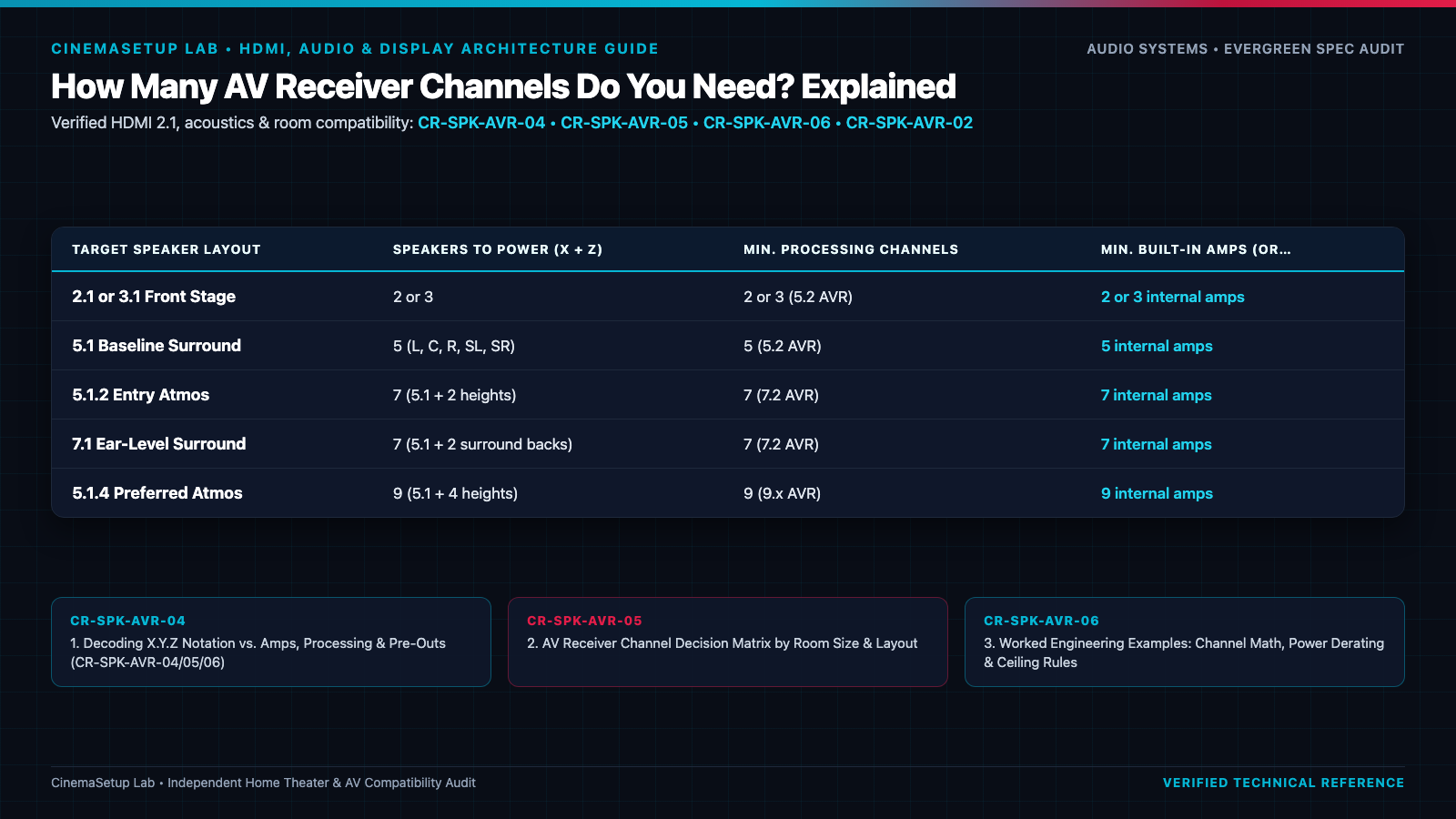
2. AV Receiver Channel Decision Matrix by Room Size & Layout
Match your room volume, seating rows, and ceiling alterations permission against the matrix below to find the exact processing and amplifier count required for your build. For deeper speaker placement geometry across each setup tier, inspect our Dolby Atmos speaker layouts explained guide.
| Target Speaker Layout | Speakers to Power (X + Z) | Min. Processing Channels | Min. Built-In Amps (or Pre-Out Path) | Best Room & Usage Fit | Critical Compatibility Caveat |
|---|---|---|---|---|---|
| 2.1 or 3.1 Front Stage | 2 or 3 | 2 or 3 (5.2 AVR) | 2 or 3 internal amps | Small bedroom or apartment (< 1,500 cu ft / 42 m³) | Add a matching-series center (CR-SPK-SPK-01) for wide couches |
| 5.1 Baseline Surround | 5 (L, C, R, SL, SR) | 5 (5.2 AVR) | 5 internal amps | Starter living rooms or rentals without height installs | Zero overhead Atmos speakers; DSP virtualization is not physical height (CR-SYS-05) |
| 5.1.2 Entry Atmos | 7 (5.1 + 2 heights) | 7 (7.2 AVR) | 7 internal amps | Standard 1,500–3,000 cu ft (42–85 m³) living rooms | Most common sweet spot; powered Zone 2 drops main room to 5.1 (CR-SPK-AVR-06) |
| 7.1 Ear-Level Surround | 7 (5.1 + 2 surround backs) | 7 (7.2 AVR) | 7 internal amps | Long rooms where couch sits ≥ 4–6 ft (1.2–1.8 m) off back wall | Uses the 2 spare channels for rear ear-level rather than overhead Atmos |
| 5.1.4 Preferred Atmos | 9 (5.1 + 4 heights) | 9 (9.x AVR) | 9 internal amps | Dedicated rooms or living rooms wanting front-to-rear overhead pans | Best 4-height balance when couch sits near the back wall |
| 7.1.2 Wide / Long Room | 9 (7.1 + 2 heights) | 9 (9.x AVR) | 9 internal amps | Deep multi-row rooms limited to 2 overhead speakers | Needs space behind main row for surround backs |
| 7.1.4 / 7.2.4 Full Atmos | 11 (7.1 + 4 heights) | 11 (11.x processing) | 11 amps, OR 9 amps + 2-ch external amp | Dedicated theaters (≥ 2,500 cu ft / 71 m³) with back-wall clearance | Confirm 11-ch pre-outs (CR-SPK-AVR-05); budget extra for the 2-ch power amp |
| 5.1.2 + Powered Zone 2 | 7 main + 2 patio/kitchen | 7 main + Zone 2 routing | 9 internal amps (or 7.2 + Zone 2 external amp) | Living room Atmos plus simultaneous outdoor/kitchen stereo | Requires 9 built-in amps to run 5.1.2 and Zone 2 simultaneously |
3. Worked Engineering Examples: Channel Math, Power Derating & Ceiling Rules
Channel count is tied directly to amplifier power sharing and physical room geometry. Working through two concrete engineering examples shows why “more channels” changes both your electrical headroom and your installation plan.
Worked Example A: The 5.1.2 + Patio Zone 2 Channel Audit (CR-SPK-AVR-04 & CR-SPK-AVR-06)
Suppose you want a 5.1.2 Dolby Atmos setup in a 15 × 20 × 8 ft (4.6 × 6.1 × 2.4 m; ~2,400 cu ft / 68 m³) living room and two wired outdoor patio speakers powered by Zone 2 while movies play inside:
- Main Room Processing Check (CR-SPK-AVR-04):
5 ear-level + 2 heights = 7processed channels in the main theater. - Simultaneous Amplifier Check (CR-SPK-AVR-06):
7 main speakers + 2 Zone 2 speakers = 9active amplifier channels required simultaneously. - Hardware Result: A 7.2 AVR passes step 1 when Zone 2 is off, but fails step 2 when Zone 2 is active—forcing the living room back to
5.1. To run both rooms together without unplugging wires, you either step up to a 9-amp AVR (allocating 7 amps to the main 5.1.2 layout and 2 amps to Zone 2) or use a 7.2 AVR’s line-level Zone 2 pre-out feeding a dedicated 2-channel patio amplifier.
Worked Example B: Multichannel Power Derating Estimate (CR-SPK-AVR-02 & CR-SPK-AVR-03)
All AVRs inside a single chassis share one main transformer and power supply. Under rule CR-SPK-AVR-03, manufacturers publish headline power using 8 ohms, 20 Hz–20 kHz, stated THD, with 2 channels driven—because driving 7 or 9 speakers simultaneously lowers available per-channel output. Under CinemaSetup Lab’s conservative spec-audit convention, we apply an approximate 30% multichannel derating to estimate real-world multichannel headroom (never presenting formula estimates as lab measurements):
- Assumptions: Bookshelf speakers rated at 87 dB sensitivity (2.83 V / 1 m, 8 ohms) placed 11.5 ft (3.5 m) from the main listening seat, paired with an AVR rated at 80 W/ch (8 ohms, 20 Hz–20 kHz, 0.08% THD, 2 ch driven).
- Distance Attenuation: Free-field inverse-square loss at 3.5 m equals
20 × log10(3.5) ≈ 10.9 dB(using0 dBconservative room gain). - By Our Estimate From Published Specs (95 dB Living-Room Peaks): Required peak power per channel is
10 ^ ((95 + 10.9 - 87) / 10) ≈ 78 W. After a ~30% multichannel derating, an 80 W/ch AVR provides roughly56 Wper channel—within ~1.4 dB of 95 dB peaks, which handles typical living-room movie playback comfortably once bass below 80 Hz is offloaded to a powered subwoofer (CR-SUB-SPK-01). - Why Channel Count Impacts Power: Pushing that same 87 dB speaker to 100 dB peaks (+5 dB louder) jumps estimated power demand to roughly
245 Wper channel. When running 7 or 9 speakers at high volume in a large room, stepping up to high-sensitivity speakers (92+ dB at 2.83 V / 1 m) or offloading front channels to an external power amp via pre-outs relieves thermal load on the AVR’s internal power supply far more effectively than chasing inflated 6-ohm 1 kHz marketing specs.
Physical Ceiling Geometry Determines .2 vs. .4 Height Value
Before paying extra for a 9.4- or 11.4-channel AVR to unlock .4 overhead sound, confirm your ceiling can actually support four physical height positions. According to Dolby Laboratories’ home theater installation guidelines, overhead layouts work best under flat, acoustically reflective ceilings between 7.5 and 12 ft (2.3 and 3.7 m) high:
- 5.1.2 Overhead Placement: A single pair of Top Middle in-ceiling speakers mounts slightly forward of the seating row at a 65° to 100° elevation angle from ear level (or as front-height on-wall modules if ceiling cutouts are prohibited).
- 5.1.4 / 7.1.4 Overhead Placement: Requires two pairs—Top Front at 30° to 55° (45° ideal) ahead of the listener and Top Rear at 30° to 45° behind the listener. If your sofa is pressed flush against the back wall, you have zero physical depth behind your ears for Top Rear ceiling speakers or Surround Backs, making a 7.2-channel
5.1.2system far more practical than forcing cramped rear channels. For step-by-step transition planning, see our roadmap on upgrading from 5.1 to 5.1.4 Atmos. - Up-Firing Atmos Modules (CR-SPK-ROOM-01): Renter-friendly upward-firing speakers depend on a flat, hard ceiling to bounce sound toward the couch; vaulted, sloped, or heavily treated ceilings smear the reflection, reducing the benefit of extra height channels.
4. Myth vs. Engineering Reality: 5 Channel Traps That Waste Budget
5 AV Receiver Channel Myths Audited Against Compatibility Rules:
- Myth 1: “Dolby Height Virtualization on a 5.1 receiver equals 5.1.2 Atmos.” Reality (CR-SYS-05): DSP virtualization modes like Dolby Height Virtualization and DTS Virtual:X process phase cues through ear-level speakers; they are not physical overhead speakers and cannot localize sound directly above your head the way
.2or.4drivers do. - Myth 2: “Adding a 2-channel external amp to my 7.2 AVR turns it into 5.1.4.” Reality (CR-SPK-AVR-04): Front L/R pre-outs on a 7.2 receiver (such as the US Denon AVR-X1800H) let an external amp relieve load on the front towers, but the internal processor still stops at 7 speaker channels. You cannot decode 9 channels on a 7-channel processor.
- Myth 3: “An 11.2 or 11.4 receiver includes 11 built-in amplifiers.” Reality (CR-SPK-AVR-05): Most enthusiast receivers under $2,000 advertise
11.2or11.4processing while housing 9 internal amplifiers. Running 11 speakers in7.1.4requires buying an external 2-channel power amplifier and connecting it to the pre-outs. - Myth 4: “Two subwoofer outputs always calibrate two subs independently.” Reality (CR-SUB-AVR-02): Entry 5.2 and 7.2 AVRs—and even some 9.2 units—wire both subwoofer jacks in parallel. Both subs receive identical delay and EQ unless the spec sheet explicitly confirms independent dual or quad subwoofer outputs.
- Myth 5: “Bi-amping front towers with unused surround-back AVR channels doubles power.” Reality (CR-SPK-AVR-06): Passive bi-amping from the same AVR chassis draws from the exact same internal power supply and transformer while consuming two amplifier channels you may need later for Atmos heights or Zone 2.
5. Verified US 120V AV Receivers Matched to Each Channel Tier
Every receiver below comes from verified North American 120V AC / 60 Hz Amazon US inventory checked as of 2026-11-26, mapped cleanly to a distinct channel tier. Remember our audio budget rule (CR-SYS-01): dedicate at least 50% of your audio budget to passive speakers and subwoofers rather than over-buying receiver channels you will never wire. For full multi-model rankings in the Atmos tiers, explore our best AV receiver for Dolby Atmos roundup. Always check the Sold by line at Amazon checkout to confirm authorized US dealer status, as unauthorized third-party sellers often forfeit US manufacturer warranty coverage (G-26).
1. Denon AVR-S570BT — 5.2-Channel Baseline (2.1, 3.1 & 5.1 Without Heights)

Key Audited Specs & Box Contents: 5 built-in amps / 5.2 processing (max layout: 5.1 ear-level; no Dolby Atmos height channels) | 70 W/ch (8 ohms, 20 Hz–20 kHz, 0.08% THD, 2 ch driven) | 6–16 ohm speaker impedance | 4x 40 Gbps HDMI 2.1 inputs / 1x eARC output | 2 parallel (mirrored) subwoofer pre-outs | Dimensions: 17.1 × 13.0 × 6.0 in (43.4 × 33.0 × 15.1 cm), 16.8 lb (7.6 kg) | In the Box: US 120V AVR-S570BT chassis, remote with batteries, setup microphone, power cord, antennas, quick-start guide (speakers, subwoofer, and HDMI cables sold separately) | Price Tier: $300-$500
If you live in an apartment, rent with strict ceiling restrictions, or simply know your living room will never expand beyond five ear-level speakers plus a powered subwoofer, the Denon AVR-S570BT gives you a clean 5.2 foundation without paying for unused Dolby Atmos amplification. Despite its entry tier, all four HDMI inputs support 40 Gbps 4K/120Hz and 8K/60Hz passthrough alongside eARC, Dolby Vision, HDR10+, Dolby TrueHD, and DTS-HD Master Audio decoding. Note two hard compatibility constraints: Denon rates this chassis strictly for 6 to 16 ohm speakers (avoid 4-ohm towers under CR-SPK-AVR-01), and its 5-channel processor cannot decode or drive physical overhead height speakers.
Pros
- All four HDMI inputs pass 40 Gbps 4K/120Hz, VRR, ALLM, Dolby Vision, and HDR10+
- Decodes lossless Dolby TrueHD and DTS-HD Master Audio for 5.1 Blu-ray and eARC playback
Cons
- No Dolby Atmos or DTS:X height processing or terminals (CR-SPK-AVR-04 caps at 5.1)
- 6-ohm minimum speaker rating excludes 4-ohm speaker loads; lacks Wi-Fi/HEOS and multichannel pre-outs
2. Denon AVR-X1800H — 7.2-Channel Living-Room Sweet Spot (5.1.2 Atmos or 7.1)

Key Audited Specs & Box Contents: 7 built-in amps / 7.2 processing (max layout: 5.1.2 Dolby Atmos/DTS:X or 7.1 ear-level) | 80 W/ch (8 ohms, 20 Hz–20 kHz, 0.08% THD, 2 ch driven) | 4–16 ohm support (with 4-ohm menu setting) | Pre-outs: Front L/R (US model), Zone 2, 2 parallel sub outputs | 6 HDMI in (3x 40 Gbps: HDMI 4, 5, 6; 3x 18 Gbps: HDMI 1–3) / 1x eARC out | Audyssey MultEQ XT | Dimensions: 17.1 × 13.3 × 6.0 in (43.4 × 33.8 × 15.2 cm), 19.0 lb (8.6 kg) | In the Box: US 120V AVR-X1800H chassis, remote with batteries, Audyssey mic + stand, power cord, antennas, quick-start guide (speakers, sub, and HDMI cables sold separately) | Price Tier: $500-$1,000
For most single-row US living rooms, 7.2 channels is the engineering sweet spot—and the Denon AVR-X1800H handles both 5.1.2 physical Dolby Atmos and 4K/120Hz gaming cleanly inside the Core budget tier. Unlike the entry S570BT, the X1800H officially supports 4-ohm speaker loads when toggled in its speaker-impedance menu (with ECO Mode off and clear cabinet ventilation under CR-AVR-ROOM-01) and adds Audyssey MultEQ XT across up to 8 microphone positions. The North American 120V model also adds Front L/R pre-outs for an external stereo amp on demanding front towers, though 7-channel processing still caps the total layout at 5.1.2 (CR-SPK-AVR-04) and powered Zone 2 drops the main room to 5.1 (CR-SPK-AVR-06).
Pros
- Runs 5.1.2 Atmos or 7.1 surround natively with three 40 Gbps HDMI 2.1 inputs (HDMI 4–6)
- Supports 4–16 ohm speakers and includes US-exclusive Front L/R pre-outs plus Audyssey MultEQ XT
Cons
- 7-channel DSP permanently prevents 5.1.4 or 7.1.4 expansion, and dual sub outs are mirrored
- HDMI 1, 2, and 3 are 18 Gbps ports (4K/60Hz max); single HDMI monitor output; no Dirac Live upgrade
3. Denon AVR-X3900H — 9.4-Channel / 11.4-Processing Hub (5.1.4 Native, 7.1.4 w/ 2-Ch Amp)

Key Audited Specs & Box Contents: 9 built-in amps / 11.4 processing (5.1.4 or 7.1.2 native; 7.1.4 with external 2-ch amp) | 105 W/ch (8 ohms, 20 Hz–20 kHz, 0.08% THD, 2 ch driven) | 4–16 ohm support (with 4-ohm menu setting) | Pre-outs: Full 11.4 multichannel pre-outs + 4 independent subwoofer outputs | 6 HDMI 2.1 40 Gbps inputs / dual eARC outputs | Audyssey MultEQ XT32 (Dirac Live, Bass Control & ART optional paid licenses) | Dimensions: 17.1 × 14.9 × 6.6 in (43.4 × 37.9 × 16.7 cm) without antennas | In the Box: US 120V AVR-X3900H chassis, remote with batteries, Audyssey mic + stand, power cord, antennas, quick-start guide (external 2-ch amp for 7.1.4, speakers, subs, and cables sold separately) | Price Tier: $1,500-$2,000
Replacing the older AVR-X3800H across active US retail channels, the Denon AVR-X3900H is the benchmark answer when your theater demands four overhead Atmos channels (5.1.4) or full 7.1.4 surround. Out of the box, its nine 105 W/ch internal amplifiers drive 5.1.4 or 5.1.2 + powered Zone 2 without dropping channels in the main room. Because it includes full 11.4-channel processing and 11.4 RCA pre-outs (CR-SPK-AVR-05), adding an inexpensive 2-channel external amplifier unlocks a complete 11-speaker 7.1.4 room—while four independent subwoofer outputs (CR-SUB-AVR-02) let Audyssey MultEQ XT32 or an optional paid Dirac Live Bass Control license calibrate up to four subwoofers individually.
Pros
- Runs 5.1.4 natively and scales cleanly to 7.1.4 via full 11.4 processing and 11.4 pre-outs
- Four independent subwoofer outputs plus Audyssey MultEQ XT32 and 40 Gbps HDMI 2.1 switching
Cons
- Only 9 internal amplifiers—7.1.4 requires purchasing a separate 2-channel external power amp (CR-SPK-AVR-05)
- Dirac Live Room Correction, Bass Control, and ART require separate paid software licenses (CR-AVR-ROOM-02)
4. Onkyo TX-RZ50 — 9.2-Channel / 11.2-Processing Alternative With Included Dirac Live

Key Audited Specs & Box Contents: 9 built-in amps / 11.2 processing (5.1.4 native; 7.1.4 with external 2-ch amp) | 120 W/ch (8 ohms, 20 Hz–20 kHz, 0.08% THD, 2 ch driven) | 4–16 ohm support | Pre-outs: 11.2 multichannel pre-outs + 2 mirrored (parallel) sub outputs | Rear HDMI: 3x 40 Gbps (HDMI 1–3) + 3x 24 Gbps (HDMI 4–6) + 9 Gbps front / dual HDMI outs | Included Full-Bandwidth Dirac Live | Dimensions: 17.13 × 15.69 × 7.94 in (43.5 × 39.8 × 20.15 cm), 30.9 lb (14.0 kg) | In the Box: US 120V TX-RZ50 chassis, remote with batteries, calibration mic, power cord, antennas, quick-start guide (external 2-ch amp for 7.1.4, speakers, subs, and cables sold separately) | Price Tier: $1,000-$1,600
If you want 5.1.4 out of the box and an upgrade path to 7.1.4 with Full-Bandwidth Dirac Live included at no extra license fee, the Onkyo TX-RZ50 is a strong Enthusiast alternative to the Denon AVR-X3900H. Like the X3900H, it pairs 9 built-in amplifiers (rated at 120 W/ch, 8 ohms, 2 ch driven) with 11-channel processing and 11.2 pre-outs, so reaching 7.1.4 requires a 2-channel external amplifier (CR-SPK-AVR-05). Keep two key trade-offs in mind: its dual subwoofer jacks output a single mirrored mono signal rather than independent sub channels (CR-SUB-AVR-02), and only rear inputs HDMI 1, 2, and 3 carry full 40 Gbps bandwidth (inputs 4–6 cap at 24 Gbps under CR-SRC-AVR-01). Also measure your rack carefully—at nearly 8 in (20.2 cm) tall and 15.7 in (39.8 cm) deep, it needs extra shelf clearance.
Pros
- Includes Full-Bandwidth Dirac Live license out of the box alongside 11.2 pre-outs for 7.1.4 expansion
- 120 W/ch continuous 8-ohm rating with 4-ohm speaker compatibility and dual HDMI outputs
Cons
- Dual subwoofer outputs are mirrored (no independent multi-sub delay/EQ or Dirac Bass Control)
- Tall 7.94 in (20.2 cm) chassis requires generous cabinet height; only HDMI 1–3 carry 40 Gbps
6. Cabinet Ventilation, CL2/CL3 In-Wall Wiring & Installation Safety
Safety, Structural & Electrical Compliance Notice (G-27 / CR-AVR-ROOM-01 / CR-ACC-SPK-02):
- Receiver Clearance & Thermal Protection (CR-AVR-ROOM-01): Higher-channel AVRs running 7 or 9 speakers simultaneously—especially into 4-ohm loads—dissipate substantial heat. Always follow the manufacturer’s printed manual for top and rear ventilation clearances (typically 4–6 in / 10–15 cm of unobstructed open space above the chassis) and avoid sealed glass-front cabinets without active cooling fans.
- UL CL2 / CL3 Wire for In-Ceiling & In-Wall Heights (CR-ACC-SPK-02): If you expand from 5.1 to 5.1.2 or 7.1.4 using in-wall or in-ceiling speakers, route exclusively UL-listed CL2 or CL3 (or local building-code equivalent) pure oxygen-free copper (OFC) wire inside drywall cavities. Follow CR-ACC-SPK-01 run limits for 8-ohm speakers: 16 AWG up to 50 ft (15.2 m), 14 AWG up to 79 ft (24.1 m), and 12 AWG up to 126 ft (38.4 m)—halving maximum distance for 4-ohm speakers.
- Manufacturer-Instruction-First Mounting & Pro Referrals: Before cutting drywall for in-ceiling Atmos channels or mounting heavy angled height speakers overhead, follow the speaker and bracket manufacturer’s instructions, confirm clear joist cavity depth (CR-SPK-ROOM-03), scan for electrical wiring, plumbing, and framing studs, and hire a licensed electrician or licensed AV installer whenever local electrical codes or structural anchoring are involved. Keep listening volume at comfortable levels during extended sessions.
- US 120V AC Verification (CR-SYS-02): Confirm that any AV receiver listing specifies North American 120V AC / 60 Hz mains voltage and an authorized US dealer on the checkout screen so factory warranty coverage remains intact (G-26).
7. Authoritative Standards & Manufacturer References
- Denon USA Official Specifications & Owner’s Manuals: Denon AVR-S570BT (70 W/ch 8-ohm rating, 6–16 ohm impedance, 4x 40 Gbps HDMI), AVR-X1800H (80 W/ch 8-ohm rating, 4–16 ohm impedance setting, US Front L/R pre-outs, parallel dual sub outs), and AVR-X3900H (9.4 amps / 11.4 processing, 105 W/ch 8-ohm rating, 4 independent sub outs, Dirac Live upgrade compatibility) at denon.com.
- Onkyo USA Official Specifications & Connection Guidelines: Onkyo TX-RZ50 (9.2 amps / 11.2 pre-outs, 120 W/ch 8-ohm rating, 4–16 ohm support, parallel dual sub pre-outs, included Full-Bandwidth Dirac Live) at onkyousa.com.
- Dolby Laboratories Home Theater Setup Guidelines: Dolby Atmos 5.1.2, 5.1.4, and 7.1.4 overhead speaker elevation angles (65°–100° Top Middle; 30°–55° Top Front / Top Rear) and 7.5–12 ft (2.3–3.7 m) flat reflective ceiling guidance at dolby.com.
- HDMI Forum / HDMI Licensing Administrator: HDMI 2.1 Fixed Rate Link (40/48 Gbps) bandwidth, eARC lossless audio return, and Ultra High Speed HDMI Cable Certification specifications at hdmi.org.
How We Audited This Guide
- Audio gear was audited across 8-ohm/4-ohm impedance stability, HDMI 2.1 40 Gbps switching and eARC/CEC behavior, speaker sensitivity and center dialogue dispersion, subwoofer room volume sizing, and US warranty authorization.
- Every AV receiver, speaker, subwoofer, soundbar, OLED/Mini-LED TV, projector, source player, and accessory spec was cross-checked against official manufacturer manuals, CEA/CTA standards, and live Amazon US listings.
- Recommendations were evaluated against our weighted vertical scoring rubrics and documented CR-* compatibility rules; we never invent nits, contrast ratios, bench wattage, or room decibels.
Continue Your Audit
8. Frequently Asked Questions
How many channels do I need on an AV receiver for Dolby Atmos?
You need at least a 7.2-channel AVR to run a physical 5.1.2 Dolby Atmos layout (five ear-level speakers, one powered subwoofer, and two height speakers). Stepping up to four overhead speakers in 5.1.4 requires a 9-channel receiver, while 7.1.4 requires 11 processing channels.
What is the difference between amplifier channels and processing channels?
Processing channels define how many speaker positions the receiver’s DSP can decode, while amplifier channels indicate how many speakers it can power internally. A 9-amp receiver with 11.4 processing (like the Denon AVR-X3900H) drives 5.1.4 natively and runs 7.1.4 by adding a 2-channel external amp.
Do subwoofer outputs count toward AV receiver speaker amplifier channels?
No. The “.1”, “.2”, or “.4” number represents line-level RCA subwoofer pre-outs feeding powered subwoofers with their own built-in amplifiers. However, check whether a receiver’s dual subwoofer jacks are mirrored (sharing one calibration) or independent before buying two subwoofers.
Does using Zone 2 reduce my main home theater surround channels?
Yes, when using the AVR’s internal speaker terminals for powered Zone 2. Assigning two built-in amplifiers to patio or kitchen speakers borrows two channels from your main theater—dropping a 7.2 receiver from 5.1.2 Atmos down to 5.1 whenever Zone 2 is active.
Can a 5.2-channel AV receiver play Dolby Atmos with up-firing speakers?
No. Under rule CR-SPK-AVR-04, a 5.2 receiver stops at five speaker channels (Front L/R, Center, and Surround L/R). It has zero height speaker terminals or overhead decoding, so physical up-firing modules or ceiling speakers require at least a 7.2-channel AVR.
Is 7.1.4 worth stepping up to over 5.1.2 in a normal living room?
Only if your couch sits at least 4 to 6 ft (1.2 to 1.8 m) away from the back wall so Top Rear height speakers and Surround Backs sit cleanly behind your ears. When seating sits flush against a back wall, a 7.2-channel 5.1.2 system avoids cramped rear geometry.


