
Disclosure: As an Amazon Associate, I earn from qualifying purchases. If you buy through links on this page, CinemaSetup Lab may earn a small commission at no extra cost to you. Commission schedules (for example, 2% on televisions versus 4% on most AV receivers, speakers, and accessories) never influence our technical audits, compatibility verdicts, or hardware selections.
Before mounting ceiling speakers or buying an AV receiver from our home theater setup guide, you need dolby atmos speaker layouts explained in plain engineering terms: how many physical drivers each X.Y.Z number requires, what angles Dolby specifies overhead, and where your room walls stop expansion cold. Adding channels without verifying seating distance, ceiling height, and processor capacity wastes both hardware budget and room acoustics.
Quick Answer: Choose 5.1.2 (7 speaker channels + subwoofer) when seating sits near a back wall; choose 5.1.4 (9 channels) for front-to-rear overhead pans with 4+ ft (1.2+ m) behind your couch; and reserve 7.1.4 (11 channels) for dedicated rooms where Surround Backs and Top Rears both clear the rear wall.
Unlike traditional channel-based 5.1 or 7.1 surround tracks, Dolby Atmos mixes audio as 3D sound objects placed in three-dimensional coordinates alongside a bed layer. Your AV receiver (AVR) or Atmos soundbar renders those objects onto the physical speakers actually connected in your room. That makes speaker geometry, elevation angles, and honest physical-versus-virtual channel accounting far more important than chasing the biggest number printed on a retail carton.
In This Guide
- 1. Decoding X.Y.Z Notation, AVR Processing Limits & Virtualization (CR-SPK-AVR-04 & CR-SYS-05)
- 2. Dolby Atmos Speaker Layout Matrix: 5.1.2 Through 7.1.4 & 7.1.6
- 3. Dolby Elevation Angles, Ear-Level Geometry & Worked Room Examples (CR-SPK-ROOM-02)
- 4. In-Ceiling vs. On-Wall Heights vs. Up-Firing Modules (CR-SPK-ROOM-01 & CR-SPK-ROOM-03)
- 5. Myth vs. Engineering Reality: 5 Dolby Atmos Layout Traps
- 6. Verified US Hardware Examples Across Layout Tiers
- 7. Stud Anchoring, CL2/CL3 In-Wall Wire & Electrical Safety (G-27)
- 8. Authoritative Standards & Manufacturer References
- 9. Frequently Asked Questions
1. Decoding X.Y.Z Notation, AVR Processing Limits & Virtualization
Every Dolby Atmos layout is written as three numbers separated by periods: X.Y.Z. Each position maps to a distinct physical speaker layer and amplifier requirement:
- X — Ear-Level Bed Speakers: Front Left (FL), Center (C), Front Right (FR), Side Surrounds (SL/SR), and optional Surround Backs (SBL/SBR). In home systems,
Xis almost always5or7(or9when Front Wide speakers are added in large rooms). - .Y — Subwoofer / LFE Outputs: Line-level Low-Frequency Effects (LFE) and bass-managed low end sent to
1,2, or4powered subwoofers (CR-SUB-AVR-01). Because active home theater subwoofers carry their own internal amplifiers,.Ynever uses up your AVR’s speaker amplifier channels. - .Z — Physical Height / Overhead Speakers: Overhead in-ceiling speakers, high on-wall angled speakers, or Dolby Atmos enabled upward-firing modules. Adding
.2gives one pair of height channels; stepping up to.4adds both a front height pair and a rear height pair.
Rule CR-SPK-AVR-04 (HARD) & CR-SPK-AVR-05: Counting Processing vs. Amp Channels
To verify whether an AV receiver supports your target layout, add X + Z (ear-level speakers plus height speakers) and compare that sum against the receiver’s DSP processing limit. Under hard rule CR-SPK-AVR-04, your speaker layout cannot exceed the AVR’s processing channels—no external amplifier can add missing surround decoding. A 7.2-channel receiver caps permanently at 5.1.2 (5 + 2 = 7) or 7.1 (7 + 0 = 7). Moving to 5.1.4 (9 speakers) requires at least a 9-channel AVR, while 7.1.4 (11 speakers) demands 11 processing channels. Under CR-SPK-AVR-05, 9-amp receivers with 11.4 processing (such as the current US Denon AVR-X3900H) run 5.1.4 out of the box and unlock 7.1.4 conditionally once you add a 2-channel external power amplifier to the pre-outs. See our how many AV receiver channels guide for full pre-out and Zone 2 channel math.
Rule CR-SYS-05 (INFO): Physical Height Channels vs. DSP Height Virtualization
Many entry 5.2-channel AVRs and single-bar soundbars advertise “Dolby Atmos” on the box even though they have zero physical height terminals or upward-firing drivers. Under CinemaSetup Lab honesty rule CR-SYS-05, software modes like Dolby Atmos Height Virtualization and DTS Virtual:X use psychoacoustic EQ and phase delays through ear-level drivers—they do not constitute a .2 or .4 physical Atmos speaker layout. True Atmos localization overhead requires physical .2, .4, or .6 height transducers.
2. Dolby Atmos Speaker Layout Matrix: 5.1.2 Through 7.1.4 & 7.1.6
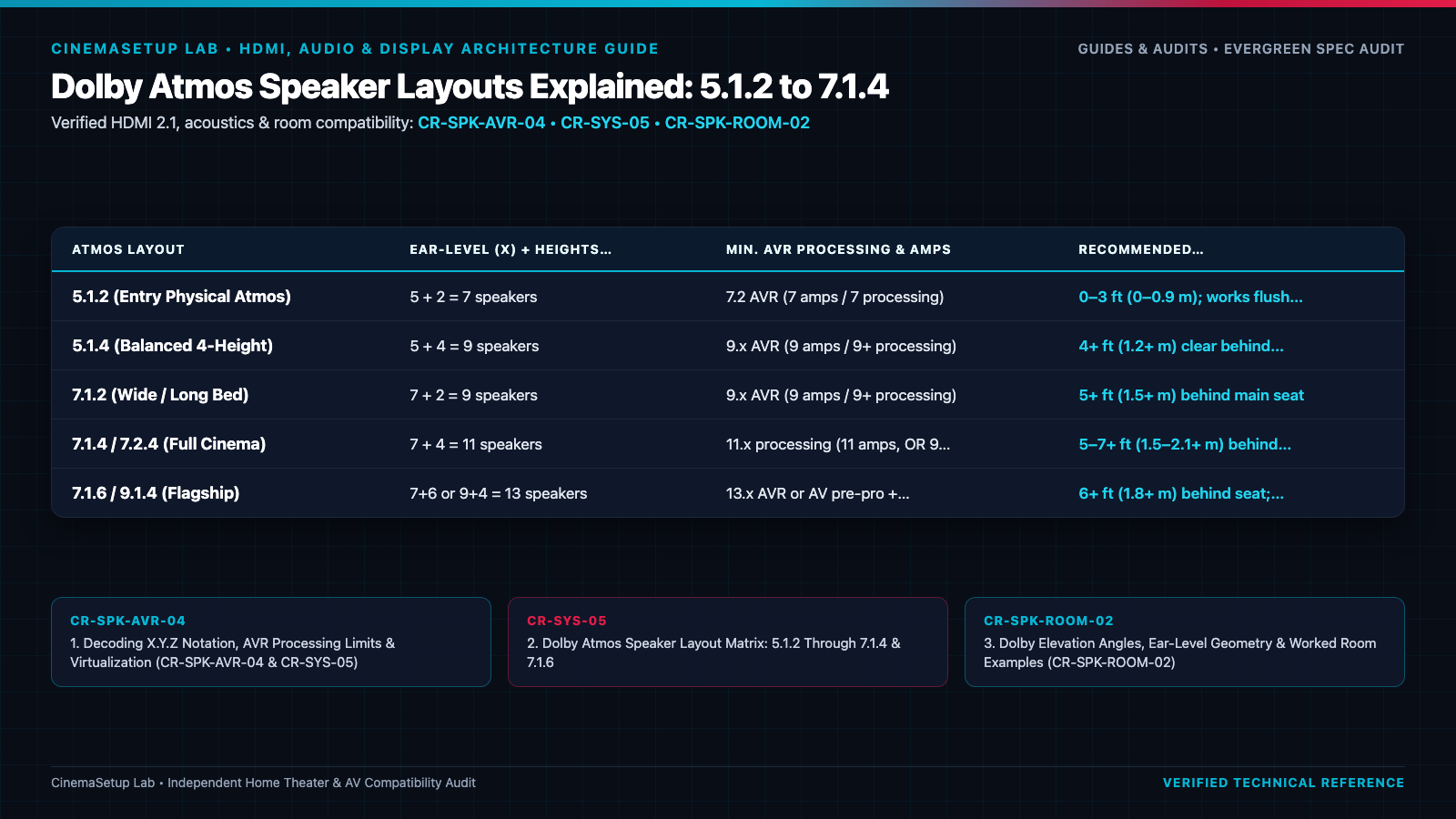
Use the matrix below to match each Dolby Atmos speaker layout against AVR channel capacity, behind-the-couch depth, and ideal room size. If you are deciding between adding two rear ear-level channels versus two overhead speakers on a 7-channel receiver, compare both paths directly in our 7.1 vs 5.1.2 surround comparison.
| Atmos Layout | Ear-Level (X) + Heights (Z) | Min. AVR Processing & Amps | Recommended Seat-to-Back-Wall Depth | Best Room & Setup Fit | Critical Compatibility Caveat |
|---|---|---|---|---|---|
| 5.1.2 (Entry Physical Atmos) | 5 + 2 = 7 speakers | 7.2 AVR (7 amps / 7 processing) | 0–3 ft (0–0.9 m); works flush against rear wall | Living rooms 1,500–3,000 cu ft (42–85 m³) with single row | Top Middle mounts slightly forward (65°–100°); no front-to-back overhead pans |
| 5.1.4 (Balanced 4-Height) | 5 + 4 = 9 speakers | 9.x AVR (9 amps / 9+ processing) | 4+ ft (1.2+ m) clear behind main seat | Media rooms wanting distinct front and rear overhead motion | Top Rears crowd listeners if couch sits within 2 ft (0.6 m) of the back wall |
| 7.1.2 (Wide / Long Bed) | 7 + 2 = 9 speakers | 9.x AVR (9 amps / 9+ processing) | 5+ ft (1.5+ m) behind main seat | Deep rooms with narrow ceiling access limited to 2 overhead speakers | Prioritizes rear ear-level SBL/SBR over front-to-back overhead depth |
| 7.1.4 / 7.2.4 (Full Cinema) | 7 + 4 = 11 speakers | 11.x processing (11 amps, OR 9 amps + 2-ch ext. amp) | 5–7+ ft (1.5–2.1+ m) behind main seat | Dedicated theaters ≥ 2,400 cu ft (68 m³) with 1–2 seating rows | Confirm 11-ch pre-outs on 9-amp AVRs (CR-SPK-AVR-05) and independent sub outs (CR-SUB-AVR-02) |
| 7.1.6 / 9.1.4 (Flagship) | 7+6 or 9+4 = 13 speakers | 13.x AVR or AV pre-pro + external amps | 6+ ft (1.8+ m) behind seat; wide room for Front Wides | Large dedicated rooms > 4,000 cu ft (113 m³) with multi-row seating | High channel count demands careful power-supply sizing and studio-style geometry |
3. Dolby Elevation Angles, Ear-Level Geometry & Worked Room Examples
Buying nine or eleven speakers does not automatically create an accurate soundfield. Under rule CR-SPK-ROOM-02, overhead speakers must maintain specific vertical elevation angles relative to your seated ear level (typically 36 to 42 in / 91 to 107 cm off the floor), while ear-level bed speakers must stay near ear height so vertical panning remains distinct.
Dolby Published Horizontal & Overhead Angle Targets
- Front Left & Right (FL / FR): Place at 22° to 30° off-center from the main listening position, forming an equilateral or slightly narrower triangle with the listener. Keep tweeters near seated ear height and timbre-match the Center channel (0°) from the same speaker series (CR-SPK-SPK-01).
- Side Surrounds (SL / SR): In
5.1.2and5.1.4, place Side Surrounds slightly behind the ear line at 110° to 120°. In7.1.2and7.1.4, shift Side Surrounds forward to 90° to 110° to make room for Surround Backs (SBL/SBR) at 135° to 150°. Avoid mounting surrounds high up on the ceiling—Dolby specifically notes ear-level surrounds should stay within roughly 0 to 1.25× seated ear height so they do not blur into the overhead height layer. - 5.1.2 Top Middle (.2): Mount directly overhead or slightly ahead of the seated ear line at 65° to 100° elevation (80° ideal), aligned horizontally in line with your Front Left and Front Right speakers.
- 5.1.4 / 7.1.4 Top Front & Top Rear (.4): Mount Top Front speakers at 30° to 55° elevation ahead of the listener (45° ideal), and Top Rear speakers at 30° to 55° elevation behind the listener (45° ideal, equivalent to 125°–150° measured from the front horizontal axis).
Worked Geometry & Power Examples (CR-SPK-ROOM-02, CR-SPK-AVR-02 & CR-SUB-SPK-01)
Trigonometry shows immediately why room depth dictates whether your space suits 5.1.2 or 5.1.4. Consider a typical 14 × 18 × 9 ft (4.3 × 5.5 × 2.7 m) media room (~2,268 cu ft / 64 m³) with seated ear height at 3.3 ft (1.0 m):
- Vertical Rise to Ceiling: Subtracting ear height from ceiling height leaves
9.0 ft - 3.3 ft = 5.7 ft (1.7 m)of vertical height above the listener’s ears. - Ideal 5.1.4 Top Front / Top Rear Offsets (CR-SPK-ROOM-02): At Dolby’s ideal 45° elevation angle (
tan 45° = 1.0), both the Top Front and Top Rear ceiling speakers should sit 5.7 ft (1.7 m) horizontally ahead of and behind your head. Even at the steep 55° limit (5.7 / tan 55° ≈ 4.0 ft), you still need at least 4.0 ft (1.2 m) of clear floor space behind your ears—plus extra depth for Surround Backs if stepping up to7.1.4. - Wall-Adjacent Sofa Pivot: If your sofa sits only 1.5 ft (0.46 m) off the rear wall, placing rear ceiling speakers there pushes elevation past 75°, collapsing separation from overhead. Pivoting to
5.1.2with Top Middle speakers at 80° places them just5.7 / tan 80° ≈ 1.0 ft (0.3 m)ahead of the couch—cleanly inside Dolby’s spec while saving two speaker channels and allowing a 7.2-channel AVR. For step-by-step wiring and receiver swaps when your room does have rear clearance, review our upgrading from 5.1 to 5.1.4 Atmos roadmap. - Amplifier Headroom & 80 Hz Crossover Estimate (CR-SPK-AVR-02 & CR-SUB-SPK-01): By our estimate from published specs (assumptions: 87 dB sensitivity at 2.83 V / 1 m, 8 ohms, 11.5 ft / 3.5 m seat distance, 0 dB room gain), reaching 95 dB living-room peaks requires roughly 78 W per channel. Applying CinemaSetup Lab’s conservative ~30% multichannel derating, a typical 80 W/ch (8 ohms, 20 Hz–20 kHz, 2 ch driven) AVR supplies roughly 56 W per channel when 7 speakers play simultaneously—adequate for typical living-room movie volumes once you set speakers to Small with an 80 Hz crossover to a powered subwoofer (CR-SUB-SPK-01).
4. In-Ceiling vs. On-Wall Heights vs. Up-Firing Modules
Every Atmos height layout (.2 or .4) can be built using three physical speaker styles, each governed by strict room rules. For a deep architectural comparison, see our up-firing vs in-ceiling Atmos speakers breakdown.
| Height Speaker Style | Ceiling & Structural Requirement | Acoustic Localization | Primary Failure Mode | Applicable Rules |
|---|---|---|---|---|
| In-Ceiling Speakers | Clear joist cavity depth (typically 3.5–5.5 in / 9–14 cm) + owner permission | Highest precision overhead; invisible grille aesthetic | Drywall/joist obstructions, concrete ceilings, or rental restrictions | CR-SPK-ROOM-03, CR-ACC-SPK-02 |
| On-Wall Angled Heights | Front/side/rear wall space ≥ 2+ ft (0.6+ m) above ear-level tweeters | Direct radiation aimed at listener; avoids ceiling reflection smearing | Low ceilings under 7.5 ft (2.3 m) limit vertical separation | CR-SPK-ROOM-02 |
| Dolby Atmos Enabled (Up-Firing) | Flat, hard, un-treated ceiling 7.5 to 12 ft (2.3 to 3.7 m) high | Creates broad overhead ambience when ceiling reflection path aligns | Vaulted, sloped, acoustic-tile, or >12 ft ceilings scatter sound | CR-SPK-ROOM-01 |
5. Myth vs. Engineering Reality: 5 Dolby Atmos Layout Traps
5 Common Dolby Atmos Layout Myths Audited Against Compatibility Rules:
- Myth 1: “Any receiver or soundbar labeled ‘Dolby Atmos’ creates overhead sound.” Reality (CR-SYS-05): Budget 5.2-channel AVRs and entry soundbars without upward-firing drivers decode Atmos metadata and simulate height via DSP virtualization over ear-level speakers. Always verify physical
.2or.4height speaker terminals or drivers. - Myth 2: “7.1.4 always sounds better than 5.1.2.” Reality (CR-SPK-ROOM-02): If your sofa sits flush against a rear wall,
7.1.4forces Surround Backs and Top Rears almost directly above your neck, smearing front-to-back cues. A properly spaced5.1.2layout with 80° Top Middle heights tracks cleaner overhead movement in shallow rooms. - Myth 3: “Up-firing Atmos toppers work on vaulted or high beam ceilings.” Reality (CR-SPK-ROOM-01): Up-firing modules depend on mirror-like acoustic reflection off a flat drywall or plaster ceiling between 7.5 and 12 ft (2.3 and 3.7 m). Angled rafters, popcorn acoustic treatments, or 14-ft great-room ceilings break the bounce path—switch to high on-wall angled speakers instead.
- Myth 4: “You can wire four Atmos speakers to a 7.2 receiver using speaker A/B or pre-outs.” Reality (CR-SPK-AVR-04): Speaker A/B switches mirror the front pair, and 7-channel DSP chips process seven speaker channels maximum. Four physical heights require a 9-channel or 11-channel processor.
- Myth 5: “Boutique directional speaker wire sharpens overhead Atmos panning.” Reality (G-14 & CR-ACC-SPK-01): Pure oxygen-free copper (OFC) cable sized to run length and impedance performs identically to expensive braided wire. Avoid copper-clad aluminum (CCA), which raises DC resistance on long ceiling runs.
6. Verified US Hardware Examples Across Layout Tiers
The three verified North American 120V AC / 60 Hz Amazon US listings below illustrate distinct layout building blocks audited in this guide: a discrete 5.1 AVR-and-speaker foundation (showing why 5.2 receivers rely on virtualization rather than physical heights), a true physical 5.1.2 up-firing soundbar kit with detachable wireless surrounds, and a single powered subwoofer fulfilling the .1 LFE channel. Always verify the Sold by line at Amazon checkout to confirm authorized US dealer status, as unauthorized third-party sellers often forfeit US manufacturer warranty coverage (G-26). For full 9-channel or 11-channel Atmos receiver builds (such as the US-stocked Denon AVR-X3900H for 5.1.4 / 7.1.4) or flagship bars like the US Samsung HW-Q990H paired with an LG C6 or Samsung S90H TV, allocate at least 50% of your audio budget to speakers and subwoofers (CR-SYS-01).
1. Yamaha YHT-4970U 5.1-Channel Home Theater System — Discrete 5.1 Foundation (Virtual Height Only)

Key Audited Specs & Box Contents: 5.2-ch US 120V AV receiver (5 built-in amps / 5.2 processing) | 70 W/ch (8 ohms, 20 Hz–20 kHz, 0.09% THD, 2 ch driven) | 4x HDMI 2.1 inputs (4K/120Hz, 8K/60Hz, VRR, ALLM, QMS, Dolby Vision, HDR10+) / 1x eARC output | Dual sub pre-outs | YPAO calibration mic | In the Box (Complete Kit): 1x Yamaha 5.2-ch AVR, 5x discrete passive ear-level speakers (Front L/R, Center, Surround L/R), 1x 8-in powered subwoofer, speaker wire, setup mic, remote with batteries, manual | Price Tier: $550-$800 (complete 5.1 kit)
The Yamaha YHT-4970U is a textbook case study in why buyers must read past “Dolby Atmos” title keywords (CR-SYS-05 & CR-SPK-AVR-04). Inside the carton you get five genuine passive ear-level speakers, an 8-inch powered subwoofer, and a current HDMI 2.1 receiver with four 4K/120Hz inputs—giving you far wider front L/C/R stereo separation and upgradeability than compact soundbars. However, because the bundled AVR houses five speaker terminals and 5.2 DSP processing, it has zero physical height channels and handles Atmos via height virtualization only. It excels as a starter 5.1 living-room system, not as a physical 5.1.2 overhead rig.
Pros
- Includes all five discrete ear-level speakers, an 8-in powered subwoofer, YPAO mic, and wire in one box
- Four 4K/120Hz HDMI 2.1 inputs with VRR, ALLM, QMS, and eARC support modern consoles
Cons
- 5.2-ch receiver relies on Atmos height virtualization only; cannot wire physical .2 ceiling or up-firing speakers (CR-SPK-AVR-04, CR-SYS-05)
- Compact satellite speakers and 8-in sub have modest output limits in large open rooms; omits Wi-Fi/AirPlay
2. JBL Bar 800 5.1.2-Channel Soundbar System — Physical 5.1.2 With Detachable Wireless Rears

Key Audited Specs & Box Contents: True physical 5.1.2 layout (main bar with 3x racetrack + 3x 0.75-in tweeters + 2x 2.75-in up-firing drivers; 2x detachable wireless surround speakers; 10-in down-firing wireless subwoofer) | 1x HDMI in (4K/60Hz Dolby Vision / HDR10) / 1x HDMI eARC out / Optical / Wi-Fi / Bluetooth | Dimensions: Bar w/ rears 46.2 × 2.2 × 4.7 in (117.4 × 5.6 × 12.0 cm), Sub 12.0 × 17.3 × 12.0 in (30.5 × 44.0 × 30.5 cm) | In the Box (Complete Kit): US 120V main soundbar, 2 detachable battery-powered wireless rear speakers, 10-in wireless subwoofer, HDMI cable, remote with batteries, wall brackets, power cords | Price Tier: $600-$900 (Launch MSRP: $1,000)
When renting prevents cutting drywall or running rear speaker wire, the JBL Bar 800 delivers a genuine physical 5.1.2 layout without an AV receiver. Unlike virtualized bars, it houses two dedicated 2.75-inch upward-firing height drivers on the main bar plus two battery-powered detachable surround speakers you place beside or behind the couch at 110°–120°. Under CR-SPK-ROOM-01 and CR-SBAR-ROOM-01, those front up-firing drivers still require a flat, hard ceiling roughly 7.5 to 12 ft (2.3 to 3.7 m) high for clean reflections. Also verify two limits before buying: the Bar 800 omits DTS/DTS:X decoding (CR-SBAR-DISP-04), and its single HDMI input caps at 4K/60Hz (plug 4K/120Hz consoles straight into the TV and return Dolby Digital Plus or Dolby MAT via eARC per CR-SBAR-SRC-01).
Pros
- Genuine physical 5.1.2 drivers: 2 upward-firing Atmos drivers, 2 cable-free detachable surrounds, and a 10-in wireless sub
- Slim 2.2 in (5.6 cm) bar height clears nearly all TV tabletop stands (CR-SBAR-DISP-05)
Cons
- Omits DTS and DTS:X decoding, and single HDMI passthrough input caps at 4K/60Hz (no 4K/120Hz VRR)
- Closed ecosystem locks subwoofer/rears to the bundled kit (CR-SUB-SBAR-01), and rear batteries require periodic recharging
3. Polk Audio PSW10 10-Inch Powered Subwoofer (Single Unit) — Entry .1 LFE Channel

Key Audited Specs & Box Contents: Sold as 1 single unit (not a pair) | 10-in polymer woofer, front-firing flared bass port | 50 W RMS continuous / 100 W dynamic peak built-in amp | Maker-rated LF extension: 40 Hz–160 Hz (-3 dB); overall range 35 Hz–200 Hz | Stereo RCA line-in + speaker-level terminals (no dedicated LFE bypass jack) | Dimensions: 14.4 × 14.0 × 16.1 in (36.5 × 35.6 × 41.0 cm), 26.0 lb (11.8 kg) | In the Box: 1x US 120V PSW10 powered subwoofer, removable grille, power cord, manual (RCA cable sold separately) | Price Tier: $150-$250 (per single subwoofer)
Under rule CR-SUB-AVR-01, every discrete Atmos layout (5.1.2, 5.1.4, 7.1.4) requires an active, self-powered subwoofer because an AVR’s subwoofer pre-out carries an unamplified line-level signal. Sold strictly as a single unit (G-29), the Polk Audio PSW10 illustrates how entry subwoofers fit compact spaces under 1,500 cu ft (42 m³) per CR-SUB-ROOM-01: its front-firing port allows snug placement near walls, while setting your AVR speakers to Small at an 80 Hz crossover (CR-SUB-SPK-01) relieves your main receiver power supply. Note two clear limits: its 50 W RMS amplifier and 40 Hz (-3 dB) low-frequency cutoff miss the deepest 20–30 Hz movie LFE rumble, and because it lacks an unfiltered LFE jack, connect your AVR’s Sub Out to the Left Line-In and dial its onboard low-pass knob to 160 Hz.
Pros
- Front-firing flared bass port installs cleanly close to front walls without rear-port boom
- Long 3-year amplifier / 5-year driver US warranty when purchased from an authorized dealer
Cons
- 40 Hz (-3 dB) cutoff and 50 W RMS rating limit deep 20–30 Hz cinema LFE impact in rooms over 1,500 cu ft (42 m³)
- No dedicated LFE bypass input (requires Left Line-In with crossover knob set to maximum 160 Hz)
7. Stud Anchoring, CL2/CL3 In-Wall Wire & Electrical Safety
Installation, Structural & Electrical Safety Notice (G-27 / CR-SPK-ROOM-03 / CR-ACC-SPK-01 / CR-ACC-SPK-02):
- Manufacturer-Instruction-First Overhead Mounting: Overhead and high on-wall height speakers sit directly above seating. Always follow the speaker and mount manufacturer’s printed instructions, verify bracket weight ratings, anchor wall mounts into structural wood studs or manufacturer-rated masonry hardware (never bare drywall), and confirm joist cavity depth plus clearance from electrical wiring and plumbing before cutting ceiling drywall (CR-SPK-ROOM-03).
- UL CL2 / CL3 Wire & Copper Gauge Limits (CR-ACC-SPK-01 & CR-ACC-SPK-02): Any speaker cable routed inside wall or ceiling cavities must carry a UL-listed CL2 or CL3 (or local building-code equivalent) jacket rating. Use pure oxygen-free copper (OFC) sized under CR-ACC-SPK-01 for 8-ohm runs: 16 AWG up to 50 ft (15.2 m), 14 AWG up to 79 ft (24.1 m), and 12 AWG up to 126 ft (38.4 m), halving those distances for 4-ohm speakers.
- Licensed Pros & Listening Comfort: Whenever an installation requires new 120V AC ceiling/wall outlets, code-regulated fire-rated penetrations, or heavy overhead structural framing, hire a licensed electrician or licensed AV installer. Keep playback volume at comfortable levels during long movie marathons.
8. Authoritative Standards & Manufacturer References
- Dolby Laboratories Home Theater Speaker Setup Guides: Official 5.1.2, 5.1.4, and 7.1.4 horizontal angles (22°–30° front, 90°–120° surround, 135°–150° rear surround), overhead elevation angles (65°–100° Top Middle; 30°–55° Top Front/Rear), and 7.5–12 ft (2.3–3.7 m) up-firing ceiling guidance at dolby.com.
- HDMI Forum / HDMI Licensing Administrator: HDMI 2.1 eARC lossless Dolby TrueHD Atmos audio return and 40/48 Gbps Fixed Rate Link specifications at hdmi.org.
- Yamaha USA Home Theater Systems: Yamaha YHT-4970U 5.1-channel HTiB specifications (70 W/ch at 8 ohms, 20 Hz–20 kHz, 0.09% THD, 2 ch driven; 5.2-ch AVR processing limits) at usa.yamaha.com.
- JBL USA & Polk Audio Official Product Specifications: JBL Bar 800 5.1.2 physical driver layout (jbl.com) and Polk Audio PSW10 10-inch powered subwoofer specifications (polkaudio.com).
How We Audited This Guide
- Room setups, upgrade roadmaps, and Amazon marketplace audits enforce system-wide CR-* budgets and acoustics, Canadian /ZC grey-market alerts, pair-vs-single speaker clarity, and manufacturer-first mounting safety.
- Every AV receiver, speaker, subwoofer, soundbar, OLED/Mini-LED TV, projector, source player, and accessory spec was cross-checked against official manufacturer manuals, CEA/CTA standards, and live Amazon US listings.
- Recommendations were evaluated against our weighted vertical scoring rubrics and documented CR-* compatibility rules; we never invent nits, contrast ratios, bench wattage, or room decibels.
9. Frequently Asked Questions
What is the difference between 5.1.2, 5.1.4, and 7.1.4 Dolby Atmos layouts?
In X.Y.Z notation, 5.1.2 uses five ear-level speakers, one subwoofer, and two overhead heights (7 channels). Moving to 5.1.4 adds a second pair of overhead speakers for front-to-rear ceiling pans (9 channels), while 7.1.4 adds two rear ear-level Surround Backs (11 channels).
Where should 5.1.2 Top Middle ceiling speakers go?
Dolby recommends placing 5.1.2 Top Middle in-ceiling speakers slightly ahead of your main seating row at a 65° to 100° vertical elevation angle (80° ideal), aligned left-to-right with your Front Left and Front Right speakers rather than wide out toward the side walls.
Can I run 5.1.4 or 7.1.4 if my couch touches the back wall?
Not cleanly. Four-height layouts need 4 ft (1.2 m) or more behind your seat so Top Rear speakers sit at 30°–55° behind you, and 7.1.4 needs even deeper clearance for Surround Backs. When seating touches the rear wall, a well-placed 5.1.2 layout works better.
Do up-firing Dolby Atmos speakers work with vaulted ceilings?
Rarely well. Under rule CR-SPK-ROOM-01, upward-firing modules rely on bouncing sound off a flat, hard ceiling roughly 7.5 to 12 ft (2.3 to 3.7 m) high. Vaulted, sloped, or acoustically treated ceilings deflect or absorb the bounce—use high on-wall angled speakers instead.
Is Dolby Atmos Height Virtualization the same as physical Atmos speakers?
No. Under rule CR-SYS-05, height virtualization applies DSP phase processing over standard ear-level speakers or front-facing soundbar drivers. While it can widen the front soundstage, it cannot localize overhead effects directly above your head like physical .2 or .4 height speakers.


