
Disclosure: As an Amazon Associate, I earn from qualifying purchases. If you buy through links on this page, we may earn a small commission at no extra cost to you.
Choosing between up-firing vs in-ceiling atmos speakers hinges on your ceiling geometry, structural access, and lease restrictions rather than brand loyalty. In-ceiling speakers place physical drivers directly overhead at Dolby’s target elevation angles, delivering consistent localization across vaulted, sloped, or acoustically treated rooms. Up-firing Dolby Atmos-enabled modules eliminate drywall cuts and concealed wiring completely, bouncing height cues off a flat, hard ceiling between 7.5 and 12 ft (2.3 and 3.7 m) high—making them the practical path for renters and finished living spaces.
Before selecting height hardware, review our best home theater speakers pillar hub to align ear-level front, center, and surround timber matching first. If you are still deciding between a 5.1.2 starter layout and a four-overhead 5.1.4 or 7.1.4 system, our Dolby Atmos speaker layouts explained guide breaks down receiver channel counts and placement geometry. Below, we compare verified manufacturer specifications, installation rules, and Amazon US retail listings for both height architectures.
In This Comparison
- Winner-by-Room & Use-Case Quick Verdict Matrix
- Verified Contender Specifications & Pack Quantities
- Battleground 1: Ceiling Height, Surface Type & Bounce Physics (CR-SPK-ROOM-01)
- Battleground 2: Elevation Angles, Aimable Drivers & Virtualization Honesty (CR-SPK-ROOM-02 & CR-SYS-05)
- Battleground 3: Cavity Depth, CL2/CL3 Wiring & Installation Safety (CR-SPK-ROOM-03 & CR-ACC-SPK-02)
- Battleground 4: AVR Channels, Sensitivity & Timbre Matching (CR-SPK-AVR-01..05)
- Battleground 5: Pair-vs-Single Traps, US Warranty & Authorized Dealers
- Choose Up-Firing Modules vs. Choose In-Ceiling Speakers + Product Cards
- Frequently Asked Questions
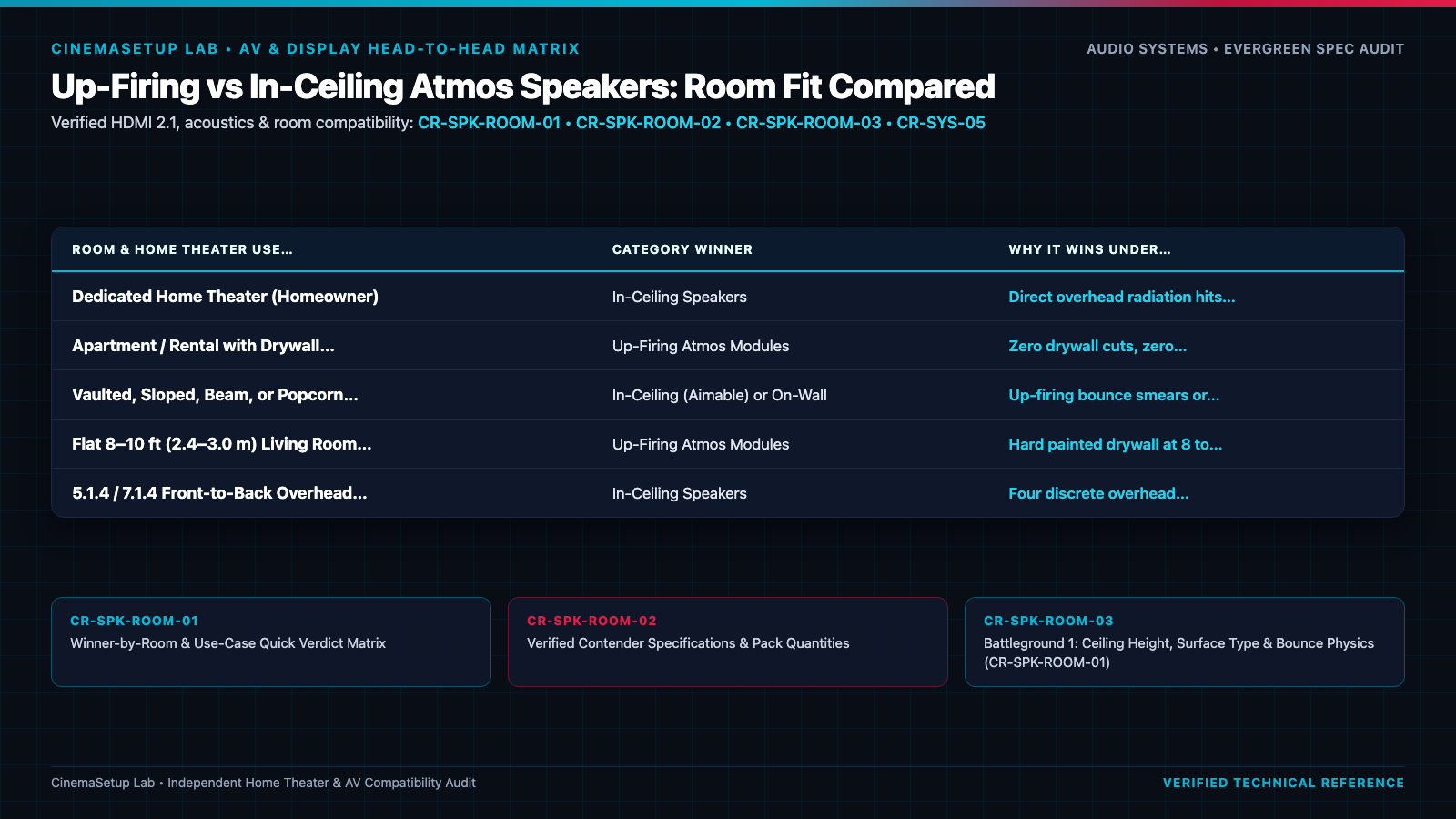
Quick Verdict: Up-Firing vs. In-Ceiling Atmos by Room Profile
Neither height format wins universally. Under CinemaSetup Lab compatibility rules, your ceiling construction and homeownership status decide the superior option before you even compare driver materials:
| Room & Home Theater Use Case | Category Winner | Why It Wins Under Audited Rules |
|---|---|---|
| Dedicated Home Theater (Homeowner) | In-Ceiling Speakers | Direct overhead radiation hits Dolby’s 45-degree (.4) or 65–100-degree (.2) elevation angles cleanly regardless of ceiling height or acoustic panels (CR-SPK-ROOM-02). |
| Apartment / Rental with Drywall Restrictions | Up-Firing Atmos Modules | Zero drywall cuts, zero ceiling wire fishing, and instant portability when moving—preserving lease terms while delivering physical Atmos channels (CR-SPK-ROOM-03). |
| Vaulted, Sloped, Beam, or Popcorn Ceiling | In-Ceiling (Aimable) or On-Wall | Up-firing bounce smears or misses the seating zone on non-flat or sound-absorbing surfaces; pivoting in-ceiling drivers (such as CDT models) aim directly at the seat (CR-SPK-ROOM-01). |
| Flat 8–10 ft (2.4–3.0 m) Living Room (No Attic) | Up-Firing Atmos Modules | Hard painted drywall at 8 to 10 ft (2.4 to 3.0 m) sits squarely inside Dolby’s 7.5 to 12 ft (2.3 to 3.7 m) reflection window when attic access is sealed. |
| 5.1.4 / 7.1.4 Front-to-Back Overhead Panning | In-Ceiling Speakers | Four discrete overhead speakers separated forward and behind the couch maintain sharper front-to-rear object separation than four reflected modules. |
| Tight Ceiling Joist Bay (< 3 in / 7.6 cm Clear) | Shallow In-Ceiling or Up-Firing | Deep pivoting speakers need 4.5 in (11.4 cm) depth; shallow models like the Polk RC60i fit 2.5 in (6.4 cm) cavities, or up-firing bypasses cavity limits altogether. |
Side-by-Side Contender Specs & Pack Quantities
To keep hardware comparisons grounded in verified manufacturer documentation (G-03, G-04, and G-29), the table below pairs two representative Amazon US up-firing Atmos modules against two representative Amazon US in-ceiling speakers across budget and mid-tier brackets. Notice how sensitivity bases (1 W / 1 m vs. 2.83 V / 1 m) and pack quantities (Pair vs. Each) are explicitly separated.
| Verified Specification | Klipsch RP-500SA (Up-Firing / On-Wall) | Polk Monitor XT90 (Up-Firing / On-Wall) | Polk Audio RC60i (In-Ceiling) | Klipsch CDT-5650-C II (In-Ceiling) |
|---|---|---|---|---|
| Retail Pack Quantity (G-29) | Pair (2 speakers) | Pair (2 speakers) | Pair (2 speakers) | Each / Single (1 speaker; buy qty 2) |
| Amazon US Price Tier (G-08) | $400–$600 per pair | $150–$250 per pair | $150–$250 per pair | $150–$250 each ($300–$500 per pair) |
| Acoustic Configuration | 2-way (5.25-in / 13.3 cm woofer + 1-in / 2.54 cm horn tweeter) | Single 4-in (10.2 cm) bi-laminate full-range driver | 2-way 6.5-in (16.5 cm) woofer + aimable dome tweeter | 2-way 6.5-in (16.5 cm) pivoting woofer + 1-in (2.54 cm) horn tweeter |
| Nominal Impedance (CR-SPK-AVR-01) | 8 ohms compatible | 4- and 8-ohm compatible | 8 ohms compatible | 8 ohms compatible |
| Sensitivity & Rating Basis | Conforms to Dolby Atmos specs (numeric dB not published separately) | 89 dB (1 W / 1 m) | 89 dB (1 W / 1 m) | 94 dB (2.83 V / 1 m) |
| Frequency Response & Tolerance | Conforms to Dolby Atmos specs (Hz tolerance not published separately) | 164 Hz – 17 kHz (-3 dB) • 94 Hz – 22 kHz overall | 60 Hz – 20 kHz (-3 dB) • 40 Hz – 20 kHz overall | 63 Hz – 23 kHz (±3 dB) |
| Power Handling / Amp Guidance | 75 W continuous / 300 W peak | Maker lists standard AVR compatibility; no fixed RMS spec published | 20 – 100 W per channel recommended | 50 W RMS / 200 W peak |
| Dimensions / Cutout & Depth | 6.81 x 7.39 x 11.16 in (17.3 x 18.8 x 28.4 cm) • 8 lb (3.6 kg) each | 7.56 x 5.69 x 8.5 in (19.2 x 14.5 x 21.6 cm) • 6 lb (2.7 kg) each | Cutout 7-9/16 in (19.2 cm) • Depth 2-1/2 in (6.4 cm) • 9 in (22.9 cm) overall | Cutout 8-3/16 in (20.8 cm) • Depth 4-1/2 in (11.4 cm) • Weight omitted in summary |
| Aiming / Mode Flexibility | Rear switch: Atmos up-firing or Surround / On-wall | Angled cabinet + rear keyhole wall-mount slots | Swivel/aimable tweeter | 360° rotating / 15° tilting woofer + swivelling 100° horn tweeter |
| US Limited Warranty (G-26) | 5-year US parts & labor (authorized dealer) | 5-year US parts & labor (authorized dealer) | 5-year US parts & labor (authorized dealer) | Limited lifetime US warranty (authorized dealer) |
Spec Note (G-01 & G-09): Klipsch publishes RP-500SA sensitivity and frequency response solely as “conforms to Dolby Atmos specifications” rather than independent decibel or +/-3 dB limits, and Crutchfield/Klipsch retail summaries omit a published single-unit shipping weight for the CDT-5650-C II. Independent third-party anechoic measurements (Spinorama) for these specific height modules are not yet verified in our knowledge graph.
Battleground 1: Ceiling Height, Surface Type & Bounce Physics (CR-SPK-ROOM-01)
Under compatibility rule CR-SPK-ROOM-01, up-firing Dolby Atmos-enabled modules carry a CONDITIONAL or SOFT status depending on your room’s ceiling architecture. Unlike in-ceiling speakers that radiate sound waves straight down toward your ears, an up-firing module relies on a two-leg acoustic reflection: sound leaves an upward-tilted baffle (typically angled near 20 degrees), strikes the ceiling midpoint between your front speakers and couch, and reflects downward to the listening row.
According to Dolby’s published Dolby Atmos Home Theater Installation Guidelines, that reflection geometry requires three strict physical conditions to work reliably:
- Ceiling Height Window (7.5 to 12 ft / 2.3 to 3.7 m): Dolby identifies 7.5 to 12 ft (2.3 to 3.7 m) as the ideal height band for residential Atmos-enabled modules, with 14 ft (4.3 m) as the maximum upper threshold. Below 7.5 ft (2.3 m), the speaker sits too close to ear height and blends into the front soundstage; above 12 to 14 ft (3.7 to 4.3 m), the extra path distance attenuates high-frequency cues and spreads the reflection cone across too wide an area.
- Flat, Horizontal Geometry: Vaulted, cathedral, sloped, or heavily coffered ceilings alter the angle of incidence. On an angled roof line, sound aimed upward often bounces toward the back wall or a side window rather than down to your sofa.
- Hard, Acoustically Reflective Material: Standard painted drywall, plaster, or wood decking reflects mid-to-high frequencies cleanly. Acoustic ceiling tiles, heavy popcorn texture, exposed fiberglass batts, or ceiling-mounted broadband absorption panels absorb the upward energy—causing overhead effects to sound muted or localized at the front towers.
Up-firing modules also face a perceptual hurdle known as direct-sound leakage. Even with Dolby Atmos-enabled crossover shaping (which carves out specific psychoacoustic notches to mask the upward-facing cabinet), listeners sitting within 6 to 8 ft (1.8 to 2.4 m) of tall front speakers often hear subtle high-frequency bleed directly from the module rather than purely from overhead. In-ceiling speakers eliminate reflection guesswork altogether: because the driver lives inside the ceiling plane, there is zero bounce loss, zero vaulted-angle deflection, and far stronger vertical separation between ear-level dialogue and overhead rain or aircraft pans.
Battleground 2: Elevation Angles, Aimable Drivers & Virtualization Honesty
Cutting holes in drywall does not automatically guarantee convincing Atmos immersion. Under rule CR-SPK-ROOM-02, overhead localization depends on hitting Dolby’s vertical elevation angles measured from your seated ear height at the main listening position:
- 5.1.2 / 7.1.2 (Single Overhead Pair): Dolby specifies Top Middle placement at an elevation angle between 65 degrees and 100 degrees (centered near 80 degrees, slightly forward of the listener’s head). Placing a `.2` in-ceiling pair way out near the TV wall—at 30 degrees—causes overhead effects to collapse onto the front stage.
- 5.1.4 / 7.1.4 (Two Overhead Pairs): Dolby targets 45 degrees ahead of the main seat for Top Fronts and 45 degrees behind the main seat for Top Rears (acceptable range: 30 to 55 degrees). Notice that if your couch sits flush against the back wall, you have no room behind your ears to reach the 30-to-55-degree Top Rear window—making a 5.1.2 layout (or pulling the sofa 2 to 3 ft / 0.6 to 0.9 m forward) far cleaner than forcing compressed `.4` ceiling spacing.
Why Aimable In-Ceiling Drivers Matter: Ceiling joists rarely run exactly where your geometry chart wants them. Standard flush-mount speakers fire straight toward the floor, which works fine if the speaker lands directly above you in a 5.1.2 room. However, when joists force a 5.1.4 Top Front or Top Rear speaker 2 to 4 ft (0.6 to 1.2 m) wider or farther forward than ideal, high frequencies beam past the sofa. That is why aimable designs differ meaningfully: the Polk RC60i pivots its tweeter toward the seating area, while the Klipsch CDT-5650-C II rotates its entire 6.5-inch (16.5 cm) woofer assembly 360 degrees with 15 degrees of tilt alongside a swivelling 100-degree Tractrix horn tweeter.
The On-Wall Angled Middle Ground: What if your ceiling is vaulted or you rent, so neither ceiling cuts nor ceiling bounce works? Both up-firing contenders reviewed here—the Klipsch RP-500SA and Polk Monitor XT90—include rear keyhole mounting hardware so you can hang them high on the front or side walls angled downward toward your couch. On the RP-500SA, a rear switch toggles the internal crossover between Atmos reflection mode and direct-radiating surround/height mode, turning the module into a physical Front Height or Rear Height speaker without touching the ceiling drywall.
Physical Height Channels vs. DSP Virtualization (CR-SYS-05): Many AV receivers advertise “Dolby Atmos Height Virtualization” or “DTS Virtual:X” for 5.1 systems lacking overhead speakers. Under rule CR-SYS-05, software psychoacoustic processing is not equivalent to physical height channels. Even entry-level up-firing modules like the Polk Monitor XT90 provide discrete amplified transducer channels that localize sound above ear level far more convincingly than virtualized phantom processing from ear-level fronts.
Battleground 3: Cavity Depth, CL2/CL3 Wiring & Installation Safety
Before ordering in-ceiling speakers, run compatibility rule CR-SPK-ROOM-03 and electrical safety rule CR-ACC-SPK-02. An in-ceiling speaker requires three things that up-firing modules never ask for: clear joist cavity depth, unobstructed routing from the AV receiver, and permission to alter structural drywall.
- Check Mounting Depth Before Cutting: Shallow-basket speakers like the Polk RC60i need just 2.5 in (6.4 cm) of clear mounting depth inside the ceiling, fitting easily inside standard 2×4 or 2×6 furred basement ceilings. Deep pivoting gimbal units like the Klipsch CDT-5650-C II demand 4.5 in (11.4 cm) of clearance behind the drywall face—meaning shallow drop-downs or HVAC soffits can cause a hard physical fit failure.
- Mandatory Manufacturer-First & Structural Safety (G-27): Always follow the speaker manufacturer’s supplied cut-out template and installation manual first. Before making any drywall cut, scan the joist bay with a stud finder and inspection camera or probe to confirm the cavity is clear of framing lumber, plumbing lines, HVAC ductwork, fire-blocking plates, and live 120 V AC electrical wiring. Never cut into structural trusses or load-bearing joists. If your ceiling runs cross fire-rated garage boundaries, multi-story floors, or unknown electrical conduits, hire a licensed electrician or qualified custom AV installer.
- In-Wall Cable Safety & Wire Gauge (CR-ACC-SPK-01 & CR-ACC-SPK-02): Any speaker cable routed inside walls or ceiling cavities must carry a UL-listed CL2 or CL3 in-wall fire-resistance jacket (or plenum CMP rating where required by local US building codes). Do not hide standard zip-cord lamp wire or unrated PVC speaker wire behind drywall. For signal integrity, choose pure oxygen-free copper (OFC) over copper-clad aluminum (CCA): for 8-ohm height speakers, 16 AWG OFC handles one-way runs up to roughly 50 ft (15 m), 14 AWG OFC reaches roughly 79 ft (24 m), and 12 AWG OFC covers runs up to 126 ft (38 m) without audible resistance loss.
If you choose on-wall mounting for the Klipsch RP-500SA (8 lb / 3.6 kg each) or Polk Monitor XT90 (6 lb / 2.7 kg each), follow the maker’s bracket instructions and anchor mounting screws directly into structural wall studs or properly load-rated toggle anchors—never rely on light plastic drywall plugs overhead above seating rows.
Battleground 4: AVR Channels, Sensitivity & Timbre Matching
Both up-firing and in-ceiling Atmos speakers place identical channel demands on your AV receiver under rules CR-SPK-AVR-04 and CR-SPK-AVR-05:
- 5.1.2 Systems (7 Processed & Amplified Channels): Require at least a 7.2-channel AVR (such as the Denon AVR-X1800H or Yamaha RX-V6A). Five amplifiers power your ear-level bed layer, and two amplifiers drive your height pair.
- 5.1.4 Systems (9 Channels): Step up to a 9-channel receiver such as the US 120 V Denon AVR-X3900H (which supersedes older discontinued X3800H stock in current Amazon US listings).
- 7.1.4 Systems (11 Processed Channels): Require 11 processing channels; a 9-amp / 11.4-processing receiver like the Denon AVR-X3900H runs 9 speakers internally and needs a separate 2-channel external power amplifier connected to its pre-outs for the final pair.
Impedance & Sensitivity Estimates (CR-SPK-AVR-01 & CR-SPK-AVR-02): All four audited speakers are compatible with standard 8-ohm AV receiver outputs (the Polk Monitor XT90 is rated compatible with 4- and 8-ohm outputs). Because height channels primarily carry transient ambient and directional effects rather than full-range deep bass—and should be set to Small with a crossover around 100 to 150 Hz (or 180 to 200 Hz for compact modules like the Polk MXT90 whose -3 dB point sits at 164 Hz under CR-SUB-SPK-01)—your subwoofer handles heavy low-frequency power demands.
By our estimate from published specs (using an 8-ohm load, 10 ft / 3.0 m acoustic path, and conservative ~30% multichannel AVR derating), an 89 dB (1 W / 1 m) speaker like the Polk RC60i or Monitor XT90 reaches 95 dB living-room peaks cleanly on ~37 W per channel, whereas the higher-sensitivity 94 dB (2.83 V / 1 m) Klipsch CDT-5650-C II needs roughly one-third as much amplifier wattage for the same output—helpful when an up-firing or high-ceiling path stretches over 12 to 16 ft (3.7 to 4.9 m) total distance.
Calibration & Timbre Matching (CR-SPK-SPK-02): Matching height speakers to your front bed layer (for example, Klipsch RP-500SA or CDT-5650-C II with Reference Premiere fronts, or Polk MXT90 with Monitor XT fronts) keeps overhead pans tonally cohesive, though brand matching matters less overhead than across your front LCR stage. After wiring, always run your receiver’s room-correction microphone sweep (Audyssey, Dirac Live, or YPAO) and verify channel routing with internal level-calibration tones so distance delays account for the longer ceiling-bounce path on up-firing modules.
Battleground 5: Pair-vs-Single Listings, US Warranty & Commission Note
Before clicking buy on Amazon US, verify three marketplace traps flagged across our speaker audits (G-26, G-29, and ISS-SPK-PAIR-VS-SINGLE-LISTING):
- Pair vs. Single Quantity Traps (G-29): Up-firing modules like the Klipsch RP-500SA and Polk Monitor XT90, as well as value in-ceiling kits like the Polk Audio RC60i, ship as a pair (2 speakers) per box. By contrast, higher-tier architectural speakers like the Klipsch CDT-5650-C II are sold each (1 single speaker per box)—even when product photos or customer builds show two units. Confirm quantity before checkout so you do not arrive on installation weekend one speaker short.
- US Authorized-Dealer Warranty Coverage (G-26): Both Klipsch (5-year passive speaker warranty on RP-500SA; limited lifetime warranty on CDT-5650-C II) and Polk Audio (5-year limited US warranty on Monitor XT90 and RC60i) honor manufacturer coverage only when purchased new from an authorized US dealer. On Amazon US (ZIP 10001 check, 2026-11-26), confirm the “Ships from / Sold by” box reads Amazon.com or an explicitly listed authorized audio retailer rather than an unverified third-party liquidator.
- Commission Independence (G-25): Standard Amazon Associates commission tiers (4% on home audio speakers and accessories vs. 2% on televisions) never affect our compatibility verdicts, rankings, or hardware recommendations.
Final Verdict: Choose Up-Firing vs. Choose In-Ceiling Atmos
Choose Up-Firing Modules if…
- You rent, live in a condo with concrete ceilings, or cannot cut drywall or fish CL2/CL3 cable through ceiling joists (CR-SPK-ROOM-03).
- Your room has a flat, painted drywall or plaster ceiling between 7.5 and 12 ft (2.3 and 3.7 m) high with no acoustic tile or heavy absorption (CR-SPK-ROOM-01).
- You want dual-purpose flexibility to repurpose the cabinets later as wall-mounted front or rear height speakers.
Choose In-Ceiling Speakers if…
- You own your home, have clear joist depth (2.5 to 4.5 in / 6.4 to 11.4 cm), and can route UL-listed CL2/CL3 OFC speaker cable safely.
- Your theater has vaulted, sloped, coffered, or acoustically treated ceilings that ruin up-firing reflection paths (CR-SPK-ROOM-01).
- You are building a 5.1.4 or 7.1.4 layout and want crisp, direct overhead localization without visible speakers on top of your front towers.
Verified Amazon US Atmos Height Picks (Up-Firing & In-Ceiling)
1. Klipsch RP-500SA Reference Premiere Dolby Atmos Speakers (Pair) — Best Switchable Up-Firing & On-Wall

Quick Specs: Sold as a Pair | Up-firing Atmos module or keyhole on-wall mount | 8 ohms compatible | 75 W continuous / 300 W peak | 5.25-in (13.3 cm) Cerametallic woofer + 1-in (2.54 cm) Titanium LTS horn tweeter | 6.81 x 7.39 x 11.16 in (17.3 x 18.8 x 28.4 cm), 8 lb (3.6 kg) each | Price Tier: $400–$600 per pair
Pros
- Rear crossover switch toggles cleanly between Atmos ceiling-bounce mode and direct surround/height wall mounting
- Dedicated 5.25-in (13.3 cm) woofer and horn-loaded tweeter match Reference Premiere fronts seamlessly
- Zero drywall cutting required when placed on flat 7.5–12 ft (2.3–3.7 m) living room setups
Cons
- Klipsch does not publish separate numeric dB sensitivity or +/-3 dB frequency limits beyond Atmos conformance
- Deep 11.16-in (28.4 cm) footprint can overhang compact bookshelf speakers; check top-panel dimensions first
2. Polk Audio Monitor XT90 Height Speaker (Pair) — Best Value Up-Firing & Renter Pick

Quick Specs: Sold as a Pair | Up-firing or keyhole wall-mount | 4- and 8-ohm compatible | 89 dB (1 W / 1 m) | 164 Hz – 17 kHz (-3 dB) | Single 4-in (10.2 cm) bi-laminate driver | 7.56 x 5.69 x 8.5 in (19.2 x 14.5 x 21.6 cm), 6 lb (2.7 kg) each | Price Tier: $150–$250 per pair
Pros
- Compact 8.5-in (21.6 cm) depth sits cleanly atop smaller bookshelf speakers and Monitor XT towers
- Keyhole wall-mount slots allow converting from ceiling-bounce to wall-mounted height placement anytime
- Accessible $150–$250 per pair tier backed by a 5-year US limited warranty from authorized dealers
Cons
- Single 4-in (10.2 cm) driver rolls off sharply below 164 Hz (-3 dB); set AVR crossover high around 180–200 Hz (CR-SUB-SPK-01)
- Lacks a dedicated tweeter and relies heavily on a flat 7.5–12 ft (2.3–3.7 m) reflective ceiling when up-firing
3. Polk Audio RC60i 6.5-Inch In-Ceiling Speakers (Pair) — Best Value & Shallow-Cavity In-Ceiling

Quick Specs: Sold as a Pair | Flush in-ceiling with aimable tweeter | 8 ohms compatible | 89 dB (1 W / 1 m) | 60 Hz – 20 kHz (-3 dB) | 20–100 W/ch amp guidance | Cutout 7-9/16 in (19.2 cm), Depth 2-1/2 in (6.4 cm), Overall 9 in (22.9 cm) | Price Tier: $150–$250 per pair
Pros
- Ultra-shallow 2.5-in (6.4 cm) mounting depth clears tight ceiling joists where deeper gimbal models fail
- Sold as a complete pair with paintable white grilles, aimable tweeters, and 60 Hz (-3 dB) bass reach for smooth 80–100 Hz crossovers
- Wide availability directly from Amazon US authorized channels with a 5-year US warranty
Cons
- Only the tweeter pivots—the 6.5-in (16.5 cm) woofer remains fixed straight downward, limiting steep off-axis aiming
- Uses a standard flanged bezel rather than a modern magnetic borderless grille, and requires drywall cutting + CL2/CL3 wiring
4. Klipsch CDT-5650-C II In-Ceiling Speaker (Each / Single) — Best Aimable Driver Geometry

Quick Specs: Sold Each / Single (order qty 2 per pair) | Aimable CDT in-ceiling | 8 ohms compatible | 94 dB (2.83 V / 1 m) | 63 Hz – 23 kHz (±3 dB) | 50 W RMS / 200 W peak | Cutout 8-3/16 in (20.8 cm), Depth 4-1/2 in (11.4 cm) | Price Tier: $150–$250 each ($300–$500 per pair)
Pros
- 360-degree rotating / 15-degree tilting 6.5-in (16.5 cm) woofer plus swivelling 100-degree Tractrix horn aims both drivers directly toward the main couch
- High 94 dB (2.83 V / 1 m) sensitivity delivers strong overhead headroom even with modest AV receiver power (CR-SPK-AVR-02)
- Paintable magnetic SlimTrim grille and treble/midbass attenuation switches simplify visual and acoustic blending
Cons
- Sold as a single speaker rather than a pair—doubling the true cost for a 5.1.2 layout (G-29)
- Requires 4.5 in (11.4 cm) of joist cavity depth and an 8-3/16 in (20.8 cm) cutout; verify space above soffits before ordering
Authoritative Technical Sources
- Dolby Laboratories Official Atmos Home Theater Speaker Setup Guides — Ceiling height guidelines (7.5–12 ft ideal, 14 ft upper limit), elevation angles (45° for .4, 65–100° for .2), and reflective ceiling criteria.
- Klipsch USA Official Product Specifications — RP-500SA switchable Atmos/Surround crossover, CDT-5650-C II 94 dB sensitivity, cutout/depth dimensions, and US passive speaker warranty terms.
- Polk Audio USA Official Product Specifications — Monitor XT90 and RC60i 89 dB (1 W / 1 m) sensitivity, frequency response limits, 2.5-in RC60i mounting depth, and 5-year US limited warranty.
- Crutchfield Technical Specification Summaries — Cross-verified cutout diameters, cabinet dimensions, and pack quantity notes for US retail listings.
How We Audited This Guide
- Audio gear was audited across 8-ohm/4-ohm impedance stability, HDMI 2.1 40 Gbps switching and eARC/CEC behavior, speaker sensitivity and center dialogue dispersion, subwoofer room volume sizing, and US warranty authorization.
- Every AV receiver, speaker, subwoofer, soundbar, OLED/Mini-LED TV, projector, source player, and accessory spec was cross-checked against official manufacturer manuals, CEA/CTA standards, and live Amazon US listings.
- Recommendations were evaluated against our weighted vertical scoring rubrics and documented CR-* compatibility rules; we never invent nits, contrast ratios, bench wattage, or room decibels.
Continue Your Audit
- Best AV Receivers (2026): 9 Home Theater Picks Audited
- Best AV Receivers Under $1,000 2026: 7.2-Channel Picks Audited
- Best AV Receivers for Dolby Atmos 2026: 5.1.4 & 7.1.4 Audited
Frequently Asked Questions: Up-Firing vs. In-Ceiling Atmos
Are in-ceiling Atmos speakers noticeably better than up-firing modules?
Yes, in most rooms in-ceiling speakers localize overhead effects more accurately because sound travels straight from the ceiling without reflection loss or bounce smearing. Up-firing modules can still produce convincing overhead height in rooms with flat, hard drywall ceilings 7.5 to 12 ft (2.3 to 3.7 m) high.
Do up-firing Atmos speakers work on vaulted or popcorn ceilings?
No, vaulted, sloped, or heavily textured ceilings weaken up-firing Atmos performance under rule CR-SPK-ROOM-01. Sloped roofs bounce sound away from your sofa, while acoustic tiles or heavy texture absorb high frequencies. Choose aimable in-ceiling speakers or wall-mounted angled height modules instead.
Where should I place two in-ceiling speakers for a 5.1.2 Dolby Atmos layout?
Mount a single `.2` Top Middle pair overhead or slightly forward of your couch at a 65-to-100-degree elevation angle from seated ear height, aligned vertically with your front left and right speakers. Placing them too far forward collapses overhead effects into the front stage.
What speaker wire rating do I need for in-ceiling Atmos speakers?
In-wall and in-ceiling runs require UL-listed CL2 or CL3 fire-rated cable made from pure oxygen-free copper (OFC) rather than standard lamp cord or copper-clad aluminum. For 8-ohm speakers, 16 AWG OFC handles runs up to ~50 ft (15 m) and 14 AWG OFC reaches ~79 ft (24 m).
Can I mount up-firing Atmos modules on the wall instead of putting them on my towers?
Yes, both the Klipsch RP-500SA and Polk Monitor XT90 include keyhole wall-mount slots for high front or side wall placement into structural studs. Switch the RP-500SA rear crossover to Surround mode so it behaves as a direct-radiating elevation speaker rather than a ceiling-bounce module.
Are in-ceiling Atmos speakers sold in pairs or individually on Amazon US?
It varies by model, so check the pack quantity carefully before ordering. Value kits like the Polk Audio RC60i ship as a two-speaker pair, whereas architectural models such as the Klipsch CDT-5650-C II sell as a single speaker each—requiring quantity two for 5.1.2.


