
Disclosure: As an Amazon Associate, I earn from qualifying purchases. If you buy through links on this page, CinemaSetup Lab may earn a small commission at no extra cost to you. Commission schedules (for example, lower 2% rates on televisions versus 4% on most soundbars and AV gear) never influence our technical audits, scores, or verdicts.
This sonos arc ultra review audits the North American retail configuration of Sonos’s flagship standalone Dolby Atmos soundbar—a single-bar centerpiece sitting in the $900-$1,100 bracket (Launch MSRP: $999) inside our best soundbars hub. Rather than repeating marketing claims about “9.1.4 spatial audio” or counting internal amplifier chips as room speakers, we audited every specification against Sonos’s official US hardware documentation, HDMI Forum eARC rules, and CinemaSetup Lab’s cross-compatibility framework.
On paper, the Sonos Arc Ultra delivers a major acoustic overhaul over the original Arc thanks to its 14-driver array, four-motor Sound Motion woofer, three-level Speech Enhancement, Bluetooth 5.3 radio, and Android-compatible Quick Trueplay tuning. At the same time, it retains three rigid architectural boundaries—zero HDMI passthrough inputs, zero DTS:X or DTS-HD Master Audio decoding, and a closed wireless expansion ecosystem—that every buyer must weigh before checkout.
In This Audit
- Audit Verdict Summary & 100% Weighted Scorecard
- Key Specifications & Driver Architecture Breakdown
- Room Fit, HDMI eARC Routing & System Pairing Analysis
- Compatibility Audit (CR-* Rules), Known Issues & Pros/Cons
- Top Alternatives, Rejected Picks & Verified US Product Cards
- Authoritative Standards & Manufacturer Citations
- Frequently Asked Questions
Audit Verdict Summary & 100% Weighted Scorecard
One-Line Verdict: The Sonos Arc Ultra earns an 8.3 / 10 overall audit score as a refined, low-profile standalone Dolby Atmos soundbar with dramatically stronger built-in bass and vocal clarity than its predecessor—provided your TV offers HDMI eARC with sufficient spare gaming ports, your media library does not depend on DTS:X discs, and you accept Sonos’s closed subwoofer and wireless rear speaker pricing.
Following our editorial audit standard, all hardware counts, dimensions, and codec capabilities below come from verified manufacturer documentation (confidence A), while comparative bass-compression observations are explicitly attributed to published third-party measurement reports (such as RTINGS’ frequency-response and dynamic-compression evaluations comparing the Arc Ultra against the original Arc). We do not fabricate in-house decibel measurements or compare soundbars by total amplifier wattage.
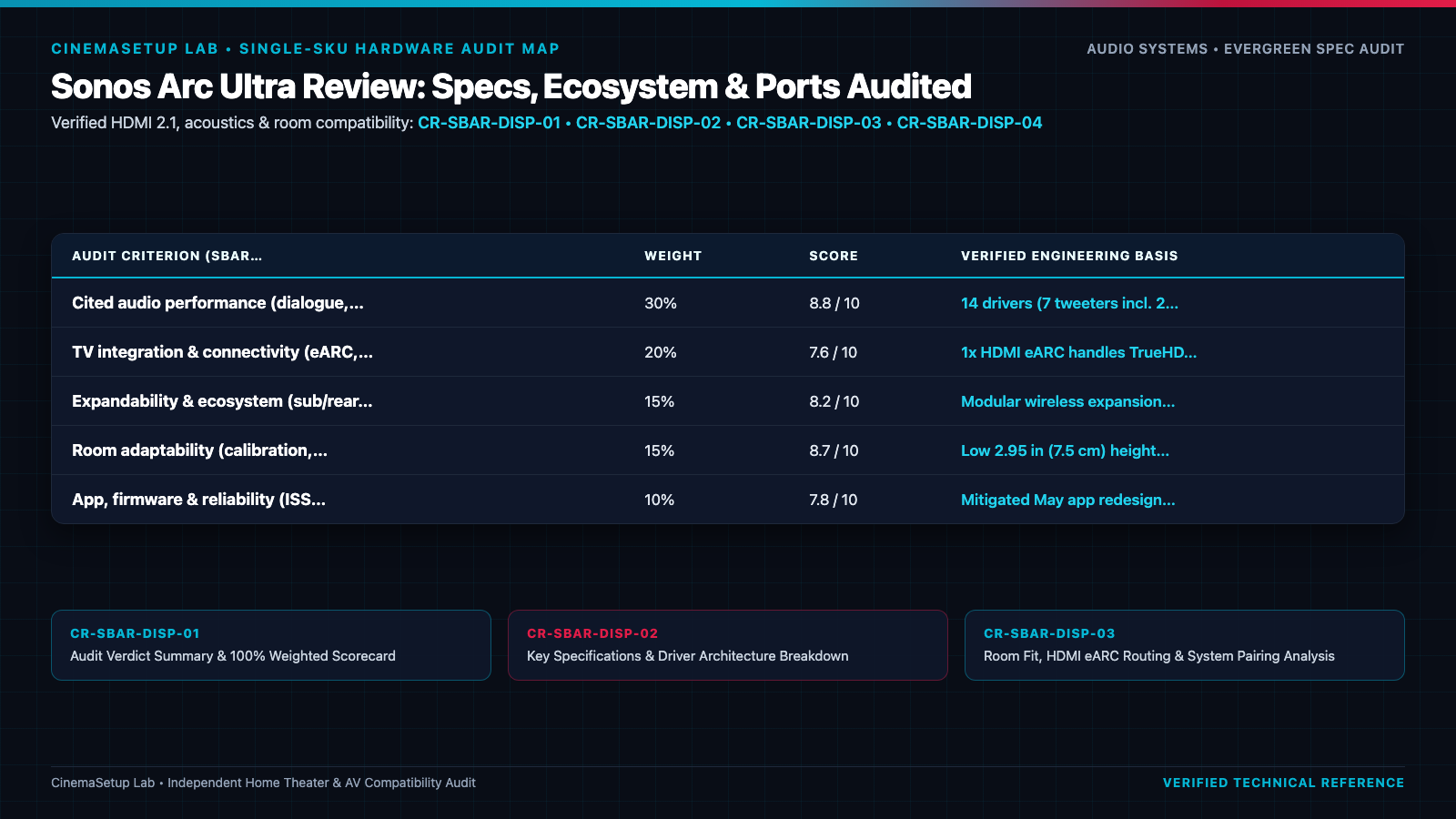
| Audit Criterion (SBAR Rubric) | Weight | Score | Verified Engineering Basis |
|---|---|---|---|
| Cited audio performance (dialogue, bass, height, output) | 30% | 8.8 / 10 | 14 drivers (7 tweeters incl. 2 up-firing, 6 midwoofers, 1 Sound Motion woofer); 3-level Speech Enhancement; published third-party evaluations confirm deeper bass and lower compression than original Arc, though standalone bar lacks true rear localization. |
| TV integration & connectivity (eARC, HDMI in, optical, DTS) | 20% | 7.6 / 10 | 1x HDMI eARC handles TrueHD Atmos & Multichannel LPCM, plus Wi-Fi 6 & Bluetooth 5.3; penalized for 0 HDMI passthrough inputs (CR-SBAR-SRC-01), optical requiring a separate adapter (CR-SBAR-DISP-01), and no DTS:X / DTS-HD MA decoding (CR-SBAR-DISP-04). |
| Expandability & ecosystem (sub/rear locks, upgrade cost) | 15% | 8.2 / 10 | Modular wireless expansion with Sonos Sub 4, Sub Gen 3, Sub Mini, Era 300, and Era 100; docked for strict closed ecosystem (CR-SUB-SBAR-01, CR-SBAR-SPK-01), zero wired sub pre-out, and high combined add-on cost. |
| Room adaptability (calibration, reflections, stand clearance) | 15% | 8.7 / 10 | Low 2.95 in (7.5 cm) height clears most TV stands (CR-SBAR-DISP-05); Quick Trueplay built-in mics work on iOS and Android plus Advanced Trueplay on iOS; reflection-dependent height weakens in vaulted or open-plan rooms (CR-SBAR-ROOM-01). |
| App, firmware & reliability (ISS history & updates) | 10% | 7.8 / 10 | Mitigated May 2024 app redesign issue (ISS-SBAR-SONOS-APP-2024) has received multiple stability and feature-restoration firmware updates, though app-dependent setup and occasional eARC CEC handshakes remain worth monitoring. |
| Value within tier (bar-only vs full kits) | 10% | 8.4 / 10 | Strong standalone engineering at Launch MSRP: $999 ($900-$1,100 tier), but adding Sonos Sub 4 plus a pair of Era 300 surrounds pushes total cost well above complete all-in-one kits like the Samsung HW-Q990H. |
| Weighted Total | 100% | 8.3 / 10 | Calculated weighted average: 8.315 / 10 (rounded to 8.3 / 10). |
Key Specifications & Driver Architecture Breakdown
Before evaluating how the Arc Ultra integrates with your television and room acoustics, examine its verified US hardware specifications below. All physical dimensions list imperial units first with metric equivalents in parentheses, and marketing channel notation is separated strictly from physical transducers (CR-SYS-05).
| Specification Category | Sonos Arc Ultra (US Retail Model) | Audit & Compatibility Note |
|---|---|---|
| Claimed Spatial Output | 9.1.4 spatial audio experience (Sonos rating) | Maker output notation using beam-steering & virtualization; not 14 room speakers (CR-SYS-05). |
| Physical Driver Array | 14 drivers: 7 silk-dome tweeters (incl. 2 up-firing), 6 midwoofers, 1 Sound Motion woofer | Physical height comes from 2 dedicated upward-firing tweeters with waveguides. |
| Internal Amplification | 15 Class-D digital amplifiers | Active multi-amp tuning; amplifier count and total watts are not loudness metrics (G-16). |
| TV Audio Connection | 1x HDMI eARC port (4.9 ft / 1.5 m HDMI cable included) | Optical fallback requires separate Sonos Optical Audio Adapter; drops Atmos (CR-SBAR-DISP-01). |
| HDMI Passthrough Inputs | 0 HDMI inputs | Consoles, streaming boxes, and Blu-ray players must plug into the TV (CR-SBAR-SRC-01). |
| Supported Audio Formats | Dolby Atmos (DD+ & TrueHD), Dolby TrueHD, DD+, DD, Multichannel PCM, Stereo PCM, DTS Digital Surround | Requires eARC for TrueHD Atmos & Multichannel PCM; no DTS:X or DTS-HD MA (CR-SBAR-DISP-02/04). |
| Wireless & Network | Wi-Fi 6 (802.11ax, 2.4/5 GHz), Bluetooth 5.3, Apple AirPlay 2, 10/100 Ethernet | Adds direct Bluetooth 5.3 playback absent on the original 2020 Sonos Arc; no Chromecast. |
| Compatible Subwoofers | Sonos Sub 4, Sonos Sub Gen 3 (and listed prior Sub generations), Sonos Sub Mini | Zero wired sub pre-out; third-party subs cannot connect (CR-SUB-SBAR-01). |
| Compatible Rear Speakers | Sonos Era 300, Sonos Era 100 (and listed legacy One/One SL/Five pairs) | Sold singly; two matching speakers required for wireless surrounds (CR-SBAR-SPK-01, G-29). |
| Room Calibration & Dialogue | Trueplay (Quick Tuning on iOS/Android; Advanced Tuning on iOS); 3-level Speech Enhancement | Night Sound & AV lip-sync delay (TV Dialog Sync) included in Sonos app (CR-SYS-04). |
| Dimensions (H x W x D) | 2.95 x 46.38 x 4.35 in (7.5 x 117.8 x 11.1 cm) | Lower 2.95 in (7.5 cm) profile improves TV stand clearance; best under 55+ in TVs (CR-SBAR-DISP-05). |
| Weight & Electrical | 13.01 lb (5.9 kg); universal 100-240V AC 50/60 Hz internal PSU w/ US 120V cord | Verify US retail unit and authorized dealer at checkout (CR-SYS-02, G-26). |
| Price Tier / Launch MSRP | $900-$1,100 bar-only bracket (Launch MSRP: $999) | Standalone bar only; adding Sub 4 + Era 300 pair moves total cost past $2,500 (G-29). |
Physical Drivers vs. “9.1.4” Channel Notation (CR-SYS-05)
Sonos describes the Arc Ultra as a 9.1.4 Dolby Atmos soundbar, which can mislead first-time buyers into assuming it physically places nine ear-level speakers, a standalone subwoofer, and four overhead speakers around the couch. In reality, per rule CR-SYS-05 and guardrail G-06, “9.1.4” describes Sonos’s combined physical and virtualized spatial rendering from a single 46.38 in (117.8 cm) bar. Inside the matte grille, 14 physical drivers are powered by 15 Class-D amplifiers: seven angled silk-dome tweeters (two of which fire upward through custom waveguides to bounce height cues off your ceiling), six midwoofers covering left, center, right, and surround-steering duties, and one Sound Motion woofer.
Compared to virtualization-only bars such as the Sonos Beam Gen 2—which lack upward-firing hardware entirely—the Arc Ultra does produce genuine physical ceiling reflections from its two up-firing tweeters. However, without dedicated wireless rear speakers bonded behind the seating area, rear surround and rear height cues still rely on acoustic side-wall reflections and psychoacoustic processing rather than discrete speakers behind your ears.
Sound Motion Woofer & 3-Level Speech Enhancement
The headline hardware engineering change inside the Arc Ultra is its Sound Motion woofer. Rather than squeezing a conventional single-motor cone into a shallow bar chassis, Sonos uses a flat, dual-membrane transducer driven by four lightweight neodymium motors moving in opposing directions to cancel cabinet vibration. Published third-party frequency-response evaluations (including RTINGS) report roughly double the low-frequency output of the original Sonos Arc and noticeably less dynamic bass compression at higher listening volumes, extending usable bass into the mid-to-upper 40–50 Hz range without immediate rattling.
Even with that gain, a compact internal transducer inside a 2.95 in (7.5 cm) tall enclosure cannot replicate the sub-30 Hz tactile extension of a dedicated floor-standing subwoofer like the Sonos Sub 4. On the vocal side, Sonos replaced the original Arc’s single binary dialogue toggle with a three-tier dialogue enhancement engine (Low, Medium, and High Speech Enhancement) tuned around the dedicated center array—a practical upgrade for news, sports, and dialogue-heavy dramas.
HDMI eARC Only: Zero Passthrough Inputs & Optical Caveat
Connectivity is where the Arc Ultra demands careful system planning before you buy. The rear recess contains only one HDMI port—an HDMI eARC input—paired with a 10/100 Ethernet jack, AC power inlet, and pairing/Bluetooth controls. There are zero HDMI passthrough inputs on the soundbar itself (CR-SBAR-SRC-01). Consequently, every external device—PlayStation 5, Xbox Series X, Apple TV 4K, or 4K UHD Blu-ray player—must plug directly into your TV’s HDMI ports, and your TV must pass audio back to the Arc Ultra.
To receive uncompressed Dolby TrueHD Atmos from 4K Blu-ray discs or Multichannel LPCM / Dolby MAT from an Apple TV 4K or Xbox, both your television and the Arc Ultra must communicate over HDMI eARC (CR-SBAR-DISP-02). If your TV only has standard HDMI ARC, streaming apps still deliver compressed Dolby Digital Plus Atmos cleanly, but lossless TrueHD drops to core Dolby Digital or stereo PCM—see our detailed eARC vs. ARC lossless audio guide to verify what your television passes. Worse, if you own an older TV or home theater projector with zero ARC/eARC port, the Arc Ultra has no built-in Toslink jack: you must buy the separate Sonos Optical Audio Adapter, which eliminates Dolby Atmos entirely and caps audio at compressed 5.1 (CR-SBAR-DISP-01).
Codec Audit: TrueHD Atmos Supported, DTS:X & DTS-HD MA Omitted
Sonos officially lists support for Stereo PCM, Dolby Digital, Dolby Digital Plus, Dolby Atmos (both Dolby Digital Plus and Dolby TrueHD), Dolby TrueHD, Multichannel PCM / Dolby Multichannel PCM, and lossy DTS Digital Surround. Notably absent are lossless DTS-HD Master Audio and object-based DTS:X (CR-SBAR-DISP-04). If you watch physical 4K Blu-ray discs encoded with DTS:X—common across Universal and Sony catalog releases—the Arc Ultra cannot decode the object layer. Furthermore, your television must support DTS passthrough over eARC just to reach the lossy DTS 5.1 core (many Samsung TVs drop DTS passthrough altogether; buyers with DTS-heavy disc collections must configure their Blu-ray player to decode DTS-HD MA internally to Multichannel PCM before sending it over eARC).
Room Fit, HDMI eARC Routing & System Pairing Analysis
A soundbar’s physical and acoustic match depends on your living space just as much as its driver sheet. Below is how the Sonos Arc Ultra maps to CinemaSetup Lab’s standardized room profiles, TV port budgets, and mounting safety standards.
Living Room vs. Open-Plan vs. Apartment Fit (CR-SBAR-ROOM-01)
- Medium Enclosed Living Room (~2,400 cu ft / 68 m³, flat 8 ft / 2.4 m ceiling): This is the Arc Ultra’s sweet spot. Per Dolby guidance and CR-SBAR-ROOM-01, a flat drywall or plaster ceiling between 7.5 and 12 ft (2.3–3.7 m) with nearby side walls gives the two upward-firing tweeters and side-firing waveguides clean acoustic bounce surfaces. In this space, the standalone Arc Ultra fills movie dialogue and mid-bass comfortably at 9–11 ft (2.7–3.4 m) seating distances.
- Large Open-Plan Great Room (6,000+ cu ft / 170+ m³, vaulted or missing side walls): Reflection-based virtual surround drops off sharply when one or both side walls open into a kitchen or dining area, or when ceilings rise above 12 ft (3.7 m) or slope awkwardly. In open floor plans, relying on the bar alone leaves overhead and rear effects flat; pairing two physical wireless rear speakers (Era 300 or Era 100) plus a Sonos Sub 4 becomes critical to anchor the soundfield.
- Apartment / Shared-Wall Den (~1,340 cu ft / 38 m³): Because the Sound Motion woofer keeps mechanical cabinet buzz low and Sonos provides both Night Sound dynamic-range compression and 3-level Speech Enhancement, the standalone Arc Ultra works well for late-night apartment viewing without shaking shared floors. Keep playback at comfortable listening levels, and remember that adding any dedicated subwoofer (even the compact Sub Mini) transfers low-frequency energy through walls and floors (CR-SUB-ROOM-03).
Console 4K/120Hz Port Budgets & TV-Brand Sync Limits (CR-SBAR-SRC-01 & DISP-03)
Because the Arc Ultra has no HDMI inputs, pay close attention to your TV’s HDMI 2.1 port layout if you game at 4K/120Hz with VRR. On a four-port 48 Gbps OLED television such as the LG C6, plugging the Arc Ultra into the designated HDMI 2 eARC port still leaves three full-bandwidth 4K/120Hz inputs open for a PS5, Xbox Series X, and gaming PC. On many mid-range TVs that only equip two 40/48 Gbps HDMI 2.1 ports where eARC shares one of them, the Arc Ultra occupies half your high-frame-rate inputs—leaving only one 4K/120Hz port free unless you add a certified HDMI 2.1 switch.
Additionally, note CR-SBAR-DISP-03 and CR-SYS-03: unlike Samsung Q-Symphony, LG WOW Orchestra, or Sony Acoustic Center Sync, Sonos never plays simultaneously with your TV’s internal speakers—and you cannot run both an AV receiver and the Arc Ultra on the same TV’s eARC port at the same time.
Trueplay Calibration, TV Stand Clearance & Mounting Safety (G-27)
Sonos addressed a long-standing complaint on the Arc Ultra by adding Quick Trueplay, which uses microphones built directly into the soundbar to run room EQ calibration from either an Android or iOS phone. iOS owners still retain Advanced Trueplay, which uses the iPhone or iPad microphone as you walk around the seating area for finer reflection mapping. If speech ever drifts slightly behind or ahead of on-screen lips, the Sonos app’s TV Dialog Sync delay slider aligns audio timing (CR-SYS-04).
Physically, the Arc Ultra measures 2.95 in (7.5 cm) tall by 46.38 in (117.8 cm) wide by 4.35 in (11.1 cm) deep and weighs 13.01 lb (5.9 kg). That 2.95 in (7.5 cm) height clears under-screen stands on more 55 in and larger TVs than bulkier bars, though you should still measure your TV stand clearance so the chassis neither clips the bottom bezel nor blocks the TV’s IR remote sensor (CR-SBAR-DISP-05).
If wall-mounting the Arc Ultra using the optional Sonos Arc Ultra Wall Mount (or legacy Arc mount), follow Sonos’s printed installation instructions strictly: anchor fasteners into structural wood studs or manufacturer-approved masonry anchors (never rely on bare drywall alone for overhead or shelf-free mounting), keep at least 4 in (10.2 cm) of open vertical space below the bottom edge of the TV so upward-firing drivers clear the screen overhang, and use only UL-listed CL2 or CL3 rated HDMI and Ethernet cables for any in-wall runs. Never route the standard included AC power cord inside a wall cavity—install a code-compliant recessed power kit or consult a licensed electrician or professional AV installer.
Compatibility Audit (CR-* Rules), Known Issues & Pros/Cons
Every relevant HARD, CONDITIONAL, SOFT, and INFO compatibility rule from CinemaSetup Lab’s knowledge graph has been executed against the Sonos Arc Ultra US retail model below (G-10):
| Rule ID | Level | Audit Outcome for Sonos Arc Ultra | Required Buyer Action / Condition |
|---|---|---|---|
| CR-SYS-02 | HARD | PASS (US Retail SKU) | Confirm US retail listing & authorized dealer at purchase; avoid grey-market imports. |
| CR-SBAR-DISP-01 | HARD / CONDITIONAL | CONDITIONAL | Connects via included HDMI cable to TV eARC/ARC; projectors or legacy TVs without ARC require separate Sonos Optical Adapter (loses Atmos). |
| CR-SBAR-SRC-01 | CONDITIONAL | CONDITIONAL (0 HDMI In) | Connect PS5, Xbox Series X, Apple TV 4K, and Blu-ray players directly to TV; verify spare TV 4K/120Hz ports after using eARC. |
| CR-SUB-SBAR-01 | HARD | CLOSED ECOSYSTEM | Zero wired sub pre-out; pairs wirelessly ONLY with Sonos Sub 4, Sub Gen 3 (and listed prior Subs), or Sub Mini. |
| CR-SBAR-SPK-01 | HARD | CLOSED ECOSYSTEM | Passive speakers cannot connect; rear surrounds restricted to Sonos Era 300, Era 100, or listed legacy Sonos pairs. |
| CR-SBAR-DISP-02 | SOFT | CONDITIONAL / SOFT | TrueHD Atmos and Multichannel LPCM require HDMI eARC on both TV and bar; plain ARC limits Atmos to DD+ streaming. |
| CR-SBAR-DISP-04 | SOFT | LIMITED DTS | Decodes DTS Digital Surround 5.1 only (no DTS:X or DTS-HD MA), and requires TV DTS passthrough or Blu-ray LPCM conversion. |
| CR-SBAR-DISP-05 | SOFT | CHECK CLEARANCE | Verify at least 3.0 in (7.6 cm) under TV bezel for stand placement, or 4 in (10.2 cm) gap below wall-mounted TVs. |
| CR-SBAR-ROOM-01 | SOFT | REFLECTION DEPENDENT | Up-firing height expects flat 7.5-12 ft (2.3-3.7 m) ceilings and nearby side walls; open-plan rooms benefit from Era 300 rears. |
| CR-SYS-03 / 04 / 05 | INFO | SYSTEM RULES | Use bar as sole eARC device (03); use TV Dialog Sync for lip-sync (04); 9.1.4 notation includes virtualized channels alongside 14 drivers (05). |
Known Issues & Mitigation Status (ISS — G-12)
- ISS-SBAR-SONOS-APP-2024 (Mitigated): Sonos’s May 2024 mobile app overhaul introduced widespread feature omissions, sluggish local library responsiveness, and speaker-discovery hiccups across the Sonos ecosystem. Since then, Sonos has shipped a series of app and firmware updates restoring Trueplay, setup reliability, and core controls. Even so, prospective buyers should ensure strong Wi-Fi 6 / router mDNS multicast stability (or hardwire the 10/100 Ethernet port where convenient) and keep the Sonos app updated before initial setup.
- ISS-SBAR-EARC-HANDSHAKE & ISS-SBAR-LIPSYNC (Open / Model-Specific): As with nearly all eARC soundbars, intermittent HDMI-CEC wake bugs or lip-sync offsets can occur after television firmware updates. Enabling TV eARC + Bitstream/Pass-Through mode, using a certified Ultra High Speed HDMI cable, power-cycling both TV and bar, and dialing in Sonos’s TV Dialog Sync slider resolve most pairing hiccups.
Verified Pros
- Sound Motion 4-motor woofer delivers substantially deeper, cleaner standalone bass than the original Arc without immediate sub dependency
- Physical 14-driver layout includes 2 genuine upward-firing tweeters with waveguides plus 3-level Speech Enhancement
- Adds Bluetooth 5.3, Wi-Fi 6, and Android-compatible Quick Trueplay alongside iOS Advanced Trueplay
- 2.95 in (7.5 cm) chassis height clears tighter TV stands than taller Atmos bars
Verified Cons
- Zero HDMI passthrough inputs force consoles and players onto the TV and consume an eARC/HDMI 2.1 port
- No DTS:X or DTS-HD Master Audio decoding (lossy DTS Digital Surround core only)
- Strictly closed wireless ecosystem with no wired sub pre-out; full Sub 4 + Era 300 kit costs well over $2,500
- No built-in optical jack (requires separate adapter) and no physical remote or Google Cast included
Buy the Sonos Arc Ultra if: You want a minimalist, single-bar living-room Dolby Atmos upgrade (UC-MINIMALIST-WIRELESS, UC-TV-DIALOGUE) with strong built-in bass and multi-tier speech clarity under a modern 4-port eARC TV, or you already own Sonos multi-room speakers and plan to expand incrementally.
Skip it if: You own a dedicated theater room (UC-DEDICATED-THEATER), collect DTS:X 4K Blu-rays, need HDMI passthrough inputs to save 4K/120Hz ports on a 2-port TV (UC-CONSOLE-4K120), or want an out-of-the-box subwoofer and wireless rear speakers without paying $2,500+ across modular Sonos add-ons.
Top Alternatives, Rejected Picks & Verified US Product Cards
In the $900-$1,100 standalone tier, the Sonos Arc Ultra competes directly with single-bar rivals such as the Bose Smart Ultra Soundbar ($800-$1,000 bracket), while expanding it into a full surround system competes directly with complete bar+sub+rear kits like the Samsung HW-Q990H—or even jumping to a discrete soundbar vs. AV receiver system comparison path with a 5.1.2 AVR and passive speakers.
US Authorized-Dealer Warranty Check (G-26, Verified 2026-11-26): Sonos provides a 1-year US limited manufacturer warranty on new units purchased directly from Sonos or an Authorized Sonos Dealer (including direct Ships from / Sold by Amazon.com or listed authorized US storefronts). Before clicking checkout on Amazon US, inspect the seller line carefully—unauthorized third-party liquidators or non-US grey-market listings can forfeit Sonos warranty coverage.
1. Sonos Arc Ultra Soundbar with Dolby Atmos – Black (Audited Pick)

Package & Tier (G-29): Standalone bar only ($900-$1,100 tier, Launch MSRP: $999; also offered in Matte White) | Key Specs: 14 drivers (7 tweeters incl. 2 up-firing, 6 midwoofers, 1 Sound Motion woofer), 15 Class-D amps, 1x HDMI eARC (0 HDMI in), Wi-Fi 6, Bluetooth 5.3, Trueplay (iOS & Android), 2.95 x 46.38 x 4.35 in (7.5 x 117.8 x 11.1 cm), 13.01 lb (5.9 kg).
Best For: Clean living-room eARC setups prioritizing standalone dialogue clarity, tighter TV stand clearance, and modular Sonos multi-room expansion without cluttering the floor on day one.
2. Sonos Sub 4 – Wireless Subwoofer (Official Bass Expansion)

Package & Tier (G-29): Single wireless subwoofer sold separately ($700-$900 bracket) | Key Specs: Dual 5 x 8 in force-cancelling elliptical woofers, dual Class-D amps, Wi-Fi 6 pairing, rated down to 25 Hz, 15.31 x 15.83 x 6.22 in (38.9 x 40.2 x 15.8 cm), 26 lb (11.8 kg).
Why Pair It: Because the Arc Ultra has zero wired RCA subwoofer output (CR-SUB-SBAR-01), adding the Sonos Sub 4 is the primary high-output path to unlock sub-30 Hz movie rumble and offload low bass from the bar’s Sound Motion driver.
3. Sonos Era 300 Wireless Spatial Speaker (Single Unit — Pair Required for Rears)

Package & Tier (G-29): Sold as a single speaker ($400-$500 each; buy 2 units for rear surround bonding) | Key Specs: 6 custom drivers (4 tweeters incl. upward-firing height driver, 2 woofers), Wi-Fi 6, Bluetooth 5.3, USB-C line-in via separate adapter.
Why Pair a Duo: Bonding two Era 300 units adds physical rear surround and rear upward-firing Atmos channels behind your couch—turning the Arc Ultra’s virtualized rear stage into real behind-the-listener placement (CR-SBAR-SPK-01).
4. Bose Smart Ultra Dolby Atmos Soundbar (Direct Single-Bar Rival)

Package & Tier (G-29): Standalone bar with included remote, HDMI cable, optical cable & ADAPTiQ headset ($800-$1,000 bracket; within 15% of Arc Ultra) | Key Specs: Up-firing dipole drivers, HDMI eARC + built-in Optical in, AirPlay 2, Chromecast built-in, A.I. Dialogue Mode, 2.29 x 41.14 x 4.21 in (5.8 x 104.5 x 10.7 cm), 12.68 lb (5.75 kg).
Why Choose Instead: Pick the Bose Smart Ultra if you have ultra-tight TV stand clearance under 2.5 in (6.4 cm), prefer Chromecast built-in and a physical remote control, or need an included built-in optical jack without buying an adapter.
Rejected Models & Marketplace Traps Excluded (G-22)
- Canadian-Market Samsung Soundbar Liquidations (e.g., /ZC Variants): Strictly excluded from Amazon US buyer picks. Third-party Woot/liquidator listings carrying Canadian regional SKUs create US manufacturer warranty friction (CR-SYS-02, G-26); shoppers wanting an all-in-one bar+sub+rears kit with SpaceFit calibration and HDMI 2.1 passthrough should verify a genuine US retail Samsung HW-Q990H (superseding the older Q990D).
- Original Sonos Arc (2020 Generation): Rejected for new flagship purchases unless heavily discounted into the $500-$600 tier, as it omits the Arc Ultra’s Sound Motion woofer, Bluetooth 5.3 radio, 3-tier Speech Enhancement, and Android Quick Trueplay.
- Sonos Beam Gen 2 (Standalone Living-Room Substitute): Rejected as a primary living-room Atmos alternative to the Arc Ultra because it contains zero physical up-firing drivers and relies entirely on height virtualization (CR-SYS-05), reserving it for smaller bedrooms or offices.
Authoritative Standards & Manufacturer Citations
- Sonos US — Official Sonos Arc Ultra Product & Specification Page (14-driver Sound Motion architecture, 15 Class-D amps, dimensions, weight, Wi-Fi 6, Bluetooth 5.3, Trueplay, box contents).
- Sonos Support US — Supported Home Theater Audio Formats Documentation (Dolby Atmos DD+ & TrueHD eARC requirements, Multichannel PCM, DTS Digital Surround scope, and lack of DTS:X / DTS-HD MA).
- HDMI Licensing Administrator — HDMI 2.1b & eARC Specification (Enhanced Audio Return Channel uncompressed lossless audio bandwidth vs. legacy ARC).
- Dolby Laboratories — Dolby Atmos Home Theater Speaker & Up-Firing Ceiling Guidelines (Reflective ceiling height 7.5-12 ft and flat surface acoustic rules).
How We Audited This Guide
- Audio gear was audited across 8-ohm/4-ohm impedance stability, HDMI 2.1 40 Gbps switching and eARC/CEC behavior, speaker sensitivity and center dialogue dispersion, subwoofer room volume sizing, and US warranty authorization.
- Every AV receiver, speaker, subwoofer, soundbar, OLED/Mini-LED TV, projector, source player, and accessory spec was cross-checked against official manufacturer manuals, CEA/CTA standards, and live Amazon US listings.
- Recommendations were evaluated against our weighted vertical scoring rubrics and documented CR-* compatibility rules; we never invent nits, contrast ratios, bench wattage, or room decibels.
Continue Your Audit
- Best AV Receivers (2026): 9 Home Theater Picks Audited
- Best AV Receivers Under $1,000 2026: 7.2-Channel Picks Audited
Frequently Asked Questions
Does the Sonos Arc Ultra have an HDMI input for a PS5 or Xbox Series X?
No. The Sonos Arc Ultra provides only a single HDMI eARC port and zero HDMI passthrough inputs. Plug your PS5, Xbox Series X, Apple TV 4K, or 4K Blu-ray player directly into your television, then route audio back to the soundbar over HDMI eARC.
Does the Sonos Arc Ultra decode DTS:X or DTS-HD Master Audio?
No. Sonos supports lossy DTS Digital Surround 5.1, Dolby Atmos (DD+ and TrueHD), Dolby TrueHD, and Multichannel PCM, but omits DTS:X and DTS-HD Master Audio. Blu-ray owners should set their player to convert DTS-HD discs into Multichannel PCM over eARC.
Can I connect a third-party subwoofer like SVS or Klipsch to the Sonos Arc Ultra?
No. The Sonos Arc Ultra has no wired RCA subwoofer pre-out and locks wireless bass expansion strictly to Sonos subwoofers, including the Sonos Sub 4, Sub Gen 3, and Sub Mini. Passive surround speakers are also incompatible without a Sonos wireless pair.
Does Trueplay work on Android with the Sonos Arc Ultra?
Yes, partially. Sonos added Quick Trueplay on the Arc Ultra, which uses microphones built into the soundbar chassis and runs from both Android and iOS devices. However, Advanced Trueplay—which maps room reflections by walking around the seating area—still requires a compatible iPhone or iPad.
Can the Sonos Arc Ultra connect to an older TV via optical cable?
Only with an extra adapter. Unlike the Bose Smart Ultra, the Sonos Arc Ultra lacks a built-in optical Toslink jack, so you must purchase the separate Sonos Optical Audio Adapter. Note that optical connections cannot carry Dolby Atmos and cap playback at compressed 5.1.
Are Sonos Era 300 surround speakers sold as a pair or individually?
Standard Sonos Era 300 retail listings are sold per single speaker, not as a stereo pair. To bond physical wireless rear and rear-height surround channels to the Sonos Arc Ultra, you must purchase two matching Era 300 units (or two Era 100 speakers).


