
Disclosure: As an Amazon Associate, I earn from qualifying purchases. If you buy through links on this page, we may earn a small commission at no extra cost to you. Commission differences (TVs typically earn 2% while AV receivers, soundbars, and HDMI extractors generally earn 4%) never influence our compatibility rules, technical verdicts, or hardware selections.
Comparing earc vs arc comes down to one decisive engineering threshold: bandwidth. Standard HDMI ARC (Audio Return Channel) caps return audio around 1 Mbps, which handles compressed Dolby Digital Plus streaming Atmos from Netflix or Disney+ effortlessly, while HDMI eARC (Enhanced Audio Return Channel) expands that pipe to roughly 37 Mbps so lossless Dolby TrueHD Atmos, DTS-HD Master Audio, and uncompressed 5.1/7.1 LPCM travel cleanly from your television to an AV receiver or soundbar. If you only watch built-in smart TV apps, standard ARC already delivers everything those apps output—but the moment you plug a 4K UHD Blu-ray player, PS5, Xbox Series X, or Apple TV 4K into your TV, end-to-end eARC becomes mandatory for full-resolution surround sound.
Rather than treating eARC as a universal audio upgrade or crowning one blanket winner, we audited the governing signal-chain rules from our complete home theater setup guide alongside HDMI Licensing Administrator specifications and current US retail hardware port maps. Below, we map exactly where standard ARC suffices, where optical fallbacks break Dolby Atmos, and how to wire TVs, soundbars, and receivers without losing 4K120 console ports.
In This Comparison
- Winner-by-Use-Case Quick Verdict Matrix
- Side-by-Side eARC vs. ARC Spec & Codec Table
- Battleground 1: 37 Mbps vs. 1 Mbps & Lossless Audio Formats
- Battleground 2: ARC/eARC Handshakes, CEC & Optical Fallbacks
- Battleground 3: TV 4K120 Port Budgets & Direct AVR Bypass
- Battleground 4: HDMI Cabling, DTS Passthrough & In-Wall Safety
- Choose HDMI eARC vs. Standard ARC
- Audited eARC Hardware & Bridges on Amazon US
- Authoritative Specifications & Sources
- Frequently Asked Questions
Quick Verdict: eARC vs. ARC by Source & Room Setup
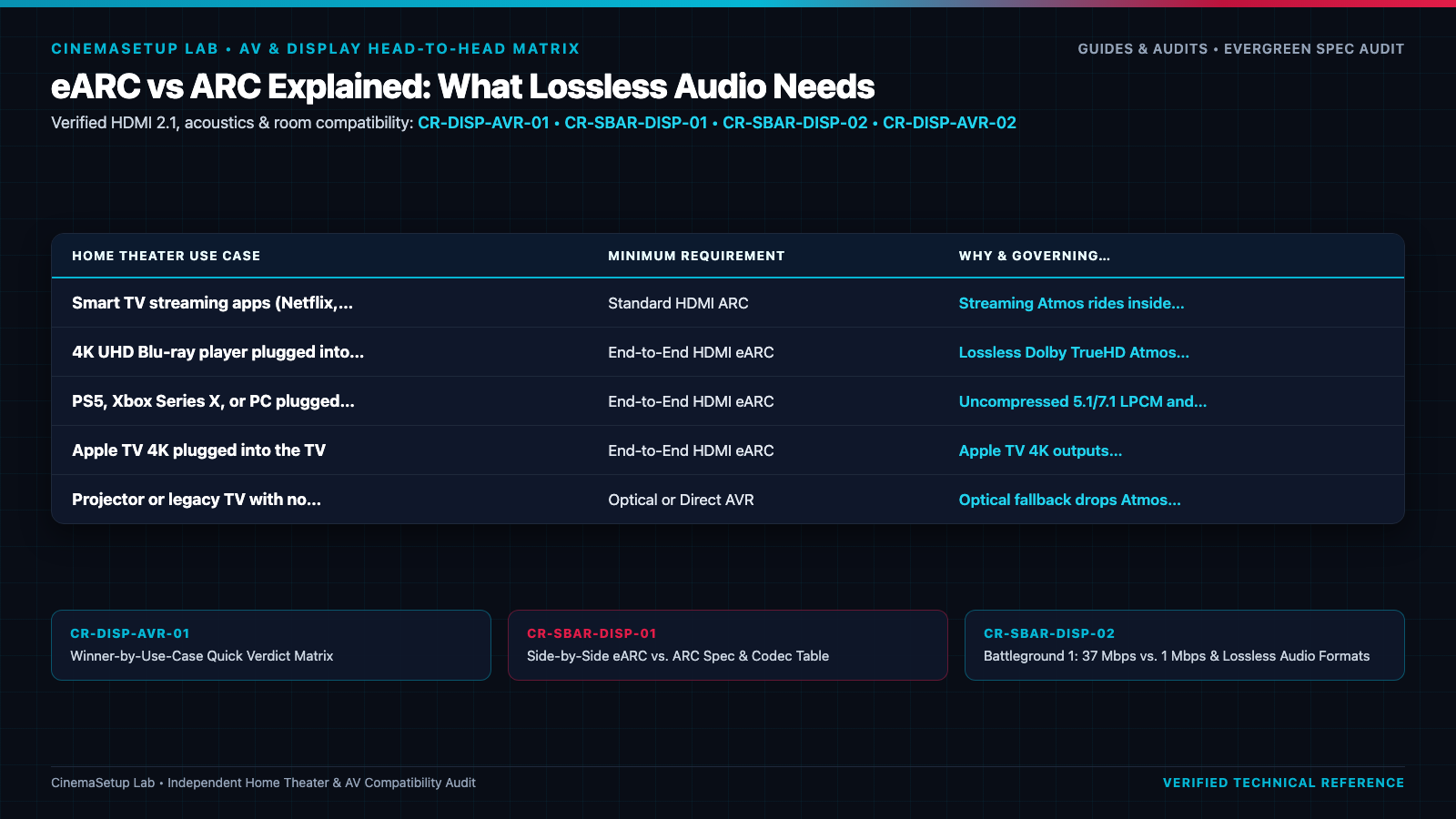
Under CinemaSetup Lab compatibility rules (CR-DISP-AVR-01, CR-SBAR-DISP-01, and CR-SBAR-DISP-02), your source devices—not marketing labels on the TV bezel—determine whether eARC changes what you hear.
| Home Theater Use Case | Minimum Requirement | Why & Governing Compatibility Rule |
|---|---|---|
| Smart TV streaming apps (Netflix, Disney+, Max, Prime) | Standard HDMI ARC | Streaming Atmos rides inside lossy Dolby Digital Plus (~448–768 kbps), fitting cleanly inside ARC’s ~1 Mbps ceiling (CR-SBAR-DISP-02). |
| 4K UHD Blu-ray player plugged into the TV | End-to-End HDMI eARC | Lossless Dolby TrueHD Atmos and DTS-HD MA exceed ARC bandwidth; both TV and AVR/bar need eARC (CR-DISP-AVR-01). |
| PS5, Xbox Series X, or PC plugged into the TV | End-to-End HDMI eARC | Uncompressed 5.1/7.1 LPCM and Dolby MAT Atmos drop to 2.0 stereo over ARC; eARC preserves full 8-channel PCM. |
| Apple TV 4K plugged into the TV | End-to-End HDMI eARC | Apple TV 4K outputs multichannel LPCM and Dolby MAT Atmos—requiring eARC or a direct AVR HDMI input (CR-SRC-AVR-04). |
| Projector or legacy TV with no ARC/eARC | Optical or Direct AVR In | Optical fallback drops Atmos and caps at compressed 5.1 (CR-SBAR-DISP-01); plug sources into an AVR first instead. |
Side-by-Side Verified Spec & Audio Codec Comparison
According to the HDMI Licensing Administrator Enhanced Audio Return Channel specification, eARC replaces ARC’s single-ended utility pin signaling with a dedicated differential physical channel (HEAC). That architectural jump multiplies peak audio throughput nearly 37-fold and shifts capability discovery and lip-sync timing out of fragile HDMI-CEC workarounds.
| Engineering Specification | Standard HDMI ARC | HDMI eARC (Enhanced ARC) | Toslink Optical Backup |
|---|---|---|---|
| HDMI Specification Generation | HDMI 1.4 and later | HDMI 2.1 specification feature | Legacy S/PDIF fiber optic |
| Maximum Audio Bandwidth | ~1 Mbps (single-ended line) | Up to ~37 Mbps (differential HEAC) | ~3.1 Mbps (compressed bitstreams) |
| Stereo PCM (2.0) | Yes (up to 16/24-bit 48 kHz typical) | Yes (high-bitrate stereo supported) | Yes |
| Dolby Digital 5.1 / DTS 5.1 | Yes (DTS depends on TV passthrough) | Yes (DTS depends on TV passthrough) | Yes |
| Dolby Digital Plus + Atmos (Lossy) | Yes (if TV passes DD+ over ARC) | Yes | No (drops to core DD 5.1 or 2.0) |
| Dolby TrueHD + Atmos (Lossless) | No (falls back to lossy core / DD+) | Yes (requires eARC on both ends) | No |
| DTS-HD Master Audio / DTS:X | No (lossy DTS core only if supported) | Yes (only if TV passes DTS) | No (lossy DTS 5.1 core only) |
| Uncompressed 5.1 / 7.1 LPCM | No (capped at 2.0 stereo PCM) | Yes (up to 8 uncompressed channels) | No (capped at 2.0 stereo PCM) |
| Dolby Atmos via Dolby MAT | No | Yes (Apple TV 4K, Xbox Series X/S) | No |
| Lip-Sync Auto-Correction | Optional (manual TV/AVR delay often needed) | Mandatory in HDMI 2.1 eARC spec | None (manual audio delay only) |
| HDMI-CEC Dependency | High (ARC handshake relies on CEC) | Independent HEAC discovery (CEC optional for volume) | None (separate remote required) |
| Required HDMI Cable Spec | High Speed HDMI (18 Gbps) | High Speed w/ Ethernet or Ultra High Speed (48 Gbps) | Toslink optical cable |
Battleground 1: Bandwidth Ceilings & Lossless Audio Physics (CR-DISP-AVR-01 & CR-SBAR-DISP-02)
The biggest point of confusion in the earc vs arc debate stems from seeing the “Dolby Atmos” badge appear on a receiver or soundbar over plain ARC. Under Dolby Atmos home delivery architecture, spatial metadata can travel inside two completely different audio carriers:
- Lossy Dolby Digital Plus (DD+) Atmos: Used by Netflix, Disney+, Apple TV+, Max, and Amazon Prime Video. Typical bitrates sit around 448 to 768 kbps—well under standard ARC’s ~1 Mbps ceiling. When both the TV and audio gear pass DD+ over ARC, you get real 3D height and surround metadata without needing eARC.
- Lossless Dolby TrueHD Atmos: Found on physical 4K UHD Blu-ray discs and lossless local media servers. Uncompressed TrueHD streams regularly spike past 4 to 10+ Mbps and require HDMI eARC’s ~37 Mbps pipe. Under rule CR-SBAR-DISP-02 and CR-DISP-AVR-01, if either the TV or the soundbar/receiver lacks eARC (or eARC is switched off in the TV’s HDMI menu), the disc player or TV forces a lossy fallback to core 5.1 or Dolby Digital Plus.
- Uncompressed 5.1 / 7.1 LPCM & Dolby MAT: PlayStation 5, Nintendo Switch, gaming PCs, and Apple TV 4K decode audio internally and output uncompressed multichannel PCM (often wrapped in Dolby MAT for Atmos on Xbox and Apple TV 4K). Eight channels of uncompressed 48 kHz / 24-bit audio consume roughly 9.2 Mbps—nearly nine times ARC’s capacity—so plain ARC strips surround and height channels away and leaves you with 2.0 stereo PCM.
If your home theater is experiencing silent overhead channels or stereo downmixes from a console or disc player, read our step-by-step audit on why Dolby Atmos drops between a TV and AV receiver to check TV Digital Audio Output settings (“Pass Through” vs. “Auto” vs. “PCM”) alongside eARC handshake toggles.
Battleground 2: Backward Compatibility, Optical Fallbacks & Lip-Sync (CR-SBAR-DISP-01, CR-SYS-03 & CR-SYS-04)
HDMI eARC is strictly backward compatible with standard ARC—but only as fast as the slowest link in the chain. Pairing an eARC television (such as an LG C6 or Samsung S90H OLED) with an ARC-only soundbar automatically negotiates down to standard ARC. You will not break audio playback for streaming apps, yet lossless Blu-ray TrueHD and 7.1 console LPCM remain locked out until both ends support eARC.
Things degrade much faster when a display lacks even standard ARC—common on many home theater projectors and older secondary TVs. Under rule CR-SBAR-DISP-01, falling back to a Toslink optical cable (or using an HDMI-to-optical extractor on a legacy amplifier) drops Dolby Digital Plus Atmos completely, capping playback at compressed Dolby Digital 5.1, lossy DTS 5.1, or stereo PCM. Note also that HDMI-only soundbars such as the Sonos Arc Ultra review model omit a built-in optical jack and require a separate optical-to-HDMI adapter when paired with an ARC-less projector, losing Atmos altogether.
Two additional system rules govern real-world reliability:
- Single Audio-Return Sink & CEC Arbitration (CR-SYS-03): A television can maintain an active ARC/eARC return link with only one audio device at a time. Leaving both a soundbar and an AV receiver wired simultaneously—or adding an HDMI extractor that strips CEC—creates volume-control and mute conflicts. Check our HDMI ARC and eARC soundbar no-sound troubleshooting guide if CEC handshakes drop audio after TV power cycles.
- Mandatory Auto Lip-Sync (CR-SYS-04): Standard ARC leaves audio-video delay alignment optional, which frequently causes noticeable dialogue lag when TVs apply frame-interpolation or HDR tone-mapping latency to incoming console signals. HDMI eARC embeds mandatory lip-sync timing compensation directly into the protocol; if minor offset remains, use the audio-delay slider inside your TV, soundbar, or AVR setup menu rather than chasing unverified millisecond claims.
Battleground 3: TV 4K120 Port Budgets & Direct AVR Bypass (CR-DISP-AVR-02)
Choosing between ARC/eARC and plugging sources directly into an AV receiver or soundbar HDMI input often hinges on how many 40 Gbps or 48 Gbps HDMI 2.1 ports your television offers. Under rule CR-DISP-AVR-02, many living-room TVs—including several two-port HDMI 2.1 lineups—assign their sole eARC jack to one of only two 4K120 inputs. Plugging an eARC soundbar (such as a US Samsung HW-Q990H or Sonos Arc Ultra) or receiver into that shared port leaves only one free 4K120 port on the television for a PS5, Xbox Series X, and gaming PC.
You have two clean architectural solutions depending on your hardware:
- Four-Port 48 Gbps OLED TVs (Direct-to-TV + eARC): Displays equipped with four full-bandwidth HDMI 2.1 ports—such as the LG C6 OLED (eARC on HDMI 2) and Samsung S90H OLED—keep three 4K120/VRR ports open even with eARC wired. You can plug a PS5, Xbox Series X, and Apple TV 4K straight into the TV and let eARC carry uncompressed 7.1 LPCM and Dolby MAT back to your soundbar or receiver.
- Multi-Input 40 Gbps AV Receivers (Direct-to-AVR Bypass): If your TV has limited 4K120 ports—or blocks DTS:X passthrough—plugging every console, streamer, and 4K Blu-ray player directly into a 6-input 40 Gbps receiver like the Denon AVR-X3900H solves both problems at once. The receiver decodes TrueHD Atmos, DTS:X, and 7.1 LPCM internally before video ever leaves for the TV, while passing 4K120, VRR, ALLM, Dolby Vision, and HDR10+ up one single HDMI cable.
Map out every console, Blu-ray player, and soundbar input before pulling cables behind drywall with our dedicated HDMI eARC and 4K120 port-planning guide.
Battleground 4: DTS Passthrough Traps, HDMI Cabling & In-Wall Safety (CR-SBAR-DISP-04 & G-27)
Even with eARC enabled on both devices, DTS passthrough is never guaranteed under rule CR-SBAR-DISP-04. Unlike Dolby Digital Plus, TV makers selectively license DTS decoding and passthrough by brand and model year. Many Samsung televisions drop DTS passthrough completely over eARC, turning DTS-HD Master Audio or DTS:X Blu-ray tracks into silence or 2.0 stereo unless you connect the disc player straight into an AVR or soundbar HDMI input. Similarly, certain soundbars (including the Sonos Arc Ultra per Sonos US format documentation) decode lossy DTS Digital Surround 5.1 but omit lossless DTS-HD MA and DTS:X—requiring Blu-ray owners to configure the player to decode DTS into Multichannel LPCM before transmitting over eARC.
Cabling and installation details also determine signal stability and building safety:
- Cable Certification & Length (CR-ACC-DISP-01): Standard High Speed HDMI cables without Ethernet pins cannot establish the HEAC return channel required for eARC. Always use a certified Ultra High Speed HDMI (48 Gbps) cable—verified via the official HDMI 2.1 specification QR hologram—for short 3 to 10 ft (0.9 to 3.0 m) spans. For wall-to-rack runs exceeding roughly 10 ft (3.0 m), choose a directional active optical fiber (AOC) HDMI cable explicitly rated for eARC and orient the “Source” (TV eARC) and “Display” (or AVR/soundbar) plugs carefully before closing walls.
- Channel Honesty (CR-SYS-05): Remember that upgrading from ARC to eARC preserves lossless audio tracks, yet audio format alone does not add speakers. Soundbars without physical up-firing or rear drivers rely on DSP virtualization (such as DTS Virtual:X or Dolby Atmos Height Virtualization), which is never equivalent to physical height or surround speakers in your room.
- Mounting & In-Wall Electrical Safety (CR-ACC-SPK-02 & G-27): Whenever wall-mounting a TV above a soundbar or routing HDMI and speaker runs inside drywall between a display and credenza, always follow the mount and display manufacturer’s exact instructions first. Verify the TV’s VESA hole pattern and weight rating, anchor brackets squarely into structural wood/steel studs or rated masonry (never hollow drywall alone), use only UL CL2- or CL3-rated in-wall cabling for concealed low-voltage runs, and consult a licensed electrician or qualified AV installer for recessed AC outlets or code-compliant wall fishing.
Final Verdict: Choose HDMI eARC vs. Standard ARC
You Need End-to-End HDMI eARC (or Direct AVR In) If…
- You play physical 4K UHD Blu-ray discs or remux files with lossless Dolby TrueHD Atmos or DTS-HD Master Audio (CR-DISP-AVR-01, CR-SBAR-DISP-02).
- You connect a PS5, Xbox Series X, gaming PC, or Apple TV 4K directly to the TV and want uncompressed 5.1/7.1 LPCM or Dolby MAT Atmos.
- You want HDMI 2.1 mandatory automatic lip-sync without fighting manual TV audio-delay sliders (CR-SYS-04).
- You rely on an AV receiver or Atmos soundbar with physical center, surround, and up-firing/in-ceiling height speakers.
Standard HDMI ARC Is Already Enough If…
- Nearly 100% of your viewing comes from built-in TV apps (Netflix, Disney+, Max, Prime Video, YouTube TV), which stream DD+ Atmos under ~1 Mbps.
- You already plug your 4K Blu-ray player and game consoles directly into an AV receiver’s HDMI inputs, using ARC only for occasional TV-tuner or smart-app audio.
- Your audio system is a 2.1 or 3.1.2/5.1 entry soundbar that only decodes compressed Dolby Digital / DD+ over ARC cleanly.
- You want single-remote TV volume control over HDMI-CEC without replacing a well-matched older ARC-only soundbar.
Audited eARC Receivers, Soundbars & Audio Extractors on Amazon US
Below are four verified Amazon US hardware options representing distinct ways to deploy or bridge HDMI eARC and ARC chains—from a full 9.4-channel 40 Gbps AV receiver and a budget 3.1.2 eARC soundbar to dedicated eARC/ARC audio extractors for legacy optical gear. Always verify US 120 V retail model status and authorized-dealer fulfillment at checkout (CR-SYS-02, G-26).
1. Denon AVR-X3900H 9.4-Channel 8K AV Receiver — Best Full-Bandwidth eARC & Direct 4K120 AVR

Key Specs: 9 powered amps / 11.4 processing (5.1.4 native; 7.1.4 with 2-ch external amp) | 105 W/ch (8 ohms, 20 Hz–20 kHz, 0.08% THD, 2 ch driven) | 6x 40 Gbps HDMI 2.1 inputs / 3x HDMI outputs (eARC/ARC) | Dolby TrueHD Atmos, DTS:X, DTS-HD MA, Multichannel LPCM | 17.1 x 15.3 x 6.6 in (43.4 x 38.9 x 16.7 cm), 27.6 lb (12.5 kg) | In the Box: Single 120 V US AVR chassis, remote, Audyssey mic & stand | Price Tier: $1,000–$2,000 (Core / Enthusiast AVR)
Superseding the discontinued AVR-X3800H in current Amazon US listings, the Denon AVR-X3900H eliminates eARC vs. ARC bottlenecks from both directions. Its main HDMI output supports full lossless eARC from modern TVs (CR-DISP-AVR-01), while all six rear HDMI inputs carry 40 Gbps bandwidth for 4K120 consoles, VRR, FreeSync, ALLM, Dolby Vision, HDR10+, and 4K UHD Blu-ray players—letting you bypass TV DTS passthrough blocks and two-port TV 4K120 limits completely (CR-DISP-AVR-02).
Pros
- Full HDMI eARC support plus six 40 Gbps HDMI 2.1 inputs for lossless direct-to-AVR switching
- Four independent subwoofer outputs, 11.4 pre-outs, and Audyssey MultEQ XT32 room calibration
Cons
- Dirac Live, Bass Control, and Active Room Treatment (ART) require separate paid software licenses
- Running a full 7.1.4 speaker layout requires adding a separate 2-channel external amplifier on the pre-outs
Seller & Warranty Note: Verify the US 120 V retail model shipped and sold by Amazon.com or an authorized Denon US dealer so factory warranty coverage remains valid (G-26).
2. OXS S5 3.1.2 Dolby Atmos Soundbar with HDMI eARC — Best Budget-Tier eARC Atmos Bar

Key Specs: 3.1.2 claimed layout (center channel, up-firing drivers, integrated subwoofer) | HDMI eARC + 1x HDMI input with 4K HDR passthrough, Optical, AUX, USB, Bluetooth | Maker-rated 230 W peak output (continuous RMS power and independent audio BM: no verified data available yet) | In the Box: Single all-in-one soundbar chassis, remote, wall-mount hardware, power cord | Price Tier: $100–$300 (Entry / Starter Soundbar)
Many budget soundbars cut corners with standard HDMI ARC and zero HDMI inputs—forcing lossless disc players into downmixes. The OXS S5 includes both an HDMI eARC link and a dedicated HDMI input with 4K HDR passthrough, giving movie viewers a direct path for Blu-ray or streaming boxes even on older ARC-only TVs (CR-SBAR-SRC-01). Its physical center and up-firing driver layout also avoids relying purely on virtualized height DSP (CR-SYS-05), though without a separate wireless subwoofer or rear satellites it suits bedrooms and compact living rooms best.
Pros
- Combines HDMI eARC with a direct HDMI input supporting 4K HDR passthrough in the Entry/Starter price bracket
- Includes a dedicated center speaker and physical up-firing drivers alongside an integrated woofer
Cons
- Integrated subwoofer and absence of physical rear satellites limit deep LFE rumble and rear surround envelopment in large rooms
- HDMI passthrough does not advertise 4K120/VRR console support, and continuous RMS ratings are unpublished (G-09)
Seller & Warranty Note: Single-bar unit with no external sub or rears; confirm Amazon US fulfillment or authorized OXS storefront status and check TV stand height clearance (CR-SBAR-DISP-05).
3. OREI eARC/ARC to Digital Audio Converter Extractor — Best Bridge for Legacy Optical Gear

Key Specs: HDMI eARC/ARC input from TV | Outputs: Toslink Optical, Coaxial S/PDIF, and analog audio | Supported formats: PCM 2.0, Dolby Digital 5.1, DTS 5.1 | In the Box: Single OREI extractor unit and power hardware (verify HDMI/optical cables on listing) | Price Tier: Under $100 (Accessory / Audio Bridge)
Modern televisions increasingly omit optical audio outputs, stranding older stereo amplifiers, legacy 5.1 receivers, and optical-only soundbars. The OREI eARC/ARC extractor taps the television’s eARC or ARC port and converts audio cleanly to Toslink optical, coaxial S/PDIF, or analog stereo. Be realistic about format limits under CR-SBAR-DISP-01: because optical and coaxial cables cannot carry eARC bitrates, this adapter tops out at compressed Dolby Digital 5.1, DTS 5.1, or PCM 2.0—it will not deliver Dolby TrueHD Atmos.
Pros
- Bridges eARC/ARC-equipped TVs that lack optical jacks to older optical, coaxial, or analog stereo receivers
- Supports compressed 5.1 Dolby Digital and DTS passthrough alongside 2.0 PCM stereo
Cons
- Optical and coaxial outputs cannot carry lossless Dolby TrueHD Atmos, DD+ Atmos, or 5.1/7.1 LPCM
- Requires manual TV audio output configuration (PCM or Dolby Digital) to avoid silence on unsupported Atmos streams
Seller & Warranty Note: Confirm Amazon.com or authorized OREI US seller fulfillment; do not confuse an eARC-to-optical extractor with a full HDMI eARC audio splitter for HDMI-input AVRs.
4. VPFET HDMI eARC Audio Extractor (Toslink + Coaxial, No CEC) — Best High-Sample Stereo Optical Bridge

Key Specs: HDMI eARC/ARC input only | Outputs: Toslink Optical + Coaxial digital (up to 192 kHz stereo PCM) | Explicit “No CEC” design | 4.1-star rating across 3,582 Amazon US reviews | In the Box: Single VPFET converter box and power cable (HDMI and optical cables sold separately unless bundled) | Price Tier: Under $100 (Accessory / Audio Bridge)
The VPFET HDMI eARC Audio Extractor provides another widely reviewed bridge from a TV’s eARC or ARC port to Toslink optical and coaxial inputs on older stereo DACs, integrated amps, and non-HDMI soundbars. Its listing explicitly notes “No CEC”—a crucial buyer detail to verify before checkout. Because HDMI-CEC is omitted, your television remote will not control volume over the adapter, and you must set the TV’s digital output format to PCM or Dolby Digital 5.1 rather than Atmos passthrough.
Pros
- Outputs Toslink optical and coaxial digital simultaneously up to 192 kHz for legacy stereo DACs and amps
- Broadly compatible with modern TVs that have dropped built-in coaxial or optical ports
Cons
- Explicitly lacks HDMI-CEC, disabling TV-remote volume control on the downstream audio system
- Cannot transmit Dolby Atmos, Dolby TrueHD, or uncompressed 5.1/7.1 LPCM over Toslink or coaxial outputs
Seller & Warranty Note: Connects exclusively to the TV’s HDMI ARC/eARC port (not standard HDMI inputs); use a dedicated 5 V USB wall adapter if your TV’s USB port drops power in standby.
Authoritative Specifications & Sources Cited
- HDMI Licensing Administrator — Enhanced Audio Return Channel (eARC) Specification (Differential HEAC transport, ~37 Mbps lossless audio support, mandatory auto lip-sync, and backward compatibility with ARC).
- HDMI Licensing Administrator — HDMI 2.1 & Ultra High Speed HDMI Cable Specification (40/48 Gbps Fixed Rate Link bandwidth, VRR/ALLM/eARC port integration, and official QR hologram certification).
- Dolby Laboratories — Dolby Atmos Home Delivery Overview (Object-based audio transport across compressed Dolby Digital Plus streaming vs. lossless Dolby TrueHD and Dolby MAT carriers).
- Denon US Official AV Receivers Specifications (Continuous 8-ohm 2-channel power rating basis, 40 Gbps HDMI 2.1 input counts, HDCP 2.3, and eARC architecture on current US models).
- Sonos Support US — Supported Home Theater Audio Formats (Distinction between eARC TrueHD Atmos, ARC Dolby Digital Plus Atmos, Multichannel PCM, and DTS codec passthrough caveats).
How We Audited This Guide
- Room setups, upgrade roadmaps, and Amazon marketplace audits enforce system-wide CR-* budgets and acoustics, Canadian /ZC grey-market alerts, pair-vs-single speaker clarity, and manufacturer-first mounting safety.
- Every AV receiver, speaker, subwoofer, soundbar, OLED/Mini-LED TV, projector, source player, and accessory spec was cross-checked against official manufacturer manuals, CEA/CTA standards, and live Amazon US listings.
- Recommendations were evaluated against our weighted vertical scoring rubrics and documented CR-* compatibility rules; we never invent nits, contrast ratios, bench wattage, or room decibels.
Frequently Asked Questions: eARC vs. ARC
Does eARC sound better than ARC for Netflix, Disney+, and Prime Video?
No. Major streaming apps encode Dolby Atmos inside lossy Dolby Digital Plus at roughly 448 to 768 kbps, which fits easily inside standard HDMI ARC’s 1 Mbps ceiling. Upgrading from ARC to eARC improves automatic lip-sync timing but will not raise streaming audio bitrates.
When do you actually need HDMI eARC instead of standard ARC?
You need end-to-end HDMI eARC whenever you plug a 4K UHD Blu-ray player, PS5, Xbox Series X, gaming PC, or Apple TV 4K directly into your TV and want lossless Dolby TrueHD Atmos, DTS-HD Master Audio, Dolby MAT, or uncompressed 5.1/7.1 LPCM sent to your AVR or soundbar.
Can I use my existing HDMI cable for eARC?
Only if it is a High Speed HDMI with Ethernet cable or a certified Ultra High Speed HDMI (48 Gbps) cable. Older High Speed cords without Ethernet pins can drop eARC completely and revert to ARC. For runs over 10 ft (3.0 m), use a directional active optical cable rated for eARC.
What happens if my TV has eARC, but my receiver or soundbar only has ARC?
HDMI eARC is backward compatible, so both devices fall back automatically to standard ARC. Streaming Dolby Digital Plus Atmos continues working normally, while lossless Dolby TrueHD drops to its compressed core or Dolby Digital Plus and multichannel LPCM drops to 2.0 stereo.
Why does my soundbar still show stereo PCM or silence over eARC with Blu-ray DTS discs?
Both the TV and audio device must support DTS passthrough under rule CR-SBAR-DISP-04. Many Samsung TVs block DTS over eARC, and soundbars like the Sonos Arc Ultra omit DTS:X and DTS-HD Master Audio—requiring you to connect the player directly to an AVR or set the player to decode to LPCM.
Is plugging a game console into an AV receiver better than using TV eARC?
If your TV only has two 4K120 ports and one doubles as the eARC jack (CR-DISP-AVR-02), routing consoles through a multi-input 40 Gbps receiver like the Denon AVR-X3900H frees up TV ports and guarantees lossless audio. If your TV has four 48 Gbps ports like the LG C6, plugging consoles into the TV works equally well.


