
Disclosure: As an Amazon Associate, I earn from qualifying purchases. If you buy through links on this page, we may earn a small commission at no extra cost to you. Commission differences across Amazon categories (such as 2% on televisions versus 4% on most AV receivers, speakers, and accessories) never influence our compatibility audits, hardware picks, or upgrade priorities.
Learning how to upgrade 5.1 to 5.1.4 Dolby Atmos without wasting money starts with one hard physical truth: moving from five ear-level speakers to nine discrete speakers (five at ear height plus four overhead height channels) hits a strict receiver processing wall before you hang a single ceiling speaker. Most homeowners assume they can simply wire four overhead speakers onto an existing 5.1 receiver or rely on a receiver’s “Dolby Atmos Height Virtualizer” toggle—only to discover their electronics cannot decode or amplify nine independent channels.
This chronological roadmap walks you through every hardware gate, ceiling geometry check, wire-gauge calculation, and calibration step required to take a standard 5.1 surround setup to true 5.1.4 Dolby Atmos. We frame our compatibility math around a standard living room measuring 15 ft wide × 20 ft long × 8 ft high (4.6 m × 6.1 m × 2.4 m; 2,400 cu ft / 68 m³) with primary seating 10 ft (3.05 m) from the screen. For foundational room planning before modifying an existing setup, start with our complete home theater setup guide.
In This 5.1 to 5.1.4 Dolby Atmos Upgrade Roadmap
- Target Room, Budget Split & Why 5.1.4 Beats 5.1.2
- Verified Upgrade Parts List (6 Amazon US Hardware Picks)
- IF-THEN Compatibility Proof Box (CR-* Rules Audited)
- Step 1: Audit Your Existing 5.1 Foundation & Subwoofer
- Step 2: Unlock 9+ Processing Channels (Why 5.2 & 7.2 AVRs Stop Short)
- Step 3: Pick & Place 4 Height Speakers (In-Ceiling vs. On-Wall vs. Up-Firing)
- Step 4: Wire Gauge, CL2/CL3 In-Wall Codes & Mounting Safety (G-27)
- Step 5: AVR Amp Assignment, Level-Calibration Tones & Crossovers
- Audited Upgrade Hardware Profiles (6 Verified US Listings)
- Authoritative Standards & Manufacturer References
- Frequently Asked Questions
Target Room, Budget Split & Why 5.1.4 Beats 5.1.2
In standard home theater notation, 5.1 consists of five ear-level speakers (Front Left, Center, Front Right, Surround Left, Surround Right) plus one powered subwoofer (the .1 Low-Frequency Effects channel). Expanding to 5.1.4 keeps those five ear-level speakers and subwoofer intact while adding four discrete overhead height speakers: Top Front Left (TFL), Top Front Right (TFR), Top Rear Left (TRL), and Top Rear Right (TRR).
Why target four heights (.4) instead of stopping at two (.2)? With only two overhead speakers mounted above or slightly ahead of the sofa, overhead sound pans forward-to-back cannot track behind your head—rain or aircraft audio collapses into a single overhead plane. Adding the rear height pair restores front-to-back overhead trajectory. To see how 5.1.4 compares spatially against 5.1.2 and 7.1.4 across different sofa positions, consult our breakdown of Dolby Atmos speaker layouts explained.
Also keep total system balance in check under CR-SYS-01. Across cumulative Core Surround ($1,000-$2,500) and Enthusiast Atmos ($3,000-$6,000) audio budgets, speakers and subwoofers should represent 50% to 70% of total audio spend (40%–50% passive speakers plus 15%–25% subwoofers), leaving 25%–35% for the 9-channel AV receiver and 5%–8% for CL2/CL3 copper wire, brackets, and HDMI cables. If you currently rely on a closed-ecosystem soundbar rather than a discrete AVR and passive speakers, note that soundbars cannot accept third-party passive height speakers (CR-SBAR-SPK-01) or independent wired subwoofers (CR-SUB-SBAR-01); moving to 5.1.4 requires transitioning to a discrete receiver path.
Verified Upgrade Parts List (6 Amazon US Hardware Picks)
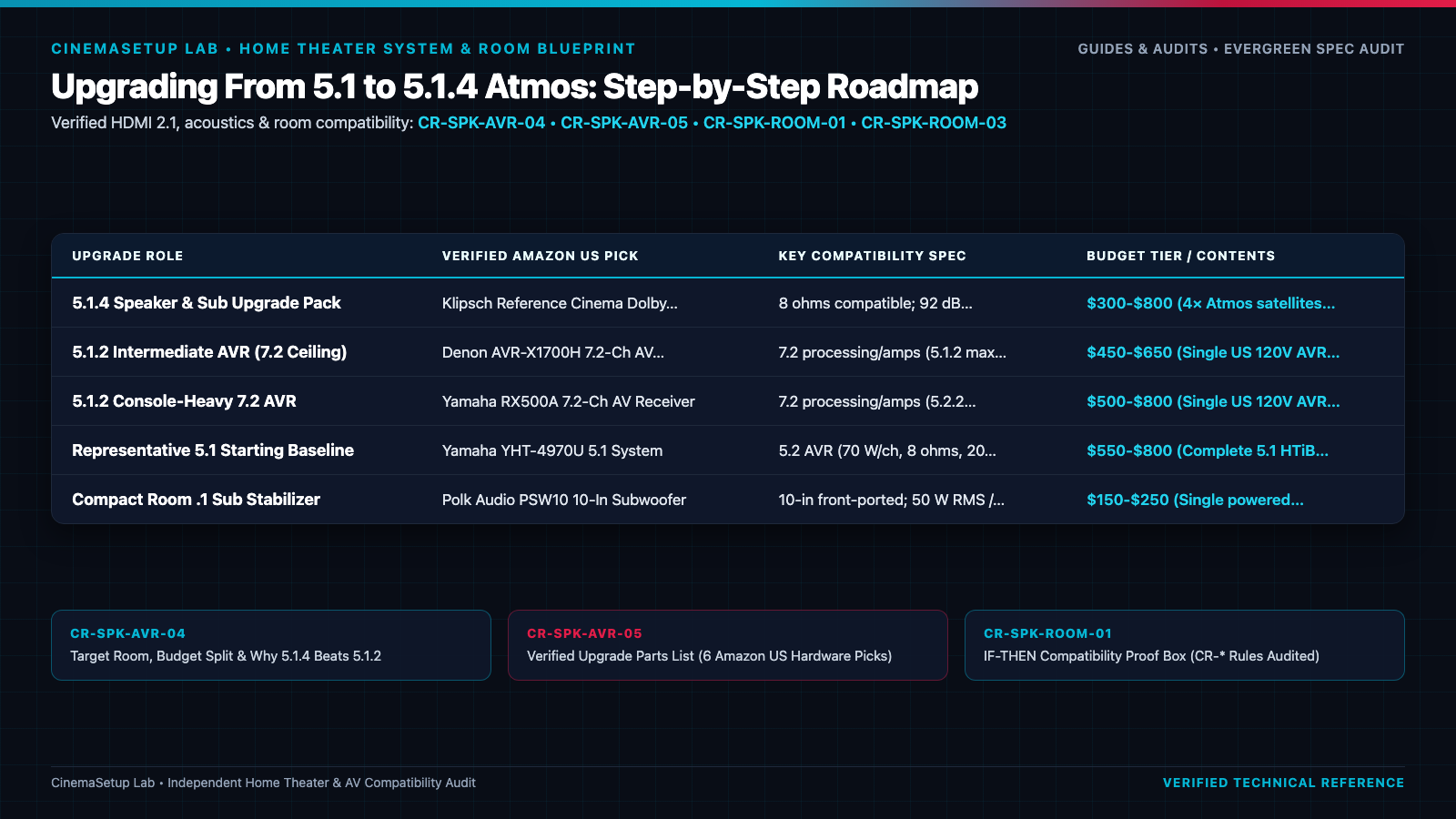
Every SKU below was verified against live Amazon US retail inventory (US 120V AC market, delivery ZIP 10001) on 2026-11-26. Because a 5.1-to-5.1.4 upgrade touches multiple component roles—starting 5.1 baselines, intermediate 7.2 stepping stones versus 9-channel Atmos requirements, speaker packs, subwoofers, and HDMI 2.1 signal bridges—the matrix below maps where each verified Amazon US listing fits in the upgrade sequence.
| Upgrade Role | Verified Amazon US Pick | Key Compatibility Spec | Budget Tier / Contents | Amazon Link |
|---|---|---|---|---|
| 5.1.4 Speaker & Sub Upgrade Pack | Klipsch Reference Cinema Dolby Atmos 5.1.4 System | 8 ohms compatible; 92 dB fronts/surrounds, 91 dB center (2.83 V / 1 m); 4 integrated up-firing drivers; 10-in 150 W RMS sub | $300-$800 (4× Atmos satellites + 1× center + 1× 10-in powered sub; no AVR) | View on Amazon |
| 5.1.2 Intermediate AVR (7.2 Ceiling) | Denon AVR-X1700H 7.2-Ch AV Receiver | 7.2 processing/amps (5.1.2 max per CR-SPK-AVR-04); 80 W/ch (8 ohms, 20 Hz–20 kHz, 0.08% THD, 2 ch); 4–16 ohms; 3× 40 Gbps HDMI 2.1 | $450-$650 (Single US 120V AVR + Audyssey mic + remote) | View on Amazon |
| 5.1.2 Console-Heavy 7.2 AVR | Yamaha RX500A 7.2-Ch AV Receiver | 7.2 processing/amps (5.2.2 max); 75 W/ch (8 ohms, 20 Hz–20 kHz, 0.09% THD, 2 ch); 6–8 ohms min; 4× 40 Gbps HDMI 2.1 | $500-$800 (Single US 120V AVR + YPAO mic + remote) | View on Amazon |
| Representative 5.1 Starting Baseline | Yamaha YHT-4970U 5.1 System | 5.2 AVR (70 W/ch, 8 ohms, 20 Hz–20 kHz, 0.09% THD, 2 ch); 5 passive speakers + 8-in sub; Atmos virtualization only (CR-SYS-05) | $550-$800 (Complete 5.1 HTiB kit; maxes out at 5 ear-level channels) | View on Amazon |
| Compact Room .1 Sub Stabilizer | Polk Audio PSW10 10-In Subwoofer | 10-in front-ported; 50 W RMS / 100 W peak; 40 Hz – 160 Hz (-3 dB); 26.0 lb (11.8 kg) | $150-$250 (Single powered 10-in sub / each; RCA cable separate) | View on Amazon |
| Staged 4K/120Hz Audio Bridge | 4K@120Hz HDMI 2.1 Audio Extractor | 4K@120Hz / VRR / HDCP 2.3 passthrough + dedicated 7.1 HDMI audio-out / optical SPDIF | $50-$120 (Single extractor unit + power adapter) | View on Amazon |
Crucial Receiver Note for Full 5.1.4: Notice that the Denon AVR-X1700H and Yamaha RX500A in the table above are 7.2-channel receivers—they run 5.1.2 (two height speakers) if you split your upgrade into stages, but they hit a hard 7-channel processing ceiling under CR-SPK-AVR-04. To power all four height speakers in a true 5.1.4 setup, your Step 2 receiver must offer at least 9 processing channels and 9 built-in amplifiers (such as the current US Denon AVR-X3900H 9.4-channel AVR), as detailed in our best AV receiver for Dolby Atmos audit.
IF-THEN Compatibility Proof Box (CR-* Rules Audited)
Run your existing 5.1 rig and planned 5.1.4 additions through these exact IF -> THEN rules before ordering speakers, wire, or a new AV receiver:
5.1 to 5.1.4 Compatibility Verification Checklist:
- CR-SPK-AVR-04 (HARD — 9-Channel Processing Ceiling): IF your target layout is 5.1.4 (5 ear-level speakers + 4 height speakers = 9 processed speaker channels, with subwoofers counted separately), THEN any 5.2 AVR (such as the Yamaha YHT-4970U’s receiver) or 7.2 AVR (Denon AVR-X1700H or Yamaha RX500A) fails HARD for 5.1.4. Adding an external power amplifier cannot create missing processing channels—you need a 9.4- or 11.4-processing AVR such as the Denon AVR-X3900H.
- CR-SPK-AVR-05 & CR-SPK-AVR-06 (HARD/CONDITIONAL — Built-In Amps, Pre-Outs & Zone 2): IF you buy a 9-amp / 11.4-processing AVR like the Denon AVR-X3900H, THEN all 9 speakers in 5.1.4 run off internal amps natively—provided you disable Zone 2 or front bi-amping (which borrow amp channels under CR-SPK-AVR-06). Only expanding later to 7.1.4 (11 channels) triggers the CONDITIONAL requirement for a 2-channel external power amp on the receiver’s pre-outs.
- CR-SYS-05 (INFO — Virtualization Honesty): IF a 5.1 AVR displays “Dolby Atmos Height Virtualizer” or “DTS Virtual:X,” THEN it simulates height ambience through ear-level drivers rather than delivering discrete
.4overhead sound. Treat virtualization strictly as a temporary 5.1 DSP mode until physical height drivers are connected. - CR-SPK-ROOM-01 (CONDITIONAL/SOFT — Up-Firing Ceiling Reflection): IF your
.4heights use upward-firing modules (like the four elevation drivers integrated atop the Klipsch Reference Cinema 5.1.4 satellites), THEN your room needs a flat, hard, acoustically untreated ceiling between 7.5 and 12 ft (2.3 and 3.7 m) high per Dolby guidance. Vaulted, sloped, popcorn-acoustic-tile, or 14-ft great-room ceilings smear overhead reflections. - CR-SPK-ROOM-03 & CR-ACC-SPK-02 (CONDITIONAL — In-Ceiling Cavity & CL2/CL3 Wire): IF you install flush in-ceiling height speakers, THEN confirm joist cavity depth exceeds the speaker’s mounting depth, verify no electrical/plumbing lines occupy the bay, obtain landlord/HOA permission in rentals, and pull UL-listed CL2 or CL3 oxygen-free copper (OFC) cable inside walls or ceilings.
- CR-SPK-AVR-01 & CR-SPK-AVR-02 (HARD/CONDITIONAL & SOFT — Impedance & Sensitivity): IF any of your existing 5.1 speakers or new height speakers carry a 4-ohm nominal rating, THEN verify 4-ohm AVR support (Denon AVRs support 4–16 ohms via menu; Yamaha RX500A stops at 6 ohms minimum) and leave 4+ in (10 cm) of open ventilation above the chassis (CR-AVR-ROOM-01).
- CR-SUB-AVR-01 & CR-SUB-SPK-01 (HARD & SOFT — Powered Sub & 1.5× Crossover): IF your AVR sends a line-level LFE sub pre-out, THEN connect a self-powered subwoofer, set all 9 speakers (including all 4 heights) to Small, and set crossovers at least
1.5 ×above each speaker’s -3 dB low-frequency floor. - CR-SYS-02 (HARD — US 120V AC & Authorized Seller): Confirm every receiver and powered subwoofer is a genuine US 120V AC / 60 Hz unit sold by an authorized US dealer on Amazon to protect factory warranty coverage (G-26).
Step 1: Audit Your Existing 5.1 Foundation & Subwoofer
Before spending money on overhead channels, audit what you already own so height speakers integrate into a balanced soundstage instead of masking weak fundamentals:
- Check Ear-Level Speaker Placement First: True 5.1.4 separation relies on vertical contrast between ear-level speakers and overhead heights. Keep your Front L/C/R tweeters near seated ear height (roughly 36–42 in / 91–107 cm) and position your two ear-level surround speakers at 110°–120° slightly behind the sofa—never mounted up near the ceiling where they collide acoustically with Top Rear heights.
- Verify Center Timbre & Sensitivity Headroom (CR-SPK-SPK-01 & CR-SPK-AVR-02): Confirm your front L/C/R share the same speaker series and tweeter architecture so voices pan smoothly. Also check speaker sensitivity in
dB SPL(with its2.83 V / 1 mor1 W / 1 mbasis): by our estimate from published specs at a 10 ft (3.05 m) seat assuming zero room gain and a conservative ~30% multichannel AVR power derating, 92 dB (2.83 V / 1 m) 8-ohm speakers need only roughly ~15 W/ch for 95 dB living-room peaks and ~47 W/ch for 100 dB dynamic peaks—easily cleared by mainstream AVRs. By contrast, 85–86 dB 4-ohm speakers require roughly four times that amplifier power for the same loudness. - Size Your .1 Subwoofer to Enclosed Volume (CR-SUB-ROOM-01): Measure
length × width × ceilingin feet (including open adjoining hallways or kitchens without doors). Rooms under 1,500 cu ft (< 42 m³) run cleanly with a compact 10-inch powered subwoofer such as the Polk Audio PSW10 (50 W RMS / 100 W peak, 40–160 Hz `-3 dB`) or the Klipsch pack’s 10-inch 150 W RMS sub. Larger 1,500–3,000 cu ft (42–85 m³) living rooms benefit from a higher-headroom 12-inch sub or dual subs placed apart (CR-SUB-ROOM-02). In shared-wall apartments (CR-SUB-ROOM-03), pair a sealed sub on decoupling feet with your receiver’s Night Mode / DRC, noting that low bass still passes through structure to neighbors.
Step 2: Unlock 9+ Processing Channels (Why 5.2 & 7.2 AVRs Stop Short)
This is the single most common point of confusion when upgrading 5.1 to 5.1.4. Let’s compare receiver channel counts cleanly using CR-SPK-AVR-04 and CR-SPK-AVR-05—and for a deeper breakdown of channel math across every layout, see how many channels do you need on an AV receiver.
| Receiver Class | Internal Amps / Processing | Max Atmos Layout | Can It Run 5.1.4? | What Happens Under CR-SPK-AVR-04 / 05 |
|---|---|---|---|---|
| 5.2 AVR (e.g., Yamaha YHT-4970U kit AVR) | 5 amps / 5.2 processing | 5.1 only (DSP virtualization) | No (HARD Fail) | Only 5 ear-level speaker terminals exist; Atmos badges rely on DSP virtualization (CR-SYS-05). |
| 7.2 AVR (e.g., Denon AVR-X1700H, Yamaha RX500A) | 7 amps / 7.2 processing | 5.1.2 (2 heights) | No (HARD Fail) | Processes 7 channels max; external power amps cannot unlock 8th or 9th height channels. |
| 9.4 / 11.4 AVR (e.g., Denon AVR-X3900H) | 9 amps / 11.4 processing | 5.1.4 native (7.1.4 w/ 2-ch amp) | Yes (Native Pass) | Powers all 5 ear-level + 4 height speakers internally; pre-outs let you add 2 more speakers later. |
Notice the strategic fork in the road: if your budget sits inside the Starter/Core tier right now and you want to upgrade in two stages, buying a 7.2 receiver like the Denon AVR-X1700H ($450-$650) or Yamaha RX500A ($500-$800) gets you to 5.1.2 immediately—but you will have to sell or replace that 7.2 receiver when you eventually add the second pair of heights for 5.1.4. If 5.1.4 is your confirmed destination, save once and step directly into a 9.4-channel receiver like the Denon AVR-X3900H (which includes 9 built-in amp channels, 11.4 processing, 4–16 ohm support, four independent subwoofer outputs under CR-SUB-AVR-02, Audyssey MultEQ XT32, and an optional paid Dirac Live upgrade under CR-AVR-ROOM-02).
Staged HDMI 2.1 Workaround: What if you already own a working 5.1 or 7.2 AVR that lacks 40 Gbps HDMI 2.1 inputs, and you want 4K/120Hz VRR gaming on your TV today while saving for a 9.4 AVR? Under CR-SRC-AVR-01 and CR-DISP-AVR-01, either plug your console straight into a TV HDMI 2.1 port and send audio back over HDMI eARC (required for lossless Dolby TrueHD Atmos and multichannel LPCM), or use a 4K/120Hz HDMI 2.1 audio extractor such as the 4K@120Hz 8K HDMI 2.1 Audio Extractor (B0HDT4GRZM) to split video to the TV and 7.1 HDMI audio to an older receiver—just remember that its optical SPDIF fallback compresses audio down to standard 5.1 rather than lossless Atmos.
Step 3: Pick & Place 4 Height Speakers (In-Ceiling vs. On-Wall vs. Up-Firing)
Once a 9-channel AVR is on your rack, choose how your four physical height channels (Top Front L/R and Top Rear L/R) will mount in your room. Never mix up height placement rules—each topology obeys a distinct compatibility gate:
| Height Topology | Optimal Placement Geometry | Where It Works Best | Where It Fails / Degrades | Governing Rule |
|---|---|---|---|---|
| In-Ceiling Speakers (4 flush drivers) | Top Front ~45° ahead of main seat; Top Rear ~135° behind main seat; aligned in-line with Front L/R width | Owned homes with accessible joist bays, flat or slightly sloped drywall ceilings | Rentals without landlord approval; concrete ceilings; shallow cavities blocking basket depth | CR-SPK-ROOM-03, CR-ACC-SPK-02 |
| On-Wall Angled Heights (Front Height + Rear Height) | Mounted high near wall-ceiling junction (~2+ ft / 61+ cm above ear level) angled down toward sofa | Vaulted ceilings, concrete slabs, apartments with wall-mount approval, no drywall cuts | Extremely low ceilings (< 7.5 ft / 2.3 m) with poor vertical separation; rear-wall-against-sofa rooms | CR-SPK-ROOM-02 |
| Up-Firing Atmos Modules (4 elevation drivers) | Placed atop or integrated inside Front L/R and Surround L/R enclosures aimed at ceiling bounce point | Renters unable to drill walls/ceilings in rooms with flat, hard ceilings 7.5–12 ft (2.3–3.7 m) high | Vaulted, coffered, beamed, acoustic-tile, or tall (>12 ft) ceilings scatter reflections | CR-SPK-ROOM-01 |
If your existing 5.1 setup relies on aging tiny plastic satellites or mismatched speakers and you live in a room with a flat, hard 8-to-10-ft (2.4–3.0 m) drywall ceiling, an integrated pack such as the Klipsch Reference Cinema Dolby Atmos 5.1.4 System (B097CJYZHD) gives you all four upward-firing height drivers built directly into the four main satellites alongside a matching center and 10-in 150 W RMS subwoofer—requiring zero ceiling drywall cuts while running cleanly on a 9-channel AVR (or as 5.1.2 on a 7.2 AVR first while leaving the rear height terminals unused until your 9.4 AVR arrives).
If your couch sits pushed flush against the back wall, watch your Top Rear geometry carefully under CR-SPK-ROOM-02: you cannot place Top Rear ceiling speakers behind a wall that touches the sofa. In tight back-wall rooms, mount Top Rear drivers slightly overhead/just behind ear position (around 110°–125° rather than 135°), or stick to 5.1.2 Top Middle if your seating allows zero rear overhead offset.
Step 4: Wire Gauge, CL2/CL3 In-Wall Codes & Mounting Safety (G-27)
Adding four height speakers doubles your speaker cable runs—and overhead runs are almost always longer than front L/C/R cables because wire routes up walls and across ceiling joists. Keep total copper round-trip resistance below ~5% of speaker impedance using pure oxygen-free copper (OFC) rather than cheap copper-clad aluminum (CCA) wire (CR-ACC-SPK-01):
- 16 AWG OFC Copper: Safe for one-way runs up to ~50 ft (15 m) into 8-ohm speakers, ~37 ft (11 m) into 6-ohm speakers, or ~25 ft (7.6 m) into 4-ohm speakers.
- 14 AWG OFC Copper (Recommended for 5.1.4 Ceiling Pulls): Handles one-way runs up to ~79 ft (24 m) at 8 ohms, ~59 ft (18 m) at 6 ohms, or ~40 ft (12 m) at 4 ohms—ideal for Top Rear ceiling runs looping back to a front AVR rack.
- 12 AWG OFC Copper: Reserved for very long basement/theater runs up to ~126 ft (38 m) at 8 ohms or ~63 ft (19 m) at 4 ohms.
Safety, Fire-Code & Installation Checklist (G-27):
- CL2 / CL3 Jacket Rating Inside Walls & Ceilings (CR-ACC-SPK-02): Standard clear-jacket zip cord is strictly for exposed floor/baseboard routing. Any speaker cable concealed behind drywall or above a ceiling must carry a UL-listed CL2 or CL3 fire-resistance rating per National Electrical Code and local building rules.
- Manufacturer-First Mounting & Stud Anchoring: Follow the speaker and bracket manufacturer’s exact cutout template, ceiling dog-ear torque limits, and wall-bracket screw specifications. Anchor on-wall height speakers into solid wood studs or manufacturer-approved masonry anchors—never hang weighted speakers from bare drywall alone—and confirm structural weight ratings before overhead mounting.
- Scan Before Cutting & Hire Licensed Trades When Needed: Always scan ceiling bays for live electrical romex, HVAC ducts, and water pipes before cutting drywall. Never run standard AC power cords inside walls; consult a licensed electrician or certified custom AV installer for attic/joist fishing, fire-blocking penetrations, or new 120V AC outlets.
- AVR Thermal Clearance & Comfortable Listening (CR-AVR-ROOM-01): Driving nine speakers simultaneously generates substantial amplifier heat. Leave at least 4 in (10 cm) (or your AVR manual’s stated clearance) of open air above and behind the chassis—never lock a 9-channel AVR inside a sealed cabinet. Keep playback at comfortable everyday listening levels.
Step 5: AVR Amp Assignment, Level-Calibration Tones & Crossovers
Physically wiring nine speakers is only half the job. Complete these five AVR configuration steps immediately after connecting your four height speakers:
- Set Amp Assign to 9.1 / 5.1.4 Mode: Open your 9-channel AVR’s speaker-configuration menu and select 5.1.4 (Top Front + Top Rear)—or Front Dolby + Rear Dolby if using up-firing Atmos modules, which applies Dolby’s ceiling-bounce HRTF filter curve. Ensure Zone 2 / Bi-Amp is turned off so all nine internal amplifiers feed the main room (CR-SPK-AVR-06).
- Verify Speaker Impedance Setting (CR-SPK-AVR-01): If any speaker in your 9-channel array is rated 4 ohms (or 6 ohms on Yamaha models), toggle the AVR’s impedance switch to match before running high-volume sweeps.
- Run Multi-Position Room Correction With Level-Calibration Tones (CR-AVR-ROOM-02): Mount the bundled calibration microphone on a tripod at ear height across 6 to 8 seating positions. Let Audyssey MultEQ XT32, Dirac Live, or YPAO emit level-calibration tones to measure acoustic distance (crucial for up-firing ceiling bounce path lengths) and trim channel levels evenly.
- Lock Crossovers & “Small” Speaker Settings (CR-SUB-SPK-01): Room calibration sometimes resets tower fronts to “Large.” Manually switch all 9 speakers to Small and set crossovers at
1.5 ×each speaker’s -3 dB limit (typically 80 Hz for capable bookshelves/towers, or 100–120 Hz for compact height modules and satellites) while setting the subwoofer’s physical crossover dial toLFE / Bypass. - Confirm Source Bitstream & eARC Output (CR-DISP-AVR-01, CR-SRC-AVR-04): Set your 4K Blu-ray player or console to Bitstream / Dolby Atmos output, set your TV’s Digital Audio Out to Pass Through over HDMI eARC, and check your AVR’s front-panel display to confirm it reads
Dolby Atmos(notDolby Surroundupmixing) during native Atmos playback.
Audited Upgrade Hardware Profiles (6 Verified US Listings)
1. Klipsch Reference Cinema Dolby Atmos 5.1.4 System — Renter-Friendly 5.1.4 Speaker & Sub Upgrade

Key Specs & Package Contents: 8 ohms compatible | Sensitivity: 92 dB fronts/surrounds, 91 dB center (2.83 V / 1 m) | Height Topology: 4 integrated upward-firing Atmos elevation drivers (Top Front L/R + Top Rear L/R) | Subwoofer: 10-in spun-copper IMG woofer, 150 W continuous RMS / 300 W peak, 32 Hz – 120 Hz (±3 dB) | In the Box: 4× Atmos-integrated satellite speakers, 1× center channel, 1× 10-in wireless/wired powered subwoofer (no AV receiver or speaker wire included) | Price Tier: $300-$800
If your existing 5.1 system relies on low-sensitivity budget boxes and you want an all-matched speaker-plus-sub upgrade engineered specifically for 5.1.4, the Klipsch Reference Cinema Dolby Atmos 5.1.4 System packs four physical up-firing height channels directly atop its four ear-level satellites. Its 92 dB sensitivity keeps amplifier wattage demand low across a 10 ft (3.05 m) seating distance (CR-SPK-AVR-02), and you can run it as 5.1.2 on a 7.2 AVR temporarily before unlocking all four height terminals on a 9.4-channel receiver like the Denon AVR-X3900H. Just confirm your room has a flat, reflective 7.5-to-12-ft (2.3–3.7 m) ceiling (CR-SPK-ROOM-01) and verify authorized US dealer fulfillment on Amazon (G-26).
Pros
- Includes four physical up-firing height drivers, timbre-matched center, and a 10-in 150 W RMS sub in one matched pack
- High 91–92 dB (2.83 V / 1 m) sensitivity and 8-ohm load pair easily with mainstream 9-channel AVRs
Cons
- Up-firing height drivers degrade sharply under vaulted, sloped, or acoustic-tile ceilings (CR-SPK-ROOM-01)
- Compact satellite cabinets require a higher 100–120 Hz subwoofer crossover and omit an AV receiver and wire
2. Denon AVR-X1700H 7.2-Channel AV Receiver — Stepping-Stone 5.1.2 Hub (7-Ch Ceiling Checkpoint)

Key Specs & Package Contents: 7.2 processing & amplification (5.1.2 max) | Rated Power: 80 W/ch (8 ohms, 20 Hz–20 kHz, 0.08% THD, 2 ch driven) | Impedance: 4–16 ohms (via menu setting) | HDMI: 6 in / 1 eARC out (3× 40 Gbps 4K/120Hz VRR/ALLM, HDCP 2.3) | Room EQ: Audyssey MultEQ XT | In the Box: US 120V AVR-X1700H receiver, setup mic, remote | Price Tier: $450-$650
The Denon AVR-X1700H is the cleanest 4-ohm-capable stepping stone if you want to leave a legacy 5.1 receiver behind for 5.1.2 Atmos in the Core Surround ($1,000-$2,500) budget tier—thanks to Audyssey MultEQ XT, three 40 Gbps HDMI 2.1 ports, and official 4–16 ohm impedance support (CR-SPK-AVR-01). However, enforce CR-SPK-AVR-04 strictly: because it processes 7 channels maximum and lacks multichannel pre-outs, it cannot run 5.1.4. Treat it as a 5.1.2 destination, or step up directly to the 9.4-channel Denon AVR-X3900H if four overhead heights are non-negotiable. Check Amazon seller authorization on 2026-11-26 before buying (G-26).
Pros
- Supports 4-to-16-ohm speaker loads and includes Audyssey MultEQ XT room correction
- Three 40 Gbps HDMI 2.1 inputs plus eARC pass 4K/120Hz VRR, Dolby Vision, and HDR10+
Cons
- HARD 7-channel processing cap stops at 5.1.2—cannot drive four Atmos height speakers (CR-SPK-AVR-04)
- Lacks main-channel pre-outs and limits 40 Gbps bandwidth to three of its six HDMI inputs
3. Yamaha RX500A 7.2-Channel AV Receiver — Quad-40 Gbps 5.1.2 Alternative

Key Specs & Package Contents: 7.2 processing & amplification (5.2.2 max) | Rated Power: 75 W/ch (8 ohms, 20 Hz–20 kHz, 0.09% THD, 2 ch driven) | Impedance: 6–8 ohms (6-ohm setting required for 6-ohm loads) | HDMI: 4 in / 1 eARC out (all 4× 40 Gbps 4K/120Hz VRR/ALLM/QMS, HDCP 2.3) | Room EQ: YPAO | In the Box: US 120V RX500A receiver, YPAO mic, remote | Price Tier: $500-$800
Like the Denon X1700H, the Yamaha RX500A is a 7.2-channel interim receiver capped at 5.1.2 / 5.2.2 rather than 5.1.4 (CR-SPK-AVR-04). Its standout advantage for gamers upgrading an aging HDMI 2.0 5.1 rig is putting full 40 Gbps 4K/120Hz bandwidth on all four HDMI inputs alongside QMS, VRR, and AirPlay 2 / Google Cast streaming. However, enforce CR-SPK-AVR-01 carefully: Yamaha rates this model down to 6 ohms minimum only, ruling out 4-ohm front or height speakers.
Pros
- All four HDMI inputs deliver 40 Gbps 4K/120Hz, VRR, ALLM, and QMS passthrough
- Compact 12.5-in (31.9 cm) chassis depth eases shallow media-cabinet placement
Cons
- 7-channel processing limit caps at two height channels (5.2.2), blocking 5.1.4 expansion
- Minimum 6-ohm speaker rating excludes 4-ohm speaker upgrades (CR-SPK-AVR-01)
4. Yamaha YHT-4970U 5.1-Channel System — Baseline 5.1 Starting Architecture

Key Specs & Package Contents: 5.2-channel AVR + 5 passive speakers + 8-in powered subwoofer | Rated Power: 70 W/ch (8 ohms, 20 Hz–20 kHz, 0.09% THD, 2 ch driven) | HDMI: 4 in / 1 eARC out (4K/120Hz, VRR, ALLM, QMS) | Atmos Handling: Height virtualization only (CR-SYS-05) | In the Box: US 120V 5.2-ch AVR, 5 ear-level speakers, 8-in powered sub, YPAO mic, wire | Price Tier: $550-$800
If you are starting from TV speakers and want a Starter ($300-$800) discrete 5.1 foundation today—or if you already own a 5.1 home-theater-in-a-box kit like the Yamaha YHT-4970U—this system illustrates the exact boundary between 5.1 and 5.1.4. While its 5.2 receiver handles modern 4K/120Hz HDMI 2.1 video and carries Dolby Atmos branding via DSP height virtualization (CR-SYS-05), it has only five speaker terminals. Upgrading from this kit to 5.1.4 means retaining or upgrading the ear-level speakers while swapping the 5.2 receiver for a 9.4-channel AVR and adding four physical height speakers.
Pros
- Complete Starter 5.1 kit with standard passive speaker terminals and 4× 4K/120Hz HDMI 2.1 inputs
- Modular speakers and powered sub can remain in service during staged front/center upgrades
Cons
- 5.2 AVR relies on Atmos virtualization only (CR-SYS-05) and cannot accept any physical .2 or .4 height speakers
- 8-in subwoofer and compact satellites lack deep output for large open rooms over 2,000 cu ft
5. Polk Audio PSW10 10-Inch Powered Subwoofer — Compact .1 Foundation

Key Specs & Package Contents: 10-in polymer woofer, front-firing flared port | Amplifier: 50 W continuous RMS / 100 W dynamic peak | Frequency Response: 40 Hz – 160 Hz (-3 dB) | Dimensions: 14.4 × 14.0 × 16.1 in (36.5 × 35.6 × 41.0 cm) | Weight: 26.0 lb (11.8 kg) | In the Box: Single US 120V powered 10-inch subwoofer (sold each; RCA subwoofer cable sold separately) | Price Tier: $150-$250
If your current system is a subwoofer-free 5.0 tower or bookshelf setup, never jump straight to overhead Atmos speakers before filling the .1 LFE channel (CR-SYS-01). In bedrooms or small closed dens under 1,500 cu ft (42 m³), the Polk Audio PSW10 adds dedicated powered bass (CR-SUB-AVR-01) at an entry $150-$250 tier and crosses over cleanly around 80–100 Hz with bookshelf mains (CR-SUB-SPK-01). In larger 1,500–3,000+ cu ft living rooms, step up to a 12-inch subwoofer or dual subs instead (CR-SUB-ROOM-01).
Pros
- Front-firing port tolerates placement near walls better than rear-ported budget subs
- Accessible entry tier for stabilizing a 5.0 rig in compact rooms under 1,500 cu ft (42 m³)
Cons
- 50 W continuous RMS amplifier and 40 Hz (-3 dB) floor lack deep sub-bass rumble in large living rooms
- Ported enclosure requires DRC / Night Mode discipline in shared-wall apartments (CR-SUB-ROOM-03)
6. 4K@120Hz 8K HDMI 2.1 Audio Extractor 7.1Ch — Staged Non-eARC Bridge

Key Specs & Package Contents: Video Passthrough: 4K@120Hz, 8K, VRR, HDCP 2.3 | Audio Outputs: Dedicated 7.1-ch HDMI audio-only out, Optical SPDIF, Coaxial, 3.5 mm | In the Box: Single HDMI 2.1 audio extractor unit and power adapter (certified Ultra High Speed HDMI cables sold separately) | Price Tier: $50-$120
When staging an upgrade over several months, your 4K/120Hz console or media player often arrives before your 9.4-channel AVR. If your display lacks HDMI eARC (common on gaming monitors and many projectors) and your existing 5.1 receiver caps at HDMI 2.0 (18 Gbps), this 4K@120Hz HDMI 2.1 Audio Extractor splits 4K/120Hz VRR video straight to the display while routing a dedicated HDMI audio-only feed to your receiver (CR-SRC-AVR-01). Just keep one limit clear: use its dedicated HDMI audio output rather than optical SPDIF, because optical drops Dolby TrueHD Atmos back down to compressed 5.1.
Pros
- Preserves 4K/120Hz VRR passthrough on monitors or projectors lacking HDMI eARC
- Dedicated 7.1-ch HDMI audio-only output avoids optical SPDIF compression limits
Cons
- Adds an extra HDMI handshake hop and requires separate Ultra High Speed 48 Gbps HDMI cables
- Optical and coaxial outputs cannot transport lossless Dolby TrueHD Atmos or multichannel LPCM
Authoritative Standards & Manufacturer References
- Dolby Official 5.1.4 Overhead Speaker Setup Guide (Top Front 45° and Top Rear 135° overhead angles, flat 7.5–12 ft ceiling reflection guidance for Dolby Atmos-enabled speakers, and ear-level surround separation).
- Denon US Official AV Receiver Specifications (AVR-X3900H 9.4-channel amplification / 11.4 processing architecture and AVR-X1700H 80 W/ch 8-ohm 2-channel driven ratings, 4–16 ohm impedance menus, and 40 Gbps HDMI 2.1 ports).
- Yamaha US Official AV Receiver & System Specifications (RX500A 75 W/ch and YHT-4970U 70 W/ch 8-ohm 2-channel driven ratings, 6-ohm minimum impedance constraints, and YPAO calibration).
- Klipsch US Official Speaker & Subwoofer Documentation (Reference Cinema Dolby Atmos 5.1.4 sensitivity ratings, 8-ohm compatibility, and 10-in 150 W RMS subwoofer response).
- HDMI Licensing Administrator — HDMI 2.1 & eARC Specification (eARC lossless Dolby TrueHD transport, 40/48 Gbps Fixed Rate Link bandwidth, HDCP 2.3, and Ultra High Speed HDMI Cable certification).
How We Audited This Guide
- Room setups, upgrade roadmaps, and Amazon marketplace audits enforce system-wide CR-* budgets and acoustics, Canadian /ZC grey-market alerts, pair-vs-single speaker clarity, and manufacturer-first mounting safety.
- Every AV receiver, speaker, subwoofer, soundbar, OLED/Mini-LED TV, projector, source player, and accessory spec was cross-checked against official manufacturer manuals, CEA/CTA standards, and live Amazon US listings.
- Recommendations were evaluated against our weighted vertical scoring rubrics and documented CR-* compatibility rules; we never invent nits, contrast ratios, bench wattage, or room decibels.
Continue Your Audit
Frequently Asked Questions
Can I upgrade from 5.1 to 5.1.4 without buying a new AV receiver?
Only if your current receiver already processes at least 9 speaker channels. Under rule CR-SPK-AVR-04, a 5.2 or 7.2 receiver cannot decode nine discrete channels even if you connect an external power amplifier—upgrading to 5.1.4 requires a 9.4- or 11.4-processing AVR.
Is there a big difference between 5.1.2 and 5.1.4 Dolby Atmos?
Yes. A 5.1.2 layout uses one pair of overhead speakers, which prevents front-to-back overhead sound panning. Upgrading to 5.1.4 adds Top Rear height channels behind the sofa, creating three-dimensional overhead movement across the entire room ceiling.
Do I need in-ceiling speakers for 5.1.4, or do up-firing modules work?
In-ceiling speakers provide the sharpest overhead localization when joist depth and drywall cutting are allowed (CR-SPK-ROOM-03). Up-firing Atmos modules work well for renters only under flat, hard, untreated ceilings 7.5 to 12 ft (2.3 to 3.7 m) high (CR-SPK-ROOM-01); otherwise, choose angled on-wall heights.
What speaker wire gauge and rating should I buy for 5.1.4 ceiling speakers?
Use pure oxygen-free copper (OFC) rather than copper-clad aluminum. Under CR-ACC-SPK-01 and CR-ACC-SPK-02, pull UL-listed CL2 or CL3 rated 14 AWG OFC wire for in-ceiling runs up to ~79 ft (24 m) at 8 ohms, or 16 AWG OFC under ~50 ft (15 m).
Can a 7.2 receiver run 5.1.4 if I add a 2-channel external amplifier?
No. Under CR-SPK-AVR-04, external amplifiers only power channels the receiver already processes. A 7.2 AVR caps at 7 processed channels (5.1.2 max). External 2-channel power amps only expand 9-amp / 11-processing receivers (like the Denon AVR-X3900H) from 5.1.4 up to 7.1.4 (CR-SPK-AVR-05).


