Disclosure: As an Amazon Associate, I earn from qualifying purchases. If you buy through links on this page, we may earn a small commission at no extra cost to you. Commission rates never influence our technical audits, scores, or rankings.
Finding the best av receiver for a modern living room or dedicated theater comes down to separating real engineering limits from glossy box labels. An AV receiver acts as the switching brain, room-correction computer, and multichannel amplifier for passive speakers, yet retail listings routinely blur single-channel peak wattage, partial 24 Gbps HDMI 2.1 ports, and processing counts that exceed built-in amplifier channels.
To cut through those marketing traps, we audited nine actively stocked US 120V receivers across Amazon US from Denon, Onkyo, Marantz, and Yamaha—ranging from budget 5.1.2 Dolby Atmos entries in the $400-$600 tier to high-output 9.4-channel flagships capable of expanding to 7.1.4. Every model below is verified against official manufacturer specifications for continuous 8-ohm power, 4-ohm speaker support, HDMI 2.1 FRL bandwidth, pre-outs, and subwoofer calibration so you can match the right chassis to your speakers and room before checking out—whether you are assembling your first home theater setup or upgrading an established surround rack.
In This Guide
- Quick Picks: Top 3 Best AV Receiver Winners
- Best AV Receiver Side-by-Side Specs Comparison
- Match Your Room & Speaker Setup
- Detailed AV Receiver Audits (1–9): 1. Denon AVR-X1800H · 2. Denon AVR-X3900H · 3. Onkyo TX-RZ50 · 4. Onkyo TX-NR7100 · 5. Yamaha RX-V6A · 6. Marantz Cinema 60 · 7. Denon AVR-X4800H · 8. Yamaha RX-A2A · 9. Denon AVR-S770H
- Best AV Receiver Buying Guide & Upgrade Roadmap
- 100% Weighted Scoring Rubric & Excluded Models
- Frequently Asked Questions
- Final Verdict
Quick Picks: Top 3 Best AV Receiver Winners
#1 Best Overall 7.2 Value
Denon AVR-X1800H
Three 40 Gbps HDMI 2.1 inputs, Audyssey MultEQ XT, and US-exclusive Front L/R pre-outs make this the smartest 5.1.2 centerpiece under $1,000. Jump to audit ↓
#2 Best Step-Up 9.4 / 11.4 Processing
Denon AVR-X3900H
Replaces the discontinued X3800H with six 40 Gbps ports, four independent subwoofer outputs, 11.4 pre-outs, and paid Dirac Live upgradability. Jump to audit ↓
#3 Best Budget 5.1.2 Entry
Denon AVR-S770H
Brings three full 40 Gbps 4K/120Hz gaming inputs and true 5.1.2 Dolby Atmos decoding into the accessible $400-$600 tier. Jump to audit ↓
Best AV Receiver Side-by-Side Specs Comparison
Every wattage rating in the comparison matrix below uses the strict two-channel-driven, full-bandwidth 8-ohm standard (20 Hz-20 kHz) so no manufacturer’s single-channel 6-ohm burst claim skews your decision. Pay close attention to the HDMI 2.1 bandwidth column: full 40 Gbps inputs pass uncompressed 4K/120Hz 10-bit RGB from modern consoles, whereas 24 Gbps ports rely on chroma subsampling or compression.
| AV Receiver & Award | Amp / Proc. Channels | 8-Ohm Rated Power (2 ch) | HDMI 2.1 Ports & Room EQ | Link |
|---|---|---|---|---|
| Denon AVR-X1800H Best Overall 7.2 Value | 7.2 / 7.2 (5.1.2 max) Front L/R pre-outs + 2 parallel subs | 80 W/ch (0.08% THD) | 3x 40 Gbps in / 1 eARC out Audyssey MultEQ XT | View on Amazon |
| Denon AVR-X3900H Best Step-Up 9.4 / 11.4 Processing | 9 / 11.4 (7.1.4 w/ 2-ch amp) 11.4 pre-outs + 4 discrete subs | 105 W/ch (0.08% THD) | 6x 40 Gbps in / 3 out Audyssey XT32 + Dirac (paid) | View on Amazon |
| Onkyo TX-RZ50 Best Dirac Live Included Out-of-Box | 9 / 11.2 (7.1.4 w/ 2-ch amp) 11.2 pre-outs + 2 parallel subs | 120 W/ch (0.08% THD) | 3x 40 Gbps + 3x 24 Gbps in / 2 out Dirac Live Included | View on Amazon |
| Onkyo TX-NR7100 Best Value 9.2 w/ Dirac Live | 9.2 / 9.2 (5.1.4 max) No speaker pre-outs + 2 parallel subs | 100 W/ch (0.08% THD) | 3x 40 Gbps + 3x 24 Gbps in / 2 out Dirac Live Included | View on Amazon |
| Yamaha RX-V6A Best 7.2 MusicCast & Streaming | 7.2 / 7.2 (5.1.2 max) Front L/R pre-outs + 2 parallel subs | 100 W/ch (0.06% THD) | 3x 24 Gbps cap in / 1 eARC out YPAO R.S.C. Multipoint | View on Amazon |
| Marantz Cinema 60 Best Compact Luxury Pre-Out 7.2 | 7.2 / 7.2 (5.1.2 max) 7.2 pre-outs + 2 parallel subs | 100 W/ch (0.08% THD) | 3x 40 Gbps in / 2 out Audyssey MultEQ XT | View on Amazon |
| Denon AVR-X4800H Best High-Output 9.4 Flagship | 9 / 11.4 (7.1.4 w/ 2-ch amp) 11.4 pre-outs + 4 discrete subs | 125 W/ch (0.05% THD) | 7x 40 Gbps in / 3 out Audyssey XT32 + Dirac (paid) | View on Amazon |
| Yamaha RX-A2A Best 24 Gbps Split-Spec Warning Pick | 7.2 / 7.2 (5.1.2 max) Front L/R pre-outs + 2 parallel subs | 100 W/ch (0.06% THD) | 3x 24 Gbps cap in / 1 eARC out YPAO R.S.C. Multipoint | View on Amazon |
| Denon AVR-S770H Best Budget 5.1.2 Entry | 7.2 / 7.2 (5.1.2 max) No speaker pre-outs + 2 parallel subs | 75 W/ch (0.08% THD) | 3x 40 Gbps in / 1 eARC out Audyssey MultEQ | View on Amazon |
Match Your Room & Speaker Setup
Before comparing chassis weights or DAC labels, lock down three physical constraints in your room: how many passive speakers you plan to mount, whether your console needs direct 40 Gbps receiver switching, and how many subwoofers your floor space requires. If you are strictly shopping under a tighter ceiling, compare our dedicated best AV receivers under $1,000 shortlist alongside the full-spectrum scenarios below.
| Buyer Scenario | Best Match | Why & Expected Outcome |
|---|---|---|
| Living room 5.1.2 Atmos + PS5/Xbox Series X | Denon AVR-X1800H | Three 40 Gbps ports handle multiple consoles natively while US Front L/R pre-outs preserve an amp upgrade path. |
| Dedicated 7.1.4 theater with 2-4 subwoofers | Denon AVR-X3900H | Four discrete sub outputs and 11.4 pre-outs let you calibrate multi-sub bass and add a 2-channel amp for rear heights. |
| 5.1.4 or 7.1.4 with Dirac Live included out of the box | Onkyo TX-RZ50 | Saves the separate software license fee while delivering 120 W/ch continuous 8-ohm output and 11.2 pre-outs. |
| Budget-conscious 5.1.4 Atmos with Dirac Live | Onkyo TX-NR7100 | Brings 9 amplified channels and bundled Dirac Live under the TX-RZ50 tier when pre-outs are not needed. |
| Large dedicated room with dual displays & 7 HDMI 2.1 sources | Denon AVR-X4800H | Seven 40 Gbps inputs, three HDMI outputs, and 125 W/ch monolithic amps cover complex racks effortlessly. |
| First-time 5.1.2 system in the $400-$600 tier | Denon AVR-S770H | Pairs genuine 40 Gbps gaming ports with straightforward Audyssey MultEQ setup for efficient living-room speakers. |
Detailed AV Receiver Audits (1–9)
1. Denon AVR-X1800H 7.2-Channel 8K AV Receiver — Best Overall 7.2 Value

Key Specs: 7.2 amp & processing channels (5.1.2 max) | Rated 80 W/ch (8 ohms, 20 Hz-20 kHz, 0.08% THD, 2 ch driven) | 4-16 ohm speaker support | 6 HDMI in / 1 eARC out (3x 40 Gbps 8K/60 & 4K/120) | Front L/R pre-outs + 2 parallel sub outs | Audyssey MultEQ XT | 17.1 x 13.3 x 6.0 in (434 x 337 x 151 mm), 19.0 lb (8.6 kg) | Price Tier: $500-$1,000
Audit Score: 9.1 / 10
- Channel Capability & Pre-Outs (25%): 8.6 / 10
- HDMI & Video Feature Set (20%): 9.3 / 10
- Amplification & 4-Ohm Support (20%): 8.8 / 10
- Room Correction & Bass Management (15%): 8.8 / 10
- Usability & Ecosystem (10%): 9.2 / 10
- Value Within Tier (10%): 9.8 / 10
Most buyers in a standard living room build around five ear-level speakers, one subwoofer, and two height channels (a 5.1.2 layout), and the Denon US AVR-X1800H specification nails every technical requirement for that footprint without inflating the budget. On the video switching board, three of its six HDMI inputs deliver full 40 Gbps HDMI 2.1 bandwidth for uncompressed 4K/120Hz, VRR, ALLM, QFT, Dolby Vision, and HDR10+, paired with HDCP 2.3 across every hop and eARC on the main output. Unlike the Yamaha RX-V6A and RX-A2A, which cap their gaming inputs at 24 Gbps, the AVR-X1800H lets a PS5, Xbox Series X, and gaming PC pass full-chroma signals straight through the receiver.
Denon rates the AVR-X1800H at 80 W per channel into 8 ohms (20 Hz-20 kHz, 0.08% THD, 2 channels driven)—do not compare that conservative benchmark against Denon’s 120 W 6-ohm 1 kHz marketing spec or single-channel figures on competing listings. Using a conservative 30% multichannel derating (~56 W available across five or more active channels), the X1800H drives typical 87-91 dB sensitivity speakers comfortably to 95-100 dB living-room peaks at 10-12 ft (3.0-3.7 m), and the US version uniquely includes Front L/R pre-outs so you can offload heavy front towers to a stereo power amp later. Compared with the entry Denon AVR-S770H, stepping up to the X1800H upgrades base MultEQ to higher-resolution Audyssey MultEQ XT, adds Zone 2 pre-outs, and supports 4-ohm speakers via the receiver’s impedance setting when given proper top ventilation.
Buyer Verification Alert: Only the North American 120V US version of the AVR-X1800H includes Front L/R pre-outs (international variants omit them). Verify the Amazon listing specifies a US 120V unit sold by an authorized Denon dealer to retain factory warranty protection.
Pros
- Three full 40 Gbps HDMI 2.1 inputs pass uncompressed 4K/120Hz, VRR, ALLM, Dolby Vision, and HDR10+
- US model adds Front L/R pre-outs for future external stereo amplification
- Audyssey MultEQ XT improves filter resolution over entry S-series models
- Official 4-16 ohm speaker impedance menu option handles 4-ohm loads safely with ventilation
Cons
- 7.2-channel processing permanently caps Atmos expansion at 5.1.2 (cannot run 5.1.4 or 7.1.4)
- Dual subwoofer outputs operate in parallel rather than offering independent multi-sub delay and EQ
- Single HDMI output cannot feed a living-room TV and a projector simultaneously
Verdict: Buy the Denon AVR-X1800H if you want the cleanest balance of 40 Gbps HDMI 2.1 switching, Audyssey MultEQ XT, and Front L/R pre-outs in a 5.1.2 system under $1,000. Skip it if you want four overhead Atmos speakers or independent dual-subwoofer calibration.
2. Denon AVR-X3900H 9.4-Channel 8K AV Receiver — Best Step-Up 9.4 / 11.4 Processing

Key Specs: 9 powered / 11.4 processing channels (7.1.4 w/ 2-ch external amp) | Rated 105 W/ch (8 ohms, 20 Hz-20 kHz, 0.08% THD, 2 ch driven) | 4-16 ohm support | 6 HDMI in (all 6 at 40 Gbps 8K/60 & 4K/120) / 3 out | 11.4 pre-outs + 4 independent sub outs | Audyssey MultEQ XT32 (Dirac Live / Bass Control / ART paid) | 17.1 x 15.3 x 6.6 in (434 x 389 x 167 mm), 27.6 lb (12.5 kg) | Price Tier: $1,000-$2,000
Audit Score: 9.4 / 10
- Channel Capability & Pre-Outs (25%): 9.6 / 10
- HDMI & Video Feature Set (20%): 9.5 / 10
- Amplification & 4-Ohm Support (20%): 9.1 / 10
- Room Correction & Bass Management (15%): 9.4 / 10
- Usability & Ecosystem (10%): 9.2 / 10
- Value Within Tier (10%): 9.2 / 10
The Denon AVR-X3900H takes over from the discontinued AVR-X3800H as Denon’s active US 9.4-channel enthusiast workhorse, and it earns the top overall engineering rank in the $1,000-$2,000 tier. Nine built-in amplifiers rated at 105 W/ch (8 ohms, 20 Hz-20 kHz, 0.08% THD, 2 channels driven) power a 5.1.4 or 7.1.2 layout straight out of the box, while 11.4-channel processing and full 11.4 pre-outs let you add an external 2-channel power amplifier to unlock a full 7.1.4 Dolby Atmos or DTS:X theater. Pre-amp disconnect mode even lets you silence internal amp channels individually if you upgrade to dedicated front or LCR amplification later.
Where the AVR-X3900H separates itself from the Onkyo TX-RZ50 and TX-NR7100 is bass management and HDMI parity. All six rear HDMI inputs support full 40 Gbps 4K/120Hz passthrough (no hunting for which ports are 24 Gbps), alongside two main HDMI outputs plus a Zone 2 output. Even more impactful for dedicated rooms, the X3900H provides four genuinely independent subwoofer outputs calibrated natively by Audyssey MultEQ XT32 and Sub EQ HT—unlike the parallel dual sub outputs on Onkyo and Marantz Cinema 60 models. You can also purchase optional licenses for Dirac Live Room Correction, Dirac Live Bass Control, and Dirac Live Active Room Treatment (ART) whenever you want deeper room optimization.
Buyer Verification Alert: Dirac Live, Bass Control, and ART are paid software licenses purchased separately from Dirac—they are not included in the box like on the Onkyo TX-RZ50. Also remember that reaching 7.1.4 requires adding a separate 2-channel power amp to the height or front pre-outs.
Pros
- Four independent subwoofer outputs enable individual distance, level, and EQ alignment across multi-sub rooms
- All six HDMI inputs carry full 40 Gbps 4K/120Hz bandwidth with dual main + Zone 2 outputs
- Full 11.4 pre-outs with channel disconnect allow clean 7.1.4 expansion with a 2-channel external amp
- Audyssey MultEQ XT32 included plus paid upgrade support for Dirac Live, Bass Control, and ART
Cons
- Dirac Live features cost extra on top of the receiver’s purchase price
- Cannot drive all 11 speakers of a 7.1.4 layout without adding an external 2-channel amplifier
Verdict: Buy the Denon AVR-X3900H if you are building a serious 5.1.4 or 7.1.4 theater with two to four subwoofers and want all-port 40 Gbps switching. Skip it if you want Dirac Live included without paying extra software licensing fees—in that case, compare the Onkyo TX-RZ50 next.
3. Onkyo TX-RZ50 9.2-Channel THX Certified AV Receiver — Best Dirac Live Included Out-of-Box

Key Specs: 9 powered / 11.2 processing channels (7.1.4 w/ 2-ch external amp) | Rated 120 W/ch (8 ohms, 20 Hz-20 kHz, 0.08% THD, 2 ch driven) | 4-16 ohm support | 7 HDMI in (3x 40 Gbps, 3x 24 Gbps, 1x 9 Gbps front) / 2 out | 11.2 pre-outs + 2 parallel sub outs | Dirac Live Full Bandwidth included | 17.1 x 15.7 x 7.9 in (435 x 398 x 201.5 mm), 30.9 lb (14.0 kg) | Price Tier: $1,000-$2,000
Audit Score: 9.2 / 10
- Channel Capability & Pre-Outs (25%): 9.3 / 10
- HDMI & Video Feature Set (20%): 8.9 / 10
- Amplification & 4-Ohm Support (20%): 9.4 / 10
- Room Correction & Bass Management (15%): 9.4 / 10
- Usability & Ecosystem (10%): 8.7 / 10
- Value Within Tier (10%): 9.4 / 10
Whereas Denon and Marantz charge extra for Dirac Live licenses, Onkyo’s TX-RZ50 specification bundles full-bandwidth Dirac Live room correction inside the chassis at zero additional cost. For enthusiasts calibrating reflective living rooms or asymmetric seating, getting Dirac Live impulse and phase correction out of the box saves hundreds of dollars relative to an equivalently licensed Denon AVR-X3900H. Backing that software is a hefty 30.9 lb (14.0 kg) THX Select-certified frame rated at 120 W/ch into 8 ohms (20 Hz-20 kHz, 0.08% THD, 2 channels driven), with 4-16 ohm speaker capability and full 11.2-channel pre-outs for expanding from 5.1.4 to 7.1.4 via a 2-channel external amp.
However, the TX-RZ50 makes two compromises compared with the Denon AVR-X3900H. First, its dual subwoofer outputs are wired in parallel (sending the same mono signal to both jacks without independent sub delay or EQ). Second, while rear HDMI Inputs 1-3 deliver full 40 Gbps bandwidth for PS5, Xbox Series X, or PC gaming, Inputs 4-6 step down to 24 Gbps and the front HDMI jack is HDMI 2.0 (9 Gbps). Still, if you own one or two 40 Gbps gaming sources and use a single subwoofer—or integrate dual subs with an external miniDSP—the TX-RZ50 packs higher rated 8-ohm wattage and bundled Dirac Live at a sharp value.
Buyer Verification Alert: Measure your media cabinet before ordering: the TX-RZ50 stands 7.9 in (201.5 mm) tall and 15.7 in (398 mm) deep before accounting for rear banana plugs and the manual’s required airflow clearance.
Pros
- Full-bandwidth Dirac Live room correction included in the box with no extra license fee
- 120 W/ch continuous 8-ohm output (2 ch driven) and 30.9 lb high-current chassis
- Full 11.2 pre-outs enable 7.1.4 Atmos expansion with a 2-channel external amplifier
- Three 40 Gbps HDMI 2.1 inputs plus dual HDMI outputs for TV + projector rooms
Cons
- Dual subwoofer outputs are parallel rather than independently calibrated
- Only three of seven HDMI inputs support 40 Gbps (Inputs 4-6 are 24 Gbps; front port is 9 Gbps)
- Tall 7.9-inch chassis limits fit inside low-profile media consoles
Verdict: Buy the Onkyo TX-RZ50 if you want included Dirac Live, 120 W/ch continuous power, and 7.1.4 pre-out headroom in one chassis. Skip it if you run multiple mismatched subwoofers that need four independent outputs (choose the Denon AVR-X3900H instead).
4. Onkyo TX-NR7100 9.2-Channel THX Certified AV Receiver — Best Value 9.2 w/ Dirac Live

Key Specs: 9.2 amp & processing channels (5.1.4 or 7.1.2 max) | Rated 100 W/ch (8 ohms, 20 Hz-20 kHz, 0.08% THD, 2 ch driven) | 4-16 ohm support | 7 HDMI in (3x 40 Gbps, 3x 24 Gbps, 1x 9 Gbps front) / 2 out | No speaker pre-outs; 2 parallel sub outs | Dirac Live Full Bandwidth included | 17.1 x 14.9 x 6.8 in (435 x 379.5 x 173.5 mm), 22.9 lb (10.4 kg) | Price Tier: $800-$1,200
Audit Score: 8.9 / 10
- Channel Capability & Pre-Outs (25%): 8.7 / 10
- HDMI & Video Feature Set (20%): 8.9 / 10
- Amplification & 4-Ohm Support (20%): 8.7 / 10
- Room Correction & Bass Management (15%): 9.3 / 10
- Usability & Ecosystem (10%): 8.6 / 10
- Value Within Tier (10%): 9.5 / 10
Shoppers stepping up from 5.1.2 to four overhead Atmos speakers (5.1.4) face a steep price jump on most brands, which is why the Onkyo TX-NR7100 remains a standout value pick in the $800-$1,200 bracket. It brings nine powered channels rated at 100 W/ch (8 ohms, 20 Hz-20 kHz, 0.08% THD, 2 channels driven), full 4-16 ohm speaker support, THX Select certification, and—most notably—full-bandwidth Dirac Live included out of the box. You also retain three 40 Gbps HDMI 2.1 inputs and dual HDMI outputs (one with eARC), matching the TX-RZ50’s video connectivity in a lighter, shorter 6.8-inch chassis.
The architectural difference between the TX-NR7100 and the TX-RZ50 is pure expandability: the TX-NR7100 carries 9.2 processing with zero main-channel pre-outs (only parallel subwoofer pre-outs and Zone 2/B line outputs). Under compatibility rule CR-SPK-AVR-05, that means you can never add an external amplifier to reach 7.1.4 or boost front tower headroom—you are strictly limited to 5.1.4 or 7.1.2. For medium living rooms running high-sensitivity speakers in a permanent 5.1.4 setup, however, skipping unused pre-outs keeps your audio budget focused on better home theater speakers and subwoofers.
Buyer Verification Alert: The TX-NR7100 has no multichannel speaker pre-outs. Confirm your room stops at 5.1.4 or 7.1.2—if you think you will ever wire four rear/side surrounds plus four ceiling speakers (7.1.4), step up to the Onkyo TX-RZ50 or Denon AVR-X3900H now.
Pros
- Lowest-cost 9-channel receiver with full-bandwidth Dirac Live included out of the box
- Powers a native 5.1.4 Atmos setup cleanly at 100 W/ch (8 ohms, 20 Hz-20 kHz, 0.08% THD, 2 ch driven)
- Three 40 Gbps HDMI 2.1 inputs plus dual HDMI outputs for TV and projector rigs
- Rated for 4-16 ohm speaker loads across main channels
Cons
- Zero speaker pre-outs—cannot expand to 7.1.4 or attach external power amplifiers
- Dual subwoofer outputs mirror the same mono channel without independent sub EQ
- HDMI Inputs 4-6 cap at 24 Gbps and the front input is HDMI 2.0 (9 Gbps)
Verdict: Buy the Onkyo TX-NR7100 if you want a permanent 5.1.4 Dolby Atmos layout with Dirac Live at the lowest possible price tier. Skip it if you want external amplifier pre-outs or independent dual-subwoofer calibration.
5. Yamaha RX-V6A 7.2-Channel MusicCast AV Receiver — Best 7.2 MusicCast & Streaming

Key Specs: 7.2 amp & processing channels (5.1.2 max) | Rated 100 W/ch (8 ohms, 20 Hz-20 kHz, 0.06% THD, 2 ch driven) | 4-ohm Front L/R only (6+ ohms other channels) | 7 HDMI in / 1 eARC out (Inputs 1-3 HDMI 2.1 capped at 24 Gbps) | Front L/R pre-outs + 2 parallel sub outs | YPAO R.S.C. Multipoint | 17.1 x 14.9 x 6.8 in (435 x 377 x 171 mm), 21.6 lb (9.8 kg) | Price Tier: $500-$800
Audit Score: 8.4 / 10
- Channel Capability & Pre-Outs (25%): 8.4 / 10
- HDMI & Video Feature Set (20%): 7.6 / 10
- Amplification & 4-Ohm Support (20%): 8.6 / 10
- Room Correction & Bass Management (15%): 8.3 / 10
- Usability & Ecosystem (10%): 9.1 / 10
- Value Within Tier (10%): 8.7 / 10
In open-plan rooms where running speaker wire to rear surrounds is impractical, the Yamaha US RX-V6A offers an ecosystem advantage Denon and Onkyo cannot match natively: MusicCast Surround lets you pair compatible MusicCast 20 or 50 wireless speakers as rear channels over Wi-Fi. Its two-channel amplifier rating is also strong for the $500-$800 tier at 100 W/ch into 8 ohms (20 Hz-20 kHz, 0.06% THD, 2 channels driven), accompanied by Front L/R pre-outs, seven total HDMI inputs, and YPAO Reflected Sound Control (R.S.C.) multipoint room calibration.
Still, our audit ranks the RX-V6A below the Denon AVR-X1800H because of two documented technical limitations. First, Yamaha caps HDMI Inputs 1-3 at 24 Gbps FRL-3 rather than 40 Gbps, forcing chroma subsampling (4:2:0) or Display Stream Compression on high-bandwidth 4K/120Hz gaming feeds—plus early 2020-launch batches required an HDMI board revision for Xbox Series X 4K/120Hz and Yamaha confirmed QMS cannot be added via firmware. Second, Yamaha’s manual restricts 4-ohm speaker loads strictly to the Front L/R terminals (requiring the receiver’s 6-ohm min Advanced Setup mode), while center, surround, and height speakers must be 6 ohms or higher.
Buyer Verification Alert: For zero video compression on PS5, Xbox Series X, or PC 4K/120Hz 10-bit RGB signals, plug your console straight into a 48 Gbps HDMI 2.1 port on your TV and send audio back to the RX-V6A over HDMI eARC instead of routing through its 24 Gbps AVR inputs.
Pros
- MusicCast platform supports wireless MusicCast rear surround speakers and multi-room streaming
- 100 W/ch continuous rating (8 ohms, 20 Hz-20 kHz, 0.06% THD, 2 ch driven) with Front L/R pre-outs
- Seven HDMI inputs accommodate legacy 1080p/4K60 gear alongside three gaming ports
- YPAO R.S.C. multipoint calibration manages early wall reflections cleanly
Cons
- 24 Gbps HDMI 2.1 cap on Inputs 1-3 forces 4:2:0 subsampling or DSC on 4K/120Hz RGB gaming feeds
- 4-ohm speakers permitted on Front L/R only (center, surround, and height channels require 6+ ohms)
- No QMS support via firmware, and early 2020 units had Xbox Series X 4K/120Hz board issues
Verdict: Buy the Yamaha RX-V6A if you want MusicCast multi-room audio or wireless rear surrounds and plan to connect 4K/120Hz consoles straight to your TV. Skip it for the Denon AVR-X1800H if you want native 40 Gbps AVR switching or 4-ohm surrounds.
6. Marantz Cinema 60 7.2-Channel 8K AV Receiver — Best Compact Luxury Pre-Out 7.2

Key Specs: 7.2 amp & processing channels (5.1.2 max) | Rated 100 W/ch (8 ohms, 20 Hz-20 kHz, 0.08% THD, 2 ch driven) | 4-16 ohm support | 6 HDMI in (3x 40 Gbps 8K/60 & 4K/120) / 2 out | Full 7.2 pre-outs + 2 parallel sub outs | Audyssey MultEQ XT | 17.4 x 14.2 x 6.3 in (442 x 360 x 160 mm), 22.3 lb (10.1 kg) | Price Tier: $1,200-$1,800
Audit Score: 8.6 / 10
- Channel Capability & Pre-Outs (25%): 8.3 / 10
- HDMI & Video Feature Set (20%): 9.1 / 10
- Amplification & 4-Ohm Support (20%): 9.0 / 10
- Room Correction & Bass Management (15%): 8.3 / 10
- Usability & Ecosystem (10%): 9.2 / 10
- Value Within Tier (10%): 7.9 / 10
Buyers who never plan to mount more than seven speakers (5.1.2) but want every single channel backed by pre-outs and higher continuous wattage should examine the Marantz US Cinema 60. Built around Marantz’s discrete HDAM stages and rated at 100 W/ch into 8 ohms (20 Hz-20 kHz, 0.08% THD, 2 channels driven), the Cinema 60 steps above the Denon AVR-X1800H with full 7.2-channel pre-outs, a second HDMI output, and a sculpted 6.3-inch architectural faceplate that sits comfortably in living-room credenzas.
The trade-off is strictly value per channel. Sitting in the $1,200-$1,800 price tier, the Cinema 60 competes directly against 9.4-channel receivers like the Denon AVR-X3900H and Onkyo TX-RZ50—both of which deliver four overhead height channels, superior room calibration (XT32 or bundled Dirac Live), and either four independent sub outs or higher 120 W/ch output. Even within Marantz’s lineup, the Cinema 60’s dual subwoofer outputs remain parallel and Audyssey MultEQ XT lacks the low-frequency filter precision of XT32.
Buyer Verification Alert: Standard Cinema 60 units include Audyssey MultEQ XT only (optional Dirac Live upgradability applies only to newer Series 2 revisions). Double-check the model revision and authorized dealer status before purchasing.
Pros
- Full 7.2-channel pre-outs let you attach external amplification to all seven main channels
- 100 W/ch (8 ohms, 20 Hz-20 kHz, 0.08% THD, 2 ch driven) with Marantz HDAM circuitry
- Three 40 Gbps HDMI 2.1 inputs plus dual HDMI outputs for TV and projector setups
- Clean HD on-screen menu and refined industrial styling for visible living-room shelves
Cons
- 7.2-channel processing cannot expand to 5.1.4 or 7.1.4 despite its $1,200-$1,800 tier
- Uses Audyssey MultEQ XT rather than XT32, with parallel rather than discrete dual sub outs
Verdict: Buy the Marantz Cinema 60 if your room is fixed at 5.1.2 and you value full 7.2 pre-outs, dual HDMI outputs, and living-room styling. Skip it if you want 9-channel Atmos processing or independent multi-subwoofer EQ for roughly the same budget.
7. Denon AVR-X4800H 9.4-Channel 8K AV Receiver — Best High-Output 9.4 Flagship

Key Specs: 9 powered / 11.4 processing channels (7.1.4 w/ 2-ch external amp) | Rated 125 W/ch (8 ohms, 20 Hz-20 kHz, 0.05% THD, 2 ch driven) | 4-16 ohm support | 7 HDMI in (all 7 at 40 Gbps 8K/60 & 4K/120) / 3 out | 11.4 pre-outs + 4 independent sub outs | Audyssey MultEQ XT32 (Dirac Live / Bass Control paid) | 17.1 x 15.3 x 6.6 in (434 x 389 x 167 mm), 29.5 lb (13.4 kg) | Price Tier: $1,800-$2,500
Audit Score: 9.3 / 10
- Channel Capability & Pre-Outs (25%): 9.6 / 10
- HDMI & Video Feature Set (20%): 9.8 / 10
- Amplification & 4-Ohm Support (20%): 9.4 / 10
- Room Correction & Bass Management (15%): 9.4 / 10
- Usability & Ecosystem (10%): 9.1 / 10
- Value Within Tier (10%): 8.4 / 10
For large dedicated theaters sitting 12-16 ft (3.7-4.9 m) from the screen, the Denon AVR-X4800H steps up to Japan-assembled monolithic amplifier construction—where each of the nine amplifier boards sits physically isolated—and boosts continuous output to 125 W/ch into 8 ohms (20 Hz-20 kHz, 0.05% THD, 2 channels driven). It also expands HDMI 2.1 switching to seven rear 40 Gbps inputs and three outputs, giving multi-console gamers, 4K Blu-ray players, and dual TV/projector setups zero port-sharing compromises.
Like the AVR-X3900H, the AVR-X4800H delivers 11.4-channel processing, full 11.4 pre-outs with per-channel amp disconnect, four independent subwoofer outputs, and built-in Audyssey MultEQ XT32 alongside optional paid Dirac Live and Dirac Live Bass Control upgrades (plus Auro-3D decoding out of the box). Because the AVR-X3900H already matches its channel count and four discrete sub outputs in the $1,000-$2,000 tier, the X4800H makes the most sense if you specifically want that seventh 40 Gbps input, extra monolithic amplifier headroom, and lower 0.05% rated distortion.
Pros
- All seven HDMI inputs support full 40 Gbps 4K/120Hz passthrough alongside three HDMI outputs
- 125 W/ch continuous rating (8 ohms, 20 Hz-20 kHz, 0.05% THD, 2 ch driven) with monolithic amps
- Four independent subwoofer outputs, 11.4 pre-outs, and Auro-3D + Dolby Atmos + DTS:X Pro decoding
- Audyssey MultEQ XT32 built in plus optional Dirac Live and Bass Control support
Cons
- Dirac Live and Bass Control still require separate paid licenses
- Premium $1,800-$2,500 tier overlaps with buying an AVR-X3900H plus a 2-channel external power amp
Verdict: Buy the Denon AVR-X4800H if you want Japan-built monolithic amps, seven 40 Gbps inputs, and 125 W/ch continuous headroom for a dedicated theater. Skip it if six 40 Gbps inputs and 105 W/ch on the Denon AVR-X3900H leave more budget for subwoofers or speakers.
8. Yamaha RX-A2A AVENTAGE 7.2-Channel AV Receiver — Best 24 Gbps Split-Spec Warning Pick

Key Specs: 7.2 amp & processing channels (5.1.2 max) | Rated 100 W/ch (8 ohms, 20 Hz-20 kHz, 0.06% THD, 2 ch driven) | 4-ohm Front L/R only (6+ ohms other channels) | 7 HDMI in / 1 eARC out (Inputs 1-3 HDMI 2.1 capped at 24 Gbps) | Front L/R pre-outs + 2 parallel sub outs | YPAO R.S.C. Multipoint | 17.1 x 14.9 x 6.8 in (435 x 377 x 171 mm), 22.4 lb (10.2 kg) | Price Tier: $700-$1,000
Audit Score: 8.2 / 10
- Channel Capability & Pre-Outs (25%): 8.4 / 10
- HDMI & Video Feature Set (20%): 7.4 / 10
- Amplification & 4-Ohm Support (20%): 8.6 / 10
- Room Correction & Bass Management (15%): 8.3 / 10
- Usability & Ecosystem (10%): 9.1 / 10
- Value Within Tier (10%): 7.5 / 10
On paper, the Yamaha RX-A2A looks like a clear upgrade into Yamaha’s AVENTAGE tier: it adds a fifth center Anti-Resonance Technology (A.R.T.) Wedge foot to damp transformer vibration, boosts chassis weight to 22.4 lb (10.2 kg), keeps 100 W/ch continuous 8-ohm power (20 Hz-20 kHz, 0.06% THD, 2 channels driven), and carries a longer AVENTAGE warranty when purchased through an authorized US Yamaha dealer. Like the RX-V6A, it also integrates MusicCast wireless surround speakers and Front L/R pre-outs.
Why does it rank eighth here? Because the Amazon listing headline advertises “8K and 4K/120 HDMI” without flagging the critical 24 Gbps HDMI 2.1 bandwidth ceiling on Inputs 1-3. Unlike the Denon AVR-X1800H, Onkyo TX-NR7100, and Marantz Cinema 60—all of which carry full 40 Gbps FRL-5 ports—the RX-A2A uses 24 Gbps FRL-3 hardware that forces 4K/120Hz signals into 4:2:0 chroma subsampling or Display Stream Compression. Combined with Yamaha’s Front L/R-only 4-ohm speaker rule and higher $700-$1,000 bracket than the RX-V6A, console gamers and 4-ohm speaker owners get stronger technical value elsewhere.
24 Gbps Split-Spec Warning: Despite “4K/120” in the retail title, the Yamaha RX-A2A caps its HDMI 2.1 inputs at 24 Gbps rather than 40 Gbps (and lacks QMS support). If you own an Xbox Series X, PS5, or PC GPU and want uncompressed 4K/120Hz 10-bit RGB, wire your console straight to a 48 Gbps TV port and rely on eARC, or choose a full 40 Gbps receiver like the Denon AVR-X1800H.
Pros
- AVENTAGE chassis with fifth center A.R.T. Wedge foot and extended authorized-dealer US warranty
- 100 W/ch (8 ohms, 20 Hz-20 kHz, 0.06% THD, 2 ch driven) plus Front L/R pre-outs
- MusicCast wireless rear speaker compatibility and 7 total HDMI inputs
- Stable HDMI eARC audio return when consoles connect directly to a modern 4K/120Hz TV
Cons
- 24 Gbps HDMI 2.1 cap restricts uncompressed 4K/120Hz 10-bit RGB passthrough compared with 40 Gbps rivals
- 4-ohm impedance support applies strictly to Front L/R (center, surround, and height channels must be 6+ ohms)
- Priced above the functionally near-identical Yamaha RX-V6A and lacks 40 Gbps switching
Verdict: Buy the Yamaha RX-A2A only if you specifically want AVENTAGE chassis damping, MusicCast wireless surrounds, and an authorized-dealer warranty while routing 4K/120Hz consoles through your TV over eARC. Skip it if you want native 40 Gbps receiver switching (pick the Denon AVR-X1800H).
9. Denon AVR-S770H 7.2-Channel 8K AV Receiver — Best Budget 5.1.2 Entry

Key Specs: 7.2 amp & processing channels (5.1.2 max) | Rated 75 W/ch (8 ohms, 20 Hz-20 kHz, 0.08% THD, 2 ch driven) | 4-16 ohm support | 6 HDMI in / 1 eARC out (3x 40 Gbps 8K/60 & 4K/120) | 0.2 pre-outs (2 parallel sub outs; no speaker pre-outs) | Audyssey MultEQ | 17.2 x 13.6 x 5.9 in (434 x 346 x 151 mm), 19.0 lb (8.6 kg) | Price Tier: $400-$600
Audit Score: 8.5 / 10
- Channel Capability & Pre-Outs (25%): 8.0 / 10
- HDMI & Video Feature Set (20%): 9.2 / 10
- Amplification & 4-Ohm Support (20%): 8.1 / 10
- Room Correction & Bass Management (15%): 8.0 / 10
- Usability & Ecosystem (10%): 8.9 / 10
- Value Within Tier (10%): 9.3 / 10
Starting a discrete 5.1.2 Dolby Atmos build on a strict budget does not mean settling for outdated HDMI 2.0 video switching. The Denon AVR-S770H sits in the $400-$600 tier yet delivers the exact same three 40 Gbps HDMI 2.1 inputs, VRR, ALLM, QFT, Dolby Vision, HDR10+, and HDCP 2.3 passthrough found on the step-up AVR-X1800H. Its on-screen setup assistant guides newcomers step by step through speaker polarity checks, level-calibration tones, and powered subwoofer crossover assignment (typically 80 Hz with speakers set to Small).
To hit that entry price, Denon trims three specifications compared with the AVR-X1800H: continuous 8-ohm output dips slightly from 80 W/ch to 75 W/ch (8 ohms, 20 Hz-20 kHz, 0.08% THD, 2 channels driven), room calibration steps down from MultEQ XT to base Audyssey MultEQ, and all speaker pre-outs are omitted (leaving two parallel subwoofer outputs only). With efficient 89-93 dB speakers at 8-10 ft (2.4-3.0 m), those 75 W/ch ratings drive living-room movie volumes cleanly, keeping more of your audio budget inside speakers and a capable subwoofer.
Buyer Verification Alert: Retail headlines often cite “165 W” for the AVR-S770H, which is a 6-ohm, 1 kHz, 10% THD single-channel burst rating. Evaluate it strictly on its 75 W/ch continuous 8-ohm, 2-channel-driven spec and pair it with high-sensitivity speakers in medium rooms.
Pros
- Three full 40 Gbps HDMI 2.1 inputs bring uncompressed 4K/120Hz gaming into the $400-$600 tier
- Drives a true physical 5.1.2 Dolby Atmos or DTS:X speaker layout out of the box
- Beginner-friendly guided setup walks through speaker wiring and level-calibration tones
- Supports 4-16 ohm speakers via the impedance menu when given unobstructed cabinet airflow
Cons
- No Front L/R or multichannel pre-outs for adding an external amplifier later
- Base Audyssey MultEQ offers lower filter precision than MultEQ XT on the AVR-X1800H
- 75 W/ch continuous rating offers limited dynamic headroom for low-sensitivity 4-ohm towers in big rooms
Verdict: Buy the Denon AVR-S770H if you want modern 40 Gbps console switching and real 5.1.2 Dolby Atmos under $600 while pairing it with efficient bookshelf or satellite speakers. Skip it for the Denon AVR-X1800H if you want Front L/R pre-outs and MultEQ XT.
Best AV Receiver Buying Guide: 6 Technical Specs That Decide Compatibility
Choosing the best av receiver is an engineering compatibility check, not a brand popularity contest. Every specification below maps directly to our hardware compatibility rules so you do not discover a missing pre-out, a capped HDMI port, or an overheating shelf after unboxing.
1. Amp Channels vs. Processing Channels vs. Pre-Outs (CR-SPK-AVR-04 & CR-SPK-AVR-05)
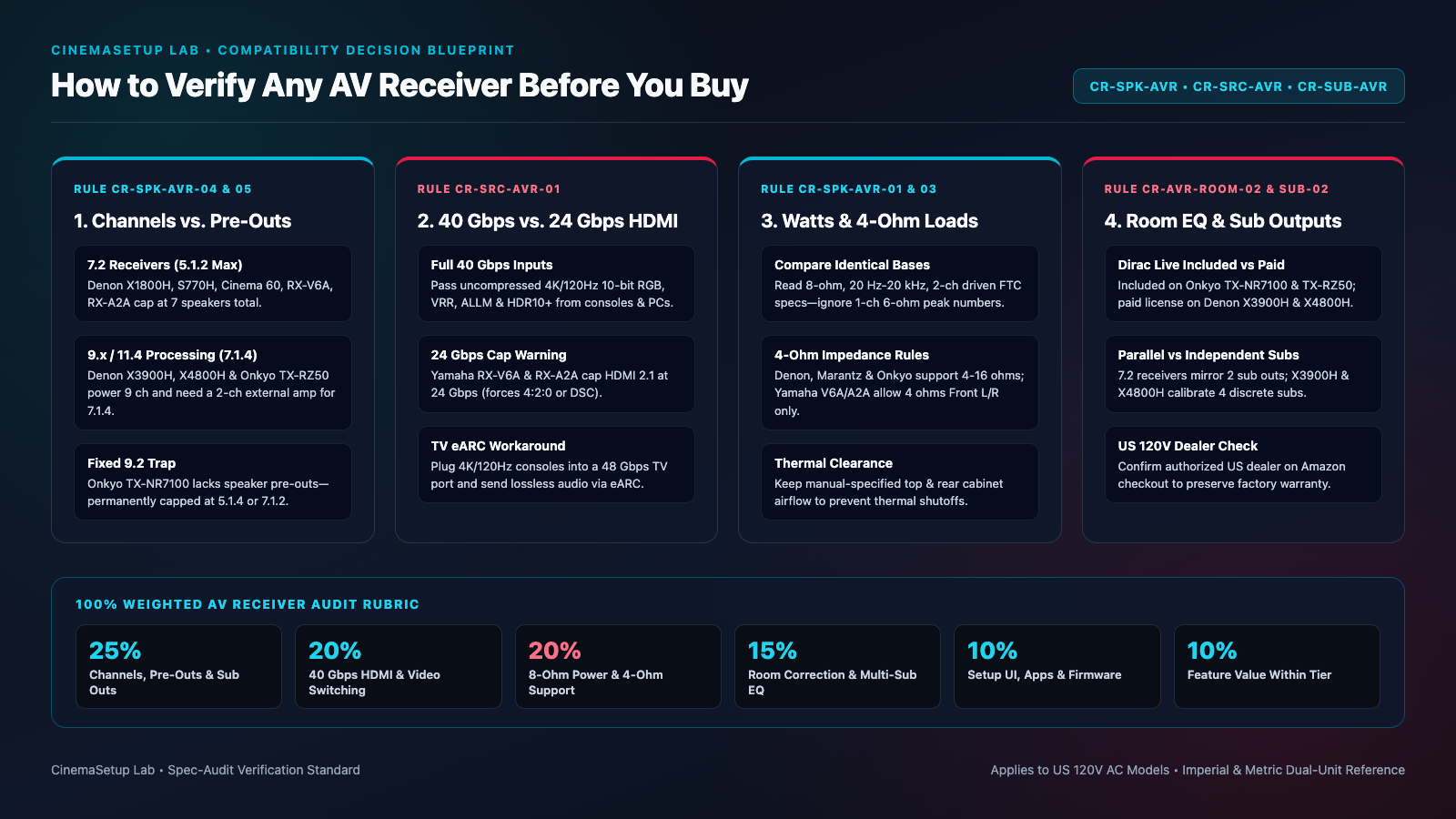
Never read an “11.4” marketing badge as 11 built-in speaker amplifiers. Under rule CR-SPK-AVR-04, an AV receiver’s processing count sets the hard ceiling on total ear-level plus overhead speakers (subwoofers count separately). A 7.2-channel AVR—such as the Denon AVR-X1800H, AVR-S770H, Marantz Cinema 60, or Yamaha RX-V6A—tops out at 5.1.2 or 7.1, and no external amp can add channels it cannot process. Meanwhile, 9-amplifier / 11.4-processing models like the Denon AVR-X3900H, AVR-X4800H, and Onkyo TX-RZ50 power 5.1.4 natively and require a 2-channel external amplifier on their pre-outs to run 7.1.4 (CR-SPK-AVR-05). By contrast, the 9.2-channel Onkyo TX-NR7100 lacks speaker pre-outs completely, capping it at 5.1.4 permanently. Explore our AV receiver channel count guide and our best AV receivers for Dolby Atmos breakdown before running ceiling wire, and remember that height virtualization modes (Dolby Atmos Height Virtualization or DTS Virtual:X) simulate overhead cues rather than replacing physical height speakers.
2. 40 Gbps vs. 24 Gbps HDMI 2.1 Ports & eARC Routing (CR-SRC-AVR-01 & CR-DISP-AVR-01)
Every video feature reaches your screen only if every hop—source, HDMI cable, AVR input, AVR output, and display—supports it. According to the HDMI Licensing Administrator HDMI 2.1 specification, an “HDMI 2.1” or “4K/120” badge alone does not guarantee 40 Gbps or 48 Gbps bandwidth. Onkyo’s TX-RZ50 and TX-NR7100 reserve 40 Gbps for rear Inputs 1-3 while capping Inputs 4-6 at 24 Gbps; Yamaha’s RX-V6A and RX-A2A cap all three gaming inputs at 24 Gbps. If you game on a PS5, Xbox Series X, or PC GPU and want uncompressed 4K/120Hz 10-bit RGB plus VRR and ALLM, reserve 40 Gbps ports on models featured in our best AV receivers for gaming guide—or plug the console directly into a 48 Gbps TV port and send lossless Dolby TrueHD Atmos or multichannel PCM back to the AVR via HDMI eARC (keeping in mind that on some TVs, the eARC port shares one of your 4K/120Hz inputs). Also confirm every cable carrying 4K/120Hz carries official Ultra High Speed HDMI certification.
3. Continuous 8-Ohm Power Basis, Speaker Sensitivity & 4-Ohm Stability (CR-SPK-AVR-01..03)
Compare amplifier ratings exclusively on identical conditions: continuous watts per channel into 8 ohms, across 20 Hz-20 kHz, at stated THD, with 2 channels driven. Ignore 1 kHz, 6-ohm, or single-channel peak figures. In real multichannel playback, expect output per channel to drop roughly 30% when five or more speakers fire simultaneously. By our estimate from published specs, 87 dB speakers (2.83 V / 1 m, 8 ohms) at an 11.5 ft (3.5 m) seat distance need roughly 78 W per channel for 95 dB living-room peaks, whereas 93 dB high-sensitivity speakers need around 62 W even at 100 dB peaks. If your speakers carry a 4-ohm nominal impedance rating, follow the manufacturer’s manual strictly: Denon, Marantz, and Onkyo support 4-ohm loads across main channels via their impedance settings alongside generous airflow, whereas Yamaha’s RX-V6A and RX-A2A permit 4-ohm speakers on Front L/R only (with the 6-ohm min setting) and require 6+ ohms on center, surround, and height channels.
4. Room Correction Tiers & Parallel vs. Independent Sub Outputs (CR-AVR-ROOM-02 & CR-SUB-AVR-02)
Two “subwoofer pre-out” jacks on the back of a 7.2-channel AVR almost always share one internal mono channel in parallel—acting like a built-in Y-splitter rather than calibrating each subwoofer separately. The Denon AVR-X3900H and AVR-X4800H are the standout exceptions on this list, offering four truly independent subwoofer outputs managed by Audyssey MultEQ XT32 (Sub EQ HT) or paid Dirac Live Bass Control. When comparing room correction systems, look at filter resolution and licensing cost rather than hype: Onkyo includes full-bandwidth Dirac Live in the TX-NR7100 and TX-RZ50 purchase price, whereas Denon includes Audyssey MultEQ XT32 on the X3900H/X4800H and treats Dirac Live as an optional paid upgrade.
5. Ventilation Clearance, In-Wall CL2/CL3 Wiring & Electrical Safety (CR-AVR-ROOM-01 & G-27)
Class AB multichannel amplifiers convert heavy current into heat, especially when driving 4-ohm speakers or multiple height channels. Follow the owner’s manual strictly for top and rear cabinet clearance—never block top chassis vents, enclose a high-output AVR in an unventilated door cabinet, or stack streaming boxes directly on top of the grate. For permanent installations, use pure oxygen-free copper (OFC) speaker wire sized appropriately for run length and impedance, and ensure any cable routed inside walls or ceilings carries a CL2 or CL3 in-wall fire rating in accordance with manufacturer instructions and local building codes. Consult a licensed electrician or qualified low-voltage installer for dedicated circuits, in-wall electrical work, or ceiling speaker mounting, and use a UL-listed surge protector to safeguard your 120V US receiver. For long listening sessions, keep master volume at comfortable levels.
6. US 120V Model Verification & Authorized-Dealer Warranty (CR-SYS-02 & G-26)
Always purchase the 120V AC US variant from an authorized dealer. Denon, Marantz, Onkyo, and Yamaha US manufacturer warranties typically require proof of purchase from an authorized US retailer; third-party gray-market marketplace listings on Amazon can void factory warranty service or ship non-US regional hardware (such as European AVR-X1800H units that omit Front L/R pre-outs). Check the “Ships from and Sold by” line at checkout before placing an order.
Upgrade Roadmap & Hidden Setup Costs
Under our system budget guideline (CR-SYS-01), passive speakers and powered subwoofers should claim 50% or more of your total audio budget, keeping the AV receiver near 25%-35% (or 35%-40% in starter builds). Leave 5%-10% for critical installation essentials: Ultra High Speed HDMI Certified cables (choose active fiber-optic directional HDMI for runs over 10 ft / 3 m), pure OFC 14 AWG or 12 AWG speaker wire, CL2/CL3 in-wall cable where required, a powered subwoofer (AVRs send line-level LFE signals and cannot drive passive subs), and—if buying a 9-amp / 11.4-processing AVR like the X3900H, X4800H, or TX-RZ50—a 2-channel external amplifier when you expand to 7.1.4.
Secondary Intent Resolver: 7.2 vs. 9.4 Receivers & AVR vs. Soundbar
7.2 vs. 9.4 AV Receivers: Choose a 7.2 receiver (Denon AVR-X1800H or AVR-S770H) if your couch sits near the back wall and two ceiling or front-height speakers (5.1.2) fit cleanly. Step up to a 9.4 / 11.4 receiver (Denon AVR-X3900H or Onkyo TX-RZ50) if you have space behind the main seating row for four overhead speakers (5.1.4 or 7.1.4) or multiple subwoofers.
AV Receiver vs. Soundbar: A soundbar kit minimizes boxes and speaker wire in apartments or small bedrooms, whereas an AV receiver system delivers true discrete front-stage separation, replaceable components, dedicated powered subwoofers, and decades of speaker longevity.
100% Weighted Scoring Rubric & Excluded Models
Every unit in this guide was evaluated strictly under CinemaSetup Lab’s published specification audit methodology using manufacturer US spec sheets, owner’s manuals, HDMI port maps, and Amazon US (ZIP 10001) inventory checks. Our scoring rubric weights the six engineering pillars below to 100%, with zero influence from affiliate commission rates:
| Evaluation Criterion | Weight | What We Verify |
|---|---|---|
| Channel Capability & Pre-Outs | 25% | Built-in amplifiers vs. processing channels (CR-SPK-AVR-04/05), multichannel pre-out expansion, and parallel vs. independent subwoofer outputs (CR-SUB-AVR-02). |
| HDMI & Video Feature Set | 20% | Full 40 Gbps vs. 24 Gbps input counts, eARC, HDCP 2.3, Dolby Vision, HDR10+, VRR, ALLM, and QFT passthrough (CR-SRC-AVR-01..03). |
| Amplification & 4-Ohm Support | 20% | Continuous 8-ohm, 20 Hz-20 kHz, 2-ch driven power basis (CR-SPK-AVR-03) and documented 4-ohm impedance settings (CR-SPK-AVR-01). |
| Room Correction & Bass Management | 15% | Bundled calibration tier (Audyssey MultEQ/XT/XT32, Dirac Live, YPAO R.S.C.), sub EQ independence, and optional paid license fees (CR-AVR-ROOM-02). |
| Usability & Ecosystem | 10% | On-screen setup clarity, HEOS/MusicCast streaming, Zone 2 channel borrowing, firmware history, and documented hardware advisories. |
| Value Within Tier | 10% | Total channel, HDMI, pre-out, and calibration hardware delivered relative to active Amazon US tier competitors. |
| Total | 100% |
Models We Audited & Excluded
- Denon AVR-X3800H: Discontinued and unlisted in active organic Amazon US (ZIP 10001) searches; superseded directly by our #2 pick, the 9.4-channel Denon AVR-X3900H.
- Unrated Car & Marine Receivers / Amplifiers: 12V DC automotive and marine units frequently surface in generic “receiver” searches on Amazon, but they cannot run on 120V AC household power or decode HDMI eARC Dolby Atmos.
- 24 Gbps HDMI Mismatch & Early 2020 Board-Revision Traps: Unpatched early-batch 2020 HDMI 2.1 receivers suffered Xbox Series X 4K/120Hz black-screen handshakes, and listings that advertise “4K/120” without disclosing 24 Gbps FRL-3 bandwidth caps catch console buyers off guard (we explicitly flag this cap on the Yamaha RX-V6A and RX-A2A above).
- Sub-Rated Receivers in 4-Ohm Closed-Cabinet Setups: Entry chassis lacking clear 4-ohm impedance guidance or shoved into unventilated media cabinets trigger thermal protection shutoffs during dynamic movie scenes.
Best AV Receiver Frequently Asked Questions
How many channels do I need on the best AV receiver for Dolby Atmos?
A 7.2-channel AV receiver supports up to a 5.1.2 Dolby Atmos layout (five ear-level speakers, one or two subwoofers, and two height speakers). Moving to four overhead speakers (5.1.4) requires a 9-channel receiver, while 7.1.4 requires 11 processing channels.
What is the difference between 40 Gbps and 24 Gbps HDMI 2.1 ports on an AV receiver?
Full 40 Gbps HDMI 2.1 inputs pass uncompressed 4K/120Hz 10-bit 4:4:4 RGB gaming signals from PS5, Xbox Series X, and PCs. Receivers capped at 24 Gbps (like the Yamaha RX-V6A and RX-A2A) require 4:2:0 chroma subsampling or Display Stream Compression for 4K/120Hz.
Can an AV receiver with 11.4 processing run 7.1.4 without an external amplifier?
Only if it has 11 built-in amplifiers. Receivers like the Denon AVR-X3900H, AVR-X4800H, and Onkyo TX-RZ50 include 9 internal amplifiers and 11-channel processing, so driving a full 7.1.4 layout requires connecting a separate 2-channel power amp to the pre-outs.
Should I change my AV receiver to the 4-ohm impedance setting for 4-ohm speakers?
Follow the manufacturer’s manual: Denon, Marantz, and Onkyo require selecting the 4-ohm setting when connecting 4-ohm loads and maintaining full ventilation clearance. On Yamaha RX-V6A and RX-A2A, 4-ohm speakers are supported on Front L/R only using the 6-ohm min setting.
Is Dirac Live worth paying extra for over Audyssey MultEQ XT32?
Audyssey MultEQ XT32 handles time alignment, dual-to-quad subwoofer EQ (Sub EQ HT), and room target curves out of the box on Denon X3900H and X4800H. Dirac Live adds mixed-phase impulse correction and optional Bass Control, but costs extra unless bundled on Onkyo TX-NR7100 or TX-RZ50.
Does buying an AV receiver on Amazon include a US manufacturer warranty?
Manufacturer warranties from Denon, Marantz, Onkyo, and Yamaha typically require purchasing a US 120V unit from an authorized dealer. Always verify the Shipped From and Sold By line at checkout—third-party unauthorized marketplace sellers may void factory coverage.
Final Verdict: Choosing the Best AV Receiver for Your Room
For most 5.1.2 living-room systems, the Denon AVR-X1800H remains the best av receiver overall: it pairs three full 40 Gbps HDMI 2.1 inputs, Audyssey MultEQ XT, and US Front L/R pre-outs under $1,000 without forcing you to work around 24 Gbps video caps. If you are building a dedicated 5.1.4 or 7.1.4 theater, choose between the Denon AVR-X3900H (for four independent subwoofer outputs and six 40 Gbps inputs) and the Onkyo TX-RZ50 (for bundled Dirac Live and 120 W/ch 8-ohm power out of the box).
Budget-focused 5.1.2 buyers get reliable 40 Gbps gaming compatibility from the Denon AVR-S770H, while permanent 5.1.4 setups that do not need external amp pre-outs save significantly with the Onkyo TX-NR7100. Whichever model fits your channel layout, confirm an authorized US dealer at checkout, leave the manual’s specified airflow clearance above the chassis, and allocate at least half of your audio budget to capable speakers and subwoofers.


