
Disclosure: As an Amazon Associate, I earn from qualifying purchases. If you buy through links on this page, CinemaSetup Lab may earn a small commission at no extra cost to you. Commission schedules (for example, 2% on televisions versus 4% on most AV receivers, speakers, and accessories) never influence our technical audits, compatibility verdicts, or product selections.
When comparing 7.1 vs 5.1.2 surround sound on a 7-channel AV receiver, you are choosing how to spend your sixth and seventh amplifier terminals: two ear-level Surround Back speakers behind your seating row (7.1) or two overhead Dolby Atmos height speakers above you (5.1.2). For most living rooms where the sofa sits near a back wall and the ceiling is flat drywall between 7.5 and 12 ft (2.3 and 3.7 m) high, 5.1.2 delivers clearer 3D immersion. Reserve 7.1 for deeper rooms with 4+ ft (1.2+ m) of space behind the main couch or vaulted ceilings that ruin up-firing reflections.
Before buying extra speakers or running wire inside walls, map your room dimensions and display chain inside our home theater setup guide. If you want a deeper look at how 7-channel layouts scale into 9- or 11-channel theaters, see our Dolby Atmos speaker layouts explained guide and our AV receiver channel capacity guide. Below, we audit the channel math, speaker angles, ceiling rules, and verified Amazon US speaker options for both 7.1 and 5.1.2 builds.
In This Comparison
- Winner-by-Room & Use-Case Quick Verdict Matrix
- Side-by-Side Layout Specs & Verified Contender Hardware
- Battleground 1: 7.2 AVR Processing Limits & Channel Math (CR-SPK-AVR-04 & CR-SPK-AVR-05)
- Battleground 2: Couch-to-Back-Wall Clearance & Dolby Angle Geometry
- Battleground 3: Ceiling Height, Up-Firing Bounce & Vaulted-Room Limits (CR-SPK-ROOM-01)
- Battleground 4: Physical Heights vs. Virtualization, Codec Support & Speaker Loads (CR-SYS-05)
- Battleground 5: Wiring Gauge, CL2/CL3 Safety, Pack Traps & US Warranty (G-26, G-27, G-29)
- Choose 7.1 Surround vs. Choose 5.1.2 Atmos + Verified Amazon US Picks
- Frequently Asked Questions
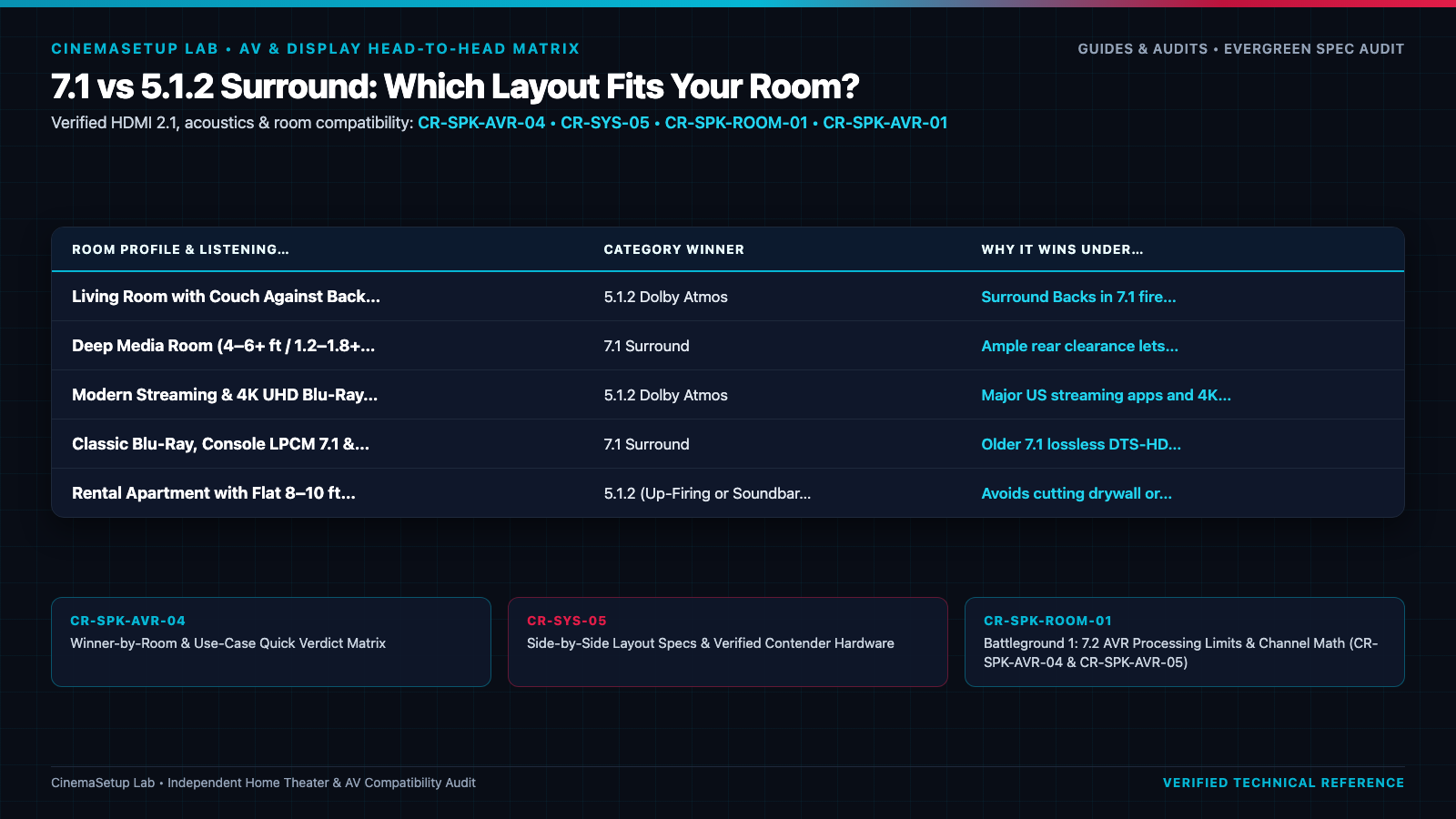
Quick Verdict: 7.1 vs. 5.1.2 by Room Geometry & Use Case
Neither 7.1 nor 5.1.2 wins across every floor plan. Under CinemaSetup Lab compatibility rules, your room depth behind the sofa, ceiling architecture, and preferred content library decide which layout performs better on a 7-channel AV receiver:
| Room Profile & Listening Priority | Category Winner | Why It Wins Under Audited Compatibility Rules |
|---|---|---|
| Living Room with Couch Against Back Wall (0–3 ft / 0–0.9 m) | 5.1.2 Dolby Atmos | Surround Backs in 7.1 fire directly into listeners’ heads when the sofa touches the rear wall; 5.1.2 shifts those two channels overhead at 65°–100° (see our 5.1.2 living-room blueprint). |
| Deep Media Room (4–6+ ft / 1.2–1.8+ m Behind Couch) + Vaulted Ceiling | 7.1 Surround | Ample rear clearance lets Surround Backs sit cleanly at 135°–150°, while vaulted or acoustic-tile ceilings weaken up-firing 5.1.2 bounce (CR-SPK-ROOM-01). |
| Modern Streaming & 4K UHD Blu-Ray Movie Watching | 5.1.2 Dolby Atmos | Major US streaming apps and 4K discs deliver native Dolby Atmos and DTS:X object tracks that actively place rain, aircraft, and ambience into physical height speakers (CR-SYS-05). |
| Classic Blu-Ray, Console LPCM 7.1 & Legacy Mixes | 7.1 Surround | Older 7.1 lossless DTS-HD Master Audio discs and uncompressed 7.1 PC/console gaming mixes route discrete rear-plane cues straight to Surround Back L/R without upmixing. |
| Rental Apartment with Flat 8–10 ft (2.4–3.0 m) Drywall Ceiling | 5.1.2 (Up-Firing or Soundbar Kit) | Avoids cutting drywall or fishing rear-wall speaker cables (CR-SPK-ROOM-03) while meeting Dolby’s 7.5–12 ft (2.3–3.7 m) flat reflective ceiling window (CR-SPK-ROOM-01). |
| Dedicated Theater Planning Future 7.1.4 Expansion | Start 5.1.2 or 7.1, Plan 9/11-Ch AVR | A 7.2 AVR caps permanently at 7 speakers (CR-SPK-AVR-04); buyers eyeing both Surround Backs and Heights need a 9.4/11.4-processing receiver such as the Denon AVR-X3900H. |
Side-by-Side Layout Matrix & Verified Contender Hardware
Before selecting hardware, compare the structural differences between a 7.1 ear-level surround topology and a 5.1.2 Dolby Atmos topology under CinemaSetup Lab rules:
| Architecture Parameter | 7.1 Ear-Level Surround | 5.1.2 Dolby Atmos | Governing Rule |
|---|---|---|---|
| Speaker Notation Breakdown | 7 ear-level (FL, C, FR, SL, SR, SBL, SBR) + 1 sub + 0 heights | 5 ear-level (FL, C, FR, SL, SR) + 1 sub + 2 physical heights | CR-SPK-AVR-04 |
| Minimum AVR Channels Needed | 7 processed speaker channels + 1 LFE sub pre-out (7.2 AVR) | 7 processed speaker channels + 1 LFE sub pre-out (7.2 AVR) | CR-SPK-AVR-04 |
| Side Surround Angles | 90° to 110° directly beside the main listening seat | 110° to 120° slightly behind the main listening seat | Dolby Geometry |
| 6th & 7th Channel Placement | Surround Back L/R at 135°–150° behind the couch (ear level) | Top Middle L/R at 65°–100° overhead, or Front Height / Up-Firing | CR-SPK-ROOM-02 |
| Minimum Rear-Wall Clearance | 4+ ft (1.2+ m) recommended behind primary seating row | 0–3 ft (0–0.9 m); compatible with sofas placed against the wall | Room Fit |
| Ceiling Type Sensitivity | Ceiling-agnostic; performs identically under vaulted or high roofs | In-ceiling/on-wall flexible; up-firing needs flat 7.5–12 ft (2.3–3.7 m) ceiling | CR-SPK-ROOM-01 |
| Physical Height Channels | Zero physical height drivers (DSP virtualization only if enabled) | 2 physical height transducers (in-ceiling, on-wall, or up-firing) | CR-SYS-05 |
| Path to 7.1.2 / 5.1.4 / 7.1.4 | Requires upgrading from 7.2 AVR to 9.4/11.4-processing AVR + heights | Requires upgrading from 7.2 AVR to 9.4/11.4-processing AVR + 2 rear heights or SBL/SBR | CR-SPK-AVR-05 |
To bridge layout theory into real Amazon US hardware, the table below compares four verified US retail options—covering switchable height/surround pairs, a four-speaker elevation bundle, a dedicated wide-dispersion 7.1 surround speaker, and a plug-and-play physical 5.1.2 wireless soundbar kit. All pack quantities (G-29) and rating bases (G-02, G-04) are listed explicitly.
| Verified Specification | Klipsch RP-500SA (Pair) | Klipsch R-41SA Set (2 Pairs / 4 Speakers) | MartinLogan EM-FX2 (Each / Single) | JBL Bar 800 (Complete 5.1.2 Kit) |
|---|---|---|---|---|
| Target Role in 7.1 vs. 5.1.2 | Switchable 5.1.2 Atmos module OR 7.1 wall surround | Scalable 4-speaker Atmos elevation / surround bundle | Dedicated wide-dispersion 7.1 side/rear surround | Wire-free physical 5.1.2 living-room kit (no AVR) |
| Retail Pack Quantity (G-29) | Pair (2 speakers) | 2 Pairs (4 speakers total) | Each / Single (1 speaker; order qty 2 for pair) | Complete 5.1.2 Kit (bar + 2 detachable rears + 10-in sub) |
| Amazon US Price Tier (G-08) | $400–$600 per pair | $400–$700 per 4-speaker set | $500–$800 each ($1,000–$1,600 per pair) | $600–$950 complete kit |
| Nominal Impedance (CR-SPK-AVR-01) | 8 ohms compatible | 8 ohms compatible | 5 ohms (4/6/8-ohm rated amps; use 4-ohm AVR setting) | Active self-amplified wireless system |
| Sensitivity & Rating Basis | Conforms to Dolby Atmos specs (numeric dB omitted) | Conforms to Dolby Atmos specs (numeric dB omitted) | 93 dB (2.83 V / 1 m) | Not applicable (active soundbar system) |
| Frequency Response & Tolerance | Conforms to Dolby Atmos specs (Hz tolerance omitted) | Conforms to Dolby Atmos specs (Hz tolerance omitted) | 55 Hz – 25 kHz (±3 dB) | No verified +/-3 dB curve published separately |
| Power / Connectivity | 75 W continuous / 300 W peak | 50 W continuous / 100 W peak | 20 – 200 W per channel recommended | 1x HDMI In (4K60 DV/HDR10) + 1x HDMI eARC + Optical (no DTS) |
| Dimensions & Weight | 6.81 x 7.39 x 11.16 in (17.3 x 18.8 x 28.4 cm) • 8 lb (3.6 kg) each | 7.0 x 5.75 x 13.0 in (17.8 x 14.6 x 33.0 cm) • weight omitted in summary | 14.9 x 14.0 x 6.8 in (37.8 x 35.6 x 17.3 cm) • 16 lb (7.3 kg) each | Bar: 46.2 x 4.7 x 2.2 in (117.4 x 12.0 x 5.6 cm) • Sub: 12.0 x 12.0 x 17.3 in |
| US Limited Warranty (G-26) | 5-year US parts & labor (authorized dealer) | 5-year US parts & labor (authorized dealer) | 5-year US limited warranty (authorized dealer) | 1-year US limited warranty (authorized dealer) |
Spec Note (G-01 & G-09): Klipsch publishes RP-500SA and R-41SA sensitivity and bandwidth solely as conforming to Dolby Atmos specifications rather than independent decibel or +/-3 dB numbers, and retail specification summaries omit a verified per-unit weight for the R-41SA. Independent third-party anechoic Spinorama measurements for these four specific SKUs are not yet verified in our knowledge graph.
Battleground 1: 7.2 AVR Processing Limits & Channel Math (CR-SPK-AVR-04 & CR-SPK-AVR-05)
The reason 7.1 vs 5.1.2 is the single most common home theater dilemma comes down to how entry and core 7.2-channel AV receivers are engineered. Add the ear-level speakers (X) and physical height speakers (Z) together: 7 + 0 = 7 for 7.1, and 5 + 2 = 7 for 5.1.2. Under hard compatibility rule CR-SPK-AVR-04, your speaker layout cannot exceed the receiver’s DSP processing channel count—and no external amplifier can add missing decoding channels.
On popular US 120 V 7.2-channel receivers such as the Denon AVR-X1800H (rated at 80 W per channel, 8 ohms, 20 Hz–20 kHz, 0.08% THD, 2 channels driven; three 40 Gbps HDMI 2.1 inputs) or the Yamaha RX-V6A (rated at 100 W per channel, 20 Hz–20 kHz, 2 channels driven; note that early 2020 Yamaha units carried an HDMI 2.1 chipset bug mitigated by board replacement and lack QMS firmware upgrades per G-12), terminals 6 and 7 are labeled Surround Back / Height (Assignable). Inside the AVR’s Amp Assign menu, you must choose either Surround Back (7.1) or Top Middle / Front Height / Dolby Enabled (5.1.2). You cannot run both simultaneously.
- Zone 2 & Bi-Amping Penalty (CR-SPK-AVR-06): If you assign two amplifier channels on a 7.2 AVR to drive patio speakers in Zone 2 or bi-amp your front towers, you drop down to 5.1 whenever those channels are active—losing both 7.1 surround backs and 5.1.2 Atmos heights.
- Subwoofer Outputs Never Consume Speaker Amps (CR-SUB-AVR-01 & CR-SUB-AVR-02): The “.1” or “.2” in 7.1, 5.1.2, and 7.2 refers to line-level LFE pre-outs feeding powered subwoofers. Most 7.2 AVRs provide two parallel (mirrored) sub outputs rather than independent dual-sub EQ.
- Stepping Up to Both Rear & Height Channels (CR-SPK-AVR-05): Combining Surround Backs and Heights into 7.1.2 (9 channels) or 7.1.4 (11 channels) requires stepping up to a 9.4-channel / 11.4-processing AVR such as the current US Denon AVR-X3900H (105 W/ch into 8 ohms, 20 Hz–20 kHz, 0.08% THD, 2 ch driven; 9 internal amps, 11.4 processing, 4 independent sub outs, and Dirac Live as a paid upgrade under CR-AVR-ROOM-02). Running 7.1.4 on a 9-amp receiver is conditional on adding a 2-channel external power amplifier to its pre-outs.
Battleground 2: Couch-to-Back-Wall Clearance & Dolby Angle Geometry
Speaker geometry—not personal preference—eliminates 7.1 in more than half of American living rooms. According to Dolby’s Home Theater Speaker Setup Guides, moving from 5.1 to 7.1 changes the required angles around your main seating position:
- 5.1 & 5.1.2 Side Surrounds (SL/SR): Placed at 110° to 120°—slightly behind ear level to fill in the rear half of the room without Surround Backs.
- 7.1 Side Surrounds + Surround Backs (SL/SR + SBL/SBR): Side surrounds move forward to 90° to 110° directly beside listeners, while Surround Backs sit behind the couch at 135° to 150°.
- 5.1.2 Overhead Top Middle Heights (TML/TMR): Placed overhead slightly in front of or above seated ear height at an elevation angle of 65° to 100°, aligned vertically with your Front Left and Front Right speakers (CR-SPK-ROOM-02).
Worked Room Example 1 (Living Room, 15 × 20 × 8 ft / 4.6 × 6.1 × 2.4 m, ~2,400 cu ft / 68 m³): Your sectional sits flush against the back wall, 10 ft (3.0 m) from a 65-inch TV (matching a comfortable-to-immersive viewing angle under CR-DISP-ROOM-01). Because there is zero space behind the sofa, mounting Surround Backs at 135°–150° is physically impossible; rear speakers mounted on that back wall fire straight into the back of your head just 12 to 18 in (30 to 46 cm) away, overpowering the front soundstage. Choosing 5.1.2 keeps the side surrounds at 110°–120° and places the two height channels overhead or slightly forward at 65°–100°—delivering clean 3D separation without cramped rear speakers.
Worked Room Example 2 (Dedicated Media Room, 14 × 20 × 9 ft / 4.3 × 6.1 × 2.7 m, ~2,520 cu ft / 71 m³): Your couch sits 5 ft (1.5 m) forward of the rear wall. Here, 7.1 Surround Backs mount cleanly on the back wall at 135°–150° with natural acoustic dispersion before reaching listeners’ ears, while side surrounds shift to 90°–110°.
Battleground 3: Ceiling Height, Up-Firing Bounce & Vaulted-Room Limits (CR-SPK-ROOM-01)
Even when your couch sits against the back wall, 5.1.2 is not automatic if you rely on upward-firing Dolby Atmos enabled speaker modules. Under compatibility rule CR-SPK-ROOM-01, up-firing speakers carry a CONDITIONAL or SOFT status because they depend on a two-leg acoustic reflection off your ceiling:
- Ideal Flat Ceiling Window: Dolby specifies a flat, horizontal, hard reflective ceiling (painted drywall or plaster) between 7.5 and 12 ft (2.3 and 3.7 m) high, with 14 ft (4.3 m) as the outer upper ceiling limit.
- Where Up-Firing Fails or Smears: Vaulted, cathedral, sloped, exposed-beam, or acoustic-tile ceilings scatter or absorb the upward acoustic ray before it reaches the listening row. In a 16-ft (4.9-m) vaulted great room with 5 ft (1.5 m) behind the couch and no way to cut the ceiling, a well-placed 7.1 ear-level system avoids weak, smeared ceiling reflections entirely.
- Renter & Vaulted Workaround (CR-SPK-ROOM-02 & CR-SPK-ROOM-03): If you own your home and have clear joist depth (typically 2.5 to 4.5 in / 6.4 to 11.4 cm), direct-radiating in-ceiling speakers bypass bounce physics completely. If cutting the ceiling isn’t permitted, switchable elevation speakers like the Klipsch RP-500SA can be mounted high on front or side walls into structural studs so they fire downward directly toward the seating area.
Battleground 4: Physical Heights vs. Virtualization, Codec Support & Speaker Loads (CR-SYS-05)
Content format compatibility and honest channel accounting further separate 7.1 and 5.1.2 setups:
- Physical Heights vs. DSP Virtualization (CR-SYS-05): Many modern AVRs and budget soundbars advertise “Dolby Atmos” alongside Dolby Atmos Height Virtualization or DTS Virtual:X. Under CinemaSetup Lab honesty rule CR-SYS-05, psychoacoustic phase processing through ear-level speakers is not equivalent to a physical 5.1.2 layout. Running Height Virtualization on a 7.1 speaker setup does not transform it into physical Atmos—only dedicated overhead, high on-wall, or physical up-firing drivers deliver true vertical localization.
- Format & HDMI eARC Path (CR-DISP-AVR-01 & CR-SBAR-DISP-02): Streaming apps deliver Dolby Atmos over lossy Dolby Digital Plus (compatible with ARC and eARC), whereas 4K UHD Blu-ray discs deliver lossless Dolby TrueHD Atmos and DTS-HD Master Audio / DTS:X. Passing lossless TrueHD Atmos or uncompressed 7.1 LPCM from a TV (such as an LG C6 OLED or Samsung S90H OLED) back to your AVR or soundbar requires HDMI eARC on both ends—or plugging your 4K Blu-ray player or console directly into the AVR’s HDMI inputs. Note also that Samsung TVs omit Dolby Vision (supporting HDR10+), while LG C6/S90H format and DTS passthrough rules vary by model (CR-SRC-DISP-01, CR-SBAR-DISP-04).
- Speaker Impedance & Multichannel Headroom (CR-SPK-AVR-01 & CR-SPK-AVR-02): Driving seven passive channels simultaneously draws more current than two-channel stereo playback. Using our conservative ~30% multichannel derating convention, an 80 W/ch AVR delivers roughly 56 W per channel with 5+ channels active. High-sensitivity speakers (90+ dB at 2.83 V / 1 m) achieve comfortable 95–100 dB living-room peaks easily, while lower-impedance 4- or 5-ohm surrounds (such as the 5-ohm MartinLogan EM-FX2) require selecting the receiver’s 4-ohm impedance setting and preserving full cabinet ventilation clearance (CR-AVR-ROOM-01).
Battleground 5: Wiring Gauge, CL2/CL3 Safety, Pack Traps & US Warranty (G-26, G-27, G-29)
Both 7.1 and 5.1.2 require running two extra speaker lines compared with 5.1—and those runs are typically the longest cables in your room:
- Pure Copper (OFC) Gauge vs. Run Length (CR-ACC-SPK-01): Use pure oxygen-free copper (OFC) rather than copper-clad aluminum (CCA) to keep round-trip resistance below ~5% of speaker impedance. For 8-ohm speakers, 16 AWG OFC handles one-way runs up to ~50 ft (15 m), and 14 AWG OFC reaches ~79 ft (24 m). For 4-ohm loads, keep 16 AWG under ~25 ft (7.6 m) and 14 AWG under ~40 ft (12 m).
- In-Wall & Ceiling Fire Ratings (CR-ACC-SPK-02 & G-27): Whenever routing speaker cable behind drywall, inside ceiling joists, or through wall cavities for either 7.1 rear walls or 5.1.2 overheads, use UL-listed CL2 or CL3 fire-rated cable and follow local building codes. Follow the speaker and bracket manufacturer’s instructions first, anchor heavy wall cabinets (such as the 16-lb / 7.3-kg MartinLogan EM-FX2) into structural wall studs or properly rated masonry anchors rather than hollow drywall alone, inspect cavities for live AC wiring and plumbing before drilling, and consult a licensed AV installer or electrician for concealed runs. Keep playback at comfortable listening levels.
- Pair-vs-Single Traps & US Authorized-Dealer Warranties (G-26 & G-29): Verify pack quantities before checkout: the Klipsch RP-500SA sells as a Pair, the Klipsch R-41SA bundle includes 2 Pairs (4 speakers), and the MartinLogan EM-FX2 sells Each / Single. Confirm US 120 V / 60 Hz model variants on powered gear (CR-SYS-02)—avoiding non-US `/ZC` variants or grey-market imports—and check the Amazon seller name, as US manufacturer warranties typically require purchase from an authorized US dealer.
Final Verdict: Choose 7.1 Surround vs. Choose 5.1.2 Dolby Atmos
Choose 7.1 Surround if…
- Your seating row has 4+ ft (1.2+ m) of open floor space behind it for Surround Backs at 135°–150°.
- Your room has a vaulted, sloped, or acoustic-tile ceiling that prevents clean up-firing reflections (CR-SPK-ROOM-01) and ceiling cutting is off the table.
- You primarily watch legacy 7.1 Blu-rays or play uncompressed 7.1 PCM PC/console mixes across a wide multi-seat row.
Choose 5.1.2 Dolby Atmos if…
- Your couch sits near or flush against the back wall (0–3 ft / 0–0.9 m), leaving no room for Surround Backs.
- You have a flat 7.5–12 ft (2.3–3.7 m) ceiling for up-firing modules, OR can mount in-ceiling / high on-wall height speakers at 65°–100°.
- You stream modern Dolby Atmos movies/shows and want real overhead 3D object placement rather than DSP virtualization (CR-SYS-05).
Verified Amazon US Hardware for 7.1 & 5.1.2 Expansion
1. Klipsch RP-500SA Reference Premiere Dolby Atmos Speakers (Pair) — Best Switchable 5.1.2 / 7.1 Pair

Quick Specs: Sold as a Pair (2 speakers) | Switchable Atmos Up-Firing or Surround On-Wall crossover | 8 ohms compatible | 75 W continuous / 300 W peak | 5.25-in (13.3 cm) Cerametallic woofer + 1-in (2.54 cm) Titanium LTS horn tweeter | 6.81 x 7.39 x 11.16 in (17.3 x 18.8 x 28.4 cm), 8 lb (3.6 kg) each | Price Tier: $400–$600 per pair
Pros
- Rear crossover switch lets you deploy the pair as 5.1.2 up-firing Atmos modules today or flip to Surround mode for 7.1 wall-mounted duty later
- Keyhole wall-mount slot supports high on-wall elevation placement in rooms with vaulted or acoustic ceilings (CR-SPK-ROOM-01/02)
- 8-ohm compatibility and 5.25-in (13.3 cm) woofer integrate cleanly with standard 7.2 AVRs
Cons
- Klipsch omits separate numeric dB sensitivity and +/-3 dB frequency limits beyond Dolby Atmos conformance (G-09)
- 11.16-in (28.4 cm) depth can overhang compact bookshelf fronts when used as top-mounted up-firing modules
2. Klipsch Reference R-41SA Elevation & Surround Set (2 Pairs, 4 Speakers) — Best Multi-Channel Expansion Pack

Quick Specs: Sold as 2 Pairs (4 speakers total) | Up-firing Atmos or angled wall-mount surround/height | 8 ohms compatible | 50 W continuous / 100 W peak | 4-in (10.2 cm) spun-copper IMG woofer + 1-in (2.54 cm) Aluminum LTS horn tweeter | 7.0 x 5.75 x 13.0 in (17.8 x 14.6 x 33.0 cm) | Price Tier: $400–$700 per 4-speaker bundle
Pros
- Supplies four matching angled cabinets—covering both rear surrounds and front heights for 5.1.2, or front + rear heights when moving to 5.1.4 on a 9-channel AVR (CR-SPK-AVR-05)
- 90° x 90° Tractrix horn matches Klipsch Reference front stages cleanly for smooth panning (CR-SPK-SPK-02)
- Sealed acoustic-suspension enclosure simplifies close-to-wall placement without rear port boom (CR-SPK-ROOM-04)
Cons
- Using all four speakers as heights requires a 9.x or 11.x AVR; a 7.2 AVR leaves two speakers unused unless paired with a 3.1 front stage (CR-SPK-AVR-04)
- 13.0-in (33.0 cm) front-to-back depth requires deep tower cabinets for top placement, and sensitivity is listed only as Atmos-compliant
3. MartinLogan EM-FX2 ElectroMotion Surround Speaker (Each / Single) — Best Wide-Dispersion 7.1 Surround

Quick Specs: Sold Each / Single (order qty 2 per pair) | Wall-mounted dual Folded Motion XT (160° x 30°) + 6.5-in (16.5 cm) woofer | 5 ohms nominal (4/6/8-ohm amps) | 93 dB (2.83 V / 1 m) | 55 Hz – 25 kHz (±3 dB) | 20–200 W/ch | 14.9 x 14.0 x 6.8 in (37.8 x 35.6 x 17.3 cm), 16 lb (7.3 kg) each | Price Tier: $500–$800 each ($1,000–$1,600 per pair)
Pros
- 160-degree horizontal dispersion wraps multi-seat rows evenly in 7.1 side or rear surround positions
- High 93 dB (2.83 V / 1 m) sensitivity and 55 Hz (±3 dB) extension deliver effortless surround dynamics across larger media rooms
- Slim 6.8-in (17.3 cm) wall protrusion keeps walkways clear behind or beside seating
Cons
- Sold individually (each) rather than as a stereo pair—budget quantity two per surround pair (G-29)
- 5-ohm nominal impedance requires selecting the 4-ohm setting on 6-ohm-minimum AVRs (CR-SPK-AVR-01) and anchoring its 16-lb (7.3-kg) cabinet securely into wall studs (G-27)
4. JBL Bar 800 5.1.2-Channel Soundbar System — Best Wire-Free Physical 5.1.2 Living-Room Kit

Quick Specs: Complete 5.1.2 Kit (main bar w/ 2x 2.75-in up-firing drivers + 2 detachable battery-powered wireless rears + 10-in wireless sub) | 1x HDMI In (4K60 DV/HDR10) + 1x HDMI eARC Out + Optical | Dolby Atmos (DD+ & TrueHD via eARC; no DTS) | Bar: 46.2 x 4.7 x 2.2 in (117.4 x 12.0 x 5.6 cm) | Price Tier: $600–$950 complete kit
Pros
- Includes genuine physical up-firing height drivers plus detachable wireless rear surrounds—delivering real 5.1.2 Atmos without speaker wire (CR-SYS-05)
- 10-in wireless subwoofer anchors action impact without running an LFE RCA cable across the floor
- Ideal living-room alternative when a sofa sits against the back wall and running 7.1 wire is off limits
Cons
- No DTS or DTS:X decoding, and its single HDMI input caps at 4K60 (connect 4K120 consoles straight to the TV and route audio over eARC per CR-SBAR-SRC-01)
- Closed ecosystem—cannot mix third-party passive speakers or expand to 7.1.2 / 5.1.4 later (CR-SBAR-SPK-01), and up-firing height cues still depend on a flat 7.5–12 ft (2.3–3.7 m) ceiling
Authoritative Standards & Manufacturer Sources
- Dolby Laboratories Official Home Theater Speaker Setup Guides — 5.1, 7.1, and 5.1.2 speaker placement angles (90°–110° sides, 135°–150° backs, 65°–100° Top Middle) and up-firing ceiling height criteria.
- Denon USA Official AV Receiver Specifications — 7.2-channel AVR-X1800H (80 W/ch, 8 ohms, 20 Hz–20 kHz, 0.08% THD, 2 ch driven) and 9.4/11.4-processing AVR-X3900H channel-assignment limits.
- Klipsch USA Official Product Documentation — RP-500SA switchable Atmos/Surround crossover, R-41SA sealed enclosure dimensions, and US 5-year authorized-dealer warranty terms.
- MartinLogan USA Official ElectroMotion FX2 Specifications — 5-ohm nominal impedance rating, 93 dB (2.83 V / 1 m) sensitivity, 55 Hz–25 kHz (±3 dB) response, and 160° x 30° dispersion.
- JBL USA Official Bar 800 Technical Specifications — 5.1.2 physical driver layout, detachable battery-powered wireless rear speakers, and HDMI eARC / 4K60 passthrough limits.
How We Audited This Guide
- Room setups, upgrade roadmaps, and Amazon marketplace audits enforce system-wide CR-* budgets and acoustics, Canadian /ZC grey-market alerts, pair-vs-single speaker clarity, and manufacturer-first mounting safety.
- Every AV receiver, speaker, subwoofer, soundbar, OLED/Mini-LED TV, projector, source player, and accessory spec was cross-checked against official manufacturer manuals, CEA/CTA standards, and live Amazon US listings.
- Recommendations were evaluated against our weighted vertical scoring rubrics and documented CR-* compatibility rules; we never invent nits, contrast ratios, bench wattage, or room decibels.
Continue Your Audit
Frequently Asked Questions: 7.1 vs. 5.1.2 Surround
Is 5.1.2 better than 7.1 for most living rooms?
Yes, 5.1.2 is the better fit for most living rooms because sofas commonly sit near or against a rear wall. Without 4+ ft (1.2+ m) of rear clearance, 7.1 Surround Backs crowd listeners’ ears, whereas 5.1.2 places two physical height channels overhead for Dolby Atmos movies.
Can a 7.2 AV receiver run 7.1 and 5.1.2 at the same time?
No, a 7.2 receiver caps at seven processed speaker channels under rule CR-SPK-AVR-04. You must assign terminals 6 and 7 to either Surround Backs (7.1) or Height speakers (5.1.2). Running both simultaneously creates a 7.1.2 layout requiring at least a 9-channel receiver.
How much space behind the couch do you need for 7.1 surround?
Plan for at least 4 to 6 ft (1.2 to 1.8 m) behind the primary listening row so Surround Back speakers at 135°–150° have room to blend cleanly without overpowering listeners. When seating sits flush against the back wall, 5.1.2 outperforms cramped 7.1 placement.
What happens if you play a Dolby Atmos movie on a 7.1 system?
Your AVR folds overhead Atmos objects down into your seven ear-level speakers. While you still hear full surround panning and the underlying 7.1 bed layer, you lose true vertical height separation—even if you turn on DSP Height Virtualization (CR-SYS-05).
Does 5.1.2 work in a room with a vaulted or popcorn ceiling?
Up-firing 5.1.2 modules weaken significantly under vaulted, sloped, or acoustic-tile ceilings under rule CR-SPK-ROOM-01. To keep 5.1.2 in those rooms, install direct-radiating in-ceiling speakers or mount angled height speakers high on front or side walls into studs.
Can I upgrade from 5.1.2 or 7.1 to 7.1.4 later?
Only by replacing a 7.2 receiver with an 11-channel-processing model (CR-SPK-AVR-04 & CR-SPK-AVR-05). Nine-amp receivers with 11.4 processing, such as the US Denon AVR-X3900H, expand to 7.1.4 once you connect a 2-channel external power amplifier to the pre-outs.


