
Disclosure: As an Amazon Associate, I earn from qualifying purchases. If you buy through links on this page, CinemaSetup Lab may earn a small commission at no extra cost to you. Category commission schedules (such as standard AV receiver rates versus lower television rates) never influence our compatibility rules, product rankings, or verdicts.
Comparing denon avr-x1800h vs yamaha rx-v6a comes down to a clear engineering trade-off inside the $500–$1,000 7.2-channel class: the Denon AVR-X1800H delivers three true 40 Gbps HDMI 2.1 inputs for uncompressed 4K/120Hz gaming, full-channel 4-ohm speaker support, Audyssey MultEQ XT, and a 3-year US warranty, while the Yamaha RX-V6A counters with a 100 W per-channel 8-ohm rating, seven total HDMI inputs, wireless MusicCast Surround rear pairing, and a 2-year US warranty despite a 24 Gbps HDMI 2.1 bandwidth ceiling.
Both receivers cap out at 7.2 channels (5.1.2 Dolby Atmos or 7.1 ear-level surround), include Front L/R pre-outs on US 120V units, and sit in the electronics budget of a Core Surround system—see our broader best AV receivers pillar hub and best AV receivers under $1,000 guide for full tier context. Below, we evaluate both US retail models strictly on confidence-A manufacturer specs and CinemaSetup Lab compatibility rules.
In This Comparison
- Winner-by-Use-Case Quick Verdict Matrix
- Side-by-Side Verified Specifications (US 120V Models)
- Battleground 1: 40 Gbps vs. 24 Gbps HDMI 2.1 & Console Routing
- Battleground 2: 8-Ohm Power Basis, 4-Ohm Support & Room Headroom
- Battleground 3: 5.1.2 Channel Limits, Pre-Outs & MusicCast Wireless Rears
- Battleground 4: Audyssey MultEQ XT vs. YPAO R.S.C. & Streaming
- Battleground 5: Cabinet Fit, Wiring Safety & US Warranty Check
- Choose Denon AVR-X1800H vs. Choose Yamaha RX-V6A + Product Cards
- Frequently Asked Questions
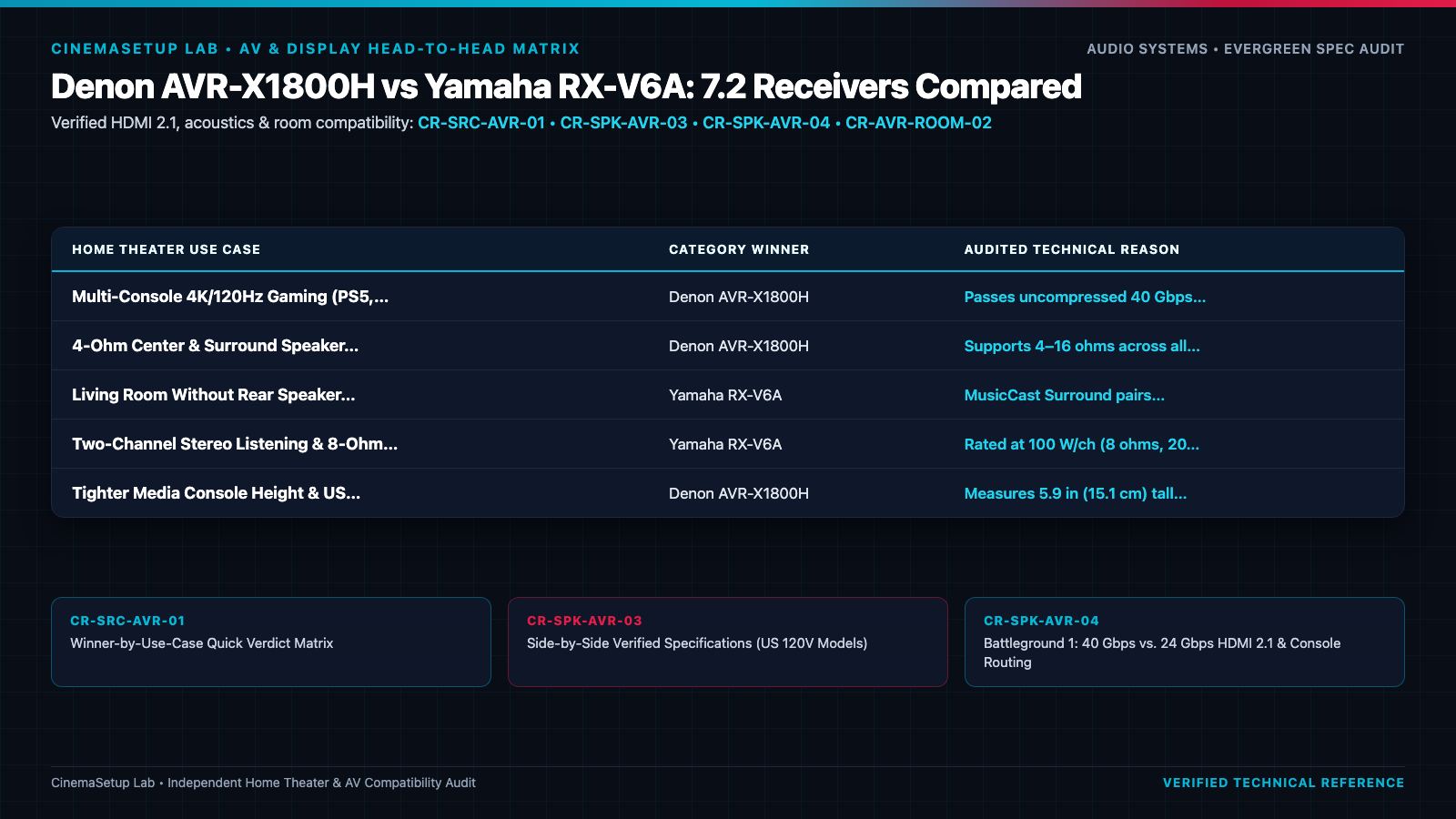
Quick Verdict: Denon AVR-X1800H vs. Yamaha RX-V6A by Room & Setup
Neither 7.2-channel AV receiver dominates every living room. Matching the hardware to your consoles, speaker impedance, rear-wiring constraints, and media cabinet dimensions determines the right pick:
| Home Theater Use Case | Category Winner | Audited Technical Reason |
|---|---|---|
| Multi-Console 4K/120Hz Gaming (PS5, Xbox Series X, PC) | Denon AVR-X1800H | Passes uncompressed 40 Gbps 4K/120Hz 10-bit 4:4:4 RGB on HDMI 4–6; Yamaha caps HDMI 1–3 at 24 Gbps (CR-SRC-AVR-01). |
| 4-Ohm Center & Surround Speaker Packages | Denon AVR-X1800H | Supports 4–16 ohms across all channels via its 4ohms menu mode; Yamaha restricts 4-ohm loads to Front L/R only (CR-SPK-AVR-01). |
| Living Room Without Rear Speaker Wire Runs | Yamaha RX-V6A | MusicCast Surround pairs wireless MusicCast 20 or 50 speakers as rear surrounds, avoiding wall or rug wire runs. |
| Two-Channel Stereo Listening & 8-Ohm Power Rating | Yamaha RX-V6A | Rated at 100 W/ch (8 ohms, 20 Hz–20 kHz, 0.06% THD, 2 ch driven) vs. Denon’s 80 W/ch (0.08% THD) (~0.97 dB edge, CR-SPK-AVR-03). |
| Tighter Media Console Height & US Warranty Length | Denon AVR-X1800H | Measures 5.9 in (15.1 cm) tall vs. 6.75 in (17.1 cm) on Yamaha, and carries a 3-year US warranty vs. Yamaha’s 2-year coverage (G-26). |
| Room Correction Customization & App Tuning | Denon AVR-X1800H | Audyssey MultEQ XT measures up to 8 mic positions and supports paid MultEQ Editor and MultEQ-X software upgrades (CR-AVR-ROOM-02). |
Side-by-Side Verified Specifications (US 120V Models)
Every specification below comes directly from Denon USA and Yamaha USA documentation for current 120V AC / 60 Hz North American models (G-28 and CR-SYS-02). Both receivers retail inside the same $500–$1,000 Amazon US bracket (Denon AVR-X1800H Launch MSRP: $799; Yamaha RX-V6A fluctuates across promotions within the same tier with less than a 15% tier separation). Neither model has an attached third-party all-channels-driven bench measurement card in our dataset (no verified data available yet for 5-channel continuous bench clipping, G-01 and G-09), so all power ratings below strictly follow confidence-A 2-channel manufacturer figures on an identical 8-ohm full-bandwidth basis.
| Specification / Audit Parameter | Denon AVR-X1800H (US 120V) | Yamaha RX-V6A (US 120V) | Compatibility Rule |
|---|---|---|---|
| Amplifier & Processing Channels | 7 built-in amps / 7.2 processing (5.1.2 max) | 7 built-in amps / 7.2 processing (5.1.2 max) | CR-SPK-AVR-04 |
| Rated Power (Identical 8-Ohm Basis) | 80 W/ch (8 ohms, 20 Hz–20 kHz, 0.08% THD, 2 ch driven) | 100 W/ch (8 ohms, 20 Hz–20 kHz, 0.06% THD, 2 ch driven) | CR-SPK-AVR-03 |
| Speaker Impedance Support | 4–16 ohms (all channels via 4ohms menu toggle) | 8-ohm min default; 6-ohm min allows 4-ohm Front L/R only | CR-SPK-AVR-01 |
| HDMI Inputs / Outputs | 6 in (3x 40 Gbps HDMI 4–6; 3x 18 Gbps HDMI 1–3) / 1 eARC out | 7 in (3x 24 Gbps HDMI 1–3; 4x 18 Gbps HDMI 4–7) / 1 eARC out | CR-SRC-AVR-01 |
| HDMI 2.1 Gaming & HDR Passthrough | 4K/120Hz 4:4:4, VRR, ALLM, QFT, DV, HDR10+, HDCP 2.3 | 4K/120Hz (24 Gbps cap), VRR, ALLM, QFT (fw), DV, HDR10+, no QMS | CR-SRC-AVR-02/03 |
| Pre-Outs & Subwoofer Outputs | Front L/R (US SKU), Zone 2, 2x parallel sub outs | Front L/R, Zone 2, 2x monaural parallel sub outs | CR-SUB-AVR-02 |
| Room Correction System | Audyssey MultEQ XT (8 positions; paid Editor/X apps) | YPAO R.S.C. Multipoint (bundled mic; no Dirac path) | CR-AVR-ROOM-02 |
| Wireless Ecosystem & Phono | HEOS, AirPlay 2, Spotify Connect, BT, Phono MM (wired surrounds) | MusicCast, AirPlay 2, Spotify Connect, BT, Phono MM + wireless rears | CR-SPK-AVR-05 |
| Dimensions (W x D x H, Antennas Down) | 17.1 x 13.3 x 5.9 in (43.4 x 33.9 x 15.1 cm) | 17.13 x 14.88 x 6.75 in (43.5 x 37.7 x 17.1 cm) | CR-AVR-ROOM-01 |
| Weight & Mains Power | 19.0 lb (8.6 kg) • 120V AC, 60 Hz | 21.6 lb (9.8 kg) • 120V AC, 60 Hz | CR-SYS-02 |
| US Manufacturer Limited Warranty | 3 years (X-Series, authorized US dealer) | 2 years (authorized US dealer) | G-26 |
| Amazon US Price Bracket | $500–$1,000 (Launch MSRP: $799) | $500–$1,000 | G-08 |
Battleground 1: 40 Gbps vs. 24 Gbps HDMI 2.1 & Console Routing (CR-SRC-AVR-01)
If you own a PlayStation 5, Xbox Series X, or high-refresh gaming PC, HDMI 2.1 architecture is the sharpest dividing line in this comparison. Under CR-SRC-AVR-01, a 4K/120Hz signal only survives if every link from source to receiver input, receiver output, certified cable, and TV supports the required Fixed Rate Link (FRL) bandwidth.
The Denon AVR-X1800H assigns three of its six inputs—specifically HDMI 4, HDMI 5, and HDMI 6—to 40 Gbps HDMI 2.1 switching, paired with a 40 Gbps eARC Monitor output and HDCP 2.3 across every port (CR-SRC-AVR-02). Once you switch Video → 4K/8K Signal Format to 8K Enhanced, the Denon passes uncompressed 4K/120Hz 10-bit 4:4:4 RGB from an Xbox Series X, PS5, or PC GPU alongside VRR, ALLM, QFT, Dolby Vision, and HDR10+ (CR-SRC-AVR-03). Our full Denon AVR-X1800H spec audit walks through that exact port map and setup toggle.
The Yamaha RX-V6A offers one extra total input (seven HDMI inputs versus six), with HDMI 1, HDMI 2, and HDMI 3 designated as high-speed gaming ports and HDMI 4–7 capped at 18 Gbps HDMI 2.0. However, two documented hardware realities affect Yamaha buyers (G-12):
- Early Production Chip Bug (ISS-AVR-HDMI21-4K120-CHIPSET-2020, Mitigated): Initial 2020–2021 RX-V6A production batches shipped with a Panasonic HDMI 2.1 transition chip that displayed a black screen with Xbox Series X and RTX 30-series 4K/120Hz signals. Yamaha offered a complimentary HDMI board replacement program, and newer retail inventory incorporates the updated board.
- Permanent 24 Gbps Bandwidth Cap & QMS Exclusion (ISS-AVR-YAMAHA-QMS-NOT-UPGRADABLE): Even on updated boards, Yamaha’s HDMI 1–3 inputs cap at 24 Gbps rather than 40 Gbps. While PS5 (capped at 32 Gbps, compressing to 4:2:2) and 4K/120Hz VRR/ALLM work after applying firmware Ver. 1.58+ and enabling 8K Mode, an Xbox Series X or PC attempting uncompressed 4K/120Hz 10-bit RGB (40 Gbps) requires manually dropping output to 4K/120Hz 4:2:0 (10-bit) or bypassing the receiver. Yamaha also confirmed the RX-V6A hardware cannot add Quick Media Switching (QMS) via firmware.
The Clean eARC Workaround (CR-DISP-AVR-01 & CR-DISP-AVR-02): If you buy the Yamaha RX-V6A for an Xbox Series X or gaming PC, plug your consoles directly into 48 Gbps HDMI 2.1 ports on your TV (for example, HDMI 1, 3, or 4 on an LG C6 or HDMI 1, 2, or 4 on a Samsung S90H) using certified Ultra High Speed HDMI (48 Gbps) cables bearing the official HDMI Forum hologram/QR label (CR-ACC-DISP-01). Then run a single cable from the TV’s eARC port to the RX-V6A’s eARC output to return lossless Dolby Atmos or multichannel LPCM. For buyers who prefer routing three consoles cleanly through the receiver itself, check our best AV receivers for PS5 and Xbox comparison—where 40 Gbps Denon switching holds a clear operational advantage.
Battleground 2: 8-Ohm Power Basis, 4-Ohm Support & Room Headroom (CR-SPK-AVR-01/02/03)
On paper, the Yamaha RX-V6A lists 100 W per channel (8 ohms, 20 Hz–20 kHz, 0.06% THD, 2 channels driven) compared to the Denon AVR-X1800H’s 80 W per channel (8 ohms, 20 Hz–20 kHz, 0.08% THD, 2 channels driven). Because both figures use the exact same 8-ohm, full-bandwidth, 2-channel-driven standard (CR-SPK-AVR-03), we can compare them directly—while ignoring higher single-channel or 6-ohm 1 kHz burst numbers (such as Denon’s 120 W 6-ohm 1 kHz 0.7% THD figure or Yamaha’s 125 W 1-ch 1 kHz rating).
How much louder is 100 W than 80 W? Acoustically, doubling amplifier power yields +3 dB. A 25% power step (100 W versus 80 W) equals roughly +0.97 dB of theoretical peak headroom—barely perceptible in a living room. By our estimate from published specs (using a conservative ~30% multichannel derating for 5+ channels driven, 0 dB room gain, and free-field inverse-square loss under CR-SPK-AVR-02), the Denon delivers roughly 56 W per channel while the Yamaha delivers roughly 70 W per channel:
- Typical 87 dB (2.83 V / 1 m) 8-Ohm Bookshelf Speakers at 11.5 ft (3.5 m): By our estimate from published specs, reaching 95 dB living-room peaks requires roughly 78 W per channel, whereas 100 dB peaks demand roughly 245 W. Both receivers reach comfortable movie levels smoothly when you set speakers to Small with an 80 Hz subwoofer crossover (CR-SUB-SPK-01), though neither reaches full 105 dB theater reference peaks without high-sensitivity speakers or external amplification.
- High-Sensitivity 93 dB (2.83 V / 1 m) 8-Ohm Speakers at 11.5 ft (3.5 m): Estimated 100 dB peak demand drops to roughly 62 W per channel, putting both the AVR-X1800H and RX-V6A comfortably inside high-headroom territory.
The Decisive Impedance Catch (CR-SPK-AVR-01): Where Denon pulls meaningfully ahead is 4-ohm speaker support. The AVR-X1800H is officially rated for 4–16 ohms across all speaker terminals once you toggle its front-panel setting (ZONE2 SOURCE + STATUS) to 4ohms (note: enabling 4ohms locks out ECO Mode and requires extra airflow). By contrast, Yamaha’s RX-V6A manual specifies 8Ω MIN (default) or 6Ω MIN (Setup → Speaker → Speaker Impedance), where 6Ω MIN permits 4-ohm speakers on the Front Left/Right channels only while requiring center, surround, and height speakers to stay at 6 ohms or higher. If you own a full 4-ohm theater speaker suite, the Denon meets manufacturer guidelines across every channel while the Yamaha violates center/surround manual limits.
Box Contents & Pair vs. Single Clarity (G-29): Both the Denon AVR-X1800H and Yamaha RX-V6A ship strictly as standalone AV receivers with their remote controls, AAA batteries, calibration microphones, Wi-Fi/Bluetooth antennas, and AM/FM antennas—speakers, powered subwoofers, speaker wire, and Ultra High Speed HDMI cables are sold separately. When budgeting the rest of your system under CR-SYS-01 (aiming for at least 50% of total audio spend on speakers and subwoofers), verify whether passive bookshelf or height speakers are sold per pair while center-channel speakers and powered subwoofers are sold each (single).
Battleground 3: 5.1.2 Channel Limits, Pre-Outs & MusicCast Wireless Rears (CR-SPK-AVR-04/05/06)
Both receivers feature seven internal amplifiers and 7.2-channel surround processing, establishing an identical hard ceiling under CR-SPK-AVR-04: you can build a 5.1.2 Dolby Atmos / DTS:X layout (front L/R, center, two surrounds, and two overhead, on-wall height, or ceiling-reflective up-firing speakers) or an ear-level 7.1 system. Neither model can decode 5.1.4 or 7.1.4—even though both North American units include Front L/R pre-outs. Connecting a 2-channel power amp to those Front L/R pre-outs relieves the receiver’s power supply for demanding floorstanding towers (note: Yamaha’s manual explicitly warns not to connect speakers directly to the Front speaker binding posts while using the Front pre-outs), but it never adds 8th or 9th processing channels.
Similarly, both models offer Zone 2 stereo capability and DSP height virtualization modes (Dolby Atmos Height Virtualization and DTS Virtual:X). Remember two operational rules: assigning internal amplifiers to powered Zone 2 speakers in another room drops your main theater room from 5.1.2 to 5.1 (CR-SPK-AVR-06), and DSP height virtualization is not equivalent to physical overhead or Atmos-enabled height speakers (CR-SYS-05).
Subwoofer Outputs (CR-SUB-AVR-01 & CR-SUB-AVR-02): Both the Denon and Yamaha require powered subwoofers via line-level LFE jacks, and both carry two rear RCA subwoofer outputs that are internally parallel (monaural)—meaning two subwoofers receive the same summed signal without independent distance or per-subwoofer EQ. If you plan to run four overhead speakers (5.1.4 or 7.1.4) or calibrate multiple subwoofers independently, step up to the actively stocked US 9.4-channel Denon AVR-X3900H (which supersedes the discontinued X3800H in US retail channels).
Yamaha’s Unique Edge — MusicCast Surround: If you rent or cannot pull speaker wire across a living-room floor to rear surround stands, the Yamaha RX-V6A supports MusicCast Surround, allowing compatible Yamaha MusicCast 20 or MusicCast 50 powered speakers to act as wireless rear surrounds (and even pair with a MusicCast SUB 100). The Denon AVR-X1800H offers HEOS multi-room streaming across rooms, but its main 5.1.2 / 7.1 theater surrounds must remain wired.
Battleground 4: Audyssey MultEQ XT vs. YPAO R.S.C. & Streaming (CR-AVR-ROOM-02)
Without comparative room-response bench data, we describe calibration tools by their documented hardware, measurement points, and upgrade paths rather than declaring one system subjectively “better sounding” (02a §c4):
- Denon AVR-X1800H — Audyssey MultEQ XT: Uses the included ACM1HB microphone to play level-calibration tones across up to 8 seating positions, adjusting channel levels, distances, speaker crossover filters, and room equalization, with Dynamic EQ and Dynamic Volume included. Enthusiasts can purchase the optional paid Audyssey MultEQ Editor mobile app or MultEQ-X PC license for custom target curves and midrange compensation edits. Dirac Live is not supported.
- Yamaha RX-V6A — YPAO R.S.C. Multipoint: Uses Yamaha’s bundled YPAO mic and level-calibration tones across multiple seating spots with Reflected Sound Control (R.S.C.) to address early room reflections, alongside YPAO Volume for low-level tonal balance. There is no paid PC calibration tier or Dirac Live upgrade path on the RX-V6A.
For daily streaming and legacy sources, both units offer dual-band Wi-Fi, Ethernet, Bluetooth, Apple AirPlay 2, Spotify Connect, and a dedicated Moving Magnet (MM) phono input for turntables—paired with HEOS on Denon versus MusicCast on Yamaha. Denon’s modern HD Setup Assistant also remains slightly friendlier on-screen during first-time speaker wiring and HDMI assignment.
Battleground 5: Cabinet Fit, Wiring Safety & US Warranty Check (CR-AVR-ROOM-01 & G-26/G-27)
Physical chassis dimensions catch more buyers off guard than spec sheets suggest (CR-AVR-ROOM-01). With wireless antennas folded flat, the Denon AVR-X1800H measures 17.1 x 13.3 x 5.9 in (43.4 x 33.9 x 15.1 cm) and weighs 19.0 lb (8.6 kg), whereas the Yamaha RX-V6A measures 17.13 x 14.88 x 6.75 in (43.5 x 37.7 x 17.1 cm) and weighs 21.6 lb (9.8 kg). That extra 0.85 in (2.0 cm) of chassis height and nearly 1.6 in (4.0 cm) of depth—before adding rear HDMI plugs and banana connectors—makes the Denon easier to fit onto tighter shelves while preserving mandatory airflow.
Both receivers use Class-AB amplification that builds heat under multichannel loads (ISS-AVR-HEAT-CABINET). Denon specifies 4–6 in (10–15 cm) of open space above the chassis, while Yamaha’s manual guidance calls for generous clearance (up to 12 in / 30 cm above and 4–8 in / 10–20 cm on the sides and rear in enclosed racks). Never trap either receiver inside a sealed wood cabinet without active thermostatic exhaust fans.
Installation & Electrical Safety (G-27 & CR-ACC-SPK-01/02): Use pure oxygen-free copper (OFC) speaker wire rather than copper-clad aluminum (CCA): 16 AWG OFC handles one-way runs up to ~50 ft (15 m) at 8 ohms or ~25 ft (7.6 m) at 4 ohms, while 14 AWG OFC reaches ~79 ft (24 m) at 8 ohms or ~40 ft (12 m) at 4 ohms. Whenever routing speaker wire inside walls or ceilings, install strictly UL-listed CL2 or CL3 in-wall rated cable, verify joist cavities for electrical wires or pipes before cutting drywall, follow speaker and mount manufacturer stud-anchoring and weight limits, plug into a properly grounded 120V AC / 60 Hz UL-listed surge protector without bypassing circuit breakers, and consult a licensed electrician or certified AV installer whenever local electrical or building codes apply. Keep listening sessions at comfortable volume levels.
US Authorized-Dealer & Voltage Verification (G-26 & CR-SYS-02, Checked 2026-11-26): Always confirm you are buying the North American 120V AC / 60 Hz retail SKU sold directly by Amazon or an authorized US dealer (check the Ships from and Sold by lines before checkout). Denon provides a 3-year US warranty on X-Series receivers and Yamaha provides a 2-year US warranty on the RX-V6A—both void if purchased from unauthorized third-party liquidators or overseas grey-market sellers. Also avoid unverified multi-item speaker/subwoofer bundles whose included low-wattage passive/budget subs bottleneck performance.
Final Verdict: Choose Denon AVR-X1800H vs. Choose Yamaha RX-V6A
Choose Denon AVR-X1800H If…
- You connect a PS5, Xbox Series X, or gaming PC through the receiver and want uncompressed 40 Gbps 4K/120Hz 4:4:4 passthrough
- You run 4-ohm center, surround, or height speakers across your layout (full 4–16 ohm support)
- You want Audyssey MultEQ XT (8 positions + optional MultEQ-X software), a slimmer 5.9 in (15.1 cm) chassis, and a 3-year US warranty
Choose Yamaha RX-V6A If…
- You want wireless rear surround speakers via MusicCast Surround (MusicCast 20 / 50) without running speaker cables across your room
- You connect 4K/120Hz consoles straight into your TV with eARC return and value seven total HDMI inputs on the receiver
- You run 8-ohm (or 6-ohm min surround) speakers and prefer Yamaha’s YPAO R.S.C. calibration plus 100 W 2-ch 8-ohm rating
1. Denon AVR-X1800H 7.2-Channel AV Receiver — Best for 40 Gbps 4K/120Hz Gaming & 4-Ohm Speakers

Configuration: Standalone US 120V 7.2-channel AVR (speakers/cables sold separately) | Key Specs: 80 W/ch (8 ohms, 20 Hz–20 kHz, 0.08% THD, 2 ch driven) | 3x 40 Gbps HDMI 2.1 inputs (HDMI 4–6) + 1 eARC out | 4–16 ohm support | Audyssey MultEQ XT | US Front L/R pre-outs | 17.1 x 13.3 x 5.9 in (43.4 x 33.9 x 15.1 cm), 19.0 lb (8.6 kg) | Price Tier: $500–$1,000 (Launch MSRP: $799)
Pros
- Three true 40 Gbps HDMI 2.1 ports pass uncompressed 4K/120Hz 10-bit 4:4:4, VRR, ALLM, Dolby Vision, and HDR10+
- Supports 4-ohm speakers across all channels via the 4ohms menu setting and includes US-exclusive Front L/R pre-outs
- Audyssey MultEQ XT (8 mic positions, optional MultEQ-X) plus a slimmer 5.9 in chassis and 3-year US warranty
Cons
- 7.2 processing caps Atmos at 5.1.2, and dual subwoofer outputs are parallel rather than independent (CR-SUB-AVR-02)
- Requires manual 8K Enhanced menu toggle for 4K/120Hz and lacks wireless surround speaker pairing
2. Yamaha RX-V6A 7.2-Channel AV Receiver — Best for MusicCast Wireless Surrounds & 7 HDMI Inputs

Configuration: Standalone US 120V 7.2-channel AVR (speakers/cables sold separately) | Key Specs: 100 W/ch (8 ohms, 20 Hz–20 kHz, 0.06% THD, 2 ch driven) | 3x 24 Gbps HDMI 2.1 inputs (HDMI 1–3) + 4x 18 Gbps inputs | YPAO R.S.C. Multipoint | MusicCast Surround | Front L/R pre-outs | 17.13 x 14.88 x 6.75 in (43.5 x 37.7 x 17.1 cm), 21.6 lb (9.8 kg) | Price Tier: $500–$1,000
Pros
- MusicCast Surround lets compatible MusicCast 20 or 50 speakers operate as wireless rear surrounds
- Higher 100 W/ch 8-ohm 2-channel power rating with Front L/R pre-outs and seven total rear HDMI inputs
- YPAO R.S.C. multipoint room correction addresses early room reflections automatically
Cons
- HDMI 1–3 inputs cap at 24 Gbps (requiring 4:2:0 10-bit on Xbox Series X 4K120 or direct TV + eARC wiring) and lack QMS support
- 4-ohm speaker support is restricted to Front L/R only (center/surrounds must be 6+ ohms), taller 6.75 in chassis, and 2-year US warranty
3. Denon AVR-X3900H 9.4-Channel AV Receiver — Step-Up Alternative for 5.1.4 / 7.1.4 & Multi-Sub EQ

Configuration: Standalone US 120V 9.4-channel AVR (superseding the discontinued X3800H) | Key Specs: 105 W/ch (8 ohms, 20 Hz–20 kHz, 0.08% THD, 2 ch driven) | 9 amps / 11.4 processing (7.1.4 with 2-ch external amp) | 4 independent subwoofer outputs | Audyssey MultEQ XT32 + paid Dirac Live option | Price Tier: $1,500–$2,000 (Step-Up Enthusiast Tier)
Pros
- Breaks past the 7.2-channel ceiling for 5.1.4 natively or 7.1.4 with an external stereo power amplifier (CR-SPK-AVR-05)
- Four independent subwoofer pre-outs with Audyssey MultEQ XT32 and optional paid Dirac Live room correction (CR-AVR-ROOM-02)
Cons
- Costs roughly double the $500–$1,000 bracket of the AVR-X1800H and RX-V6A
- Dirac Live and Dirac Bass Control licenses require separate paid purchases beyond the base receiver
Authoritative Technical Sources
- Denon USA Official AV Receiver Specifications & Web Manuals — AVR-X1800H 80 W 8-ohm rating basis, 40 Gbps HDMI 4–6 port map, 4ohms speaker impedance instructions, US Front L/R pre-outs, and 3-year US X-Series warranty.
- Yamaha USA Official RX-V6A Specifications & Owner’s Manual — 100 W 8-ohm 0.06% THD 2-channel rating, HDMI 1–3 24 Gbps bandwidth, 6Ω MIN front-only 4-ohm guidance, MusicCast Surround, and 2-year US warranty.
- HDMI Licensing Administrator HDMI 2.1 Specification — FRL link rates (24 Gbps vs. 40/48 Gbps), eARC lossless audio transport, VRR, ALLM, QMS, and Ultra High Speed HDMI cable certification.
- Dolby Laboratories Home Theater Guidelines — 5.1.2 physical speaker layout positioning, Dolby Atmos TrueHD vs. Dolby Digital Plus carriage, and height virtualization distinctions.
How We Audited This Guide
- Audio gear was audited across 8-ohm/4-ohm impedance stability, HDMI 2.1 40 Gbps switching and eARC/CEC behavior, speaker sensitivity and center dialogue dispersion, subwoofer room volume sizing, and US warranty authorization.
- Every AV receiver, speaker, subwoofer, soundbar, OLED/Mini-LED TV, projector, source player, and accessory spec was cross-checked against official manufacturer manuals, CEA/CTA standards, and live Amazon US listings.
- Recommendations were evaluated against our weighted vertical scoring rubrics and documented CR-* compatibility rules; we never invent nits, contrast ratios, bench wattage, or room decibels.
Continue Your Audit
Frequently Asked Questions: Denon AVR-X1800H vs. Yamaha RX-V6A
Does the Denon AVR-X1800H or Yamaha RX-V6A handle Xbox Series X 4K/120Hz better?
The Denon AVR-X1800H handles Xbox Series X 4K/120Hz better because HDMI 4, 5, and 6 supply 40 Gbps for uncompressed 10-bit 4:4:4 RGB. The Yamaha RX-V6A caps HDMI 1–3 at 24 Gbps, requiring 4:2:0 chroma subsampling or plugging the console directly into your TV via eARC.
Is the Yamaha RX-V6A noticeably louder than the Denon AVR-X1800H?
No, the loudness difference is under 1 dB in practice. Comparing like-for-like 8-ohm, 20 Hz–20 kHz, 2-channel ratings, Yamaha’s 100 W versus Denon’s 80 W provides roughly +0.97 dB of theoretical headroom—virtually indistinguishable when crossed over at 80 Hz to a powered subwoofer.
Can either receiver run a 5.1.4 or 7.1.4 Dolby Atmos speaker setup?
No, both receivers stop at 7.2 channels (5.1.2 Atmos or 7.1). Even though US units of both models include Front L/R pre-outs for an external stereo amplifier, internal DSP processing maxes out at seven speakers. Running 5.1.4 or 7.1.4 requires a 9.4/11.4 step-up like the Denon AVR-X3900H.
Which receiver is safer for 4-ohm home theater speakers?
The Denon AVR-X1800H is safer for full 4-ohm speaker setups because its 4ohms impedance setting supports 4–16 ohm loads across every channel. Yamaha’s 6-ohm minimum menu mode permits 4-ohm speakers strictly on Front Left and Right channels while requiring 6 ohms or higher elsewhere.
Can I use wireless rear surround speakers with the Denon AVR-X1800H or Yamaha RX-V6A?
Only the Yamaha RX-V6A supports wireless rear surround speakers natively through MusicCast Surround when paired with compatible MusicCast 20 or MusicCast 50 speakers. The Denon AVR-X1800H supports HEOS multi-room audio, but all 5.1.2 or 7.1 theater speakers require wired connections.
Do both receivers calibrate two subwoofers independently?
No, both receivers use dual parallel monaural subwoofer outputs. Plugging two powered subwoofers into either the Denon AVR-X1800H or Yamaha RX-V6A sends the identical summed LFE signal to both without separate delay or EQ calibration—independent multi-sub EQ starts at step-up models like the AVR-X3900H.


