
Disclosure: As an Amazon Associate, I earn from qualifying purchases. If you buy through links on this page, we may earn a small commission at no extra cost to you. Commission differences across categories (such as 2% on televisions versus 4% on most AV receivers, speakers, and accessories) never influence our compatibility audits, blueprint splits, or product selections.
Planning a home theater setup under $2,500 puts you directly inside our Core Surround bracket—the exact sweet spot where cheap compromises disappear and true discrete surround architecture begins. Unlike entry soundbar kits or sub-$1,000 starter bundles, a $2,500 ceiling lets you build either a full-throated, timbre-matched AV receiver + high-sensitivity Reference Premiere speaker + 12-inch sealed subwoofer audio system (when you already own a 4K TV) or a balanced all-in 65-inch Mini-LED TV + 5.1 surround build for a brand-new living room.
Before you click add-to-cart on any receiver or speaker bundle, four technical bottlenecks decide whether your room sounds effortless or strains at movie volume: enforcing the CR-SYS-01 speaker-first budget split, matching receiver processing channels to your target speaker layout (CR-SPK-AVR-04), calculating continuous 8-ohm wattage against speaker sensitivity and seating distance (CR-SPK-AVR-02), and aligning subwoofer crossover points with each speaker’s -3 dB low-frequency limit (CR-SUB-SPK-01). This blueprint extends our foundational home theater setup guide with verified US 120V AC retail picks.
In This Core Surround Under $2,500 Blueprint
- Two Sub-$2,500 Paths & CR-SYS-01 Budget Allocation
- Verified Under-$2,500 System Parts List (8 Amazon US Picks)
- IF-THEN Compatibility Proof Box (CR-* Rules Audited)
- AVR Channel Architecture, Power Math & 80–120 Hz Crossover Rules
- HDMI 2.1 Switching, eARC & Living-Room Placement
- UL CL2/CL3 Wiring, Mounting Safety & Calibration Checklist
- Audited Equipment Profiles (8 Verified US Listings)
- Authoritative Standards & Manufacturer References
- Frequently Asked Questions
Two Sub-$2,500 Paths & CR-SYS-01 Budget Allocation
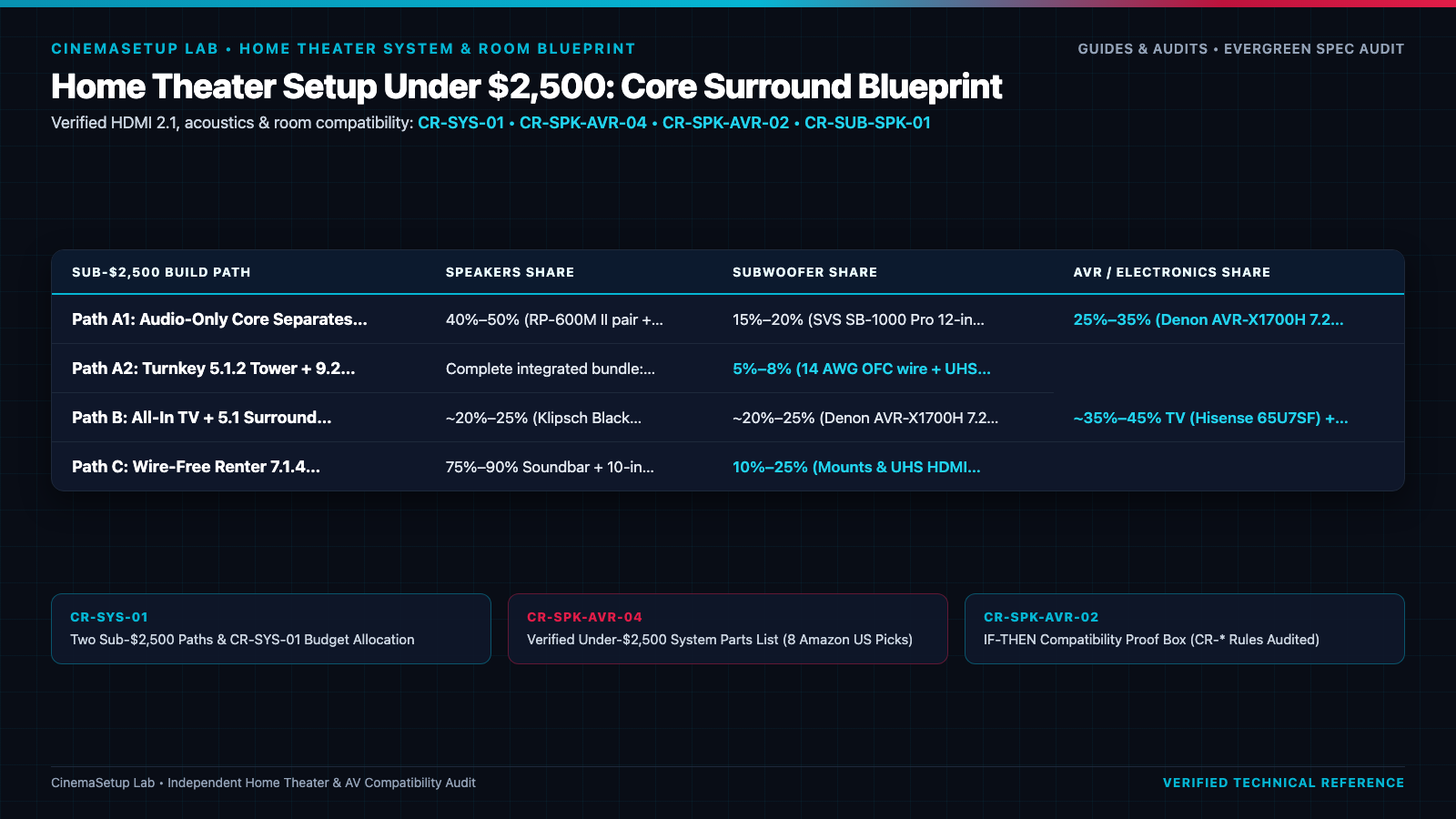
First, clarify what your $2,500 ceiling covers. In our Knowledge Graph, the Core Surround audio tier ($1,000–$2,500) covers the AV receiver, passive speakers, powered subwoofer, and wiring/stands—assuming you already have a 4K television. However, many living-room shoppers also ask how to stretch $2,500 across both a 65-inch display and surround sound. Modeling a typical 15 ft wide × 20 ft long × 8 ft flat-ceiling living room (4.6 m × 6.1 m × 2.4 m; 2,400 cu ft / 68 m³) with a primary seat 10 ft (3.05 m) from the screen separates cleanly into two compatible paths:
| Sub-$2,500 Build Path | Speakers Share | Subwoofer Share | AVR / Electronics Share | Display & Accessories |
|---|---|---|---|---|
| Path A1: Audio-Only Core Separates (3.1/5.1/5.1.2) Assumes existing 4K TV | 40%–50% (RP-600M II pair + RP-500C II + optional surrounds) | 15%–20% (SVS SB-1000 Pro 12-in sealed) | 25%–35% (Denon AVR-X1700H 7.2 AVR) | 5%–8% (14 AWG OFC wire, stands, UHS HDMI) |
| Path A2: Turnkey 5.1.2 Tower + 9.2 AVR Bundle Assumes existing 4K TV | Complete integrated bundle: Onkyo TX-NR7100 9.2-ch Dirac Live AVR + Klipsch R-625FA Atmos towers + R-52C + R-41M + R-12SW 12-in sub | 5%–8% (14 AWG OFC wire + UHS HDMI) | ||
| Path B: All-In TV + 5.1 Surround Build Includes 65-in 4K/165Hz TV | ~20%–25% (Klipsch Black Reference Theater Pack 5.1 w/ 8-in sub) | ~20%–25% (Denon AVR-X1700H 7.2 AVR) | ~35%–45% TV (Hisense 65U7SF) + 5%–10% wire/mount | |
| Path C: Wire-Free Renter 7.1.4 Soundbar Assumes existing 4K TV | 75%–90% Soundbar + 10-in wireless sub + detachable wireless surrounds (JBL Bar 1000MK2) | 10%–25% (Mounts & UHS HDMI cables) | ||
Rule CR-SYS-01 enforces a strict priority across every audio-first AVR blueprint: put at least 50% of your audio budget into speakers and subwoofers (40%–50% speakers plus 15%–20% subwoofer) and keep the AV receiver at 25%–35% (with 5%–8% reserved for pure copper speaker wire, stands, and Ultra High Speed HDMI cables). Transducers determine your tonal clarity and bass extension far more than paying for extra amplifier badges you cannot hear. If your budget sits lower—around the $1,000 mark—check our home theater setup under $1,000 blueprint; if you want dedicated overhead placement guidance for flat vs. vaulted ceilings, compare our 5.1.2 living-room setup guide.
Verified Under-$2,500 System Parts List (8 Amazon US Picks)
Every SKU below was verified on Amazon US (US 120V AC market, delivery ZIP 10001) on 2026-11-26. Path A1 starts with a core 3.1 front stage (Klipsch RP-600M II front pair, RP-500C II center, SVS SB-1000 Pro 12-inch sealed sub, and Denon AVR-X1700H) that leaves room for budget surrounds or future Atmos expansion, while Path A2 bundles a 9.2-channel Dirac Live AVR with full 5.1.2 towers, and Path B pairs a 65-inch Mini-LED TV with a compact 5.1 pack.
| System Role | Verified Amazon US Pick | Key Compatibility Spec | Budget Tier / Contents | Amazon Link |
|---|---|---|---|---|
| Core 7.2-Ch AV Receiver | Denon AVR-X1700H 7.2-Ch AVR | 80 W/ch (8 ohms, 20 Hz–20 kHz, 0.08% THD, 2 ch driven); 3x 40 Gbps HDMI 2.1; Audyssey MultEQ XT | $450-$650 (25%–35% Core AVR share) | View on Amazon |
| Front L/R Bookshelf Pair | Klipsch RP-600M II (Ebony) | 8 ohms compatible, 94.5 dB (2.83V/1m), 44 Hz–25 kHz (±3 dB); rear-ported Tractrix horn | $500-$800 (Sold strictly per pair / 2 speakers) | View on Amazon |
| Matched Center Channel | Klipsch RP-500C II (Ebony) | 8 ohms compatible, 94 dB (2.83V/1m), 56 Hz–25 kHz (±3 dB); 6.87 in (17.4 cm) tall | $300-$500 (Sold as single center / each) | View on Amazon |
| 12-In Sealed Subwoofer | SVS SB-1000 Pro (Black Ash) | 12-in sealed, 325 W RMS (820+ W peak), 20–270 Hz (±3 dB), app DSP EQ | $500-$700 (Sold as single powered sub / each) | View on Amazon |
| Turnkey 5.1.2 + 9.2 Bundle | Klipsch Atmos + Onkyo TX-NR7100 | Onkyo 9.2-ch 100 W/ch (8 ohms, 20 Hz–20 kHz, 2 ch driven) Dirac Live + R-625FA towers + R-52C + R-41M + R-12SW | $1,500-$2,500 (Complete 5.1.2 + 12-in sub + AVR) | View on Amazon |
| All-In Path 5.1 Pack | Klipsch Black Reference Theater 5.1 | 8 ohms compatible, 91 dB sats / 94 dB center, 110 Hz–23 kHz (±3 dB); 8-in 50 W RMS wireless/LFE sub | $300-$500 (4 sats + center + 8-in sub; no AVR) | View on Amazon |
| Wire-Free 7.1.4 Soundbar | JBL Bar 1000MK2 System | 480 W RMS total, physical up-firing drivers, detachable wireless rears, 10-in sub, 3x HDMI In + eARC | $1,000-$1,500 (Bar + 2 rears + 10-in sub) | View on Amazon |
| All-In 65-In 4K165Hz TV | Hisense 65U7SF Mini-LED TV | 65-in VA Mini-LED, 165 Hz native, 4x HDMI 2.1 (incl. eARC), Dolby Vision IQ & HDR10+ | $500-$1,100 (65-in TV + stand + remote) | View on Amazon |
IF-THEN Compatibility Proof Box (CR-* Rules Audited)
Every sub-$2,500 blueprint must pass our machine-readable CR-* compatibility checks before any wire is cut. Here is the exact IF -> THEN validation log for the picks above:
Core Surround Under $2,500 Compatibility Proof Box:
- CR-SYS-01 (SOFT — Speaker-First Budget Allocation): IF your audio system budget is $1,000–$2,500, THEN allocate 55%–70% to speakers plus subwoofer (such as the Klipsch RP-600M II pair, RP-500C II center, and SVS SB-1000 Pro) and 25%–35% to a 7.2-channel AVR (Denon AVR-X1700H). Overspending on a flagship 11-channel AVR while pairing it with tiny plastic speakers starves midrange clarity and bass depth.
- CR-SPK-AVR-04 & CR-SPK-AVR-05 (HARD — Channel Processing Ceiling): IF you select the 7.2-channel Denon AVR-X1700H, THEN your maximum surround layout is 5.1.2 Dolby Atmos (7 amplified speaker channels) or 7.1—it cannot drive 5.1.4 or 7.1.4 because processing caps at 7 speaker channels. IF you step into the Onkyo TX-NR7100 9.2-channel bundle, THEN you unlock 9 processed and amplified channels natively (5.1.4 or 7.1.2).
- CR-SPK-AVR-02 & CR-SPK-AVR-03 (SOFT / INFO — Wattage, Sensitivity & Seat Distance): IF your sofa sits 10 ft (3.05 m) from 94.5 dB (2.83V/1m) Klipsch RP-600M II fronts, THEN reaching 100 dB living-room peaks needs an estimated ~33 W per channel, which the Denon AVR-X1700H (80 W/ch at 8 ohms, 20 Hz–20 kHz, 0.08% THD, 2 ch driven; ~56 W/ch after conservative ~30% multichannel derating) supplies with clean dynamic headroom.
- CR-SUB-SPK-01 (SOFT — Crossover & -3 dB Extension): IF your front speakers extend to 44 Hz (±3 dB) on the RP-600M II and 56 Hz (±3 dB) on the RP-500C II, THEN set all channels to Small with an 80–90 Hz AVR crossover (clearing the
1.5 × f3rule). IF you choose the compact Klipsch Black Reference Theater Pack 5.1 satellites rated to 110 Hz (±3 dB), THEN raise the AVR crossover to 120–150 Hz so no mid-bass gap forms between the satellites and the 8-inch sub. - CR-SPK-SPK-01 (SOFT — Front Stage Timbre Match): IF your front L/R pair is the Tractrix horn-loaded Klipsch RP-600M II, THEN pair it with the matching Reference Premiere II center (RP-500C II) so voices panning left-to-right maintain identical tonal character.
- CR-SPK-AVR-01 & CR-AVR-ROOM-01 (CONDITIONAL — Impedance & Cooling): Every passive Klipsch speaker here is 8 ohms compatible, avoiding 4-ohm voltage-rail limiting on the Denon AVR-X1700H or Onkyo TX-NR7100. Still maintain at least 4 in (10 cm) of open air above the receiver and 2 in (5 cm) on the sides per Denon’s cooling guidance.
- CR-SUB-AVR-01 & CR-SUB-ROOM-01/03 (HARD / SOFT — Powered Sub & Room Fit): Both the SVS SB-1000 Pro and Klipsch R-12SW are self-powered subwoofers compatible with AVR LFE line-level outputs. In closed 1,500–2,400 cu ft (42–68 m³) living rooms or shared-wall townhomes, the sealed SVS SB-1000 Pro plus AVR dynamic-range/night compression keeps bass controlled and neighbor-friendlier—though no subwoofer or pad completely blocks low-frequency transfer next door.
- CR-SYS-02 (HARD — US 120V AC & Authorized Seller Check): Verify every powered component (AVR, subwoofer, soundbar, TV) is a genuine US 120V AC / 60 Hz retail model sold by an authorized US dealer on Amazon to protect manufacturer warranty coverage (G-26).
AVR Channel Architecture, Power Math & 80–120 Hz Crossover Rules
Shoppers comparing receivers under $2,500 frequently misread two specs: amplifier wattage and speaker channel counts. Under rule CR-SPK-AVR-03, compare receiver power strictly on a like-for-like 8-ohm, 20 Hz–20 kHz, 2-channel-driven continuous rating rather than inflated 1 kHz or 6-ohm peak numbers. When five or seven speakers demand simultaneous peaks during an action sequence, applying a conservative ~30% multichannel derating to the Denon AVR-X1700H’s 80 W/ch rating leaves roughly 56 W per channel available—and about 70 W per channel on the 100 W/ch Onkyo TX-NR7100.
Here is why speaker sensitivity in our CR-SPK-AVR-02 estimate from published specs matters so much at a 10 ft (3.05 m) living-room seat (assuming zero room gain for conservative planning):
- 94.5 dB Sensitivity (Klipsch RP-600M II, 8 ohms, 2.83V/1m): Reaching 95 dB living-room peaks requires only ~10.4 W/ch, and reaching dynamic 100 dB peaks requires roughly ~33 W/ch—comfortably inside the Denon AVR-X1700H’s ~56 W multichannel envelope.
- 87 dB Sensitivity (Typical Non-Horn 8-Ohm Bookshelf): At the exact same 10 ft (3.05 m) seat, 95 dB peaks require ~59 W/ch and 100 dB peaks jump to an estimated ~185 W/ch—more than triple what an entry 7.2 receiver delivers cleanly. Pairing high-sensitivity speakers with a Core 7.2 receiver maximizes headroom without spending $1,500+ on external power amplifiers.
Need more AVR comparisons—such as adding US Front L/R pre-outs on the Denon AVR-X1800H or dual HDMI outputs on the Onkyo TX-NR6100? Review our best AV receivers under $1,000 audit before locking in your receiver slot.
How Bass Management Completes the Budget
Setting your front speakers to “Small” inside the AVR menu even when you buy large bookshelf speakers or floorstanding towers frees both your receiver’s power supply and your speaker woofers from reproducing energy below 80 Hz. Under rule CR-SUB-SPK-01, set your crossover at least 1.5× above the speaker’s -3 dB low-frequency limit: 80–90 Hz for the RP-600M II (44 Hz) and RP-500C II (56 Hz), and 120 Hz or higher for the compact 110 Hz satellites inside the Klipsch Black Reference Theater Pack 5.1. Remember that the Denon AVR-X1700H and Onkyo TX-NR7100 both output mirrored mono signals across their two subwoofer jacks (CR-SUB-AVR-02); upgrading to independent 4-sub calibration requires stepping above this tier to a 9.4-channel AVR such as the Denon AVR-X3900H.
HDMI 2.1 Switching, eARC & Living-Room Placement
Modern streaming boxes, 4K Blu-ray players, and PS5/Xbox Series X consoles follow strict port rules (CR-SRC-AVR-01, CR-DISP-AVR-01/02):
- Denon AVR-X1700H Port Plan: Only three of the six HDMI inputs (Inputs 4, 5, and 6) carry full 40 Gbps HDMI 2.1 bandwidth for 4K/120Hz VRR/ALLM gaming. Reserve those three ports for consoles or connect consoles straight into the Hisense 65U7SF’s four HDMI 2.1 ports and return lossless multichannel PCM or Dolby TrueHD Atmos back to the AVR over HDMI eARC.
- Speaker & TV Geometry: At 10 ft (3.05 m), a 65-inch 16:9 screen spans roughly a 27°–30° comfortable viewing angle; if you sit closer at 7.5 to 8.5 ft (2.3 to 2.6 m), 65 inches sits right inside the 30°–40° cinema window (CR-DISP-ROOM-01). Note that the Hisense 65U7SF uses a VA LCD panel (CR-DISP-ROOM-04), so centered sofa seating preserves the deepest contrast, while rear-ported RP-600M II bookshelves benefit from several inches of rear wall clearance and ear-height speaker stands (CR-SPK-ROOM-04/05).
- Ceiling Rules for Heights (CR-SPK-ROOM-01 & CR-SYS-05): If you choose the Onkyo TX-NR7100 + R-625FA Atmos tower bundle, the integrated upward-firing elevation tops need a flat, reflective ceiling 7.5 to 12 ft (2.3 to 3.7 m) high. Vaulted or sloped ceilings defeat bounce reflections and favor wall-mounted angled height speakers instead—and never confuse DSP virtualization modes with physical overhead drivers.
UL CL2/CL3 Wiring, Mounting Safety & Calibration Checklist
Installation, Electrical Safety & Calibration Checklist (G-27 Compliant):
- Manufacturer-First Wall & Shelf Mounting: Whether mounting a 65-inch television or elevated speakers, always follow the mount and display manufacturer’s printed installation instructions. Verify exact VESA hole spacing, weight without stand, and fastener torque, and anchor brackets strictly into solid wood studs, joists, or rated masonry anchors—never into unsupported drywall alone. Heavy floorstanding towers and 26–31 lb (11.8–14.1 kg) subwoofers should be lifted with safe two-person technique per maker manuals.
- Speaker Wire Gauge & UL CL2/CL3 Code (CR-ACC-SPK-01/02): Choose pure oxygen-free copper (OFC) rather than copper-clad aluminum (CCA). For 8-ohm speakers, 16 AWG OFC handles runs up to ~50 ft (15 m), while 14 AWG OFC handles up to ~79 ft (24 m). Any speaker wire or active optical Ultra High Speed HDMI cable routed inside walls or ceilings must carry a UL CL2 or CL3 in-wall fire rating; consult a licensed electrician or low-voltage AV installer for in-wall electrical outlets, power-bridge kits, or code-compliant concealment.
- Ultra High Speed HDMI Certification (CR-ACC-DISP-01): Use HDMI Licensing Administrator–certified Ultra High Speed HDMI (48 Gbps) cables with the scannable QR hologram for 4K/120Hz and eARC links. For runs longer than ~10 ft (3 m), use a certified active optical fiber HDMI cable and verify its directional Source/Display ends before closing walls.
- 5-Step Calibration With Level-Calibration Tones: Set subwoofer low-pass knobs to LFE/Bypass (maximum) and phase to 0°, place the Audyssey or Dirac setup microphone on a tripod at seated ear height across 6 to 8 positions, run automated level-calibration tones, confirm speakers are set to Small with 80 Hz (or 120 Hz for satellites) crossovers, and keep listening volumes at comfortable everyday levels with Night/Dynamic Volume enabled for shared-wall households.
Audited Equipment Profiles (8 Verified US Listings)
Every SKU below was verified on Amazon US on 2026-11-26. Before completing checkout, inspect the Sold by line: US manufacturer warranties from Denon, Klipsch, SVS, Onkyo, JBL, and Hisense generally require purchasing US 120V AC inventory from an authorized dealer rather than an unauthorized third-party reseller (G-26).
1. Denon AVR-X1700H 7.2-Channel AV Receiver — Core Blueprint Receiver

Key Specs & Package Contents: 7.2 channels (5.1.2 max Atmos/DTS:X) | Rated Power: 80 W/ch (8 ohms, 20 Hz–20 kHz, 0.08% THD, 2 ch driven) | Impedance: 4–16 ohms (via impedance menu) | HDMI: 6 in / 1 eARC out (3x 40 Gbps 4K/120Hz inputs, VRR, ALLM, Dolby Vision, HDR10+) | Room Correction: Audyssey MultEQ XT | Dimensions & Weight: 17.1 × 13.3 × 6.0 in (43.4 × 33.9 × 15.1 cm), 19.0 lb (8.6 kg) | In the Box: US 120V AVR-X1700H chassis, setup mic, remote, power cord | Price Tier: $450-$650
The Denon AVR-X1700H anchors Path A1 and Path B cleanly inside the 25%–35% receiver budget target of CR-SYS-01. Rather than stripping down to entry 5.2 processing or base Audyssey MultEQ, it delivers full 7.2 amplification for future 5.1.2 overhead speakers (CR-SPK-AVR-04), three 40 Gbps HDMI 2.1 inputs for modern consoles (CR-SRC-AVR-01), and Audyssey MultEQ XT higher-resolution room correction. Paired with 94–94.5 dB Klipsch Reference Premiere speakers at 10 ft (3.05 m), its ~56 W derated multichannel output easily covers dynamic movie peaks (CR-SPK-AVR-02).
Pros
- Three 40 Gbps HDMI 2.1 ports pass 4K/120Hz, VRR, ALLM, Dolby Vision, and HDR10+ alongside eARC
- Audyssey MultEQ XT calibration and 4–16 ohm impedance setting fit a wide range of passive speakers
Cons
- Omits Front L/R speaker pre-outs and dual independent subwoofer outputs (2 parallel mono sub outs only)
- Single HDMI output and 7.2 ceiling cap layouts at 5.1.2 (cannot run 5.1.4); confirm authorized US dealer on older stock
2. Klipsch Reference Premiere RP-600M II Bookshelf Speakers (Pair) — Front L/R Stage

Key Specs & Package Contents: 8 ohms compatible nominal impedance | Sensitivity: 94.5 dB (2.83V/1m) | Frequency Response: 44 Hz–25 kHz (±3 dB) | Rear Tractrix bass port | Dimensions & Weight: 15.75 × 7.95 × 13.00 in (40.0 × 20.2 × 33.0 cm), 18.1 lb (8.2 kg) per speaker | In the Box: Sold strictly as a matched pair (2 passive bookshelf speakers) | Price Tier: $500-$800 (per pair)
Assigning the front left and right channels to the Klipsch RP-600M II pair is the highest-impact upgrade inside a sub-$2,500 budget. Its high 94.5 dB (2.83V/1m) sensitivity and 8-ohm compatible load squeeze maximum dynamics from an 80 W/ch receiver (CR-SPK-AVR-02), while its 44 Hz (±3 dB) extension blends seamlessly into an 80 Hz subwoofer crossover (CR-SUB-SPK-01). Because the cabinet is 13 in (33 cm) deep and rear-ported, mount the pair on sturdy ear-height stands several inches off the front wall (CR-SPK-ROOM-04/05).
Pros
- 94.5 dB sensitivity and 8-ohm compatibility preserve generous dynamic headroom on Core 7.2 receivers
- 44 Hz (±3 dB) low-end reach exceeds the 1.5× safety margin for a clean 80 Hz crossover
Cons
- Deep 13-in rear-ported enclosure needs wall breathing room and ear-height stands (sold separately)
- Two-speaker front pair only—budget separately for center, surrounds, and subwoofer
3. Klipsch RP-500C II Reference Premiere Center Channel Speaker (Single) — Dialogue Anchor

Key Specs & Package Contents: 8 ohms compatible nominal impedance | Sensitivity: 94 dB (2.83V/1m) | Frequency Response: 56 Hz–25 kHz (±3 dB) | Dimensions & Weight: 6.87 × 19.34 × 10.58 in (17.4 × 49.1 × 26.9 cm), 18.3 lb (8.3 kg) | In the Box: Sold as a single passive center channel speaker (each) | Price Tier: $300-$500 (each)
Under rule CR-SPK-SPK-01, mixing a soft-dome center speaker between horn-loaded front speakers shifts vocal timbre whenever dialogue pans across the screen. The Klipsch RP-500C II locks directly into the Reference Premiere II Tractrix horn family as the RP-600M II pair while standing just 6.87 in (17.4 cm) tall—compact enough to sit on top of most media consoles without blocking a raised TV bezel. Set its AVR crossover to 80–90 Hz (CR-SUB-SPK-01) to match its 56 Hz (±3 dB) bass floor.
Pros
- Exact Tractrix horn and Cerametallic woofer timbre match to the Klipsch RP-600M II front pair
- 6.87-in height and 19.34-in width fit open console shelves far more easily than oversized quad-woofer centers
Cons
- Rear-ported cabinet loses clarity if shoved flush against an enclosed shelf back wall
- Two-driver horizontal MTM layout narrows off-axis horizontal vocal dispersion for far side seats
4. SVS SB-1000 Pro 12-Inch 325W RMS Sealed Subwoofer — Living-Room Bass Anchor

Key Specs & Package Contents: 12-in high-excursion driver | Sealed acoustic-suspension cabinet | 325 W RMS (820+ W peak) Class-D Sledge amplifier | Frequency Response: 20 Hz–270 Hz (±3 dB) | Dimensions & Weight: 13.5 × 13.0 × 14.76 in (34.2 × 33.0 × 37.5 cm with grille), 26 lb (11.8 kg) | In the Box: Single powered sealed subwoofer (each), grille, AC cord | Price Tier: $500-$700 (each)
Representing the 15%–20% subwoofer allocation in Path A1, the SVS SB-1000 Pro packs a true 12-inch driver and 325 W RMS amplifier into a 13.5-inch living-room cube rated down to 20 Hz (±3 dB). Its 3-band smartphone parametric EQ lets you trim single-room bass peaks independently before running Audyssey MultEQ XT, while its sealed acoustic-suspension roll-off suits closed 1,500–2,400 cu ft (42–68 m³) living rooms and shared-wall residences (CR-SUB-ROOM-01/03). If your living room opens freely into a 4,000+ cu ft kitchen, plan a second unit later across the Denon’s second sub output.
Pros
- Compact 13.5 × 13.0-in footprint delivers 20 Hz (±3 dB) maker-rated extension with smartphone parametric EQ
- Sealed cabinet and steep DSP control suit music, movies, and neighbor-conscious townhome listening
Cons
- Single sealed sub yields less extreme sub-25 Hz output in large open-plan rooms above 3,000 cu ft than ported or dual subs
- Sold strictly as a single subwoofer (each) and ships without an LFE RCA interconnect cable
5. Klipsch Reference Dolby Atmos Home Theater + Onkyo TX-NR7100 9.2-Ch Bundle — Turnkey 5.1.2

Key Specs & Package Contents: Onkyo TX-NR7100 9.2-ch AVR (100 W/ch at 8 ohms, 20 Hz–20 kHz, 0.08% THD, 2 ch driven; Dirac Live included; HDMI 2.1 4K/120Hz + eARC; Klipsch Optimize Mode) | Speakers: 8 ohms compatible | In the Box: Onkyo TX-NR7100 AVR, 2x Klipsch R-625FA Dolby Atmos floorstanding towers, 1x R-52C center, 2x R-41M surrounds, 1x R-12SW 12-in powered subwoofer (speaker wire sold separately) | Price Tier: $1,500-$2,500
If you already own a 4K TV and want a one-click 5.1.2 floorstanding tower system under $2,500, this turnkey bundle solves every compatibility checkpoint at once. Unlike separate starter kits, it pairs a 9.2-channel Dirac Live AV receiver (100 W/ch continuous 8 ohms) with timbre-matched Klipsch Reference speakers and a 12-inch powered subwoofer—leaving two open amplifier channels on the TX-NR7100 to expand from 5.1.2 to 5.1.4 later (CR-SPK-AVR-04). Confirm your room has a flat 7.5–12 ft (2.3–3.7 m) ceiling for the R-625FA up-firing elevation tops (CR-SPK-ROOM-01).
Pros
- Includes 9.2-channel Onkyo TX-NR7100 with Dirac Live built-in and Klipsch Optimize Mode crossover presets
- Complete 5.1.2 discrete floorstanding speaker set plus 12-in powered sub under $2,500 with room to add rear heights
Cons
- Base Reference series towers and R-12SW sub trail the Reference Premiere II + SVS SB-1000 Pro separates in refinement
- Up-firing tower elevation drivers depend on flat ceilings, and heavy multi-box delivery requires careful two-person handling
6. Klipsch Black Reference Theater Pack 5.1 — All-In TV + Audio Speaker Pack

Key Specs & Package Contents: 8 ohms compatible nominal impedance | Sensitivity: 91 dB satellites, 94 dB center (2.83V/1m) | Satellites & Center: 110 Hz–23 kHz (±3 dB) | Subwoofer: 8-in down-firing ported, 50 W RMS / 150 W peak, 38–120 Hz (±3 dB), wired LFE + 2.4 GHz wireless transmitter | In the Box: 4x compact satellites, 1x center, 1x 8-in powered sub + wireless kit (no AVR or wire included) | Price Tier: $300-$500
When your total $2,500 budget must buy both a 65-inch 4K television and real 5.1 receiver-driven surround sound (Path B), the Klipsch Black Reference Theater Pack 5.1 pairs cleanly with the Denon AVR-X1700H and Hisense 65U7SF. Its 8-ohm compatible load and 91–94 dB sensitivity keep amplifier demand light (CR-SPK-AVR-02), and the 2.4 GHz wireless subwoofer transmitter adds placement flexibility. Just enforce rule CR-SUB-SPK-01 at calibration time: because the satellites roll off at 110 Hz (±3 dB), set the Denon crossover to 120–150 Hz rather than 80 Hz.
Pros
- Compact 5.1 satellite + 8-in powered sub kit fits Path B budgets alongside a 65-in Mini-LED TV and 7.2 AVR
- 8-ohm impedance, 91–94 dB sensitivity, and optional wireless sub transmitter ease living-room setup
Cons
- Satellites roll off at 110 Hz (±3 dB), forcing a 120–150 Hz crossover where sub location can become slightly directional
- 8-in 50 W RMS sub lacks deep sub-35 Hz cinema impact in rooms larger than ~1,500–1,800 cu ft
7. JBL Bar 1000MK2 7.1.4-Channel Soundbar System — Wire-Free Renter Alternative

Key Specs & Package Contents: 7.1.4-channel layout (physical upward-firing drivers + detachable battery-powered wireless rears + MultiBeam 3.0) | 480 W continuous RMS rating (960 W max) | 10-in wireless down-firing sub | 3x HDMI In + 1x HDMI eARC Out (Dolby Vision & HDR10+ passthrough), Optical, Wi-Fi 6, AirPlay, Google Cast | In the Box: Main soundbar, 2x detachable wireless surround speakers, 1x 10-in wireless sub, wall brackets | Price Tier: $1,000-$1,500
If lease restrictions or open doorways prevent running copper speaker wire across your living room, the JBL Bar 1000MK2 provides the cleanest Path C alternative inside the Core Surround bracket. Unlike virtualized single-box bars (CR-SYS-05), its detachable battery-powered surrounds sit physically behind the couch while dedicated upward-firing drivers bounce Dolby Atmos and DTS:X off flat 7.5–12 ft ceilings (CR-SBAR-ROOM-01). Even better, it pairs effortlessly with a 65-inch TV like the Hisense 65U7SF while staying well under $2,500 combined.
Pros
- True detachable wireless surround speakers and 10-in wireless sub require zero speaker wire or rear AC outlets during movies
- Decodes both Dolby Atmos and DTS:X with three HDMI inputs plus eARC, Dolby Vision, and HDR10+ support
Cons
- Closed ecosystem cannot accept third-party passive speakers, larger subwoofers, or future AVR expansion (CR-SUB-SBAR-01)
- Detachable surround batteries require periodic redocking to recharge; check TV stand height clearance (CR-SBAR-DISP-05)
8. Hisense 65-Inch U7 Mini-LED 4K Smart Fire TV (65U7SF) — All-In-Budget Display

Key Specs & Package Contents: 65-in VA Mini-LED QLED panel with anti-reflection finish | Native 165 Hz refresh rate (VRR / FreeSync Premium Pro / ALLM) | 4x HDMI 2.1 inputs (including HDMI eARC port) | HDR: Dolby Vision IQ, HDR10+, HDR10, HLG, IMAX Enhanced | In the Box: 65-in 65U7SF TV, tabletop stand legs, Alexa voice remote | Price Tier: $500-$1,100
Rounding out Path B and Path C, the Hisense 65U7SF hits the Value 4K TV tier while supplying connectivity rarely found below $1,100: four full HDMI 2.1 ports, native 165 Hz VRR support, anti-reflection treatment for sunlit living rooms, and simultaneous Dolby Vision IQ + HDR10+ compatibility (CR-SRC-DISP-01). Even after dedicating one HDMI 2.1 port to eARC for your Denon AVR-X1700H or JBL Bar 1000MK2, three high-speed HDMI 2.1 ports stay free on the TV for consoles (CR-DISP-AVR-02).
Pros
- Four HDMI 2.1 inputs leave three open high-refresh gaming ports even with HDMI eARC connected
- Supports both Dolby Vision IQ and HDR10+ dynamic metadata formats inside the $500-$1,100 Value 4K tier
Cons
- VA LCD panel loses contrast and color saturation at wide off-axis seating angles compared with OLED (CR-DISP-ROOM-04)
- At 10 ft (3.05 m), 65 inches sits near the smaller 27°–30° end of cinema viewing angles compared with 75–77 in sets
Authoritative Standards & Manufacturer References
- Denon US Official AV Receiver Specifications (AVR-X1700H 80 W/ch 8-ohm 2-channel driven power rating, 4–16 ohm impedance setting, and 40 Gbps HDMI 2.1 port allocation).
- Klipsch US Official Reference & Reference Premiere Documentation (RP-600M II 94.5 dB / 44 Hz specs, RP-500C II 94 dB / 56 Hz specs, and Black Reference Theater Pack 5.1 ratings).
- SVS Sound US Official Subwoofer Specifications (SB-1000 Pro 325 W RMS sealed cabinet output, 20–270 Hz ±3 dB rating, and room-sizing guidelines).
- Onkyo US Official AV Receiver Specifications (TX-NR7100 9.2-channel 100 W/ch 8-ohm rating, Dirac Live calibration, and Klipsch Optimize Mode).
- HDMI Licensing Administrator — HDMI 2.1a & Ultra High Speed Cable Specification (40/48 Gbps FRL bandwidth, eARC lossless audio return, VRR, ALLM, and certified hologram cables).
How We Audited This Guide
- Room setups, upgrade roadmaps, and Amazon marketplace audits enforce system-wide CR-* budgets and acoustics, Canadian /ZC grey-market alerts, pair-vs-single speaker clarity, and manufacturer-first mounting safety.
- Every AV receiver, speaker, subwoofer, soundbar, OLED/Mini-LED TV, projector, source player, and accessory spec was cross-checked against official manufacturer manuals, CEA/CTA standards, and live Amazon US listings.
- Recommendations were evaluated against our weighted vertical scoring rubrics and documented CR-* compatibility rules; we never invent nits, contrast ratios, bench wattage, or room decibels.
Continue Your Audit
Frequently Asked Questions
Should a home theater setup under $2,500 include a TV or audio only?
If you already own a 4K TV, dedicating the full $2,500 Core Surround budget to an AV receiver, Reference Premiere L/C/R speakers, and a 12-inch sealed subwoofer delivers dramatically richer dynamics. If you also need a display, pair a 65-inch Value Mini-LED TV with a 7.2 AVR and compact 5.1 pack.
How much of a $2,500 audio budget should go to speakers vs. the AV receiver?
Under compatibility rule CR-SYS-01, allocate 40%–50% to passive speakers and 15%–20% to the powered subwoofer, keeping the AV receiver between 25% and 35% and cables/stands at 5%–8%. Putting at least half your spend into speakers and subs yields far bigger sound gains.
Is an 80-watt AV receiver powerful enough for a $2,500 home theater setup?
Yes, when paired with high-sensitivity 8-ohm speakers. At a 10 ft (3.05 m) seat, 94.5 dB Klipsch RP-600M II fronts need roughly 33 W/ch for 100 dB living-room peaks (CR-SPK-AVR-02), comfortably within an 80 W/ch receiver’s ~56 W multichannel derated envelope.
What crossover frequency should I set for bookshelf vs. satellite speakers?
Under rule CR-SUB-SPK-01, set all speakers to Small and cross over at least 1.5× above each speaker’s -3 dB low-end limit. Use 80 Hz for the 44 Hz Klipsch RP-600M II, 80–90 Hz for the RP-500C II center, and 120–150 Hz for 110 Hz compact satellites.
How do I keep a sub-$2,500 setup safe and code-compliant during installation?
Follow mount and speaker instructions strictly, anchor brackets into solid studs or rated masonry using verified VESA and weight limits, leave 4+ in (10 cm) airflow above the AVR, use UL CL2/CL3 OFC wire inside walls, and hire a licensed electrician for AC outlets.


