
Disclosure: As an Amazon Associate, I earn from qualifying purchases. If you buy through links on this page, we may earn a small commission at no extra cost to you. Affiliate commission rates never influence our technical audits, scores, or rankings.
Choosing the best soundbar under 1000 means looking past inflated total-wattage stickers and misleading “9.1.4” or “5.0” channel labels that mix physical speakers with digital processing. In the $500-$1,000 bracket, you hit an authentic home theater crossroads: flagship single-chassis bars with dedicated upward-firing drivers and integrated woofers sit right alongside complete multi-piece kits packing a 10-inch (25.4 cm) wireless subwoofer and detachable wireless rear speakers.
To separate genuine acoustic hardware from marketing claims, we audited eight actively stocked US 120V AC soundbars and kits from Sonos, JBL, Bose, and Amazon on Amazon US—sitting between our flagship best soundbars hub and entry best soundbars under $300 picks. Every recommendation below is verified against official US manufacturer spec sheets for physical driver counts, HDMI eARC versus optical fallback behavior, 4K/120Hz console passthrough limits, closed-ecosystem sub/rear locks, and TV stand clearance.
In This Guide
- Quick Picks: Best Soundbar Under 1000 Winners
- Best Soundbar Under 1000 Comparison Matrix
- Match Your Room, TV & Seating Layout
- Detailed Best Soundbar Under 1000 Audits (1–8): 1. Sonos Arc Ultra · 2. JBL Bar 1000 · 3. Bose Smart Ultra · 4. JBL Bar 800 · 5. Sonos Beam Gen 2 · 6. Bose Smart Soundbar · 7. JBL Bar 500 · 8. Amazon Fire TV Soundbar Plus
- Best Soundbar Under 1000 Buying Guide: Compatibility & Upgrade Roadmap
- 100% Weighted Scoring Rubric & Excluded Models
- Best Soundbar Under 1000 Frequently Asked Questions
- Final Verdict: Choosing the Best Soundbar Under 1000
Quick Picks: Best Soundbar Under 1000 Winners
#1 Best Overall Single Bar
Sonos Arc Ultra
Packs 14 physical drivers, Sound Motion integrated bass, two physical up-firing tweeters, and iOS/Android Trueplay under a Launch MSRP around $999. Jump to audit ↓
#2 Best Full 7.1.4 Kit With Rears & Sub
JBL Bar 1000
Ships complete with detachable wireless rear speakers, a 10-in (25.4 cm) wireless sub, four up-firing drivers, and DTS:X decoding. Jump to audit ↓
#3 Best for Dialogue & Low TV Stands
Bose Smart Ultra
Ultra-slim 2.29 in (5.8 cm) profile clears tight TV pedestals while A.I. Dialogue Mode and two up-firing dipoles keep voices crisp. Jump to audit ↓
Best Soundbar Under 1000 Comparison Matrix
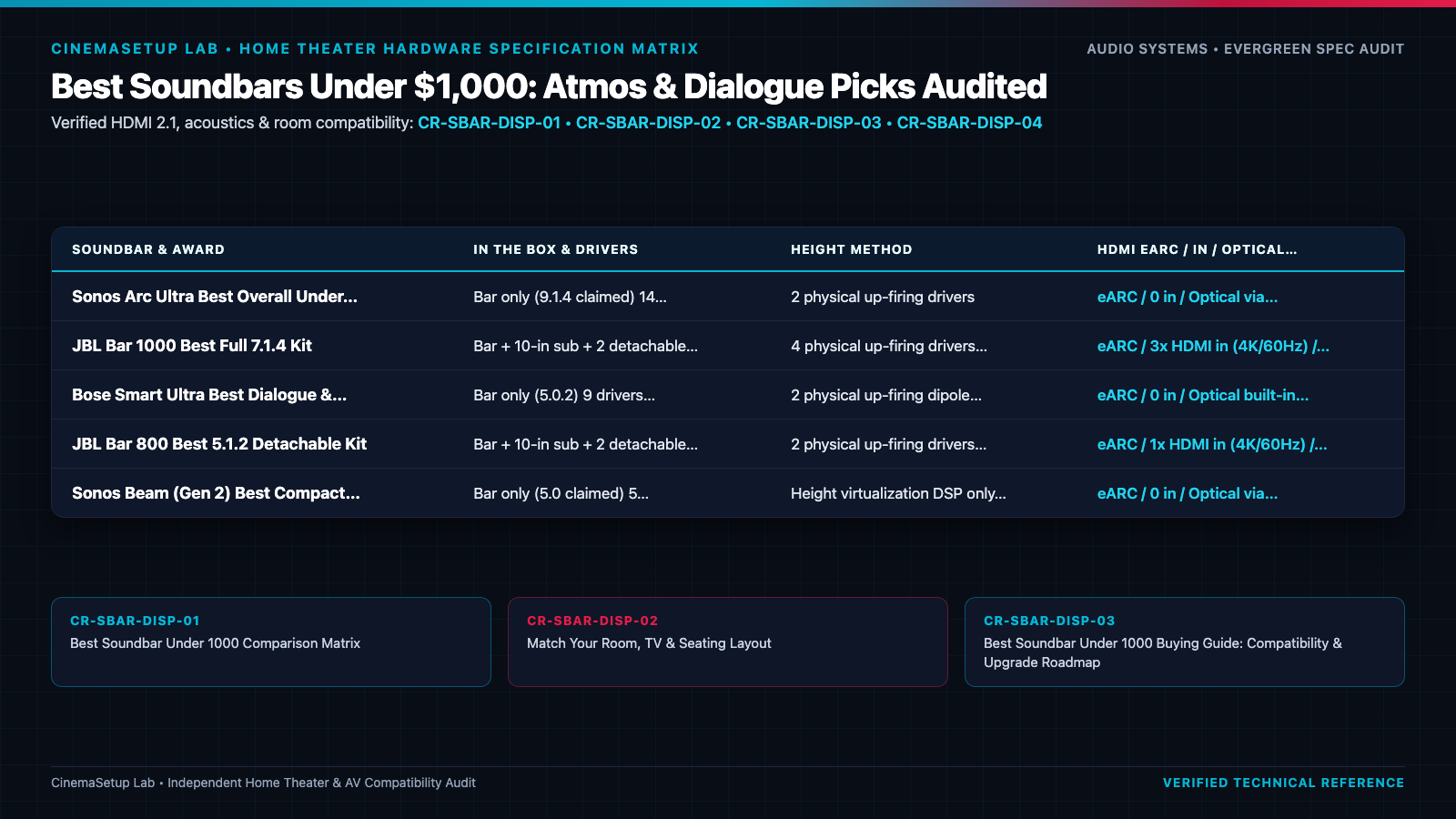
We never rank a Dolby Atmos soundbar by total marketing wattage because brands measure peak burst power inconsistently—and Bose omits amplifier wattage figures completely. Instead, the comparison matrix below isolates what physically sits in the box: real driver and upward-firing counts (CR-SYS-05), bundled subwoofers or wireless rear speakers (G-29), HDMI eARC versus HDMI input passthrough, and DTS/DTS:X codec support (CR-SBAR-DISP-04).
| Soundbar & Award | In the Box & Drivers | Height Method | HDMI eARC / In / Optical / DTS | Link |
|---|---|---|---|---|
| Sonos Arc Ultra Best Overall Under $1,000 | Bar only (9.1.4 claimed) 14 drivers incl. Sound Motion woofer | 2 physical up-firing drivers | eARC / 0 in / Optical via separate adapter Atmos (TrueHD) + DTS core (no DTS:X) | View on Amazon |
| JBL Bar 1000 Best Full 7.1.4 Kit | Bar + 10-in sub + 2 detachable rears 4 up-firing + MultiBeam array | 4 physical up-firing drivers (2 bar, 2 rear) | eARC / 3x HDMI in (4K/60Hz) / Optical Atmos (TrueHD) + DTS:X | View on Amazon |
| Bose Smart Ultra Best Dialogue & Slim Height | Bar only (5.0.2) 9 drivers incl. center tweeter | 2 physical up-firing dipole drivers | eARC / 0 in / Optical built-in Atmos (TrueHD); no DTS or DTS:X | View on Amazon |
| JBL Bar 800 Best 5.1.2 Detachable Kit | Bar + 10-in sub + 2 detachable rears Main bar + rear surrounds | 2 physical up-firing drivers (bar only) | eARC / 1x HDMI in (4K/60Hz) / Optical Atmos (TrueHD); no DTS or DTS:X | View on Amazon |
| Sonos Beam (Gen 2) Best Compact Ecosystem Bar | Bar only (5.0 claimed) 5 drivers + 3 passive radiators | Height virtualization DSP only (0 up-firing) | eARC / 0 in / Optical via included adapter Atmos (TrueHD) + DTS core (no DTS:X) | View on Amazon |
| Bose Smart Soundbar Best Compact Up-Firing Bar | Bar only (3.0.2) 5 transducers incl. center tweeter | 2 physical up-firing drivers | eARC / 0 in / Optical built-in Atmos (TrueHD); no DTS or DTS:X | View on Amazon |
| JBL Bar 500 Best 5.1 + 10-In Sub Value | Bar + 10-in wireless sub (5.1) 7 bar drivers (no rears) | Height virtualization DSP only (0 up-firing) | eARC / 1x HDMI in (4K/60Hz) / Optical Atmos (virtual); no DTS or DTS:X | View on Amazon |
| Amazon Fire TV Soundbar Plus Best Value 3.1 + DTS:X | Bar only (3.1) 8 drivers incl. 2 built-in subwoofers | Height virtualization DSP only (0 up-firing) | eARC / 0 in / Optical built-in Atmos (virtual) + DTS:X | View on Amazon |
Match Your Room, TV & Seating Layout
Before ordering any soundbar, match the hardware to your room geometry and TV ports. An open-plan living room with no nearby side walls weakens single-bar surround bouncing (CR-SBAR-ROOM-01), whereas a compact apartment bedroom rarely has floor space for a 22.0 lb (10.0 kg) 10-inch subwoofer. Use the scenario matrix below to lock onto the right architecture immediately.
| Buyer Scenario | Best Match | Why & Expected Outcome |
|---|---|---|
| Clean single-bar living room + future Sonos expansion | Sonos Arc Ultra | 14-driver array with Sound Motion woofer delivers deep integrated bass, crisp speech, and Android/iOS Trueplay without clutter. |
| Open-plan room + 4K Blu-ray DTS:X + wireless rears under $1,000 | JBL Bar 1000 | Detachable rear surrounds, four physical up-firing drivers, and a 10-in sub overcome missing side walls while decoding DTS:X. |
| Low TV stand clearance (2.3 in / 5.8 cm) + dialogue priority | Bose Smart Ultra | Low 2.29 in (5.8 cm) chassis avoids blocking bottom TV sensors while A.I. Dialogue Mode lifts voices out of dense mixes. |
| Streaming-only room wanting 5.1.2 detachable surrounds + 10-in sub | JBL Bar 800 | Retains true detachable wireless rears and the 10-in subwoofer at a lower street tier when DTS:X discs are not part of your library. |
| Small 42-55 in TV console or apartment bedroom with upgrade path | Sonos Beam (Gen 2) | 25.63 in (65.1 cm) width fits tight stands cleanly and adds HDMI eARC + Sonos multiroom music with future Sub Mini support. |
| Compact bedroom/den wanting physical up-firing Atmos height | Bose Smart Soundbar | Packs two physical upward-firing transducers and Bluetooth 5.0 into a 27.32 in (69.4 cm) chassis under a Launch MSRP around $499. |
Detailed Best Soundbar Under 1000 Audits (1–8)
1. Sonos Arc Ultra 9.1.4-Channel Dolby Atmos Soundbar — Best Overall Under $1,000

Key Specs: 9.1.4 claimed output channels (Sonos); 14 physical drivers (7 silk-dome tweeters incl. 2 up-firing, 6 midwoofers, 1 Sound Motion dual-membrane woofer); 15 Class-D amps | Kit Contents: Soundbar + HDMI cable (optical adapter sold separately) | 1x HDMI eARC/ARC (0 HDMI inputs) | Dolby Atmos (DD+ & TrueHD), Multichannel PCM, DTS Digital Surround (no DTS:X) | Trueplay (iOS & Android Quick Tune), Wi-Fi 6, Bluetooth 5.3, AirPlay 2 | 46.38 x 4.35 x 2.95 in (117.8 x 11.1 x 7.5 cm), 13.0 lb (5.9 kg) | Price Tier: $800-$1,000 (Launch MSRP around $999)
Audit Score: 9.3 / 10
- Audio & Driver Architecture (30%): 9.5 / 10
- TV Integration & Connectivity (20%): 8.6 / 10
- Expandability & Ecosystem (15%): 9.3 / 10
- Room Adaptability (15%): 9.4 / 10
- App & Reliability (10%): 8.8 / 10
- Value Within Tier (10%): 9.5 / 10
As the successor to the original Sonos Arc, the Sonos Arc Ultra earns our #1 overall slot for buyers who want maximum single-chassis cinema clarity under a Launch MSRP around $999 without placing a floor subwoofer beside the sofa. Per Sonos US official specifications, Sonos packs 14 drivers and 15 Class-D amplifiers inside its 46.38 in (117.8 cm) enclosure—led by a four-motor, dual-membrane Sound Motion woofer that targets fuller mid-bass and low-end punch than the Bose Smart Ultra manages on its own. While Sonos markets the output as “9.1.4,” remember rule CR-SYS-05: the chassis physically houses two dedicated upward-firing tweeters alongside forward and angled drivers rather than nine discrete ear-level boxes.
Day-to-day usability also takes clear steps forward over the older Arc and Bose rivals. Sonos finally opens Trueplay room calibration to Android phones via Quick Tune (keeping mic-assisted Advanced Trueplay on iOS), adds Bluetooth 5.3 alongside Wi-Fi 6 and AirPlay 2, and provides three-level Speech Enhancement for crisp dialogue enhancement. Over HDMI eARC, it accepts lossless Dolby TrueHD Atmos and Multichannel PCM from TV-connected consoles and Blu-ray players, plus basic DTS Digital Surround. The main trade-offs are structural: zero HDMI passthrough inputs (CR-SBAR-SRC-01), no optical adapter included in the box (CR-SBAR-DISP-01), no DTS:X decoding, and closed Sonos-only expansion (Sub 4, Sub Mini, Era 100, or Era 300).
Ecosystem, Optical & App Advisory: Sonos’s May 2024 mobile app redesign triggered documented connectivity and feature-gap complaints (ISS-SBAR-SONOS-APP-2024), which Sonos has mitigated through ongoing app and firmware updates—keep firmware current after setup. Older TVs lacking HDMI ARC/eARC require purchasing the Sonos Optical Audio Adapter separately, and optical connections drop Dolby Atmos.
Pros
- 14-driver architecture with Sound Motion woofer delivers stronger single-bar bass than Bose Smart Ultra
- Two physical up-firing drivers and Trueplay calibration now support both iOS and Android setups
- HDMI eARC supports lossless Dolby TrueHD Atmos, Multichannel PCM, and DTS Digital Surround
- Modular upgrade path adds Sonos Sub 4, Sub Mini, or Era 100 / Era 300 wireless rear speakers later
Cons
- Zero HDMI passthrough inputs (CR-SBAR-SRC-01) and no optical adapter included in the box
- Omits DTS:X and DTS-HD Master Audio decoding for 4K Blu-ray collectors (CR-SBAR-DISP-04)
- Closed Sonos ecosystem locks add-on subs and surrounds to Sonos models, pushing full kits well above $1,000
Verdict: Buy the Sonos Arc Ultra if you want the strongest standalone Dolby Atmos bar under $1,000 with integrated bass, multi-level speech clarity, and optional future Sonos expansion. Skip it if you want real rear speakers and a 10-inch sub inside the box today or need DTS:X disc decoding.
2. JBL Bar 1000 7.1.4-Channel Dolby Atmos & DTS:X Soundbar System — Best Full 7.1.4 Kit

Key Specs: 7.1.4-channel system (bar + 2 detachable battery-powered wireless rears + 10-in wireless sub); 4 physical up-firing drivers (2 on bar, 2 on rears) | Kit Contents: Main bar + 2 wireless rears + 10-in (25.4 cm) down-firing wireless subwoofer | 3x HDMI in (4K/60Hz DV/HDR10, HDCP 2.3) + 1x HDMI eARC out + Optical + USB | Dolby Atmos (DD+ & TrueHD), DTS:X, MultiBeam | PureVoice dialogue, Wi-Fi, AirPlay, Chromecast built-in | Bar w/ ends: 47.0 x 4.9 x 2.2 in (119.4 x 12.5 x 5.6 cm); Sub: 12.0 x 12.0 x 17.3 in (30.5 x 30.5 x 44.0 cm), 22.0 lb (10.0 kg) | Price Tier: $700-$1,000
Audit Score: 9.1 / 10
- Audio & Driver Architecture (30%): 9.3 / 10
- TV Integration & Connectivity (20%): 9.1 / 10
- Expandability & Ecosystem (15%): 8.8 / 10
- Room Adaptability (15%): 9.3 / 10
- App & Reliability (10%): 8.6 / 10
- Value Within Tier (10%): 9.4 / 10
When your living room opens into a kitchen or dining area with no side walls for virtual sound beams to bounce off (CR-SBAR-ROOM-01), no standalone single bar can match physical speakers placed behind the couch. Per JBL US specifications, the JBL Bar 1000 solves that directly in the box: its two end caps detach into battery-powered wireless rear speakers—each housing its own upward-firing driver alongside the two upward-firing drivers on the main bar for four physical height channels—paired with a 10-inch (25.4 cm) down-firing wireless subwoofer. Ignore JBL’s “880W max” brochure headline when comparing brands (G-16); the real win is discrete channels behind your seat plus deep floor-coupled bass.
Connectivity is equally strong for movie collectors. Unlike Sonos and Bose bars that omit DTS:X and provide zero HDMI inputs, the JBL Bar 1000 includes three HDMI inputs, optical backup, and native decoding for both Dolby TrueHD Atmos and DTS:X—making it a natural match for 4K Blu-ray players and older TVs that fail to pass DTS over eARC (CR-SBAR-DISP-04). Its low 2.2 in (5.6 cm) height also clears tight TV legs easily, though its 47.0 in (119.4 cm) docked width needs a 55-inch or wider console. Just keep console wiring straight: the three HDMI inputs pass 4K/60Hz Dolby Vision and HDR10, not 4K/120Hz or VRR.
Pricing Tier & 4K/120Hz Gaming Alert: Although the JBL Bar 1000 originally carried a Launch MSRP around $1,149, Amazon US street pricing regularly places it in the $700-$1,000 bracket (whereas the newer Bar 1000MK2 sits near $1,200 Launch MSRP). Plug PlayStation 5 and Xbox Series X consoles directly into your TV’s HDMI 2.1 ports and return audio via eARC (CR-SBAR-SRC-01).
Pros
- Complete 7.1.4 kit in the box with detachable wireless rear speakers and a 10-in (25.4 cm) wireless subwoofer
- Four physical up-firing drivers (two front, two rear) plus PureVoice dialogue enhancement
- Three 4K/60Hz HDMI inputs, HDMI eARC, optical input, and full Dolby Atmos + DTS:X decoding
- Low 2.2 in (5.6 cm) bar height fits beneath most 55-75 in TV stands without blocking IR receivers
Cons
- HDMI inputs cap at 4K/60Hz—no 4K/120Hz or VRR passthrough for current-generation consoles
- Detachable surround batteries run about 10 hours per charge and require docking or continuous USB-C power
- Wide 47.0 in (119.4 cm) docked footprint and 12.0 x 17.3 in subwoofer demand generous living-room space
Verdict: Buy the JBL Bar 1000 if you want true wireless rear speakers, a 10-inch subwoofer, and DTS:X support out of the box under $1,000, especially in open-plan rooms. Skip it for the Sonos Arc Ultra if you want zero subwoofer boxes on the floor or prefer a cleaner single-bar aesthetic.
3. Bose Smart Ultra Dolby Atmos Soundbar — Best for Dialogue & Low TV Stands

Key Specs: 5.0.2 single bar; 9 drivers including dedicated center tweeter and 2 physical up-firing dipole transducers | Kit Contents: Soundbar + HDMI eARC cable + Optical cable + ADAPTiQ headset | 1x HDMI eARC/ARC + 1x Optical (0 HDMI inputs) | Dolby Atmos (DD+ & TrueHD), Dolby Digital Plus, Dolby Digital (no DTS / no DTS:X) | ADAPTiQ room calibration, A.I. Dialogue Mode, Wi-Fi, Bluetooth 5.0, AirPlay 2, Chromecast | 41.14 x 4.21 x 2.29 in (104.5 x 10.7 x 5.8 cm), 12.8 lb (5.8 kg) | Price Tier: $700-$950 (Launch MSRP around $899)
Audit Score: 8.9 / 10
- Audio & Driver Architecture (30%): 8.9 / 10
- TV Integration & Connectivity (20%): 8.2 / 10
- Expandability & Ecosystem (15%): 8.9 / 10
- Room Adaptability (15%): 9.4 / 10
- App & Reliability (10%): 9.0 / 10
- Value Within Tier (10%): 8.8 / 10
TV stand height often eliminates tall soundbars before audio tuning even enters the conversation (CR-SBAR-DISP-05). At just 2.29 in (5.8 cm) tall and 41.14 in (104.5 cm) wide, the Bose Smart Ultra slips beneath low-profile OLED and Mini-LED pedestals that the 2.95 in (7.5 cm) Sonos Arc Ultra can partially overlap. Inside its metal-grille and tempered-glass housing, Bose US specifications list nine drivers, including a dedicated center tweeter and two upward-firing dipole transducers paired with Bose TrueSpace upmixing for stereo and 5.1 shows.
Its signature strength is Bose A.I. Dialogue Mode, which continuously separates vocal frequencies from ambient music and explosions rather than applying a static treble boost, making late-night news, dramas, and sports effortless to follow. Bose also includes an ADAPTiQ calibration headset (platform-agnostic across iOS and Android), an optical cable right in the box, AirPlay 2, Chromecast built-in, Spotify Connect, and SimpleSync headphone pairing. Before buying, weigh two firm limits: standalone bass lacks the physical weight of the Sonos Arc Ultra’s Sound Motion woofer (and adding a Bose Bass Module pushes total cost well above $1,000), and Bose supports zero DTS or DTS:X decoding.
No-DTS Codec Warning (CR-SBAR-DISP-04): The Bose Smart Ultra decodes Dolby formats (Dolby Atmos, TrueHD, Dolby Digital Plus) and PCM, but omits DTS and DTS:X entirely. Physical Blu-ray collectors with DTS-HD Master Audio discs must set their disc player to output PCM or choose the JBL Bar 1000.
Pros
- A.I. Dialogue Mode maintains vocal intelligibility without sacrificing background effects
- Slim 2.29 in (5.8 cm) height clears low TV stands cleanly while housing two physical up-firing drivers
- Includes ADAPTiQ calibration headset, HDMI eARC cable, and optical backup cable in the box
- Broad wireless streaming (AirPlay 2, Chromecast, Spotify Connect, Bluetooth 5.0) plus Bose SimpleSync
Cons
- Zero DTS or DTS:X decoding and zero HDMI passthrough inputs (CR-SBAR-DISP-04, CR-SBAR-SRC-01)
- Deep sub-bass output is lighter than the Sonos Arc Ultra without adding a costly Bose Bass Module
- Closed ecosystem limits subwoofer and surround upgrades strictly to Bose hardware (CR-SUB-SBAR-01)
Verdict: Buy the Bose Smart Ultra if spoken dialogue clarity, low 2.29 in (5.8 cm) TV stand clearance, and built-in Chromecast/ADAPTiQ matter more than deep standalone bass or DTS disc support. Skip it for the Sonos Arc Ultra for richer single-bar bass or the JBL Bar 1000 for DTS:X and rear speakers.
4. JBL Bar 800 5.1.2-Channel Dolby Atmos Soundbar System — Best 5.1.2 Detachable Kit

Key Specs: 5.1.2-channel system (bar + 2 detachable battery-powered wireless rears + 10-in wireless sub); 2 physical up-firing drivers on main bar | Kit Contents: Main bar + 2 wireless rears + 10-in (25.4 cm) wireless subwoofer | 1x HDMI in (4K/60Hz DV) + 1x HDMI eARC out + Optical + USB | Dolby Atmos (DD+ & TrueHD; no DTS / no DTS:X) | PureVoice dialogue, Wi-Fi, AirPlay, Chromecast built-in | Bar w/ ends: 46.2 x 4.7 x 2.2 in (117.4 x 12.0 x 5.6 cm); Sub: 12.0 x 12.0 x 17.3 in (30.5 x 30.5 x 44.0 cm), 22.0 lb (10.0 kg) | Price Tier: $600-$900 (Launch MSRP around $900)
Audit Score: 8.7 / 10
- Audio & Driver Architecture (30%): 8.8 / 10
- TV Integration & Connectivity (20%): 8.2 / 10
- Expandability & Ecosystem (15%): 8.5 / 10
- Room Adaptability (15%): 9.1 / 10
- App & Reliability (10%): 8.6 / 10
- Value Within Tier (10%): 9.0 / 10
Sitting one step below the JBL Bar 1000, the JBL Bar 800 keeps the exact same 10-inch (25.4 cm) down-firing wireless subwoofer and battery-powered detachable wireless rear speakers in a 5.1.2 layout. That gives streaming households real rear surround placement for open-plan rooms (CR-SBAR-ROOM-01) plus two physical upward-firing drivers on the main soundbar, all inside a slim 2.2 in (5.6 cm) bar height. PureVoice dialogue optimization, AirPlay, Chromecast built-in, and Alexa Multi-Room Music carry over cleanly via the JBL One app.
Comparing the Bar 800 directly against the Bar 1000 reveals three deliberate cutbacks you should weigh against Amazon US checkout pricing. First, the original Bar 800 removes the two rear upward-firing drivers (moving from 7.1.4 to 5.1.2). Second, it drops from three HDMI inputs down to one 4K/60Hz Dolby Vision HDMI input alongside HDMI eARC. Third, unlike the Bar 1000, the original Bar 800 omits DTS and DTS:X decoding entirely—restricting native spatial playback to Dolby Atmos and Dolby Digital Plus.
Checkout Cross-Check Alert: Because the JBL Bar 1000 frequently discounts into the same $700-$900 bracket as the Bar 800 (Launch MSRP around $900), always compare live listings side by side—if the gap is small, the Bar 1000 adds DTS:X, two extra HDMI inputs, and rear up-firing channels.
Pros
- Includes detachable wireless rear speakers and a 10-in (25.4 cm) wireless subwoofer in the box
- Two physical up-firing drivers on the main bar provide genuine overhead Atmos cues on flat ceilings
- 2.2 in (5.6 cm) bar profile clears low TV stands cleanly while including 1x HDMI in + eARC + optical
- PureVoice keeps speech balanced against heavy LFE output from the 10-in subwoofer
Cons
- Omits DTS and DTS:X decoding (Dolby codecs and PCM only)
- Single HDMI input caps at 4K/60Hz without 4K/120Hz VRR gaming passthrough
- Detachable rear speakers lack upward-firing drivers and need periodic docking to recharge
Verdict: Buy the JBL Bar 800 when it undercuts the JBL Bar 1000 meaningfully and you primarily stream Dolby Atmos movies in a room needing real rear speakers. Skip it for the Bar 1000 if prices sit close or you own DTS:X Blu-ray discs.
5. Sonos Beam (Gen 2) 5.0 Compact Dolby Atmos Soundbar — Best Compact Ecosystem Bar

Key Specs: 5.0 claimed output channels (Sonos); 5 physical drivers (1 tweeter, 4 midwoofers) + 3 passive radiators; ZERO physical up-firing drivers | Kit Contents: Soundbar + HDMI eARC cable + Sonos Optical Audio Adapter | 1x HDMI eARC/ARC (0 HDMI inputs) | Dolby Atmos (DD+ & TrueHD), Multichannel PCM, DTS Digital Surround (no DTS:X) | Trueplay (iOS only), Wi-Fi, AirPlay 2 (no Bluetooth) | 25.63 x 3.94 x 2.70 in (65.1 x 10.0 x 6.9 cm), 6.35 lb (2.88 kg) | Price Tier: $350-$550
Audit Score: 8.6 / 10
- Audio & Driver Architecture (30%): 8.2 / 10
- TV Integration & Connectivity (20%): 8.6 / 10
- Expandability & Ecosystem (15%): 9.2 / 10
- Room Adaptability (15%): 8.6 / 10
- App & Reliability (10%): 8.4 / 10
- Value Within Tier (10%): 9.1 / 10
Not every room fits a 46-inch soundbar. For 42-to-55-inch TVs, bedrooms, or narrow media consoles, the Sonos Beam (Gen 2) packs five Class-D amplifiers, four elliptical midwoofers, one center tweeter, and three passive radiators into a 25.63 in (65.1 cm) footprint. Unlike the pricier Sonos Arc Ultra, Sonos includes the Sonos Optical Audio Adapter right in the box alongside an HDMI eARC cable, supporting lossless Dolby TrueHD Atmos, Multichannel PCM, and DTS Digital Surround.
Be transparent about its acoustic ceiling under rule CR-SYS-05: the Beam (Gen 2) contains zero physical up-firing drivers. Its Dolby Atmos presentation relies entirely on time-aligned height virtualization DSP rather than bouncing sound off your ceiling, so overhead effects sound noticeably flatter than on the Bose Smart Soundbar or Sonos Arc Ultra. Where the Beam (Gen 2) shines is budget staging: you can pair it with a Sonos Sub Mini or Era 100 wireless rear speakers later while keeping total system cost near the $800-$1,000 ceiling.
Trueplay, Bluetooth & App Note: Trueplay room tuning on Beam (Gen 2) still requires an iOS device (Android phones cannot run Trueplay here, unlike on the Arc Ultra), Bluetooth audio streaming is omitted, and you should apply the latest Sonos app/firmware updates addressing the 2024 app transition (ISS-SBAR-SONOS-APP-2024).
Pros
- Compact 25.63 in (65.1 cm) chassis fits bedrooms, dens, and narrow TV pedestals cleanly
- Supports HDMI eARC (Dolby TrueHD Atmos), DTS Digital Surround, and includes an optical adapter
- Expandable within the Sonos ecosystem (Sub Mini, Sub 4, Era 100 / Era 300 rears)
- Speech Enhancement and Night Sound modes work well for shared-wall apartment viewing
Cons
- Zero physical up-firing drivers—relies solely on height virtualization DSP (CR-SYS-05)
- No Bluetooth streaming, zero HDMI passthrough inputs, and iOS-only Trueplay calibration
- Narrower stereo soundstage than 41-47 in living-room bars in large rooms
Verdict: Buy the Sonos Beam (Gen 2) if you have a compact TV setup, iPhone/iPad for Trueplay, and plans to build a Sonos multiroom or Sub Mini system over time. Skip it for the Bose Smart Soundbar if you want physical upward-firing drivers and Bluetooth 5.0.
6. Bose Smart Dolby Atmos Soundbar (Compact 3.0.2) — Best Compact Physical Up-Firing Bar

Key Specs: 3.0.2-channel compact bar; 5 physical transducers (1 center tweeter, 2 side-firing racetrack drivers, 2 physical upward-firing transducers) | Kit Contents: Soundbar + HDMI eARC cable + Optical cable | 1x HDMI eARC/ARC + 1x Optical (0 HDMI inputs) | Dolby Atmos (DD+ & TrueHD), Dolby Digital Plus, Dolby Digital (no DTS / no DTS:X) | A.I. Dialogue Mode, TrueSpace, Wi-Fi, Bluetooth 5.0, AirPlay 2, Chromecast | 27.32 x 4.09 x 2.21 in (69.4 x 10.4 x 5.6 cm), 6.91 lb (3.13 kg) | Price Tier: $350-$550 (Launch MSRP around $499)
Audit Score: 8.5 / 10
- Audio & Driver Architecture (30%): 8.6 / 10
- TV Integration & Connectivity (20%): 8.4 / 10
- Expandability & Ecosystem (15%): 8.4 / 10
- Room Adaptability (15%): 8.5 / 10
- App & Reliability (10%): 8.6 / 10
- Value Within Tier (10%): 8.9 / 10
Replacing the older Smart Soundbar 600 under a Launch MSRP around $499, the compact Bose Smart Soundbar solves the biggest weakness of the Sonos Beam (Gen 2): it puts two physical upward-firing transducers inside a compact 27.32 in (69.4 cm) chassis. In a bedroom or den with a flat 7.5-to-12 ft (2.3-to-3.7 m) ceiling (CR-SBAR-ROOM-01), those physical drivers create real overhead Atmos separation rather than relying solely on virtualized DSP. It also keeps Bose’s A.I. Dialogue Mode, ultra-slim 2.21 in (5.6 cm) TV stand clearance, Bluetooth 5.0, AirPlay 2, Chromecast built-in, and an included optical cable.
Understanding what Bose trims at this mid-range price keeps expectations realistic. Unlike the step-up Bose Smart Ultra (Launch MSRP around $899), this compact model omits ADAPTiQ headset room calibration and drops from nine drivers down to five, so maximum loudness and room-filling scale suit small-to-medium spaces best. Like all Bose bars in this audit, it also omits DTS and DTS:X decoding completely and lacks an included subwoofer, though you can pair a Bose Bass Module 500 or SimpleSync headphones later.
Naming Confusion Warning: Amazon listings title this compact 27.32 in bar “Bose Smart Dolby Atmos Soundbar” (B0D6W8XQ6J) and the flagship 41.14 in bar “Bose Smart Ultra” (B0C548MYF3). Confirm the 27.32 in width and absence of ADAPTiQ before ordering if you meant to buy the larger Smart Ultra.
Pros
- Two physical upward-firing drivers inside a compact 27.32 in (69.4 cm) frame (CR-SYS-05 advantage over Beam Gen 2)
- Includes A.I. Dialogue Mode, HDMI eARC, dedicated optical input, Bluetooth 5.0, AirPlay 2, and Chromecast
- 2.21 in (5.6 cm) height fits easily under tight TV pedestals without blocking IR receivers
- Supports Bose SimpleSync headphone pairing for quiet apartment listening (CR-SUB-ROOM-03)
Cons
- No ADAPTiQ or microphone-based room calibration system
- Zero DTS or DTS:X decoding and zero HDMI passthrough inputs
- Lighter low-end impact than bar-plus-subwoofer kits like the JBL Bar 500
Verdict: Buy the Bose Smart Soundbar if you want physical upward-firing Atmos drivers, A.I. Dialogue Mode, and Bluetooth 5.0 in a compact frame under $550. Skip it for the JBL Bar 500 if deep subwoofer bass matters more than overhead bounce, or the Bose Smart Ultra for larger living rooms.
7. JBL Bar 500 5.1-Channel Soundbar With 10-Inch Wireless Subwoofer — Best Bass Impact Value

Key Specs: 5.1-channel bar + 10-in wireless sub; 4 racetrack drivers + 3 tweeters on bar; ZERO physical up-firing drivers | Kit Contents: Main bar + 10-in (25.4 cm) down-firing wireless subwoofer (no rear speakers) | 1x HDMI in (4K/60Hz DV) + 1x HDMI eARC out + Optical + USB | Dolby Atmos (MultiBeam height virtualization), Dolby Digital Plus (no DTS / no DTS:X) | MultiBeam calibration, PureVoice dialogue, Wi-Fi, AirPlay 2, Chromecast | Bar: 40.0 x 4.0 x 2.2 in (101.7 x 10.4 x 5.6 cm), 6.2 lb (2.8 kg); Sub: 12.0 x 12.0 x 17.3 in (30.5 x 30.5 x 44.0 cm), 22.0 lb (10.0 kg) | Price Tier: $350-$600 (Launch MSRP around $600)
Audit Score: 8.4 / 10
- Audio & Driver Architecture (30%): 8.4 / 10
- TV Integration & Connectivity (20%): 8.3 / 10
- Expandability & Ecosystem (15%): 7.4 / 10
- Room Adaptability (15%): 8.6 / 10
- App & Reliability (10%): 8.5 / 10
- Value Within Tier (10%): 9.1 / 10
If your top priority under $600 is physical room-pressurizing bass for action movies, the JBL Bar 500 puts the exact same 10-inch (25.4 cm), 22.0 lb (10.0 kg) down-firing wireless subwoofer from the Bar 800 and Bar 1000 into a mid-range 5.1 box. That gives it far deeper low-frequency rumble than standalone bars like the Sonos Beam (Gen 2) or Bose Smart Soundbar, while JBL PureVoice keeps center-channel speech legible during heavy explosions. You also get one 4K/60Hz Dolby Vision HDMI input, HDMI eARC, optical backup, MultiBeam room calibration, AirPlay 2, and Chromecast built-in.
Under rules CR-SYS-05 and CR-SBAR-SPK-01, however, two architectural caveats define the Bar 500. First, the bar contains zero physical up-firing drivers—its “Dolby Atmos” playback relies entirely on MultiBeam wall reflections and DSP height virtualization. Second, it is a sealed 5.1 system with no path to add wireless rear speakers later; if you ever want real speakers behind the couch, step up to the JBL Bar 800 or Bar 1000 at checkout.
Virtual Atmos & No-Rear Expansion Note: Do not mistake MultiBeam Dolby Atmos for overhead physical drivers (CR-SYS-05), and verify that you do not plan to add rear surround speakers later—JBL’s standalone wireless surrounds do not pair with the Bar 500.
Pros
- Includes a full-sized 10-in (25.4 cm) wireless subwoofer in the box at a mid-range price tier
- PureVoice dialogue enhancement prevents bass effects from burying spoken lines
- Includes 1x 4K/60Hz Dolby Vision HDMI input, eARC, optical, AirPlay 2, and Chromecast
- Low 2.2 in (5.6 cm) bar height clears low TV stands cleanly
Cons
- Zero physical up-firing drivers—Dolby Atmos height is virtualized DSP only (CR-SYS-05)
- Cannot add wireless rear speakers later (CR-SBAR-SPK-01) and lacks DTS / DTS:X decoding
- Single HDMI input caps at 4K/60Hz (connect 4K/120Hz consoles straight to the TV)
Verdict: Buy the JBL Bar 500 if you want big 10-inch subwoofer bass and PureVoice dialogue under $600 and do not need rear surround speakers. Skip it for the JBL Bar 800 if you want physical rear channels and up-firing Atmos drivers.
8. Amazon Fire TV Soundbar Plus (3.1-Channel) — Best Value 3.1 Bar With DTS:X

Key Specs: 3.1-channel standalone bar; 8 internal drivers (3 full-range + 3 tweeters + 2 built-in subwoofers); ZERO physical up-firing drivers | Kit Contents: Standalone 3.1 bar + HDMI cable + remote | 1x HDMI eARC/ARC + 1x Optical + Bluetooth + USB + Ethernet (0 HDMI inputs) | Dolby Atmos (virtualized), DTS:X, Dolby Digital Plus | Fire TV on-screen EQ sync, Dialogue Enhancer, Night Mode | 37.0 x 5.2 x 2.5 in (94.0 x 13.2 x 6.4 cm), 8.8 lb (4.0 kg) | Price Tier: $200-$350
Audit Score: 8.1 / 10
- Audio & Driver Architecture (30%): 7.9 / 10
- TV Integration & Connectivity (20%): 8.7 / 10
- Expandability & Ecosystem (15%): 7.7 / 10
- Room Adaptability (15%): 8.0 / 10
- App & Reliability (10%): 8.1 / 10
- Value Within Tier (10%): 9.0 / 10
Buyers who do not want to spend $500-$1,000 still deserve a dedicated physical center channel for clear speech and honest HDMI eARC connectivity. The Amazon Fire TV Soundbar Plus houses eight internal drivers—three full-range cones paired with three tweeters for discrete left, center, and right channels plus two built-in subwoofer drivers—inside a 37.0 in (94.0 cm) bar. Remarkably for its $200-$350 bracket, it decodes both Dolby Atmos and DTS:X natively over HDMI eARC, making it the only budget standalone bar on our list that handles DTS:X tracks without dropping audio (CR-SBAR-DISP-04).
Its compromises align squarely with its lower budget tier. There are zero physical up-firing drivers (Atmos and DTS:X rely on height virtualization only per CR-SYS-05), zero Wi-Fi music casting protocols (no AirPlay 2 or Chromecast), and no room-calibration microphone. Its 5.2 in (13.2 cm) depth also runs deeper front-to-back than slimmer Bose or Sonos bars, so measure shallow TV shelves before buying. If your target budget is strictly sub-$300, check our best soundbars under $300 guide alongside this pick.
Standalone vs. Bundle Selector Warning: ASIN B0CXZTT4MT is the standalone 3.1 bar with internal woofers; Amazon also sells higher-priced bundle listings that include an external wireless subwoofer and rear speakers. Verify the listing contents before checkout (G-29).
Pros
- Decodes both Dolby Atmos and DTS:X over HDMI eARC at an affordable $200-$350 price tier
- Dedicated physical center driver and tweeter clarify TV dialogue cleanly
- Dual built-in subwoofer drivers add low-end warmth without needing floor space
- Includes optical backup input and direct Fire TV on-screen EQ/Night Mode control
Cons
- Zero physical up-firing drivers—spatial height is virtualized DSP only (CR-SYS-05)
- Omits Wi-Fi music streaming (AirPlay 2 / Chromecast), HDMI inputs, and auto room calibration
- 5.2 in (13.2 cm) depth requires deeper shelf clearance than slim 4.1-4.3 in rivals
Verdict: Buy the Amazon Fire TV Soundbar Plus if you want an affordable 3.1 standalone bar with a real center channel, HDMI eARC, and DTS:X support under $350. Skip it for the Sonos Beam (Gen 2) or JBL Bar 500 if you want Wi-Fi multiroom streaming or a 10-inch wireless subwoofer.
Best Soundbar Under 1000 Buying Guide: Compatibility & Upgrade Roadmap
Picking the best soundbar under 1000 depends less on marketing wattages and more on four compatibility rules governing HDMI eARC, physical driver geometry, closed wireless ecosystems, and room clearance. The audit matrix below maps every signal path and physical check before you buy.
1. Physical Up-Firing Drivers vs. Height Virtualization (CR-SYS-05 & CR-SBAR-ROOM-01)
Soundbar channel counts like “9.1.4” or “5.0” are manufacturer output claims, not a literal count of physical speaker cabinets in your living room. Under compatibility rule CR-SYS-05, separate physical up-firing drivers from height virtualization DSP. The JBL Bar 1000 (4 up-firing), Sonos Arc Ultra (2 up-firing), Bose Smart Ultra (2 up-firing), Bose Smart Soundbar (2 up-firing), and JBL Bar 800 (2 up-firing) physically angle drivers toward your ceiling. Per Dolby Atmos home theater placement guidelines, ceiling reflections work best with flat, hard ceilings roughly 7.5 to 12 ft (2.3 to 3.7 m) high—vaulted, sloped, or acoustically treated ceilings weaken overhead bounce. By contrast, the Sonos Beam (Gen 2), JBL Bar 500, and Amazon Fire TV Soundbar Plus contain zero upward drivers and rely purely on DSP virtualization. And in open-plan rooms missing nearby side walls, physical wireless rear speakers (like the JBL Bar 1000 or Bar 800) outperform single-bar side-wall bouncing every time.
2. HDMI eARC, Optical Backup, DTS:X & 4K/120Hz Gaming (CR-SBAR-DISP-01..04 & CR-SBAR-SRC-01)
According to the HDMI Licensing Administrator HDMI 2.1 specification, standard HDMI ARC carries compressed Dolby Digital Plus Atmos from built-in TV streaming apps, whereas lossless Dolby TrueHD Atmos and multichannel LPCM from a 4K Blu-ray player or game console connected to your TV require HDMI eARC on both ends (CR-SBAR-DISP-02). Falling back to an optical backup cable drops Dolby Atmos entirely and caps audio at compressed 5.1 or 2.0 stereo (CR-SBAR-DISP-01)—and note the Sonos Arc Ultra ships without an optical adapter in the box. For PS5, Xbox Series X, or PC gamers, none of the eight soundbars here support 4K/120Hz VRR passthrough (Sonos and Bose omit HDMI inputs altogether, while JBL bars cap at 4K/60Hz), so wire consoles straight to your TV’s 48 Gbps HDMI 2.1 inputs and return audio via eARC (CR-SBAR-SRC-01). Finally, check DTS support (CR-SBAR-DISP-04): JBL Bar 1000 and Fire TV Soundbar Plus decode DTS:X, Sonos decodes lossy DTS Digital Surround core only, and Bose plus JBL Bar 800/500 omit DTS entirely. Also keep in mind that TV-brand sync features like Samsung Q-Symphony, LG WOW Orchestra, or Sony Acoustic Center Sync only function with matching-brand TVs (CR-SBAR-DISP-03), and never connect both a soundbar and an AV receiver to the same TV’s eARC loop simultaneously (CR-SYS-03).
3. Closed Ecosystems, Subwoofers & TV Stand Clearance (CR-SUB-SBAR-01 & CR-SBAR-DISP-05)
Unlike passive speakers paired with an AV receiver, every model in this guide is a closed wireless ecosystem (CR-SUB-SBAR-01 and CR-SBAR-SPK-01) with zero wired RCA subwoofer pre-outs. Sonos bars pair exclusively with Sonos Sub 4, Sub Mini, and Sonos Era/One surrounds; Bose bars pair strictly with Bose Bass Modules and Bose Surround Speakers; and JBL kits operate only with their bundled wireless subwoofers. Before clicking buy, measure the vertical gap beneath your TV bezel and IR sensor (CR-SBAR-DISP-05): our eight picks span 2.20 in (5.6 cm) on JBL bars up to 2.95 in (7.5 cm) on the Sonos Arc Ultra. If voices lag behind lips after setup, adjust your TV or companion-app AV-sync delay (CR-SYS-04), and run a quick CEC/eARC power-cycle reset if handshake dropouts occur after TV firmware updates.
4. Wall Mounting, CL2/CL3 In-Wall Safety & US Warranty Check (G-26 & G-27)
If you wall-mount a 13.0 lb (5.9 kg) Sonos Arc Ultra or Bose Smart Ultra beneath a wall-mounted display, follow the soundbar and bracket manufacturer’s mounting instructions strictly—anchor weight-bearing brackets into structural wall studs using rated hardware rather than hollow drywall alone, and verify bracket load limits. Never route standard unrated AC power cords inside drywall cavities; consult a licensed electrician or qualified AV installer before cutting drywall, installing recessed UL-listed power kits, or routing UL-listed CL2/CL3-rated in-wall cables per local building codes. Plug your TV and soundbar into a UL-listed surge protector, and keep playback at comfortable listening levels during extended sessions. Finally, confirm US 120V AC retail status (CR-SYS-02) and check Amazon’s “Ships from and Sold by” line for an authorized Sonos, Bose, JBL, or Amazon dealer to protect US factory warranty coverage (G-26).
Upgrade Roadmap & Secondary Intent: Soundbar vs. Discrete AV System Under $1,000
Under our system budget guidelines, single-bar upgrades like the Sonos Arc Ultra or Beam (Gen 2) let you spread spending—adding a Sonos Sub Mini or wireless rear speakers later—whereas full JBL Bar 1000 or Bar 800 kits put 100% of your subwoofer and surround hardware in one box on day one. Reserve a small accessory budget for a certified Ultra High Speed HDMI cable if your TV lacks a spare high-bandwidth lead, or a manufacturer-approved wall bracket. Still debating separates instead of a bar? Read our complete home theater setup under $1,000 blueprint or explore our best Dolby Atmos soundbars guide: choose a soundbar under $1,000 for minimal wiring and small footprints, or choose a discrete 5.1 AVR and passive speakers when you want wide front L/C/R stereo separation and standard upgradability.
100% Weighted Scoring Rubric & Excluded Models
Every model in this roundup was audited under CinemaSetup Lab’s published evaluation methodology using official US 120V manufacturer specifications, owner’s manuals, Dolby and HDMI eARC standards, and Amazon US (ZIP 10001) availability checks. Affiliate commission differences never influence our picks, scores, or verdicts:
| Evaluation Criterion | Weight | What We Verify |
|---|---|---|
| Driver Layout, Dialogue, Bass & Height | 30% | Physical driver counts, dedicated center channels, physical up-firing drivers vs. height virtualization (CR-SYS-05), and integrated or bundled subwoofers. |
| TV Integration & Connectivity | 20% | HDMI eARC lossless TrueHD support (CR-SBAR-DISP-02), optical backup (CR-SBAR-DISP-01), HDMI passthrough limits (CR-SBAR-SRC-01), and DTS:X support (CR-SBAR-DISP-04). |
| Expandability & Ecosystem | 15% | Exact box contents (G-29) alongside closed-list wireless subwoofer and rear speaker expansion options (CR-SUB-SBAR-01, CR-SBAR-SPK-01). |
| Room Adaptability & Clearance | 15% | Trueplay / ADAPTiQ / MultiBeam room calibration, ceiling and side-wall dependence (CR-SBAR-ROOM-01), and TV stand clearance (CR-SBAR-DISP-05). |
| App, Firmware & Reliability | 10% | Companion app stability, documented advisories (including Sonos’s mitigated 2024 app transition), EQ controls, and AV-sync delay options. |
| Value Within Tier | 10% | Hardware delivered—standalone acoustics vs. bundled 10-in subwoofers and detachable rears—under $1,000 in the US market. |
| Total | 100% |
Models We Audited & Rejected
- Samsung HW-Q990H & Gray-Market Canadian /ZC Listings: Samsung’s active 11.1.4 flagship HW-Q990H kit (replacing the discontinued HW-Q990D) sits above $1,000, while unauthorized Canadian /ZC marketplace variants risk forfeiting US 120V manufacturer warranty service (G-26).
- JBL Bar 1000MK2 & Sony Bravia Theater Bar 9: Both active flagship models carry US Launch MSRPs around $1,200-$1,400 above our strict under-$1,000 budget cap outside brief promotional sales.
- Bose TV Speaker & Samsung HW-B400F (2.0 Entry Bars): Both are simple 2.0-channel dialogue enhancers using HDMI ARC rather than eARC and lacking Dolby Atmos decoding (CR-SBAR-DISP-02), belonging in sub-$300 bedroom roundups instead.
- Unbranded Sub-$200 “600W Peak” Marketplace Bars & Unauthorized Resellers: Ultra-budget generic bars frequently advertise inflated peak wattages without physical up-firing drivers (CR-SYS-05), while unauthorized third-party sellers can void Sonos, Bose, and JBL US warranties.
Continue Your Audit
Best Soundbar Under 1000 Frequently Asked Questions
What is the best soundbar under 1000 for most living rooms?
The Sonos Arc Ultra is the best soundbar under 1000 for most living rooms when you want a single-bar design, combining 14 physical drivers, Sound Motion integrated bass, two physical up-firing drivers, and iOS/Android Trueplay calibration. Buyers wanting real wireless rear speakers and a 10-inch sub in the box should pick the JBL Bar 1000.
Do I need HDMI eARC on my TV for a Dolby Atmos soundbar under $1,000?
Streaming Dolby Atmos works over ARC, while lossless TrueHD Atmos needs eARC. Apps like Netflix and Disney+ deliver compressed Dolby Digital Plus Atmos over standard HDMI ARC, whereas 4K Blu-ray players and game consoles plugged into your TV require HDMI eARC on both ends under rule CR-SBAR-DISP-02.
Are 9.1.4 or 5.0 soundbar channel numbers equal to physical speakers?
No. Under compatibility rule CR-SYS-05, soundbar channel labels describe maker-claimed output channels rather than separate physical cabinets. Always verify physical up-firing drivers and discrete rear speakers—bars like the Sonos Beam (Gen 2) and JBL Bar 500 use height virtualization DSP without upward drivers.
Can I plug a PS5 or Xbox Series X directly into these soundbars for 4K/120Hz?
No. Sonos and Bose bars include zero HDMI passthrough inputs, and JBL Bar 1000, Bar 800, and Bar 500 inputs cap at 4K/60Hz without VRR. Under rule CR-SBAR-SRC-01, connect 4K/120Hz consoles straight to a 48 Gbps TV port and route audio back over HDMI eARC.
Can I add a third-party subwoofer like SVS or Klipsch to a Sonos, Bose, or JBL soundbar?
No. Under rules CR-SUB-SBAR-01 and CR-SBAR-SPK-01, every soundbar in this roundup uses a closed wireless ecosystem with zero wired RCA subwoofer pre-outs. Sonos bars pair only with Sonos subs and surrounds, Bose pairs strictly with Bose Bass Modules, and JBL kits use their bundled wireless subwoofer.
What happens if I use an optical backup cable instead of HDMI ARC or eARC?
Optical drops Dolby Atmos completely. Under compatibility rule CR-SBAR-DISP-01, TOSLINK optical connections max out at compressed 5.1 Dolby Digital or 2.0 stereo PCM and disable HDMI-CEC volume control. Also verify whether an optical cable or adapter is included—Sonos Arc Ultra requires buying its optical adapter separately.
Final Verdict: Choosing the Best Soundbar Under 1000
For most living rooms wanting uncluttered hardware, the Sonos Arc Ultra stands as the best soundbar under 1000 overall, delivering 14 physical drivers, Sound Motion integrated bass, two physical up-firing drivers, and Trueplay for both iOS and Android under a Launch MSRP around $999. If you have an open-plan room or want a complete surround system in one box, choose the JBL Bar 1000 for its 10-inch wireless subwoofer, detachable rear speakers, four physical height drivers, and DTS:X support.
For low-profile TV stands where speech clarity leads every decision, pick the 2.29 in (5.8 cm) Bose Smart Ultra—just confirm you do not need DTS Blu-ray decoding. Whichever US 120V model fits your room, verify an authorized Amazon US dealer at checkout, wire 4K/120Hz consoles straight to your TV over HDMI eARC, and measure your TV stand clearance before unboxing.


