
Disclosure: As an Amazon Associate, I earn from qualifying purchases. If you buy through links on this page, CinemaSetup Lab may earn a small commission at no extra cost to you. Commission schedules (for example, 2% on televisions versus 4% on projectors, screens, and AV accessories) never influence our technical audits, scores, or verdicts.
Comparing epson ls800 vs hisense px3 pro comes down to one decisive living-room trade-off: raw daytime lumen output and shallow-console geometry versus dark-room native contrast and modern HDMI eARC connectivity. The Epson EpiqVision Ultra LS800 pairs a 3-chip 3LCD laser engine rated at 4,000 lumens (ISO 21118 / IDMS) with a class-leading 0.16:1 throw ratio and zero DLP rainbow artifacts. The Hisense PX3-PRO counters with a 3,000 ANSI lumen TriChroma RGB triple-laser DLP engine, 3,000:1 native contrast, Dolby Vision, HDR10+, Google TV, and dedicated HDMI eARC in a more compact chassis.
Before committing to either ultra-short-throw (UST) laser console—neither of which includes a screen in the box—weigh whether your room calls for an 85-inch flat panel in our best TVs for home theater pillar hub or a 100-to-150-inch projection surface from our best ultra short throw projector roundup. Below, we evaluate both US retail models across manufacturer specifications, cited third-party measurements, and CinemaSetup Lab compatibility rules.
In This Comparison
- Winner-by-Use-Case Quick Verdict Matrix
- Side-by-Side Verified Specs & Cited Measurements
- Battleground 1: 3LCD vs. TriChroma DLP, Lumens & Contrast (CR-DISP-ROOM-03)
- Battleground 2: 0.16:1 vs. 0.22:1 Throw Geometry & UST ALR Screens (CR-DISP-ACC-01)
- Battleground 3: Dolby Vision, HDMI eARC & 4K60 Gaming Limits (CR-SRC-DISP-02)
- Battleground 4: Built-In Audio, Smart OS, Mounting Safety & US Warranty
- Choose Epson LS800 vs. Choose Hisense PX3-PRO + Product Cards
- Frequently Asked Questions
Quick Verdict: Epson LS800 vs. Hisense PX3-PRO by Room & Use Case
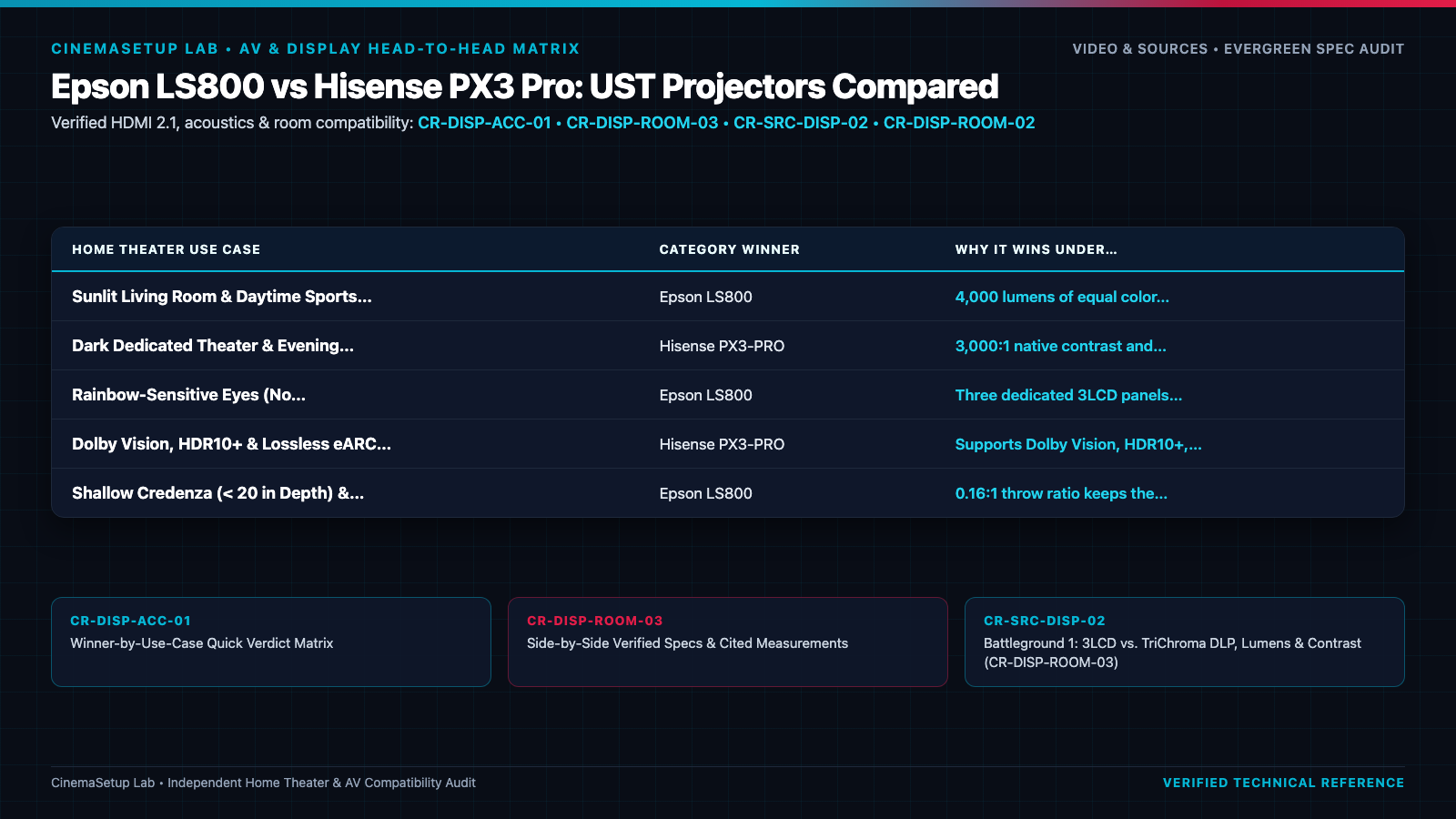
Rather than crowning one universal winner across every home theater layout, each projector dominates specific room lighting, furniture depth, and signal-routing conditions:
| Home Theater Use Case | Category Winner | Why It Wins Under Audited Rules |
|---|---|---|
| Sunlit Living Room & Daytime Sports (UC-SPORTS-BRIGHT-ROOM) | Epson LS800 | 4,000 lumens of equal color and white brightness (ISO 21118 / IDMS) resist ambient glare better than 3,000 ANSI lumen rivals when paired with a UST ALR screen (CR-DISP-ROOM-03). |
| Dark Dedicated Theater & Evening Cinema (UC-DEDICATED-THEATER) | Hisense PX3-PRO | 3,000:1 native contrast and TriChroma 110% BT.2020 color gamut deliver noticeably deeper shadow blacks than the LS800’s lighter native black floor. |
| Rainbow-Sensitive Eyes (No Color-Wheel Fringing) | Epson LS800 | Three dedicated 3LCD panels illuminate red, green, and blue simultaneously—eliminating single-chip DLP rainbow artifacts and triple-laser speckle completely. |
| Dolby Vision, HDR10+ & Lossless eARC Audio | Hisense PX3-PRO | Supports Dolby Vision, HDR10+, IMAX Enhanced, and dedicated HDMI eARC for lossless Dolby TrueHD Atmos return, whereas the LS800 stops at HDR10/HLG and standard ARC (CR-DISP-AVR-01). |
| Shallow Credenza (< 20 in Depth) & 120-In Screen | Epson LS800 | 0.16:1 throw ratio keeps the rear of the chassis 3.9 in (9.8 cm) from the wall at 100 in and ~6.8 in (17.3 cm) at 120 in, saving 5 to 8 in (13 to 20 cm) of console space (CR-DISP-ROOM-02). |
| Console Gaming (1080p High Refresh & ALLM) | Hisense PX3-PRO (Slight Edge) | Both cap 4K at 60 Hz (CR-SRC-DISP-02), but the PX3-PRO adds Designed for Xbox ALLM, eARC, and 1080p/240Hz HSR (~5–9.4 ms cited) versus the LS800’s 1080p/120Hz (~16.7 ms cited). |
Side-by-Side Verified Specs & Cited Measurements (US Models)
In US retail listings, the Hisense PX3-PRO sits in the $2,500–$3,500 bracket (upper TIER-DISP-PROJ-MID / lower TIER-DISP-PROJ-HIGH), while the Epson LS800 spans $3,000–$3,800 (Launch MSRP: $3,499, projector only)—a modest ~10%–15% tier overlap where neither unit includes a screen. Every specification below reflects official North American documentation (confidence A), kept strictly separate from cited third-party measurements (confidence B, guardrails G-02 and G-03):
| Specification / Compatibility Check | Epson EpiqVision LS800 (US Model) | Hisense PX3-PRO (US Model) | Audited Rule |
|---|---|---|---|
| Optical Architecture | 3-Chip 3LCD (0.62-in poly-silicon TFT) • Laser Phosphor | Single 0.47-in DMD DLP • TriChroma RGB Triple Laser | 02e §g |
| 4K Resolution Method | 4K PRO-UHD (dual-axis pixel-shifting from 1080p panels) | 4K UHD (4-way XPR pixel-shifting from 0.47-in DMD) | Pixel-Shift (Not Native 4K) |
| Rated Light-Source Life | Up to 20,000 hours | 25,000+ hours | Maker Spec (A) |
| Standardized Brightness | 4,000 lumens Color (IDMS) & 4,000 lumens White (ISO 21118) | 3,000 ANSI lumens | CR-DISP-ROOM-03 |
| Contrast & Color Gamut | >2,500,000:1 dynamic contrast (no native contrast published) | 3,000:1 native contrast (2,000,000:1 dynamic) • 110% BT.2020 | Maker Spec (A) |
| Throw Ratio & Image Size | 0.16:1 wide (0.16–0.40 digital zoom) • 80–150 in (203–381 cm) | 0.22:1 fixed • 80–150 in (203–381 cm) | CR-DISP-ROOM-02 |
| Optical Lens Shift | None (adjustable feet + digital multipoint geometry) | None (motorized focus + 8-point digital geometry) | CR-DISP-ROOM-05 |
| HDMI Ports & Audio Return | 3x HDMI 2.0 (18 Gbps, HDCP 2.3) • Port 2 Standard ARC only | 2x HDMI 2.1 + 1x HDMI 2.0 (Dedicated Lossless eARC) | CR-DISP-AVR-01 |
| 4K120 & Gaming Refresh | 4K/60 Hz cap • 1080p/120 Hz (HDMI 3 Game) • No VRR | 4K/60 Hz cap • 1080p/240 Hz HSR • ALLM (Designed for Xbox) | CR-SRC-DISP-02 |
| Dynamic HDR Support | HDR10, HLG (no Dolby Vision, no HDR10+) | Dolby Vision, HDR10+, HDR10, HLG, IMAX Enhanced | CR-SRC-DISP-01 |
| Built-In Speaker Array | 2.1-ch Yamaha virtual surround (20 W total: 2x 5 W + 10 W) | 50 W Harman Kardon front-firing speakers (Dolby Atmos DSP) | CR-SYS-05 |
| Smart Platform & Networking | Android TV (no native Netflix) • Wi-Fi 5 (no Ethernet jack) | Google TV (native certified Netflix) • Wi-Fi + Ethernet | ISS / G-15 |
| Rated Acoustic Fan Noise | 32 dB(A) Normal / 19 dB(A) Eco | 32 dB(A) rated | Maker Spec (A) |
| Dimensions (W x D x H) & Weight | 27.4 x 13.4 x 6.2 in (69.6 x 34.0 x 15.7 cm) • 27.6 lb (12.5 kg) | 21.7 x 11.7 x 4.8 in (55.0 x 29.6 x 12.2 cm) • 19.8 lb (9.0 kg) | CR-DISP-ROOM-02 |
| US Limited Warranty | 2-year Epson US Limited w/ Home Service (authorized dealer) | 2-year Hisense US Limited Warranty (authorized dealer) | G-26 |
Cited Third-Party Measurements (Separated from Manufacturer Claims — G-02, G-03)
Independent published evaluations (including RTINGS and specialty home theater reviewers) underscore how sharply these two engines diverge once calibrated picture modes and low-latency game modes are active:
- Dark-Room Contrast & Black Floor: Published third-party evaluations confirm that the Hisense PX3-PRO maintains ~3,000:1 to 3,300:1 native contrast with deep dark-room blacks, whereas the Epson LS800 exhibits a markedly higher native black floor in dark rooms—rendering letterbox bars and midnight scenes closer to dark charcoal-gray despite its dynamic laser dimming.
- Input Lag Under Low-Latency Modes: Cited third-party measurements place the Epson LS800 around ~16.7 ms at 4K/60 Hz (and under 20 ms at 1080p/120 Hz on HDMI 3), while the Hisense PX3-PRO measures ~18 ms at 4K/60 Hz and drops to ~5 to 9.4 ms in 1080p/240 Hz High Refresh Rate mode.
Battleground 1: 3LCD vs. TriChroma DLP, Lumens & Contrast (CR-DISP-ROOM-03)
Under rule CR-DISP-ROOM-03 and guardrail G-16, comparing projector brightness is only meaningful when both figures rest on standardized lumen methods rather than inflated “LED lumens.” Epson measures the LS800 at 4,000 lumens using both ISO 21118 (white brightness) and IDMS (color brightness), whereas Hisense rates the PX3-PRO at 3,000 ANSI lumens. Both are legitimate standardized metrics, and the LS800’s 33% headroom on paper translates visibly in rooms with open window shades or recessed kitchen lighting.
Even more important is how each projector generates color and 4K sharpness:
- Epson LS800 (3-Chip 3LCD, 4K PRO-UHD): Inside the LS800, a blue laser diode excites a yellow phosphor wheel, and dichroic mirrors split the beam into red, green, and blue paths illuminated simultaneously across three separate 0.62-inch LCD panels. Because all three primary colors hit the screen at the exact same instant, viewers never see DLP “rainbow” flashes during fast eye movement or bright white subtitles on black backgrounds, nor do they see laser speckle. As we detail in our standalone Epson LS800 review, that comfort advantage makes 3LCD mandatory for rainbow-sensitive households.
- Hisense PX3-PRO (Single-Chip 0.47-in DLP + TriChroma RGB Laser): Instead of phosphor conversion, the PX3-PRO fires pure red, green, and blue lasers sequentially at high speed onto a single 0.47-inch Texas Instruments DLP micromirror chip. That architecture unlocks an expansive 110% BT.2020 color gamut—giving animated films, neon sci-fi highlights, and saturated foliage richer saturation than phosphor-based 3LCD—alongside a 3,000:1 native contrast ratio that anchors dark scenes. The trade-off is that viewers sensitive to sequential color modulation can occasionally spot subtle red-green-blue fringes, and pure narrow-band RGB lasers can exhibit faint shimmer (speckle) on certain screen materials.
Pixel-Shift 4K Honesty (02e §g): Neither projector uses a native 3840 × 2160 imaging chip. The Epson LS800 shifts native 1080p LCD panels across two diagonal axes (4K PRO-UHD), while the Hisense PX3-PRO flashes a 1920 × 1080 micromirror array across four positions per frame (XPR 4K UHD). Both render crisp 4K streaming and UHD Blu-ray detail from 10 to 13 ft (3.0 to 4.0 m) seating distances, though ultra-fine desktop PC text looks slightly softer than on a true native 4K long-throw LCoS or SXRD theater projector—and the Hisense’s 4-way XPR pixel grid tends to resolve slightly sharper pixel boundaries up close than Epson’s 2-axis shift.
Battleground 2: 0.16:1 vs. 0.22:1 Throw Geometry & UST ALR Screens (CR-DISP-ACC-01)
Ultra-short-throw projectors live or die by living-room furniture fit (rule CR-DISP-ROOM-02). Because neither the LS800 nor the PX3-PRO offers optical lens shift (rule CR-DISP-ROOM-05), every inch of image diagonal dictates exactly how far forward from the wall the chassis must sit—and how high the screen sits above your credenza.
| 16:9 Screen Size (Width x Height) | Epson LS800 (0.16:1 Throw) Placement | Hisense PX3-PRO (0.22:1 Throw) Placement | Viewing Distance Band (30°–40°, CR-DISP-ROOM-01) |
|---|---|---|---|
| 100 in (87.2 x 49.0 in / 221 x 125 cm) | Rear gap: 3.9 in (9.8 cm) • Front edge: 17.3 in (43.9 cm) from wall | Lens-to-screen: ~19 in (48 cm) • Front edge: ~23–25 in (58–64 cm) from wall | 10.0–13.6 ft (3.0–4.1 m) |
| 120 in (104.6 x 58.8 in / 266 x 149 cm) | Rear gap: ~6.8 in (17.3 cm) • Front edge: ~20.2 in (51.3 cm) from wall | Lens-to-screen: ~28 in (71 cm) • Front edge: ~32 in (81 cm) from wall | 12.0–16.3 ft (3.7–5.0 m) |
Look closely at those front-edge numbers. Standard living-room media consoles measure 16 to 20 in (40.6 to 50.8 cm) deep. On a 100-inch screen, the Epson LS800 sits with its back edge just 3.9 in (9.8 cm) from the wall, keeping its front edge 17.3 in (43.9 cm) out—often fitting flush on an existing credenza without pulling furniture into the room. On a 120-inch screen, the Hisense PX3-PRO’s 0.22:1 lens requires roughly 28 in (71 cm) from lens to wall, forcing you either to pull a standard media cabinet noticeably forward or install a dedicated motorized floor-retractable UST slider drawer. On the flip side, the PX3-PRO’s smaller 21.7 × 11.7 × 4.8 in (55.0 × 29.6 × 12.2 cm), 19.8 lb (9.0 kg) footprint looks far less imposing than the Epson’s 27.4 in (69.6 cm) wide, 27.6 lb (12.5 kg) body.
Avoid Digital Keystone & Match Your Screen (CR-DISP-ROOM-05 & CR-DISP-ACC-01): Both projectors ship as hardware-only consoles without screens. Never project either UST beam onto a standard long-throw angular-reflective ALR screen—those screens reject steep light arriving from below, creating severe bright hotspots and dark upper corners. Pair both strictly with a tensioned, sawtooth lenticular UST ALR / CLR (ceiling-light-rejecting) screen (such as 0.6-gain lenticular models). Finally, level the chassis physically with its adjustable feet rather than engaging digital keystone or 8-point geometry correction, which electronically resamples the 4K image grid and softens fine detail.
Battleground 3: Dolby Vision, HDMI eARC & 4K60 Gaming Limits (CR-SRC-DISP-02)
Here the generational gap between Epson’s 2022-era HDMI board and Hisense’s modern media-hub architecture becomes unmistakable across three critical compatibility rules:
- HDR Dynamic Metadata (CR-SRC-DISP-01): The Hisense PX3-PRO supports the full dynamic HDR sweep—Dolby Vision, HDR10+, baseline HDR10, HLG, and IMAX Enhanced—adjusting tone mapping scene by scene to preserve highlight detail within a projector’s luminance envelope. The Epson LS800 omits both Dolby Vision and HDR10+, automatically falling back to static HDR10 with manual scene-adaptive gamma sliders.
- HDMI eARC vs. Standard ARC Audio Return (CR-DISP-AVR-01): The Hisense PX3-PRO provides two HDMI 2.1 inputs plus one dedicated HDMI 2.0 eARC port, enabling lossless Dolby TrueHD Atmos, DTS:X, and uncompressed multichannel PCM passthrough from projector-connected consoles or players back to a modern AV receiver or soundbar. By contrast, the Epson LS800 equips three 18 Gbps HDMI 2.0 ports where Port 2 supports standard ARC only—meaning lossless Dolby TrueHD Atmos and DTS:X drop to compressed Dolby Digital Plus or core 5.1 if you plug players into the projector. To bypass that limit on the LS800, route your 4K Blu-ray player, Apple TV 4K, and consoles directly into an AVR such as the Denon AVR-X3900H or the HDMI inputs on a US Samsung HW-Q990H soundbar first, sending only video up to the Epson.
- 4K60 Cap & Console High Refresh (CR-SRC-DISP-02): Despite Hisense equipping two HDMI 2.1 inputs and “Designed for Xbox” certification, neither UST projector displays native 4K at 120 Hz. Both cap 4K HDR signals at 60 Hz and step down to 1080p for high-refresh gaming: up to 1080p/120 Hz on Epson’s HDMI 3 Game port (no VRR) versus up to 1080p/240 Hz High Refresh Rate with ALLM on the Hisense PX3-PRO. For true 4K/120Hz VRR console play across all ports, flat-panel OLEDs like the LG C6 or Samsung S90H remain unmatched, though both USTs deliver snappy sub-20 ms response at 4K/60Hz. Use Ultra High Speed HDMI Certified (48 Gbps) cables for 1080p/240Hz or eARC links, switching to directional active optical fiber HDMI cables for concealed runs longer than 10 ft (3 m) (rule CR-ACC-DISP-01).
Battleground 4: Built-In Audio, Smart OS, Mounting Safety & US Warranty
Integrated Soundbars vs. Real Surround (CR-SYS-05): Both projectors embed surprisingly capable front-firing speaker bars for casual news, sports, and bedroom streaming—a 20 W 2.1-channel Yamaha system (two 5 W full-range drivers plus a 10 W woofer) on the LS800, and a punchier 50 W Harman Kardon array with Dolby Atmos processing on the PX3-PRO. Under rule CR-SYS-05, however, virtualized Dolby Atmos or Yamaha DSP inside a single tabletop chassis is never equivalent to physical height and rear surround speakers. Cinematic rooms should still pair either projector with an external AVR speaker system or full-kit soundbar.
Smart Platform & Netflix (ISS-DISP-LS800-NO-NATIVE-NETFLIX): Out of the box, the Hisense PX3-PRO runs Google TV with built-in Wi-Fi, wired Ethernet, and a native certified Netflix app. The Epson LS800 runs an older Android TV interface over Wi-Fi 5 (no Ethernet jack) and omits native certified Netflix—making a $50–$150 external streamer (Apple TV 4K, Google TV Streamer, or Roku Ultra) effectively mandatory for LS800 households.
Installation Safety & US Warranty Caveats (G-26 & G-27): Follow every manufacturer-printed clearance and mounting instruction strictly. Fixed-frame 100-to-150-inch UST ALR screens must be anchored into structural wood studs or manufacturer-rated masonry hardware—never hollow drywall alone. Conceal HDMI or speaker wiring inside wall cavities only with UL-listed CL2 or CL3 rated cabling, never route a standard AC power cord inside a wall, consult a licensed electrician or professional AV installer for recessed outlets, avoid looking into the upward-firing laser lens, and keep playback at comfortable listening levels. Finally, under CR-SYS-02 and G-26, buy new US 120 V retail stock strictly from Epson, Hisense, or an authorized US dealer (such as Ships from and Sold by Amazon.com): third-party Amazon Renewed LS800 listings (such as ASIN B0CQ47DYH8) and grey-market imports forfeit full 2-year factory warranty coverage.
Choose Epson LS800 vs. Choose Hisense PX3-PRO
Choose Epson EpiqVision LS800 if…
- Your screen sits in a sunlit or partially lit living room where 4,000 lumens of equal color and white brightness hold daytime punch.
- Anyone in your household notices single-chip DLP rainbow flashes or laser speckle—3-chip 3LCD eliminates both completely.
- You need a steep 0.16:1 throw ratio to fit a 100-to-120-inch image onto a standard 17-to-20-inch deep media credenza without pulling furniture forward.
Choose Hisense PX3-PRO if…
- You watch movies primarily at night or in a light-controlled room where 3,000:1 native contrast and 110% BT.2020 color depth dominate.
- You want Dolby Vision, HDR10+, IMAX Enhanced, and Google TV with native certified Netflix built directly into the projector.
- You rely on HDMI eARC for lossless Dolby TrueHD Atmos to an AVR or soundbar, or want 1080p/240Hz low-lag gaming modes.
Verified Amazon US Contenders & Epson 3LCD Sibling Alternative
Commission Independence Note (G-25): Projector hardware and screens carry standard Amazon AV/electronics referral rates rather than the lower 2% Television category rate, and referral rates never alter our compatibility rulings or category picks. All listings below correspond to verified US 120 V retail ASINs (screens sold separately).
1. Epson EpiqVision LS800 4K PRO-UHD Ultra Short Throw Laser Projector — Best for Bright Living Rooms & 0.16:1 Throw

Quick Specs: 3-Chip 3LCD (4K PRO-UHD pixel-shift) | 4,000 lumens Color & White (ISO 21118 / IDMS) | 0.16:1 throw (80–150 in) | 3x HDMI 2.0 (Port 2 ARC only; Port 3 1080p/120Hz Game) | HDR10, HLG | 20 W 2.1-ch Yamaha audio | 27.4 x 13.4 x 6.2 in (69.6 x 34.0 x 15.7 cm), 27.6 lb (12.5 kg) | Price Tier: $3,000–$3,800 (Launch MSRP: $3,499, projector only)
Pros
- 4,000 lumens of equal color and white brightness cut through daytime ambient light on a UST ALR screen
- 3-chip 3LCD engine guarantees zero DLP rainbow flashes and zero triple-laser speckle
- 0.16:1 throw ratio keeps 100-to-120-inch setups on standard 17-to-20-inch deep credenzas
Cons
- 18 Gbps HDMI 2.0 inputs lack eARC (ARC only), VRR, and 4K/120Hz, and omit Dolby Vision and HDR10+
- Lighter native dark-room black floor than DLP rivals; Android TV omits native Netflix and Ethernet
2. Hisense PX3-PRO Ultra Short Throw Triple Laser Projector — Best for Dark-Room Contrast, Dolby Vision & eARC

Quick Specs: 0.47-in DMD DLP (pixel-shift 4K UHD, TriChroma RGB Laser) | 3,000 ANSI lumens | 3,000:1 native contrast | 110% BT.2020 | 0.22:1 throw (80–150 in) | 2x HDMI 2.1 + 1x HDMI 2.0 (eARC) | Dolby Vision, HDR10+, IMAX Enhanced | Google TV w/ Netflix | 50 W Harman Kardon Atmos audio | 21.7 x 11.7 x 4.8 in (55.0 x 29.6 x 12.2 cm), 19.8 lb (9.0 kg) | Price Tier: $2,500–$3,500 (projector only)
Pros
- 3,000:1 native contrast and 110% BT.2020 color volume deliver deeper shadow detail for dark-room movies
- Supports Dolby Vision, HDR10+, lossless HDMI eARC, and Google TV with native certified Netflix
- Designed for Xbox ALLM with ultra-low ~5–9.4 ms cited lag in 1080p/240Hz HSR gaming mode
Cons
- 0.22:1 throw ratio requires deeper furniture clearance (~28 in lens-to-wall at 120 in) than 0.16:1 USTs
- Single-chip DLP XPR can trigger rainbow artifacts for sensitive eyes, and 4K signals still cap at 60 Hz
3. Epson Lifestudio Grand Ultra Short Throw 4K PRO-UHD Laser Projector — Modern 3LCD eARC & 4K120 Sibling Alternative

Quick Specs: 3-Chip 3LCD (4K PRO-UHD pixel-shift) | 3,600 ISO lumens Color & White | 0.25–0.62:1 throw (60–120 in) | 3x HDMI (HDMI eARC & 4K/120Hz ALLM input) | HDR10, HLG | Google TV | Sound by Bose 2.1 audio | Price Tier: $2,000–$3,000 (projector only)
Pros
- Combines zero-rainbow 3-chip 3LCD optics with HDMI eARC, 4K/120Hz ALLM, and Google TV
- Compact tabletop footprint with Sound by Bose 2.1 audio at a lower $2,000–$3,000 tier
Cons
- Longer 0.25:1 minimum throw requires noticeably more credenza depth than the LS800’s 0.16:1 lens
- Maximum 120-inch screen ceiling and 3,600 ISO lumens trail the LS800 for 135-to-150-inch bright rooms
Authoritative Technical Sources
- Epson America Official Home Entertainment Projectors — LS800 4,000 ISO/IDMS lumens, 0.16:1 throw chart, 3-chip 3LCD specifications, HDMI 2.0 ARC layout, and 2-year US Home Service warranty terms.
- Hisense USA Official TriChroma Laser Cinema Specifications — PX3-PRO 3,000 ANSI lumens, 3,000:1 native contrast, 0.22:1 throw, Dolby Vision, HDR10+, HDMI eARC, and Harman Kardon audio specifications.
- HDMI Licensing Administrator HDMI 2.1 Specification — eARC lossless audio transport, ALLM, 48 Gbps bandwidth, and Ultra High Speed HDMI cable certification requirements.
- Dolby Laboratories Official Formats — Dolby Vision dynamic metadata tone mapping and lossless Dolby TrueHD Atmos transmission requirements over HDMI eARC.
How We Audited This Guide
- Displays and sources were audited across OLED vs. Mini-LED HDR formats (Dolby Vision, HDR10+), 4K/120Hz VRR console support, verified ANSI/ISO projector lumens, throw distance ratios, and lossless optical disc vs. streaming audio codecs.
- Every AV receiver, speaker, subwoofer, soundbar, OLED/Mini-LED TV, projector, source player, and accessory spec was cross-checked against official manufacturer manuals, CEA/CTA standards, and live Amazon US listings.
- Recommendations were evaluated against our weighted vertical scoring rubrics and documented CR-* compatibility rules; we never invent nits, contrast ratios, bench wattage, or room decibels.
Continue Your Audit
- Best TVs for PS5 & Xbox Series X 2026: 4K120 Ports Audited
- Best TVs for Bright Rooms 2026: Mini-LED Picks Audited
Frequently Asked Questions: Epson LS800 vs. Hisense PX3-PRO
Which projector is brighter in a sunlit living room, the Epson LS800 or Hisense PX3-PRO?
The Epson LS800 is brighter for daytime rooms, rating 4,000 lumens of equal color and white output (ISO 21118 / IDMS) versus 3,000 ANSI lumens on the Hisense PX3-PRO. Paired with a sawtooth lenticular UST ALR screen, the LS800 holds sports and TV punch noticeably better under ambient light.
Does the Hisense PX3-PRO have better black levels and contrast than the Epson LS800?
Yes, the Hisense PX3-PRO wins decisively in dark-room contrast, delivering a 3,000:1 native contrast ratio alongside 110% BT.2020 color coverage. Published third-party evaluations confirm that the Epson LS800 displays a visibly lighter dark-gray black floor in pitch-black home theater rooms.
Can either the Epson LS800 or Hisense PX3-PRO run consoles at 4K/120Hz?
No—both projectors cap 4K signals at 60 Hz and require stepping down to 1080p for high-refresh console or PC gaming. The Epson LS800 supports 1080p/120Hz on its dedicated HDMI 3 Game port, while the Hisense PX3-PRO reaches 1080p/240Hz High Refresh Rate with ALLM.
How do I get lossless Dolby Atmos from the Epson LS800 without HDMI eARC?
Route your sources through an AV receiver or soundbar first rather than plugging players into the Epson LS800. Because the LS800’s HDMI Port 2 supports standard ARC only, connecting your 4K Blu-ray player or console to a Denon AVR-X3900H or Samsung HW-Q990H preserves lossless Dolby TrueHD Atmos.
Which projector fits a shallow media console better for a 100-to-120-inch screen?
The Epson LS800 fits shallow credenzas far more easily thanks to its steep 0.16:1 throw ratio, needing just 3.9 in (9.8 cm) rear wall clearance for a 100-inch image. The Hisense PX3-PRO’s 0.22:1 lens pushes the chassis roughly 5 to 8 in (13 to 20 cm) farther forward.
Do either the Epson LS800 or Hisense PX3-PRO include a projector screen in the box?
No, both ship as projector-only retail units in the United States. For living-room or mixed-light viewing, budget separately for a sawtooth lenticular UST ALR / CLR screen, and avoid standard long-throw ALR screens that reject upward ultra-short-throw light and cause severe hotspots.


