
Disclosure: As an Amazon Associate, I earn from qualifying purchases. If you buy through links on this page, we may earn a small commission at no extra cost to you. Commission differences across product categories (such as 2% on televisions versus 4% on projectors, screens, and AV accessories) never influence our technical audits, scores, or rankings.
Choosing the best ultra short throw projector for a living room or media room means solving three engineering traps before you check out: inflated non-standardized lumen claims, mismatched projection screens that wash out contrast under ceiling lights, and shallow media consoles that force image-softening digital keystone. Unlike ceiling-mounted long-throw units covered in our best home theater projectors guide, an ultra short throw (UST) laser projector sits inches from the wall to beam a 100-inch to 200-inch picture upward onto a dedicated screen—offering a massive alternative to flat-panel sets in our best TVs for home theater hub.
To separate true US 120V AC home cinema performers from generic marketplace clutter, we audited ten active retail UST models on Amazon US from Hisense, Epson, AWOL Vision, JMGO, XGIMI, and Optoma—spanning portable 1080p apartment units under $1,000 to iris-equipped flagship RGB triple-laser cinemas over $3,500. Every unit below is evaluated on standardized ISO/ANSI brightness, native contrast, throw ratio, UST CLR/ALR screen pairing, HDR formats, and HDMI eARC audio return.
In This Guide
- Quick Picks: Top 3 Best Ultra Short Throw Projector Winners
- Best Ultra Short Throw Projector Comparison Matrix (1–10)
- Match Your Room Light, Credenza & Screen Size
- Detailed Laser UST Projector Audits (1–10): 1. Hisense PX3-PRO · 2. Epson EpiqVision LS800 · 3. Hisense PX4 Pro · 4. AWOL Vision Aetherion Max · 5. JMGO O2S Ultra · 6. Epson Lifestudio Grand · 7. Hisense PT1 · 8. AWOL Vision LTV-3000 Pro · 9. XGIMI MIRA Pro · 10. Optoma ML1080UST Photon GO
- Best Ultra Short Throw Projector Buying Guide: CLR Screens, Throw Math & Safety
- 100% Weighted Scoring Rubric & Excluded Models
- Frequently Asked Questions
- Final Verdict
Quick Picks: Top 3 Best Ultra Short Throw Projector Winners
#1 Best Overall Laser UST
Hisense PX3-PRO
3,000 ANSI lumens, 3,000:1 native contrast, Dolby Vision, HDR10+, HDMI 2.1 eARC, and 50W Harman Kardon audio deliver the most balanced 80-to-150-inch living-room package. Jump to audit ↓
#2 Best Bright-Room 3LCD UST
Epson EpiqVision LS800
4,000 lumens of equal color and white brightness, zero DLP rainbow artifacts, and a 0.16:1 throw ratio handle sunlit living rooms and narrow consoles. Jump to audit ↓
#3 Best Flagship Contrast & 200-In Cinema
Hisense PX4 Pro
Adjustable 7-step iris pushes contrast to 6,500:1 alongside 3,500 ANSI lumens, 4K/120Hz FreeSync Premium, 0.20:1 throw up to 200 in, and 4.0.2 Devialet sound. Jump to audit ↓
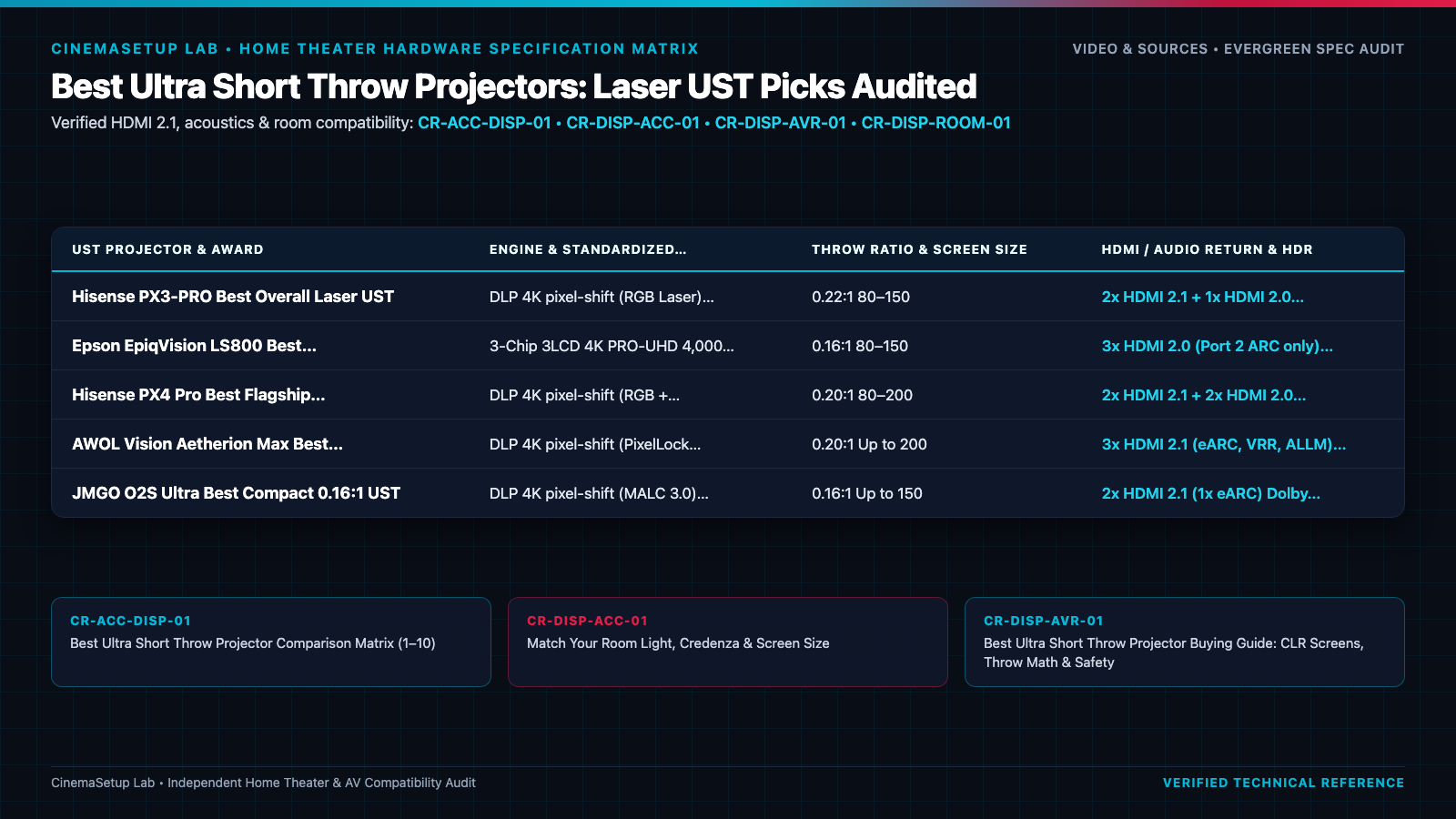
Best Ultra Short Throw Projector Comparison Matrix (1–10)
Every brightness specification below states the exact measurement standard (ISO 21118 or ANSI lumens) so marketing-inflated “LED lumens” never distort comparisons (rule CR-DISP-ROOM-03). Keep in mind that all ten models ship as projector-only hardware—you must pair a fixed-frame or floor-rising UST CLR/ALR screen separately (rule CR-DISP-ACC-01).
| UST Projector & Award | Engine & Standardized Lumens | Throw Ratio & Screen Size | HDMI / Audio Return & HDR | Link |
|---|---|---|---|---|
| Hisense PX3-PRO Best Overall Laser UST | DLP 4K pixel-shift (RGB Laser) 3,000 ANSI Lumens | 3,000:1 native | 0.22:1 80–150 in | 2x HDMI 2.1 + 1x HDMI 2.0 (eARC) Dolby Vision, HDR10+, HLG | View on Amazon |
| Epson EpiqVision LS800 Best Bright-Room 3LCD UST | 3-Chip 3LCD 4K PRO-UHD 4,000 Lumens (Color & White) | 0.16:1 80–150 in | 3x HDMI 2.0 (Port 2 ARC only) HDR10, HLG (no DV/HDR10+) | View on Amazon |
| Hisense PX4 Pro Best Flagship Contrast & 200-In | DLP 4K pixel-shift (RGB + Iris) 3,500 ANSI Lumens | 6,500:1 | 0.20:1 80–200 in | 2x HDMI 2.1 + 2x HDMI 2.0 (eARC) Dolby Vision, HDR10+, 4K/120Hz | View on Amazon |
| AWOL Vision Aetherion Max Best 200-In Gaming & 3D | DLP 4K pixel-shift (PixelLock RGB) 3,300 ISO Lumens | 6,000:1 native | 0.20:1 Up to 200 in | 3x HDMI 2.1 (eARC, VRR, ALLM) DV Gaming, HDR10+, Active 3D | View on Amazon |
| JMGO O2S Ultra Best Compact 0.16:1 UST | DLP 4K pixel-shift (MALC 3.0) 3,600 ISO Lumens | 4,000:1 FOFO | 0.16:1 Up to 150 in | 2x HDMI 2.1 (1x eARC) Dolby Vision, HDR10, HLG | View on Amazon |
| Epson Lifestudio Grand Best Bose-Tuned 3LCD Lifestyle | 3-Chip 3LCD 4K PRO-UHD 3,600 ISO Lumens (Color & White) | 0.25–0.62:1 60–120 in | 3x HDMI (eARC, 4K/120Hz ALLM) HDR10, HLG (Sound by Bose 2.1) | View on Amazon |
| Hisense PT1 Best Mid-Range TriChroma Value | DLP 4K pixel-shift (RGB Laser) 2,500 ANSI Lumens | 3,000:1 native | 0.20:1 80–150 in | 2x HDMI 2.1 + HDMI 2.0 (eARC) Dolby Vision, HDR10+, Active 3D | View on Amazon |
| AWOL Vision LTV-3000 Pro Best Active-3D & Quiet (<27 dB) | DLP 4K pixel-shift (RGB Laser) 2,400 ANSI (3,000 peak) | ~2,500:1 | 0.25:1 80–150 in | 3x HDMI 2.0b (HDMI 2 eARC) Dolby Vision, HDR10+, Active 3D | View on Amazon |
| XGIMI MIRA Pro Best 1080p/240Hz VRR & 0.175:1 | DLP 4K pixel-shift (Triple Laser) 3,000 ISO Lumens | 20,000:1 dyn. | 0.175:1 Up to 150 in | 3x HDMI (HDMI 2.1, eARC, VRR) Dolby Vision, HDR10, HLG | View on Amazon |
| Optoma ML1080UST Photon GO Best Portable 1080p UST | DLP Native 1080p (RGB Laser) 650 ISO Lumens (1,200 HK) | 0.18:1 Up to 100 in | 1x HDMI 2.0 (no eARC) + USB-C 4K HDR input downscaled | View on Amazon |
Match Your Room Light, Credenza & Screen Size
Before selecting a laser UST console, evaluate three physical constraints in your space: daytime window glare (rule CR-DISP-ROOM-03), media cabinet depth from the wall to its front edge (rule CR-DISP-ROOM-02), and whether your AVR or soundbar requires lossless HDMI eARC return (rule CR-DISP-AVR-01). Use the scenario matrix below to lock onto the right architecture.
| Living Room or Theater Scenario | Recommended Pick | Why & Expected Outcome |
|---|---|---|
| All-around evening cinema + Xbox / PS5 (80–150 in) | Hisense PX3-PRO | Combines 3,000 ANSI lumens, 3,000:1 native contrast, Dolby Vision, HDR10+, two HDMI 2.1 ports, eARC, and 50W Harman Kardon audio. |
| Bright sunlit living room & rainbow-sensitive viewers | Epson EpiqVision LS800 | 4,000 lumens of equal color/white output with 3-chip 3LCD optics resist washout on a UST ALR screen without DLP color fringing. |
| Dark dedicated theater scaling to 150–200 in | Hisense PX4 Pro | 7-step adjustable iris pushes contrast to 6,500:1 alongside 3,500 ANSI lumens, 4K/120Hz FreeSync Premium, and 4.0.2 Devialet sound. |
| Competitive console gaming & 3D up to 200 in | AWOL Vision Aetherion Max | Three HDMI 2.1 ports deliver VRR, ALLM, ~1 ms 1080p/240Hz response, Dolby Vision Gaming, 6,000:1 contrast, and Active 3D. |
| Shallow media credenza (< 15 in) needing high lumens | JMGO O2S Ultra | 0.16:1 throw ratio beams 100 in from 6.6 in (16.8 cm) away inside a 9.9 lb (4.5 kg) body delivering 3,600 ISO lumens and eARC. |
| Portable apartment / bedroom setup under $1,000 | Optoma ML1080UST Photon GO | Projects up to 100 in from under 9.8 in (25 cm) on battery or USB-C PD in dark rooms without drilling or heavy furniture. |
Detailed Laser UST Projector Audits (1–10)
1. Hisense PX3-PRO Ultra Short Throw Triple Laser Projector — Best Overall Ultra Short Throw Projector

Key Specs: 0.47-in DMD DLP (pixel-shift 4K UHD) | TriChroma RGB Triple Laser (25,000+ hr rated life) | 3,000 ANSI Lumens | 3,000:1 native contrast (2,000,000:1 dynamic) | 110% BT.2020 color gamut | 0.22:1 throw ratio (80–150 in diagonal) | 2x HDMI 2.1 + 1x HDMI 2.0 (eARC) | Dolby Vision, HDR10+, HDR10, HLG | ALLM, Designed for Xbox, 1080p/240Hz HSR (<30 ms cited lag) | 50W Harman Kardon Dolby Atmos audio | Google TV | 21.7 x 11.7 x 4.8 in (550 x 296 x 120 mm), 19.8 lb (9.0 kg) | Price Tier: $2,500-$3,500 | Box Contents: Projector unit, voice remote, power cord (UST ALR screen sold separately)
Audit Score: 9.4 / 10
- Picture Performance (35%): 9.4 / 10
- Gaming & Connectivity (20%): 9.1 / 10
- HDR & Format Support (15%): 9.8 / 10
- Room Fit & Throw (15%): 9.2 / 10
- Life, Noise, OS & Warranty (10%): 9.2 / 10
- Value Within Tier (5%): 9.4 / 10
Balancing high-contrast evening cinema with broad HDR format support makes the Hisense PX3-PRO our top overall recommendation. According to Hisense USA specifications, its TriChroma RGB triple-laser light engine hits 3,000 ANSI lumens and 110% BT.2020 color coverage alongside a 3,000:1 native contrast ratio—a substantial dark-room upgrade over older 1,500:1 DLP laser consoles. Complete dynamic-metadata support for both Dolby Vision and HDR10+ ensures streaming movies and 4K UHD discs tone-map cleanly without clipping bright highlights.
Connectivity is equally well resolved for modern living rooms: two HDMI 2.1 ports pair with a dedicated HDMI 2.0 eARC jack, passing uncompressed multichannel LPCM and lossless Dolby TrueHD Atmos back to a soundbar or AV receiver. As detailed in our Epson LS800 vs Hisense PX3-PRO comparison, the PX3-PRO easily wins on shadow depth, HDR tone mapping, and Google TV polish, whereas the LS800 holds an advantage in unshaded daytime rooms and shallow-depth consoles.
Buyer Alert: The PX3-PRO ships without a screen. Pair it strictly with a sawtooth lenticular UST CLR/ALR screen (rule CR-DISP-ACC-01), and verify at checkout that the Amazon seller is an authorized US Hisense dealer to retain full factory coverage.
Pros
- 3,000:1 native contrast preserves shadow detail better than older 1,500:1-2,000:1 DLP UST rivals
- Supports Dolby Vision, HDR10+, IMAX Enhanced, and Google TV with built-in Netflix
- Two HDMI 2.1 inputs plus dedicated HDMI eARC port handle consoles and lossless audio
- 50W front-firing Harman Kardon speaker array provides clear casual-viewing dialogue
Cons
- Single-chip DLP XPR pixel shifting can show faint rainbow flashes for sensitive eyes
- 4K signals cap at 60 Hz (240 Hz high-refresh mode steps down to 1080p)
- 0.22:1 throw ratio sits slightly further from the wall than 0.16:1 competitors
Upgrade Note: Connect your PS5, Xbox Series X, or 4K Blu-ray player using Ultra High Speed HDMI Certified (48 Gbps) cables—or route multi-source rigs through an AVR like the Denon AVR-X3900H. Buy it if you want the strongest mix of contrast, Dolby Vision, Google TV, and console-ready HDMI eARC under $3,500. Skip it if you notice single-chip DLP rainbow artifacts or need native 4K/120Hz display refresh.
2. Epson EpiqVision LS800 4K PRO-UHD Ultra Short Throw Laser Projector — Best Bright-Room & 3LCD No-Rainbow UST

Key Specs: 3-Chip 3LCD (4K PRO-UHD pixel-shift) | Laser Phosphor (20,000 hr rated life) | 4,000 Lumens Color & White Brightness | >2,500,000:1 dynamic contrast | Zero DLP rainbow effect | 0.16:1 throw ratio (0.16–0.40 digital zoom, 80–150 in) | 3x HDMI 2.0 (18 Gbps; Port 2 ARC only, Port 3 Game) | HDR10, HLG | 1080p/120Hz Game port (~16.7 ms cited lag) | 2.1-ch Yamaha speaker system | Android TV | 27.4 x 13.4 x 6.2 in (696 x 340 x 157 mm), 27.6 lb (12.5 kg) | Price Tier: $3,000-$3,800 | Box Contents: New US 120V AC projector, remote, power cord (screen sold separately)
Audit Score: 9.1 / 10
- Picture Performance (35%): 9.2 / 10
- Gaming & Connectivity (20%): 8.2 / 10
- HDR & Format Support (15%): 8.1 / 10
- Room Fit & Throw (15%): 9.8 / 10
- Life, Noise, OS & Warranty (10%): 9.4 / 10
- Value Within Tier (5%): 9.0 / 10
Daylight living rooms and rainbow-sensitive eyes quickly narrow the field to Epson US 3-chip 3LCD projection, and the EpiqVision LS800 remains the benchmark for sheer daytime punch and tight wall placement. Rather than spinning a color wheel or sequencing RGB lasers across a single DLP chip, three dedicated LCD panels emit 4,000 lumens of equal color and white brightness simultaneously—eradicating color-fringe rainbow artifacts and laser speckle completely.
Just as important for furniture fit, its 0.16:1 throw ratio projects a 100-inch or 120-inch frame while sitting noticeably closer to the drywall than 0.22:1 or 0.25:1 rivals, saving you from pulling your media credenza out into the walking path. In our dedicated Epson LS800 review, we also document its main trade-offs: Port 2 handles standard ARC rather than lossless eARC, and HDR support stops at HDR10 and HLG without Dolby Vision.
Buyer Alert: Do not confuse this brand-new US 120V AC listing (B0BCXTVXMC) with third-party Amazon Renewed units (B0CQ47DYH8), which lack guaranteed factory warranty coverage. Because Port 2 is ARC-only, plug 4K Blu-ray players directly into your AV receiver first for lossless Dolby TrueHD Atmos (rule CR-DISP-AVR-01).
Pros
- 4,000 lumens of equal color and white brightness resist washout in daytime living rooms
- 3-chip 3LCD engine guarantees zero DLP rainbow effect and zero triple-laser speckle
- 0.16:1 throw ratio places 120-inch installations comfortably onto standard 16-to-18-inch credenzas
- 19 dB Eco acoustic mode keeps fan noise hushed during quiet evening dialogue
Cons
- HDMI Port 2 supports standard ARC rather than eARC, dropping lossless TrueHD passthrough
- No Dolby Vision or HDR10+ dynamic metadata, and higher native black floor in pitch-dark rooms
- 18 Gbps HDMI 2.0 inputs limit 4K to 60 Hz (120 Hz requires 1080p on Port 3)
Upgrade Note: Pair the LS800 with a 0.6-gain UST ALR screen such as Epson SilverFlex Ultra to reject overhead ceiling glare and anchor shadow contrast. Buy it if daytime brightness, zero rainbow artifacts, and a shallow-console 0.16:1 throw matter most. Skip it if you watch movies primarily in pitch-black rooms or need Dolby Vision and eARC.
3. Hisense PX4 Pro Ultra Short Throw RGB Laser Cinema — Best Flagship Contrast & 200-Inch Cinema UST

Key Specs: 0.47-in DMD DLP (pixel-shift 4K UHD) | LPU 3.0 TriChroma RGB Laser w/ 7-step adjustable iris | 3,500 ANSI Lumens | 6,500:1 contrast | 118% BT.2020 color gamut | 0.20:1 throw ratio (80–200 in) | 4x HDMI total (2x HDMI 2.1 + 2x HDMI 2.0 w/ eARC) | Dolby Vision, HDR10+, IMAX Enhanced, HDR10, HLG | 4K/120Hz, 1080p/240Hz, FreeSync Premium, VRR, ALLM (~1 ms cited) | 4.0.2-ch Devialet Dolby Atmos audio | VIDAA OS | 21.3 x 11.3 x 5.6 in (540 x 288 x 142 mm), 18.3 lb (8.3 kg) | Price Tier: Over $3,500 | Box Contents: Projector unit, remote, power cord (screen sold separately)
Audit Score: 9.5 / 10
- Picture Performance (35%): 9.7 / 10
- Gaming & Connectivity (20%): 9.7 / 10
- HDR & Format Support (15%): 9.8 / 10
- Room Fit & Throw (15%): 9.4 / 10
- Life, Noise, OS & Warranty (10%): 8.9 / 10
- Value Within Tier (5%): 8.6 / 10
Traditional fixed-aperture UST optics struggle to balance daytime punch with dark-room black levels, which is precisely what the Hisense PX4 Pro solves. By pairing an LPU 3.0 TriChroma RGB triple-laser module (rated at 3,500 ANSI lumens and 118% BT.2020 gamut) with a precision 7-step adjustable optical iris and Eco Black Level processing, the PX4 Pro pushes contrast to 6,500:1—more than double the PX3-PRO’s 3,000:1 native rating.
Connectivity and audio scale up alongside the optics: four HDMI inputs (two HDMI 2.1, two HDMI 2.0 with eARC) handle true 4K/120Hz gaming with FreeSync Premium and VRR, while the chassis throws cleanly from 80 in all the way up to 200 in at a tighter 0.20:1 ratio. Its Devialet-tuned 4.0.2 speaker array also projects wider front-stage sound than basic dual-driver projector speakers, though dedicated theaters should still hand off lossless Atmos via eARC.
Buyer Alert: Because the PX4 Pro scales up to 200 in, verify your ceiling height and bottom-edge credenza clearance before ordering screens larger than 130 in (rule CR-DISP-ROOM-05), and note that it runs VIDAA OS rather than Google TV.
Pros
- Adjustable 7-step optical iris drives 6,500:1 contrast for darker cinema letterbox bars
- 3,500 ANSI lumens and 0.20:1 throw scale up to massive 150-to-200-inch screens
- Four HDMI ports with dual HDMI 2.1 inputs unlock 4K/120Hz, VRR, FreeSync Premium, and eARC
- 4.0.2 Devialet-tuned speaker system easily outperforms average built-in projector audio
Cons
- Flagship bracket over $3,500 places total system cost near $5,000 once a UST CLR screen is added
- VIDAA smart platform offers narrower US app breadth than Google TV or Apple TV 4K
- Single-chip DLP architecture may still trigger subtle rainbow fringes for sensitive viewers
Upgrade Note: Add an Apple TV 4K or Nvidia Shield TV Pro over an Ultra High Speed HDMI cable if you rely on niche North American streaming apps outside VIDAA. Buy it if you have the wall space and budget for flagship dark-room contrast, 4K/120Hz VRR, and giant 130-to-200-inch projection. Skip it if you want better value under $3,500—our #1 PX3-PRO covers 80-to-150-inch living rooms for less.
4. AWOL VISION Aetherion Max 4K Ultra Short Throw Projector — Best 200-Inch Gaming & 3D UST

Key Specs: DLP (pixel-shift 4K UHD) | RGB Triple Laser w/ PixelLock Anti-RBE | 3,300 ISO Lumens | 6,000:1 native contrast | 0.20:1 throw ratio (up to 200 in) | 3x HDMI 2.1 (incl. eARC) | Dolby Vision, Dolby Vision Gaming, HDR10+, Active 3D | VRR, ALLM, 1080p/240Hz (~1 ms cited response) | 22.1 x 12.7 x 5.5 in (562 x 323 x 139.5 mm), 19.3 lb (8.75 kg) | Price Tier: Over $3,500 | Box Contents: Projector unit, remote, power cord (screen & 3D glasses sold separately)
Audit Score: 9.3 / 10
- Picture Performance (35%): 9.4 / 10
- Gaming & Connectivity (20%): 9.6 / 10
- HDR & Format Support (15%): 9.7 / 10
- Room Fit & Throw (15%): 9.3 / 10
- Life, Noise, OS & Warranty (10%): 8.9 / 10
- Value Within Tier (5%): 8.5 / 10
Replacing AWOL Vision’s earlier 1,500:1 LTV platform, the AWOL Vision Aetherion Max transforms every weak spot of the older chassis into a flagship strength. Native contrast rises fourfold to 6,000:1, throw ratio tightens from 0.25:1 down to 0.20:1 (enabling screen sizes up to 200 in with far less wall standoff), and all three inputs upgrade to HDMI 2.1 with eARC, VRR, ALLM, and Dolby Vision Gaming.
Where AWOL Vision maintains a clear niche edge over the Hisense PX4 Pro is dual support for Active 3D playback alongside PixelLock anti-RBE processing engineered to suppress single-chip DLP rainbow artifacts. If you maintain a 3D Blu-ray library and want near-instant ~1 ms high-refresh console response without giving up deep dark-room blacks, the Aetherion Max matches the PX4 Pro punch-for-punch at the top of the UST tier.
Buyer Alert: Check the Amazon variant selector carefully—Aetherion Max (3,300 ISO lumens) and Aetherion Pro (2,600 ISO lumens) share a similar shell, so confirm the 3,300-lumen Max SKU if you have ambient window light.
Pros
- 6,000:1 native contrast delivers deep dark-room black floors up to 200 in
- Three full HDMI 2.1 ports support VRR, ALLM, eARC, and Dolby Vision Gaming
- PixelLock anti-RBE processing reduces DLP rainbow visibility while keeping Active 3D support
- 0.20:1 throw ratio installs much closer to the wall than 0.25:1 LTV predecessors
Cons
- Flagship bracket over $3,500 leaves UST ALR screen and 3D glasses as extra line items
- 3,300 ISO lumens trail the 4,000-lumen Epson LS800 in unshaded daytime rooms
Upgrade Note: Add DLP-Link Active 3D glasses and a 48 Gbps Ultra High Speed HDMI Certified cable between your AVR and HDMI eARC input. Buy it if you want 6,000:1 contrast, three HDMI 2.1 ports, VRR, and Active 3D up to 200 in. Skip it if you want stronger built-in Devialet 4.0.2 audio (choose the Hisense PX4 Pro) or a budget under $3,000.
5. JMGO O2S Ultra 4K Ultra Short Throw Triple Laser Projector — Best Compact 0.16:1 High-Lumen UST

Key Specs: DLP (4K UHD pixel-shift) | MALC 3.0 Triple Laser | 3,600 ISO Lumens | 4,000:1 FOFO native contrast (3,000,000:1 dynamic) | 0.16:1 throw ratio (100 in from ~6.6 in / 16.8 cm) | 2x HDMI 2.1 (1 port w/ eARC) | HDR10, HLG, Dolby Vision | Game mode (no verified ms lag figure published yet) | Dual 10W Dynaudio speakers (Dolby Atmos & DTS-HD) | Google TV | 12.3 x 11.4 x 5.5 in (312 x 290 x 140 mm), 9.9 lb (4.5 kg) | Price Tier: $2,000-$3,000 | Box Contents: Projector unit, remote, power adapter/cord (screen sold separately)
Audit Score: 9.0 / 10
- Picture Performance (35%): 9.2 / 10
- Gaming & Connectivity (20%): 8.4 / 10
- HDR & Format Support (15%): 9.0 / 10
- Room Fit & Throw (15%): 9.6 / 10
- Life, Noise, OS & Warranty (10%): 8.8 / 10
- Value Within Tier (5%): 9.1 / 10
Most high-output UST projectors span two feet wide and weigh nearly 30 lb (13.6 kg), forcing homeowners to buy oversized custom consoles. The JMGO O2S Ultra flips that ergonomic script: it packs a 3,600 ISO lumen MALC 3.0 triple-laser engine and 4,000:1 FOFO native contrast into a 12.3-inch wide, 9.9 lb (4.5 kg) chassis—less than half the weight of the Epson LS800 while matching its ultra-tight 0.16:1 throw ratio.
At 0.16:1, you can park the O2S Ultra roughly 6.6 in (16.8 cm) from the wall to project a 100-inch picture atop a narrow 14-inch bookshelf or credenza without cutting drywall or installing pull-out drawers. Google TV with native Netflix handles streaming directly, and dual HDMI 2.1 ports include eARC for external Atmos bars, though competitive gamers should note that JMGO has not published a verified millisecond input-lag figure yet.
Buyer Alert: Because the O2S Ultra carries only two HDMI 2.1 ports and eARC uses one of them, connect consoles and UHD Blu-ray players through an external AVR if you own more than one HDMI source.
Pros
- 0.16:1 throw ratio plus 11.4-inch depth fits shallow media consoles easily
- 3,600 ISO lumens and 4,000:1 FOFO contrast punch far above its 9.9 lb (4.5 kg) footprint
- Dual HDMI 2.1 ports with eARC, Google TV, and Dynaudio Dolby Atmos / DTS-HD tuning
Cons
- Two total HDMI inputs fill immediately once eARC connects to an AVR or soundbar
- No published millisecond input-lag specification for competitive esports play
- 20W onboard Dynaudio stereo lacks the room-filling punch of 50W UST soundbars
Upgrade Note: Budget for an HDMI eARC soundbar or compact 5.1.2 AVR system so audio scale matches the 100-to-120-inch image. Buy it if you need 3,600 ISO lumens and a 0.16:1 throw on a narrow credenza in the $2,000-$3,000 bracket. Skip it if you plug multiple consoles straight into the projector or demand published 1 ms latency specs.
6. Epson Lifestudio Grand Ultra Short Throw 4K PRO-UHD Laser Projector — Best Bose-Tuned 3LCD Lifestyle UST

Key Specs: 3-Chip 3LCD (4K PRO-UHD pixel-shift) | Laser Phosphor | 3,600 ISO Lumens Color & White Brightness | Zero DLP rainbow effect | 0.25–0.62:1 throw ratio (60–120 in diagonal) | 3x HDMI (incl. eARC & 4K/120Hz ALLM input) | HDR10, HLG | Sound by Bose 2.1-ch audio | Google TV | 18.4 x 15.7 x 6.2 in (467 x 400 x 153 mm), 16.6 lb (7.4 kg) | Price Tier: $2,000-$3,000 | Box Contents: Projector unit, remote, power cord (screen sold separately)
Audit Score: 8.9 / 10
- Picture Performance (35%): 8.9 / 10
- Gaming & Connectivity (20%): 9.1 / 10
- HDR & Format Support (15%): 8.2 / 10
- Room Fit & Throw (15%): 8.8 / 10
- Life, Noise, OS & Warranty (10%): 9.4 / 10
- Value Within Tier (5%): 9.0 / 10
Buyers who love Epson’s rainbow-free 3-chip 3LCD picture on the LS800—yet hesitate at its massive 27.4-inch chassis and missing eARC port—get a streamlined answer in the Epson Lifestudio Grand (LS670 platform). It shaves 9 in (22.9 cm) of width and 11 lb (5.0 kg) off the LS800, upgrades to Google TV with HDMI eARC and 4K/120Hz ALLM input support, and integrates a surprisingly full Sound by Bose 2.1-channel speaker chamber.
With 3,600 ISO lumens of matched color and white output, it easily handles moderate living-room light when paired with a 100-inch or 120-inch UST CLR screen. The trade-off compared with the LS800 and JMGO O2S Ultra is its 0.25:1 base throw ratio and 15.7-inch body depth, which sit further forward from the wall and cap recommended image sizing at 120 in rather than 150 in.
Buyer Alert: Measure your credenza depth before ordering: a 0.25:1 base throw paired with a 15.7-inch deep enclosure requires deeper media furniture than 0.16:1 units for a 120-inch screen (rule CR-DISP-ROOM-02).
Pros
- 3,600 ISO lumens of equal color and white brightness with zero DLP rainbow effect
- Adds HDMI eARC, 4K/120Hz ALLM support, and Google TV missing on the older LS800
- 2.1-channel Sound by Bose acoustic chamber sounds richer than typical onboard speakers
Cons
- 0.25:1 base throw and 15.7-inch depth demand deeper furniture than 0.16:1 UST rivals
- Caps recommended image size at 120 in and omits Dolby Vision and HDR10+
- 3LCD black floor remains lighter than iris-equipped triple-laser DLP flagships
Upgrade Note: Pair with a 100-inch or 120-inch UST ALR screen mounted at eye level so you never need digital keystone to square the frame. Buy it if you want rainbow-free 3LCD projection, Google TV, HDMI eARC, and Bose 2.1 sound in a friendlier $2,000-$3,000 tier. Skip it if you want a 150-inch wall, Dolby Vision, or a shallower 0.16:1 throw.
7. Hisense PT1 Ultra Short Throw Triple Laser Projector — Best Mid-Range TriChroma Value UST

Key Specs: 0.47-in DMD DLP (pixel-shift 4K UHD) | TriChroma RGB Triple Laser | 2,500 ANSI Lumens | 3,000:1 native contrast | 110% BT.2020 color gamut | 0.20:1 throw ratio (80–150 in diagonal) | 2x HDMI 2.1 + HDMI 2.0 (eARC) | Dolby Vision, HDR10+, IMAX Enhanced, Active 3D | 1080p/240Hz HSR, ALLM | Dolby Atmos onboard audio | Google TV | Price Tier: $1,500-$2,500 | Box Contents: Projector unit, remote, power cord (screen & 3D glasses sold separately)
Audit Score: 8.8 / 10
- Picture Performance (35%): 8.7 / 10
- Gaming & Connectivity (20%): 8.9 / 10
- HDR & Format Support (15%): 9.6 / 10
- Room Fit & Throw (15%): 9.0 / 10
- Life, Noise, OS & Warranty (10%): 8.7 / 10
- Value Within Tier (5%): 9.5 / 10
Stepping down into the $1,500-$2,500 mid-range bracket usually forces heavy compromises on color gamut or HDR tone mapping, yet the Hisense PT1 preserves nearly the entire TriChroma DNA of the PX3-PRO. You still get 110% BT.2020 RGB triple-laser color, a 3,000:1 native contrast ratio, Dolby Vision, HDR10+, IMAX Enhanced, Active 3D, Google TV, and dual HDMI 2.1 ports alongside eARC—plus an even tighter 0.20:1 throw ratio.
The primary concession for the lower tier is peak output: 2,500 ANSI lumens look crisp and vibrant in evening living rooms or dim basement dens at 100 to 120 in, whereas the 3,000-lumen PX3-PRO and 4,000-lumen Epson LS800 hold up noticeably better against daytime window glare. For dark-room shoppers watching total system budget alongside a $600-$1,500 UST CLR screen, the PT1 hits the sweet spot.
Buyer Alert: Keep screen diagonal at 100-120 in if your room has any ambient lamp light; stretching a 2,500-lumen UST to 150 in spreads available brightness across too much surface area (rule CR-DISP-ROOM-03).
Pros
- Brings 110% BT.2020 TriChroma color and 3,000:1 native contrast into the $1,500-$2,500 tier
- Tighter 0.20:1 throw ratio tucks closer to the wall than the 0.22:1 PX3-PRO
- Supports Dolby Vision, HDR10+, IMAX Enhanced, Active 3D, Google TV, and HDMI eARC
Cons
- 2,500 ANSI lumens require drawn shades for daytime viewing on 120-inch screens
- 4K signals cap at 60 Hz, reserving 240 Hz high-refresh mode for 1080p input
Upgrade Note: Pair with a 100-inch or 120-inch lenticular UST CLR screen and route audio over HDMI eARC to an external 5.1.2 system or wireless Atmos soundbar. Buy it if you watch movies primarily at night and want Dolby Vision, HDR10+, and TriChroma contrast under $2,500. Skip it if your living room stays sunlit all afternoon.
8. AWOL VISION LTV-3000 Pro 4K 3D Ultra Short Throw Triple Laser Projector — Best Active-3D & Quiet (<27 dB) UST

Key Specs: 0.47-in DMD DLP (pixel-shift 4K UHD) | Tri-Color Pure Laser (25,000+ hr life) | 2,400 ANSI Lumens (3,000 peak / ISO marketed) | ~2,000:1–2,500:1 contrast | <27 dB rated fan noise | 0.25:1 throw ratio (80–150 in diagonal) | 3x HDMI 2.0b (HDMI 2 w/ eARC) | Dolby Vision, HDR10+, Active 3D | ~15 ms (4K/60Hz) & ~8 ms (1080p/120Hz) cited lag | Built-in Dolby Atmos speakers | 23.6 x 13.9 x 5.7 in (599 x 353 x 145 mm), 26.5 lb (12.0 kg) | Price Tier: $2,000-$3,000 | Box Contents: Projector unit, remote, power cord (verify dongle inclusion; screen & 3D glasses sold separately)
Audit Score: 8.7 / 10
- Picture Performance (35%): 8.5 / 10
- Gaming & Connectivity (20%): 8.7 / 10
- HDR & Format Support (15%): 9.5 / 10
- Room Fit & Throw (15%): 8.2 / 10
- Life, Noise, OS & Warranty (10%): 9.1 / 10
- Value Within Tier (5%): 8.8 / 10
While the newer Aetherion Max takes over AWOL Vision’s flagship tier, the active AWOL Vision LTV-3000 Pro remains an appealing mid-tier choice for two specific buyer priorities: whisper-quiet fan acoustics under 27 dB and snappy ~15 ms 4K/60Hz (~8 ms 1080p/120Hz) gaming latency. Sitting just a few feet from a bright UST projector makes cooling fan hum noticeable during hushed drama scenes, and the LTV-3000 Pro stays audibly calmer than 32 dB rivals.
It also keeps full Active 3D Blu-ray support alongside Dolby Vision, HDR10+, and HDMI eARC on HDMI 2. Before choosing it over the Hisense PX3-PRO or PT1, however, check your furniture geometry: its 0.25:1 throw ratio and 13.9-inch deep body require noticeably more standoff from the wall to hit 120 in cleanly without digital keystone.
Buyer Alert: Because the LTV-3000 Pro uses a 0.25:1 throw and relies on an external streaming stick (consuming one of its three HDMI 2.0b inputs), map out your credenza depth and source ports before mounting a fixed screen (rule CR-DISP-ROOM-02).
Pros
- Sub-27 dB cooling acoustics keep fan noise low in quiet rooms
- ~15 ms (4K/60Hz) and ~8 ms (1080p/120Hz) input lag deliver responsive console play
- Supports Active 3D, Dolby Vision, HDR10+, and HDMI eARC lossless audio return
Cons
- 0.25:1 throw ratio and 13.9-inch body depth demand deeper credenzas or pull-out trays
- HDMI 2.0b inputs lack VRR and 4K/120Hz support
- ~2,000:1–2,500:1 contrast trails the 3,000:1 PX3-PRO and 6,000:1 Aetherion Max
Upgrade Note: If you use an external Fire TV Stick 4K Max alongside two consoles and an eARC soundbar, route sources through an AV receiver to avoid unplugging cables. Buy it if quiet <27 dB operation, Active 3D, and sub-15 ms lag matter more than shallow throw depth. Skip it if your TV stand is under 18 in deep.
9. XGIMI MIRA Pro Ultra Short Throw Laser Projector — Best 1080p/240Hz VRR & 0.175:1 Compact UST

Key Specs: DLP (4K UHD pixel-shift) | Triple Laser | 3,000 ISO Lumens | 20,000:1 dynamic contrast (DBLE) | 0.175:1 throw ratio (100 in from ~7.6 in / 19.3 cm) | 3x HDMI (incl. HDMI 2.1 & eARC) | Dolby Vision, HDR10, HLG | 1080p/240Hz (~1 ms cited), VRR, ALLM, 4K/60Hz | 36W Harman Kardon audio | Google TV | 18.3 x 10.6 x 4.8 in (464 x 268 x 122 mm), 11.7 lb (5.3 kg) | Price Tier: $2,000-$3,000 | Box Contents: Projector unit, remote, power cord (screen sold separately)
Audit Score: 8.6 / 10
- Picture Performance (35%): 8.5 / 10
- Gaming & Connectivity (20%): 8.9 / 10
- HDR & Format Support (15%): 8.7 / 10
- Room Fit & Throw (15%): 9.3 / 10
- Life, Noise, OS & Warranty (10%): 8.6 / 10
- Value Within Tier (5%): 8.5 / 10
Combining an ultra-tight 0.175:1 throw ratio with 3,000 ISO lumens and VRR gaming, the XGIMI MIRA Pro slides neatly into smaller apartments where bulky 27-inch projectors look out of place. Weighing only 11.7 lb (5.3 kg) with a trim 10.6-inch cabinet depth, it beams a 100-inch frame from roughly 7.6 in (19.3 cm) off the wall while bundling Google TV and 36W Harman Kardon stereo sound.
Gamers get Variable Refresh Rate (VRR), ALLM, and ~1 ms 1080p/240Hz response alongside three HDMI inputs with eARC, though 4K gaming remains capped at 60 Hz. Compared with the Hisense PX3-PRO, the MIRA Pro relies more heavily on dynamic laser dimming (DBLE) rather than high native optical contrast, so pitch-dark rooms favor the PX3-PRO while compact media consoles benefit from XGIMI’s 0.175:1 geometry.
Buyer Alert: Confirm you are selecting the 3,000 ISO lumen MIRA Pro (B0GYYKCG8Z) rather than the lower-output 2,000 ISO lumen standard MIRA variant (B0GYX8GZ4D) when comparing listings.
Pros
- 0.175:1 throw ratio and 10.6-inch depth fit narrow shelves without overhang
- Supports VRR, ALLM, ~1 ms 1080p/240Hz play, and three HDMI ports with eARC
- 3,000 ISO lumens, Google TV, and 36W Harman Kardon audio in an 11.7 lb (5.3 kg) chassis
Cons
- Dynamic black-level processing lacks the deep native contrast of iris-equipped flagships
- 4K output caps at 60 Hz rather than 120 Hz
- Triple-laser DLP optics can show faint laser shimmer on overly glossy surfaces
Upgrade Note: Pair with a matte lenticular UST CLR screen (0.5-0.6 gain) rather than a glossy high-gain wall paint to suppress laser speckle. Buy it if you want VRR, 3,000 ISO lumens, and a slim 0.175:1 footprint. Skip it if deep unassisted native contrast is your top cinema priority.
10. Optoma ML1080UST Photon GO Ultra Short Throw 1080p Portable Projector — Best Portable & Apartment 1080p UST

Key Specs: Native 1080p DLP (4K HDR input downscaled) | DuraCore RGB Triple Laser | 650 ISO Lumens (1,200 HK lumens marketed separately) | 0.18:1 throw ratio (up to 100 in from <9.8 in / 25 cm) | 1x HDMI 2.0 (no eARC) + USB-C PD + Bluetooth | Google TV | Stereo Dolby Audio speakers | Integrated rechargeable battery | 3.79 lb (1.72 kg) | Price Tier: $500-$1,000 | Box Contents: Portable UST projector, remote, power adapter/cable (screen sold separately)
Audit Score: 7.9 / 10
- Picture Performance (35%): 7.3 / 10
- Gaming & Connectivity (20%): 7.4 / 10
- HDR & Format Support (15%): 7.6 / 10
- Room Fit & Throw (15%): 9.1 / 10
- Life, Noise, OS & Warranty (10%): 8.4 / 10
- Value Within Tier (5%): 9.2 / 10
Genuine ultra short throw optics almost never exist under $1,000, making the Optoma ML1080UST Photon GO a rare entry-tier standout for renters and bedrooms. Weighing just 3.79 lb (1.72 kg) with an integrated rechargeable battery and USB-C Power Delivery support, it uses a real 0.18:1 RGB triple-laser lens to cast up to a 100-inch picture from less than 9.8 in (25 cm) off a wall—zero ceiling drilling or long HDMI cable runs required.
Be realistic about its brightness ceiling: standardized at 650 ISO lumens (often marketed alongside a separate 1,200 perceptual HK lumen rating), it belongs strictly in dark rooms or late-night bedrooms rather than sunlit living rooms. It also outputs native 1080p rather than pixel-shifted 4K UHD and provides a single HDMI 2.0 input without eARC, separating it clearly from the $1,500-$3,500+ living-room replacements above.
Buyer Alert: Evaluate brightness strictly on the 650 ISO lumen standard rather than the 1,200 HK figure (rule CR-DISP-ROOM-03), and avoid projecting onto rooms with open curtains or bright overhead lamps.
Pros
- Genuine 0.18:1 RGB triple-laser UST geometry in an entry $500-$1,000 bracket
- 3.79 lb (1.72 kg) chassis with built-in battery, USB-C PD, and Google TV
- Auto-focus and auto-keystone simplify temporary no-drill bedroom setups
Cons
- 650 ISO lumens wash out rapidly under daytime windows or overhead room lights
- Native 1080p resolution downscales 4K HDR feeds instead of resolving 4K pixel-shift detail
- Single HDMI 2.0 port lacks eARC for lossless Dolby Atmos soundbar return
Upgrade Note: Set the Photon GO level on a nightstand at exact distance so you can disable digital keystone and preserve full native 1080p sharpness. Buy it if you want a portable, battery-powered 0.18:1 bedroom or apartment projector under $1,000. Skip it if you are replacing a living-room television or want 4K UHD clarity.
Best Ultra Short Throw Projector Buying Guide: CLR Screens, Throw Math & Safety
1. Why UST Projectors Require a UST-Specific CLR / ALR Screen (CR-DISP-ACC-01)
Projecting an ultra short throw laser onto bare painted drywall exaggerates every plaster wave because light hits the wall at an extreme grazing angle—and daytime ceiling lights immediately bleach out dark scenes. Standard long-throw ALR screens fail here too because their angular coating is built to reflect horizontal rays while rejecting steep off-axis light, which inadvertently blocks the steep upward beam coming from your UST console and creates severe hotspots.
Instead, follow rule CR-DISP-ACC-01 and pair your projector strictly with a lenticular ceiling-light-rejecting (CLR) or UST-specific ALR surface (typically 0.5-0.6 gain), as detailed in our best UST projector screen guide. Horizontal sawtooth micro-ridges absorb overhead room lamps on their matte upper faces while reflecting the UST laser cleanly forward toward your seating row.
2. Standardized ISO/ANSI Lumens & Ambient Light Control (CR-DISP-ROOM-03)
Never compare an unlabeled “LED lumen” or “lux” badge against standardized ISO 21118 or ANSI lumen figures (rule CR-DISP-ROOM-03). In a dark dedicated room, 2,500 ANSI lumens (such as the Hisense PT1) easily drive a punchy 100-to-120-inch picture. Once windows or recessed ceiling lamps enter the mix, aim for 3,000 to 4,000 ISO/ANSI lumens—led by the Epson LS800, JMGO O2S Ultra, and Hisense PX4 Pro—on a UST CLR screen, while reserving 650-ISO-lumen portable models strictly for dark bedrooms.
3. Throw Ratio (0.16:1 vs. 0.25:1), Credenza Depth & Viewing Distance
Always calculate total wall-to-front-edge footprint using the manufacturer’s official throw chart (rule CR-DISP-ROOM-02), adding the projector’s physical body depth plus 6 to 12 in (15 to 30 cm) of rear ventilation clearance to the wall-to-lens gap. A 0.16:1 engine like the Epson LS800 or JMGO O2S Ultra projects 100 to 120 in while resting comfortably atop a standard 16-to-18-inch credenza, whereas a 0.25:1 chassis (AWOL LTV-3000 Pro or Epson Lifestudio Grand) sits noticeably further into the room. Set your console height so the projected bottom edge aligns squarely with the bottom of the screen frame without digital keystone correction, which wastes active DMD/LCD pixels and softens 4K detail (rule CR-DISP-ROOM-05).
For comfortable seating geometry (rule CR-DISP-ROOM-01), multiply screen diagonal by 1.20 for an immersive 40-degree theater view or 1.63 for a relaxed 30-degree view: a 100-inch screen (87 in / 221 cm wide) fits seats roughly 10.0 to 13.6 ft (3.0 to 4.1 m) back, while a 120-inch screen (105 in / 267 cm wide) suits 12.0 to 16.3 ft (3.7 to 5.0 m).
4. HDMI 2.1, eARC vs. ARC & 48 Gbps Cabling (CR-DISP-AVR-01 & CR-ACC-DISP-01)
Check whether your projector’s return port supports HDMI eARC or legacy ARC before finalizing your audio rack. Models like the Hisense PX3-PRO, PX4 Pro, AWOL Aetherion Max, JMGO O2S Ultra, and Epson Lifestudio Grand carry HDMI eARC, passing lossless Dolby TrueHD Atmos and multichannel LPCM from connected consoles back to an AVR or soundbar. By contrast, the Epson LS800’s Port 2 is limited to standard ARC, so connect 4K UHD Blu-ray players straight into your AV receiver first and run a single video cable up to the projector. As outlined in the HDMI 2.1 specification, any 4K/120Hz link requires an Ultra High Speed HDMI Certified cable (48 Gbps)—switching to a directional active optical fiber cable for runs exceeding 10 ft (3 m).
5. Upgrade Roadmap, Hidden Costs & Installation Safety
- UST CLR/ALR Screen Budget ($600-$1,800): A fixed-frame or motorized floor-rising lenticular screen is not included with any projector on this list and accounts for the single largest hidden system cost.
- Low-Profile Credenza & Center-Channel Audio: Most 100-to-120-inch UST screens mount lower on the wall than standard TVs—use a 14-to-20-inch tall media stand or motorized pull-out laser drawer so your center-channel speaker sits clear below or behind an acoustically transparent surface.
- Wall Anchoring, In-Wall Cabling & Laser Safety: Follow the screen manufacturer’s mounting manual strictly, anchoring heavy fixed frames into wall studs or masonry-rated hardware rather than bare drywall. Use UL-listed CL2- or CL3-rated HDMI and speaker cables for any in-wall runs, protect AC equipment with a UL 1449-listed surge protector, consult a licensed electrician or qualified AV installer for recessed outlets or structural mounting, avoid looking directly down into active UST laser lenses, and keep playback at comfortable listening levels.
6. 3LCD vs. Triple-Laser DLP (And UST vs. 85-to-98-Inch Mini-LED TVs)
3LCD vs. Triple-Laser DLP: Choose 3-chip 3LCD (Epson LS800 or Lifestudio Grand) if anyone in your household perceives rainbow color flashes on single-chip DLP projectors or dislikes faint triple-laser speckle. Choose RGB triple-laser DLP (Hisense PX3-PRO, PX4 Pro, PT1, or AWOL Aetherion Max) for 110–118% BT.2020 color volume, deeper native contrast, and Dolby Vision/HDR10+ support.
UST Laser vs. XL Mini-LED TV: If your room stays brightly lit all afternoon and you are comfortable at 85 in, a flagship Mini-LED TV delivers higher specular HDR nit peaks with zero screen-alignment work. Step up to a UST laser system when you want 110 to 150+ inches of theater scale without hauling an immovable 150 lb glass panel up narrow stairs.
100% Weighted Scoring Rubric & Excluded Models
Every best ultra short throw projector candidate is evaluated strictly in specification-audit mode using published US manufacturer datasheets, owner’s manuals, and our home theater audit methodology. We never invent laboratory measurements or let Amazon commission differences affect rankings.
| Evaluation Criterion | Weight | What We Audit |
|---|---|---|
| Picture Performance | 35% | Standardized ISO 21118 / ANSI lumens, native vs. dynamic contrast, BT.2020 color gamut, 3LCD vs. DLP rainbow behavior, pixel-shift 4K clarity |
| Gaming & Connectivity | 20% | HDMI 2.1 vs. 2.0b ports, lossless eARC vs. ARC audio return, VRR / ALLM / FreeSync, and cited 1080p/4K input lag |
| HDR & Format Support | 15% | Dolby Vision, HDR10+, HDR10/HLG dynamic tone mapping, IMAX Enhanced, and Active 3D support |
| Room Fit & Throw Geometry | 15% | Throw ratio (0.16:1–0.25:1), digital zoom/offset, credenza clearance without keystone, and UST CLR/ALR ambient light handling |
| Reliability, Acoustics & Warranty | 10% | Rated laser life (20,000–25,000+ hr), fan dB ratings, smart TV OS, onboard audio, and US 120V AC authorized-dealer warranty |
| Value Within Tier | 5% | Optical engine, lumens, and port set per budget bracket with the UST ALR screen excluded unless bundled |
Models We Audited & Rejected (And Why)
- Epson EpiqVision Ultra LS800 (Amazon Renewed B0CQ47DYH8): Refurbished third-party Renewed listings carry shorter coverage and omit guaranteed US authorized-dealer factory laser warranty protection compared with the brand-new US 120V LS800 (B0BCXTVXMC).
- Epson PowerLite 760W (B0CF72NDVW): Commercial 16:10 WXGA (1280×800) classroom/conference UST projector—wrong aspect ratio, lower resolution, and no home cinema HDR tone mapping.
- Hisense M2 Pro (B0F6ZV1367): Portable standard/long-throw triple-laser lifestyle unit with optical zoom rather than an ultra-short-throw lens; fails credenza placement rules (CR-DISP-ROOM-02).
- Generic Sub-$400 “4K Support” & Unbranded 1080p Listings (B0HMWLHVCQ, B0HHJGW3T2, HAPPRUN, Magcubic): Disqualified because “4K support” marketing badges mask native 1080p or 720p panels, weak edge focus, and unverified non-ISO lumen claims (CR-DISP-ROOM-03).
- AWOL Vision LTV-2500 (B0B6HXCMQJ): Phased out of AWOL Vision’s direct US lineup in favor of the newer Aetherion generation; its 0.25:1 throw ratio, 1,500:1 native contrast, and HDMI 2.0b ceiling are outclassed by Aetherion Max and Hisense PT1.
Authoritative Technical References
- Hisense USA Official Laser TV & Cinema Specifications — TriChroma ANSI lumen ratings, 0.20–0.22:1 throw ratios, native contrast, and HDMI 2.1 eARC details.
- Epson US Home Entertainment Projectors — 3-chip 3LCD equal color/white brightness, 0.16:1 throw geometry, and ARC/eARC documentation.
- AWOL Vision Official US Specifications — Aetherion Max 6,000:1 contrast, PixelLock anti-RBE, Active 3D, and LTV-3000 Pro acoustic ratings.
- Optoma USA Ultra Short Throw Projectors — DuraCore RGB triple-laser specs, 650 ISO lumens, and 0.18:1 throw specifications for Photon GO.
- HDMI Licensing Administrator HDMI 2.1 Specification — eARC lossless audio transport, VRR, ALLM, and 48 Gbps Ultra High Speed cable certification standards.
Best Ultra Short Throw Projector Frequently Asked Questions
Do I really need a special ALR or CLR screen for an ultra short throw projector?
Yes—in any room with windows or overhead lamps, a UST-specific CLR or UST ALR screen is essential. Its angled sawtooth lenticular ridges reflect steep upward projector light toward viewers while absorbing ceiling glare, whereas standard long-throw ALR screens reject UST rays and create hotspots.
How many ISO or ANSI lumens does the best ultra short throw projector need for a living room?
Aim for at least 3,000 ISO or ANSI lumens paired with a 0.5-to-0.6-gain UST CLR screen for evening living-room viewing. Sunlit spaces with open blinds favor 3,500 to 4,000 lumens like the Epson LS800 or Hisense PX4 Pro, while 650-lumen portable models belong in dark bedrooms.
Why does throw ratio (0.16:1 vs. 0.25:1) matter when shopping for a UST projector?
A lower throw ratio lets your projector sit closer to the wall for a 100-inch or 120-inch screen. At 0.16:1, models like the Epson LS800 and JMGO O2S Ultra fit atop standard 15-to-18-inch media consoles, whereas 0.25:1 models sit farther forward and often require deeper cabinets or pull-out trays.
Can I plug a PS5, Xbox Series X, or 4K Blu-ray player into a UST projector and get Dolby Atmos?
Yes, provided the projector offers an HDMI eARC port—such as the Hisense PX3-PRO, PX4 Pro, AWOL Aetherion Max, or Epson Lifestudio Grand. The Epson LS800 provides standard ARC rather than eARC, so plug 4K Blu-ray players straight into your AV receiver first for lossless Dolby TrueHD Atmos.
What is the difference between 3LCD and triple-laser DLP ultra short throw projectors?
3-chip 3LCD projectors (Epson) split light across three dedicated LCD panels, guaranteeing equal color and white brightness with zero rainbow artifacts. Single-chip RGB triple-laser DLP units (Hisense, AWOL Vision, JMGO, XGIMI) hit wider BT.2020 color gamuts and stronger native contrast, though sensitive viewers may notice subtle rainbow fringes.
Are generic sub-$400 ‘4K support’ projectors on Amazon true ultra short throw home theater options?
No—budget marketplace listings advertising “4K support” under $400 almost always use standard-throw optics, native 1080p or 720p panels, and inflated non-ISO lumen claims. True home theater UST laser models start around the $500-$1,000 bracket with Optoma’s 1080p Photon GO and scale above $1,500 for 4K UHD.
Final Verdict: Picking the Best Ultra Short Throw Projector for Your Room
For most living rooms and evening media spaces, the best ultra short throw projector is the Hisense PX3-PRO: its 3,000 ANSI lumens, 3,000:1 native contrast, full Dolby Vision and HDR10+ tone mapping, dual HDMI 2.1 inputs, eARC audio return, and 50W Harman Kardon sound cover cinema and console gaming with few compromises.
If your family room stays bright during the day, your credenza is shallow, or anyone in your household notices DLP rainbow flashes, step right to the 4,000-lumen, 0.16:1 Epson EpiqVision LS800 (routing disc players through your AVR first). Dedicated dark theaters aiming at 150 to 200 inches should compare the iris-equipped Hisense PX4 Pro against the Active-3D-ready AWOL Vision Aetherion Max, while shallow consoles on a mid-range budget fit neatly around the 9.9 lb JMGO O2S Ultra.


