Disclosure: As an Amazon Associate, I earn from qualifying purchases. If you buy through links on this page, CinemaSetup Lab may earn a small commission at no extra cost to you. Commission schedules (including lower rates on TVs compared to accessories) never influence our compatibility audits, category winners, or recommendations.
Choosing between an alr screen vs white screen comes down to room light control, wall reflectivity, and your projector’s throw geometry. A matte white screen (typically 1.0 to 1.1 gain) wins in dark, light-controlled theaters with wide seating and zero laser-speckle tolerance, whereas an ambient-light-rejecting (ALR) screen wins in lit living rooms or white-walled spaces by deflecting off-axis lamp and window glare away from your eyes—provided you match standard-throw ALR versus ultra-short-throw (UST) lenticular CLR optics strictly to your projector lens.
Inside our best home theater accessories pillar, screen selection is the most misunderstood compatibility decision after HDMI 2.1 cable certification. Buying a high-gain standard ALR frame for a UST laser TV—or hanging a 0.6-gain UST CLR screen in a pitch-black basement—introduces hotspotting, dimmed highlights, or severe off-axis falloff. Below, we compare matte white, anti-speckle PET matte, standard-throw gray ALR, and lenticular UST ALR screens under CinemaSetup Lab’s compatibility rules alongside four verified Amazon US models.
In This Comparison
- Quick Verdict: ALR vs. Matte White Screen by Room Profile
- Side-by-Side Optical Gain, Throw & Light-Rejection Table
- Battleground 1: Throw Geometry & Directionality (CR-DISP-ACC-01)
- Battleground 2: Room Light, Wall Bounce & Black Floor (CR-DISP-ROOM-03)
- Battleground 3: RGB Laser Speckle, Color Uniformity & Sizing Math (CR-DISP-ROOM-01)
- Battleground 4: Audit Rubric, Mounting Safety & US Warranty (G-26, G-27)
- Final Verdict: Choose ALR vs. Choose Matte White
- Verified Amazon US ALR & Matte White Screens
- Frequently Asked Questions
Quick Verdict: ALR vs. Matte White Screen by Room Profile
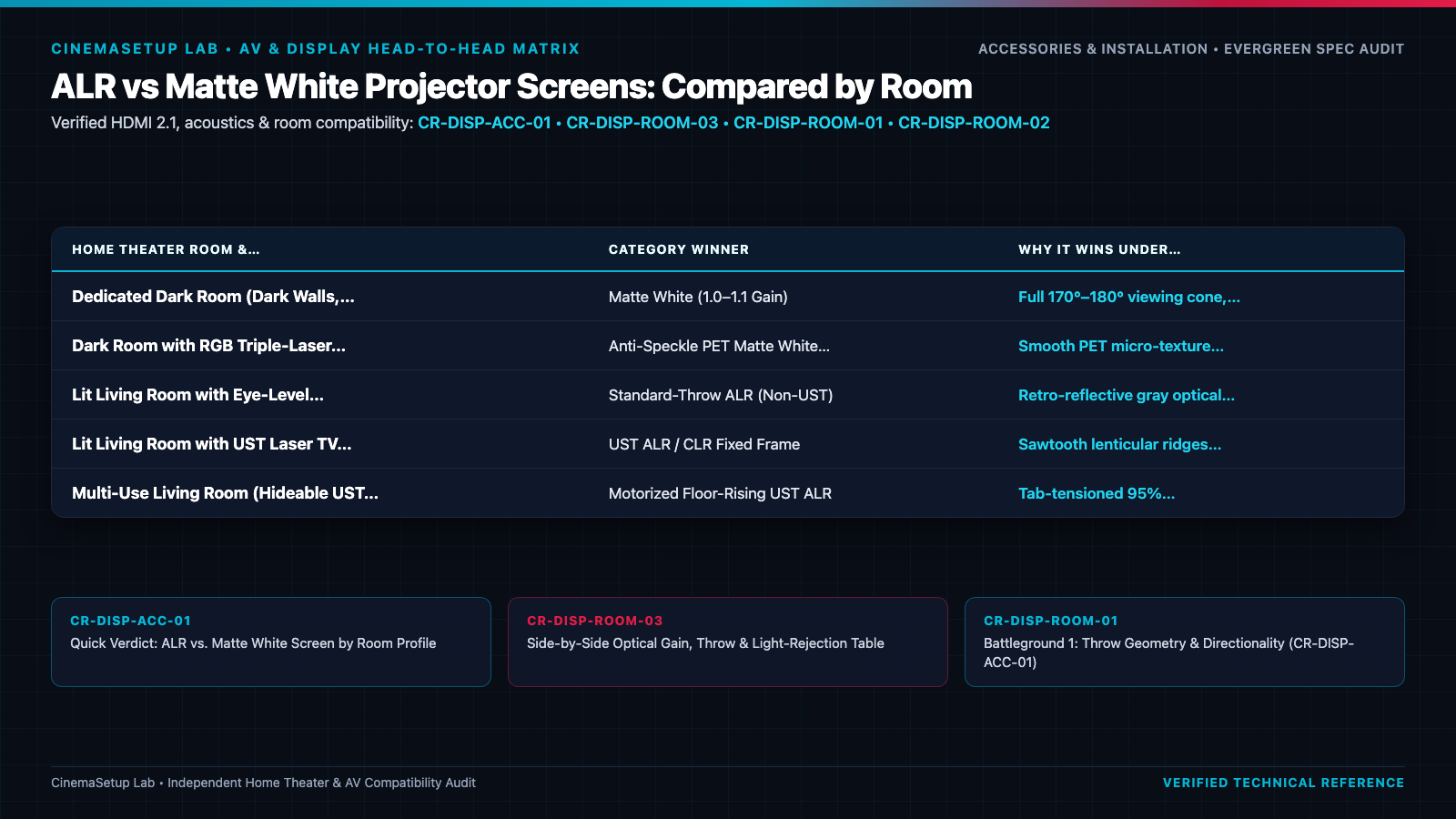
There is no single universal winner in an ALR screen vs. white screen comparison because optical coatings trade wide-angle uniformity and peak brightness for off-axis glare rejection. Match your room’s ambient light, wall color, seating spread, and projector type to the audited room winners below:
| Home Theater Room & Projector | Category Winner | Why It Wins Under Audited Rules |
|---|---|---|
| Dedicated Dark Room (Dark Walls, Long-Throw) | Matte White (1.0–1.1 Gain) | Full 170°–180° viewing cone, true neutral white balance, zero angular hotspotting, and lowest cost per inch. |
| Dark Room with RGB Triple-Laser Projector | Anti-Speckle PET Matte White (1.0 Gain) | Smooth PET micro-texture suppresses RGB laser shimmer without sacrificing dark-room contrast or color purity. |
| Lit Living Room with Eye-Level Long-Throw | Standard-Throw ALR (Non-UST) | Retro-reflective gray optical coating rejects ~70% off-axis lamp glare when projector and seating stay centered (CR-DISP-ROOM-03). |
| Lit Living Room with UST Laser TV (Fixed Wall) | UST ALR / CLR Fixed Frame | Sawtooth lenticular ridges reflect steep 0.16:1–0.25:1 upward beams toward seats while shedding overhead light (CR-DISP-ACC-01). |
| Multi-Use Living Room (Hideable UST Screen) | Motorized Floor-Rising UST ALR | Tab-tensioned 95% light-rejecting surface rises cleanly on demand without permanent wall anchors or blocking windows. |
| Wide Living Room Couch (Evening-Only Viewing) | Matte White (1.0–1.1 Gain) | Avoids the ~40° narrow viewing cone of retro-reflective long-throw ALR screens when seating spans multiple chairs. |
Side-by-Side Optical Gain, Throw & Light-Rejection Table
Shoppers often lump every gray screen together under “ALR,” yet standard long-throw ALR and ultra-short-throw ALR behave completely differently from one another and from matte white vinyl or PET fabrics. Compare all three architectures side by side before pairing one with your projector:
| Optical & Room Attribute | Matte White Screen (1.0–1.1 Gain) | Standard-Throw ALR (Long-Throw) | UST ALR / CLR (Lenticular) |
|---|---|---|---|
| Optical Gain Range | 1.0–1.1 gain (neutral Lambertian diffusion) | Varies widely (~0.8–2.7x depending on coating) | Typically ~0.6 gain (directional lenticular CLR) |
| Horizontal Viewing Cone | 170°–180° wide uniform brightness | Narrow (~40° half-gain cone on high-gain types) | 160°–170° horizontal spread |
| Ambient Light Rejection | None; reflects stray room light across blacks | High off-axis rejection (up to ~70% on gray ALR) | Up to 85%–95% overhead ceiling-light rejection |
| Compatible Throw (CR-DISP-ACC-01) | Universal: long-throw, short-throw & dark-room UST | Standard / long-throw only (~1.3:1–2.1:1); rejects UST | 0.16:1–0.25:1 UST engines only; rejects ceiling mount |
| RGB Laser Speckle & Hotspotting | Minimal; PET matte suppresses speckle | Moderate hotspot & shimmer risk on metallic coats | Low to mild depending on lenticular pitch |
| Placement & Alignment Tolerance | Very forgiving (ceiling, shelf, or table) | Favors near-eye-level alignment; steep mounts dim | Strict credenza inches & flat tension required |
| Typical US Budget Tier (G-08) | Under $500 (fixed frame / motorized) | Under $500 to $1,000+ (fixed / tab-tensioned) | $500–$1,000 (fixed) to $1,000+ (floor-rising) |
Measurement & Specification Transparency (G-01, G-03, G-09): Optical gain, rejection percentages, and viewing-cone angles above reflect manufacturer specifications (confidence A) and published optical engineering references. Across many marketplace sub-brands on Amazon US, independent third-party laboratory ANSI contrast measurements for specific sheet batches have no verified universal dataset available yet—so treat uncertified “80% / 95% ALR” listing bullets cautiously unless backed by a documented optical structure. Likewise, evaluate projector brightness exclusively in ISO 21118 or ANSI lumens; never size a low-gain ALR screen around unlabeled marketing “LED lumens.”
Battleground 1: Throw Geometry & Directionality (CR-DISP-ACC-01)
The single most costly mistake shoppers make when comparing an ALR screen against a matte white surface is treating “ALR” as one interchangeable material. Under CinemaSetup Lab compatibility rule CR-DISP-ACC-01, directional screen coatings are optically locked to the projector’s angle of incidence:
- Matte White Screens (Universal Angle Acceptance): A true 1.0-to-1.1-gain matte white sheet scatters incoming light nearly equally in all forward directions (Lambertian diffusion). Whether your projector sits on a coffee table, mounts inverted on a 9 ft (2.7 m) ceiling, or sits 15 in (38 cm) below the frame as an ultra-short-throw laser projector, the screen reflects uniform brightness across the entire 16:9 image.
- Standard-Throw (Non-UST) ALR Screens: Long-throw ALR surfaces use angular-reflective or retro-reflective optical layers engineered to accept light arriving nearly perpendicular to the screen (from a rear table or mid-wall shelf) while rejecting light hitting at steeper oblique angles. If you aim an upward-firing UST projector at a standard-throw ALR screen, the optical layer bounces those steep bottom-up rays away from your couch—producing severe vertical falloff, bright bottom hotspots, and dim upper corners.
- UST ALR / CLR (Ceiling-Light-Rejecting) Screens: Purpose-built UST screens—covered in depth in our best UST projector screen guide—rely on microscopic horizontal sawtooth ridges (lenticular CLR) or concentric Fresnel grooves. The bottom facet of each tiny ridge catches steep upward 0.16:1 to 0.25:1 UST light and redirects it horizontally toward seated viewers, while the black light-absorbing top facet blocks overhead ceiling lights. Aim a ceiling-mounted long-throw projector at a UST CLR screen and its downward beam hits those black absorbing facets, slashing picture brightness.
Pay close attention to mounting offset and lens shift under CR-DISP-ROOM-05 as well. Retro-reflective standard-throw ALR coatings—such as SilverMagic’s non-UST gray material—deliver their strongest gain and contrast when the projector lens sits near seated eye height or slightly above center. High ceiling mounts angled sharply downward with digital keystone can trigger uneven brightness gradients on directional long-throw ALR screens, whereas matte white handles steep ceiling offsets effortlessly (though you should still use optical lens shift rather than digital keystone to avoid softening 4K pixels).
Battleground 2: Room Light, Wall Bounce & Black Floor (CR-DISP-ROOM-03)
Many first-time projector buyers assume a matte white screen looks ideal whenever the window blinds are closed at night. In reality, compatibility rule CR-DISP-ROOM-03 hinges on two distinct light sources: direct ambient light (lamps, sunlit windows) and reflected room bounce from your own walls and ceiling.
Because a matte white screen reflects projector light in a 170-to-180-degree hemisphere, bright scenes splash massive amounts of white light onto nearby pale drywall, glossy trim, and flat white ceilings. That room bounce immediately reflects back onto the screen, illuminating dark shadow regions and lifting black bars into milky gray—even in a windowless room at midnight if your walls are painted light beige or white. If your room has white walls and ceilings you cannot paint dark matte charcoal or cover with velvet, a throw-matched ALR or neutral gray screen often outperforms a matte white screen even with the lights off.
In rooms where overhead fixtures stay on or daytime curtains leak sunbeams, the difference becomes dramatic. As documented in ProjectorCentral’s screen gain and ALR engineering guides, a 1.1-gain matte white screen reflects room lamps straight back to the viewer with zero discrimination, destroying shadow detail. By contrast, a lenticular UST ALR screen rated for up to 95% ceiling-light rejection keeps black levels visibly darker under living-room recessed cans.
That contrast protection carries two crucial trade-offs that every buyer must weigh:
- Gain Penalty vs. ISO/ANSI Lumens: Many UST lenticular CLR screens measure around 0.6 gain—meaning they reflect roughly 60% as much peak white light back to the viewer as a 1.0-gain matte white screen in a pitch-black room. Pairing a dim 1,500-ANSI-lumen projector with a 0.6-gain screen on a 120-inch diagonal leaves HDR highlights flat. Always ensure strong ISO 21118 / ANSI lumen output (such as 3,000 to 4,000 ISO/ANSI lumens for lit living-room UST setups) before choosing a sub-1.0 gain ALR surface.
- Viewing Cone Narrowing on Standard-Throw ALR: While lenticular UST CLR screens hold a wide 160-to-170-degree horizontal viewing spread, high-gain standard-throw ALR fabrics often narrow the sweet spot to around 40 degrees. Viewers sitting on far side loveseats see noticeable brightness drop-off and contrast shifts compared to a 1.0-gain matte white screen.
Battleground 3: RGB Laser Speckle, Color Uniformity & Sizing Math (CR-DISP-ROOM-01)
Modern RGB triple-laser projectors (both UST and long-throw models) introduce an optical variable that older lamp projectors rarely triggered: laser speckle and subtle color-uniformity shifts. Coherent red, green, and blue laser wavelengths interfere constructively and destructively when bouncing off coarse vinyl grains, metallic reflective flakes, or rigid micro-grooves—producing a faint sparkling shimmer across bright white clouds and snow.
High-gain and metallic standard-throw ALR surfaces amplify laser speckle more noticeably than fine-grain matte coatings. That is why makers like AWOL Vision and Valerion market dedicated anti-speckle 1.0-gain PET matte white screens (such as the PureVision line) specifically for light-controlled rooms paired with RGB triple-laser projectors. If your theater room has dark matte walls, blackout shades, and an RGB laser engine, a smooth 1.0-gain PET matte white screen avoids shimmer and preserves reference white balance better than an aggressive ALR fabric.
Whichever surface you pick, verify viewing distance and throw depth before ordering so you do not oversize your screen and starve it of luminance:
- Viewing Distance Band (CR-DISP-ROOM-01): Under CinemaSetup Lab’s 40-degree THX immersive to 30-degree SMPTE comfortable range, a 100-inch 16:9 screen (87.2 in / 221.5 cm wide) pairs best with seating 10.0 to 13.6 ft (3.0 to 4.1 m) away. Stepping up to a 120-inch 16:9 screen (104.6 in / 265.7 cm wide) suits seating 12.0 to 16.3 ft (3.7 to 5.0 m) back and expands surface area by 44%—which significantly lowers foot-lambert brightness if you also step down from 1.1-gain matte white to 0.6-gain ALR.
- Throw Depth & Wall Geometry (CR-DISP-ROOM-02 & ACC-018): A typical 1.3:1 to 2.1:1 long-throw zoom projector needs 11.4 to 18.4 ft (3.5 to 5.6 m) from lens to screen for a 120-inch image, plus 6 to 12 in (15 to 30 cm) of rear cable and exhaust clearance. A UST laser projector sits roughly 11 to 21 in (28 to 54 cm) from the wall per the maker’s throw chart, and requires a rigid tensioned frame—not bare drywall—as detailed in our projector screen vs wall audit.
Battleground 4: Audit Rubric, Mounting Safety & US Warranty (G-26, G-27)
Every screen in CinemaSetup Lab’s Accessories (ACC) vertical is evaluated under a transparent 100% weighting rubric before any model earns a recommendation—independent of Amazon affiliate commission tiers (G-25):
- Verified Compliance (35%): Clear optical gain and structure disclosures, US 120 V / 60 Hz motor electrical specs where powered (CR-SYS-02), and rated wall/ceiling hardware.
- Fit & Compatibility (30%): Throw-angle alignment (CR-DISP-ACC-01), room-light suitability (CR-DISP-ROOM-03), and seating distance geometry (CR-DISP-ROOM-01).
- Build & Installation (15%): Frame tension flatness, velvet overscan masking, and clear US stud/credenza instructions.
- Value Within Tier (10%): Optical consistency and included hardware relative to budget tier.
- Warranty & US Support (10%): Documented US support channels and authorized-dealer warranty transparency (G-26).
Structural Mounting, Wiring & US Warranty Safety (G-26, G-27): Fixed-frame 100-to-120-inch aluminum screens typically weigh 20 to 35 lb (9.1 to 15.9 kg), while motorized floor-rising or ceiling drop-down housings can exceed 40 to 60 lb (18.1 to 27.2 kg) across 9-to-10-foot (2.7 to 3.0 m) spans. Always follow the screen manufacturer’s mounting instructions first: anchor wall cleats directly into wood or metal wall studs (or rated masonry anchors), use a two-person lift so tensioned rails do not twist, and confirm any motorized cassette runs on US 120 V / 60 Hz power (CR-SYS-02). For ceiling projector runs exceeding roughly 10 to 15 ft (3.0 to 4.6 m), route directional Ultra High Speed HDMI Certified active optical fiber cables and UL-listed CL2 or CL3 in-wall rated wiring—consulting a licensed electrician or qualified AV installer for local building code compliance. Finally, verify the Amazon “Ships from / Sold by” seller before checkout: US manufacturer warranties from brands like Silver Ticket Products and AWOL Vision require purchase through authorized US dealers (G-26).
Final Verdict: Choose ALR vs. Choose Matte White
Choose an ALR Screen if…
- Your theater doubles as a living room with windows, recessed ceiling cans, or white walls/ceilings that bounce stray light back onto dark scenes (CR-DISP-ROOM-03).
- You own a 0.16:1–0.25:1 ultra-short-throw laser projector and pair it strictly with a UST lenticular ALR/CLR fixed or floor-rising screen (CR-DISP-ACC-01).
- You run a bright long-throw projector aligned near eye level with centered seating and choose a matching non-UST standard-throw ALR screen.
Choose a Matte White Screen if…
- You watch in a dedicated light-controlled room or darkened basement with dark matte walls and minimal ambient spill.
- You want maximum 170°–180° off-axis seating uniformity for wide family couches without directional brightness falloff or hotspotting.
- You own an RGB triple-laser projector and want an anti-speckle 1.0-gain PET matte surface with neutral color accuracy and lower cost per inch.
Verified Amazon US ALR & Matte White Screens
The four verified Amazon US screens below represent the distinct optical architectures covered in this audit—traditional 1.1-gain matte white, anti-speckle 1.0-gain PET matte, non-UST standard-throw gray ALR, and motorized floor-rising UST lenticular ALR. For full long-throw rankings, see our best projector screen roundup.
1. Silver Ticket Products STR Series 120-Inch Fixed Frame (STR-169120) — Best Dark-Room Matte White Reference

Quick Specs & Pack Contents (G-29): 120 in (304.8 cm) diagonal 16:9 | 109.25 × 63.625 in (277.5 × 161.6 cm) outer black velvet aluminum frame | White 1.1 gain matte material | Universal long-throw, short-throw & dark-room UST compatibility | Single 120-inch 6-piece fixed-frame screen kit with wall cleats (projector and cables sold separately) | Price Tier: Under $500
Pros
- Calibrated 1.1-gain matte white sheet delivers wide off-axis viewing uniformity and natural color accuracy in darkened rooms
- Velvet-wrapped 6-piece aluminum bezel absorbs pixel-shift overscan spill and maintains tensioned flatness across a 120-inch span
- Strong US retail track record across 5,000+ verified buyer ratings for 12.0 to 16.3 ft (3.7 to 5.0 m) seating (CR-DISP-ROOM-01)
Cons
- Zero ambient light rejection—lamps, open blinds, and bright white walls wash out shadow blacks quickly (CR-DISP-ROOM-03)
- Large permanent 109.25 × 63.625 in (277.5 × 161.6 cm) wall footprint requires two-person assembly, stud anchoring, and authorized-seller verification for US warranty coverage (G-26, G-27)
2. AWOL Valerion 100-Inch PureVision Fixed-Frame Screen — Best Anti-Speckle Matte PET Screen

Quick Specs & Pack Contents (G-29): 100 in (254 cm) diagonal 16:9 (87.2 in / 221.5 cm viewable width) | 1.0 gain PureVision PET matte white with laser speckle reduction | 170-degree wide viewing angle | Long-throw, short-throw & RGB triple-laser UST compatible | Single 100-inch fixed-frame screen assembly with wall hardware (projector sold separately) | Price Tier: Under $500
Pros
- Purpose-engineered PET matte surface minimizes RGB triple-laser speckle better than coarser high-gain or metallic ALR materials
- True 1.0-gain neutral white color reproduction across a 170-degree viewing cone fits wide seating for 10.0 to 13.6 ft (3.0 to 4.1 m) rooms
Cons
- Offers no directional ambient light rejection, making it unsuitable for daytime living rooms with open blinds or ceiling glare (CR-DISP-ROOM-03)
- Independent third-party contrast measurements are not yet published for this specific SKU, and buyer review volume remains small—verify authorized AWOL/Valerion seller warranty terms (G-09, G-26)
3. SilverMagic 100-Inch Standard-Throw (Non-UST) ALR Fixed Frame — Best Lit-Room Long-Throw ALR

Quick Specs & Pack Contents (G-29): 100 in (254 cm) diagonal 16:9 (87.2 in / 221.5 cm viewable width) | Standard-Throw (Non-UST) gray ALR fixed-frame surface | Designed for standard/long-throw projectors in lit rooms (strictly non-UST under CR-DISP-ACC-01) | Single 100-inch wall-mounted fixed-frame ALR screen kit (projector sold separately) | Price Tier: Under $500
Pros
- Rejects off-axis ambient glare from lamps and side windows where standard white screens lose shadow depth (CR-DISP-ROOM-03)
- Fixed wall-mounted frame keeps optical tension uniform without requiring a four-figure cinema budget
Cons
- Strictly incompatible with ultra-short-throw (UST) projectors under CR-DISP-ACC-01, and retro-reflective standard ALR coatings narrow off-axis seating and dislike steep high-ceiling projector angles
- Exact half-gain angle specs and long-term US warranty documentation are limited on the Amazon listing—confirm seller support before checkout (G-09, G-26)
4. AWOL VISION 120-Inch Motorized ALR Floor-Rising UST Screen (ALR-F220C) — Best Lit-Room UST ALR

Quick Specs & Pack Contents (G-29): 120 in (304.8 cm) diagonal 16:9 (104.6 in / 265.7 cm viewable width) | Lenticular UST ALR material rated by maker for 95% ambient light reduction | Motorized tab-tensioned floor-rising cassette (UST projectors only under CR-DISP-ACC-01) | Single 120-inch motorized floor-rising ALR screen unit and power hardware (UST projector sold separately) | Price Tier: $1,000+
Pros
- Purpose-built UST lenticular surface sheds overhead ceiling glare while maintaining a wide horizontal viewing spread for 12.0 to 16.3 ft (3.7 to 5.0 m) living rooms
- Motorized floor-rising design disappears behind or inside a low media credenza when powered off—ideal in front of windows or multi-use rooms
Cons
- Optically incompatible with standard ceiling-mounted long-throw projectors (CR-DISP-ACC-01), and sub-1.0 ALR gain demands high ISO/ANSI lumen UST output
- Substantially higher cost tier than fixed matte white frames, plus motorized US 120 V / 60 Hz power and credenza depth planning required (CR-SYS-02, CR-DISP-ROOM-02)
Authoritative References & Standards Cited
- ProjectorCentral Optical Screen Gain & ALR Engineering Guides — Directional ALR viewing-cone physics, lenticular CLR light-rejection behavior, and throw-ratio math.
- Silver Ticket Products Official US Specifications — 1.1-gain matte white fixed-frame specifications, frame geometry, and US warranty documentation.
- AWOL Vision Official UST & PureVision Screen Specifications — ALR-F220C motorized floor-rising UST ALR parameters, 95% ceiling-light reduction specs, and 1.0-gain anti-speckle PET matte specifications.
- HDMI Licensing Administrator (HDMI.org) — Ultra High Speed HDMI 48 Gbps certification and directional active optical fiber cable guidance for long projector runs.
- UL Solutions Safety & In-Wall Wiring Standards — CL2/CL3 low-voltage indoor cable ratings and US electrical safety requirements.
How We Audited This Guide
- Installation cabling and hardware were verified across HDMI Ultra High Speed QR certification vs. active fiber directionality, CL2/CL3 UL in-wall cable ratings, VESA/weight wall-mount limits, and UST ALR vs. standard screens.
- Every AV receiver, speaker, subwoofer, soundbar, OLED/Mini-LED TV, projector, source player, and accessory spec was cross-checked against official manufacturer manuals, CEA/CTA standards, and live Amazon US listings.
- Recommendations were evaluated against our weighted vertical scoring rubrics and documented CR-* compatibility rules; we never invent nits, contrast ratios, bench wattage, or room decibels.
Continue Your Audit
Frequently Asked Questions
Is an ALR screen better than a white screen in a dark room?
If your room has dark matte walls and blackout curtains, a 1.0-to-1.1-gain matte white screen usually wins with wider 170-to-180-degree seating, neutral colors, zero hotspotting, and lower laser speckle. However, if your dark room still has white walls and ceilings, an ALR screen reduces wall-bounce washout.
Can I use a standard ALR screen with an ultra-short-throw (UST) projector?
No. Under compatibility rule CR-DISP-ACC-01, standard-throw ALR screens are engineered to reject steep off-axis angles and will deflect upward 0.16:1 to 0.25:1 UST beams away from your seats. UST projectors require either a lenticular UST ALR/CLR screen or a dark-room matte white screen.
Why do ALR screens sometimes look dimmer than matte white screens?
Many UST lenticular ALR/CLR screens carry roughly 0.6 optical gain compared to 1.0 or 1.1 on matte white screens. That intentional dark tint deepens perceived blacks under room lamps, but reduces peak white luminance in dark rooms—requiring higher ISO 21118 or ANSI lumen output from your projector.
Do ALR screens cause more laser speckle than matte white screens?
Yes, high-gain or metallic-coated standard-throw ALR screens can accentuate shimmer on RGB triple-laser projectors. In light-controlled rooms, smooth 1.0-gain PET matte screens—such as AWOL Valerion PureVision—significantly reduce laser speckle while maintaining neutral color accuracy across wide seating angles.
How much narrower is the viewing angle on an ALR screen vs. a white screen?
Matte white screens offer uniform brightness across 170 to 180 degrees, and lenticular UST CLR screens typically preserve 160 to 170 degrees horizontally. High-gain retro-reflective standard-throw ALR screens, however, often narrow to roughly a 40-degree sweet spot, dimming quickly for side-angled seats.
What screen size fits my room when choosing ALR vs. matte white?
Follow rule CR-DISP-ROOM-01: a 100-inch 16:9 screen (87.2 in / 221.5 cm wide) suits 10.0 to 13.6 ft (3.0 to 4.1 m) seating, while 120 inches (104.6 in / 265.7 cm wide) fits 12.0 to 16.3 ft (3.7 to 5.0 m) back. Also verify throw depth under CR-DISP-ROOM-02.


