
Disclosure: As an Amazon Associate, I earn from qualifying purchases. If you buy through links on this page, we may earn a small commission at no extra cost to you. Affiliate commission rates never influence our technical audits, scores, or rankings.
Finding the best bookshelf speakers for home theater comes down to three physical constraints that glossy retail headlines rarely explain: acoustic sensitivity relative to your seating distance, bass extension into an 80 Hz subwoofer crossover, and whether your speaker family includes a timbre-matched center channel. Two compact monitors sitting in the same budget bracket can differ by more than 8 dB in sensitivity—meaning one pair plays effortlessly at cinema volumes on an entry receiver while the other demands four to eight times as much amplifier wattage.
Rather than repeating vague tonal adjectives, we audited eight actively stocked passive stereo pairs on Amazon US from Klipsch, Polk Audio, Sony, and Edifier against official US manufacturer specification sheets and cross-compatibility rules. Whether you are building a compact 3.1 living-room stage, expanding into 5.1.2 Dolby Atmos, or comparing compact standmount pairs against full-size floorstanding models in our best home theater speakers pillar hub, this guide breaks down pair-versus-single pricing, stand and port clearance requirements, and authorized-dealer warranty coverage before you order.
In This Guide
- Quick Picks: Best Bookshelf Speakers for Home Theater
- Bookshelf Speakers Comparison Matrix
- Match Your Room Size, AVR Power & Placement
- Detailed Best Bookshelf Speakers for Home Theater Audits (1–8): 1. Klipsch RP-600M II · 2. Polk Signature Elite ES20 · 3. Sony SS-CS5M2 · 4. Polk Monitor XT20 · 5. Klipsch R-51M · 6. Polk Monitor XT15 · 7. Klipsch R-41M · 8. Edifier P12
- Best Bookshelf Speakers for Home Theater Buying Guide: Compatibility & Upgrade Roadmap
- 100% Weighted Scoring Rubric & Excluded Models
- Best Bookshelf Speakers for Home Theater Frequently Asked Questions
- Final Verdict: Choosing the Right Bookshelf Pair
Quick Picks: Best Bookshelf Speakers for Home Theater
#1 Best Overall for Home Theater
Klipsch RP-600M II (Pair)
High 94.5 dB (2.83 V / 1 m) sensitivity, 44 Hz (+/-3 dB) extension, and matching Tractrix horn centers maximize AVR headroom. Jump to audit ↓
#2 Best Mid-Range Value & Near-Wall Bass
Polk Signature Elite ES20 (Pair)
Down-diffused rear Power Port and 41 Hz total range deliver clean near-wall integration with 4/8-ohm AVRs. Jump to audit ↓
#3 Best Compact 3-Way Budget Pick
Sony SS-CS5M2 (Pair)
3-way super-tweeter array in an 8.75 in (22.2 cm) deep cabinet pairs easily with 6-8 ohm entry AVRs and an 80 Hz sub. Jump to audit ↓
Bookshelf Speakers Comparison Matrix
Every model in the table below is sold as a matched passive stereo pair (two speakers) requiring an AV receiver or external stereo amplifier. Notice the sensitivity rating basis column carefully: Klipsch and Sony rate sensitivity at 2.83 V / 1 m, whereas Polk Monitor XT models and Edifier publish 1 W / 1 m figures. For an 8-ohm speaker, 2.83 V equals 1 W, while a 6-ohm speaker driven at 2.83 V draws roughly 1.33 W (meaning Sony’s 87 dB at 2.83 V / 1 m equates to approximately 85.8 dB at 1 W / 1 m).
| Bookshelf Pair & Award | Drivers & Port Type | Sensitivity & Impedance | Low Extension & Matching Family | Link |
|---|---|---|---|---|
| Klipsch RP-600M II Best Overall (Pair) | 1 in LTS horn + 6.5 in woofer Rear Tractrix port | 94.5 dB (2.83 V / 1 m) 8 ohms compatible | 44 Hz – 25 kHz (+/-3 dB) RP-504C II / RP-500SA II | View on Amazon |
| Polk Signature Elite ES20 Best Mid-Range Value (Pair) | 1 in Terylene dome + 6.5 in woofer Rear Power Port diffuser | 86 dB (2.83 V / 1 m) 4-ohm & 8-ohm compatible | 41 Hz – 40 kHz (maker range) ES30 / ES35 / ES90 | View on Amazon |
| Sony SS-CS5M2 Best Compact 3-Way (Pair) | 0.75 in + 0.98 in domes + 5.12 in woofer Rear bass-reflex port | 87 dB (2.83 V / 1 m) 6 ohms nominal | 53 Hz – 50 kHz (maker range) SS-CS8M2 / SS-CSEM2 | View on Amazon |
| Polk Monitor XT20 Best Budget 6.5-Inch (Pair) | 1 in Terylene dome + 6.5 in woofer Rear bass-reflex port | 87 dB (1 W / 1 m) 4-ohm & 8-ohm compatible | 38 Hz – 40 kHz (maker range) MXT30 / MXT35 / MXT90 | View on Amazon |
| Klipsch R-51M Best High-Sensitivity Budget (Pair) | 1 in LTS horn + 5.25 in woofer Rear bass-reflex port | 93 dB (2.83 V / 1 m) 8 ohms compatible | 62 Hz – 21 kHz (+/-3 dB) R-52C / R-41SA | View on Amazon |
| Polk Monitor XT15 Best Small-Room 5.25-Inch (Pair) | 1 in Terylene dome + 5.25 in woofer Rear bass-reflex port | 86 dB (1 W / 1 m) 4-ohm & 8-ohm compatible | 48 Hz – 40 kHz (maker range) MXT30 / MXT90 | View on Amazon |
| Klipsch R-41M Best Compact Surround (Pair) | 1 in LTS horn + 4 in woofer Rear bass-reflex port | 90 dB (2.83 V / 1 m) 8 ohms compatible | 68 Hz – 21 kHz (+/-3 dB) R-52C / R-51M | View on Amazon |
| Edifier P12 Best Wall-Mount Surround (Pair) | 0.75 in silk dome + 4 in woofer Front oval port + wall bracket | 79 dB (1 W / 1 m) 6 ohms nominal | 55 Hz – 20 kHz (maker range) No matching passive center | View on Amazon |
Match Your Room Size, AVR Power & Placement
Selecting passive bookshelf speakers without checking your seating distance, front-wall clearance, and receiver power rating leads to clipped peaks or boomy mid-bass. Match your exact room profile below to jump straight to the right pair.
| Home Theater Scenario | Best Match | Why & Compatibility Outcome |
|---|---|---|
| Medium-to-large living room (10-13 ft seating) on 70-100 W/ch AVR | Klipsch RP-600M II | 94.5 dB (2.83 V / 1 m) sensitivity delivers strong movie dynamics without stressing multichannel AVR power reserves. |
| Media console placement near back wall + mixed music/movies | Polk Signature Elite ES20 | Rear Power Port diffuser tames boundary turbulence better than open rear ports while extending down to 41 Hz. |
| Compact apartment 5.1.2 stage under $250 per pair | Sony SS-CS5M2 | 8.75 in (22.2 cm) cabinet depth fits tight consoles while 3-way dispersion keeps dialogue and effects wide across seating. |
| Budget 6.5-inch Front L/R with matching Atmos upgrade path | Polk Monitor XT20 | 38 Hz maker-listed reach hands off cleanly at 80 Hz and scales with MXT30/35 centers and MXT90 height modules. |
| Entry 5.1/7.2 receiver needing high loudness per watt | Klipsch R-51M | 93 dB sensitivity pairs cleanly with modest 70 W/ch receivers once crossed at 80 Hz to a powered subwoofer. |
| Flush wall-mounted rear/side surrounds on a strict budget | Edifier P12 | Front-facing oval port and built-in rear bracket eliminate wall-port boom for close-range surround channels. |
Detailed Best Bookshelf Speakers for Home Theater Audits (1–8)
1. Klipsch Reference Premiere RP-600M II Bookshelf Speakers (Pair) — Best Overall for Home Theater

Key Specs: 1 in (2.5 cm) Titanium LTS vented tweeter in 90 x 90 deg Tractrix horn + 6.5 in (16.5 cm) Cerametallic woofer | Sensitivity: 94.5 dB (2.83 V / 1 m) | Nominal Impedance: 8 ohms compatible | Frequency Response: 44 Hz – 25 kHz (+/-3 dB) | Crossover: 1,500 Hz | Rear Tractrix port | Dual bi-wire/bi-amp binding posts | 7.95 x 15.75 x 13.0 in (20.2 x 40.0 x 33.0 cm), 18.1 lb (8.2 kg) each | Sold as a stereo pair | Price Tier: $450-$650 per pair (around $649 Launch MSRP)
Audit Score: 9.3 / 10
- Acoustic Architecture & Extension (30%): 9.5 / 10
- AVR Fit & Family Completeness (25%): 9.7 / 10
- Port & Placement Flexibility (15%): 8.2 / 10
- Per-Pair Value Within Tier (15%): 8.9 / 10
- Cabinet Build & Binding Posts (10%): 9.5 / 10
- US Warranty & Dealer Support (5%): 9.2 / 10
When building a 5.1 or 5.1.2 living-room theater around a mainstream 7.2-channel AV receiver, the Klipsch Reference Premiere RP-600M II solves the hardest physics bottleneck in bookshelf audio: delivering cinematic dynamic peaks without overtaxing receiver amplification. Per Klipsch official RP-600M II specifications, the pair carries a 94.5 dB (2.83 V / 1 m) sensitivity rating into an 8-ohm compatible load. Under compatibility rule CR-SPK-AVR-02, by our estimate from published specs (assuming 11.5 ft / 3.5 m seating distance and zero room gain), hitting 100 dB peaks requires roughly 43 W per channel—well within the ~56 W multichannel-derated output of a standard 80 W/ch 8-ohm receiver.
Unlike budget monitors that omit measurement tolerances, Klipsch publishes a strict +/-3 dB window across 44 Hz to 25 kHz, crossing over at 1,500 Hz between the 6.5 in (16.5 cm) spun-copper Cerametallic woofer and the updated edge-to-edge 90 x 90 degree Tractrix horn. Because its -3 dB floor sits well below an 80 Hz crossover (rule CR-SUB-SPK-01), handing sub-80 Hz LFE duties to a powered subwoofer leaves zero mid-bass gap. Better still, the Reference Premiere II ecosystem provides exact timbre matching (rule CR-SPK-SPK-01) across the RP-500C II and RP-504C II center channels plus sealed RP-500SA II height modules, alongside dual aluminum binding posts for single-wire or bi-amp configurations.
Buyer Verification Alert: Check that the Amazon seller is an authorized Klipsch US dealer before checkout. Klipsch’s 5-year passive speaker warranty explicitly excludes purchases from unauthorized third-party marketplace liquidators (G-26).
Pros
- High 94.5 dB (2.83 V / 1 m) sensitivity minimizes receiver clipping across medium-to-large rooms
- Published 44 Hz – 25 kHz (+/-3 dB) response pairs cleanly with an 80 Hz AVR crossover
- Dual aluminum binding posts and braced 18.1 lb (8.2 kg) cabinets with magnetic grilles
- Complete Reference Premiere II center and Atmos height family for uniform front-stage timbre
Cons
- Rear-firing Tractrix port demands 6-12 in (15-30 cm) clearance behind the cabinet (CR-SPK-ROOM-04)
- Deep 13.0 in (33.0 cm) and tall 15.75 in (40.0 cm) footprint outgrows shallow shelves
- Higher price bracket than Polk Signature Elite ES20 and Monitor XT20 pairs
Verdict: Buy it if you want maximum acoustic headroom on an 80-100 W/ch AV receiver with a seamless path to horn-matched centers and Atmos heights. Skip it if your speakers must sit flush against drywall or inside tight media cubbies—the Polk Signature Elite ES20 handles tight rear-wall placement more gracefully. Check Price on Amazon
2. Polk Audio Signature Elite ES20 Bookshelf Speaker Pair — Best Mid-Range Value & Near-Wall Bass

Key Specs: 1 in (2.5 cm) Terylene high-res dome tweeter + 6.5 in (16.5 cm) mica-polypropylene woofer | Sensitivity: 86 dB (2.83 V / 1 m) | Impedance: 4-ohm and 8-ohm compatible | Frequency Range: 41 Hz – 40 kHz (maker-listed total range) | Crossover: 2,400 Hz | Rear Power Port diffuser | Dual gold-plated 5-way binding posts | 8.5 x 14.8 x 13.8 in (21.6 x 37.6 x 35.1 cm), 17.0 lb (7.7 kg) each | Sold as a stereo pair | Price Tier: $300-$450 per pair (around $399 Launch MSRP)
Audit Score: 9.0 / 10
- Acoustic Architecture & Extension (30%): 9.1 / 10
- AVR Fit & Family Completeness (25%): 8.8 / 10
- Port & Placement Flexibility (15%): 9.1 / 10
- Per-Pair Value Within Tier (15%): 9.2 / 10
- Cabinet Build & Binding Posts (10%): 9.2 / 10
- US Warranty & Dealer Support (5%): 9.0 / 10
Most large 6.5-inch bookshelf monitors punish you with boomy upper bass and port chuffing when placed within a few inches of a living-room wall. According to Polk Audio official ES20 specifications, the Signature Elite ES20 counters that constraint with a rear Power Port diffuser plate that redirects low-frequency airflow smoothly across the back baffle rather than firing an unbaffled jet straight into drywall. That engineering makes the ES20 the strongest mid-range candidate for credenzas or shallow stand clearances under rule CR-SPK-ROOM-04.
Where the Klipsch RP-600M II wins on raw efficiency, the ES20 counters with a substantially lower pair price (around $399 Launch MSRP per pair vs. around $649 for the Klipsch) and broad 2.4 kHz Terylene dome integration for mixed music-and-cinema rooms. However, check your receiver math carefully before buying: Polk rates the ES20 at 86 dB (2.83 V / 1 m) and lists 4-ohm and 8-ohm compatibility with 20-125 W recommended power. Compared with the 94.5 dB RP-600M II, reaching identical SPL demands roughly seven times more amplifier wattage—so pair the ES20 with a capable 80-100 W/ch 4-ohm-certified receiver in 9-11 ft (2.7-3.4 m) rooms and cross over cleanly at 80 Hz.
Buyer Verification Alert: The Contemporary Walnut listing linked here and the Stunning Black variant share identical acoustic hardware. Confirm authorized Polk US seller status at checkout so the 5-year passive speaker warranty stays valid (G-26).
Pros
- Patented rear Power Port plate diffuses airflow for cleaner near-wall bass placement
- 41 Hz maker-listed bass extension pairs effortlessly with an 80 Hz subwoofer crossover
- 4-ohm and 8-ohm output compatibility with dual gold-plated 5-way binding posts
- Signature Elite family includes full ES30 and low-profile ES35 centers plus ES10/ES90 surrounds
Cons
- 86 dB (2.83 V / 1 m) sensitivity requires solid AVR wattage in larger living rooms
- Deep 13.8 in (35.1 cm) and 17.0 lb (7.7 kg) cabinet needs generous console or stand-plate depth
- Published 41 Hz – 40 kHz spec omits a +/-3 dB tolerance figure
Verdict: Buy it if you want sturdy 6.5-inch musical warmth and cleaner near-wall bass diffusion at a mid-range pair price. Skip it if you run a low-power 50-70 W/ch entry receiver in a cavernous room—choose the 94.5 dB Klipsch RP-600M II or 93 dB R-51M instead. Check Price on Amazon
3. Sony SS-CS5M2 3-Way 3-Driver Compact Bookshelf Speakers (Pair) — Best Compact 3-Way Budget Pick

Key Specs: 0.75 in (1.9 cm) super-tweeter + 0.98 in (2.5 cm) dome tweeter + 5.12 in (13.0 cm) MRC woofer | Sensitivity: 87 dB (2.83 V / 1 m) | Nominal Impedance: 6 ohms | Frequency Range: 53 Hz – 50 kHz (maker-listed range) | Crossovers: 2,500 Hz & 17,000 Hz | Rear bass-reflex port | 7.13 x 13.25 x 8.75 in (18.1 x 33.7 x 22.2 cm), 9.5 lb (4.3 kg) each | Sold as a stereo pair | Price Tier: $150-$250 per pair
Audit Score: 8.7 / 10
- Acoustic Architecture & Extension (30%): 8.6 / 10
- AVR Fit & Family Completeness (25%): 8.9 / 10
- Port & Placement Flexibility (15%): 8.7 / 10
- Per-Pair Value Within Tier (15%): 9.3 / 10
- Cabinet Build & Binding Posts (10%): 8.2 / 10
- US Warranty & Dealer Support (5%): 8.5 / 10
Most entry-level bookshelf speakers use a simple two-driver layout. Per Sony US SS-CS5M2 specifications, this refreshed Mark 2 pair packs a 3-way 3-driver array—pairing a 5.12 in (13.0 cm) mica-reinforced cellular woofer with a 0.98 in (2.5 cm) main dome tweeter and a 0.75 in (1.9 cm) wide-dispersion super-tweeter crossed at 2,500 Hz and 17,000 Hz. Sony updated the Mark 2 revision with revised internal bracing, an adjusted crossover network, and a matte tweeter waveguide while preserving the apartment-friendly 8.75 in (22.2 cm) cabinet depth.
From a system-compatibility perspective, the SS-CS5M2 carries a 6-ohm nominal impedance rating, meaning it stays well clear of 4-ohm receiver lockout rules (CR-SPK-AVR-01) even on compact 6-ohm minimum receivers. Note the sensitivity normalization rule (`03` §3.4d): Sony’s 87 dB figure is specified at 2.83 V / 1 m into 6 ohms, which normalizes to roughly 85.8 dB at 1 W / 1 m. At 8-10 ft (2.4-3.0 m) seating distances paired with an active subwoofer at an 80 Hz crossover, the SS-CS5M2 punches above its sub-$250 tier and matches Sony’s SS-CS8M2 center and SS-CSEM2 up-firing modules cleanly—though buyers wanting deeper standmount bass without relying as heavily on a sub should step up to the 6.5-inch Polk Monitor XT20.
Buyer Verification Alert: Confirm the exact SKU reads SS-CS5M2 (Mark 2) rather than leftover original SS-CS5 inventory so you get the updated bracing and crossover network.
Pros
- 3-way super-tweeter topology delivers wide high-frequency dispersion across couch seating
- Shallow 8.75 in (22.2 cm) depth fits media stands that cannot hold 13 in deep 6.5-inch monitors
- 6-ohm nominal load works reliably with entry 6-8 ohm AV receivers
- Timbre-matched Sony SS-CS8M2 center and SS-CSEM2 height speakers keep 5.1.2 builds cohesive
Cons
- 53 Hz maker-listed bass floor requires a powered subwoofer with an 80 Hz crossover for movies
- 87 dB (2.83 V / 1 m) into 6 ohms (~85.8 dB at 1 W / 1 m) limits headroom in big open rooms
- Rear-firing port needs several inches of breathing room behind the enclosure
Verdict: Buy it if you want compact 3-way clarity under $250 per pair for a small-to-medium 5.1.2 living room with a subwoofer. Skip it if you sit beyond 11 ft (3.4 m) in an open-plan space or want deeper 6.5-inch mid-bass weight—look at the Polk Monitor XT20 or Klipsch R-51M. Check Price on Amazon
4. Polk Audio Monitor XT20 Bookshelf Speakers (Pair) — Best Budget 6.5-Inch Front Stage

Key Specs: 1 in (2.5 cm) Terylene dome tweeter + 6.5 in (16.5 cm) bi-laminate paper Dynamic Balance woofer | Sensitivity: 87 dB (1 W / 1 m) | Impedance: 4-ohm and 8-ohm compatible | Frequency Range: 38 Hz – 40 kHz (maker-listed total range) | Crossover: 3,200 Hz | Rear bass-reflex port | 5-way binding posts | 7.5 x 13.0 x 10.99 in (19.1 x 33.0 x 27.9 cm), 12.0 lb (5.4 kg) each | Sold as a stereo pair | Price Tier: $200-$300 per pair
Audit Score: 8.6 / 10
- Acoustic Architecture & Extension (30%): 8.7 / 10
- AVR Fit & Family Completeness (25%): 8.9 / 10
- Port & Placement Flexibility (15%): 8.2 / 10
- Per-Pair Value Within Tier (15%): 9.1 / 10
- Cabinet Build & Binding Posts (10%): 8.0 / 10
- US Warranty & Dealer Support (5%): 8.8 / 10
If your budget tops out under $300 per pair for Front Left and Right speakers yet you want full 6.5-inch woofer scale rather than a smaller 5.25-inch driver, the Polk Monitor XT20 hits the sweet spot. Per Polk Audio official Monitor XT20 specifications, its bi-laminate paper Dynamic Balance woofer reaches down to a maker-listed 38 Hz total extension while pairing with a 1 in (2.5 cm) Terylene dome tweeter at a 3,200 Hz crossover.
Compared directly with the step-up Signature Elite ES20, the Monitor XT20 trims cabinet weight from 17.0 lb (7.7 kg) down to 12.0 lb (5.4 kg) and trades the ES20’s rear Power Port diffuser for a standard open rear bass-reflex tube. That means you need to follow rule CR-SPK-ROOM-04 carefully by leaving 6-12 in (15-30 cm) behind the XT20 so low frequencies do not thicken near walls. On the upside, Polk rates sensitivity honestly at 87 dB (1 W / 1 m) with 4- and 8-ohm compatibility, and the broader Monitor XT lineup gives budget 5.1.2 builders an easy upgrade path via MXT30/MXT35 centers, XT15 surrounds, and sealed MXT90 Atmos height modules.
Buyer Verification Alert: Unlike the Signature Elite ES20, the Monitor XT20 uses an open rear port and ships only in Midnight Black vinyl—verify shelf depth (10.99 in / 27.9 cm plus port space) before ordering.
Pros
- 6.5 in Dynamic Balance woofer delivers deeper 38 Hz maker-listed bass extension than 5.25 in budget peers
- Rated 87 dB (1 W / 1 m) with 30-200 W recommended power and 4/8-ohm AVR support
- Complete budget Monitor XT center (MXT30/MXT35), surround (XT15), and height (MXT90) ecosystem
- 5-way binding posts accept bare wire, spades, or banana plugs cleanly
Cons
- Open rear port requires wall clearance to prevent boomy mid-bass
- Lighter 12.0 lb (5.4 kg) enclosure offers less cabinet mass and finish variety than the ES20
- 38 Hz – 40 kHz range lacks a published +/-3 dB tolerance window
Verdict: Buy it if you want 6.5-inch front-stage presence and full Monitor XT 5.1.2 expandability under $300 per pair. Skip it if your speakers must sit close to a wall—step up to the Polk Signature Elite ES20 for Power Port airflow diffusion. Check Price on Amazon
5. Klipsch R-51M Reference Bookshelf Speakers (Pair) — Best High-Sensitivity Budget Pair for Entry AVRs

Key Specs: 1 in (2.5 cm) Aluminum LTS tweeter on 90 x 90 Tractrix horn + 5.25 in (13.3 cm) spun-copper IMG woofer | Sensitivity: 93 dB (2.83 V / 1 m) | Nominal Impedance: 8 ohms compatible | Frequency Response: 62 Hz – 21 kHz (+/-3 dB) | Power Handling: 85 W continuous / 340 W peak | Rear-firing bass-reflex port | 7.0 x 13.3 x 8.5 in (17.8 x 33.8 x 21.5 cm), 11.0 lb (5.0 kg) each | Sold as a stereo pair | Price Tier: $150-$300 per pair
Audit Score: 8.4 / 10
- Acoustic Architecture & Extension (30%): 8.1 / 10
- AVR Fit & Family Completeness (25%): 9.1 / 10
- Port & Placement Flexibility (15%): 8.4 / 10
- Per-Pair Value Within Tier (15%): 8.6 / 10
- Cabinet Build & Binding Posts (10%): 8.0 / 10
- US Warranty & Dealer Support (5%): 8.3 / 10
Entry-level 5.1 and 7.2 AV receivers typically deliver 70 to 80 W/ch into 8 ohms (2 channels driven), which drops roughly 30% when driving five or more surround channels simultaneously. That is where the Klipsch R-51M shines: at 93 dB (2.83 V / 1 m) and 8 ohms nominal impedance, our CR-SPK-AVR-02 estimate from published specs shows it takes roughly 62 W per channel to reach 100 dB living-room peaks at 11.5 ft (3.5 m). Compare that with an 86-87 dB bookshelf monitor at the same seating distance, which demands more than 200 W per channel for equivalent 100 dB headroom.
The trade-off is low-frequency depth. Klipsch specifies the 5.25 in (13.3 cm) IMG woofer down to 62 Hz (+/-3 dB), meaning the R-51M relies strictly on an active subwoofer and an 80 Hz Small crossover in your receiver (rule CR-SUB-SPK-01) for explosions and LFE weight. While Klipsch has introduced the newer Reference R-50M line in its broader catalog, the actively stocked R-51M on Amazon US remains a practical budget match for Klipsch R-52C centers and R-41M surrounds when price matters most.
Buyer Verification Alert: Do not confuse the passive Klipsch R-51M with the powered R-51PM variant. Verify that the listing specifies passive speaker-wire binding posts and authorized Klipsch US dealer coverage (G-26).
Pros
- High 93 dB (2.83 V / 1 m) sensitivity delivers high movie volume from 70-80 W/ch AVRs
- Honest +/-3 dB tolerance on its 62 Hz – 21 kHz response specification
- Trim 8.5 in (21.5 cm) depth fits compact consoles and surround wall stands easily
- Pairs cleanly with Klipsch R-52C centers and R-41M surrounds for budget 5.1 packages
Cons
- 62 Hz (-3 dB) low-frequency cutoff requires a dedicated subwoofer at an 80 Hz crossover
- Rear-firing port needs rear-wall breathing space
- Older Reference generation compared with the current RP-600M II cabinet and horn design
Verdict: Buy it if you own a modest 70-80 W/ch AV receiver plus a subwoofer and want loud, effortless horn dynamics under $300 per pair. Skip it if you want sub-45 Hz front-stage extension without relying entirely on your subwoofer—step up to the RP-600M II or Polk XT20. Check Price on Amazon
6. Polk Audio Monitor XT15 Bookshelf Speakers (Pair) — Best Compact 5.25-Inch Pair for Small Rooms & Surrounds
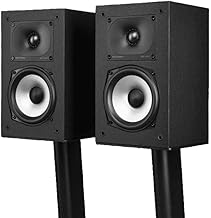
Key Specs: 1 in (2.5 cm) Terylene dome tweeter + 5.25 in (13.3 cm) Dynamic Balance woofer | Sensitivity: 86 dB (1 W / 1 m) | Impedance: 4-ohm and 8-ohm compatible | Frequency Range: 48 Hz – 40 kHz (maker-listed range) | Crossover: 2,200 Hz | Rear bass-reflex port | 6.5 x 10.6 x 7.18 in (16.5 x 26.9 x 18.2 cm), 9.0 lb (4.1 kg) each | Sold as a stereo pair | Price Tier: $150-$200 per pair
Audit Score: 8.3 / 10
- Acoustic Architecture & Extension (30%): 8.0 / 10
- AVR Fit & Family Completeness (25%): 8.8 / 10
- Port & Placement Flexibility (15%): 8.4 / 10
- Per-Pair Value Within Tier (15%): 8.8 / 10
- Cabinet Build & Binding Posts (10%): 7.9 / 10
- US Warranty & Dealer Support (5%): 8.7 / 10
In tight 12 x 14 ft (3.7 x 4.3 m) apartments or bedrooms where 13-inch-deep monitors stick awkwardly into walkways, the Polk Monitor XT15 compresses the Monitor XT architecture into a 6.5 x 10.6 x 7.18 in (16.5 x 26.9 x 18.2 cm) enclosure weighing 9.0 lb (4.1 kg) per speaker. It uses the exact same 1 in (2.5 cm) Terylene dome tweeter found across the Monitor XT line, making it an ideal timbre-matched side or rear surround pair behind Monitor XT20 fronts and a Monitor XT30 center (rule CR-SPK-SPK-02).
As primary Front Left/Right speakers, keep room size realistic: at 86 dB (1 W / 1 m) sensitivity, the XT15 works best at 7-9 ft (2.1-2.7 m) apartment seating distances rather than large open floor plans. Its maker-listed 48 Hz low-frequency extension and 4/8-ohm compatibility pair cleanly with an 80 Hz subwoofer crossover, though the lack of integrated keyhole mounting slots means you should plan on clamp-style wall brackets or compact floor stands (CR-SPK-ROOM-05).
Buyer Verification Alert: Check that the Amazon selector is set to the Monitor XT15 Pair rather than a single Monitor XT30 center or XT90 height module, and confirm authorized Polk US dealer status for warranty validity.
Pros
- Trim 7.18 in (18.2 cm) depth fits tight apartment shelves and narrow side surround stands
- Matches Monitor XT20 fronts and MXT30/MXT35 centers with identical Terylene tweeter voicing
- 48 Hz maker-listed reach blends smoothly into an 80 Hz AVR subwoofer crossover
- 4-ohm and 8-ohm compatible with 30-150 W recommended amplifier power
Cons
- 86 dB (1 W / 1 m) sensitivity limits dynamic output in large or open-plan rooms
- Rear-firing port needs clearance when used as full-range-ish front monitors
- No built-in rear keyhole hanger—requires side-clamp brackets if wall-mounted
Verdict: Buy it if you need compact 5.25-inch surrounds for a Monitor XT 5.1.2 system or tidy front monitors for a small apartment under $200 per pair. Skip it if you have space for 6.5-inch cabinets as your primary fronts—the Monitor XT20 costs only slightly more for deeper bass reach. Check Price on Amazon
7. Klipsch R-41M Reference Bookshelf Speakers (Pair) — Best Compact Horn-Loaded Surround & Near-Field Pair

Key Specs: 1 in (2.5 cm) Aluminum LTS tweeter on 90 x 90 Tractrix horn + 4 in (10.2 cm) spun-copper IMG woofer | Sensitivity: 90 dB (2.83 V / 1 m) | Nominal Impedance: 8 ohms compatible | Frequency Response: 68 Hz – 21 kHz (+/-3 dB) | Power Handling: 50 W continuous / 200 W peak | Rear-firing bass-reflex port | 5.75 x 11.3 x 7.9 in (14.6 x 28.7 x 20.0 cm), 7.0 lb (3.2 kg) each | Sold as a stereo pair | Price Tier: $120-$200 per pair
Audit Score: 8.0 / 10
- Acoustic Architecture & Extension (30%): 7.5 / 10
- AVR Fit & Family Completeness (25%): 8.6 / 10
- Port & Placement Flexibility (15%): 8.2 / 10
- Per-Pair Value Within Tier (15%): 8.3 / 10
- Cabinet Build & Binding Posts (10%): 7.8 / 10
- US Warranty & Dealer Support (5%): 8.2 / 10
At just 5.75 in (14.6 cm) wide and 7.0 lb (3.2 kg) per cabinet, the Klipsch R-41M is built primarily as a compact side or rear surround pair—or a tight near-field desk setup—rather than a main living-room front pair. Even with a 4 in (10.2 cm) woofer, its 90 x 90 degree Tractrix horn maintains a 90 dB (2.83 V / 1 m) sensitivity into 8 ohms, which keeps surround effects crisp alongside larger Klipsch Reference front channels (rule CR-SPK-SPK-02).
Pay close attention to rule CR-SUB-SPK-01 during AVR calibration: Klipsch publishes a 68 Hz (+/-3 dB) low-frequency cutoff for the R-41M. Because 68 Hz sits right below the standard 80 Hz receiver crossover, setting the R-41M to Small at 90 Hz or 100 Hz protects the 4-inch driver from over-excursion while keeping bass localized cleanly in your powered subwoofer. Compared with the Klipsch R-51M, the R-41M gives up 3 dB of efficiency and 35 W of continuous power handling purely to fit narrower side-wall spaces.
Buyer Verification Alert: Do not confuse the passive R-41M with the powered R-41PM. The passive R-41M requires speaker wire connected to an AV receiver or external stereo amplifier.
Pros
- 90 dB (2.83 V / 1 m) sensitivity keeps surround channels energetic on entry AVRs
- Narrow 5.75 in (14.6 cm) width and 7.0 lb (3.2 kg) weight simplify side-wall stand placement
- Matches Klipsch Reference front towers, R-51M monitors, and R-52C center voicing
Cons
- 68 Hz (-3 dB) cutoff demands a subwoofer and 90-100 Hz AVR crossover (CR-SUB-SPK-01)
- 50 W continuous limit and 4 in woofer under-scale main living-room L/R duties
- Rear-firing port restricts flush wall mounting unless angled on standoff brackets
Verdict: Buy it if you want compact, high-efficiency surround channels for a Klipsch Reference 5.1 or 7.1 theater. Skip it if you are buying primary Front Left/Right speakers—step up to the R-51M or RP-600M II. Check Price on Amazon
8. Edifier P12 Passive Bookshelf Speakers (Pair) — Best Ultra-Budget Front-Ported & Wall-Mountable Surround Pair

Key Specs: 0.75 in (1.9 cm) silk-dome tweeter + 4 in (11.6 cm) bass driver | Sensitivity: 79 dB (1 W / 1 m) | Nominal Impedance: 6 ohms | Frequency Range: 55 Hz – 20 kHz (maker-listed range) | Crossover: 1,500 Hz | Front-facing oval bass-reflex port + built-in rear wall-mount bracket | Spring-clip terminals | 5.0 x 9.4 x 6.6 in (12.8 x 23.8 x 16.8 cm), 6.6 lb (3.0 kg) each | Sold as a stereo pair | Price Tier: Under $120 per pair
Audit Score: 7.6 / 10
- Acoustic Architecture & Extension (30%): 7.0 / 10
- AVR Fit & Family Completeness (25%): 7.1 / 10
- Port & Placement Flexibility (15%): 9.3 / 10
- Per-Pair Value Within Tier (15%): 8.6 / 10
- Cabinet Build & Binding Posts (10%): 7.2 / 10
- US Warranty & Dealer Support (5%): 7.5 / 10
Every other pair in this roundup places its bass-reflex port on the back baffle, forcing you to leave wall clearance or buy clamping wall brackets. The Edifier P12 solves that narrow installation headache under $120 per pair by pairing a front-facing oval bass-reflex port with an integrated rear keyhole wall-mount bracket inside a compact 6.6 in (16.8 cm) deep MDF wood-grain cabinet. Because airflow vents forward, mounting the P12 flat against side or rear walls avoids rear-port compression.
Treat the Edifier P12 strictly as a rear/side surround specialist or near-field desktop monitor rather than your main home theater front stage. Edifier publishes a low 79 dB (1 W / 1 m) sensitivity and 5-20 W recommended power rating, which severely caps peak output across living-room distances (rule CR-SPK-AVR-02), and Edifier sells no matching passive center channel for 3.1/5.1 front-stage timbre matching (rule CR-SPK-SPK-01). When wall-mounting, follow manufacturer mounting instructions first—anchor into wood studs rather than bare hollow drywall—and use UL CL2 or CL3 in-wall cable if routing wire inside walls (CR-ACC-SPK-02).
Buyer Verification Alert: Edifier sells many powered bookshelf models (R1280T, R1700BT), but the P12 is strictly passive—it has no internal amplifier and connects via spring clips to an AV receiver or stereo amp.
Pros
- Front-facing oval port eliminates rear-port wall boom in flush wall-mounted surround positions
- Built-in rear wall-mount bracket saves the expense of aftermarket clamping mounts
- 6-ohm nominal impedance works cleanly with standard AV receivers and mini stereo amps
- Includes starter speaker wire in the box for short hookups under $120 per pair
Cons
- Low 79 dB (1 W / 1 m) sensitivity and 5-20 W amp rating prohibit living-room Front L/R duty
- No matching Edifier passive center channel exists for 3.1/5.1 front timbre consistency
- Spring-clip terminals accept bare wire only rather than banana plugs
Verdict: Buy it if you need inexpensive, flush wall-mountable rear surrounds or near-field desk speakers under $120 per pair. Skip it if you are building main Left/Right front channels—spend slightly more on the Polk Monitor XT15, Sony SS-CS5M2, or Klipsch R-51M. Check Price on Amazon
Best Bookshelf Speakers for Home Theater Buying Guide: Compatibility & Upgrade Roadmap
Choosing the best bookshelf speakers for home theater involves matching four interdependent hardware layers: amplifier sensitivity math, bass-management crossovers, physical ear-level placement, and same-series timbre matching. The compatibility schematic below summarizes the exact checkpoints we verify before recommending any passive stereo pair.
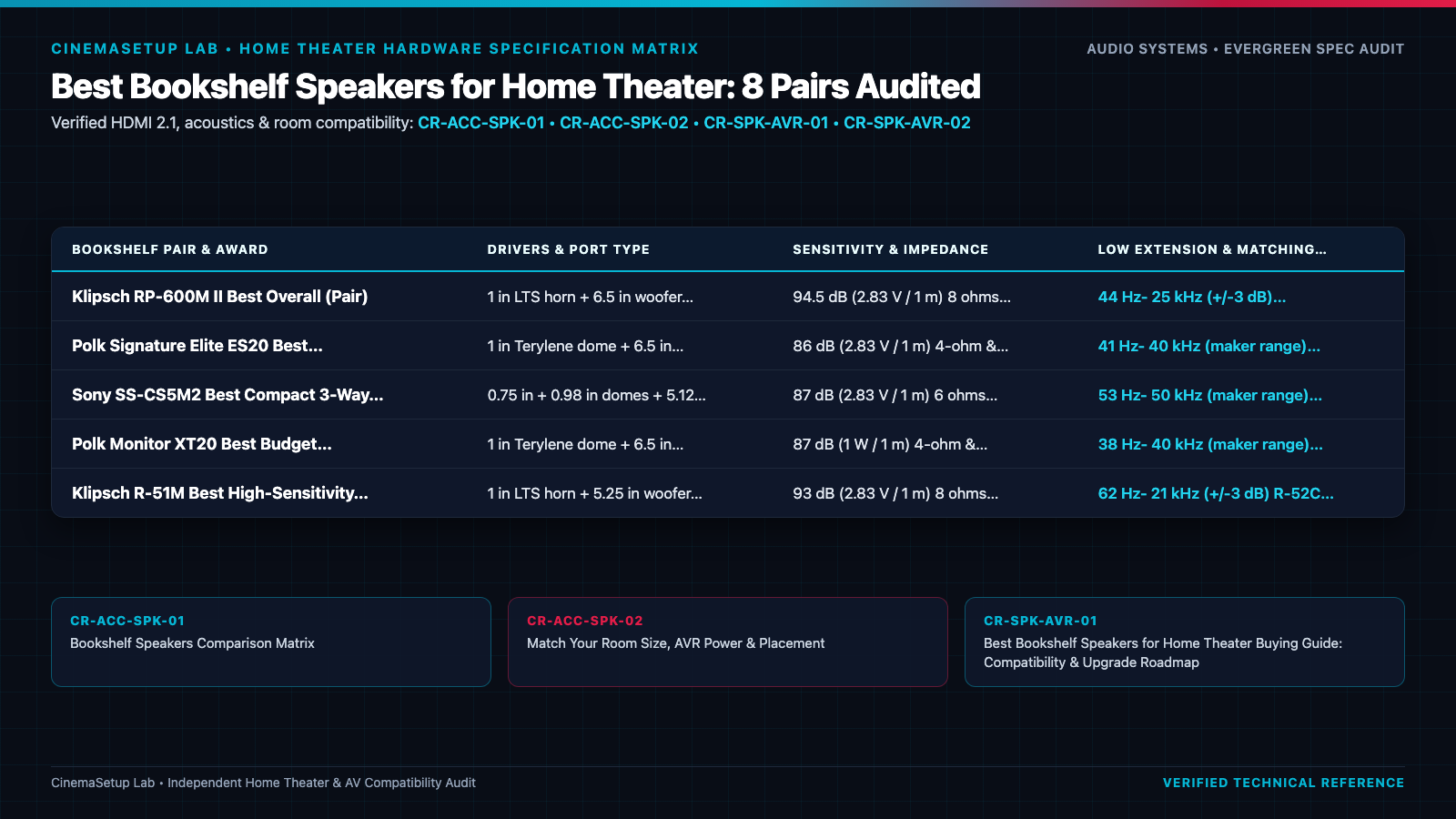
1. Sensitivity dB SPL, Nominal Impedance & AVR Wattage Math (CR-SPK-AVR-01 & 02)
Never shop by “recommended amplifier power” alone—those ranges merely tell you safe thermal boundaries, not how loud a speaker plays in your room. Instead, check sensitivity dB SPL alongside its exact measurement basis (2.83 V / 1 m versus 1 W / 1 m) and nominal impedance. Every +3 dB increase in target loudness doubles required amplifier wattage, and every +10 dB requires ten times the power.
By our estimate from published specs (using a conservative 30% multichannel derating on an 8-ohm, 20 Hz-20 kHz, 2-channel-driven AVR rating and zero room gain), a 93 dB (2.83 V / 1 m) 8-ohm speaker like the Klipsch R-51M needs roughly 62 W per channel to hit 100 dB living-room peaks at 11.5 ft (3.5 m). At that exact same distance and peak level, an 87 dB (1 W / 1 m) 8-ohm monitor requires nearly 245 W per channel—or drops naturally to a comfortable 95 dB living-room peak target at ~78 W per channel. Also confirm impedance compatibility (CR-SPK-AVR-01): Polk ES20, XT20, and XT15 are rated 4- and 8-ohm compatible, Sony SS-CS5M2 and Edifier P12 are 6-ohm nominal, and Klipsch RP-600M II, R-51M, and R-41M are 8-ohm compatible.
2. Pair vs Single Pricing, Timbre Matching & Dolby Atmos Height Paths (G-29 & CR-SPK-SPK-01)
Always verify pair vs single checkout language before comparing prices across Amazon listings. All eight bookshelf models audited above ship as two-speaker stereo pairs, whereas horizontal center channels and floorstanding towers are frequently sold as single units. Keep your audio budget split healthy under rule CR-SYS-01: passive speakers and subwoofers should receive at least 50% of your total audio budget, leaving 25-40% for the AV receiver and 5-10% for stands, wire, and mounts.
Because the center channel anchors most movie dialogue, compatibility rule CR-SPK-SPK-01 advises timbre matching Front Left/Right bookshelves to a center speaker from the exact same brand series—never mix a horn-loaded Klipsch front pair with a soft-dome Polk center. Follow Dolby Atmos 5.1.2 speaker placement guidelines when expanding into physical Dolby Atmos height channels (remembering under rule CR-SYS-05 that virtualized DSP height modes are never equivalent to physical height drivers):
| Front Bookshelf Family | Matching Series Center Channel | Matching Surround & Height Options |
|---|---|---|
| Klipsch Reference Premiere II (RP-600M II) | RP-500C II or RP-504C II | RP-500M II / RP-500SA II on-wall or up-firing height |
| Polk Signature Elite (ES20) | ES30 (full) or ES35 (slim console) | ES10 compact surrounds / ES90 height modules |
| Polk Monitor XT (XT20 / XT15) | MXT30 (full) or MXT35 (slim console) | Monitor XT15 surrounds / MXT90 sealed height modules |
| Sony CS Series (SS-CS5M2) | SS-CS8M2 | SS-CS5M2 surrounds / SS-CSEM2 Atmos modules |
| Klipsch Reference (R-51M / R-41M) | R-52C or R-34C | R-41M surrounds / R-41SA elevation modules |
3. Ear-Level Placement, Port Clearance & 80 Hz Crossover Tuning (CR-SPK-ROOM-04/05 & CR-SUB-SPK-01)
Bookshelf speakers rarely perform at their best sitting directly on a low TV credenza or stuffed inside enclosed cabinetry. Under rule CR-SPK-ROOM-05, budget for rigid 24-28 in stands—see our audited best speaker stands for bookshelf speakers guide—so your tweeters sit at seated ear-level placement (roughly 36-40 in / 91-102 cm from the floor) and angle slightly toward the main couch.
Mind port clearance behind the cabinet (CR-SPK-ROOM-04): open rear-ported designs such as the Klipsch RP-600M II, R-51M, Polk Monitor XT20, and Sony SS-CS5M2 sound cleanest with 6-12 in (15-30 cm) of space from the wall behind them, whereas the Polk ES20’s rear Power Port diffuser and the Edifier P12’s front port tolerate tighter wall gaps. Once wired into your AVR’s binding posts, run room calibration with level-calibration tones, set all bookshelf speakers to Small, and engage an 80 Hz crossover (or 90-100 Hz for 4-inch monitors like the Klipsch R-41M) so your powered subwoofer handles sub-bass LFE tracks cleanly.
4. Upgrade Roadmap, Speaker Wire Gauge & Mounting Safety (G-27)
Plan three post-purchase essentials right alongside your bookshelf speakers so total system cost stays predictable:
- Proper Copper Speaker Wire (CR-ACC-SPK-01): Use 16 AWG oxygen-free copper wire for one-way runs up to ~50 ft (15 m) on 8-ohm speakers (or ~37 ft / 11 m on 6-ohm speakers like the Sony SS-CS5M2 and Edifier P12); step up to 14 AWG for runs up to ~79 ft (24 m) at 8 ohms or ~59 ft (18 m) at 6 ohms.
- In-Wall Fire Rating & Mounting Safety (CR-ACC-SPK-02 & G-27): Any speaker wire concealed inside drywall or ceiling cavities must carry a UL CL2 or CL3 in-wall fire rating per local electrical codes. When wall-mounting surrounds or anchoring heavy stands around pets and children, follow manufacturer mounting instructions first—anchor brackets into structural wood studs rather than hollow drywall, respect bracket weight limits, and consult a licensed AV installer or electrician for concealed in-wall wiring. Keep listening levels comfortable over extended movie marathons.
- Stepwise 2.1 → 3.1 → 5.1.2 Expansion: Start with a strong Left/Right bookshelf pair and a capable powered subwoofer (2.1), add the exact series center channel for anchored dialogue (3.1), and later move compact pairs like the Monitor XT15 or R-41M to surround channels while adding physical height modules for 5.1.2 Dolby Atmos.
Secondary Intent Resolver: Horn-Loaded vs. Soft-Dome Tweeters
Buyers comparing Klipsch Tractrix horns against Polk Terylene domes or Sony 3-way soft domes often treat the choice as subjective preference, yet measurable system fit draws a clean line. Horn-loaded Klipsch speakers (90-94.5 dB at 2.83 V / 1 m) turn modest 70-80 W/ch AV receivers into high-output cinema systems at 10-13 ft seating distances with tighter vertical/horizontal directivity control that reduces sidewall bounce. Soft-dome monitors like the Polk ES20, XT20, and Sony SS-CS5M2 offer wider off-axis horizontal dispersion across broad sofa seating, provided you supply firmer AVR wattage or sit within 7-10 ft (2.1-3.0 m).
100% Weighted Scoring Rubric & Excluded Models
Every speaker pair on CinemaSetup Lab is audited exclusively against published manufacturer US specification sheets, owner manuals, and our deterministic compatibility rule engine rather than marketing adjectives. Affiliate commission structures (4% on passive audio accessories/speakers versus 2% on televisions) play zero role in rankings or verdicts (G-25). Read our full review methodology and editorial standards for complete documentation.
| Evaluation Criterion | Weight | What We Verify |
|---|---|---|
| Acoustic Architecture & Extension | 30% | Driver sizing, tweeter design, crossover frequency, and low-end cutoff with stated tolerance notes |
| AVR Fit & Family Completeness | 25% | Sensitivity basis normalization, 4/6/8-ohm AVR safety, and matching center/height family options |
| Port & Placement Flexibility | 15% | Rear-port clearance versus Power Port or front-ported wall tolerance, depth, and mount options |
| Per-Pair Value Within Tier | 15% | Confirmed pair pricing tier against direct Amazon US passive competitors |
| Cabinet Build & Binding Posts | 10% | Enclosure mass, 5-way or bi-wire posts versus spring clips, grilles, and finishes |
| US Warranty & Dealer Support | 5% | US factory passive warranty coverage and authorized-seller clarity at Amazon checkout |
Models We Audited & Excluded (And Why)
- ULTIMEA BS-3 Powered Bookshelf Speakers (B0GY3YTDXL): Active powered monitors with built-in amplification cannot be wired to an AV receiver’s speaker-level terminals (risking amplifier damage) and lack a passive matching center channel for 3.1/5.1 timbre alignment (CR-SPK-SPK-01).
- Klipsch R-15M & Polk Audio T15: Older-generation entry bookshelf pairs largely superseded in their respective brand lineups by the current Klipsch R-51M and Polk Monitor XT15, which align cleanly with current-generation centers and Atmos height modules.
- Polk Monitor XT60 Single Tower & In-Ceiling/Height Modules: The XT60 is sold as a single floorstanding speaker rather than a stereo bookshelf pair (G-29), while models like the Klipsch CDT-3650-C II and RP-500SA are dedicated overhead/elevation modules rather than ear-level bookshelf monitors.
- Polk Reserve R200 & KEF Q3 Meta: Well-regarded audiophile bookshelf lines referenced in our knowledge base, excluded from this roundup because verified single-pair Amazon US (ZIP 10001) retail listings and official CDN image URLs were absent from our active catalog slice (G-20/G-21).
Continue Your Audit
- Best AV Receivers (2026): 9 Home Theater Picks Audited
- Best AV Receivers Under $1,000 2026: 7.2-Channel Picks Audited
- Best AV Receivers for Dolby Atmos 2026: 5.1.4 & 7.1.4 Audited
Best Bookshelf Speakers for Home Theater Frequently Asked Questions
What are the best bookshelf speakers for home theater right now?
The Klipsch Reference Premiere RP-600M II is our top overall pick for most home theater builds. Its 94.5 dB (2.83 V / 1 m) sensitivity, 44 Hz (+/-3 dB) low-end reach, and horn-matched RP-504C II center ecosystem maximize AVR headroom and front-stage consistency.
Are bookshelf speakers sold individually or as a pair on Amazon?
It varies by speaker type, so always verify the listing title under guardrail G-29. All eight bookshelf models audited here ship as stereo pairs (two speakers), whereas center channels, subwoofers, and most floorstanding tower listings are priced per single speaker.
What crossover frequency should I set for home theater bookshelf speakers?
Set all bookshelf speakers to Small with an 80 Hz crossover in your AV receiver menu when using a powered subwoofer (rule CR-SUB-SPK-01). Compact 4-inch monitors such as the Klipsch R-41M (68 Hz cutoff) perform cleaner at a 90-100 Hz crossover.
Do I need speaker stands for home theater bookshelf speakers?
Yes, in nearly every living room under rule CR-SPK-ROOM-05. Rigid 24-28 in stands align tweeters with seated ear height (36-40 in / 91-102 cm), decouple cabinets from booming media consoles, and preserve 6-12 in (15-30 cm) rear-port wall clearance.
Can I mix different brands for my bookshelf fronts and center channel?
Mixing front-stage brands is strongly discouraged under compatibility rule CR-SPK-SPK-01. Horn-loaded tweeters and soft-dome tweeters disperse sound differently, causing voices and effects panning across Left, Center, and Right to shift tone noticeably unless all three share the same series.
How much receiver power do bookshelf speakers actually need?
Power demand hinges on sensitivity and seating distance under rule CR-SPK-AVR-02. At 11.5 ft (3.5 m) for 100 dB movie peaks, a 93 dB (8-ohm) pair needs roughly 62 W per channel, whereas an 87 dB pair needs nearly four times as much power.
Final Verdict: Choosing the Right Bookshelf Pair
Choosing the best bookshelf speakers for home theater starts by matching speaker efficiency and cabinet porting to your actual room and AV receiver rather than chasing driver counts alone. For most 5.1 and 5.1.2 living rooms, the Klipsch Reference Premiere RP-600M II stands clearly ahead thanks to its 94.5 dB (2.83 V / 1 m) sensitivity, +/-3 dB 44 Hz low-frequency extension, and deep Reference Premiere II center and height ecosystem.
If your speakers sit close to a front wall or inside a mid-range budget, the Polk Signature Elite ES20 tames rear-port boundary boom better than any open-ported rival. For tighter starter budgets under $250 per pair, choose the compact 3-way Sony SS-CS5M2 for narrow consoles, the Polk Monitor XT20 for 6.5-inch subwoofer handoff, or the Edifier P12 when you strictly need flush wall-mounted rear surrounds.


