
Disclosure: As an Amazon Associate, I earn from qualifying purchases. If you buy through links on this page, we may earn a small commission at no extra cost to you.
Deciding between a sealed vs ported subwoofer comes down to your room volume in cubic feet, wall-clearance limits, and whether you share walls with neighbors rather than chasing generic “music versus movies” myths. A sealed (acoustic suspension) subwoofer traps air inside an airtight cabinet, yielding a compact footprint and a gradual 12 dB/octave roll-off that blends naturally with enclosed room gain. A ported (bass-reflex) subwoofer uses a calibrated vent to boost efficiency near its tuning frequency—delivering higher acoustic output per dollar for larger living rooms before dropping off steeply at roughly 24 dB/octave below tuning.
Note an important tier spread in our live Amazon US retail comparison below: the mid-tier sealed SVS SB-1000 Pro ($550–$700 single unit) sits more than 15% above our value ported contenders from Dayton Audio ($150–$350 single units) and our compact passive-radiator Audio Pro SW-10 ($300–$450 single unit), because higher-excursion drivers and 325 W RMS amplifiers are required to match ported deep-bass output without a vent. For a complete room-by-room buyer shortlist across all price brackets, start at our best home theater subwoofers hub, then use this architectural breakdown to match cabinet physics to your exact room.
In This Comparison
- Winner-by-Room & Use-Case Quick Verdict Matrix
- Verified Contender Specifications & Unit Pricing Context
- Battleground 1: Acoustic Suspension vs. Bass-Reflex Physics & RMS Power
- Battleground 2: Room Volume Sizing & Open-Plan Traps (CR-SUB-ROOM-01 & 02)
- Battleground 3: Apartments, Shared Walls & Port Clearance (CR-SUB-ROOM-03)
- Battleground 4: AVR Compatibility, Bass Management & Soundbar Locks
- Battleground 5: Lifting Safety, US Warranty Coverage & Marketplace Traps
- Choose Sealed vs. Choose Ported Verdict Cards & Amazon US Picks
- Frequently Asked Questions
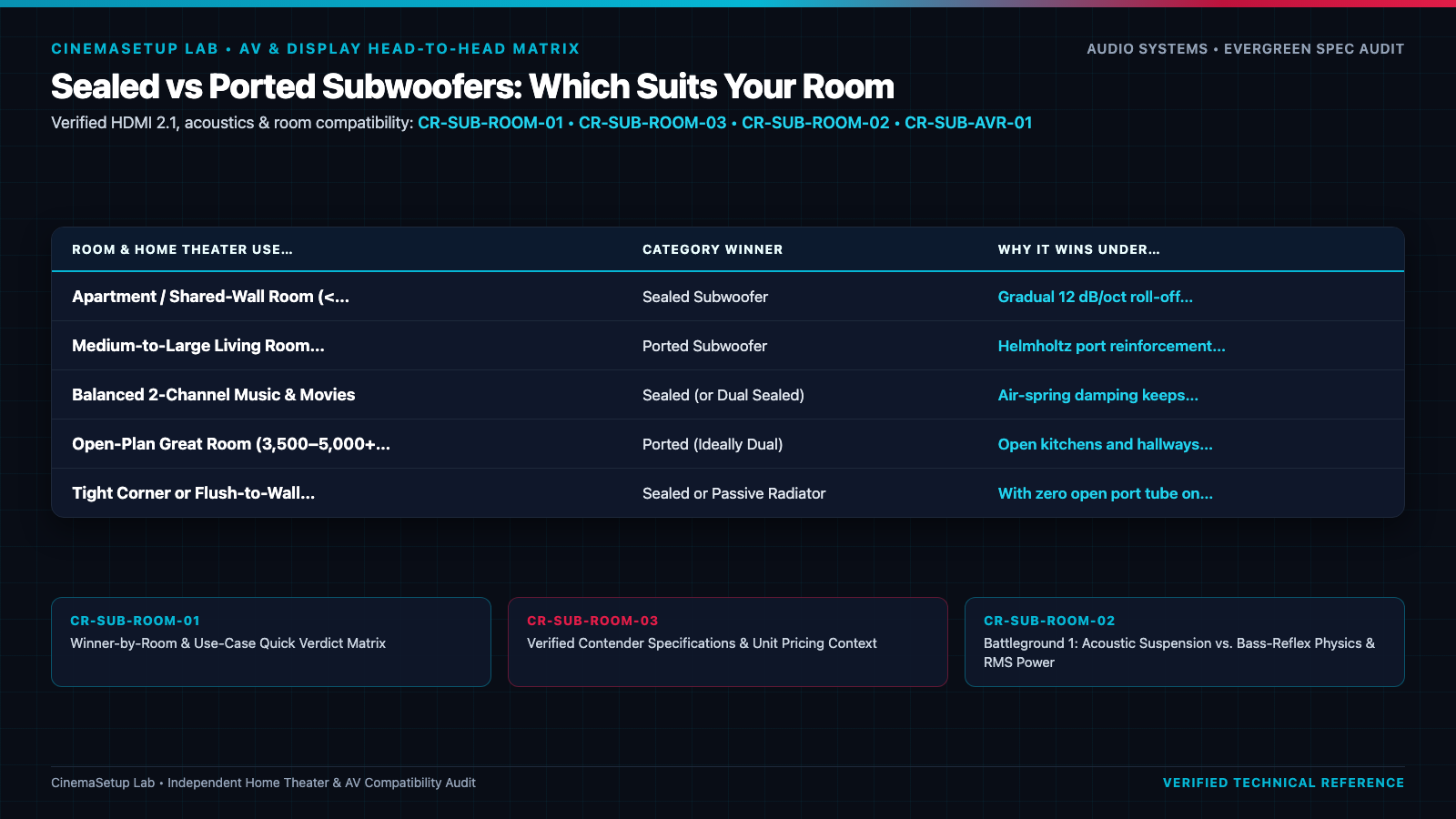
Quick Verdict: Sealed vs. Ported Subwoofer by Room Profile
Neither cabinet topology dominates every room. Under CinemaSetup Lab compatibility rules, room volume, shared-wall constraints, and floor space dictate which enclosure performs cleanly in your home:
| Room & Home Theater Use Case | Category Winner | Why It Wins Under Audited Rules |
|---|---|---|
| Apartment / Shared-Wall Room (< 1,500 cu ft / 42 m³) | Sealed Subwoofer | Gradual 12 dB/oct roll-off avoids sharp port peaks, and pairing a sealed box with decoupling pads and AVR Night Mode minimizes cabinet rattle (CR-SUB-ROOM-03). |
| Medium-to-Large Living Room (1,500–3,800 cu ft / 42–108 m³) | Ported Subwoofer | Helmholtz port reinforcement extracts higher acoustic output per dollar around 25–40 Hz, pressurizing larger air volumes without blowing the audio budget (CR-SUB-ROOM-01). |
| Balanced 2-Channel Music & Movies | Sealed (or Dual Sealed) | Air-spring damping keeps low-frequency group delay low and resists over-excursion below 25 Hz when paired cleanly at an 80 Hz crossover (CR-SUB-SPK-01). |
| Open-Plan Great Room (3,500–5,000+ cu ft / 99–142+ m³) | Ported (Ideally Dual) | Open kitchens and hallways leak bass energy; high-displacement ported enclosures maintain cinematic LFE authority across connected spaces. |
| Tight Corner or Flush-to-Wall Placement | Sealed or Passive Radiator | With zero open port tube on the back panel, sealed and passive-radiator cabinets can sit closer to walls without choking port airflow. |
| Wide Sofa or Two-Row Theater Seating | Dual Matched Subs (Sealed or Ported) | Two smaller matched subwoofers placed apart smooth seat-to-seat peaks and nulls more effectively than one oversized cabinet (CR-SUB-ROOM-02). |
Side-by-Side Contender Specs & Pack Quantities
To keep hardware comparisons grounded in verified manufacturer documentation (G-03, G-04, and G-29), the table below contrasts four verified Amazon US powered subwoofers spanning acoustic suspension (sealed), dual passive radiator (a port-free sealed-box hybrid), and ported bass-reflex designs. Every model listed here is sold as a Single unit (1 subwoofer).
| Verified Specification | SVS SB-1000 Pro (Sealed) | Audio Pro SW-10 (Passive Radiator) | Dayton Audio CS1200 (Ported 12″) | Dayton Audio CS1000 (Ported 10″) |
|---|---|---|---|---|
| Retail Pack Quantity (G-29) | Single unit (1 subwoofer) | Single unit (1 subwoofer) | Single unit (1 subwoofer) | Single unit (1 subwoofer) |
| Amazon US Price Tier (G-08) | $550–$700 (Mid-Tier) | $300–$450 (Compact Hybrid) | $200–$350 (Value Cinema) | $150–$300 (Starter) |
| Enclosure Architecture | Sealed acoustic suspension | Closed cabinet w/ dual 9-in passive radiators | Ported / bass-reflex (tuned 32 Hz) | Ported / bass-reflex (tuned 39 Hz) |
| Active Driver Size | 12-in (30.5 cm) fiber composite cone | 8-in (20.3 cm) long-throw woofer | 12-in (30.5 cm) mineral-filled poly cone | 10-in (25.4 cm) mineral-filled poly cone |
| Amplifier Power (RMS vs. Peak) | 325 W RMS / 820+ W peak (Class D) | 200 W Digital Class D (DSP; peak unpublished) | 200 W RMS (Class D; peak unpublished) | 180 W RMS (Class D; peak unpublished) |
| Maker LF Extension & Tolerance | 20 Hz – 270 Hz (±3 dB) | 33 Hz – 120 Hz (dB tolerance unpublished) | 26 Hz – 200 Hz (dB tolerance unpublished) | 28 Hz – 200 Hz (dB tolerance unpublished) |
| Inputs & Integration Controls | LFE RCA, stereo RCA in/out, speaker-level, 3–12 V trigger, BLE DSP app (3-band PEQ) | RCA line-in, variable 40–120 Hz crossover, 0/180° phase | Dedicated LFE RCA, stereo RCA, speaker-level in/out, 40–160 Hz crossover, 0/180° phase | Dedicated LFE RCA, stereo RCA, speaker-level in/out, 40–160 Hz crossover, 0/180° phase |
| Dimensions (H × W × D) & Weight | 13.5 × 13.0 × 14.76 in (34.2 × 33.0 × 37.5 cm) w/ grille • 26.0 lb (11.9 kg) | 11.0 × 11.0 × 11.6 in (28.0 × 28.0 × 29.5 cm) • 21.3 lb (9.65 kg) | 18.0 × 15.5 × 16.37 in (45.7 × 39.3 × 41.5 cm) • 38.8 lb (17.8 kg) | 16.0 × 13.5 × 14.37 in (40.6 × 34.2 × 36.5 cm) • 29.3 lb (13.3 kg) |
| US Limited Warranty (G-26) | 5-year unconditional US warranty (authorized dealer) | 2-year webshop warranty (partner terms vary) | 1-year powered-sub electronics warranty (authorized dealer) | 1-year powered-sub electronics warranty (authorized dealer) |
Measurement Transparency Note (G-01, G-03 & G-09): The frequency ranges printed above are manufacturer specifications, not third-party in-room measurements. Notice that SVS publishes a strict ±3 dB tolerance (20 Hz – 270 Hz), whereas Dayton Audio and Audio Pro omit a decibel tolerance window on their summary sheets—meaning you cannot treat a 26 Hz or 33 Hz range rating as equivalent to a ±3 dB specification. Independent ANSI/CTA-2010 burst output benchmarks across identical measurement conditions are not yet verified in our knowledge graph for the Dayton Audio CS1000/CS1200 and Audio Pro SW-10.
Battleground 1: Acoustic Suspension vs. Bass-Reflex Physics & RMS Power
Understanding what happens inside the cabinet explains why sealed and ported subwoofers behave so differently in real rooms:
- How a Sealed Subwoofer Works (Acoustic Suspension): The woofer mounts inside a rigid, airtight enclosure. As the cone moves backward, the trapped air compresses like a linear mechanical spring, resisting excessive excursion and keeping cone motion tightly controlled. Because acoustic pressure only comes from the front of the cone, low-frequency output tapers gradually at roughly 12 dB per octave below resonance. That gentle slope pairs naturally with typical residential room boundary gain (which boosts low frequencies in enclosed spaces), allowing a compact 13.5-inch sealed cube like the SVS SB-1000 Pro to reach 20 Hz (±3 dB) cleanly when driven by a robust 325 W RMS amplifier.
- How a Ported Subwoofer Works (Bass-Reflex): A ported cabinet cuts a tuned tube or flared slot into the enclosure so rear-wave energy inside the box resonates at a chosen frequency—such as 32 Hz on the Dayton Audio CS1200 or 39 Hz on the Dayton Audio CS1000. Near that tuning point, air moving inside the port works in phase with the cone, adding roughly 3 to 6 dB of free acoustic reinforcement while reducing cone excursion. Below the tuning frequency, however, the port unloads and acoustic cancellation causes output to plunge steeply at roughly 24 dB per octave.
- Where Passive Radiators Fit In: Designs like the Audio Pro SW-10 replace an open port tube with weighted passive diaphragms (dual 9-inch radiators flanking an 8-inch active woofer). Acoustically, passive radiators still act like a bass-reflex system with a steep low-end roll-off, yet they avoid audible port turbulence (“chuffing”) and allow a tiny 11.0-inch cube where a long internal port tube would never physically fit.
Why RMS Power Matters More Than Peak Watts (G-03): Always compare continuous RMS wattage rather than flashy “peak” or “dynamic” power numbers. Peak wattage reflects brief millisecond bursts rather than sustained output during prolonged low-frequency movie passages. Because a sealed woofer fights internal air pressure down to 20 Hz without help from a port, sealed designs rely heavily on high-RMS amplifiers and long-throw motors—explaining why the sealed SVS SB-1000 Pro packs 325 W RMS (820+ W peak) into a 13.5-inch box, whereas the larger ported Dayton CS1200 leans on port efficiency with 200 W RMS.
Battleground 2: Room Volume Sizing & Open-Plan Traps (CR-SUB-ROOM-01 & 02)
Under compatibility rule CR-SUB-ROOM-01, cabinet style only succeeds when matched to total connected air volume. Compute your room volume using Length × Width × Ceiling Height in feet (multiply cubic feet by 0.0283 for cubic meters). Crucially, if your living room opens onto a kitchen, dining area, or stairwell with no solid door, you must add that connected volume—sub-bass waves pressurize the entire open air space, not just the area around your rug.
| Total Connected Room Volume | Example Room Dimensions | Sealed vs. Ported Sizing Guidance (CR-SUB-ROOM-01) |
|---|---|---|
| Under 1,500 cu ft (< 42 m³) | 12 × 14 × 8 ft (3.7 × 4.3 × 2.4 m) closed bedroom or den = 1,344 cu ft (38.1 m³) | Sealed shines here: One compact 8–12 in sealed or passive-radiator sub (such as the Audio Pro SW-10 or SVS SB-1000 Pro) benefits from strong boundary gain. |
| 1,500 – 3,000 cu ft (42 – 85 m³) | 15 × 20 × 9 ft (4.6 × 6.1 × 2.7 m) enclosed living room = 2,700 cu ft (76.5 m³) | True crossover zone: Choose a high-output 12-in sealed sub for compact aesthetics/music, or a 10–12 in ported sub (like the Dayton CS1200) for maximum cinema impact per dollar. |
| 3,000 – 5,000 cu ft (85 – 142 m³) | 18 × 25 × 10 ft (5.5 × 7.6 × 3.0 m) great room = 4,500 cu ft (127.4 m³) | Ported pulls ahead: Single small sealed boxes run out of headroom here; choose a larger 13–16 in ported sub or run two 12-in subs. |
| Over 5,000 cu ft (> 142 m³) or Open Plan | Living room + kitchen + vaulted foyer = 6,000+ cu ft (170+ m³) | Multi-sub mandatory for cinema impact: Run two or more 12–16 in ported subwoofers with independent AVR room calibration (CR-SUB-AVR-02). |
The Dual-Subwoofer Advantage (CR-SUB-ROOM-02): Even inside a modest 2,200 cu ft (62.3 m³) room, a single subwoofer excites standing-wave room modes—causing boomy peaks on the left cushion and hollow bass three feet away. Placing two smaller matched subwoofers apart (for example, opposite corners or front-wall quarter points) evens out bass across every seat more reliably than buying one massive ported box. Note that dual-sub pricing doubles unit cost, so always verify single-unit pack quantities (G-29).
Battleground 3: Apartments, Shared Walls & Port Clearance (CR-SUB-ROOM-03)
Many shoppers assume a sealed subwoofer stops bass from bothering neighbors. Under compatibility rule CR-SUB-ROOM-03 and safety/honesty guardrail G-27, no subwoofer is silent through shared walls or floors. Long 30–80 Hz sound waves travel readily through wood joists, drywall, and concrete slabs regardless of enclosure type, and we never promise decibel isolation figures for decoupling pads.
That said, a sealed cabinet remains far easier to live with in apartments for three practical reasons:
- Smoother Roll-Off & Night-Mode Pairing: Ported enclosures often emphasize 32–45 Hz peaks that rattle drywall studs and downstairs ceilings. Pairing a sealed cabinet with your AV receiver’s Night Mode or Dynamic Range Compression (DRC) trims sudden LFE explosions while keeping quiet dialogue intelligible.
- App-Based Room-Mode Taming: Models with built-in parametric EQ—such as the SVS SB-1000 Pro Bluetooth app—let you pull down a booming 45 Hz or 60 Hz room resonance by several decibels, cutting neighbor-annoying boom without killing overall warmth.
- Wall & Corner Clearance: Rear-ported subwoofers need several inches of breathing clearance behind the cabinet so air exiting the vent does not bounce directly off drywall and chuff. Sealed cubes and passive-radiator enclosures can sit closer to front walls or corners, leaving only enough rear clearance for power cords, RCA plugs, and amplifier heatsink airflow per the manual.
Before locking in a permanent spot, use the qualitative subwoofer crawl: place the subwoofer temporarily at your main seating cushion, play bass-rich music or level-calibration tones at comfortable volume, and walk along the perimeter walls to locate the spot where bass sounds smoothest and least boomy. Move the subwoofer there, then re-run your AV receiver’s microphone calibration.
Battleground 4: AVR Compatibility, Bass Management & Soundbar Locks
Whether you choose sealed or ported, four cross-component compatibility rules determine whether the subwoofer integrates cleanly with your electronics:
- Powered Amplification Mandatory (CR-SUB-AVR-01 — HARD): An AV receiver’s Subwoofer / LFE Pre-Out sends an unamplified line-level signal. It cannot drive passive subwoofer enclosures (such as bare DIY boxes or car audio cabinets that frequently show up in broad Amazon searches). Every home theater pick in our comparison includes a built-in Class-D plate amplifier.
- Independent Dual-Sub Outputs (CR-SUB-AVR-02 — CONDITIONAL): If you run two sealed or two ported subwoofers, check whether your receiver has truly independent subwoofer outputs (such as the 9.4-channel Denon AVR-X3900H) or mirrored outputs that share one delay and trim channel. Mirrored outputs force you to align physical distances manually or rely on a Y-splitter.
- Set Speakers to “Small” & Bypass the Sub Dial (CR-SUB-SPK-01 — SOFT): In your AV receiver setup menu, set all main, center, and surround speakers—even floorstanding towers—to Small with an 80 Hz crossover default (or 100–150 Hz for compact satellites, staying at or above 1.5 times each speaker’s -3 dB bass limit). On the subwoofer itself, turn the low-pass crossover knob to its maximum setting (or LFE Bypass) so the receiver handles filtering without double-attenuating bass.
- Closed Soundbar Ecosystems (CR-SUB-SBAR-01 — HARD): Powered subwoofers from SVS, Dayton Audio, or Audio Pro cannot pair with closed soundbar kits like the Samsung HW-Q990H or Sonos Arc Ultra unless the soundbar explicitly provides a wired RCA subwoofer pre-out. Soundbar users must stick strictly to their brand’s listed wireless subwoofers (such as the Sonos Sub 4 or Sub Mini).
Known Reliability Notes (G-12): Two model-agnostic issues appear across powered subwoofers (ISS-SUB-AUTO-STANDBY-DROPOUT and ISS-SUB-WIRELESS-PAIRING-LOSS). First, subwoofers set to “Auto-On” sometimes sleep during quiet dialogue scenes when AVR LFE trim sits too low. To fix this, raise your receiver’s subwoofer channel level by +3 to +6 dB while lowering the gain knob on the back of the subwoofer to keep total loudness identical—or use a 3–12 V trigger cable if your sub supports one (as the SVS SB-1000 Pro does). Second, according to community reports, not officially confirmed, third-party wireless subwoofer kits and ecosystem subs occasionally drop pairing after firmware updates; wired shielded RCA cables remain the most reliable path whenever floor routing is feasible.
Battleground 5: Lifting Safety, US Warranty Coverage & Marketplace Traps
Before clicking buy on Amazon US, audit three practical ownership details that spec sheets gloss over:
- Lifting, Ventilation & Electrical Safety (G-27 & CR-SYS-02): Follow the manufacturer’s owner’s manual for unsealing, lifting, and placement. Heavy ported 12-inch cabinets like the Dayton Audio CS1200 (38.8 lb / 17.8 kg)—and step-up 50+ lb (22.7+ kg) ported models—benefit from two-person lifting and felt or isolation feet on hardwood floors. Keep rear Class-D heatsinks clear of curtains or tight alcoves, verify US 120 V AC / 60 Hz compatibility (never gray-market foreign-voltage units), and consult a licensed electrician or certified AV installer if adding dedicated outlets or routing UL-listed CL2/CL3 in-wall subwoofer cable. Keep listening volumes comfortable over long movie marathons.
- US Warranty & Authorized Sellers (G-26): Coverage varies sharply by brand. SVS backs the SB-1000 Pro with a 5-year unconditional US warranty when purchased through authorized US dealers. By contrast, Dayton Audio’s 5-year policy applies to passive speakers—powered subwoofers like the CS1000 and CS1200 carry a 1-year electronics warranty. Audio Pro lists a 2-year direct webshop warranty, while authorized third-party partner terms vary. Always verify that the Amazon checkout seller is Amazon.com or a named authorized US dealer (checked 2026-11-26) before ordering.
- Avoid Car Audio & Passive Box Traps (G-29): Broad Amazon searches for “sealed vs ported subwoofer” mix home theater powered cabinets with passive carpeted car enclosures, bare 12V drivers, and slim under-seat truck subwoofers. Verify that your listing specifies a built-in 120 V AC plate amplifier, an LFE/RCA line input, and clear Single unit packaging before checkout.
Verdict Summary: Choose Sealed vs. Choose Ported
Choose a Sealed Subwoofer if…
- Your room is under 2,500 cu ft (71 m³), closed off by doors, or shares walls/floors with neighbors (CR-SUB-ROOM-03).
- You need a compact cube footprint under 15 in (38.1 cm) that tucks cleanly near a front wall without rear-port chuffing.
- You want smooth 12 dB/octave roll-off, zero port noise, and 5-year US electronics coverage backed by Bluetooth PEQ room tuning.
Choose a Ported Subwoofer if…
- Your space exceeds 1,500–3,000 cu ft (42–85 m³) or opens into an adjacent kitchen, dining area, or hallway (CR-SUB-ROOM-01).
- You want maximum movie LFE punch and acoustic output per dollar on a $150–$350 starter or core budget.
- You have floor space for a deeper cabinet plus several inches of rear-port breathing room away from drywall.
Verified Amazon US Sealed & Ported Subwoofer Picks
1. SVS SB-1000 Pro 12-Inch Sealed Subwoofer (Single Unit) — Best Compact Sealed Pick

Quick Specs: Sold Single unit (1 subwoofer) | Sealed acoustic suspension | 12-in (30.5 cm) driver | 325 W RMS / 820+ W peak | 20 Hz – 270 Hz (±3 dB) | LFE/stereo RCA, speaker-level, 3–12 V trigger, BLE app PEQ | 13.5 × 13.0 × 14.76 in (34.2 × 33.0 × 37.5 cm) w/ grille, 26.0 lb (11.9 kg) | Price Tier: $550–$700 each
Pros
- Genuine 20 Hz – 270 Hz (±3 dB) rated reach inside a remarkably compact 13.5-in (34.2 cm) sealed cabinet
- Smartphone BLE DSP app includes 3-band parametric EQ, phase, and room-gain compensation for taming apartment resonances
- Includes both LFE RCA, speaker-level terminals, a 3–12 V trigger to prevent standby dropouts, and a 5-year unconditional US warranty
Cons
- Costs more than double budget ported 12-inch competitors ($550–$700 vs. $200–$350 tier)
- Single sealed 12-inch box lacks the deep 20–30 Hz room-pressurizing output of big ported cabinets in spaces above 3,000 cu ft (85 m³)
2. Audio Pro SW-10 Compact Powered Subwoofer (Single Unit) — Best Port-Free Passive-Radiator Cube

Quick Specs: Sold Single unit (1 subwoofer) | Closed cabinet w/ dual 9-in passive radiators | 8-in (20.3 cm) active woofer | 200 W Digital Class D | 33 Hz – 120 Hz (tolerance unpublished) | RCA line-in, 40–120 Hz crossover | 11.0 × 11.0 × 11.6 in (28.0 × 28.0 × 29.5 cm), 21.3 lb (9.65 kg) | Price Tier: $300–$450 each
Pros
- Ultra-compact 11.0-in (28.0 cm) cube fits small bedrooms, desks, and tight living corners cleanly
- Dual 9-inch side-firing passive radiators deliver bass reinforcement with zero open port wind noise
- 200 W DSP-controlled Class-D amplifier provides solid headroom for rooms under 1,500 cu ft (42 m³)
Cons
- 33 Hz – 120 Hz maker range lacks a ±3 dB tolerance and skips the deepest 20–28 Hz movie LFE octave
- Lacks high-level speaker terminals and smartphone PEQ app controls; verify US authorized dealer warranty terms at checkout
3. Dayton Audio Classic CS1200 12-Inch Ported Subwoofer (Single Unit) — Best Value 12-Inch Ported

Quick Specs: Sold Single unit (1 subwoofer) | Ported / bass-reflex (tuned 32 Hz) | 12-in (30.5 cm) poly cone | 200 W RMS Class D | 26 Hz – 200 Hz (tolerance unpublished) | LFE RCA, stereo RCA, speaker-level in/out | 18.0 × 15.5 × 16.37 in (45.7 × 39.3 × 41.5 cm), 38.8 lb (17.8 kg) | Price Tier: $200–$350 each
Pros
- 12-inch cone plus 32 Hz port tuning and 200 W RMS power deliver strong mid-to-low movie impact in the $200–$350 bracket
- Full input flexibility includes dedicated LFE RCA, stereo line-in, and high-level speaker passthrough
- Affordable enough to scale into a matched dual-subwoofer pair (CR-SUB-ROOM-02) for multi-seat living rooms
Cons
- Dayton Audio limits powered subwoofer electronics coverage to 1 year rather than the 5-year policy on passive speakers (G-26)
- 26 Hz – 200 Hz bandwidth lacks a published ±3 dB tolerance, and the 38.8 lb (17.8 kg) ported cabinet needs rear clearance
4. Dayton Audio Classic CS1000 10-Inch Ported Subwoofer (Single Unit) — Best Starter Ported Pick

Quick Specs: Sold Single unit (1 subwoofer) | Ported / bass-reflex (tuned 39 Hz) | 10-in (25.4 cm) poly cone | 180 W RMS Class D | 28 Hz – 200 Hz (tolerance unpublished) | LFE RCA, stereo RCA, speaker-level in/out | 16.0 × 13.5 × 14.37 in (40.6 × 34.2 × 36.5 cm), 29.3 lb (13.3 kg) | Price Tier: $150–$300 each
Pros
- 180 W RMS Class-D power out-muscles entry 50–70 W subs in starter 1,200–2,200 cu ft (34–62 m³) setups
- Includes LFE RCA, stereo RCA, and high-level speaker terminals for seamless integration with AVRs or stereo amps
- Lighter 29.3 lb (13.3 kg) build makes one-person subwoofer-crawl positioning much easier than heavy 12-inch boxes
Cons
- 39 Hz port tuning focuses on mid-bass punch rather than sub-25 Hz infrasonic movie rumble
- 1-year US powered-subwoofer electronics warranty and unpublished ±3 dB extension tolerance
Authoritative Technical Sources
- Dolby Laboratories Official Home Theater Speaker Setup Guides — LFE (.1) channel routing, bass-management speaker sizing, and subwoofer placement fundamentals.
- SVS US Official SB-1000 Pro Specifications — 325 W RMS / 820+ W peak Sledge STA-325D amp, 20–270 Hz (±3 dB) sealed response, dimensions, inputs, and 5-year unconditional US warranty.
- Dayton Audio Official Classic Collection Specifications — CS1200 (200 W RMS, 32 Hz port tuning) and CS1000 (180 W RMS, 39 Hz port tuning) specs and 1-year powered subwoofer warranty terms.
- Audio Pro Official SW-10 Specifications — 8-in active woofer with dual 9-in passive radiators, 200 W DSP Class-D amplifier, 33–120 Hz range, and compact cabinet geometry.
- Consumer Technology Association (CTA) Standards Portal — Reference framework for ANSI/CTA-2010 standardized subwoofer burst output and distortion comparison criteria.
How We Audited This Guide
- Audio gear was audited across 8-ohm/4-ohm impedance stability, HDMI 2.1 40 Gbps switching and eARC/CEC behavior, speaker sensitivity and center dialogue dispersion, subwoofer room volume sizing, and US warranty authorization.
- Every AV receiver, speaker, subwoofer, soundbar, OLED/Mini-LED TV, projector, source player, and accessory spec was cross-checked against official manufacturer manuals, CEA/CTA standards, and live Amazon US listings.
- Recommendations were evaluated against our weighted vertical scoring rubrics and documented CR-* compatibility rules; we never invent nits, contrast ratios, bench wattage, or room decibels.
Continue Your Audit
- Best AV Receivers (2026): 9 Home Theater Picks Audited
- Best AV Receivers Under $1,000 2026: 7.2-Channel Picks Audited
- Best AV Receivers for Dolby Atmos 2026: 5.1.4 & 7.1.4 Audited
- Best AV Receivers for PS5 & Xbox (2026): 4K120 Inputs Audited
Frequently Asked Questions: Sealed vs. Ported Subwoofers
Is a sealed or ported subwoofer better for music and movies?
Neither type is strictly limited to one format. Sealed subwoofers suit smaller rooms and listeners prioritizing compact size, smooth 12 dB/octave roll-off, and tight transient control, while ported subwoofers deliver more deep-bass acoustic output per dollar for movies in medium-to-large spaces.
Does a sealed subwoofer stop noise from bothering apartment neighbors?
No, no subwoofer is silent through shared walls or floors because low-frequency sound waves travel structurally. However, under rule CR-SUB-ROOM-03, a sealed subwoofer paired with isolation feet, parametric EQ, and your receiver’s Night Mode reduces cabinet vibration and sharp LFE peaks.
How do I know if my room is too big for a sealed subwoofer?
Calculate total connected volume in cubic feet (Length × Width × Ceiling Height, adding open kitchens or hallways without doors). Under rule CR-SUB-ROOM-01, a single compact 10-to-12-inch sealed sub suits up to roughly 1,500–2,500 cu ft (42–71 m³); larger spaces favor ported or dual subwoofers.
Should I set my speakers to Small or Large with a sealed or ported subwoofer?
Set all main, center, and surround speakers to Small in your AV receiver menu with an 80 Hz crossover default (100–150 Hz for small satellites) under rule CR-SUB-SPK-01. Turn the subwoofer’s own low-pass dial to maximum or LFE Bypass so filtering happens once.
Can I connect a sealed or ported powered subwoofer to a soundbar?
Usually no, unless your soundbar explicitly includes an RCA subwoofer pre-out. Under hard rule CR-SUB-SBAR-01, mainstream wireless soundbars like the Sonos Arc Ultra or Samsung HW-Q990H lock pairing exclusively to their brand’s listed wireless subwoofers rather than generic AVR subs.
Why are passive subwoofer boxes on Amazon incompatible with my AV receiver?
An AV receiver’s LFE Sub Out carries only a low-voltage line-level signal and has zero built-in amplification for a subwoofer. Under hard rule CR-SUB-AVR-01, passive car or DIY boxes cannot run off an AVR pre-out unless you purchase an external subwoofer power amplifier.


