
Disclosure: As an Amazon Associate, I earn from qualifying purchases. If you buy through links on this page, CinemaSetup Lab may earn a small commission at no extra cost to you. Commission tiers differ across categories—for example, televisions typically earn around 2% while projectors, screens, and AV accessories earn around 4%—and commission rates never influence our compatibility audits, seller checks, or recommendations.
Type "4K projector" into Amazon US search and page one fills with sub-$400 white and black cubes promising "4K Ultra HD" alongside tiny fine print reading "Native 720P" or "Native 1080P." Understanding 4k support projector vs native 4k—and where legitimate 4K pixel-shifting fits in between—is the single best safeguard against buying a soft, dim bedroom gadget disguised as a 4K cinema machine.
Across our live ZIP 10001 catalog checks documented in our Amazon home theater buying audit, generic sub-$400 projector listings routinely conflate input signal decoding with projected optical resolution. Under CinemaSetup Lab compatibility rules (CR-SRC-DISP-01, CR-DISP-ROOM-03, CR-DISP-ROOM-05, and CR-SYS-02) and our published specification audit methodology, "4K support" simply means the HDMI board accepts a 3840×2160 video stream without throwing an error before shrinking it down to 11% to 25% of true 4K pixel detail. This audit dissects the marketing playbook, maps a 60-second pre-checkout filter, and surfaces four verified US listings that state their chip resolution honestly.
In This Audit
- Urgent Buyer Alert: 4 "4K Support" Traps on Amazon US
- Amazon Projector Listing Inspection Matrix
- Native 4K vs. Pixel-Shift 4K vs. "4K Support" Explained
- HDR10 Fallback, Inflated Lumens & Digital Keystone Loss
- Seller Integrity, Variant Pooling & Mounting Safety (G-26 / G-27)
- 60-Second Pre-Checkout Audit Checklist
- Verified Transparent Alternatives on Amazon US
- Authoritative Standards & References
- Frequently Asked Questions
Urgent Buyer Alert: 4 "4K Support" Traps on Amazon US
Marketplace Buyer Alert (Verified 2026-11-26, ZIP 10001): Before ordering any Amazon US projector carrying "4K" in its headline—especially under $400—screen the product page for these four recurring traps:
- "4K Support / 4K Decoding" Hiding 720p Panels (
G-16): Generic sub-$400 units (including common HAPPRUN, XuanPad, KOGATA, and Magcubic marketplace listings) spotlight "4K Support" in bold graphics while burying1280×720or1920×1080native LCD chip specs in lower bullet points—discarding 75% to 88.9% of incoming 4K UHD pixels. - Clashing "HDR10 / Dolby Vision" & Unstandardized Lumens (
CR-SRC-DISP-01,CR-DISP-ROOM-03): Cheap single-LCD light engines claiming "8,000+ Lux/LED Lumens" and "4K HDR" lack dynamic tone-mapping hardware and standardized ISO 21118 or ANSI optical ratings, clipping bright scenes and washing out in modest ambient light. - Heavy Auto-Keystone Cropping Instead of Optical Shift (
CR-DISP-ROOM-05): Fixed-lens budget projectors market "Auto Keystone" as a convenience feature, yet tilting the unit beyond 10 to 15 degrees digitally shrinks the active image area, sacrificing even more sharpness and brightness. - Pooled Variant Reviews & Missing US Warranty Backing (
G-05,G-26): Unbranded sellers frequently merge older 720p or 1080p mini-projector reviews onto "2026 Upgraded 4K Support" variants and ship from rotating third-party storefronts with no accountable US service center after Amazon’s 30-day return window.
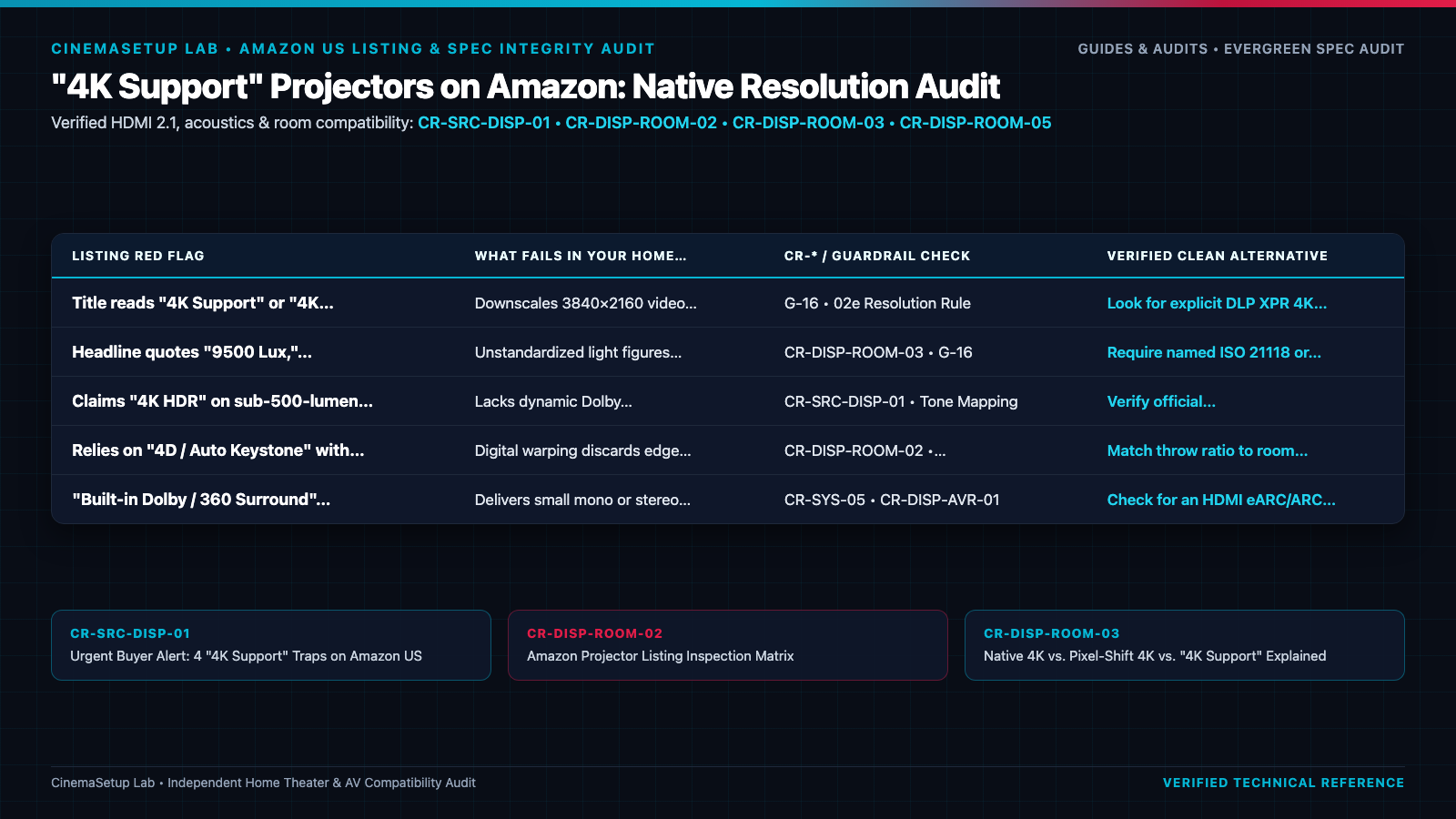
Amazon Projector Listing Inspection Matrix
Cross-check suspicious marketplace copy against physical projection behavior, governing CinemaSetup Lab rules, and verified standards in the table below.
| Listing Red Flag | What Fails in Your Home Theater | CR-* / Guardrail Check | Verified Clean Alternative |
|---|---|---|---|
| Title reads "4K Support" or "4K Decoding" under $400 | Downscales 3840×2160 video onto a native 720p (0.92 MP) or 1080p (2.07 MP) panel; fine subtitles and hair textures turn soft. | G-16 • 02e Resolution Rule | Look for explicit DLP XPR 4K or 3LCD 4K PRO-UHD pixel-shift, or buy an honest branded 1080p model. |
| Headline quotes "9500 Lux," "15000L," or "LED Lumens" | Unstandardized light figures inflate perceived output drastically; image turns gray and washed out with any room lamp on. | CR-DISP-ROOM-03 • G-16 | Require named ISO 21118 or ANSI lumens measured across a standardized 9-point white grid. |
| Claims "4K HDR" on sub-500-lumen single-LCD panel | Lacks dynamic Dolby Vision/HDR10+ metadata and optical headroom; forces flat HDR10 fallback with crushed shadows. | CR-SRC-DISP-01 • Tone Mapping | Verify official HDR10/HLG/Dolby Vision specs on calibrated DLP or 3LCD light engines above 1,500+ ISO/ANSI lumens. |
| Relies on "4D / Auto Keystone" with zero optical zoom | Digital warping discards edge pixels on an already low-res chip and leaves a visible faint gray trapezoid border on the wall. | CR-DISP-ROOM-02 • CR-DISP-ROOM-05 | Match throw ratio to room depth and favor 1.2x–1.6x optical zoom or optical lens shift over digital tilt. |
| "Built-in Dolby / 360 Surround" inside a mini cube | Delivers small mono or stereo chassis sound—not physical multichannel surround or overhead height audio. | CR-SYS-05 • CR-DISP-AVR-01 | Check for an HDMI eARC/ARC port to pass audio cleanly to a discrete soundbar or AV receiver. |
| Unfamiliar storefront name with "10,000+ reviews" | Pooled child ASINs inherit ratings from cheap legacy models; zero authorized US warranty repair path once return window closes. | G-05 • G-26 • CR-SYS-02 | Verify Ships from and sold by Amazon.com or an official brand storefront on US 120 V AC / 60 Hz models. |
Native 4K vs. Pixel-Shift 4K vs. "4K Support" Explained
When comparing a 4k support projector vs native 4k model on Amazon US, shoppers actually face three distinct optical architectures—not two. Treating pixel-shift 4K and "4K support" as the same thing causes buyers to either fall for sub-$400 downscaling traps or overlook legitimate $1,000 to $3,500 home theater projectors.
1. True Native 4K Projectors (8.3 Million Physical Pixels)
A true native 4K projector contains imaging chips with 3840×2160 (4K UHD, 8,294,400 pixels) or 4096×2160 (DCI 4K) physical light-modulating elements on the silicon panel itself—displaying every pixel simultaneously without actuator shifting. In today’s home theater market, true native 4K projection lives primarily in 3-chip LCoS architectures such as Sony SXRD (for example, Sony’s VPL-XW5000ES / BRAVIA Projector series) and JVC D-ILA cinema projectors. Because manufacturing three precision native 4K reflective panels and large-diameter glass lenses is expensive, legitimate native 4K models sit in the $5,000+ high-end tier—never at $199 or $699 on Amazon.
2. Pixel-Shift 4K Projectors (DLP XPR & 3LCD 4K PRO-UHD)
Between true native 4K and "4K support" sits pixel-shift 4K, the standard engineering approach across $800 to $4,500 branded home theater projectors. Under Texas Instruments DLP 4K UHD XPR architecture, a high-speed 0.47-in or 0.65-in Digital Micromirror Device (DMD) switches mirrors in microseconds while a precision optical actuator shifts each sub-frame across four positions per refresh—putting 8.3 million discrete, addressable 3840×2160 pixels onto your screen. Similarly, Epson’s 4K PRO-UHD 3LCD engines shift full-HD LCD chips diagonally/four-way to achieve crisp 4K detail without DLP rainbow artifacts.
Per CinemaSetup Lab’s display rules (02e), pixel-shift projectors must never be misrepresented as "native 4K," because their base modulator chip has fewer than 8.3 million physical mirrors. However, unlike "4K support" downscalers, a true XPR or 4K PRO-UHD projector actually resolves distinct 4K pixels on your wall or ALR screen.
3. "4K Support" / "4K Decoding" Projectors (720p & 1080p Downscalers)
By contrast, a "4K support" projector has zero optical pixel-shifting hardware and zero 4K panel matrix. Instead, its HDMI receiver chip or budget Android SoC accepts an incoming 3840×2160 signal from an Apple TV 4K, PlayStation 5, or 4K streaming stick—rather than flashing "Unsupported Resolution"—and immediately downscales the picture to match a fixed 1280×720 (921,600 pixels, just 11.1% of 4K) or 1920×1080 (2,073,600 pixels, 25.0% of 4K) panel.
During our live US catalog audit, generic sub-$400 projector listings—including common HAPPRUN, XuanPad, KOGATA, and Magcubic units—routinely feature "4K Support" in product titles while operating on native 720p or entry 1080p single-LCD optics. That is why CinemaSetup Lab strictly excludes generic sub-$400 "4K support" listings from branded roundups such as our best projectors under $1,000 guide and our best portable projectors shortlist. Notably, reputable brands occasionally list "4k supported" transparently as well—for instance, the BenQ GV50 explicitly puts 1080P in the headline so shoppers know it accepts 4K HDMI signals onto a verified native 1080p laser DLP engine.
HDR10 Fallback, Inflated Lumens & Digital Keystone Loss
Misleading resolution badges rarely travel alone on Amazon US. Across budget projector pages, three interconnected optical and signal-chain shortcuts erode real-world picture quality on 100-to-120-inch screens:
1. HDR Metadata Fallback & Clipped Highlights (CR-SRC-DISP-01)
Compatibility rule CR-SRC-DISP-01 governs what happens when a 4K streamer or Ultra HD Blu-ray player sends dynamic HDR metadata (Dolby Vision or HDR10+) to a display. When a projector lacks Dolby Vision or HDR10+ support, the source falls back to baseline static HDR10—or standard SDR if HDR is unsupported. On calibrated high-output projectors (like the 3,200-lumen BenQ TK710STi), static HDR10 tone mapping still preserves crisp highlights. On a dim sub-$400 "4K support" single-LCD unit advertising "HDR10," however, limited native contrast and weak light output compress shadow gradations and clip bright clouds into flat white patches.
2. Marketing Lumens vs. ISO 21118 / ANSI Lumens (CR-DISP-ROOM-03)
Just as "4K support" inflates apparent sharpness, unlabeled brightness claims like "8,000 Lumens," "15,000 Lux," or "LED Lumens" exaggerate usable screen illumination. Under CR-DISP-ROOM-03 and our dedicated projector lumens claims on Amazon audit, only standardized ISO 21118 or ANSI lumens allow valid brightness comparisons across models. For a 100-inch 16:9 screen (7.27 × 4.09 ft / 2.21 × 1.25 m, or 29.7 sq ft / 2.76 sq m), a genuine 1,700 to 3,200 ISO/ANSI lumen projector delivers strong cinema luminance in dark or dimly lit rooms—whereas a generic "10,000 Lux" cube often produces only a fraction of that output in actual full-screen white measurements.
3. Throw Distance & Digital Keystone Pixel Loss (CR-DISP-ROOM-02 / 05)
Budget "4K support" cubes almost universally rely on fixed-focal-length plastic lenses with zero optical zoom and zero optical lens shift. Under CR-DISP-ROOM-02, a fixed 1.25:1 throw lens projecting onto a 100-in (87.2 in / 2.21 m wide) 16:9 screen must sit squarely around 9.1 ft (2.77 m) from lens to screen, plus 6 to 12 in (15 to 30 cm) of rear cable and intake clearance. Place that projector off to the side on a nightstand and rely on "Auto 4D Keystone" (CR-DISP-ROOM-05), and the scalar digitally squishes the active pixel grid into a smaller rectangle—leaving a glowing gray border around the picture and dropping effective pixel count even further below 720p or 1080p.
Seller Integrity, Variant Pooling & Mounting Safety (G-26 / G-27)
Beyond optical chips, marketplace structure creates real ownership hazards on Amazon US:
- Parent/Child ASIN Review Pooling (
G-05): Many generic projector listings combine multiple internal hardware revisions—720p base models, 1080p refreshes, and bundled tripods—under one shared review pool. Always filter customer reviews by the exact variant title and model number rather than trusting the aggregate star badge. - US 120 V Compliance & Authorized Dealer Warranties (
CR-SYS-02,G-26): Verify that any projector you buy is a North American120 V AC / 60 HzSKU sold by Amazon.com or the brand’s authorized US storefront (such as BenQ, JMGO, Epson, or AWOL Vision). Third-party marketplace liquidators and unbranded importers rarely qualify for multi-year US factory service—and "Amazon Renewed" units (such as renewed BenQ W4100i listings) carry shorter refurbishment guarantees instead of full 3-year new-unit coverage. - Chassis Audio vs. True Surround Sound (
CR-SYS-05): Listings touting "Dolby Surround Built-In" describe internal 5W to 20W chassis speakers, not physical 5.1.2 surround sound. Look for a true HDMI eARC or ARC port (CR-DISP-AVR-01) if you plan to route Dolby Digital Plus or lossless Dolby TrueHD Atmos back to a soundbar or AV receiver. - Mounting, In-Wall Cabling & Electrical Safety (
G-27,CR-DISP-ACC-02): Whenever ceiling-mounting a projector (4.6 to 19.3+ lb / 2.1 to 8.8+ kg) or hanging a fixed-frame ALR screen, follow both the projector and mount manufacturer instructions first, verify load ratings, and anchor strictly into solid ceiling joists or wall studs—never hollow drywall alone. For concealed HDMI runs longer than 10 ft (3.0 m), use directional Ultra High Speed Certified fiber cables carrying a ULCL2orCL3in-wall fire rating (CR-ACC-DISP-01), and refer ceiling AC outlet wiring or structural mounting to a licensed electrician or licensed AV installer. Keep external sound-system listening at comfortable volume levels.
60-Second Pre-Checkout Audit Checklist
Run every Amazon projector listing through these six quick checks before clicking Buy Now:
- Locate "Native Resolution" in the Specs Grid: Confirm whether the optical engine is native
3840×2160($5,000+), 4K UHD pixel-shift (DLP XPRor 4K PRO-UHD), or native1920×1080/1280×720masquerading behind "4K Support." - Verify the Lumen Standard (
CR-DISP-ROOM-03): Accept only namedISO 21118orANSIlumen ratings; disregard "Lux," "LED lumens," or "source lumens." - Check Optical Zoom & Lens Shift (
CR-DISP-ROOM-02/05): Calculatethrow ratio × screen widthfor your room depth and look for optical zoom (1.2x+) or lens shift so you avoid digital keystone degradation. - Audit HDR & HDMI eARC Ports (
CR-SRC-DISP-01,CR-DISP-AVR-01): Confirm exact HDR formats (Dolby Vision,HDR10+,HDR10) and whether an HDMI port supportseARCorARCfor external audio. - Confirm Box Contents & Screen Needs (
G-29,CR-DISP-ACC-01): Check whether a streaming dongle, screen, or ceiling mount is sold separately; UST projectors require a lenticular UST CLR/ALR screen. - Verify Seller & US 120 V Model (
CR-SYS-02,G-26): Buy "Ships from and sold by Amazon.com" or an official US brand store so your manufacturer warranty stays valid.
Verified Transparent Alternatives on Amazon US
To replace vague sub-$400 "4K support" listings with transparent optics, these four verified US 120 V retail models on Amazon US state their true chip architecture and standardized ISO/ANSI brightness upfront—spanning three genuine 4K pixel-shift laser projectors and one honest native 1080p portable benchmark.
1. JMGO N1S 4K Upgrade Triple Laser Projector, 1700 ISO Lumens, Google TV — Best Compact 4K Pixel-Shift Entry

Audit Snapshot: Display Engine: 0.47-in DLP DMD with 4K UHD XPR pixel-shift (3840×2160 on-screen) | Brightness: 1,700 ISO lumens (MALC triple RGB laser) | Throw & Gimbal: 1.20:1 fixed throw, 127-degree vertical tilt gimbal | Audio & Ports: HDMI 2.1 (eARC), USB-A, Google TV (licensed Netflix), dual 5W speakers | Dimensions & Weight: 7.4 × 6.5 × 7.5 in (18.7 × 16.5 × 19.1 cm), 4.9 lb (2.2 kg) | In the Box: US 120 V projector, remote control, power adapter/cord, manual (screen sold separately) | Price Tier: $800-$1,200 (Entry / Mid Projector)
Shoppers tempted by sub-$400 mini gimbal cubes claiming "4K support" should look closely at what genuine entry-4K hardware requires: the JMGO N1S 4K Upgrade uses a 0.47-in DLP DMD with 4-way XPR pixel-shifting to put all 8.3 million 3840×2160 pixels on-screen—not downscaled 720p. Its brightness is stated cleanly in 1,700 ISO lumens (CR-DISP-ROOM-03), its built-in Google TV platform includes licensed Netflix, and its HDMI 2.1 port supports eARC (CR-DISP-AVR-01) for routing sound cleanly to a home theater receiver or soundbar rather than relying solely on its compact 10W chassis speakers (CR-SYS-05).
Seller & Variant Check (2026-11-26): Confirm you are selecting the N1S 4K (1700 ISO) variant sold by JMGO Direct or Amazon.com for valid US warranty coverage (G-26, CR-SYS-02), and note that its fixed 1.20:1 lens works best when aimed squarely at the screen to avoid digital keystone softening (CR-DISP-ROOM-05).
Pros
- Genuine 4K UHD XPR pixel-shifting projects full 3840×2160 addressable detail rather than downscaling
- Standardized 1,700 ISO lumens from a triple RGB laser light engine for darkened bedrooms and media dens
- Includes HDMI 2.1 eARC, licensed Google TV with Netflix, and a built-in 127-degree gimbal stand
Cons
- Fixed 1.20:1 throw ratio has no optical zoom or optical lens shift (CR-DISP-ROOM-05)
- 1,700 ISO lumens wash out in sunlit living rooms and lack Dolby Vision dynamic HDR (CR-SRC-DISP-01)
2. BenQ TK710STi 3200 Lumens 4K HDR Short Throw Home Entertainment Projector — Best Bright Short-Throw 4K Laser

Audit Snapshot: Display Engine: DLP XPR 4K UHD pixel-shift (3840×2160 on-screen) | Brightness: 3,200 ANSI lumens (laser phosphor, up to 20,000 hr) | Throw & Zoom: 0.69–0.83:1 short-throw (1.2x optical zoom) | Connectivity: 2x HDMI 2.0b (HDCP 2.2, eARC), 16.7 ms @ 4K60 / 4.2 ms @ 1080p240, HDR10/HLG | Dimensions & Weight: 12.0 × 4.4 × 10.0 in (30.4 × 11.2 × 25.4 cm), 6.8 lb (3.1 kg) | In the Box: US 120 V TK710STi projector, QS02 Android TV dongle (with Netflix), remote, power cord, manual (screen and ceiling mount sold separately) | Price Tier: $1,500-$2,200 (Mid Projector)
Where generic "4K support" listings inflate numbers and omit optical zoom, the BenQ TK710STi delivers transparent home-theater engineering: 3,200 verified **ANSI lumens** (CR-DISP-ROOM-03), full 4K UHD XPR pixel-shifting, and a 0.69–0.83:1 short-throw zoom lens that fits a 100-in (87.2 in / 2.21 m wide) screen from just 5.0 to 6.0 ft (1.5 to 1.8 m) away (CR-DISP-ROOM-02). That 1.2x optical zoom lets you dial in frame size optically rather than shrinking pixels with digital keystone (CR-DISP-ROOM-05). It also pairs HDMI eARC audio return with low-lag console modes—making it a dramatic optical upgrade for compact living rooms and game rooms.
Warranty & Port Check (2026-11-26): Confirm purchase from Amazon.com or an authorized BenQ US dealer so BenQ’s 3-year US factory limited warranty applies (G-26), and note that its HDMI 2.0b ports top out at 4K60 or 1080p240 rather than 4K120 (CR-SRC-DISP-02).
Pros
- Verified 3,200 ANSI lumen laser light engine maintains strong punch on 100-to-120-in screens in dim rooms
- Short-throw 0.69–0.83:1 lens with 1.2x optical zoom simplifies tight-room sizing without digital cropping
- HDMI eARC passes Dolby Atmos to AVRs/soundbars, backed by BenQ’s 3-year US warranty
Cons
- HDMI 2.0b inputs cap 4K refresh rates at 60 Hz (no 4K120) and omit Dolby Vision / HDR10+ (CR-SRC-DISP-01)
- Onboard 5W mono speaker requires an external soundbar or AVR speaker system
3. AWOL VISION Aetherion Max 4K Ultra Short Throw Projector, 3,300 ISO Lumens — Best High-Output 4K UST Laser

Audit Snapshot: Display Engine: 0.47-in DLP DMD XPR 4K UHD pixel-shift (3840×2160 on-screen) | Brightness: 3,300 ISO lumens (RGB triple laser) | Throw Ratio: 0.20:1 ultra-short-throw (80–200 in) | Connectivity & HDR: 3x HDMI 2.1 (HDMI 2 eARC, VRR, ALLM), Dolby Vision, HDR10+, HDR10, HLG, Google TV | Dimensions & Weight: 22.1 × 12.7 × 5.5 in (56.2 × 32.3 × 14.0 cm), 19.3 lb (8.8 kg) | In the Box: US 120 V Aetherion Max projector, power cable, remote control, manual (UST CLR/ALR screen sold separately) | Price Tier: $3,000+ (High-End Projector; Launch MSRP: $4,499)
If your priority is replacing a living-room television with a 100-to-150-in laser cinema screen that preserves dynamic HDR metadata, the AWOL VISION Aetherion Max demonstrates what full-bandwidth 4K projection entails. Alongside 3,300 ISO lumens and 0.47-in XPR 4K pixel-shifting, it includes three 48 Gbps **HDMI 2.1** inputs with eARC, VRR, and ALLM plus both **Dolby Vision** and **HDR10+** (CR-SRC-DISP-01)—avoiding the metadata fallback that plagues budget models. Just remember under CR-DISP-ACC-01 that an ultra-short-throw lens firing steeply from below requires a matching lenticular UST CLR/ALR screen (~0.6 gain) rather than a bare wall or standard long-throw ALR fabric.
Credenza & Screen Check (2026-11-26): Confirm purchase from Amazon.com or an authorized AWOL Vision US dealer for 2-year US warranty backing (G-26), verify credenza depth against AWOL’s 0.20:1 throw chart (~6.2 in / 15.8 cm from rear chassis to wall for 100 in), and budget separately for a UST CLR/ALR screen.
Pros
- 3,300 ISO lumens and RGB triple-laser color hold vivid HDR contrast even on 0.6-gain UST CLR screens
- Supports Dolby Vision, HDR10+, and three HDMI 2.1 ports with VRR, ALLM, and eARC (HDMI 2)
- Ultra-short 0.20:1 throw avoids ceiling mounting and long in-wall HDMI runs
Cons
- High-End $3,000+ pricing (Launch MSRP: $4,499) plus mandatory UST CLR/ALR screen cost (CR-DISP-ACC-01)
- Fixed UST optics require precise level placement on a deep media console
4. BenQ GV50 1080P Portable Laser Smart Projector 500 Lumens 4k supported — Honest 1080p Counter-Example
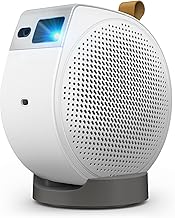
Audit Snapshot: Display Engine: Laser DLP | Native 1080p (1920×1080; accepts 4K HDMI input) | Brightness: 500 ANSI lumens | Throw & Base: 1.20:1 fixed throw, 135-degree magnetic tilt base | Connectivity & Battery: 1x HDMI 2.0b (ARC), USB-C PD & DisplayPort Alt Mode, ~2.5-hr video battery, Google TV, 18W 2.1-ch audio | Dimensions & Weight: 5.1 × 8.3 × 7.5 in (13.0 × 21.1 × 19.1 cm), 4.6 lb (2.1 kg) | In the Box: US 120 V GV50 projector, magnetic tilt base, remote, AC adapter/cord (screen sold separately) | Price Tier: $650-$850 (Entry Projector)
Why include a "4k supported" projector inside a resolution audit? Because the BenQ GV50 illustrates how an honest manufacturer labels 4K input compatibility: it places 1080P upfront in the product title, discloses its standardized 500 ANSI lumens without inflating numbers, and makes clear that 4K HDMI signals downscale cleanly onto a crisp native 1920×1080 laser DLP chip. For darkened bedroom ceilings or cordless patio nights where true 2.5-hour battery runtime and built-in 18W 2.1-channel speakers matter more than 8.3-megapixel projection, an honest 1080p laser unit outperforms murky sub-$400 720p "4K support" cubes in sharpness, color accuracy, and 3-year US warranty backing.
Resolution & Seller Check (2026-11-26): Buy the GV50 knowing it renders native 1080p (2.07 MP) rather than pixel-shift 4K, keep room lights off due to its 500 ANSI ceiling (CR-DISP-ROOM-03), and verify Amazon.com or an authorized BenQ US dealer for 3-year warranty protection (G-26).
Pros
- Transparent listing places Native 1080p upfront and pairs it with verified 500 ANSI laser lumens
- Built-in 2.5-hour battery, USB-C PD/DisplayPort input, licensed Google TV, and 18W 2.1-ch audio
- 135-degree magnetic tilt base aims effortlessly at bedroom ceilings with a 3-year US warranty
Cons
- Downscales 4K input signals to 1920×1080 rather than projecting 4K UHD pixel-shift
- 500 ANSI lumens demand dark rooms or post-sunset outdoor conditions (CR-DISP-ROOM-03)
Authoritative Standards & References
- Texas Instruments — DLP 4K UHD XPR Display Chipsets (Technical documentation on 0.47-in and 0.65-in DMD 4-way XPR pixel-shifting delivering 8.3 million addressable 3840×2160 pixels)
- International Organization for Standardization (ISO) — ISO 21118 Standard (Standardized optical brightness and luminous flux reporting methodology for front projectors)
- BenQ USA — Official Home Entertainment & Portable Projector Specifications (TK710STi 3,200 ANSI lumens / 4K XPR / eARC specs, GV50 500 ANSI native 1080p specs, and 3-year US limited warranty terms)
- JMGO & AWOL Vision USA Documentation (JMGO N1S 4K 1,700 ISO lumens and 0.47-in DMD specs; AWOL Vision Aetherion Max 3,300 ISO lumens and 0.20:1 UST specs)
- HDMI Licensing Administrator — HDMI 2.1 Specification (48 Gbps bandwidth, VRR, ALLM, eARC lossless audio return, and HDCP 2.2/2.3 compliance)
Continue Your Audit
Frequently Asked Questions
What does "4K support" mean on an Amazon projector listing?
"4K support" or "4K decoding" means the projector’s HDMI port or internal processor can receive a 3840×2160 video stream without showing an unsupported-signal error, then downscales the image to fit a lower-resolution native panel—typically 1280×720 (720p) or 1920×1080 (1080p).
How is pixel-shift 4K different from native 4K and "4K support"?
True native 4K projectors (such as $5,000+ Sony SXRD or JVC D-ILA units) use physical 8.3-megapixel panels. Pixel-shift 4K projectors (DLP XPR or Epson 4K PRO-UHD) optically shift a chip 2 or 4 times per frame to display all 8.3 million 4K pixels, whereas "4K support" projectors discard 75% to 89% of 4K pixels.
Why does CinemaSetup Lab exclude sub-$400 "4K support" projectors from roundups?
Generic sub-$400 marketplace listings routinely combine native 720p or basic 1080p single-LCD panels with unstandardized "8,000+ Lux" or "LED lumen" brightness claims and unclear US dealer warranties—failing our CR-DISP-ROOM-03, G-16, and G-26 transparency requirements.
Does a "4K support" projector deliver real Dolby Vision or HDR10+?
No. Under compatibility rule CR-SRC-DISP-01, projectors lacking dynamic HDR licensing and optical brightness headroom fall back to static HDR10 or clipped SDR tone mapping—causing dim 720p single-LCD engines to blow out bright highlights and crush shadow detail.
How can I audit an Amazon projector’s true resolution in 60 seconds?
Ignore the title headline and check the specification table for "Native Resolution" (verify 3840×2160 or XPR/PRO-UHD pixel-shift vs. 1920×1080 or 1280×720), demand ISO 21118 or ANSI lumen ratings, check for optical zoom instead of digital keystone, and verify Amazon.com or an authorized US dealer.


