
Disclosure: As an Amazon Associate, I earn from qualifying purchases. If you buy through links on this page, we may earn a small commission at no extra cost to you.
Finding the best projector under 1000 dollars requires filtering out inflated marketplace claims before comparing lens specs. Hundreds of sub-$400 listings promise “4K support” and impossible brightness figures while delivering low-contrast single-LCD panels that wash out once any lamp turns on. Genuine branded projectors in the $500–$1,000 Entry Projector bracket make clear engineering trade-offs instead: high-lumen 3LCD or DLP lamp engines for shaded living rooms, short-throw optics for tight apartments, or compact smart LED and triple-laser units with built-in Google TV.
To identify the strongest values, we audited eight current US 120V retail models from Epson, BenQ, XGIMI, ViewSonic, and Optoma across standardized ISO 21118, IDMS, and ANSI lumen ratings, throw-ratio geometry, optical zoom, HDMI ARC/eARC audio return, and gaming latency. If you watch primarily in bright daytime rooms from under 9 ft (2.7 m), check our best TVs for home theater pillar hub first, or compare higher-tier laser models in our best home theater projectors overview.
In This Guide
- Quick Picks at a Glance
- Side-by-Side Specs Comparison
- Match Your Use Case
- Detailed Projector Audits (1–8)
- 1. Epson Home Cinema 980 (Best Overall Under $1,000)
- 2. BenQ TH575 (Best Value Long-Throw & Gaming)
- 3. Epson Lifestudio Pop Plus (Best Pixel-Shift 4K & Audio)
- 4. BenQ TH671ST (Best Short-Throw Under $1,000)
- 5. XGIMI Halo+ Google TV (Best Portable with eARC)
- 6. XGIMI MoGo 4 Laser (Best Triple-Laser Gimbal)
- 7. ViewSonic PX700HDH (Best Budget Dual-HDMI)
- 8. Optoma HD146X (Best Entry Dark-Room Long-Throw)
- Buying Guide: Throw Distance, Lumens, Screens & Mounting Safety
- Scoring Rubric, Commission Policy & Excluded Models
- Frequently Asked Questions
- Final Verdict
Quick Picks: Best Projector Under 1000 at a Glance
#1 Best Overall
Epson Home Cinema 980
Delivers 4,000 equal color and white ISO/IDMS lumens on a rainbow-free 3-chip 3LCD engine with 1.21–1.45:1 zoom optics. (Jump to audit)
#2 Best Gaming & Value
BenQ TH575
Pairs 3,800 ANSI lumens and 16.7 ms low input lag with dual HDMI inputs in the $600–$750 tier. (Jump to audit)
#3 Best Pixel-Shift 4K Smart
Epson Lifestudio Pop Plus
Packs 4K PRO-UHD pixel shifting, Google TV, HDMI eARC, and Sound by Bose stereo into a compact 3LCD chassis. (Jump to audit)
Side-by-Side Comparison: 8 Audited Projectors Under $1,000
| Projector & Award | Engine & Throw Ratio | Brightness & Light Life | HDMI, Audio & Smart OS | Link |
|---|---|---|---|---|
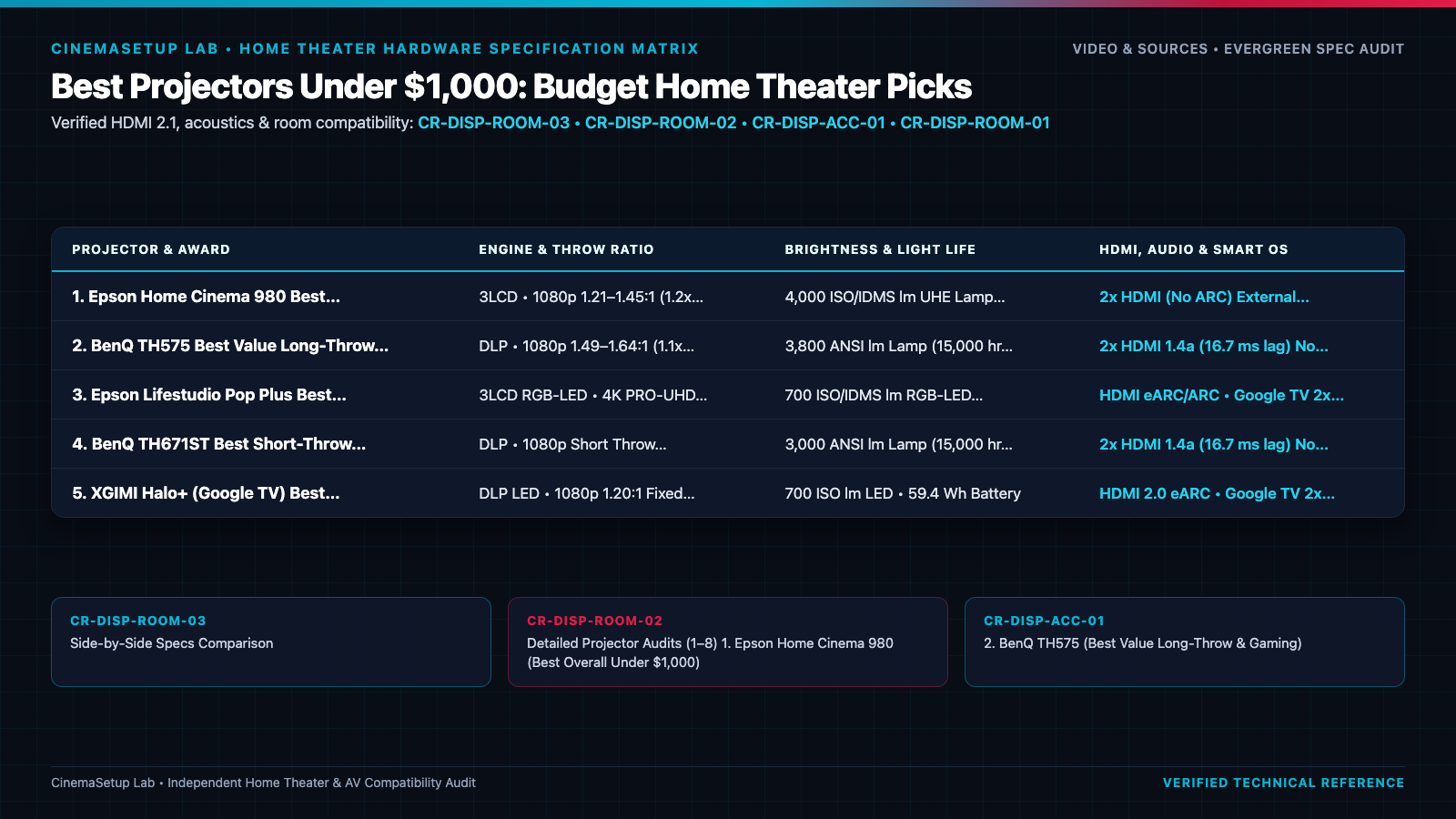
| 1. Epson Home Cinema 980 Best Overall Under $1,000 | 3LCD • 1080p 1.21–1.45:1 (1.2x Zoom) | 4,000 ISO/IDMS lm UHE Lamp (12,000 hr Eco) | 2x HDMI (No ARC) External streamer needed | View on Amazon |
| 2. BenQ TH575 Best Value Long-Throw & Gaming | DLP • 1080p 1.49–1.64:1 (1.1x Zoom) | 3,800 ANSI lm Lamp (15,000 hr LampSave) | 2x HDMI 1.4a (16.7 ms lag) No ARC • 10W mono | View on Amazon |
| 3. Epson Lifestudio Pop Plus Best Pixel-Shift 4K & Audio | 3LCD RGB-LED • 4K PRO-UHD 1.20:1 Fixed Lens | 700 ISO/IDMS lm RGB-LED (20,000 hr) | HDMI eARC/ARC • Google TV 2x 5W Sound by Bose | View on Amazon |
| 4. BenQ TH671ST Best Short-Throw Under $1,000 | DLP • 1080p Short Throw 0.69–0.83:1 (1.2x Zoom) | 3,000 ANSI lm Lamp (15,000 hr LampSave) | 2x HDMI 1.4a (16.7 ms lag) No ARC • 5W speaker | View on Amazon |
| 5. XGIMI Halo+ (Google TV) Best Portable with eARC | DLP LED • 1080p 1.20:1 Fixed Lens | 700 ISO lm LED • 59.4 Wh Battery | HDMI 2.0 eARC • Google TV 2x 5W Harman Kardon | View on Amazon |
| 6. XGIMI MoGo 4 Laser Best Triple-Laser Gimbal | RGB Triple Laser • 1080p 1.20:1 (360° Gimbal) | 550 ISO lm Triple Laser • 71.28 Wh Battery | HDMI ARC • Google TV 2x 6W Harman Kardon | View on Amazon |
| 7. ViewSonic PX700HDH Best Budget Dual-HDMI | DLP • 1080p 1.49–1.64:1 (1.1x Zoom) | 3,700 ANSI lm Lamp (15,000 hr SuperEco) | 2x HDMI 1.4 (16 ms Game) USB-A dongle power | View on Amazon |
| 8. Optoma HD146X Best Entry Dark-Room Throw | DLP • 1080p 1.47–1.62:1 (1.1x Zoom) | 3,600 ANSI lm Lamp (15,000 hr Dynamic) | 1x HDMI 1.4a (16 ms Game) No ARC • External AVR ideal | View on Amazon |
Match Your Use Case: Which Budget Projector Fits Your Space?
| Buyer Scenario | Best Match | Why & Expected Outcome |
|---|---|---|
| Shaded living room or rainbow-sensitive viewers | 1. Epson Home Cinema 980 | 4,000 equal color/white ISO lumens and 3-chip 3LCD panels resist ambient washout without DLP color-wheel flicker. |
| 1080p 60 Hz console gaming + bright movie wall | 2. BenQ TH575 | 16.7 ms input lag, 3,800 ANSI lumens, and dual HDMI ports deliver snappy big-screen gameplay at a mid-tier price. |
| Bedroom or dark den wanting 4K PRO-UHD + Bose sound | 3. Epson Lifestudio Pop Plus | Pixel-shift 4K detail, Google TV, HDMI eARC, and Sound by Bose stereo replace extra streaming sticks and tabletop speakers. |
| Tight apartment or coffee-table placement under 6 ft | 4. BenQ TH671ST | 0.69–0.83:1 short-throw optics project a 100-inch (254 cm) image from 5.0 to 6.0 ft (1.5 to 1.8 m) with 3,000 ANSI lumens. |
| Backyard movie nights + eARC soundbar fallback | 5. XGIMI Halo+ (Google TV) | Built-in 59.4 Wh battery, Google TV with licensed Netflix, and HDMI 2.0 eARC work indoors or outdoors after dusk. |
| Ceiling projection & travel with RGB laser color | 6. XGIMI MoGo 4 Laser | 360-degree gimbal stand aims effortlessly at walls or ceilings while its 71.28 Wh battery runs up to 2.5 hours in Eco mode. |
Detailed Audits: Best Projector Under 1000 Picks Ranked 1–8
1. Epson Home Cinema 980 3-Chip 3LCD 1080p Movie Projector — Best Overall Under $1,000
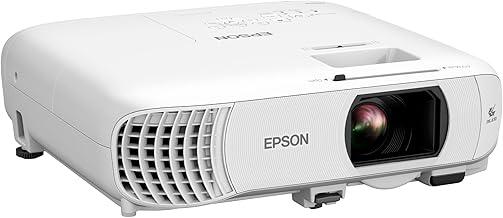
Quick Specs: 3-Chip 3LCD UHE Lamp (up to 12,000 hr Eco) | Native 1080p (1920 x 1080) | 4,000 equal color and white ISO/IDMS lumens | 1.21–1.45:1 throw ratio (1.2x manual optical zoom) | 2x HDMI (no ARC/eARC) | Built-in speaker | 12.2 x 11.1 x 4.2 in (31.0 x 28.2 x 10.7 cm), 6.8 lb (3.1 kg) | Price Tier: $700–$900 (Entry Projector)
Audit Score: 8.8 / 10
- Cited Picture Performance (35%): 8.9 / 10
- Gaming & Connectivity (20%): 8.0 / 10
- HDR & Format Support (15%): 7.8 / 10
- Room Fit & Optics (15%): 9.0 / 10
- Light Source, OS & Warranty (10%): 8.6 / 10
- Value Within Tier (5%): 9.4 / 10
Most budget projectors under $1,000 rely on single-chip DLP color wheels that can leave saturated scenes noticeably dimmer than white highlights. The Epson Home Cinema 980 solves both issues at once with a 3-chip 3LCD engine rated at 4,000 equal color and white ISO/IDMS lumens, completely eliminating DLP rainbow artifacts while preserving punchy primaries on 100-inch to 120-inch screens even when ambient curtains let some evening light leak through (CR-DISP-ROOM-03).
Its 1.21–1.45:1 throw ratio with 1.2x manual optical zoom also sits slightly shorter than the 1.49–1.64:1 lenses on the BenQ TH575 and ViewSonic PX700HDH, letting you project a 100-inch (254 cm) 16:9 image from 8.8 to 10.5 ft (2.7 to 3.2 m) in mid-sized living rooms (CR-DISP-ROOM-02). The compromises are straightforward: it outputs native 1080p rather than pixel-shift 4K, lacks built-in streaming apps and HDMI ARC/eARC, and relies on an eventual UHE replacement bulb.
Buyer Verification Alert: Because the Home Cinema 980 has no smart OS or HDMI ARC/eARC, plug your streaming stick or console into an AV receiver first and run one HDMI cable to the projector. Verify Sold By Amazon.com or an authorized Epson dealer so the 2-year projector and 90-day lamp US warranties apply (G-26).
Pros
- 4,000 equal color and white ISO/IDMS lumens outshine every smart portable projector under $1,000
- 3-chip 3LCD optical engine completely eliminates single-chip DLP rainbow artifacts
- 1.21–1.45:1 throw ratio with 1.2x optical zoom fits typical 9 to 12 ft (2.7 to 3.7 m) rooms
Cons
- No built-in smart streaming platform, no HDMI ARC/eARC, and native 1080p resolution only
- UHE lamp (up to 12,000 hours in Eco mode) requires periodic bulb replacement unlike LED or laser units
Verdict: Buy it if you want maximum standardized brightness, zero rainbow artifacts, and reliable dual-HDMI performance with an external streamer or AVR. Skip it if you want a built-in smart OS, battery portability, or 4K pixel-shifting, where the Epson Lifestudio Pop Plus or XGIMI Halo+ fits better.
2. BenQ TH575 1080p 3800 Lumens Home Entertainment Projector — Best Value Long-Throw & Gaming

Quick Specs: Single-Chip DLP Lamp (up to 15,000 hr LampSave) | Native 1080p (1920 x 1080) | 3,800 ANSI lumens | 1.49–1.64:1 throw ratio (1.1x manual optical zoom) | 2x HDMI 1.4a (16.7 ms lag at 1080p 60 Hz, no ARC/eARC) | 10W mono speaker | 11.7 x 8.7 x 4.7 in (29.6 x 22.1 x 12.0 cm), 5.5 lb (2.5 kg) | Price Tier: $600–$750 (Entry Projector)
Audit Score: 8.6 / 10
- Cited Picture Performance (35%): 8.4 / 10
- Gaming & Connectivity (20%): 8.7 / 10
- HDR & Format Support (15%): 7.5 / 10
- Room Fit & Optics (15%): 8.6 / 10
- Light Source, OS & Warranty (10%): 8.4 / 10
- Value Within Tier (5%): 9.6 / 10
For buyers comparing value in the $600–$750 bracket, the BenQ TH575 hits the cleanest balance of high ANSI brightness, crisp DLP pixel alignment, and low-latency console play. BenQ rates the lamp engine at 3,800 ANSI lumens with a 15,000:1 contrast specification and 16.7 ms input lag at 1080p 60 Hz, making sports broadcasts and PlayStation or Xbox sessions responsive on a 100-inch to 120-inch screen.
Compared with the similarly priced Optoma HD146X, the TH575 adds a second HDMI port so a console and streaming dongle can stay connected at once, plus an extended 15,000-hour LampSave rating and a lighter 5.5 lb (2.5 kg) chassis. Its 1.49–1.64:1 throw ratio requires 10.8 to 11.9 ft (3.3 to 3.6 m) for a 100-inch image, so measure room depth carefully before ordering (CR-DISP-ROOM-02). Like most lamp DLPs at this tier, it omits optical lens shift and HDMI ARC/eARC.
Buyer Verification Alert: Amazon sells both the standard TH575 (`B0B4QV9YV6`) and the TH575i Google TV bundle (`B0H7T3RBGJ`)—confirm which variant is selected before checkout. Neither variant supports HDMI ARC/eARC, so route audio through an AV receiver or use the 3.5 mm analog line out.
Pros
- 3,800 ANSI lumens and 16.7 ms cited input lag excel for living-room sports and 1080p 60 Hz gaming
- Dual HDMI 1.4a ports plus USB-A power keep both a console and streaming stick plugged in
- LampSave mode extends rated lamp life up to 15,000 hours at lower operating cost
Cons
- 1.49–1.64:1 throw ratio and 1.1x zoom require at least 10.8 ft (3.3 m) lens-to-screen depth for 100 inches
- No optical lens shift, no HDMI ARC/eARC, and 10W mono speaker requires external audio for movie impact
Verdict: Buy it if you have 11+ ft (3.4+ m) of throw room and want the strongest price-to-performance long-throw DLP for movies and 1080p gaming. Skip it if your room is under 10 ft deep (pick the BenQ TH671ST) or if you are sensitive to single-chip DLP rainbow shimmer (pick the Epson Home Cinema 980).
3. Epson Lifestudio Pop Plus (EF-62) 4K PRO-UHD Smart Projector — Best Pixel-Shift 4K & Smart Audio Under $1,000

Quick Specs: 3-Chip 3LCD RGB-LED (up to 20,000 hr) | 4K PRO-UHD pixel-shift (1080p native chip) | 700 ISO/IDMS color & white lumens | 1.20:1 fixed throw ratio | Google TV built-in | HDMI with eARC/ARC | 2x 5W Sound by Bose stereo | 7.8 x 7.5 x 3.0 in (19.9 x 19.0 x 7.5 cm), 3.5 lb (1.6 kg) | Price Tier: $700–$850 (Entry Projector)
Audit Score: 8.5 / 10
- Cited Picture Performance (35%): 8.3 / 10
- Gaming & Connectivity (20%): 8.4 / 10
- HDR & Format Support (15%): 8.4 / 10
- Room Fit & Optics (15%): 8.4 / 10
- Light Source, OS & Warranty (10%): 9.3 / 10
- Value Within Tier (5%): 8.8 / 10
Unlike generic budget projectors that accept a 4K signal only to downscale it back to 1080p or 720p, the Epson Lifestudio Pop Plus (model EF-62) uses 2-phase 4K PRO-UHD pixel-shifting paired with a 3-chip 3LCD RGB-LED engine rated for 20,000 hours. That architecture delivers sharper 4K streaming detail than native 1080p lifestyle rivals while avoiding both DLP rainbow shimmer and lamp replacements.
Epson also solves two common smart-projector weak spots: it integrates full Google TV alongside an HDMI eARC/ARC port for external surround bars, and tunes its dual 5W stereo drivers with Sound by Bose for clear bedroom dialogue. Still, its 700 ISO/IDMS lumen ceiling puts it in a completely different brightness class from the 4,000-lumen Epson Home Cinema 980—keep ambient room lights off or tightly dimmed for punchy contrast (CR-DISP-ROOM-03).
Buyer Verification Alert: Check the exact Epson model code on the Amazon listing: EF-62 (“Pop Plus”) includes 4K PRO-UHD pixel shifting, whereas the base EF-61 (“Pop”) is capped at 1080p. Note also that the Pop Plus uses wall AC power with no internal battery.
Pros
- Real 4K PRO-UHD pixel-shift resolution on a rainbow-free 3-chip 3LCD RGB-LED light source (20,000 hr)
- Built-in Google TV and HDMI eARC/ARC support simplify soundbar and AVR audio return
- Compact 3.5 lb (1.6 kg) footprint with Sound by Bose stereo audio fits bedrooms cleanly
Cons
- 700 ISO/IDMS lumens require darkened rooms and struggle against daytime window glare
- Fixed 1.20:1 lens lacks optical zoom and requires wall AC power (no built-in battery)
Verdict: Buy it if you watch in a darkened bedroom or den and want genuine pixel-shift 4K detail, Google TV, eARC, and Bose-tuned audio in one compact box. Skip it if you need high-lumen daytime brightness (Epson Home Cinema 980) or battery power outdoors (XGIMI Halo+).
4. BenQ TH671ST 3000 Lumens 1080p Short-Throw Projector — Best Short-Throw Under $1,000

Quick Specs: Single-Chip DLP Lamp (up to 15,000 hr LampSave) | Native 1080p (1920 x 1080) | 3,000 ANSI lumens | 0.69–0.83:1 short-throw ratio (1.2x optical zoom) | 2x HDMI 1.4a (16.7 ms lag, no ARC/eARC) | 5W chambered speaker | 11.7 x 8.8 x 4.7 in (29.6 x 22.4 x 12.0 cm), 6.0 lb (2.7 kg) | Price Tier: $700–$900 (Entry Projector)
Audit Score: 8.5 / 10
- Cited Picture Performance (35%): 8.3 / 10
- Gaming & Connectivity (20%): 8.6 / 10
- HDR & Format Support (15%): 7.4 / 10
- Room Fit & Optics (15%): 9.4 / 10
- Light Source, OS & Warranty (10%): 8.3 / 10
- Value Within Tier (5%): 8.9 / 10
Standard long-throw projectors fail rule CR-DISP-ROOM-02 in small apartments, spare bedrooms, or rooms with ceiling fans blocking the rear throw path. The BenQ TH671ST solves that geometry bottleneck with a 0.69–0.83:1 short-throw optical zoom lens that casts a full 100-inch (254 cm) 16:9 picture from just 5.0 to 6.0 ft (1.5 to 1.8 m) away—sitting comfortably on a coffee table or low forward ceiling mount without casting viewer shadows across the canvas.
Despite its wide-angle optics, the TH671ST retains 3,000 ANSI lumens, 16.7 ms gaming response at 1080p 60 Hz, and a 1.2x zoom ring that gives you real placement wiggle room compared with fixed-lens portable boxes. Unlike the BenQ TH575, however, it trades off 800 ANSI lumens for short-throw geometry, carries a smaller 5W speaker, and still requires an external streaming device and audio system because HDMI ARC is absent.
Buyer Verification Alert: Short-throw lenses magnify any slight wall ripples or screen waves. Pair the TH671ST with a flat fixed-frame matte white or tensioned screen rather than a loose pull-down sheet (CR-DISP-ACC-01), and keep the projector centered horizontally because there is no horizontal lens shift.
Pros
- 0.69–0.83:1 short-throw lens fills a 100-in screen from 5.0 to 6.0 ft (1.5 to 1.8 m)
- 3,000 ANSI lumens and 16.7 ms low input lag handle bright living-room gaming cleanly
- 1.2x optical zoom helps fine-tune image size without digital scaling distortion
Cons
- Steep projection angle exaggerates wall unevenness on untensioned surfaces
- No built-in smart TV platform, no HDMI ARC/eARC, and older lamp light source
Verdict: Buy it if tight room depth prevents standard long-throw placement and you still want 3,000 ANSI lumens plus snappy 16.7 ms gaming. Skip it if you have 11+ ft (3.4+ m) of clear room depth, where the BenQ TH575 or Epson Home Cinema 980 delivers higher brightness per dollar.
5. XGIMI Halo+ Portable Projector (Google TV & Licensed Netflix) — Best Portable Battery Projector with eARC

Quick Specs: 0.33-in DMD DLP LED | Native 1080p (1920 x 1080) | 700 ISO lumens | 1.20:1 fixed throw ratio (ISA 2.0 auto focus/keystone) | Google TV with licensed Netflix | 1x HDMI 2.0 with eARC | Dual 5W Harman Kardon speakers | 59.4 Wh battery (~2.5 hr playback) | 6.8 x 5.7 x 4.5 in (17.2 x 14.5 x 11.4 cm), 3.5 lb (1.6 kg) | Price Tier: $750–$900 (Entry Projector)
Audit Score: 8.3 / 10
- Cited Picture Performance (35%): 8.0 / 10
- Gaming & Connectivity (20%): 8.5 / 10
- HDR & Format Support (15%): 7.8 / 10
- Room Fit & Optics (15%): 8.3 / 10
- Light Source, OS & Warranty (10%): 9.1 / 10
- Value Within Tier (5%): 8.4 / 10
Older portable projectors frustrated Netflix viewers with clunky sideloaded apps and omitted HDMI audio return. The XGIMI Halo+ (Google TV edition) fixes both pain points: it runs native Google TV with officially licensed Netflix, pairs a 0.33-inch DMD chip with 700 ISO lumens of LED brightness, and includes an HDMI 2.0 port supporting full eARC so you can send audio from built-in streaming apps directly to a living-room soundbar or receiver.
In a direct comparison with the smaller XGIMI MoGo 4 Laser, the Halo+ uses a larger 0.33-inch imaging chip (versus 0.23-inch) and outputs 700 ISO lumens versus 550 ISO lumens, producing brighter 80-inch to 100-inch images in shaded rooms. Its 59.4 Wh battery handles roughly 2.5 hours of unplugged movie time, though only one HDMI port means you must choose between plugging in a console or using eARC audio return.
Buyer Verification Alert: Confirm the listing states “Google TV” and “Licensed Netflix” (`B0D8KQ5HP9`) rather than older Android TV 10 stock that lacked native Netflix certification. Also disable auto-keystone when mounting permanently so digital warping does not trim resolution (CR-DISP-ROOM-05).
Pros
- 700 ISO lumens on a 0.33-in DMD chip outperform smaller 0.23-in pocket projectors
- Google TV with licensed Netflix plus HDMI 2.0 eARC and dual 5W Harman Kardon speakers
- 59.4 Wh internal battery supports ~2.5 hours of cordless backyard or bedroom screening
Cons
- Only one HDMI port forces a choice between wired external sources and eARC audio output
- 700 ISO lumens still wash out quickly in lit rooms compared with 3,000–4,000 lumen lamp units
Verdict: Buy it if you want an all-in-one battery-powered smart projector with licensed Netflix, eARC audio flexibility, and solid 700 ISO lumen output after sunset. Skip it if you want pixel-shift 4K detail at home (Epson Lifestudio Pop Plus) or maximum bright-room punch (Epson Home Cinema 980).
6. XGIMI MoGo 4 Laser Portable RGB Triple-Laser Projector — Best Compact Triple-Laser & Gimbal Stand

Quick Specs: 0.23-in DMD DLP RGB Triple Laser | Native 1080p (1920 x 1080) | 550 ISO lumens (110% BT.2020 gamut spec) | 1.20:1 fixed throw ratio (360-degree gimbal stand) | Google TV with licensed Netflix | 1x HDMI with ARC | Dual 6W Harman Kardon speakers | 71.28 Wh battery (~2.5 hr Eco) | 8.2 x 3.8 x 3.8 in (20.8 x 9.7 x 9.7 cm), 2.9 lb (1.3 kg) | Price Tier: $700–$850 (Entry Projector)
Audit Score: 8.2 / 10
- Cited Picture Performance (35%): 7.9 / 10
- Gaming & Connectivity (20%): 8.1 / 10
- HDR & Format Support (15%): 8.0 / 10
- Room Fit & Optics (15%): 8.7 / 10
- Light Source, OS & Warranty (10%): 9.0 / 10
- Value Within Tier (5%): 8.2 / 10
The XGIMI MoGo 4 Laser brings pure RGB triple-laser illumination—an optical architecture usually reserved for expensive living-room laser consoles—into a 2.9 lb (1.3 kg) soda-can cylinder built around a 360-degree rotating gimbal stand. That hinge lets you aim straight up at a bedroom ceiling without stacking books under the chassis, while its 71.28 Wh battery and USB-C PD 3.0 input make backyard or travel setups effortless.
Its manufacturer-cited 110% BT.2020 color gamut gives animated films and dark-room streaming vivid saturation alongside dual 6W Harman Kardon drivers and licensed Netflix on Google TV. Still, 550 ISO lumens and a 0.23-inch DMD chip limit realistic screen sizes to 60–90 inches in dark rooms; compared with the Halo+, it trades 150 ISO lumens and full eARC (offering ARC instead) for triple-laser color and built-in gimbal articulation.
Buyer Verification Alert: XGIMI sells both the standard LED MoGo 4 (`B0F3CBV5HP`) and this RGB triple-laser MoGo 4 Laser (`B0F3C2XFKR`). Confirm “550 ISO Lumens” and “Laser” in the title, and note that RGB triple-laser optics can show mild laser speckle on high-gain screens—matte white fabric works best.
Pros
- RGB triple-laser light source covers wide color gamut in a compact 2.9 lb (1.3 kg) cylinder
- Integrated 360-degree gimbal stand pivots smoothly from wall to ceiling projection
- 71.28 Wh battery, USB-C PD charging, Google TV with licensed Netflix, and HDMI ARC
Cons
- 550 ISO lumens strictly require dark rooms and cap ideal canvas size around 80–90 inches
- Uses HDMI ARC rather than lossless eARC and omits optical zoom
Verdict: Buy it if ceiling projection, ultra-compact travel portability, and triple-laser color in dark bedrooms matter most. Skip it if you want a permanent living-room projector or brighter 80–120 inch movie nights, where the XGIMI Halo+ or Epson Home Cinema 980 pulls ahead.
7. ViewSonic PX700HDH 1080p 3700 Lumens Home Theater Projector — Best Budget Dual-HDMI Long-Throw

Quick Specs: Single-Chip DLP Lamp (up to 15,000 hr SuperEco) | Native 1080p (1920 x 1080) | 3,700 ANSI lumens | 1.49–1.64:1 throw ratio (1.1x manual optical zoom) | 2x HDMI 1.4 (16 ms gaming response, no ARC/eARC) | USB-A power output | 11.5 x 8.7 x 4.5 in (29.3 x 22.1 x 11.5 cm), 5.3 lb (2.4 kg) | Price Tier: $550–$700 (Entry Projector)
Audit Score: 8.1 / 10
- Cited Picture Performance (35%): 8.1 / 10
- Gaming & Connectivity (20%): 8.2 / 10
- HDR & Format Support (15%): 7.0 / 10
- Room Fit & Optics (15%): 8.3 / 10
- Light Source, OS & Warranty (10%): 8.1 / 10
- Value Within Tier (5%): 9.0 / 10
Sitting in the $550–$700 sweet spot, the ViewSonic PX700HDH offers an appealing step up over bare-bones entry projectors by pairing 3,700 ANSI lumens with dual HDMI 1.4 ports and a powered USB-A jack for streaming sticks. Its 16 ms cited response handles casual console play smoothly, and SuperEco lamp dimming stretches rated bulb life up to 15,000 hours.
With an identical 1.49–1.64:1 throw ratio to the BenQ TH575, it sits 10.8 to 11.9 ft (3.3 to 3.6 m) back for a 100-inch screen. Why does it rank behind the TH575 and Home Cinema 980? It offers narrower HDR tone-mapping flexibility, basic 1.1x zoom without lens shift, and modest dark-scene contrast compared with dedicated cinema units. Still, it handily beats the single-HDMI Optoma HD146X if you wire two HDMI devices directly without an AVR.
Buyer Verification Alert: Verify you are ordering the 1080p PX700HDH (`B0DDQ3C46W`) rather than ViewSonic’s lower-resolution SVGA/XGA office projectors with similar chassis styling, and confirm Amazon.com or an authorized US dealer for warranty validity (G-26).
Pros
- 3,700 ANSI lumens hold up cleanly in evening living rooms on 100-in to 120-in screens
- Dual HDMI 1.4 ports and powered USB-A accommodate a streaming stick alongside a console
- 16 ms cited gaming latency and 15,000-hour SuperEco lamp rating in the $550–$700 tier
Cons
- Zero optical lens shift and tight 1.1x zoom require careful centered mount placement
- No HDMI ARC/eARC, no built-in streaming OS, and modest native dark-room black levels
Verdict: Buy it if you want a dual-HDMI, 3,700-lumen 1080p projector under $700 and occasionally find it below the BenQ TH575. Skip it if you want stronger color calibration or wider short-throw placement, where the BenQ TH575 and TH671ST lead.
8. Optoma HD146X 1080p High-Brightness Home Theater Projector — Best Entry-Budget Dark-Room Long-Throw

Quick Specs: Single-Chip DLP Lamp (up to 15,000 hr Dynamic) | Native 1080p (1920 x 1080) | 3,600 ANSI lumens | 1.47–1.62:1 throw ratio (1.1x manual optical zoom) | 1x HDMI 1.4a (16 ms Enhanced Gaming Mode, 3D support, no ARC) | 12.4 x 9.5 x 4.3 in (31.5 x 24.1 x 10.9 cm), 6.2 lb (2.8 kg) | Price Tier: $500–$650 (Entry Projector)
Audit Score: 7.9 / 10
- Cited Picture Performance (35%): 8.0 / 10
- Gaming & Connectivity (20%): 7.4 / 10
- HDR & Format Support (15%): 7.1 / 10
- Room Fit & Optics (15%): 8.2 / 10
- Light Source, OS & Warranty (10%): 7.8 / 10
- Value Within Tier (5%): 9.1 / 10
When your projector budget sits right around $500–$600 and an AV receiver already handles source switching, the Optoma HD146X remains one of the most straightforward ways to skip unverified white-label LCDs in favor of real 3,600 ANSI lumen DLP projection. Enhanced Gaming Mode lowers 1080p 60 Hz latency to 16 ms, and Dynamic lamp dimming keeps rated bulb hours up to 15,000 hours.
Why is it ranked eighth? Connectivity is Spartan: a single HDMI 1.4a port leaves zero room for plugging in both a streaming stick and a game console directly without an external HDMI switch or AVR. Its US warranty is also shorter than Epson’s 2-year replacement coverage, offering 1 year parts/labor on the projector and 90 days on the lamp. For pure dark-room single-cable cinema at the floor of the Entry Projector tier, however, it outperforms every sub-$400 generic box on clarity and brightness truth.
Buyer Verification Alert: With only one HDMI 1.4a input and no ARC/eARC, pair the HD146X with an AV receiver or external HDMI switcher if you own more than one source, and avoid unverified third-party sellers so the US 1-year warranty applies (G-26).
Pros
- 3,600 ANSI lumens and genuine 1080p DLP optics in the $500–$650 price floor
- 16 ms Enhanced Gaming Mode keeps 1080p 60 Hz console games responsive
- Supports Full 3D Blu-ray playback alongside up to 15,000-hour Dynamic lamp mode
Cons
- Single HDMI 1.4a port requires an AV receiver or switcher for multi-source rooms
- Shorter 1-year US parts/labor warranty (90-day lamp) and no optical lens shift
Verdict: Buy it if you already run an AV receiver and want the lowest-cost genuine 3,600 ANSI lumen 1080p DLP projector from a major brand. Skip it if you need dual HDMI inputs (ViewSonic PX700HDH / BenQ TH575) or longer US warranty coverage (Epson Home Cinema 980).
Buying Guide: How to Choose the Best Projector Under 1000
Picking the best projector under 1000 comes down to matching optics and standardized brightness to your room rather than chasing headline feature checklists. Walk through these five compatibility checks before ordering a mount, cable, or screen.
1. Throw Ratio, Room Depth & Viewing Geometry (CR-DISP-ROOM-02 & CR-DISP-ROOM-01)
Under rule CR-DISP-ROOM-02, a 16:9 image has a horizontal width equal to diagonal × 0.872 (87.2 in / 221.5 cm for a 100-inch screen; 104.6 in / 265.7 cm for 120 inches). Multiply that image width by the projector’s throw ratio, then add the projector body depth plus 6 to 12 in (15 to 30 cm) of rear ventilation and HDMI cable clearance. A BenQ TH575 (1.49–1.64:1) needs roughly 11.5 to 12.6 ft (3.5 to 3.8 m) of total room depth for a 100-inch screen, whereas the short-throw BenQ TH671ST (0.69–0.83:1) achieves the same 100-inch canvas from just 5.0 to 6.0 ft (1.5 to 1.8 m) lens-to-screen.
Also confirm seating distance under CR-DISP-ROOM-01: a 100-inch 16:9 screen provides an immersive 40-degree horizontal field of view at 10.0 ft (3.0 m) and a comfortable 30-degree view at 13.6 ft (4.1 m), while a 120-inch screen spans 12.0 ft (3.7 m) to 16.3 ft (5.0 m). For 1080p native projectors, staying toward the middle or farther half of that band keeps pixel structure invisible.
| 16:9 Screen Size | Image Width | Short-Throw (0.69–0.83:1) | Mid-Throw (1.20–1.45:1) | Long-Throw (1.49–1.64:1) |
|---|---|---|---|---|
| 92 in (234 cm) | 80.2 in (203.7 cm) | 4.6–5.5 ft (1.4–1.7 m) | 8.0–9.7 ft (2.4–3.0 m) | 10.0–11.0 ft (3.0–3.4 m) |
| 100 in (254 cm) | 87.2 in (221.5 cm) | 5.0–6.0 ft (1.5–1.8 m) | 8.7–10.5 ft (2.7–3.2 m) | 10.8–11.9 ft (3.3–3.6 m) |
| 110 in (279 cm) | 95.9 in (243.6 cm) | 5.5–6.6 ft (1.7–2.0 m) | 9.6–11.6 ft (2.9–3.5 m) | 11.9–13.1 ft (3.6–4.0 m) |
| 120 in (305 cm) | 104.6 in (265.7 cm) | 6.0–7.2 ft (1.8–2.2 m) | 10.5–12.6 ft (3.2–3.8 m) | 13.0–14.3 ft (4.0–4.4 m) |
2. ISO / ANSI Lumens vs. Marketing “LED Lumens” & Fake “4K Support” (CR-DISP-ROOM-03)
Rule CR-DISP-ROOM-03 exists for a reason: brightness figures are only comparable when measured under a named standard—ISO ANSI lumens (ISO 21118, ANSI IT7.228) or IDMS equal Color and White ratings. Sub-$400 white-label projectors regularly advertise “12,000 lumens” or “4K support” without any recognized lumen standard; in reality, “4K support” only means the HDMI chip accepts a 4K signal before downscaling it to 1080p or 720p, and unstandardized LED claims wildly exaggerate real light output.
Within our audited under-$1,000 lineup, brightness separates into two distinct tiers. Lamp-based home theater models (Epson Home Cinema 980 at 4,000 ISO/IDMS lumens, BenQ TH575 at 3,800 ANSI lumens, ViewSonic PX700HDH at 3,700 ANSI lumens, Optoma HD146X at 3,600 ANSI lumens, and BenQ TH671ST at 3,000 ANSI lumens) easily hold an image in shaded living rooms with dim lamps on. Portable smart LED and RGB-laser models (XGIMI Halo+ and Epson Lifestudio Pop Plus at 700 ISO lumens; XGIMI MoGo 4 Laser at 550 ISO lumens) look crisp in dark bedrooms or outdoors after dusk, yet wash out rapidly against daytime sun.
3. Screen Pairing & Secondary Intent: Matte White vs. Gray vs. ALR/CLR (CR-DISP-ACC-01)
Screens are budgeted separately unless explicitly bundled, and choosing the wrong fabric ruins contrast under CR-DISP-ACC-01. For a dedicated dark room with dark paint, a 1.0-gain matte white fixed-frame screen preserves uniform brightness and color neutrality across every pick here. In living rooms with white walls or light spill, a 0.8-gain light-gray screen or angular long-throw ALR screen deepens perceived blacks on high-lumen lamp units like the Epson Home Cinema 980 or BenQ TH575. Never buy a lenticular UST CLR screen for a long-throw or short-throw ceiling projector—UST CLR micro-ridges are engineered for steep bottom-up laser cones and reject normal forward projection light. Explore compatible fixed and pull-down options in our best projector screens guide.
4. Optical Zoom, Missing Lens Shift & Why Keystone Hurts Sharpness (CR-DISP-ROOM-05)
Every sub-$1,000 model in this guide omits mechanical optical lens shift—a feature that typically enters the market in step-up tiers such as the Epson Home Cinema 2350 or models inside our best 4K projectors under $3,000 guide. When a projector lacks lens shift, tilting the body up or down and relying on digital keystone electronically shrinks and interpolates the pixel grid, softening subtitles and leaving a faint grey trapezoid halo outside the active movie frame (CR-DISP-ROOM-05). Mount or shelf-place your projector squarely at the manufacturer’s natural lens-offset height so optical zoom alone fills the frame.
5. HDMI Audio Return, Upgrade Roadmap & Mount/Wiring Safety (G-27 & CR-ACC-DISP-01)
Plan your audio chain before buying: traditional lamp projectors (Home Cinema 980, TH575, TH671ST, PX700HDH, HD146X) lack HDMI ARC/eARC, so your Apple TV, Blu-ray player, or game console should connect into an AV receiver first, sending video over a single long HDMI cable to the projector (CR-DISP-AVR-01). Even portable units with Sound by Bose or Harman Kardon speakers rely on compact stereo or virtualized DSP rather than physical surround or overhead Atmos drivers (CR-SYS-05). Upgrade budget roadmap essentials include a proper tensioned or fixed-frame screen, an Ultra High Speed HDMI Certified cable (use a directional active fiber HDMI cable for runs over 10 ft / 3.0 m per CR-ACC-DISP-01), and a universal ceiling mount rated above the chassis weight.
Installation Safety (G-27): Always follow the projector and mount manufacturer’s instructions first. Bolt overhead mounts into solid structural ceiling joists or rated masonry—never hang a 5 to 7 lb (2.3 to 3.2 kg) projector plus mount arm from drywall anchors alone. Any concealed ceiling power outlet or in-wall speaker/HDMI wire run requiring CL2 or CL3 UL fire-rated cabling (CR-ACC-SPK-02) should follow local building codes and be handled by a licensed electrician or qualified AV installer.
How We Audited, Scored & Filtered These Projectors
Our evaluations rely strictly on manufacturer US technical documentation, standardized ISO 21118 / IDMS / ANSI lumen disclosures, optical throw formulas, and cross-compatibility rules rather than invented lab metrics. We confirm current US 120V retail availability (CR-SYS-02) and separate marketing claims from verifiable hardware capabilities.
Editorial Commission & Warranty Policy (G-25 & G-26): On Amazon US Associates, Televisions typically earn 2% while projectors, screens, and AV accessories typically earn 4%. Commission structure never alters our recommendations or prevents us from steering bright-room buyers toward a TV instead. Always verify the Sold By line on Amazon so you purchase brand-new US 120V inventory from Amazon.com or an authorized dealer; third-party grey-market and renewed listings frequently lack valid US manufacturer warranties.
| Evaluation Criterion | Weight | What We Audited |
|---|---|---|
| Cited Picture Performance | 35% | Standardized ISO 21118, IDMS, or ANSI lumens, 3LCD vs DLP contrast architecture, native 1080p vs pixel-shift 4K detail, and rainbow mitigation. |
| Gaming & Connectivity | 20% | HDMI input count, eARC/ARC audio return capability, console signal handling, and manufacturer-cited low-lag gaming specs. |
| HDR & Format Support | 15% | HDR10/HLG support, wide color gamut coverage on RGB laser/LED engines, and 3D or Cinema mode availability. |
| Room Fit & Optics | 15% | Throw distance feasibility (CR-DISP-ROOM-02), optical zoom vs fixed lens placement (CR-DISP-ROOM-05), and screen pairing (CR-DISP-ACC-01). |
| Light Source, OS & Warranty | 10% | Lamp vs LED/laser rated lifespan, built-in Google TV vs external streamer needs, onboard speakers, and US OEM warranty length. |
| Value Within Tier | 5% | Overall capability within the Entry Projector tier ($500–$1,000), budgeting screens and cables separately. |
Models We Audited & Excluded
- Generic Sub-$400 “4K Support” Projectors (HAPPRUN, XuanPad, KOGATA, Magcubic): Excluded under CR-DISP-ROOM-03 and G-16 because these marketplace listings use low-contrast single-LCD panels paired with misleading “4K support” phrasing and unstandardized marketing lumen claims.
- ViewSonic LS740HD 5,000 ANSI Lumen Laser Projector (B0CDG3JKQP): Excluded from this under-$1,000 budget list because typical US street pricing sits between $999 and $1,299 (higher Launch MSRP) and its high-output conference optics prioritize daylight presentations over dark-room contrast.
- Epson EpiqVision Ultra LS800 Renewed (B0CQ47DYH8): Disqualified under G-20 and G-26 because it sits well over $1,000 even refurbished and carries shortened renewed coverage instead of Epson’s full new-unit warranty.
- Epson PowerLite 760W 16:10 Classroom UST (B0CF72NDVW): Excluded because its 16:10 WXGA (1280 x 800) classroom aspect ratio and business focus mismatch 16:9 home theater screens and cinema sources.
Continue Your Audit
Frequently Asked Questions About the Best Projector Under $1,000
Can a projector under $1,000 deliver true native 4K resolution?
No branded projector under $1,000 uses native 4K imaging chips. Most models in this tier are native 1080p, while smart lifestyle models like the Epson Lifestudio Pop Plus (EF-62) use 4K PRO-UHD pixel-shifting from a 1080p panel. Avoid generic sub-$400 listings claiming “4K support,” which merely downscale 4K inputs.
Why do lamp projectors list 3,600–4,000 lumens while portable smart projectors list 550–700 ISO lumens?
Traditional high-wattage UHE and DLP lamps push far more raw light output through larger optics than compact battery-friendly LED or RGB-laser engines. Choose a 3,000–4,000 lumen lamp model for rooms with any ambient light, and save 550–700 ISO lumen portables for darkened bedrooms or nighttime outdoor viewing.
Do I need a special screen for a budget home theater projector?
A dedicated flat screen improves uniformity and contrast significantly over a textured wall. Dark rooms perform best on a 1.0-gain matte white fixed-frame screen, while shaded living rooms benefit from a 0.8-gain gray screen. Never use a UST CLR screen with a standard or short-throw overhead projector.
How do I connect a soundbar or AV receiver if my budget projector lacks HDMI ARC?
Plug your streaming stick, Blu-ray player, or console into your AV receiver or soundbar HDMI input first, then run one HDMI cable from its output to the projector. Alternatively, pick a model with built-in Google TV and HDMI eARC/ARC like the Epson Lifestudio Pop Plus or XGIMI Halo+.
How far back do I need to place a short-throw vs. long-throw projector for a 100-inch screen?
A short-throw projector like the BenQ TH671ST needs just 5.0 to 6.0 ft (1.5 to 1.8 m) lens-to-screen for a 100-inch (254 cm) 16:9 image. Standard long-throw models like the BenQ TH575 or Optoma HD146X require roughly 10.7 to 11.9 ft (3.3 to 3.6 m) plus chassis and rear cable clearance.
What HDMI cable should I buy for a ceiling-mounted projector run?
Use an Ultra High Speed HDMI Certified cable for shorter runs under 10 ft (3.0 m), or a directional active optical fiber HDMI cable for longer ceiling runs so 1080p/4K signals stay dropout-free. Verify CL2 or CL3 UL rating whenever routing cables inside walls or ceilings.
Final Verdict: Choosing the Best Projector Under 1000
For most living rooms and family media spaces, the best projector under 1000 overall is the Epson Home Cinema 980 thanks to its 4,000 equal color and white ISO/IDMS lumens, rainbow-free 3-chip 3LCD image, and versatile 1.21–1.45:1 zoom lens. Console gamers and value hunters with 11+ ft (3.4+ m) of room depth should step to the BenQ TH575 for 16.7 ms low input lag, while smaller apartments should pick the short-throw BenQ TH671ST. Prefer an all-in-one smart hub with Google TV, HDMI eARC, and pixel-shift 4K detail in a dark bedroom? Choose the Epson Lifestudio Pop Plus or battery-powered XGIMI Halo+.


