
Disclosure: As an Amazon Associate, I earn from qualifying purchases. If you buy through links on this page, we may earn a small commission at no extra cost to you.
Finding the best 4k projector under 3000 means separating genuine 4K UHD pixel-shift laser engines from deceptive marketplace listings and matching the optics to your room. At this mid-range price bracket, buyers face a genuine architectural fork: ultra-short-throw (UST) laser consoles sitting inches below the screen versus compact gimbal or long-throw projectors offering optical zoom and mechanical lens shift. Order the wrong throw geometry for your cabinet depth, or pair a UST console with a standard matte or long-throw screen, and ambient room light washes out your image before movie night begins.
To cut through unverified brightness claims, we audited eight current US 120V retail 4K projectors available under $3,000 across five established display manufacturers. Every model here was evaluated for standardized ISO ANSI lumens output, real 3840 x 2160 addressable pixel-shift hardware, HDMI 2.1 and eARC audio return behavior, dynamic HDR format coverage, and throw-ratio flexibility. If you are still deciding between an oversized projection canvas and an OLED or Mini-LED television for a sunlit room, start with our best TVs for home theater hub, or compare entry-level options in our best projectors under $1,000 guide.
In This Guide
- Quick Picks: Best 4K Projector Under 3000
- Side-by-Side Specs Comparison
- Match Your Use Case
- Detailed Audits: Best 4K Projectors Under 3000 (1–8)
- 1. Hisense PX3-PRO (Best Overall UST Laser)
- 2. Epson EpiqVision LS800 (Best Bright Living-Room UST)
- 3. XGIMI MIRA Pro (Best Compact UST Value)
- 4. JMGO N3 Ultimate (Best High-Brightness Long-Throw Gimbal)
- 5. Hisense PT1 (Best Value TriChroma UST)
- 6. AWOL VISION LTV-3000 Pro (Best 3D & Dual-HDR UST)
- 7. Hisense M2 Pro (Best Portable Triple-Laser 4K)
- 8. Epson Home Cinema 2350 (Best Easy-Alignment Long-Throw)
- Buying Guide: Throw Depth, ISO/ANSI Lumens, ALR Screens & Cabling
- Scoring Rubric, Commission Policy & Excluded Models
- Frequently Asked Questions
- Final Verdict
Quick Picks: Best 4K Projector Under 3000 at a Glance
#1 Best Overall
Hisense PX3-PRO
Pairs 3,000 ANSI lumens, TriChroma RGB color, Dolby Vision, HDR10+, Google TV, and dual HDMI 2.1 inputs in a 0.22:1 UST console. (Jump to audit)
#2 Best Bright-Room UST
Epson EpiqVision LS800
Delivers 4,000 equal color/white ISO/IDMS lumens, zero DLP rainbow artifacts, and an ultra-tight 0.16:1 throw for shallow stands. (Jump to audit)
#3 Best Compact UST Value
XGIMI MIRA Pro
Packs 3,000 ISO lumens, Dolby Vision, VRR, eARC, Google TV, and a 0.175:1 throw into an 18.3-in (46.4 cm) footprint under $2,200. (Jump to audit)
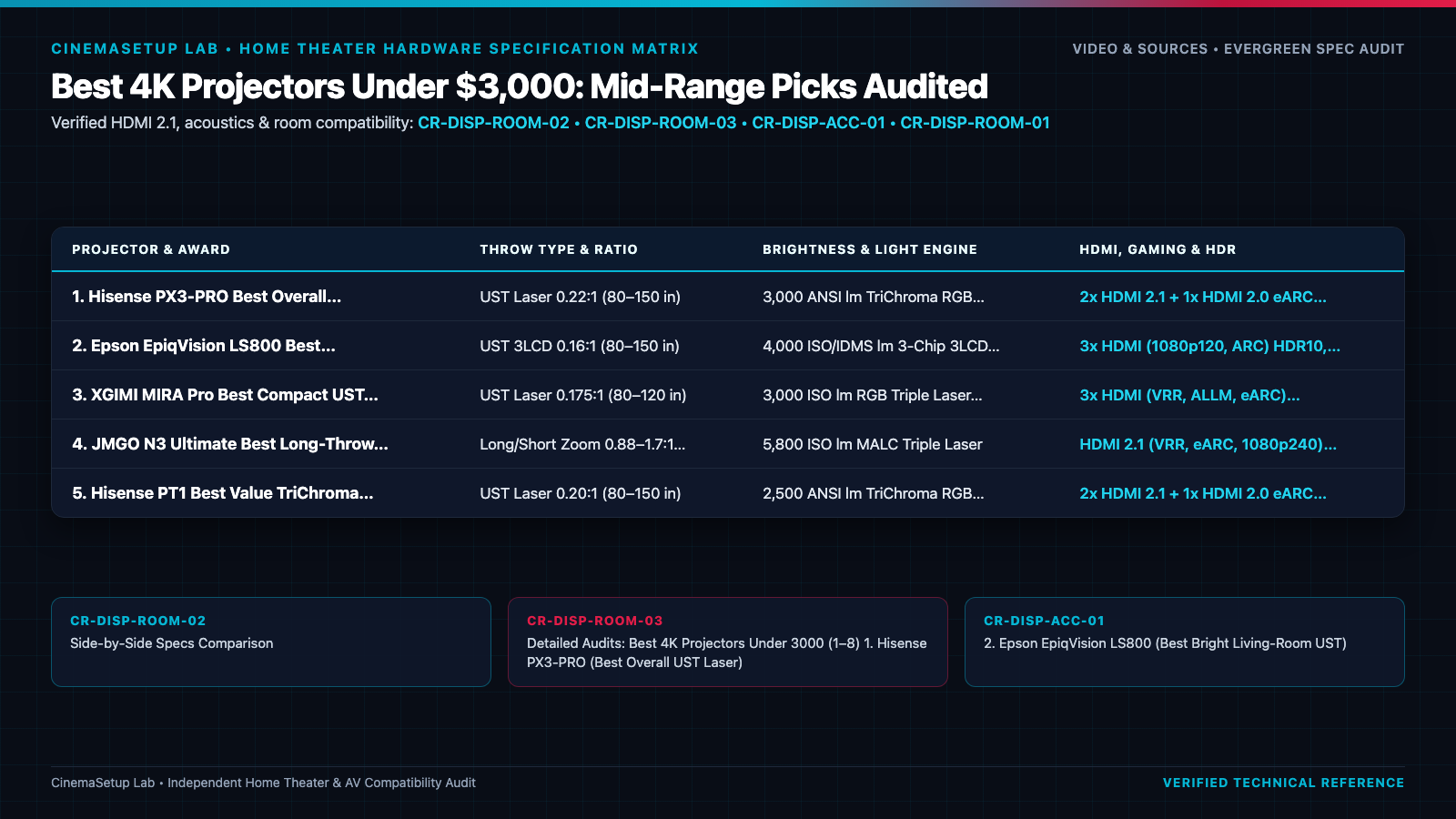
Side-by-Side Comparison: 8 Audited 4K Projectors Under $3,000
| Projector & Award | Throw Type & Ratio | Brightness & Light Engine | HDMI, Gaming & HDR | Link |
|---|---|---|---|---|
| 1. Hisense PX3-PRO Best Overall Under $3,000 | UST Laser 0.22:1 (80–150 in) | 3,000 ANSI lm TriChroma RGB Laser | 2x HDMI 2.1 + 1x HDMI 2.0 eARC Dolby Vision, HDR10+, HLG | View on Amazon |
| 2. Epson EpiqVision LS800 Best Bright-Room UST | UST 3LCD 0.16:1 (80–150 in) | 4,000 ISO/IDMS lm 3-Chip 3LCD Laser | 3x HDMI (1080p120, ARC) HDR10, HLG (no DV) | View on Amazon |
| 3. XGIMI MIRA Pro Best Compact UST Value | UST Laser 0.175:1 (80–120 in) | 3,000 ISO lm RGB Triple Laser DLP | 3x HDMI (VRR, ALLM, eARC) Dolby Vision, HDR10+, HLG | View on Amazon |
| 4. JMGO N3 Ultimate Best Long-Throw Gimbal | Long/Short Zoom 0.88–1.7:1 (4-Way Shift) | 5,800 ISO lm MALC Triple Laser | HDMI 2.1 (VRR, eARC, 1080p240) Dolby Vision, HDR10, HLG | View on Amazon |
| 5. Hisense PT1 Best Value TriChroma UST | UST Laser 0.20:1 (80–150 in) | 2,500 ANSI lm TriChroma RGB Laser | 2x HDMI 2.1 + 1x HDMI 2.0 eARC Dolby Vision, HDR10+, 3D | View on Amazon |
| 6. AWOL LTV-3000 Pro Best 3D & Dual-HDR UST | UST Laser 0.25:1 (80–150 in) | 2,000 ISO / 2,400 ANSI RGB Triple Laser DLP | 3x HDMI (eARC, 1080p120) Dolby Vision, HDR10+, 3D | View on Amazon |
| 7. Hisense M2 Pro Best Portable 4K Laser | Portable Zoom 1.0–1.3:1 (Gimbal) | 1,300 ANSI lm TriChroma RGB Laser | 1x HDMI 2.1 (eARC, CEC) Dolby Vision, HDR10+, HLG | View on Amazon |
| 8. Epson Home Cinema 2350 Best Easy-Shift Long-Throw | Long-Throw 3LCD 1.32–2.15:1 (V ±60%) | 2,800 ISO/IDMS lm 200W UHE Lamp | 2x HDMI (1080p120, ARC) HDR10, HLG, Android TV | View on Amazon |
Match Your Use Case: Which 4K Projector Fits Your Space?
| Buyer Scenario | Best Match | Why & Expected Outcome |
|---|---|---|
| All-around living-room 120-in Laser TV + Xbox gaming | 1. Hisense PX3-PRO | 3,000 ANSI lumens, TriChroma RGB color, Dolby Vision, HDR10+, and dual HDMI 2.1 inputs balance daytime usability with low-lag gaming on a UST CLR screen. |
| Bright family room + shallow credenza clearance | 2. Epson EpiqVision LS800 | 4,000 equal color/white lumens and a 0.16:1 throw ratio sit inches from the wall while projecting up to 150 in without DLP rainbow flicker. |
| Apartment media console under $2,200 (80–120 in) | 3. XGIMI MIRA Pro | Compact 18.3-in (46.4 cm) width, 0.175:1 throw, 3,000 ISO lumens, and Google TV fit tight living rooms without overhanging shallow shelves. |
| Flexible shelf/ceiling placement with maximum brightness | 4. JMGO N3 Ultimate | 5,800 ISO lumens, 0.88–1.7:1 optical zoom, and 4-way mechanical lens shift handle difficult room depths without digital keystone loss. |
| Mid-range TriChroma UST with Dolby Atmos under $2,500 | 5. Hisense PT1 | 0.20:1 throw ratio, Dolby Vision, HDR10+, and 46W up-firing speakers deliver flagship TriChroma DNA at a lighter weight and lower price bracket. |
| Portable bedroom 4K vs. budget 3LCD shelf alignment | 7. Hisense M2 Pro / 8. Epson HC 2350 | Pick the M2 Pro for movable RGB laser color and Dolby Vision in dark bedrooms; pick the HC 2350 for ±60% vertical shift in fixed long-throw setups. |
Detailed Audits: Best 4K Projectors Under 3000 Ranked 1–8
1. Hisense PX3-PRO Ultra Short Throw Triple Laser Projector — Best Overall 4K Projector Under $3,000

Quick Specs: TriChroma RGB Triple Laser DLP (0.47-in DMD, 25,000+ hr) | 4K UHD pixel-shift (80–150 in) | 3,000 ANSI lumens, 3,000:1 native contrast | 0.22:1 UST fixed throw | 2x HDMI 2.1 (ALLM, HSR 1080p240) + 1x HDMI 2.0 (eARC) | Dolby Vision, HDR10+, HDR10, HLG, IMAX Enhanced | Google TV | 21.7 x 11.7 x 4.8 in (55.0 x 29.6 x 12.0 cm), 19.8 lb (9.0 kg) | Price Tier: $2,400–$3,000 (Mid Projector; Launch MSRP around $3,499)
Audit Score: 9.4 / 10
- Cited Picture Performance (35%): 9.3 / 10
- Gaming & Connectivity (20%): 9.4 / 10
- HDR & Format Support (15%): 9.8 / 10
- Room Fit & Optics (15%): 9.0 / 10
- Light Source, OS & Warranty (10%): 9.2 / 10
- Value Within Tier (5%): 9.4 / 10
Few displays balance living-room practicality and cinematic HDR accuracy as cleanly as the Hisense PX3-PRO, earning it our top spot as the best 4k projector under 3000. Its TriChroma pure RGB laser engine generates red, green, and blue light directly without a phosphor wheel, producing wide BT.2020 color volume alongside a verified 3,000 ANSI lumen ceiling and 3,000:1 native contrast spec per Hisense USA specifications. Unlike rivals locked to static HDR10, the PX3-PRO decodes both Dolby Vision and HDR10+ alongside IMAX Enhanced mastering.
Connectivity is equally disciplined for modern console and audio chains. Two HDMI 2.1 inputs handle Xbox Series X or PS5 gaming—carrying “Designed for Xbox” tuning with ~17–21 ms input lag at 4K60 and 240 high-refresh mode at 1080p—while a dedicated third HDMI 2.0 port handles eARC passthrough to an AV receiver or Atmos soundbar (CR-DISP-AVR-01). Compared with the brighter Epson EpiqVision LS800, the PX3-PRO yields 1,000 rated lumens in exchange for full dynamic HDR, deeper TriChroma saturation, native Google TV, and true eARC lossless passthrough.
Buyer Alert: Because the PX3-PRO uses a 0.22:1 throw ratio, a 120-inch (305 cm) screen requires placing the front edge of the 11.7-inch (29.6 cm) deep chassis noticeably farther into the room than the 0.16:1 Epson LS800. Verify your credenza depth against Hisense’s throw chart (CR-DISP-ROOM-02) and confirm Amazon.com or an authorized Hisense USA dealer so the 2-year US laser warranty remains valid (G-26).
Pros
- TriChroma RGB triple-laser light source (3,000 ANSI lumens, 25,000+ hr) supports both Dolby Vision and HDR10+
- Two HDMI 2.1 inputs plus dedicated HDMI eARC port avoid switching compromises with consoles and AVRs
- Built-in Google TV streamlines native 4K streaming apps with 50W Harman Kardon onboard speakers
Cons
- 0.22:1 throw ratio needs slightly deeper media furniture than 0.16–0.175:1 UST competitors
- Requires a separately budgeted lenticular UST CLR/ALR screen to prevent overhead room light washout (CR-DISP-ACC-01)
Upgrade & System Note: Pair the PX3-PRO with a 100-inch to 120-inch UST CLR screen and route HDMI 3 eARC to a 5.1.2 AV receiver, because built-in downward/front speakers cannot replace physical overhead surround channels (CR-SYS-05).
Buy it if: You want the best balance of TriChroma 4K contrast, Dolby Vision, HDR10+, Google TV, and console connectivity under $3,000.
Skip it if: Your TV stand is shallower than 16 in (41 cm) and cannot accommodate a 0.22:1 throw setback.
2. Epson EpiqVision LS800 4K PRO-UHD Ultra Short Throw Laser Projector — Best Bright Living-Room 4K UST

Quick Specs: 3-Chip 3LCD Laser (20,000 hr) | 4K PRO-UHD pixel-shift (80–150 in) | 4,000 ISO/IDMS lumens (equal color & white) | 0.16:1 ultra-tight UST throw | 3x HDMI (1080p120 gaming port <20 ms; HDMI ARC) | HDR10, HLG | Android TV + Yamaha 2.1 audio | 27.4 x 13.4 x 6.1 in (69.5 x 34.1 x 15.6 cm), 26.5 lb (12.0 kg) | Price Tier: $2,500–$3,000 (Mid Projector)
Audit Score: 9.1 / 10
- Cited Picture Performance (35%): 9.4 / 10
- Gaming & Connectivity (20%): 8.4 / 10
- HDR & Format Support (15%): 8.0 / 10
- Room Fit & Optics (15%): 9.8 / 10
- Light Source, OS & Warranty (10%): 9.2 / 10
- Value Within Tier (5%): 8.9 / 10
When daylight competes with your screen, raw lumen output and optical proximity trump dynamic HDR logos. The Epson EpiqVision LS800 pairs a 3-chip 3LCD laser engine rated at 4,000 equal color and white ISO/IDMS lumens with an ultra-tight 0.16:1 throw lens per Epson USA documentation. For a 120-inch (305 cm) image, the rear of the LS800 sits roughly 6.8 in (17.3 cm) from the wall, saving critical credenza depth in living rooms where 0.22:1 or 0.25:1 rivals force you to pull furniture out into walkways.
Because 3LCD projects red, green, and blue simultaneously across three chips, viewers sensitive to single-chip DLP color-wheel flashes see zero rainbow artifacts. Compared with the Hisense PX3-PRO and XGIMI MIRA Pro, however, the LS800 trades away Dolby Vision, HDR10+, and full HDMI eARC. Its three HDMI inputs top out at 4K60 (120 Hz gaming on HDMI 3 requires dropping to 1080p), and audio return uses standard ARC—meaning lossless Dolby TrueHD Atmos from a 4K Blu-ray player should route straight into an AVR first rather than through the projector (CR-DISP-AVR-01).
Buyer Alert: Avoid third-party “Renewed” LS800 listings (such as B0CQ47DYH8) if you want Epson’s full 2-year US new-unit limited warranty; stick to factory-sealed US 120V retail stock from Amazon.com or an authorized Epson dealer (G-26). Note also the wide 27.4 in (69.5 cm) and 26.5 lb (12.0 kg) footprint before choosing a console.
Pros
- 4,000 equal color and white ISO/IDMS lumens handle daytime living-room viewing better than dimmer RGB laser rivals
- 0.16:1 ultra-tight throw ratio projects 80 to 150 inches while sitting closer to the wall than any other UST here
- Zero DLP rainbow artifacts on 3-chip 3LCD optics, paired with Android TV and a built-in Yamaha 2.1 speaker array
Cons
- No Dolby Vision or HDR10+ tone mapping, and 4K inputs are limited to 60 Hz (120 Hz runs at 1080p)
- HDMI ARC omits lossless TrueHD eARC passthrough, and the 27.4 in (69.5 cm) chassis requires a sturdy, wide credenza
Upgrade & System Note: Pair the LS800 with an Epson SilverFlex Ultra or lenticular UST CLR screen (CR-DISP-ACC-01). Remember that its onboard Yamaha 2.1 system delivers stereo plus integrated woofer support rather than discrete overhead Atmos (CR-SYS-05).
Buy it if: You watch sports or daytime TV in a brighter room, have shallow wall clearance, or are sensitive to DLP rainbows.
Skip it if: You prioritize Dolby Vision, HDR10+, 4K120 console passthrough, or dark-room black levels.
3. XGIMI MIRA Pro Ultra Short Throw Laser Projector — Best Compact 4K UST Value Under $2,500

Quick Specs: RGB Triple Laser DLP (0.39-in DMD) | 4K UHD pixel-shift (80–120 in) | 3,000 ISO lumens | 0.175:1 UST fixed throw | 3x HDMI (VRR, ALLM, eARC; 1080p240 high-refresh) | Dolby Vision, HDR10+, HLG | Google TV + 36W Harman Kardon 2.1 audio | 18.3 x 10.6 x 4.8 in (46.4 x 26.9 x 12.2 cm), 10.6 lb (4.8 kg) | Price Tier: $1,500–$2,200 (Mid Projector)
Audit Score: 9.0 / 10
- Cited Picture Performance (35%): 8.9 / 10
- Gaming & Connectivity (20%): 9.2 / 10
- HDR & Format Support (15%): 9.6 / 10
- Room Fit & Optics (15%): 9.0 / 10
- Light Source, OS & Warranty (10%): 8.7 / 10
- Value Within Tier (5%): 9.5 / 10
Most UST consoles are wide, heavy boxes that force apartment dwellers to buy deeper furniture. The XGIMI MIRA Pro solves that ergonomics problem while hitting an aggressive mid-tier price well below $2,500. Measuring just 18.3 in (46.4 cm) wide and 10.6 lb (4.8 kg) per XGIMI official documentation, it shrinks the footprint dramatically compared with the 27.4-inch Epson LS800 while retaining a 0.175:1 throw ratio that projects a 100-inch (254 cm) image from roughly 7.6 in (19.3 cm) off the wall.
Inside that compact frame sits an RGB triple-laser light engine rated at 3,000 ISO lumens alongside native Google TV (with licensed Netflix), Dolby Vision, HDR10+, HDMI eARC, VRR, ALLM, and a 36W Harman Kardon 2.1 speaker system. Compared with the Hisense PX3-PRO, the MIRA Pro trades the larger 0.47-inch DMD optical block and 150-inch maximum projection size for a smaller 0.39-inch DMD chip and a 120-inch sweet-spot ceiling—a worthwhile compromise for rooms where 100 to 120 inches is already the wall limit.
Buyer Alert: Avoid leaning on XGIMI’s ISA automatic keystone correction once your UST CLR screen is hung; digital warping trims addressable 4K resolution and leaves a faint border halo (CR-DISP-ROOM-05). Instead, adjust the physical leveling feet until the optical image fills your fixed-frame bezel squarely.
Pros
- 3,000 ISO lumens and 0.175:1 throw deliver bright, wall-hugging UST placement well under $2,500
- Full Google TV with Netflix, Dolby Vision, HDR10+, VRR, ALLM, HDMI eARC, and 36W Harman Kardon audio
- Compact 18.3 in (46.4 cm) width and 10.6 lb (4.8 kg) weight fit narrow media consoles effortlessly
Cons
- Recommended maximum image size stops at 120 inches rather than 150 inches on the PX3-PRO and LS800
- Smaller 0.39-inch DMD chip and auto-keystone features soften edge sharpness if mechanical leveling is skipped
Upgrade & System Note: Pair with a 100-inch or 120-inch lenticular UST CLR screen and turn off wall-color adaptation so calibrated skin tones stay accurate.
Buy it if: You want a bright, feature-rich 100–120 inch Dolby Vision UST laser projector with Google TV for a smaller living room or apartment.
Skip it if: You are building a 135-inch to 150-inch cinema wall or insist on a 0.47-inch DMD optical assembly.
4. JMGO N3 Ultimate 4K Triple Laser Projector — Best High-Brightness Long-Throw & Gimbal 4K

Quick Specs: MALC 5.0 RGB Triple Laser DLP | 4K UHD pixel-shift | 5,800 ISO lumens, 20,000:1 FOFO contrast | 0.88–1.7:1 motorized optical zoom + 4-way mechanical lens shift (V ±130%, H ±53%) + 360-deg gimbal | HDMI 2.1 (eARC, VRR, 1080p240 ~1 ms) | Dolby Vision, HDR10, HLG | Google TV | 12.1 x 9.1 x 10.8 in (30.8 x 23.1 x 27.4 cm), 15.3 lb (6.9 kg) | Price Tier: $1,900–$3,000 (Mid Projector; Launch MSRP around $2,999)
Audit Score: 9.1 / 10
- Cited Picture Performance (35%): 9.3 / 10
- Gaming & Connectivity (20%): 9.2 / 10
- HDR & Format Support (15%): 8.9 / 10
- Room Fit & Optics (15%): 9.6 / 10
- Light Source, OS & Warranty (10%): 8.6 / 10
- Value Within Tier (5%): 9.0 / 10
Most lifestyle gimbal projectors rely on digital keystone cropping that discards sharpness the moment you set them on an off-center coffee table. The JMGO N3 Ultimate breaks that pattern by combining a massive 5,800 ISO lumen MALC 5.0 triple-laser engine with true 0.88–1.7:1 motorized optical zoom and 4-way mechanical lens shift (±130% vertical and ±53% horizontal) per JMGO technical documentation. That optical flexibility lets a 120-inch (305 cm) screen sit anywhere from roughly 7.7 ft (2.3 m) to 14.9 ft (4.5 m) away without softening 4K detail (CR-DISP-ROOM-02, CR-DISP-ROOM-05).
Connectivity and smart software are equally strong for a non-UST chassis: you get Google TV with native Netflix, Dolby Vision, HDMI 2.1 with VRR and eARC, 240 Hz 1080p gaming support, and dual 12.5W speakers supporting Dolby Audio and DTS:X. Compared with the Epson Home Cinema 2350, the N3 Ultimate delivers more than double the rated brightness, eliminates lamp replacements, adds horizontal mechanical shift, and upgrades gaming with HDMI 2.1 VRR—though it omits HDR10+ dynamic metadata and carries a shorter 1-year US limited warranty.
Buyer Alert: Because the N3 Ultimate uses an integrated gimbal stand and weighs 15.3 lb (6.9 kg), ceiling installations require a manufacturer-compatible ceiling adapter anchored into structural joists per load ratings (G-27). Confirm US 120V retail fulfillment from an authorized JMGO seller at checkout (G-26).
Pros
- 5,800 ISO lumens and 0.88–1.7:1 motorized optical zoom handle both compact bedrooms and deep living rooms
- True 4-way mechanical lens shift (±130% V, ±53% H) aligns off-axis shelves with zero digital keystone blur
- Google TV with Netflix, Dolby Vision, HDMI 2.1 VRR, and eARC make external streaming boxes optional
Cons
- Omits HDR10+ support (Dolby Vision, HDR10, and HLG only) and carries a 1-year US limited warranty
- Gimbal form factor requires careful mounting hardware selection for permanent upside-down ceiling installs
Upgrade & System Note: Pair with a 100-inch to 135-inch matte white or neutral-gray fixed screen in dark rooms, or a long-throw angular ALR screen in living rooms, and use a directional fiber Ultra High Speed HDMI cable for runs past 10 ft (3.0 m) (CR-ACC-DISP-01).
Buy it if: You want ultra-bright long-throw or short-throw laser projection with genuine mechanical lens shift and motorized optical zoom.
Skip it if: You prefer a console sitting directly beneath the wall (choose a UST model) or need HDR10+.
5. Hisense PT1 Ultra Short Throw Triple Laser Projector — Best Value TriChroma 4K UST

Quick Specs: TriChroma RGB Triple Laser DLP (0.47-in DMD) | 4K UHD pixel-shift (80–150 in, Active 3D) | 2,500 ANSI lumens, 3,000:1 native contrast | 0.20:1 UST fixed throw | 2x HDMI 2.1 (ALLM, HSR 240) + 1x HDMI 2.0 (eARC) | Dolby Vision, HDR10+, HDR10, HLG, IMAX Enhanced | Google TV + 46W Dolby Atmos/DTS:X speakers | 20.5 x 11.1 x 4.7 in (52.1 x 28.2 x 11.9 cm), 15.9 lb (7.2 kg) | Price Tier: $1,800–$2,500 (Mid Projector; Launch MSRP around $2,999)
Audit Score: 8.9 / 10
- Cited Picture Performance (35%): 8.8 / 10
- Gaming & Connectivity (20%): 9.3 / 10
- HDR & Format Support (15%): 9.8 / 10
- Room Fit & Optics (15%): 9.1 / 10
- Light Source, OS & Warranty (10%): 8.4 / 10
- Value Within Tier (5%): 9.3 / 10
Think of the Hisense PT1 as the lighter, more affordable sibling to our top-ranked PX3-PRO. It preserves the same 0.47-inch DMD 4K pixel-shift core, 110% BT.2020 TriChroma RGB triple-laser gamut, 3,000:1 native contrast spec, Dolby Vision, HDR10+, IMAX Enhanced, Active 3D, and dual HDMI 2.1 + eARC port layout, while trimming weight to 15.9 lb (7.2 kg) and tightening the throw ratio slightly from 0.22:1 down to 0.20:1 per Hisense USA specifications.
The trade-off sits strictly in peak lumen output and warranty duration: the PT1 delivers 2,500 ANSI lumens instead of the PX3-PRO’s 3,000 ANSI lumens (or the Epson LS800’s 4,000 ISO/IDMS lumens) and carries a 1-year US limited warranty rather than 2 years. In evening-controlled living rooms or basements paired with a UST CLR screen, that 500-lumen step-down barely registers—while the savings go straight toward your CLR screen budget or surround speaker package.
Buyer Alert: Confirm the listing specifies the US 120V Google TV edition (ASIN B0FMVWN22H) rather than grey-market international VIDAA units (CR-SYS-02), and verify seller authorization so the 1-year Hisense USA warranty holds (G-26).
Pros
- 0.20:1 throw ratio and 15.9 lb (7.2 kg) chassis sit closer to the wall than the PX3-PRO and AWOL LTV-3000 Pro
- Full Dolby Vision, HDR10+, IMAX Enhanced, Active 3D, Google TV, and dual HDMI 2.1 + eARC connectivity
- 46W up-firing onboard speakers decode Dolby Atmos and DTS:X for immediate living-room playback
Cons
- 2,500 ANSI lumens lose daytime punch faster in unshaded sunlit rooms than 3,000–4,000 lumen rivals
- 1-year US limited warranty trails the 2-year laser coverage on the Hisense PX3-PRO and Epson LS800
Upgrade & System Note: Pair with a 100-inch or 120-inch lenticular UST CLR screen, and connect an AVR or discrete soundbar via HDMI 3 eARC when stepping up from the built-in 46W stereo/up-firing array (CR-SYS-05).
Buy it if: You watch mostly at night or in shaded rooms and want PX3-PRO triple-laser color and HDMI 2.1 features at a lower cost.
Skip it if: Midday sunlight hits your living room wall directly, where the PX3-PRO or Epson LS800 hold contrast better.
6. AWOL VISION LTV-3000 Pro 4K 3D UST Triple Laser Projector — Best 3D & Custom-Integration UST

Quick Specs: RGB Pure Triple Laser DLP (0.47-in DMD, 25,000+ hr) | 4K UHD pixel-shift (80–150 in, Active 3D) | 2,000 ISO / ~2,400 ANSI lumens | 0.25:1 UST fixed throw | 3x HDMI (HDMI 2 eARC; Turbo Mode ~15 ms 4K60 / ~8 ms 1080p120) | Dolby Vision, HDR10+, HDR10, HLG | 36W stereo audio | 23.6 x 13.9 x 5.7 in (59.9 x 35.3 x 14.5 cm), 26.5 lb (12.0 kg) | Price Tier: $2,200–$3,000 (Mid Projector; Launch MSRP around $3,999)
Audit Score: 8.6 / 10
- Cited Picture Performance (35%): 8.6 / 10
- Gaming & Connectivity (20%): 8.2 / 10
- HDR & Format Support (15%): 9.6 / 10
- Room Fit & Optics (15%): 7.9 / 10
- Light Source, OS & Warranty (10%): 8.8 / 10
- Value Within Tier (5%): 8.6 / 10
Designed originally as a custom-integrator staple, the AWOL VISION LTV-3000 Pro drops comfortably under $3,000 while keeping features missing from several newer lifestyle models: Active 3D Blu-ray playback, Control4/Savant/PJLink IP automation drivers, and both Dolby Vision and HDR10+ on an RGB pure triple-laser engine per AWOL Vision documentation. Its HDMI 2 port handles eARC Dolby Atmos passthrough to an AV receiver, and Turbo Mode drops latency down to roughly 15 ms at 4K60 and 8 ms at 1080p120.
Two practical constraints keep it in sixth place behind the Hisense PX3-PRO and PT1. First, its 0.25:1 throw ratio and deep 13.9 in (35.3 cm) chassis push the console farther away from the wall than 0.16–0.22:1 competitors, often requiring a 20-inch+ cabinet or sliding UST shelf for a 120-inch screen. Second, its standardized 2,000 ISO lumen output trails 3,000–4,000 lumen rivals in bright rooms, and streaming relies on a bundled external stick rather than integrated Google TV.
Buyer Alert: Measure your media credenza before ordering—a 0.25:1 throw needs substantially more setback from the wall than the Epson LS800 (0.16:1) or XGIMI MIRA Pro (0.175:1). Register your US serial number at awolvision.com after authorized purchase to extend the 1-year warranty to 2 years (G-26).
Pros
- Supports Dolby Vision, HDR10+, HDR10, HLG, and Active 3D playback on an RGB triple-laser light source
- Full HDMI eARC audio return plus Control4, Savant, and PJLink smart-home integration support
- Low-lag Turbo Mode (~15 ms 4K60 / ~8 ms 1080p120) and 36W built-in stereo speaker array
Cons
- 0.25:1 throw ratio and 13.9 in (35.3 cm) depth demand deeper living-room furniture or a pull-out shelf
- Lower 2,000 ISO lumen output and lacks HDMI 2.1 4K120/VRR support
Upgrade & System Note: Pair with a 100-inch or 120-inch lenticular UST CLR screen and consider swapping the external dongle for an Apple TV 4K if you use a dedicated AVR chain.
Buy it if: You own a deep media cabinet, want Active 3D and Control4 integration, and watch mostly in shaded rooms.
Skip it if: You need a compact console, 4K120 VRR console ports, or brighter daytime light output.
7. Hisense M2 Pro Triple Laser Smart Portable Projector — Best Portable 4K Under $1,500

Quick Specs: TriChroma RGB Triple Laser DLP (25,000+ hr) | 4K UHD pixel-shift (65–200 in) | 1,300 ANSI lumens | 1.0–1.3:1 motorized optical zoom + 360-deg gimbal | 1x HDMI 2.1 (eARC, CEC) + USB 3.0 | Dolby Vision, HDR10+, HDR10, HLG | VIDAA OS (Netflix) + 20W stereo audio | Portable gimbal body (~8.6 lb / 3.9 kg class) | Price Tier: $900–$1,400 (Mid / Entry-Border Projector; Launch MSRP around $1,299)
Audit Score: 8.5 / 10
- Cited Picture Performance (35%): 8.3 / 10
- Gaming & Connectivity (20%): 8.4 / 10
- HDR & Format Support (15%): 9.4 / 10
- Room Fit & Optics (15%): 8.6 / 10
- Light Source, OS & Warranty (10%): 8.2 / 10
- Value Within Tier (5%): 9.5 / 10
Budget-conscious shoppers hunting the best 4k projector under 3000 without spending near the ceiling often end up trapped between dim 1080p portables and noisy lamp boxes. The Hisense M2 Pro delivers genuine 4K UHD pixel-shift resolution, a 25,000+ hour TriChroma RGB triple-laser light source, Dolby Vision, and HDR10+ decoding in a compact gimbal chassis sitting near $1,000–$1,400. Even better, it incorporates a rare 1.0–1.3:1 motorized optical zoom lens, letting you resize a 100-inch (254 cm) canvas cleanly between roughly 7.3 ft (2.2 m) and 9.4 ft (2.9 m) without relying on resolution-robbing digital zoom.
Compared with the JMGO N3 Ultimate, the M2 Pro naturally concedes headroom: 1,300 ANSI lumens require dim or evening viewing for crisp 100-inch to 120-inch HDR contrast (CR-DISP-ROOM-03), and only a single HDMI 2.1 (eARC) input sits on the back panel. For bedrooms, apartments, or occasional backyard movie nights after dusk, however, its combination of optical zoom, native Netflix VIDAA OS, and RGB laser color outclasses every native 1080p portable in its price band.
Buyer Alert: With only one HDMI 2.1 port onboard, you cannot keep both a game console and a 4K Blu-ray player plugged in simultaneously unless you route them through an AV receiver or a certified HDMI 2.1 switch first (CR-ACC-DISP-01). Keep the gimbal squared up to your screen so digital keystone stays off.
Pros
- Motorized 1.0–1.3:1 optical zoom preserves full 4K pixel-shift sharpness across varied room distances
- TriChroma RGB triple laser (110% BT.2020) with Dolby Vision and HDR10+ near $1,000–$1,400
- Built-in VIDAA OS with Netflix plus HDMI 2.1 eARC and 20W stereo speakers minimize setup clutter
Cons
- 1,300 ANSI lumens cannot fight daytime windows; needs dim or dark room control for 100-inch+ screens
- Single HDMI port forces external switching for multi-source wired setups
Upgrade & System Note: Pair with a 100-inch matte white 1.0-gain pull-down or fixed screen in a darkened bedroom or den, and add a compact soundbar over HDMI eARC for fuller dialogue clarity.
Buy it if: You want movable RGB triple-laser 4K quality with optical zoom and Dolby Vision near $1,000–$1,400.
Skip it if: You watch in bright living rooms or need multiple direct HDMI inputs without an AVR.
8. Epson Home Cinema 2350 4K PRO-UHD Projector — Best Easy-Alignment Long-Throw Under $1,400

Quick Specs: 3-Chip 3LCD UHE Lamp (4,500–7,500 hr) | 4K PRO-UHD pixel-shift (2x Shift) | 2,800 ISO/IDMS lumens | 1.32–2.15:1 throw ratio, 1.62x zoom, V ±60% optical lens shift | 2x HDMI (1080p120 <20 ms; HDMI ARC) | HDR10, HLG | Android TV dongle | 13.1 x 10.8 x 4.8 in (33.2 x 27.4 x 12.1 cm), 8.8 lb (4.0 kg) | Price Tier: $1,000–$1,400 (Mid Projector)
Audit Score: 8.4 / 10
- Cited Picture Performance (35%): 8.1 / 10
- Gaming & Connectivity (20%): 8.2 / 10
- HDR & Format Support (15%): 7.9 / 10
- Room Fit & Optics (15%): 9.3 / 10
- Light Source, OS & Warranty (10%): 8.0 / 10
- Value Within Tier (5%): 9.2 / 10
Rounding out our list is the only traditional lamp-based long-throw projector still earning a place in the mid-range bracket—and it does so strictly on optical convenience and rainbow-free 3LCD color. The Epson Home Cinema 2350 provides ±60% vertical optical lens shift alongside a generous 1.62x manual zoom lens (1.32–2.15:1 throw ratio) per Epson USA specs. That lets you place the 8.8 lb (4.0 kg) chassis high on a rear bookshelf or ceiling mount and drop the image straight onto your screen without digital keystone blur (CR-DISP-ROOM-05).
With 2,800 equal color and white ISO/IDMS lumens, built-in Android TV, and under-20 ms input lag at 1080p 120 Hz, it easily handles evening sports, movies, and casual gaming. Compared with the JMGO N3 Ultimate and Hisense M2 Pro, however, you give up laser longevity—its 200W UHE bulb is rated for 4,500 hours Normal or 7,500 hours Eco—along with Dolby Vision, HDR10+, and deep dark-room native black levels.
Buyer Alert: Budget for a replacement UHE lamp after 4,500–7,500 hours of heavy nightly viewing, and purchase from Amazon.com or an authorized Epson dealer so the 2-year projector warranty and 90-day lamp coverage apply (G-26).
Pros
- ±60% vertical optical lens shift and 1.62x optical zoom simplify shelf or ceiling alignment without keystone distortion
- 3-chip 3LCD architecture delivers 2,800 equal color/white lumens with zero DLP rainbow artifacts
- Lightweight 8.8 lb (4.0 kg) frame includes Android TV streaming and <20 ms 1080p120 responsiveness
Cons
- Replaceable UHE lamp requires bulb maintenance over multi-year ownership unlike 20,000+ hour lasers
- HDR10 and HLG only (no Dolby Vision or HDR10+), lacks 4K120 HDMI 2.1, and has modest dark-room contrast
Upgrade & System Note: Pair with a 100-inch to 120-inch matte white or 0.8-gain gray fixed-frame screen in a dim room, and route audio from HDMI ARC or a streaming box into an AV receiver.
Buy it if: You are sensitive to DLP rainbows and need generous vertical lens shift in an affordable long-throw room.
Skip it if: You watch daily and want zero bulb replacements, Dolby Vision, or higher laser contrast.
Buying Guide: Choosing the Best 4K Projector Under 3000
1. Throw Ratio & Room Depth Math (CR-DISP-ROOM-02)
Before clicking buy on any projector, calculate physical throw distance rather than guessing from room length. For a 16:9 widescreen canvas, image width equals diagonal × 0.872—meaning a 120-inch (305 cm) screen measures roughly 105 in (267 cm) wide. Multiply that width by a projector’s throw ratio to find lens-to-screen distance, then add chassis body depth plus 6 to 12 in (15 to 30 cm) for rear exhaust ventilation and HDMI plug clearance.
On long-throw models like the Epson Home Cinema 2350 (1.32–2.15:1), a 120-inch screen demands a long-throw distance of 11.5 to 18.8 ft (3.5 to 5.7 m) from lens to screen, whereas the JMGO N3 Ultimate’s 0.88–1.7:1 optical zoom fits down to ~7.7 ft (2.3 m). An ultra-short-throw UST console works from the opposite wall: the 0.16:1 Epson LS800 sits inches closer than the 0.22:1 Hisense PX3-PRO or 0.25:1 AWOL LTV-3000 Pro. Always double-check the manufacturer’s official throw chart against your exact media credenza depth before hanging a fixed UST screen.
2. ISO 21118 / ANSI Lumens vs. Marketing Claims (CR-DISP-ROOM-03)
Standardized brightness ratings—ISO 21118 and ANSI lumens—measure multi-point calibrated white-field light output so you can compare models honestly across brands. In darkened, light-controlled theater rooms, 1,300 to 2,500 ANSI/ISO lumens (such as the Hisense M2 Pro or PT1) drive a punchy 100-inch to 120-inch image. Living rooms with evening lamps or daytime window bleed benefit heavily from 3,000 to 5,800 rated lumens (Hisense PX3-PRO, XGIMI MIRA Pro, Epson LS800, or JMGO N3 Ultimate).
Be skeptical of unbranded marketplace listings promising “8,000+” or “15,000 LED lumens” alongside vague “4K support” phrasing. As detailed in our broader best home theater projectors hub, LED lumens have no standardized calibration protocol, and generic sub-$400 engines routinely pair low-output single-LCD panels with 720p or 1080p native chips that downscale 4K inputs.
3. Pixel-Shift 4K vs. Native 4K Architecture
Every model in this sub-$3,000 bracket produces 3840 x 2160 on-screen pixels via fast optical pixel-shifting rather than native 4K LCOS imaging panels (which generally start in higher brackets over $5,000). Texas Instruments 0.47-inch and 0.39-inch XPR DLP chips shift mirrors four times per frame to display 8.3 million distinct pixels, while Epson’s 3-chip 3LCD PRO-UHD engines shift diagonally across dual axes. At standard viewing distances—10 to 16.3 ft (3.0 to 5.0 m) for a 100-inch to 120-inch screen per SMPTE and THX viewing-angle guidelines (CR-DISP-ROOM-01)—well-focused pixel-shift optics resolve crisp 4K detail without visible pixel grid structure.
4. Screen Pairing: UST CLR/ALR vs. Matte White (CR-DISP-ACC-01)
Matching screen material to projector geometry matters just as much as the projector itself. Ultra-short-throw lasers fire upward at steep angles from directly beneath the bottom bezel. Pair a UST console with a standard long-throw angular ALR screen and the surface literally rejects your projector’s beam toward the floor, producing dark hotspots and uneven edges. Instead, UST projectors in rooms with ambient light require a lenticular ceiling-light-rejecting ALR CLR screen featuring horizontal sawtooth micro-ridges that bounce upward laser light straight to the sofa while blocking ceiling fixtures.
Conversely, long-throw and gimbal projectors (JMGO N3 Ultimate, Hisense M2 Pro, Epson HC 2350) belong on a tensioned matte white (1.0–1.1 gain) or light-gray fixed screen in dark dedicated rooms, or a dedicated long-throw angular ALR screen when ambient light cannot be eliminated. Projecting onto textured painted drywall ripples fine 4K detail and wastes contrast.
5. HDMI 2.1, eARC Audio Return & Long-Run Cabling (CR-SRC-DISP-02, CR-ACC-DISP-01)
Video and audio features only reach your eyes and ears if every hop in the chain supports them, as outlined by the HDMI Licensing Administrator HDMI 2.1 specification. Check two port details carefully: first, whether the projector carries eARC (supporting lossless Dolby TrueHD Atmos passthrough from projector-connected sources) or legacy ARC only (Epson LS800 and HC 2350, which cap return audio at compressed Dolby Digital Plus and stereo PCM). Second, confirm whether gaming inputs support 4K60 or high-refresh 1080p120/240 rather than assuming every HDMI 2.1 label implies 48 Gbps 4K120 panel refresh.
For runs longer than 10 ft (3.0 m) from an AV receiver up to a ceiling-mounted projector, passive copper cables frequently suffer signal dropouts at high bitrates. Use an Ultra High Speed HDMI Certified active optical fiber cable—clearly observing the directional “Source” and “Display” connector labels—and verify CL2 or CL3 fire ratings before routing any wire inside drywall or ceiling joists.
6. Secondary Intent Resolver & Installation Safety (G-27)
UST Laser vs. Long-Throw Zoom Under $3,000: Choose a UST console (Hisense PX3-PRO, Epson LS800, XGIMI MIRA Pro) when you want a sleek living-room installation with short HDMI cords, zero ceiling shadows, and 100–120 inch ambient-light punch via a UST CLR screen. Choose a long-throw zoom projector (JMGO N3 Ultimate, Epson HC 2350) when you have a rear shelf or ceiling position, want lower total cost (matte white screens cost less than UST CLR screens), or want flexible 135-inch+ sizing.
Upgrade Roadmap, Hidden Costs & Safety: Budget separately for your screen ($500–$1,200+ for UST CLR fixed frames; $250–$600 for matte white tensioned frames), an AV receiver or eARC Atmos soundbar, and UL 1449-listed surge protection. When ceiling-mounting a long-throw projector or wall-hanging a heavy aluminum screen frame, always follow the manufacturer’s hardware instructions first, anchor brackets into solid wood studs or structural ceiling joists rather than bare drywall, use CL2/CL3-rated in-wall cables per local building codes, and consult a licensed electrician or qualified AV installer for in-wall power outlets or complex structural mounts.
Methodology, Scoring Rubric & Models We Excluded
Every ranking on CinemaSetup Lab is built from manufacturer US specification sheets, owner’s manuals, official lumen disclosures, and cross-compatibility rules rather than sponsored placements or commission rates. Amazon Associates pays 2% on televisions versus 4% on most AV equipment and projectors, yet commission percentages never influence which model earns our top recommendation (Methodology).
| Evaluation Criterion | Weight | What We Audit |
|---|---|---|
| Cited Picture Performance | 35% | Standardized ISO 21118 / ANSI lumen output, 3LCD vs RGB triple-laser contrast & color gamut, pixel-shift 4K precision |
| Gaming & Connectivity | 20% | HDMI 2.1 capability, 4K60 vs 1080p120/240 modes, VRR/ALLM, dedicated eARC/ARC port behavior, cited input lag |
| HDR & Format Support | 15% | Dolby Vision, HDR10+, HDR10, HLG, IMAX Enhanced, and Active 3D playback |
| Room Fit & Optics | 15% | Throw ratio, optical zoom and mechanical lens shift (without keystone blur), and ALR/CLR screen compatibility |
| Light Source, OS & Warranty | 10% | Rated laser/lamp hours, built-in smart TV ecosystem (Google TV, Android TV, VIDAA), onboard audio, and US dealer warranty |
| Value Within Tier | 5% | Feature competitiveness inside the $1,000–$3,000 Mid Projector bracket (screen budgeted separately) |
Models We Audited & Rejected (And Why)
- Generic Sub-$400 “4K Support” & Unbranded “Outdoor 4K” Projectors (HAPPRUN, XuanPad, KOGATA, Magcubic, plus B0HJZDYGCZ, B0HDPT8JGZ, B0GXV4XTK2): Disqualified under CR-DISP-ROOM-03 because unbranded marketplace units frequently combine native 720p or 1080p LCD panels with unstandardized lumen claims and vague “4K support” labels.
- XGIMI MoGo 2 Pro (New) Portable Projector (B0FK4S3H29): Disqualified because its native imaging panel is 1080p (accepting 4K signals only via downscaling), falling short of true 4K UHD pixel-shift resolution.
- Epson EpiqVision Ultra LS800 Renewed Listings (B0CQ47DYH8 / B0CQ46DXF4): Excluded under our US warranty guardrail in favor of factory-new retail stock (B0BCXTVXMC), as renewed marketplace units forfeit Epson’s full 2-year US new-unit limited warranty.
- AWOL Vision Aetherion Pro 150-Inch Bundle (B0GXF98VRL) & Epson LS11000: Excluded from this sub-$3,000 projector-only tier because both sit in the High-End pricing bracket over $3,000.
Continue Your Audit
- Best TVs for PS5 & Xbox Series X 2026: 4K120 Ports Audited
- Best TVs for Bright Rooms 2026: Mini-LED Picks Audited
Frequently Asked Questions
What is the best 4k projector under 3000 for most living rooms?
The Hisense PX3-PRO is the best 4k projector under 3000 for most living rooms because it pairs 3,000 ANSI lumens, TriChroma RGB color, Dolby Vision, HDR10+, Google TV, and dual HDMI 2.1 inputs in a 0.22:1 UST design. Brighter daytime rooms with shallow stands should pick the 4,000-lumen Epson LS800.
Should I pick an ultra-short-throw or long-throw 4K projector under $3,000?
Pick a UST laser projector like the Hisense PX3-PRO or XGIMI MIRA Pro if you want a 100-inch to 120-inch screen without ceiling mounts or long HDMI runs. Pick a long-throw model like the JMGO N3 Ultimate or Epson HC 2350 when you have 10 to 16 ft (3.0 to 4.9 m) of room depth.
Why do UST projectors under $3,000 need a special ALR/CLR screen?
Ultra-short-throw projectors fire steep upward light cones from inches beneath the wall, causing standard long-throw ALR screens to reject the image. Pairing a UST console with a lenticular ceiling-light-rejecting (CLR/ALR) screen reflects projector light toward the sofa while blocking overhead room lamps.
How do ISO and ANSI lumens compare to generic “4K support” listings?
ISO 21118 and ANSI lumens measure standardized multi-point white-field brightness you can compare fairly across reputable brands. Generic sub-$400 “4K support” listings frequently run native 720p or 1080p LCD panels with unverified marketing lumen claims that underperform in real living rooms.
Do pixel-shift 4K projectors under $3,000 look as sharp as native 4K?
Modern 0.47-inch XPR DLP and 4K PRO-UHD pixel-shift projectors display all 8.3 million addressable 4K pixels on screen, looking crisp at normal 9 to 13 ft (2.7 to 4.0 m) seating distances. Native 4K LCOS panels hold an advantage in close-up text inspection and native contrast, but typically cost well over $3,000.
What HDMI cable and mounting precautions apply to 4K projectors?
Use an Ultra High Speed HDMI Certified cable for 48 Gbps HDMI 2.1 sources, switching to a directional active optical fiber cable (CL2/CL3-rated if in-wall) for runs longer than 10 ft (3.0 m). For ceiling mounts, follow manufacturer hardware instructions, anchor into structural joists, and consult a licensed installer when unsure.
Final Verdict: Choosing the Best 4K Projector Under 3000
Picking the best 4k projector under 3000 comes down to ambient room light, furniture depth, and HDR format priorities. For most buyers building a living-room cinema, the Hisense PX3-PRO leads with 3,000 ANSI lumens, TriChroma RGB color, Dolby Vision, HDR10+, Google TV, and dual HDMI 2.1 + eARC inputs. Sunlit family rooms or shallow credenzas belong with the 4,000-lumen, 0.16:1 Epson EpiqVision LS800, while compact apartments under $2,200 get tremendous value from the XGIMI MIRA Pro. If your room favors traditional rear-shelf or ceiling placement, the 5,800-lumen JMGO N3 Ultimate delivers unmatched optical zoom and 4-way mechanical lens shift without keystone compromises.


