
Disclosure: As an Amazon Associate, I earn from qualifying purchases. If you buy through links on this page, CinemaSetup Lab may earn a small commission at no extra cost to you. Commission tiers differ across categories—for example, televisions typically earn around 2% while projectors, screens, and AV accessories earn around 4%—and commission rates never influence our compatibility audits, brightness verifications, or recommendations.
Search for a home theater projector on Amazon US and you will immediately see sub-$300 plastic boxes boasting "9,500 Lumens," "15,000 Lux," or even "3,000 ANSI Lumens" alongside dramatic daylight living-room photos. Auditing projector lumens claims on amazon is essential before checkout because brightness is the single easiest projector specification to inflate without technically lying about a unit label.
Across our live ZIP 10001 marketplace checks documented in our Amazon home theater buying audit, misleading brightness numbers routinely travel alongside downscaled "4K support" optics and non-authorized third-party storefronts. Guided by CinemaSetup Lab compatibility rules (CR-DISP-ROOM-03, CR-DISP-ACC-01, CR-DISP-ROOM-02, CR-DISP-ROOM-05, and CR-SYS-02) and our specification audit methodology, this guide explains how standardized ISO 21118 and ANSI lumens work, exposes why LED lumens, Lux, and center-lumen claims mislead buyers, and highlights four transparent Amazon US alternatives.
In This Audit
- Urgent Buyer Alert: 4 Projector Brightness Traps on Amazon US
- Amazon Projector Lumens Inspection Matrix
- ISO 21118 & ANSI Lumens vs. LED Lumens, Lux & Center Lumens
- Ambient Light, Screen Size Dilution & Optical Zoom (CR-DISP-ROOM-03)
- Seller Integrity, Variant Pooling, Box Contents & Safety (G-26 / G-27)
- 60-Second Pre-Checkout Lumens Audit Checklist
- Verified Brightness-Transparent Projectors on Amazon US
- Authoritative Standards & References
- Frequently Asked Questions
Urgent Buyer Alert: 4 Projector Brightness Traps on Amazon US
Marketplace Buyer Alert (Verified 2026-11-26, ZIP 10001): Before ordering any projector on Amazon US based on a bold brightness number in its title or hero graphic, screen the listing for these four recurring traps:
- "LED Lumens" & "Light-Source Lumens" (
G-16,CR-DISP-ROOM-03): Unregulated marketing labels measure raw light directly at the internal LED emitter inside the chassis before polarizers, single-LCD panels, and plastic lenses absorb 50% to 80% of the output—causing a "5,000 LED lumen" unit to project only a small fraction of that light onto your wall. - Uncontextualized "Lux" Claims (
G-16): Lux measures illuminance at one single spot on a surface rather than total luminous flux across a screen. Moving a meter inches from the lens creates massive "10,000+ Lux" numbers that collapse into a dim, unevenly lit rectangle once stretched across a 100-inch screen. - "Center Lumens" & Unverified Sub-$400 "ANSI" Claims (
G-01,CR-DISP-ROOM-03): Even established manufacturers occasionally place higher center lumens in an Amazon headline while listing the lower 9-point ANSI average in the spec PDF—and generic sub-$400 marketplace listings (such as common HAPPRUN, XuanPad, KOGATA, and Magcubic units) sometimes stamp "ANSI" onto titles without published ISO 21118 or ANSI IT7.228 verification docs. - Pooled Variant Reviews & Non-Authorized US Warranty Gaps (
G-05,G-26): Sellers frequently merge thousands of reviews from older low-output trims onto newly renamed high-lumen variants and ship through rotating marketplace resellers lacking authorized US120 Vservice support.
Amazon Projector Lumens Inspection Matrix
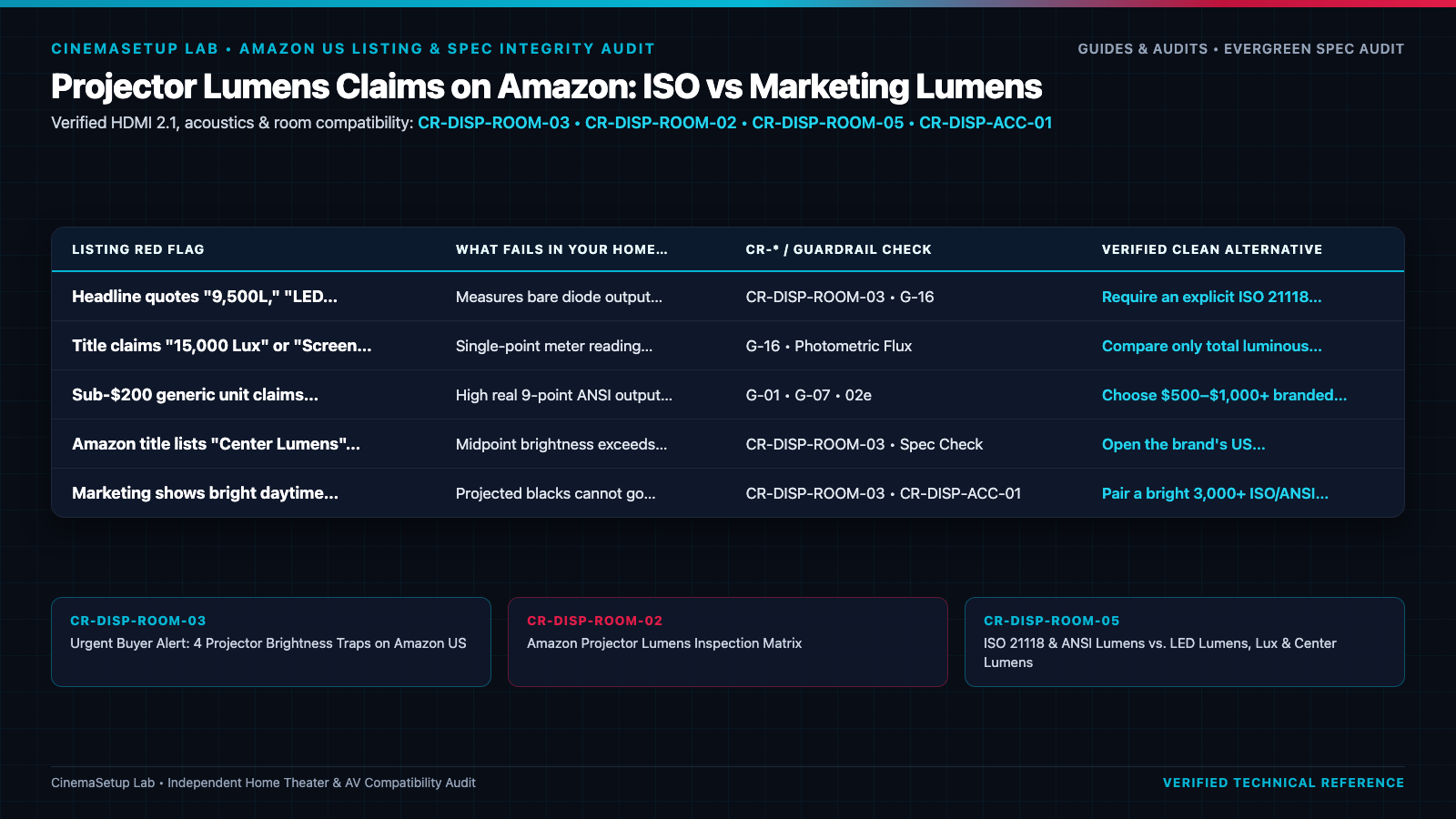
Use the inspection table below to translate common Amazon brightness badges into what actually reaches your projection screen—and verify which CinemaSetup Lab rules apply before clicking Add to Cart.
| Listing Red Flag | What Fails in Your Home Theater | CR-* / Guardrail Check | Verified Clean Alternative |
|---|---|---|---|
| Headline quotes "9,500L," "LED Lumens," or "Source Lumens" | Measures bare diode output inside the casing; polarizers and single-LCD optics discard most light before it reaches the wall. | CR-DISP-ROOM-03 • G-16 | Require an explicit ISO 21118 or ANSI lumens rating on the manufacturer's US spec page. |
| Title claims "15,000 Lux" or "Screen Lux" | Single-point meter reading spikes when held close to the lens; a 100-in image washes out with any room lamp on. | G-16 • Photometric Flux | Compare only total luminous flux averaged across a standardized 9-point white screen grid. |
| Sub-$200 generic unit claims "2,000–3,000 ANSI" without spec PDF | High real 9-point ANSI output requires high-wattage thermal cooling and larger glass optics rarely found in ultra-cheap cubes. | G-01 • G-07 • 02e | Choose $500–$1,000+ branded Entry models with documented ANSI/ISO spec sheets and independent measurements. |
| Amazon title lists "Center Lumens" instead of ANSI average | Midpoint brightness exceeds corner luminance; image edges appear noticeably darker than the middle of the frame. | CR-DISP-ROOM-03 • Spec Check | Open the brand's US specification sheet and verify the 9-point ANSI or ISO 21118 number separately. |
| Marketing shows bright daytime living room with bare white wall | Projected blacks cannot go darker than the ambient light hitting the wall; daytime sunlight erases shadow detail. | CR-DISP-ROOM-03 • CR-DISP-ACC-01 | Pair a bright 3,000+ ISO/ANSI UST projector with a lenticular UST CLR/ALR screen, or control room light. |
| Generic listing mixes "4K Support" + high lumens + 10,000 pooled reviews | Inherited reviews from older 720p models hide dim real-world optics and absent post-return US warranty service. | G-05 • G-26 • CR-SYS-02 | Verify Ships from and sold by Amazon.com or an official brand storefront on US 120 V AC / 60 Hz models. |
ISO 21118 & ANSI Lumens vs. LED Lumens, Lux & Center Lumens
When evaluating projector lumens claims on amazon, the word "lumens" on its own is meaningless unless accompanied by the measurement protocol behind it. Under CinemaSetup Lab's display rule CR-DISP-ROOM-03 and guardrail G-16, projector brightness can only be compared across models when both figures follow a recognized photometric standard—specifically ISO 21118 or ANSI lumens.
1. ANSI Lumens (ANSI/NAPM IT7.228) & ISO 21118: The Two Trustworthy Benchmarks
Developed by the American National Standards Institute, ANSI lumens measure real projected light hitting the screen inside a light-controlled dark room. The projector displays a 100% full-white reference pattern onto a screen of known area, and a calibrated illuminance meter records Lux at the center of nine equal rectangular grid zones across the entire image. Those nine readings are averaged and multiplied by the screen area in square meters (1 lumen = 1 lux × 1 sq m) to determine true on-screen luminous flux.
ISO 21118—published by the International Organization for Standardization—uses the same fundamental 9-point full-white screen methodology while adding tighter environmental conditions (controlled line voltage and ambient temperature) and strict mass-production tolerances. Under ISO 21118 rules, serialized retail units shipped to consumers must not drop below 80% of the published specification. That is why reputable modern smart-projector and home-cinema makers (such as XGIMI, JMGO, and AWOL Vision) quote ISO 21118 lumens, while legacy commercial and home-entertainment brands (such as BenQ, ViewSonic, and Epson) commonly quote ANSI lumens. In practice, both standards track closely and allow fair apples-to-apples comparisons.
2. "LED Lumens" & "Light-Source Lumens": Why They Inflate Reality
Because ISO 21118 and ANSI procedures expose low-wattage optics immediately, budget marketplace brands invented unregulated labels like "LED lumens" and "light-source lumens." Instead of measuring projected light after it exits the front glass or plastic lens onto a nine-zone screen, source-lumen claims measure raw emission right at the bare LED chip inside the housing—or apply arbitrary perceptual multipliers to account for LED color saturation (sometimes referencing the Helmholtz-Kohlrausch effect without an industry-wide formula).
Inside an inexpensive single-panel LCD projector, light must pass through condenser lenses, heat filters, polarizing films, an LCD color filter matrix, and a multi-element projection lens. That optical path absorbs roughly 50% to 80% of the emitter's raw light before it ever leaves the chassis. Consequently, an unregulated "6,000 LED lumens" or "9,500 lumens" budget listing frequently behaves like only a few hundred true ANSI lumens in an actual living room.
3. "Lux" & "Center Lumens": Close-Range & Midpoint Shortcuts
Two other deceptive numbers regularly appear on Amazon product pages:
- Uncontextualized "Lux" (
10,000 Lux/15,000 Lux): Lux measures light intensity falling on a single square meter at one specific distance—not total projector output. Hold a meter 2.0 ft (0.6 m) in front of a projector lens and the concentrated beam registers thousands of Lux. Move that same projector back to cast a 100-in (2.54 m diagonal) screen and intensity drops with the inverse square of distance. Without a stated screen size and full 9-point grid average, Lux figures are useless for comparing projectors. - "Center Lumens" vs. 9-Point ANSI Average: Even legitimate brands occasionally highlight a brighter center lumen number in Amazon titles while putting the true 9-point ANSI rating in the full spec sheet. For example, ViewSonic's official US specification sheet for the LS740HD laser projector transparently lists 5,000 ANSI lumens alongside 5,500 center lumens, whereas its Amazon product title leads with "5500 Lumens." Because the center of a projected rectangle is almost always brighter than its four corners, reading the full spec PDF prevents subtle overestimation.
4. Why Cinema Picture Modes Look Dimmer Than Rated Peak Specs
Even on an honest ISO 21118 or ANSI-rated projector, maximum rated lumens are typically measured in the brightest factory preset (often labeled Dynamic, Vivid, or Bright), which pushes green output and cools white balance to maximize full-white meter readings. When you switch to an accurate Cinema or Filmmaker Mode calibrated near D65 white balance for movies, real-world calibrated output drops below the headline peak specification. Our projector lumens room-light sizing guide breaks down exact screen luminance (foot-lamberts and nits) across dark theaters and bright rooms so you can size headroom accurately.
Ambient Light, Screen Size Dilution & Optical Zoom (CR-DISP-ROOM-03)
Standardized lumens only tell half the story; room geometry and screen selection determine how bright the picture actually looks to your eyes. Under CinemaSetup Lab rules CR-DISP-ROOM-03, CR-DISP-ACC-01, and CR-DISP-ROOM-02, three physical constraints catch Amazon buyers off guard:
- Screen Area Dilution (100 in vs. 150 in): Projectors spread a fixed amount of light across the entire surface area of your screen. A 100-in 16:9 screen measures 87.2 × 49.0 in (2.21 × 1.25 m), covering
29.7 sq ft(2.76 sq m). Stepping up to a 150-in 16:9 screen (130.7 × 73.5 in / 3.32 × 1.87 m) expands the area to66.8 sq ft(6.21 sq m)—spreading the same projector lumens across 2.25× more surface area and cutting perceived brightness by more than half. That is why sub-$400 cubes promising "300-inch cinema" turn barely watchable beyond 80 to 90 inches. - Ambient Light & Black-Floor Washout (
CR-DISP-ROOM-03): A projector cannot project darkness—its "black" level is simply the unlit color of your wall or screen under whatever room light is present. In a dark, light-controlled theater, 1,500 to 2,500 verified ISO/ANSI lumens on a 1.0-to-1.1-gain matte white screen look punchy and cinematic. In a daytime living room, stray sunlight washes out blacks on standard long-throw setups; either control ambient light or pair a high-output 3,000+ ISO/ANSI ultra-short-throw (UST) laser projector with a dedicated lenticular UST CLR/ALR screen (CR-DISP-ACC-01). - Optical Zoom vs. Digital Keystone Brightness Loss (
CR-DISP-ROOM-02/05): Fixed-lens budget models lack optical zoom and optical lens shift. When buyers rely on "Auto 4D Keystone" to square a tilted image from a side table, digital scaling shrinks the active pixel window inside the chip—wasting light output on unused dark-gray border pixels while softening resolution. Choosing models with true optical zoom (1.1x to 1.5x) or mechanical lens shift preserves every lumen and pixel on screen.
Because generic sub-$400 marketplace models (including common HAPPRUN, XuanPad, KOGATA, and Magcubic listings) frequently combine inflated brightness marketing with native 720p/1080p "4K support" downscaling, CinemaSetup Lab strictly excludes them from branded home theater roundups such as our best projectors under $1,000 guide and best portable projectors picks. You can also inspect the chip-resolution side of this trap in our "4K support" projector resolution audit.
Seller Integrity, Variant Pooling, Box Contents & Safety (G-26 / G-27)
Even after verifying an ISO 21118 or ANSI lumen claim, check four marketplace ownership details before buying on Amazon US:
- Parent/Child ASIN Review Pooling (
G-05): Many marketplace projector pages stack multiple hardware trims—entry 720p editions, updated 1080p units, and tripod bundles—under one shared review count. Always open the product reviews and filter by exact variant name so five-star feedback on an older trim does not mask brightness complaints on the SKU in your cart. - US 120 V Compliance & Authorized Dealer Warranty (
CR-SYS-02,G-26): Confirm the projector is a North American120 V AC / 60 HzSKU sold by Amazon.com or the brand's official authorized US storefront (such as XGIMI Direct, JMGO Direct, ViewSonic, or BenQ). Gray-market third-party liquidators and unbranded importers routinely fail to honor 2-to-3-year US factory warranties once Amazon's 30-day return window ends. - Box Contents & Built-In Audio Honesty (
G-29,CR-SYS-05): Branded home theater projectors ship with the projector, remote, and US power cord—screens, ceiling mounts, and long HDMI cables are sold separately unless explicitly bundled. Likewise, internal 10W to 24W stereo speakers are not physical multichannel surround sound; look for an HDMI eARC or ARC port (CR-DISP-AVR-01) if you plan to pass audio to an AV receiver or soundbar, or budget an external streaming stick plus audio switcher for commercial-style HDMI 1.4 models. - Mounting, In-Wall Wiring & Electrical Safety (
G-27,CR-DISP-ACC-02): Whenever ceiling-mounting a 4.9 to 11.5 lb (2.2 to 5.2 kg) projector or hanging a wall screen, follow the projector and mount manufacturer's installation instructions first, verify load ratings, and anchor strictly into solid wood ceiling joists or wall studs—never hollow drywall alone. Concealed HDMI runs longer than 10 ft (3.0 m) should use directional Ultra High Speed Certified fiber cables carrying a ULCL2orCL3in-wall fire rating (CR-ACC-DISP-01), and any ceiling AC outlet wiring or structural mounting should be referred to a licensed electrician or licensed AV installer. Keep external sound playback at comfortable volume levels.
60-Second Pre-Checkout Lumens Audit Checklist
Run every Amazon projector listing through these six quick verification steps before clicking Buy Now:
- Demand ISO 21118 or ANSI Lumens (
CR-DISP-ROOM-03): Verify that the brightness unit explicitly statesISOorANSI lumens—reject listings quoting "Lux," "LED lumens," "source lumens," or bare "Lumens" with no standard. - Check the Brand's US Spec Sheet for Center Lumens: If an Amazon headline highlights a rounded figure (such as 5,500 lumens), confirm on the manufacturer's US page whether that is a center-only reading above the true 9-point ANSI rating.
- Match Lumens to Screen Size & Room Light: Remember a 150-in screen has 2.25× the area of a 100-in screen; size output for calibrated Cinema modes rather than Vivid presentation modes.
- Audit Native Resolution Separately (
02e): Never equate high lumens with 4K sharpness—verifyDLP XPR/4K PRO-UHDpixel-shift or honest native1920×1080rather than "4K Support" 720p panels. - Check Optical Zoom, Lens Shift & Audio Ports (
CR-DISP-ROOM-02/05): Confirm throw ratio fits your room depth without heavy digital keystone cropping, and verify HDMIeARC/ARCor external audio needs. - Verify Authorized Seller & US 120 V Model (
CR-SYS-02,G-26): Buy "Ships from and sold by Amazon.com" or an official US brand storefront so your 2-to-3-year manufacturer warranty remains valid.
Verified Brightness-Transparent Projectors on Amazon US
Rather than gambling on unverified sub-$400 marketing numbers, the four US 120 V AC / 60 Hz retail models below publish standardized ISO 21118 or ANSI lumen ratings verifiable on their manufacturers' US pages—including one real-world example illustrating how to read "center lumens" versus 9-point ANSI specs honestly.
1. XGIMI HORIZON 20 4K RGB Triple Laser Home Projector, 3200 ISO Lumens — Best Standardized 4K Triple-Laser + Lens Shift

Audit Snapshot: Brightness: 3,200 ISO lumens (RGB triple laser) | Display Engine: 0.47-in DLP DMD 4K UHD XPR pixel-shift (3840×2160 on-screen) | Throw & Optics: 1.20–1.50:1 optical zoom with hardware lens shift (V ±120%, H ±45%) | Connectivity & HDR: 2x HDMI (HDMI 1 eARC), Dolby Vision, HDR10+, IMAX Enhanced, VRR, ALLM, Google TV, 2x 12W Harman Kardon | Dimensions & Weight: 11.7 × 9.8 × 7.5 in (29.8 × 24.9 × 19.0 cm), 10.6 lb (4.8 kg) | In the Box: US 120 V projector, remote control, power adapter/cord, manual (screen and ceiling mount sold separately) | Price Tier: $1,500-$2,500 (Mid Projector)
The XGIMI HORIZON 20 exemplifies transparent brightness engineering on Amazon US: its 3,200 ISO lumens specification conforms to ISO 21118's nine-point screen standard and mass-production floor rather than inflated emitter estimates (CR-DISP-ROOM-03). Equally important for real-world brightness preservation, it pairs 1.20–1.50:1 physical optical zoom with mechanical vertical (±120%) and horizontal (±45%) lens shift—so you can align the frame onto a 100-to-150-in screen without sacrificing light or pixel sharpness to digital keystone cropping (CR-DISP-ROOM-05). It also supports both Dolby Vision and HDR10+ (CR-SRC-DISP-01) plus HDMI eARC for external Atmos audio.
Seller & Warranty Check (2026-11-26): Confirm purchase from XGIMI Direct or Amazon.com for XGIMI's 2-year US limited manufacturer warranty (G-26, CR-SYS-02), and verify you are selecting the 3,200 ISO base HORIZON 20 rather than higher-tier Pro/Max trims if targeting this tier.
Pros
- Verified 3,200 ISO 21118 lumens from an RGB triple-laser engine sustain strong contrast on 120-to-150-in screens
- Physical 1.20–1.50:1 optical zoom and V ±120% / H ±45% lens shift avoid digital keystone lumen loss
- Supports Dolby Vision, HDR10+, IMAX Enhanced, VRR/ALLM, Google TV, and HDMI eARC
Cons
- Mid-tier pricing ($1,500–$2,500) excludes projection screens and ceiling mounts
- Calibrated Cinema/Filmmaker picture presets trade peak white output for accurate D65 color
2. JMGO N1S 4K Upgrade Triple Laser Projector, 1700 ISO Lumens, Google TV — Best Compact 4K Entry With Verified ISO Output

Audit Snapshot: Brightness: 1,700 ISO lumens (MALC triple RGB laser) | Display Engine: 0.47-in DLP DMD 4K UHD XPR pixel-shift (3840×2160 on-screen) | Throw & Gimbal: 1.20:1 fixed throw ratio, 127-degree vertical tilt gimbal | Connectivity & HDR: HDMI 2.1 (eARC), USB-A, Google TV (licensed Netflix), HDR10, dual 5W speakers | Dimensions & Weight: 7.4 × 6.5 × 7.5 in (18.7 × 16.5 × 19.1 cm), 4.9 lb (2.2 kg) | In the Box: US 120 V projector, remote control, power adapter/cord, manual (screen sold separately) | Price Tier: $800-$1,200 (Entry / Mid Projector)
Many shoppers comparing gimbal-mounted lifestyle projectors get distracted by sub-$400 cubes claiming "8,000+ LED lumens." The JMGO N1S 4K Upgrade demonstrates what genuine compact laser projection delivers: 1,700 ISO lumens verified to ISO 21118, full 4K UHD XPR pixel-shifting, licensed Google TV with Netflix, and an HDMI 2.1 eARC port (CR-DISP-AVR-01). In a light-controlled bedroom or evening den at 80 to 110 inches, 1,700 calibrated ISO lumens easily outperform "6,000 LED lumen" single-LCD toys while keeping chassis weight at just 4.9 lb (2.2 kg).
Seller & Variant Check (2026-11-26): Select the exact N1S 4K (1700 ISO) model sold by JMGO Direct or Amazon.com for US 120 V coverage (G-26, CR-SYS-02), and align its fixed 1.20:1 lens squarely with the screen to avoid digital keystone losses (CR-DISP-ROOM-05).
Pros
- Standardized 1,700 ISO lumens rating accurately reflects real dark-room screen brightness
- 4K UHD XPR pixel-shifting resolves 8.3 million addressable pixels alongside HDMI 2.1 eARC
- Compact 4.9 lb (2.2 kg) chassis with 127-degree gimbal and licensed Google TV
Cons
- Fixed 1.20:1 lens offers no optical zoom or mechanical lens shift (CR-DISP-ROOM-05)
- 1,700 ISO lumens wash out in bright daytime rooms and omit Dolby Vision / HDR10+ (CR-SRC-DISP-01)
3. ViewSonic LS740HD 1080P Laser Projector, 5500 Lumens — Best Bright-Room Laser (ANSI vs. Center Lumens Case)

Audit Snapshot: Brightness: 5,000 ANSI lumens (listed as 5,500 center lumens on ViewSonic's US spec sheet) | Display Engine: DLP Native 1080p (1920×1080), 3rd-gen laser phosphor (up to 30,000 hr Eco) | Throw & Zoom: 1.13–1.47:1 (1.3x optical zoom) | Connectivity & Audio: 2x HDMI 1.4, USB-A power, 3.5 mm audio out, 15W speaker | Dimensions & Weight: 11.3 × 8.5 × 5.1 in (28.6 × 21.6 × 12.9 cm), 6.6 lb (3.0 kg) | In the Box: US 120 V projector, power cord, remote control, manual (streaming stick and screen sold separately) | Price Tier: $1,000-$1,500 (Mid Projector)
The ViewSonic LS740HD is a textbook illustration of why checking manufacturer US spec PDFs matters even with respected brands. While the Amazon listing headline promotes "5500 Lumens," ViewSonic's official US specifications clearly distinguish 5,500 center lumens from its true 9-point 5,000 ANSI lumens rating. Even after applying that 500-lumen audit correction, 5,000 genuine ANSI lumens from a 3rd-generation laser phosphor light engine provide serious headroom for daytime family rooms, sports viewing, and 130-to-150-in 1080p screens—far exceeding generic sub-$400 boxes claiming twice as much.
Spec & Warranty Check (2026-11-26): Note that the LS740HD uses native 1080p HDMI 1.4 inputs without built-in smart streaming or HDMI ARC/eARC—plan to plug a streaming stick into an AVR or HDMI audio extractor for surround sound, and verify Amazon.com or an authorized ViewSonic US dealer for the 3-year US warranty (G-26).
Pros
- Verified 5,000 ANSI lumen laser engine holds clear visibility in lit rec rooms and large 130-to-150-in setups
- 1.3x optical zoom (1.13–1.47:1) eases throw placement without digital cropping (CR-DISP-ROOM-02)
- 3-year US limited warranty covering parts, labor, and laser light source
Cons
- Amazon title highlights 5,500 center lumens while official 9-point ANSI brightness is 5,000 ANSI lumens
- Native 1080p HDMI 1.4 inputs omit 4K HDR decoding, smart TV apps, and HDMI eARC/ARC audio return
4. BenQ TH585P 1080p Home Entertainment Projector, 3500 ANSI Lumens — Best Entry ($500-$1,000) ANSI Benchmark

Audit Snapshot: Brightness: 3,500 ANSI lumens (UHP lamp) | Display Engine: DLP Native 1080p (1920×1080) | Throw & Zoom: 1.50–1.65:1 (1.1x optical zoom) | Connectivity & Gaming: 2x HDMI 1.4a, 16.7 ms input lag @ 1080p60, 10W speaker | Dimensions & Weight: 12.2 × 4.3 × 8.8 in (31.0 × 11.0 × 22.4 cm), 6.2 lb (2.8 kg) | In the Box: US 120 V projector, remote control, power cord, manual (streaming device, screen, and mount sold separately) | Price Tier: $500-$1,000 (Entry Projector)
Shoppers moving up from sub-$400 "9,500 Lux" marketplace boxes do not have to spend $2,000 to get honest brightness. Sitting squarely in the $500-$1,000 Entry Projector band, the BenQ TH585P delivers a documented 3,500 ANSI lumens on a native 1080p DLP engine—producing bright, crisp 100-to-120-in evening movies and low-latency 16.7 ms console gaming at 1080p60. With a 1.50–1.65:1 throw ratio and 1.1x optical zoom, a 100-in (87.2-in / 2.21 m wide) frame requires roughly 10.9 to 12.0 ft (3.32 to 3.67 m) of lens-to-screen depth (CR-DISP-ROOM-02).
Box Contents & Warranty Check (2026-11-26): Despite "Stream Netflix & Prime Video" phrasing in the Amazon title, the TH585P ships without an integrated smart OS—connect an external Apple TV 4K, Roku, or Fire TV stick via HDMI. Verify Amazon.com or a BenQ-authorized US dealer for the 3-year chassis warranty (1-year / 2,000-hr lamp coverage; G-26).
Pros
- Genuine 3,500 ANSI lumens outperform sub-$400 LED-lumen and Lux boxes in the $500-$1,000 tier
- Low 16.7 ms input lag at 1080p60 and 1.1x optical zoom suit entry movie and console setups
- Backed by BenQ America's 3-year US body parts-and-labor warranty through authorized sellers
Cons
- Lamp-based light engine requires periodic bulb replacement (4,000 to 15,000 hours depending on Eco mode)
- No built-in streaming OS, no 4K HDR input support, and no HDMI ARC/eARC port
Authoritative Standards & References
- International Organization for Standardization (ISO 21118): ISO Projection Brightness Specification — Defines the 9-point full-white luminous flux methodology and 80% mass-production tolerance floor.
- XGIMI USA Official Specifications: XGIMI HORIZON 20 US Technical Specifications — Confirms 3,200 ISO lumens, RGB triple-laser architecture, 1.20–1.50:1 optical zoom, hardware lens shift, and 2-year US warranty.
- JMGO Official US Specifications: JMGO N1S 4K US Technical Specifications — Documents 1,700 ISO lumens triple-laser brightness, 0.47-in DMD 4K XPR pixel-shift, and HDMI 2.1 eARC specs.
- ViewSonic USA Official Specifications: ViewSonic LS740HD US Spec Sheet — Verifies the distinction between 5,000 ANSI lumens and 5,500 center lumens alongside 1.3x optical zoom and 3-year US coverage.
- BenQ America Corp. Official Specifications: BenQ TH585P Specs & US Projector Warranty — Confirms 3,500 ANSI lumens, 1.50–1.65:1 throw ratio, 16.7 ms latency, and 3-year US chassis / 1-year lamp warranty terms.
Frequently Asked Questions
Why do cheap Amazon projectors claim 8,000 or 15,000 lumens?
Budget marketplace sellers routinely quote unregulated "LED lumens," "source lumens," or single-point "Lux" readings taken directly at the internal emitter or inches from the lens. Those figures ignore 50% to 80% optical light loss across single-LCD panels and plastic lenses, dramatically overstating on-screen brightness.
What is the difference between ISO 21118 lumens and ANSI lumens?
Both ISO 21118 and ANSI IT7.228 measure projected light across a full-white 9-point screen grid averaged and multiplied by screen area. ISO 21118 adds stricter environmental conditions and requires production units to hit at least 80% of rated output, making both standards trustworthy for comparisons.
Can a $150 Amazon projector really output 3,000 true ANSI lumens?
Treat sub-$200 "3,000 ANSI" titles skeptically unless the brand publishes verifiable ISO 21118 or ANSI certification details and independent measurements. Generating 3,000+ true 9-point ANSI lumens demands high-wattage laser, LED, or UHP lamp cooling and larger multi-element glass optics found in $500+ branded models.
What are "center lumens" vs. ANSI lumens on branded listings?
Some reputable manufacturers highlight higher "center lumens" in Amazon headlines—measuring only the brightest midpoint of the projected image—while publishing the lower 9-point ANSI lumen average inside the official spec PDF. Always inspect the brand's US specification sheet to confirm the true ANSI or ISO number.
How can I verify projector lumens claims on Amazon in 60 seconds?
Scroll past the headline and check whether brightness explicitly cites "ISO 21118" or "ANSI lumens," reject "Lux" and "LED lumens," cross-check the brand's US spec sheet for center-lumen inflation or Cinema-mode tradeoffs, and confirm Amazon.com or an authorized US dealer for 120 V warranty backing.


