
Disclosure: As an Amazon Associate, I earn from qualifying purchases. If you buy through links on this page, CinemaSetup Lab may earn a small commission at no extra cost to you. Commission schedules (for example, 2% on televisions versus 4% on most projectors, screens, mounts, and AV accessories) never influence our technical audits, compatibility verdicts, or product selections.
Before deciding between a large flat panel from our best TVs for home theater pillar hub and a ceiling-mounted or ultra-short-throw projection system, every buyer faces the same core engineering question: how many lumens do i need for a projector? Unlike a television whose self-emissive OLED pixels or Mini-LED backlight deliver fixed luminance across a sealed glass panel, a projector spreads a fixed beam of light across an entire wall or screen surface—where ambient room light, screen area, and screen gain determine whether your image pops or washes out.
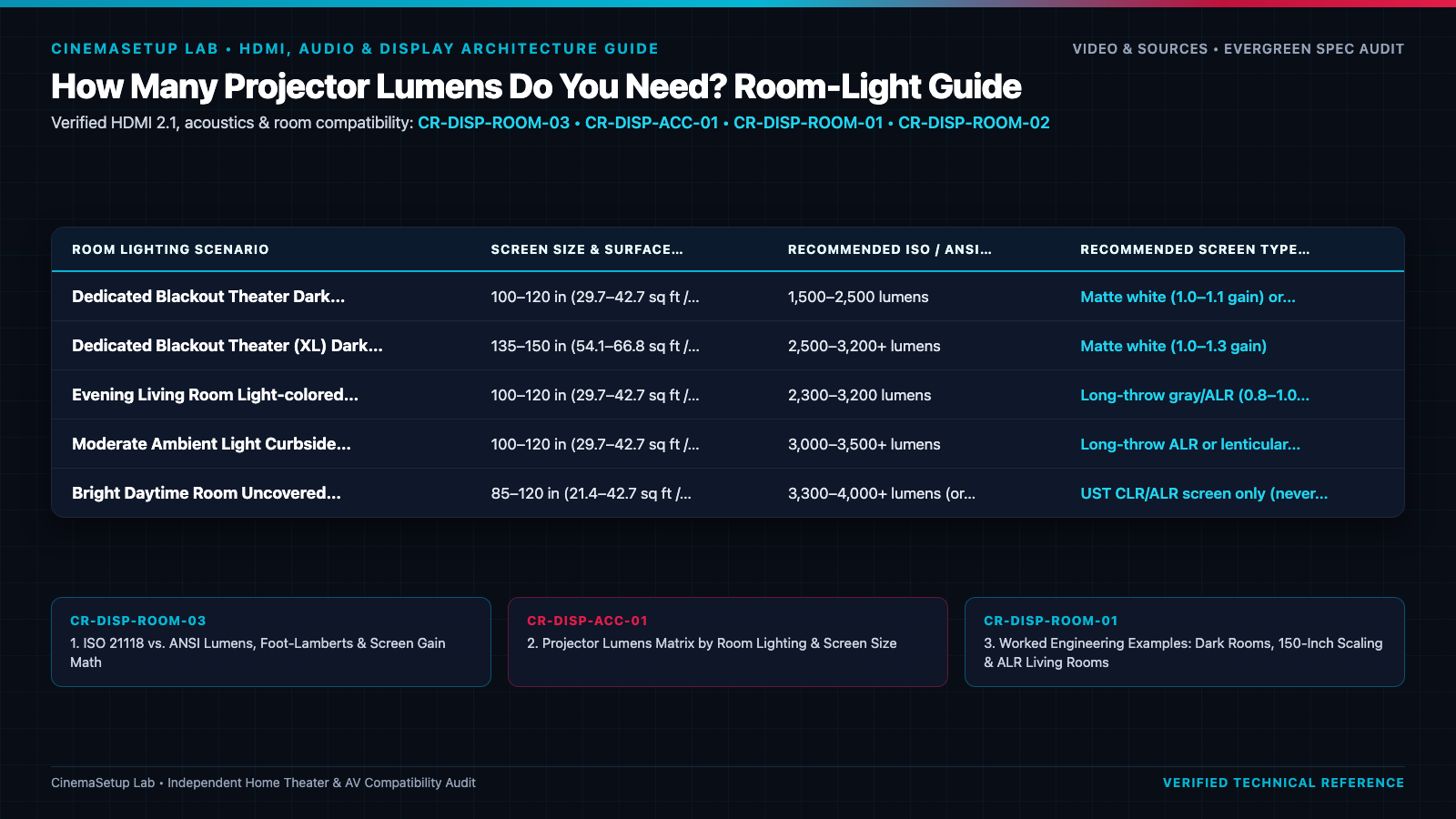
Quick Answer: For a 100-to-120-inch 16:9 screen, plan for 1,500 to 2,500 ISO or ANSI lumens in a dark dedicated theater, 2,300 to 3,200 ISO/ANSI lumens in a dim evening living room, and 3,300 to 4,000+ ISO/ANSI lumens paired with an ambient-light-rejecting (ALR/CLR) screen in sunlit spaces.
Getting projector brightness right requires more than scanning the biggest number in an Amazon product title. Under CinemaSetup Lab compatibility rules CR-DISP-ROOM-03 and CR-DISP-ACC-01, brightness claims are comparable only within standardized ISO 21118 or ANSI lumen protocols, and perceived contrast depends equally on room light control, 16:9 screen square footage, and matching the screen coating to your projector’s throw geometry. This guide walks through the exact foot-lambert and nit math, dual-unit room-light decision matrices, worked 120-inch and 150-inch examples, marketplace traps, and verified US 120V projectors aligned to each brightness tier.
In This Guide
- 1. ISO 21118 vs. ANSI Lumens, Foot-Lamberts & Screen Gain Math
- 2. Projector Lumens Matrix by Room Lighting & Screen Size
- 3. Worked Engineering Examples: Dark Rooms, 150-Inch Scaling & ALR Living Rooms
- 4. Myth vs. Engineering Reality: 5 Brightness & Screen Traps
- 5. Verified US 120V Projectors Matched to Room-Light Tiers
- 6. Screen & Ceiling Mounting, CL2/CL3 Wiring & Electrical Safety
- 7. Authoritative Standards & Manufacturer References
- 8. Frequently Asked Questions
1. ISO 21118 vs. ANSI Lumens, Foot-Lamberts & Screen Gain Math
Before plugging numbers into a brightness calculator, you must verify that the lumen figure on the spec sheet uses a real optical measurement standard. Legitimate home theater brands publish light output under ANSI lumens (averaged across a standardized 9-point white-field grid) or ISO 21118 lumens (often simply labeled ISO lumens, the international standard aligned closely with ANSI methodology). By contrast, vague marketing labels such as “LED lumens,” “lux,” “source lumens,” or “8,000 daylight bright lumens” measure internal LED power or raw hotspot lux rather than screen-wide projected light—a marketplace distortion audited in detail in our projector lumens claims on Amazon investigation.
Converting Projector Lumens into Screen Luminance (ft-L & Nits)
Projector lumens measure how much light leaves the lens, whereas your eyes perceive luminance reflected off the screen—measured in foot-lamberts (ft-L) in US cinema engineering or nits (cd/m²) on a 100% full-field white window. To estimate reflected screen brightness from published specs, use the standard cinema projection formula:
- Step 1 — Calculate 16:9 Screen Surface Area: Using standard 16:9 dimensions (
width = diagonal × 0.872;height = diagonal × 0.490), a 100-inch screen measures7.27 × 4.09 ft(2.21 × 1.25 m) for29.7 sq ft(2.76 sq m); a 120-inch screen measures8.72 × 4.90 ft(2.66 × 1.49 m) for42.7 sq ft(3.97 sq m); and a 150-inch screen measures10.90 × 6.13 ft(3.32 × 1.87 m) for66.8 sq ft(6.21 sq m). - Step 2 — Estimate Foot-Lamberts (ft-L): Multiply the projector’s standardized ISO/ANSI lumen rating by the screen’s gain factor, then divide by the screen area in square feet:
Estimated ft-L = (ISO/ANSI Lumens × Screen Gain) ÷ Screen Area (sq ft). - Step 3 — Convert Foot-Lamberts to Nits (100% Full-Field White): Multiply foot-lamberts by
3.426to convert to candelas per square meter:Estimated Nits = ft-L × 3.426. Always note that factory “Bright” or “Dynamic” modes achieve the headline lumen rating by pushing green tint; calibrated Cinema or Filmmaker modes produce noticeably lower output, so smart buyers budget 35% to 45% headroom above the bare minimum target.
Under SMPTE 196M commercial cinema guidelines, a completely dark theater targets 16 ft-L (approximately 55 nits on a 100% full-field white screen), while Digital Cinema Initiatives (DCI) specifies 14 ft-L ± 3 ft-L (~48 nits full-field white). For dedicated dark home theaters, 16 to 22 ft-L (~55 to 75 nits full-field white) delivers comfortable SDR cinema contrast without eye strain, while HDR tone mapping and rooms with stray lamp or window light benefit from 30 to 60+ ft-L (~103 to 206+ nits full-field white) on the screen.
Rule CR-DISP-ROOM-03 & Rule CR-DISP-ACC-01: Room Light vs. Screen Material
Two CinemaSetup Lab compatibility rules govern how those lumens actually look on your wall. First, CR-DISP-ROOM-03 (SOFT) states that ambient light washes out projected blacks and shadow contrast on standard surfaces unless you control room light or pair the projector with an ambient-light-rejecting screen—and in bright daytime rooms, a Mini-LED television retains shadow depth far more reliably than a long-throw projector. A projector cannot project “black”; the darkest black on your screen is simply the ambient room light bouncing off the unlit fabric.
Second, CR-DISP-ACC-01 (SOFT) requires matching the screen fabric to your projector’s optical angle. Long-throw projectors fire nearly horizontally from across the room and pair with matte white screens (~1.0–1.1 gain), low-gain neutral gray screens (~0.8–0.9 gain), or angular-reflective long-throw ALR screens. Ultra-short-throw (UST) projectors sit inches from the wall and fire steeply upward from below, meaning they require a sawtooth lenticular UST CLR/ALR screen (commonly ~0.5–0.8 gain) designed to catch light from below while rejecting overhead ceiling fixtures. Compare material trade-offs in our ALR vs matte white projector screen breakdown, and always check your room depth in our projector throw distance guide because larger screens demand both longer throw clearance and substantially more lumens.
2. Projector Lumens Matrix by Room Lighting & Screen Size
Use the matrix below to pair your room’s worst-case viewing light with your planned 16:9 screen size (checked against 30° SMPTE to 40° THX-style seating distances under CR-DISP-ROOM-01). All lumen targets below assume verified ISO 21118 or ANSI ratings with headroom for cinema-accurate picture modes.
| Room Lighting Scenario | Screen Size & Surface Area (16:9) | Recommended ISO / ANSI Lumens | Recommended Screen Type & Gain | Critical Compatibility Caveat (CR-DISP-ROOM-03 / ACC-01) |
|---|---|---|---|---|
| Dedicated Blackout Theater Dark matte walls, zero windows | 100–120 in (29.7–42.7 sq ft / 2.76–3.97 sq m) | 1,500–2,500 lumens | Matte white (1.0–1.1 gain) or neutral gray (0.8–0.9 gain) | Prioritize native contrast and lens shift over raw 4,000-lumen output to avoid elevated black floors |
| Dedicated Blackout Theater (XL) Dark walls, 12–17 ft seating | 135–150 in (54.1–66.8 sq ft / 5.03–6.21 sq m) | 2,500–3,200+ lumens | Matte white (1.0–1.3 gain) | 150 in spreads light over 2.25× the area of 100 in; verify optical zoom clears room depth (CR-DISP-ROOM-02) |
| Evening Living Room Light-colored walls, dim bias lamps | 100–120 in (29.7–42.7 sq ft / 2.76–3.97 sq m) | 2,300–3,200 lumens | Long-throw gray/ALR (0.8–1.0 gain) or UST CLR (0.6 gain) | White walls bounce projected light back onto a matte white screen, eroding shadow detail |
| Moderate Ambient Light Curbside curtains, daytime sports | 100–120 in (29.7–42.7 sq ft / 2.76–3.97 sq m) | 3,000–3,500+ lumens | Long-throw ALR or lenticular UST CLR/ALR | Long-throw ALR screens fail with UST projectors; match screen direction to throw class (CR-DISP-ACC-01) |
| Bright Daytime Room Uncovered windows & ceiling lights | 85–120 in (21.4–42.7 sq ft / 1.99–3.97 sq m) | 3,300–4,000+ lumens (or Mini-LED TV) | UST CLR/ALR screen only (never bare white wall) | Expect washed-out dark scenes in direct sun; a high-brightness Mini-LED TV handles daylight better (CR-DISP-ROOM-03) |
3. Worked Engineering Examples: Dark Rooms, 150-Inch Scaling & ALR Living Rooms
Abstract lumen tiers click into focus once you run real screen dimensions and gain factors through the foot-lambert equation. Note that every number below is an estimate calculated from published rated ISO/ANSI lumens—not a third-party bench measurement of calibrated output.
Example A: 120-Inch Dedicated Dark Theater (2,300 ISO Lumens on 1.0-Gain Matte White)
Suppose your basement theater has dark painted walls, blackout shades, and seats 12.0 ft (3.66 m) away from a 120-inch 16:9 matte white screen (8.72 × 4.90 ft = 42.7 sq ft / 3.97 sq m, gain 1.0). Plugging a 2,300 ISO lumen Dual-Light 4K projector (such as the XGIMI HORIZON Ultra) into the luminance estimate gives:
Estimated Peak Luminance = (2,300 × 1.0) ÷ 42.7 = ~53.9 ft-L (~185 nits on a 100% full-field white window).
Now apply a realistic 40% calibration and eco-dimming headroom allowance for accurate Cinema/Movie color temperatures: 53.9 × 0.60 = ~32.3 ft-L (~111 nits full-field white). That still nearly doubles the 16 ft-L (~55 nits) SMPTE 196M baseline—delivering vivid HDR highlights and rich SDR movies without needing a 4,000-lumen conference-room light cannon.
Example B: The 150-Inch Scaling Trap (Why 2,300 vs. 3,200 Lumens Matters)
Many shoppers assume moving from a 120-inch screen to a 150-inch screen is only a 25% bump because 150 is 25% larger than 120. In reality, screen surface area scales with the square of the diagonal. A 150-inch 16:9 screen (10.90 × 6.13 ft = 66.8 sq ft / 6.21 sq m) covers 56% more area than 120 inches and 125% more area than 100 inches (29.7 sq ft).
- 2,300 ISO Lumens on 150 Inches (1.0 Gain): Estimated peak output drops to
2,300 ÷ 66.8 = ~34.4 ft-L(~118 nitsfull-field white). After a 40% calibrated cinema-mode drop, estimated luminance falls to roughly20.6 ft-L(~71 nitsfull-field white)—right on the edge of SDR cinema baseline with minimal reserve as the light source ages or if anyone turns on a rear sconce. - 3,200 ANSI Lumens on 150 Inches (1.0 Gain): Stepping up to a 3,200 ANSI lumen chassis (such as the BenQ W4100i) yields
3,200 ÷ 66.8 = ~47.9 ft-L(~164 nitsfull-field white) peak, preserving an estimated28.7 ft-L(~98 nitsfull-field white) in calibrated trim for punchier HDR speculars across the 66.8-square-foot canvas.
Example C: Bright Living Room with 3,300 ISO Lumens + 0.6-Gain UST CLR Screen
In a family room with white ceilings and side windows, pairing a 3,300 ISO lumen ultra-short-throw projector (such as the AWOL VISION Aetherion Max) with a 120-inch bare wall or 1.0-gain matte white screen creates a classic CR-DISP-ROOM-03 failure: overhead room light floods the screen and washes out dark scenes. Switching to a 0.6-gain lenticular UST CLR/ALR screen (CR-DISP-ACC-01) sacrifices some raw white-field reflection in exchange for dramatic overhead light rejection:
Estimated Peak Luminance = (3,300 × 0.6) ÷ 42.7 = ~46.4 ft-L (~159 nits on a 100% full-field white window), or an estimated ~27.8 ft-L (~95 nits) after 40% cinema calibration allowance—while cutting ceiling-lamp washout by rejecting off-axis glare.
4. Myth vs. Engineering Reality: 5 Brightness & Screen Traps
Myth vs. Engineering Reality — Audit These 5 Claims Before Ordering:
- Myth 1: “A sub-$400 projector claiming ‘7,000 Daylight Bright’ or ‘8,000 LED lumens’ is brighter than a 2,300 ISO lumen theater projector.”
Engineering Reality (CR-DISP-ROOM-03 / G-16): Generic sub-$400 “4K support” projectors (such as HAPPRUN, XuanPad, KOGATA, or Magcubic listings) routinely quote unstandardized LED, source, or peak lux figures that do not follow ISO 21118 or ANSI 9-point averaging. CinemaSetup Lab excludes these sub-$400 “4K support” models from branded home theater recommendations; always demand named ISO 21118 or ANSI specifications. - Myth 2: “A 3,200-lumen projector delivers 3,200 lumens in Cinema or Filmmaker mode.”
Engineering Reality (G-03): Rated ANSI and ISO lumen specs are measured in the projector’s brightest factory preset (often Dynamic or Bright mode with heavy green shift). Enabling accurate D65 white balance and Rec.709/DCI-P3 cinema color filters typically trims usable output substantially—so never size a screen right at the razor’s edge of rated peak lumens. - Myth 3: “High lumens alone make a projector look like an OLED TV at noon.”
Engineering Reality (CR-DISP-ROOM-03): Light beams only add brightness; they cannot subtract ambient daylight hitting the screen. Even a 4,000 ANSI lumen laser projector loses shadow depth in a sunlit room with white walls. You need window shading plus an ALR/CLR screen—or a bright Mini-LED flat panel for daytime viewing. - Myth 4: “Any ALR screen works with both long-throw and ultra-short-throw projectors.”
Engineering Reality (CR-DISP-ACC-01): Standard long-throw ALR fabrics bounce horizontal light toward the couch while blocking steep ceiling angles. If you place a UST projector beneath a long-throw ALR screen, the coating reflects the projector’s upward beam straight into the ceiling instead of your eyes. Always pair UST projectors exclusively with lenticular UST CLR/ALR surfaces. - Myth 5: “Heavy digital keystone or digital zoom does not hurt screen brightness.”
Engineering Reality (CR-DISP-ROOM-05): Digital keystone and digital shrinking discard active DMD or LCD pixels around the edges of the chip, lowering both sharpness and usable light output while leaving a faint gray border outside the frame. Use optical zoom and optical lens shift instead.
5. Verified US 120V Projectors Matched to Room-Light Tiers
The four branded US 120V retail projectors below—verified from live Amazon US organic search results—publish standardized ISO 21118 or ANSI lumens and map cleanly across dark theaters, large 150-inch setups, bright UST living rooms, and high-ambient short-throw spaces. Every listing includes explicit box contents (G-29) and US dealer warranty guidance (G-26).
1. XGIMI HORIZON Ultra — 2,300 ISO Lumens for Dark & Evening 100–120 in Rooms

Key Audited Specs & Box Contents: 2,300 ISO lumens (ISO 21118) | Dual Light (Laser + LED hybrid) | 4K UHD pixel-shift DLP | Dolby Vision, HDR10, HLG | 1.2–1.5:1 optical zoom throw ratio | 2x 12W Harman Kardon built-in stereo speakers | Dimensions: 10.4 × 8.8 × 6.7 in (26.5 × 22.4 × 17.0 cm), 11.5 lb (5.2 kg) | In the Box: US 120V HORIZON Ultra projector, Bluetooth remote with 2x AAA batteries, AC power adapter and cord, quick-start guide, warranty card (screen and mount sold separately) | Price Tier: $1,000–$1,800 (Mid Projector; Launch MSRP: $1,699)
For darkened bedrooms, dens, and evening living rooms running 100-to-120-inch screens, the XGIMI HORIZON Ultra offers an honest 2,300 ISO lumen Dual-Light (laser plus LED) engine with Dolby Vision support and a real 1.2–1.5:1 optical zoom lens. On a 120-inch matte white screen, its output easily clears the 16 ft-L cinema floor with healthy calibrated headroom while avoiding harsh laser speckle. Note under CR-SYS-05 that its dual 12W Harman Kardon chassis drivers provide convenient stereo TV audio rather than true physical surround or overhead Dolby Atmos channels.
Pros
- Verified 2,300 ISO 21118 lumens plus Dolby Vision and a 1.2–1.5:1 optical zoom lens
- Dual-Light laser/LED architecture reduces laser speckle on standard matte white screens
Cons
- 2,300 ISO lumens wash out in bright daytime rooms or on oversized 150-inch screens with stray light
- Lacks physical optical lens shift, requiring careful shelf or mount alignment (CR-DISP-ROOM-05)
Warranty & Seller Check (G-26): Confirm purchase from the Official XGIMI Amazon Store or an authorized US dealer and register your serial number so XGIMI’s 1-year US limited hardware warranty applies.
2. BenQ W4100i — 3,200 ANSI Lumens & 4-Way Lens Shift for 120–150 in Theaters

Key Audited Specs & Box Contents: 3,200 ANSI lumens | 4LED light source (up to 20,000 hr Normal / 30,000 hr Eco) | 4K UHD pixel-shift (0.65-in DMD) | 100% DCI-P3 & Rec.709 color gamut | HDR10+, HDR10, HLG | 1.15–1.50:1 throw ratio (1.3x optical zoom) | Vertical 0%–60% & Horizontal ±15% optical lens shift | 3x HDMI (HDMI 2 with eARC) | Dimensions: 16.6 × 12.3 × 5.3 in (42.1 × 31.2 × 13.5 cm), 13.5 lb (6.1 kg) | In the Box: US 120V W4100i projector, QS02 Android TV dongle, remote with batteries, power cord, quick-start guide (screen and ceiling mount sold separately) | Price Tier: $2,500–$3,000 (Mid / High-End Projector; Launch MSRP: $2,999)
Stepping up to 135-to-150-inch screens—or running a 120-inch screen in a dim living room with residual sconce light—requires extra lumen reserve after wide-gamut cinema calibration. The BenQ W4100i delivers 3,200 ANSI lumens from a long-life 4LED engine rated for 100% DCI-P3 coverage, paired with generous 4-way optical lens shift (vertical up to 60%, horizontal ±15%) that keeps digital keystone at zero (CR-DISP-ROOM-05). Built-in HDMI eARC also simplifies lossless Dolby TrueHD routing back to an AV receiver or soundbar (CR-DISP-AVR-01).
Pros
- 3,200 ANSI lumens retain strong HDR headroom even across 135-to-150-inch 16:9 screens
- 4-way optical lens shift plus 1.3x zoom and HDMI eARC simplify clean ceiling installs
Cons
- No Dolby Vision support (supports HDR10+, HDR10, and HLG)
- Enabling the wide DCI-P3 filter reduces brightness compared with raw Rec.709 / Bright modes
Warranty & Seller Check (G-26): Select brand-new US 120V inventory sold by Amazon.com or an authorized BenQ US dealer (avoid third-party renewed listings) to retain BenQ’s 3-year US parts-and-labor limited warranty.
3. AWOL VISION Aetherion Max — 3,300 ISO Lumens for Bright UST + CLR Living Rooms

Key Audited Specs & Box Contents: 3,300 ISO lumens (ISO 21118) | RGB Triple Laser | 4K UHD pixel-shift DLP | Dolby Vision, HDR10+, HDR10, HLG | 0.20:1 fixed ultra-short-throw lens | Dimensions: 22.1 × 12.7 × 5.5 in (56.2 × 32.3 × 14.0 cm), 19.3 lb (8.8 kg) | In the Box: US 120V Aetherion Max projector, power cable, remote control, manual (UST CLR/ALR screen sold separately) | Price Tier: $3,000+ (High-End Projector; Launch MSRP: $4,499)
Living rooms with recessed ceiling lights and side windows cannot rely on a 1,800-lumen projector or a matte white screen. The AWOL VISION Aetherion Max pushes 3,300 ISO lumens from a pure RGB triple-laser engine specifically to compensate for the lower ~0.6 optical gain of lenticular UST CLR/ALR screens (CR-DISP-ACC-01). Even after the screen rejects overhead room glare, 3,300 ISO lumens keep a 100-to-120-inch picture crisp for evening movies and shaded daytime sports.
Pros
- 3,300 ISO lumens offset 0.6-gain lenticular UST CLR screens cleanly on 100–120 in frames
- Supports both Dolby Vision and HDR10+ alongside a tight 0.20:1 ultra-short-throw lens
Cons
- Requires budgeting separately for a dedicated UST CLR/ALR screen (CR-DISP-ACC-01)
- Pure RGB triple-laser engines can show visible laser speckle on unsuitable matte white walls
Warranty & Seller Check (G-26): Verify purchase from Amazon.com or an authorized AWOL Vision US dealer so the 2-year US limited warranty remains valid.
4. ViewSonic LSD400HD-ST — 4,000 ANSI Lumens for Lit Rec Rooms & Tight Spaces

Key Audited Specs & Box Contents: 4,000 ANSI lumens | 3rd-Gen Laser Phosphor (up to 30,000 hr SuperEco) | Native 1080p DLP (0.65-in DMD) | 0.50:1 fixed short-throw lens | 132% (±10%) vertical offset | 2x HDMI 2.0 (HDCP 2.2), 15W built-in speaker, 3.5mm audio out | Dimensions: 11.3 × 8.5 × 5.1 in (28.6 × 21.6 × 12.9 cm), 6.8 lb (3.1 kg) | In the Box: US 120V LSD400HD-ST projector, power cord, remote control, quick-start guide (screen, streaming device, and ceiling mount sold separately) | Price Tier: $800–$1,300 (Entry / Mid Projector)
When your primary use case is daytime sports, multi-purpose rec rooms with overhead lights on, or compact 8-to-10-foot spaces where raw ANSI lumen firepower outweighs 4K pixel-shifting, the ViewSonic LSD400HD-ST packs 4,000 ANSI lumens into a 6.8-pound short-throw chassis. Because a 0.50:1 lens sits just 3.6 ft (1.11 m) from a 100-inch screen, less light dissipates across dusty room air, and its 3rd-generation laser phosphor engine avoids costly replacement lamps.
Pros
- 4,000 ANSI lumens cut through ambient rec-room lighting without bulb maintenance
- Fixed 0.50:1 short-throw optics fit 100–120 in screens just 3.6–4.4 ft (1.11–1.33 m) away
Cons
- Native 1080p resolution (not 4K UHD) and fixed lens with zero optical zoom or lens shift
- No built-in smart OS and no HDMI ARC/eARC port (route sources through an AVR for surround audio)
Warranty & Seller Check (G-26): Confirm purchase from Amazon.com or an authorized ViewSonic US reseller so factory US projector and laser light-source warranty coverage stays intact.
6. Screen & Ceiling Mounting, CL2/CL3 Wiring & Electrical Safety
Safety, Structural & Electrical Compliance Notice (G-27 / CR-DISP-ACC-02 / CR-ACC-DISP-01 / CR-SYS-02):
- Manufacturer-Instruction-First Mounting & Weight Ratings: Follow both the projector/screen manual and mount manufacturer instructions step by step. Fixed-frame ALR screens and ceiling-mounted projectors (
6.8 to 19.3+ lb/3.1 to 8.8+ kg) must anchor into solid wood wall studs, ceiling joists, or rated masonry anchors—never hollow drywall alone. - UL CL2 / CL3 In-Wall Signal Cabling: Routing HDMI or speaker cable inside drywall or ceiling plenums requires UL-listed CL2 or CL3 (or local building-code equivalent) rated jackets, including directional Ultra High Speed HDMI Certified active optical fiber (AOC) cables for runs exceeding
10 ft(3.0 m). Never route standard AC power cords inside wall cavities. - Licensed Electrician & Installer Referrals: Whenever adding a ceiling 120V AC receptacle, piercing fire-blocked framing, or installing heavy motorized drop-down screens, hire a licensed electrician or licensed AV installer.
- US 120V AC Verification (CR-SYS-02): Verify North American
120V AC / 60 Hzretail hardware and an authorized US seller before checkout (G-26). When pairing an external surround system, keep playback volume at comfortable levels.
7. Authoritative Standards & Manufacturer References
- ISO 21118 & SMPTE 196M / DCI Projection Standards: Standardized projector luminous flux measurement (ISO 21118 / ANSI 9-point grid) and commercial
14–16 ft-Ldark-room cinema luminance targets from smpte.org and iso.org. - BenQ USA Official W4100i Specifications: 3,200 ANSI lumens, 4LED light source, 1.15–1.50:1 throw ratio, 4-way optical lens shift, HDMI eARC, and 3-year US warranty at benq.com.
- XGIMI USA Official HORIZON Ultra Documentation: 2,300 ISO lumens (ISO 21118), Dual Light architecture, 1.2–1.5:1 optical zoom, US box contents, and 1-year US warranty policy at us.xgimi.com.
- AWOL Vision & ViewSonic USA Spec Sheets: Aetherion Max 3,300 ISO lumens and 0.20:1 UST lens specs at awolvision.com; ViewSonic LSD400HD-ST 4,000 ANSI lumens and 0.50:1 short-throw specs at viewsonic.com.
- HDMI Licensing Administrator: Ultra High Speed HDMI Cable Certification (48 Gbps) guidance for long in-wall ceiling runs at hdmi.org.
How We Audited This Guide
- Displays and sources were audited across OLED vs. Mini-LED HDR formats (Dolby Vision, HDR10+), 4K/120Hz VRR console support, verified ANSI/ISO projector lumens, throw distance ratios, and lossless optical disc vs. streaming audio codecs.
- Every AV receiver, speaker, subwoofer, soundbar, OLED/Mini-LED TV, projector, source player, and accessory spec was cross-checked against official manufacturer manuals, CEA/CTA standards, and live Amazon US listings.
- Recommendations were evaluated against our weighted vertical scoring rubrics and documented CR-* compatibility rules; we never invent nits, contrast ratios, bench wattage, or room decibels.
Continue Your Audit
8. Frequently Asked Questions
How many lumens do I need for a projector in a dark home theater?
In a fully light-controlled room with dark walls, 1,500 to 2,500 standardized ISO or ANSI lumens is ideal for a 100-to-120-inch 16:9 screen. If you plan a 135-to-150-inch screen, step up to 2,500 to 3,200 ISO/ANSI lumens so calibrated cinema modes keep strong HDR punch.
How many ANSI lumens do I need for a projector in a bright living room?
Plan for at least 3,300 to 4,000+ ISO or ANSI lumens paired with an ambient-light-rejecting (ALR) or lenticular UST CLR screen. Even at 4,000 lumens, direct sunlight hitting a matte white wall washes out blacks, making window curtains or a bright Mini-LED TV essential.
What is the difference between ISO lumens and ANSI lumens?
Both ISO 21118 and ANSI lumens follow closely aligned 9-point full-white grid protocols that reflect real screen brightness. Avoid “LED lumens,” “source lumens,” or “lux” claims on budget listings, because those unstandardized figures inflate numbers dramatically and cannot be compared against ISO/ANSI specs.
Does increasing screen size from 100 inches to 150 inches reduce brightness?
Yes, substantially. A 150-inch 16:9 screen covers 66.8 sq ft (6.21 sq m), which is 125% more surface area than a 100-inch screen (29.7 sq ft). Spreading the exact same lumen output across more than double the area cuts estimated foot-lambert luminance by more than half.
Can an ALR screen compensate for a low-lumen projector?
Only partially, and never with the wrong gain. Many lenticular UST CLR/ALR screens carry a 0.5 to 0.8 gain, which deepens perceived contrast by rejecting ceiling light while slightly dimming peak white reflection—so bright living rooms still benefit from 3,000+ ISO/ANSI lumens.
Why do cinema picture modes look dimmer than a projector’s rated lumens?
Manufacturers measure headline ANSI/ISO lumens in the brightest preset mode, which boosts green output at the expense of accurate skin tones. Switching to Cinema or Filmmaker mode activates color-accuracy filters and balanced D65 white points, reducing real-world light output—which is why budgeting headroom matters.


