
Disclosure: As an Amazon Associate, I earn from qualifying purchases. If you buy through links on this page, we may earn a small commission at no extra cost to you. Commission differences across categories (such as 2% on televisions versus 4% on most AV receivers, speakers, and accessories) never alter our upgrade priorities, compatibility verdicts, or hardware selections.
Figuring out what to upgrade first in a home theater comes down to fixing your largest acoustic or signal-chain bottleneck before spending money on features your current speakers and room cannot reveal. Most upgrade regret happens in reverse: homeowners replace a working 5.1 AV receiver expecting richer bass or clearer dialogue, only to discover their tiny satellite speakers, missing subwoofer, or mismatched center channel still bottleneck every movie.
This chronological upgrade roadmap sequences every dollar using CinemaSetup Lab’s compatibility physics—prioritizing room-matched subwoofers and timbre-matched front stages under CR-SYS-01, unlocking Atmos channel counts under CR-SPK-AVR-04, separating real overhead speakers from virtual DSP modes under CR-SYS-05, and scaling display size to your exact seating distance. If you are starting from scratch instead of upgrading an existing rig, start with our foundational home theater setup guide or our home theater setup under $1,000 starter blueprint.
In This Home Theater Upgrade Priority Roadmap
- The 5-Stage Home Theater Upgrade Order (Chronological Matrix)
- Verified Upgrade Parts List (8 Amazon US Hardware Picks)
- IF-THEN Compatibility Proof Box (CR-* Rules Audited)
- Stage 1: Powered Subwoofer & Matched Center Channel First
- Stage 2: High-Sensitivity Front L/R Speakers & Impedance Math
- Stage 3: AV Receiver Channel Processing & 40 Gbps HDMI 2.1 Hub
- Stage 4: Physical Dolby Atmos Heights vs. Virtual DSP (CR-SYS-05)
- Stage 5: Display Sizing, OLED vs. Mini-LED & Dual-Sub Polish
- Installation, CL2/CL3 Wiring Safety & Calibration Checklist
- Audited Upgrade Hardware Profiles (8 Verified US Listings)
- Authoritative Standards & Manufacturer References
- Frequently Asked Questions
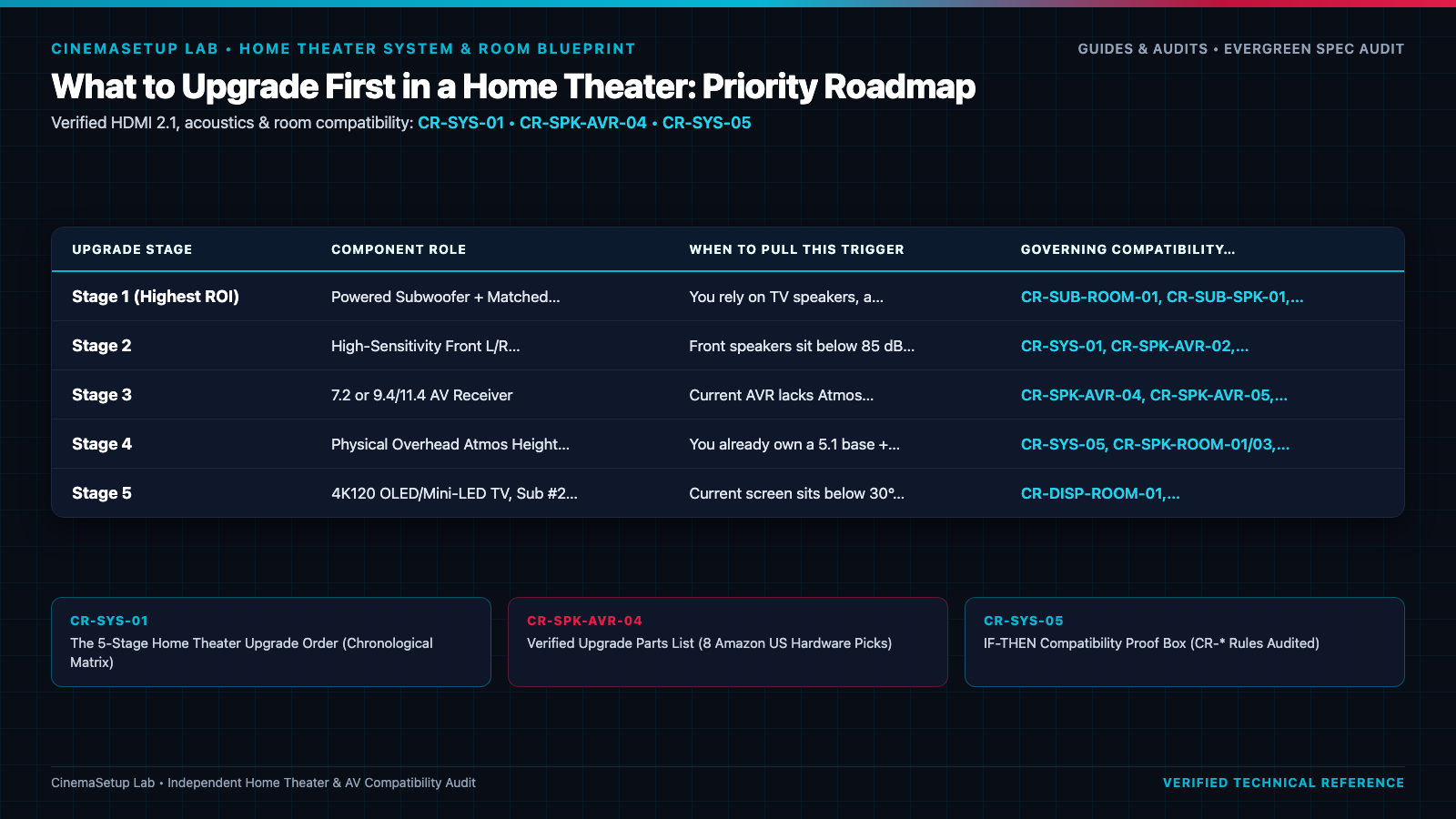
The 5-Stage Home Theater Upgrade Order (Chronological Matrix)
Before buying any component, run a quick baseline audit on your room: measure length × width × ceiling height in feet to calculate total air volume (including open adjoining hallways or kitchens without doors), measure eye-to-screen seating distance, and list your receiver’s speaker processing count and HDMI bandwidth. Using a standard medium living room of 15 ft wide × 20 ft long × 8 ft high (4.6 m × 6.1 m × 2.4 m; 2,400 cu ft / 68 m³) with a primary seat at 10 ft (3.05 m), the chronological upgrade path below maximizes audible and visual improvement at every step:
| Upgrade Stage | Component Role | When to Pull This Trigger | Governing Compatibility Rules | Target Budget Share / Tier |
|---|---|---|---|---|
| Stage 1 (Highest ROI) | Powered Subwoofer + Matched Center Channel | You rely on TV speakers, a 2.0/5.0 setup without a sub, or muffled voice panning | CR-SUB-ROOM-01, CR-SUB-SPK-01, CR-SPK-SPK-01 | 15%–20% Sub ($200-$450 entry to $500-$700 core) + Center |
| Stage 2 | High-Sensitivity Front L/R Speakers | Front speakers sit below 85 dB sensitivity or sound strained at 9–12 ft | CR-SYS-01, CR-SPK-AVR-02, CR-SPK-AVR-01 | 40%–50% of total audio budget (all passive speakers) |
| Stage 3 | 7.2 or 9.4/11.4 AV Receiver | Current AVR lacks Atmos channels, 40 Gbps 4K120 inputs, or eARC | CR-SPK-AVR-04, CR-SPK-AVR-05, CR-SRC-AVR-01 | 25%–35% Core/Enthusiast ($450-$800 for 7.2; $1,100+ for 9.4) |
| Stage 4 | Physical Overhead Atmos Height Speakers | You already own a 5.1 base + 7.2/9.4 AVR and want true overhead sound | CR-SYS-05, CR-SPK-ROOM-01/03, CR-ACC-SPK-02 | $100-$300 per pair + UL CL2/CL3 OFC copper wire |
| Stage 5 | 4K120 OLED/Mini-LED TV, Sub #2 & Room EQ | Current screen sits below 30° viewing angle, lacks VRR/HDR, or bass varies by seat | CR-DISP-ROOM-01, CR-SRC-DISP-01, CR-SUB-ROOM-02 | $1,100-$3,000 Premium TV tier + second identical sub |
Notice one major branching rule: if you currently use a closed-ecosystem soundbar—such as a flagship all-in-one kit like the Samsung HW-Q990H—you cannot swap in a passive center speaker or an independent third-party subwoofer (CR-SUB-SBAR-01, CR-SBAR-SPK-01). Moving beyond a soundbar requires jumping straight to Stage 2 and Stage 3 together with a discrete AV receiver and passive speaker pair, whereas existing 3.1 or 5.1 AVR owners can upgrade modularly one stage at a time.
Verified Upgrade Parts List (8 Amazon US Hardware Picks)
Every component below was verified against Amazon US retail availability (US 120V AC market, delivery ZIP 10001) on 2026-11-26. Rather than listing eight identical receivers, these eight picks populate each rung of the upgrade ladder—from compact and living-room subwoofers to 7.2-channel Atmos AVRs, surround/height speaker pairs, and 4K/120Hz displays.
| Upgrade Stage & Role | Verified Amazon US Pick | Key Compatibility Spec | Budget Tier / Package Contents | Amazon Link |
|---|---|---|---|---|
| Stage 1: Medium-Room 12-In Sub | Klipsch Synergy Black Label Sub-120 | 12-in front-firing ported, 200 W continuous RMS / 400 W dynamic | $250-$450 (Single powered subwoofer / each) | View on Amazon |
| Stage 1: Compact-Room 10-In Sub | Klipsch Reference R-101SW | 10-in front-firing ported, 150 W RMS / 300 W peak, 29.5–120 Hz | $200-$350 (Single powered subwoofer / each) | View on Amazon |
| Stage 2: Compact Surrounds / Starter Pair | Edifier P12 Passive Bookshelf Pair | 6 ohms nominal, ~79 dB (1W/1m), 55 Hz–20 kHz, wall-mount brackets | $100-$150 (Sold strictly per pair / 2 speakers; needs amp) | View on Amazon |
| Stage 3: 4-Ohm Ready 7.2 Atmos AVR | Denon AVR-X1700H 7.2-Ch AVR | 80 W/ch (8 ohms, 20 Hz–20 kHz, 0.08% THD, 2 ch driven); 4–16 ohms; 3× 40 Gbps HDMI 2.1 | $450-$650 (Single AVR + Audyssey mic + remote) | View on Amazon |
| Stage 3: 4-Port 4K120 7.2 Atmos AVR | Yamaha RX500A 7.2-Ch AVR | 75 W/ch (8 ohms, 20 Hz–20 kHz, 0.09% THD, 2 ch driven); 6–8 ohms min; 4× 40 Gbps HDMI 2.1 | $500-$800 (Single AVR + YPAO mic + remote) | View on Amazon |
| Stage 4: In-Ceiling Atmos Heights | Dayton Audio CC65W 6.5-In Pair | 8 ohms nominal, 50 W RMS / 100 W peak, 45 Hz–20 kHz, 3-1/8 in depth | $100-$150 (Sold strictly per pair / 2 in-ceiling speakers) | View on Amazon |
| Stage 5: Dark-Room 65-In OLED TV | Samsung 65-In S90H OLED Bundle | 65-in self-emissive OLED, 4× HDMI 2.1 (4K/120Hz, 165Hz PC), eARC, HDR10+ | $1,100-$3,000 (65-in TV + 2× HDMI cables + guide + 1-yr CPS) | View on Amazon |
| Stage 5: Bright-Room 50-In Mini-LED | Samsung 50-In Neo QLED QN90F | 50-in Glare-Free Mini-LED, 4× HDMI 2.1 (120Hz/165Hz), eARC, VESA 200×200 | $1,100-$3,000 (50-in TV + stand + SolarCell remote) | View on Amazon |
IF-THEN Compatibility Proof Box (CR-* Rules Audited)
Upgrading piecemeal only works when every new purchase clears the hard and conditional compatibility gates of your existing gear. Run your proposed upgrade through this exact IF -> THEN checklist before ordering:
Upgrade Order Compatibility Proof Box:
- CR-SYS-01 (SOFT — Speaker-First Budget Discipline): IF you are upgrading a discrete AVR setup, THEN allocate at least 50% to 70% of your cumulative audio budget to speakers and subwoofers (40%–50% speakers plus 15%–20% sub) and keep receiver electronics at 25%–35% (35%–40% only in Starter tiers under $800). Exceptions apply only when multiple 4K/120Hz consoles or 11-channel processing dictate a step-up AVR first.
- CR-SPK-AVR-04 & CR-SPK-AVR-05 (HARD — Channel Processing & Pre-Out Ceiling): IF your target layout is 5.1.2 Dolby Atmos (7 processed speaker channels), THEN a 7.2-channel AVR (Denon AVR-X1700H or Yamaha RX500A) handles every speaker natively. IF you plan to expand to 5.1.4 or 7.1.4 (9 or 11 channels), THEN a 7.2 AVR hits a HARD processing wall—no external power amplifier can add missing channels. You must step up to a 9.4/11.4-processing receiver such as the Denon AVR-X3900H (plus a 2-channel external power amp on its pre-outs for 7.1.4).
- CR-SYS-05 (INFO — Physical Heights vs. Virtualization): IF an AVR menu or entry soundbar advertises “Dolby Atmos Height Virtualization” or “DTS Virtual:X” without physical ceiling, on-wall height, or up-firing elevation drivers, THEN it does not constitute a true
.2or.4Atmos speaker layout—treat it strictly as stereo/5.1 DSP ambience until physical height drivers are installed. - CR-SPK-AVR-01 & CR-SPK-AVR-02 (HARD/CONDITIONAL & SOFT — Impedance & Sensitivity): IF you pair 6-ohm speakers such as the Edifier P12 with the Yamaha RX500A, THEN you must enable Yamaha’s 6-ohm speaker impedance menu setting—and never connect 4-ohm speakers to an AVR rated only down to 6 ohms (choose the 4–16 ohm Denon AVR-X1700H for 4-ohm loads). IF your front speakers sit near 79 dB (1W/1m) sensitivity at 10 ft (3.05 m), THEN upgrading to 90+ dB 8-ohm front speakers cuts required amplifier wattage dramatically.
- CR-SUB-AVR-01 & CR-SUB-SPK-01 (HARD & SOFT — Powered Sub & 1.5× Crossover): IF your AVR sends a line-level LFE sub pre-out, THEN you must buy a self-powered subwoofer (such as the Klipsch Sub-120 or R-101SW)—passive subs will not produce sound. Set all speakers to Small and cross over at least
1.5 ×above their -3 dB low-end limit (80–90 Hz for 55 Hz bookshelves like the Edifier P12; 120–150 Hz for compact 110 Hz satellites). - CR-SPK-ROOM-03 & CR-ACC-SPK-02 (CONDITIONAL — In-Ceiling Depth & CL2/CL3 Wire): IF you install Dayton Audio CC65W in-ceiling height speakers, THEN confirm at least 3-1/4 in (8.3 cm) of clear ceiling cavity depth, obtain homeowner/landlord permission before cutting drywall, and pull UL-listed CL2 or CL3 oxygen-free copper (OFC) cable rated for enclosed spaces.
- CR-DISP-AVR-02 & CR-SRC-DISP-01 (CONDITIONAL & SOFT — eARC Port & HDR Formats): IF you connect the Samsung S90H or QN90F (4× HDMI 2.1, eARC on HDMI 3) to an AVR, THEN three full-bandwidth 4K/120Hz ports stay open on the TV for consoles—while noting that Samsung TVs support HDR10+ and HDR10 rather than Dolby Vision.
- CR-SYS-02 (HARD — US 120V AC & Authorized Seller): Confirm every powered receiver, subwoofer, and TV is a genuine US 120V AC / 60 Hz SKU sold by an authorized US dealer on Amazon to preserve factory warranty coverage (G-26).
Stage 1: Powered Subwoofer & Matched Center Channel First
If you already own an entry 5.1 receiver with a pair of bookshelf speakers—or a 2.0 stereo setup hooked to your TV—the fastest audible transformation per dollar is adding a room-sized powered subwoofer and a timbre-matched center channel. Cinema mixes dedicate an entire discrete .1 Low-Frequency Effects (LFE) track plus bass-managed energy below 80 Hz to the subwoofer. No pair of compact bookshelf speakers can move air below 50 Hz at movie levels without distorting mid-bass vocals.
Sizing Your Subwoofer to Enclosed Room Volume (CR-SUB-ROOM-01)
Match your subwoofer’s driver size and enclosure to your room’s total cubic footage rather than buying on peak watt marketing claims (G-16). Always include open adjoining hallways or kitchens when computing volume:
- Under 1,500 cu ft (< 42 m³) — Bedrooms & Enclosed Dens (e.g., 12 × 14 × 8 ft): One 10-inch powered subwoofer such as the Klipsch Reference R-101SW (150 W RMS / 300 W peak, rated down to 29.5 Hz) delivers clean low-end impact without overwhelming tight floor space.
- 1,500–3,000 cu ft (42–85 m³) — Standard Living Rooms (e.g., 15 × 20 × 8 ft): Step up to a 12-inch subwoofer such as the Klipsch Synergy Black Label Sub-120 (200 W continuous RMS / 400 W dynamic) so deep action scenes maintain composure across the room.
- Shared Walls & Apartments (CR-SUB-ROOM-03): Deep bass frequencies travel directly through floor joists and drywall. In apartments, pair a compact sub (or a sealed 12-inch sub) with decoupling feet and your AVR’s Dynamic Range Compression / Night Mode—while keeping in mind that no subwoofer or isolation pad blocks low-frequency transfer completely next door.
Timbre Matching & Crossover Alignment (CR-SPK-SPK-01 & CR-SUB-SPK-01)
Once your subwoofer handles deep bass, set every main speaker in your receiver’s bass-management menu to Small and dial the crossover at least 1.5× above each speaker’s published -3 dB low-frequency floor. With 55 Hz–20 kHz bookshelves like the Edifier P12, an 80–90 Hz crossover hands deep bass cleanly to the sub and relieves your AVR’s internal amplifiers of heavy low-frequency current draw. When adding a dedicated center speaker for dialogue clarity, buy from the exact same speaker series and tweeter family as your front left and right speakers (horn-loaded with horn-loaded, soft dome with soft dome) so voices panning across the screen never shift tone (CR-SPK-SPK-01).
Stage 2: High-Sensitivity Front L/R Speakers & Impedance Math
Once your foundation includes a sub and center, upgrade weak front left and right speakers before buying a pricier AV receiver. Under CR-SYS-01, dedicating 40%–50% of your audio budget to passive speakers (and 50%–70% combined with the subwoofer) yields dramatically clearer midrange detail and wider dynamic range than swapping an 80 W/ch receiver for a 105 W/ch receiver on the same entry speakers.
Speaker sensitivity and impedance govern how hard your amplifier actually works. By our estimate from published specs using CinemaSetup Lab’s inverse-square seating calculation (assuming zero room gain for conservative living-room planning at a 10 ft / 3.05 m seat, and applying a conservative ~30% multichannel derating to 2-channel 8-ohm AVR ratings per CR-SPK-AVR-02 and CR-SPK-AVR-03):
- Low-Sensitivity 6-Ohm Bookshelf (Edifier P12, ~79 dB at 1 W / 1 m): Reaching 95 dB living-room peaks at 10 ft (3.05 m) demands roughly ~370 W per channel—nearly seven times what an 80 W/ch receiver (~56 W multichannel derated) supplies cleanly. That is why compact ~79 dB bookshelves belong in near-field dens (4–6 ft) or as rear surround speakers—never as main living-room fronts at 10–12 ft.
- High-Sensitivity 8-Ohm Front Stage (93–94.5 dB at 2.83 V / 1 m): At the identical 10 ft (3.05 m) seat, 95 dB peaks require only ~10–15 W/ch and dynamic 100 dB movie peaks need roughly ~33–47 W/ch, sitting squarely inside the Denon AVR-X1700H (~56 W/ch derated) and Yamaha RX500A (~52.5 W/ch derated) continuous envelope.
Best of all, upgrading your front L/R stage creates zero e-waste: move your older compact front bookshelves (like the Edifier P12 pair, which include built-in wall-mount brackets) to the side or rear surround channels, where listener distances are shorter and ambient effects demand far less continuous power (CR-SPK-SPK-02).
Stage 3: AV Receiver Channel Processing & 40 Gbps HDMI 2.1 Hub
Upgrade your AV receiver only when one of three hard walls blocks your system: you need more decoded speaker channels (moving from 5.1 to 5.1.2 or 5.1.4/7.1.4), your old AVR lacks HDCP 2.3 / 40 Gbps HDMI 2.1 / eARC for modern 4K/120Hz consoles and lossless Dolby TrueHD audio, or your speaker load drops to 4 ohms and requires a 4-ohm-capable receiver.
Under CR-SPK-AVR-04, count speaker channels accurately before buying:
- Upgrading to 5.1.2 Atmos (7 Speaker Channels): Choose a 7.2-channel AVR such as the Denon AVR-X1700H (80 W/ch, 8 ohms, 20 Hz–20 kHz, 0.08% THD, 2 ch driven; three 40 Gbps HDMI 2.1 inputs; Audyssey MultEQ XT; 4–16 ohm impedance setting) or the Yamaha RX500A (75 W/ch, 8 ohms, 20 Hz–20 kHz, 0.09% THD, 2 ch driven; four 40 Gbps HDMI 2.1 inputs; YPAO; 6-ohm minimum menu setting). Remember: Yamaha’s RX500A caps at 6-ohm minimum speaker loads, whereas Denon’s X1700H accepts 4-ohm speakers via its impedance menu (CR-SPK-AVR-01).
- Upgrading to 5.1.4 or 7.1.4 Atmos (9 to 11 Speaker Channels): A 7.2 AVR cannot process 9 or 11 channels even with external amps. You must upgrade to a 9.4-amp / 11.4-processing AVR such as the Denon AVR-X3900H (the current US Amazon successor to the retired X3800H), which powers 5.1.4 natively and unlocks 7.1.4 with an external 2-channel power amp on its pre-outs (CR-SPK-AVR-05). See our step-by-step 5.1 to 5.1.4 Dolby Atmos upgrade guide for complete wiring and channel-assignment maps.
Check your HDMI chain at the same time (CR-DISP-AVR-01, CR-SRC-AVR-01): if your older receiver only handles 18 Gbps HDMI 2.0 (4K/60Hz) and your TV has HDMI eARC, plug your PS5 or Xbox Series X straight into a TV HDMI 2.1 port and send lossless Dolby Atmos or multichannel LPCM back to an eARC-capable AVR over HDMI—only replacing the AVR when you need Atmos height processing or lack eARC on either end.
Stage 4: Physical Dolby Atmos Heights vs. Virtual DSP (CR-SYS-05)
With a 5.1 speaker base and a 7.2 or 9.4 receiver in place, Stage 4 adds true overhead height channels. Here, compatibility rule CR-SYS-05 draws an uncompromising boundary: Dolby Atmos Height Virtualization and DTS Virtual:X are DSP illusions, not physical height channels. A 5.1 AVR running virtualization cannot project localized rain or overhead aircraft above your head the way two or four dedicated height drivers do.
Choose your physical height method based strictly on your room’s ceiling and alteration rules:
- In-Ceiling Speakers (Best Precision — CR-SPK-ROOM-03): Pairs like the Dayton Audio CC65W (8 ohms, 7.75 in / 19.7 cm cutout, 3.125 in / 7.9 cm mounting depth) vanish flush into drywall slightly ahead of (and behind, for
.4) the main sofa. Verify joist clearance, avoid pipes/wiring, obtain landlord/HOA approval if renting, and use UL-listed CL2 or CL3 cable inside walls (CR-ACC-SPK-02). - On-Wall / High-Front Height Speakers (Best Renter Option — CR-SPK-ROOM-02): Surface-mounted compact speakers angled down from the front wall at least 2+ ft above ear level avoid ceiling cutting entirely and preserve overhead separation even under sloped ceilings.
- Up-Firing Atmos Modules (Conditional — CR-SPK-ROOM-01): Reflective modules sitting atop front towers require a flat, hard, untreated ceiling roughly 7.5 to 12 ft (2.3 to 3.7 m) high. Vaulted, acoustic-tile, or 14-ft great-room ceilings smear the reflection—skip up-firing modules in those rooms.
Stage 5: Display Sizing, OLED vs. Mini-LED & Dual-Sub Polish
Why does upgrading your TV or projector sit at Stage 5 if you already own a working 4K display? Because upgrading from a 55-inch 4K TV to a newer 55-inch 4K TV rarely transforms cinema immersion the way adding a dedicated 12-inch subwoofer or discrete surround stage does—unless your current TV is drastically undersized for your sofa distance or lacks 4K/120Hz VRR for next-gen consoles.
Under CR-DISP-ROOM-01, calculate your optimal 16:9 screen diagonal before buying: divide your seating distance in inches by 1.63 for a 30° SMPTE comfortable view, and by 1.20 for a 40° THX-style immersive view. At a 10 ft (120 in / 3.05 m) seat, the ideal window spans 74 to 100 inches—and stepping up from an aging 55-inch LCD to a 65-inch Samsung S90H OLED or 77-inch LG C6 OLED makes an unmistakable jump. Match your panel to room lighting and HDR format priorities (CR-DISP-ROOM-03, CR-SRC-DISP-01): Samsung’s S90H OLED and 50-inch Neo QLED QN90F both supply four full-bandwidth HDMI 2.1 ports (with eARC on HDMI 3) and HDR10+, while LG’s C6 OLED carries Dolby Vision without HDR10+.
Finally, if your room seats multiple viewers across a sectional couch or two rows and bass sounds heavy in one corner yet thin in the center, use your AVR’s second subwoofer output to add a second identical subwoofer (CR-SUB-ROOM-02) and re-run Audyssey MultEQ XT or YPAO—or step up to an AVR offering Dirac Live (noting Dirac Live requires a paid license on Denon/Marantz receivers per CR-AVR-ROOM-02).
Installation, CL2/CL3 Wiring Safety & Calibration Checklist (G-27)
- Manufacturer-First Mounting & VESA Compliance: Follow the display and mount manufacturer’s instructions strictly. Verify your TV’s VESA bolt pattern (for example, 200 × 200 mm on the Samsung 50QN90F) and weight without stand against the bracket’s maximum rated load (CR-DISP-ACC-02), anchoring into solid wood studs or manufacturer-rated masonry hardware—never drywall alone.
- In-Wall Speaker Wire & Electrical Safety: Route only UL-listed CL2 or CL3 pure oxygen-free copper (OFC) cable inside walls or ceilings (CR-ACC-SPK-02)—16 AWG up to ~50 ft (15 m) at 8 ohms, 14 AWG up to ~79 ft (24 m) at 8 ohms or ~59 ft (18 m) at 6 ohms, and 12 AWG for longer 4-ohm runs (CR-ACC-SPK-01). Never run TV power cords inside drywall; consult a licensed electrician or certified AV installer for recessed AC outlets, ceiling framing cuts, or local building code compliance.
- Two-Person Handling & AVR Ventilation: Large 65-inch OLED displays and 36-lb subwoofers require careful two-person lifting to prevent panel flex or back strain. Leave at least 4 in (10 cm) of open airflow above your AV receiver and never stack amps inside sealed cabinets (CR-AVR-ROOM-01).
- Post-Upgrade Calibration Routine: After every hardware swap, re-run your AVR’s microphone calibration using level-calibration tones, confirm all satellite/bookshelf speakers are set to Small with 80–120 Hz crossovers, set the sub’s physical low-pass dial to
LFE / Bypass, and keep playback at comfortable everyday listening levels.
Audited Upgrade Hardware Profiles (8 Verified US Listings)
1. Klipsch Synergy Black Label Sub-120 12-Inch Subwoofer — Stage 1 Living-Room Bass Upgrade

Key Specs & Package Contents: 12-in front-firing spun-copper IMG woofer, ported enclosure | 200 W continuous RMS / 400 W dynamic amplification | Controls: low-pass crossover, phase switch, gain, line/LFE RCA input | Dimensions: 21.3 × 17.7 × 23.7 in (54.1 × 45.0 × 60.2 cm) | Weight: 36.4 lb (16.5 kg) | In the Box: Single powered 12-inch subwoofer (sold each; RCA LFE cable sold separately) | Price Tier: $250-$450
For medium living rooms between 1,500 and 3,000 cu ft (42–85 m³) currently running subwoofer-free 2.0 or 5.0 speakers, the Klipsch Sub-120 delivers immediate Stage 1 cinema weight without blowing up your upgrade budget. Moving low frequencies below 80 Hz off your receiver onto its dedicated 200 W RMS amplifier cleans up dialogue and lets your main speakers play louder without strain (CR-SUB-SPK-01). Note per G-09 that Klipsch does not publish a standardized ±3 dB low-frequency extension spec on this retail variant, and verify authorized US dealer fulfillment on Amazon before ordering (G-26).
Pros
- 12-inch front-firing driver and 200 W RMS amplifier match 1,500–3,000 cu ft living rooms cleanly
- Front-firing layout simplifies placement near consoles compared with rear-ported designs
Cons
- Large 23.7-in depth and 36.4 lb weight require generous floor space and careful two-person handling
- Lacks smartphone DSP parametric EQ and a published ±3 dB low-frequency rating
2. Klipsch Reference R-101SW 10-Inch Subwoofer — Stage 1 Compact-Room Upgrade

Key Specs & Package Contents: 10-in front-firing spun-copper TCP woofer, rear-ported | 150 W RMS / 300 W peak all-digital amp | Frequency Response: 29.5 Hz – 120 Hz | Dimensions: 14.6 × 14.0 × 19.7 in (37.0 × 35.6 × 50.0 cm) | Weight: 31.0 lb (13.9 kg) | In the Box: Single powered 10-inch subwoofer (sold each) | Price Tier: $200-$350
If your theater sits inside an enclosed bedroom, office, or apartment den under 1,500–1,800 cu ft (42–51 m³), the slimmer 14-inch-wide Klipsch Reference R-101SW fits tight corners where a 12-inch box will not physically clear furniture. Rated down to 29.5 Hz with 150 W RMS output, it integrates cleanly with 80–120 Hz AVR crossovers (CR-SUB-SPK-01). In open-plan living rooms exceeding 2,500 cu ft, step up to the Sub-120 or dual subs instead (CR-SUB-ROOM-01).
Pros
- Compact 14.0-in width tucks beside media stands in bedrooms and small dens
- Published 29.5 Hz – 120 Hz response integrates smoothly with 80–100 Hz bookshelf crossovers
Cons
- 10-in 150 W RMS output loses deep visceral punch in open-plan rooms over ~2,000 cu ft
- Rear port needs several inches of rear wall clearance to avoid port chuffing
3. Edifier P12 Passive Bookshelf Speakers (Pair) — Compact Surrounds & Starter Role

Key Specs & Package Contents: 6 ohms nominal impedance | Sensitivity: ~79 dB (1 W / 1 m) | Frequency Response: 55 Hz – 20 kHz | Dimensions (each): 5.0 × 9.4 × 6.6 in (12.8 × 23.8 × 16.8 cm) | Weight: 13.2 lb (6.0 kg) for the pair | In the Box: Matched pair (2 passive speakers with built-in rear wall-mount brackets + 2× speaker wire lengths; requires AVR or external amp) | Price Tier: $100-$150
The Edifier P12 pair illustrates exactly why impedance and sensitivity math matter during upgrades. Priced in the entry $100-$150 bracket per pair with integrated keyhole wall brackets, these 6-ohm 2-way bookshelves work nicely as compact surround channels (expanding 3.1 to 5.1) or near-field desktop monitors. However, their low ~79 dB (1W/1m) sensitivity makes them a poor fit as main front L/R speakers in 10–12 ft living rooms (CR-SPK-AVR-02)—so graduate to 90+ dB front towers or larger bookshelves when upgrading Stage 2, and set 6-ohm AVR impedance menus accordingly (CR-SPK-AVR-01).
Pros
- Compact 5.0-in width and built-in wall-mount brackets simplify rear surround upgrades
- 55 Hz low-end extension pairs cleanly with an 80–90 Hz subwoofer crossover
Cons
- Low ~79 dB (1W/1m) sensitivity limits clean loudness as main fronts beyond 6–7 ft
- 6-ohm nominal load requires enabling the 6-ohm setting on Yamaha AVRs and lacks a matching series center
4. Denon AVR-X1700H 7.2-Channel AV Receiver — Stage 3 4-Ohm-Safe Atmos Hub

Key Specs & Package Contents: 7.2-channel processing & amplification (5.1.2 Dolby Atmos / DTS:X max) | Rated Power: 80 W/ch (8 ohms, 20 Hz–20 kHz, 0.08% THD, 2 ch driven) | Impedance: 4–16 ohms (via impedance menu) | HDMI: 6 in / 1 eARC out (3× 40 Gbps 4K/120Hz VRR/ALLM, HDCP 2.3, DV & HDR10+) | Room EQ: Audyssey MultEQ XT | Dimensions: 17.1 × 13.3 × 6.0 in (43.4 × 33.8 × 15.2 cm) | Weight: 19.0 lb (8.6 kg) | In the Box: AVR-X1700H US 120V receiver, calibration mic, remote | Price Tier: $450-$650
When upgrading from an aging 5.1 receiver or entry soundbar into discrete 5.1.2 Dolby Atmos, the Denon AVR-X1700H clears three compatibility hurdles that trip up cheaper receivers: official 4-ohm speaker support via its impedance menu (CR-SPK-AVR-01), three 40 Gbps HDMI 2.1 inputs alongside HDMI eARC, and higher-resolution Audyssey MultEQ XT room correction. Just note its 7-channel ceiling (CR-SPK-AVR-04): if your upgrade roadmap targets 5.1.4 or 7.1.4 eventually, jump straight to a 9.4/11.4 receiver like the Denon AVR-X3900H. Verify authorized US dealer seller status on Amazon to preserve Denon’s US warranty (G-26).
Pros
- Supports 4-to-16-ohm speaker loads and includes Audyssey MultEQ XT calibration
- Three 40 Gbps HDMI 2.1 inputs plus eARC pass 4K/120Hz VRR, Dolby Vision, and HDR10+
Cons
- 7-channel processing ceiling tops out at 5.1.2 Atmos with no pre-outs for main channels
- Only three of six HDMI inputs support 40 Gbps 4K/120Hz—reserve them for gaming consoles
5. Yamaha RX500A 7.2-Channel AV Receiver — Stage 3 Quad-40 Gbps HDMI 2.1 Alternative

Key Specs & Package Contents: 7.2-channel processing & amplification (5.2.2 Dolby Atmos / DTS:X max) | Rated Power: 75 W/ch (8 ohms, 20 Hz–20 kHz, 0.09% THD, 2 ch driven) | Impedance: 6–8 ohms (6-ohm menu switch required for 6-ohm speakers) | HDMI: 4 in / 1 eARC out (all 4× 40 Gbps 4K/120Hz, VRR, ALLM, QMS, HDCP 2.3) | Room EQ: YPAO | Dimensions: 17.1 × 12.5 × 6.1 in (43.4 × 31.9 × 15.7 cm) | Weight: 17.6 lb (8.0 kg) | In the Box: RX500A US 120V receiver, YPAO mic, remote | Price Tier: $500-$800
If your Stage 3 upgrade centers on plugging multiple 4K/120Hz gaming consoles and a media streamer straight into the receiver without HDMI port bottlenecks (CR-SRC-AVR-01), the Yamaha RX500A dedicates all four of its HDMI inputs to 40 Gbps HDMI 2.1 bandwidth alongside AirPlay 2, Google Cast, and Bluetooth multipoint. Enforce CR-SPK-AVR-01 strictly before buying: Yamaha rates this chassis for 6-to-8-ohm speakers only (requiring a manual 6-ohm menu switch), making it incompatible with 4-ohm speaker upgrades.
Pros
- All four HDMI inputs support full 40 Gbps 4K/120Hz passthrough with VRR, ALLM, and QMS
- Compact 12.5-in chassis depth and modern AirPlay 2 / Google Cast / multipoint Bluetooth streaming
Cons
- Rated down to 6 ohms minimum only—cannot safely drive 4-ohm front speakers (CR-SPK-AVR-01)
- 7-channel limit tops out at 5.2.2 Atmos and includes only four total HDMI inputs
6. Dayton Audio CC65W 6-1/2-Inch In-Ceiling Speaker Pair — Stage 4 Physical Atmos Heights

Key Specs & Package Contents: 8 ohms nominal impedance | Power Handling: 50 W RMS / 100 W peak | Frequency Response: 45 Hz – 20 kHz | Drivers: 6.5-in polypropylene woofer + 0.5-in aimable PEI dome tweeter | Cutout: 7-3/4 in (19.7 cm) | Mounting Depth: 3-1/8 in (7.9 cm) | Overall Diameter: 9-1/8 in (23.2 cm) | In the Box: Matched pair (2 in-ceiling speakers with grilles, sold per pair; CL2/CL3 speaker wire sold separately) | Price Tier: $100-$150
Once your Stage 3 receiver gives you seven or nine channels, adding a pair of Dayton Audio CC65W in-ceiling speakers delivers real overhead Dolby Atmos effects that virtual DSP modes cannot replicate (CR-SYS-05). Its shallow 3-1/8 in (7.9 cm) mounting depth clears standard ceiling joists, and the aimable tweeter directs high frequencies toward your main seating row. Note per G-09 that Dayton Audio does not publish an official sensitivity figure on its spec sheet, and verify joist clearance, landlord permission, and UL CL2/CL3 wiring before cutting drywall (CR-SPK-ROOM-03, CR-ACC-SPK-02).
Pros
- Easy 8-ohm load and shallow 3-1/8 in mounting depth fit standard US ceiling cavities
- Aimable dome tweeter improves off-axis overhead localization toward the sofa
Cons
- Requires permanent drywall cutouts and CL2/CL3 in-ceiling cable pulls (unsuitable for most rentals)
- Official dB sensitivity rating is not published by the manufacturer
7. Samsung 65-Inch S90H OLED 4K Smart TV (QN65S90HAEXZA Bundle) — Stage 5 Cinema Display Upgrade

Key Specs & Package Contents: 65-in self-emissive OLED panel | Refresh Rate: 4K/120Hz consoles, up to 165Hz PC VRR (FreeSync Premium Pro, G-SYNC Compatible, ALLM) | HDMI: 4× full-bandwidth HDMI 2.1 inputs (eARC on HDMI 3) | HDR: HDR10+, HDR10, HLG (no Dolby Vision) | In the Box (Third-Party Bundle): Samsung QN65S90HAEXZA 65-in OLED TV, 2× HDMI cables, theater guide, 1-yr CPS protection pack | Price Tier: $1,100-$3,000
When your Stage 5 upgrade replaces a washed-out 55-inch LCD in an evening-lit living room, the current US Samsung S90H OLED (successor to the older S90D) delivers per-pixel contrast, wide viewing angles (CR-DISP-ROOM-04), and four full-bandwidth HDMI 2.1 ports so reserving HDMI 3 for eARC leaves three 4K/120Hz ports open (CR-DISP-AVR-02). Two buyer checks apply: Samsung omits Dolby Vision in favor of HDR10+ (CR-SRC-DISP-01), and because this listing is a third-party retailer bundle, confirm Samsung authorized-dealer warranty eligibility and verify included HDMI cables carry official Ultra High Speed certification if used for 4K/120Hz (G-26, CR-ACC-DISP-01).
Pros
- Four full-bandwidth HDMI 2.1 ports prevent console port conflicts even with eARC connected
- Self-emissive OLED panel preserves black levels and off-axis color for wide couches
Cons
- No Dolby Vision support (falls back to HDR10) and OLED carries static-HUD retention risk
- Third-party bundle listing requires verifying authorized Samsung US dealer warranty coverage (G-26)
8. Samsung 50-Inch Neo QLED 4K QN90F Mini-LED TV — Stage 5 Sunlit-Room Upgrade

Key Specs & Package Contents: 50-in Neo QLED Mini-LED LCD with Glare-Free coating | Refresh Rate: 120Hz native, up to 165Hz PC VRR | HDMI: 4× HDMI 2.1 inputs (eARC on HDMI 3) | VESA Pattern: 200 × 200 mm | HDR: HDR10+, HDR10, HLG (no Dolby Vision) | In the Box: 50-in 50QN90F TV, tabletop stand, SolarCell remote | Price Tier: $1,100-$3,000
In sunlit bedrooms, home offices, or compact dens seated 5 to 7 ft (1.5–2.1 m) from the wall (CR-DISP-ROOM-01), glare and static UI elements make a high-brightness Mini-LED LCD a smarter Stage 5 upgrade than OLED. The Samsung 50QN90F combines a matte Glare-Free filter with four full-bandwidth HDMI 2.1 inputs, VESA 200 × 200 mm wall-mount compatibility (CR-DISP-ACC-02), and zero burn-in anxiety for daytime sports or PC HUDs. If you sit 9 to 12 ft away in a main living room, choose a 65-inch to 85-inch screen instead.
Pros
- Glare-Free screen coating and Mini-LED backlight resist daytime window reflections
- Four HDMI 2.1 inputs plus 165Hz PC / 120Hz console VRR with zero burn-in risk
Cons
- 50-in diagonal suits 5–7 ft dens—too small for 9–12 ft living rooms (CR-DISP-ROOM-01)
- Lacks Dolby Vision support and typically shows narrower off-axis contrast than OLED
Authoritative Standards & Manufacturer References
- Denon US Official AV Receiver Specifications (AVR-X1700H 80 W/ch 8-ohm 2-channel driven power rating, 4–16 ohm impedance setting, Audyssey MultEQ XT, and AVR-X3900H 9.4/11.4 architecture).
- Yamaha US Official AV Receiver Documentation (RX500A 75 W/ch 8-ohm 2-channel driven output, 6-ohm minimum impedance menu requirement, YPAO calibration, and 40 Gbps HDMI 2.1 ports).
- Klipsch US Official Subwoofer Documentation (Reference R-101SW 150 W RMS / 29.5 Hz specifications and Synergy Black Label Sub-120 200 W RMS / 400 W dynamic ratings).
- Dayton Audio Official Architectural Speaker Specifications (CC65W 8-ohm load, 7.75-in cutout, and 3.125-in mounting depth guidelines).
- Dolby Official Home Theater Speaker Setup Guides (5.1.2 and 5.1.4 overhead vs. up-firing ceiling height and angle placement standards).
- HDMI Licensing Administrator — HDMI 2.1a & Ultra High Speed Cable Specification (40/48 Gbps FRL bandwidth, eARC lossless audio return, VRR, ALLM, and certified cable hologram verification).
How We Audited This Guide
- Room setups, upgrade roadmaps, and Amazon marketplace audits enforce system-wide CR-* budgets and acoustics, Canadian /ZC grey-market alerts, pair-vs-single speaker clarity, and manufacturer-first mounting safety.
- Every AV receiver, speaker, subwoofer, soundbar, OLED/Mini-LED TV, projector, source player, and accessory spec was cross-checked against official manufacturer manuals, CEA/CTA standards, and live Amazon US listings.
- Recommendations were evaluated against our weighted vertical scoring rubrics and documented CR-* compatibility rules; we never invent nits, contrast ratios, bench wattage, or room decibels.
Continue Your Audit
- 5.1.2 Home Theater Setup 2026: Living-Room Blueprint Audited
- Home Theater Setup Under $2,500 2026: Core Surround Blueprint
Frequently Asked Questions
What should you upgrade first in a home theater?
Upgrade your subwoofer and timbre-matched center channel first if you already have a working AV receiver and front speakers. Adding real low-frequency extension and clear vocal panning delivers the highest acoustic improvement per dollar before replacing electronics or adding height speakers.
Should I upgrade my AV receiver or speakers first?
Upgrade your speakers and subwoofer first under rule CR-SYS-01 unless your current receiver lacks Atmos channels, 4-ohm support, or eARC/HDMI 2.1 connectivity you actively need. High-sensitivity 8-ohm front speakers unlock far more volume headroom than modest AVR wattage bumps.
Can I upgrade from 5.1 to 5.1.2 or 5.1.4 without replacing my receiver?
Only if your existing receiver already processes 7 or 9 channels. Under hard rule CR-SPK-AVR-04, a 5.1 receiver caps at five ear-level channels and a 7.2 receiver caps at 5.1.2—no external amplifier can add missing Atmos processing channels.
Is Dolby Atmos Height Virtualization a real substitute for height speakers?
No. Under rule CR-SYS-05, height virtualization uses digital processing across ear-level drivers to widen ambience rather than projecting discrete overhead objects. Physical in-ceiling, high on-wall, or flat-ceiling up-firing elevation speakers are required for true Atmos height performance.
When should I upgrade my TV before my sound system?
Prioritize a display upgrade if you sit far outside the 30-to-40-degree viewing-angle window (CR-DISP-ROOM-01), suffer heavy daytime glare, or own a 60 Hz panel blocking 4K/120Hz VRR consoles—while ensuring your new TV includes HDMI eARC for audio upgrades later.


